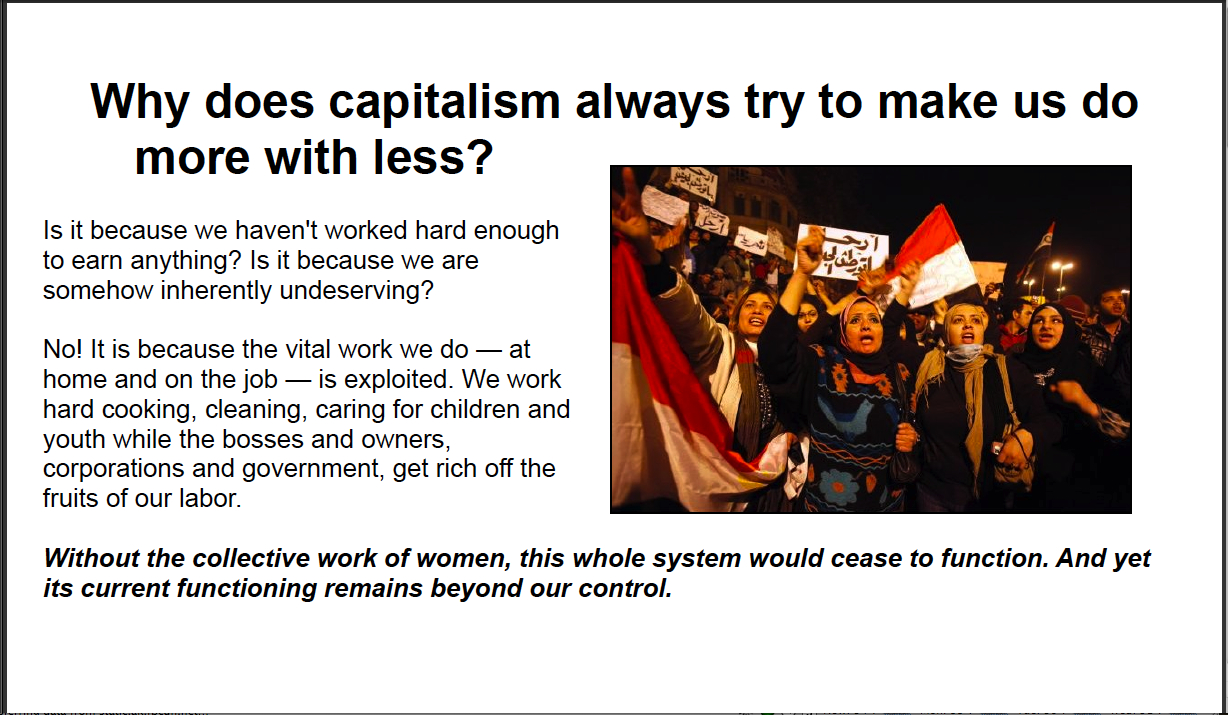
Hey friends — sorry for such a late post today! It’s been a whirlwind. Morning tea with a dharma/movement kindred spirit (a revival of Radical Sangha is in the works!); a super-intense two-and-a-half-hour group session with a generative somatics facilitator/counselor/consultant/rad person at the Faithful Fools; being interviewed by someone who’s making a video documentary about the Fools; and now off to prep some work with the Marxist feminist group in honor of International Women’s Day tomorrow.
Life: it’s full sometimes! And I was in a similar gear last Friday when, among other things, I showed up to join a crew of about 20 supporters of a rank-and-file picket of health care workers (above) who were illegally fired for going on strike. More on their inspiring (and victorious!) battle, including videos of Friday’s picket, here. Then, most of us supporters rolled out to a downtown Oakland rally against the gang injunctions. Here are some photos of each; sorry for the lack of commentary, but hopefully tomorrow I’ll have time to add a little more.
Back at Harvard, I learned two twin currencies for liberal political engagement: prestige and critique. In order to make the most important, sophisticated contribution to your community, you should try to do one or the other. (Or, in my case, kind of switch back and forth between them.)
Prestige meant planning events with lots of endorsements by student and Real World groups; generating lots of publicity (including Real World media, if possible); and generally capitalizing on linkages with nodes of power, with the aim of Getting Big Things Done.
Critique meant showing up to a prestigious event and eviscerating it with progressive analysis. Pointing out that it reifies X Y and Z oppressive dynamic, invizibilizes A B and C communities, and generally fortifies neoliberalism and hierarchies of privilege.
Something like that. Now, I’m not saying that other approaches didn’t exist at Harvard (Harvard Progressive Action Group was probably doing things at least a little differently; and same for the Student-Labor Action Movement), but these were the ones that most affected me, in my thinky liberal way of moving through the world.
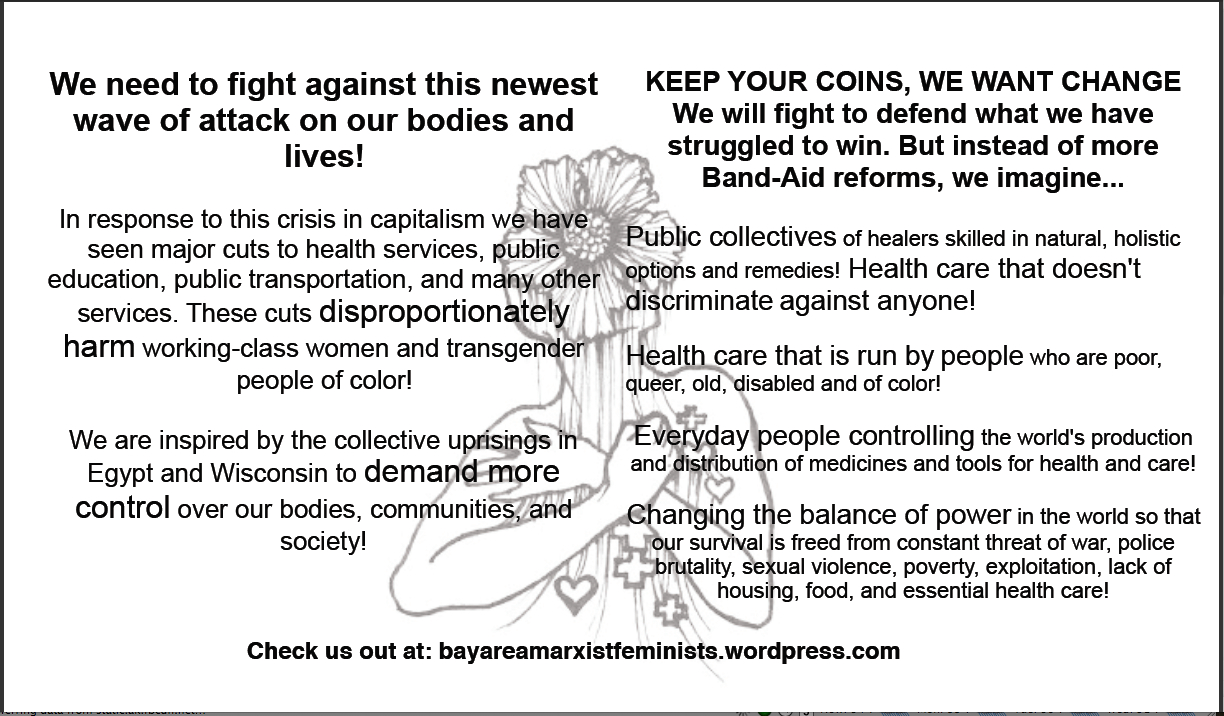
And so, yesterday, when six of us from the Marxist-Feminist study group arrived at a Bay Area Pro-Choice march armed with flyers that we had each played a part in creating, I thought to myself, This is a good offering. We chanted, we participated, we were a part of what was happening, and I felt tremendously grateful to all the people who have fought before us for the right to legal abortions. Some of the signs people carried gave me chills: “ABORTION ON DEMAND, WITHOUT APOLOGY”; “Rape Survivor For Choice [because I didn’t have one]”; and of course, the iconic coat hanger. At the rally, women shared personal stories about terminating their pregnancies, making real and visible the object of our shared struggle. No doubt, there was bravery here. This was something we wanted to support.
We were not, however, blind to the limitations of the event. A narrow focus on defending abortion rights completely overlooked the ways that austerity measures here in California are generally pummeling working-class people’s access to sexual health care. This myopia has long been a problem of largely white, middle-class reproductive rights movements. Surveying the crowd and listening to the speeches, I felt a little pessimistic about how our half-sheets would go over, fingering capitalism as a major part of women’s oppression and choicelessness.
But instead of standing on the sidelines hating (read: critiquing), we engaged. When the organizers opened up the stage for anyone to take the bullhorn, two of us got up and articulated our comparatively broader analysis. And the crowd was feelin it!
After that, flyering was easier and less awkward. People came to us.
I don’t remember who exactly — though I have a hunch it was Joseph Goldstein — who said, at a dharma talk I went to once at CIMC, that much of dukkha (the Buddhist word for “suffering” — the basis of the First Noble Truth) is not this dramatic, cataclysmic affair. Instead, the majority of dukkha is like rubbing your face softly against a brick wall. Doesn’t really hurt. But the problem is, we don’t stop. We keep on rubbing . . . and rubbing . . . and rubbing. Ouch.
I think a similar insight finds its expression in those two unforgettable lines of the poem I shared here last year, by Nyoshul Khenpo:
Those with dualistic perception regard suffering as happiness,
Like they who lick the honey from a razor’s edge.
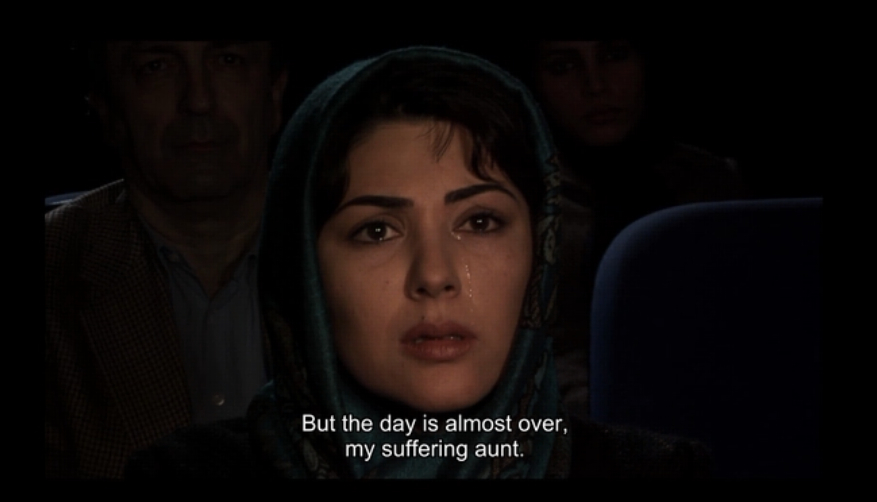
And yesterday, this dharma found its way to me yet again, in the form of an Iranian movie. Celebrated filmmaker Abbas Kiarostami created this work, Shirin, by filming the faces of over 100 Iranian stage and screen actresses as they themselves watch a film of an 800-year-old Persian epic love poem: the story of Shirin and Khosrow. Shirin is an hour and thirty minutes of framed face shots, inviting us to meditate on subtle and dramatic changes of expression as the women become emotionally involved with the story. The film also invokes self-consciousness about our own being and emotional vicariousness: spectators spectating other spectators.
For me, the arresting part in the epic poem (which is both audible and subtitled in Kiarostami’s film) was this, from a scene where a dying queen shares her final words with her heiress, Shirin:
AUNT: “I had my blossoming spring, I grew old at fall. Now I welcome the winter and the snow that will cover my grave.”
SHIRIN—”Haven’t I suffered enough? My heart can’t afford to be broken again, or my body to be abandoned.”
AUNT: “It took me a long time on this earth to understand that the joys of life are like the caress of a feather on the palm of your hand. Pleasurable at first, and a real torment if it perdures. I leave this earth to people who deserve a better life.”
(Visuals show women’s faces, teary and crying.)
The feathers tickling our palms are not emotions themselves. Rather, they are the self-generated process of reacting blindly to those emotions: embracing pleasant ones and running from unpleasant ones. We blindly, habitually react in countless small ways like this every day, allowing transient moods and the vicissitudes of experience — pain, pleasure, neutrality — to dictate our internal well-being.
Part of what I love about Kiarostami’s film, though, is that it allows us to step back from our emotional entanglements and watch them play out externally, on a stream of other faces. It’s like ninety minutes of looking in a mirror, and watching the flow of feeling pass by, unhindered. We don’t get to know any one woman long enough to get caught up in her story. It’s simply beautiful to greet her for a moment, welcoming her into a growing rosary of all the audience members. I’m reminded that I myself am, in some ways, a rosary of many faces: always changing, counted one by one. This allows me to relax. It’s the same comfort I feel when I look out the window on a long train or bus ride. The scenery is flowing by so quickly that there’s no time to fixate on it; and so I let go and simply watch. Give the feather — and the brick wall — a rest.
Folks, I’m going through it a little bit this week. Just a lot of complex stuff coming up. Haven’t found the right words for sharing it here, yet. But in the meantime, this video of my friend and fellow Goddardite — vocalist, composer, interfaith priestess, and cultural worker Imani Uzuri — made me smile today in a full, full way. Not only does Imani bless the world with mad artistic skills (including, but not limited to, the most moving voice I’ve ever heard in person in my whole entire life: no lie), she also illuminates the people around her with her spiritual reflections, historical insights, unbeatable hilarity, and genuine compassion.
Here, she reminds us of the importance of exploring and loving our always-complex selves. It reminds me of an essay I read yesterday in the current issue of make/shift: a piece by Alexis Pauline Gumbs called “M/Othering Ourselves: A Black Feminist Genealogy, Or, The Queer Thing.” The essay in turn takes its inspiration from a line from Audre Lorde: “We can learn to mother ourselves.” Gumbs asks:
What would it mean for us to take the word mother less as a gendered identity and more as a possible action, a technology of transformation that those people who do the most mothering labor are teaching us right now?
I hear this question (and its associated family of questions) echoed in Imani’s 120-second share. (And enacted, unwittingly, in the sweet out-takes in the final few seconds.)
Imani’s work itself is powerful enough; being in her presence during Goddard residencies, and seeing the mind, soul, and radical self-mothering behind the music, has been an extraordinary gift to me. She’s real and grounded, as well as spiritually developed and crazy talented. Quite the combo. Check her out, and join me in celebrating the friends who inspire us, even unknowingly, while we’re slogging along.
This semester in my MFA I have the profound good fortune of working with an amazing faculty member: poet, writer, and cultural historian Gale Jackson. Today in our twelve-person advising group, we worked together to respond to one of her poems — “1691. Tituba of Salem.” — which happened to be the first and only one I had already read.
* * * * * * * *
The whole poem is a deeply layered thing that I know I’ll continue to revisit. One line (now the title of this blog post) echoed as I was reading Detroit: I Do Mind Dying: A Study In Urban Revolution. (Remember when I mentioned that? Yep, ha, still makin’ my way through it.) Describing an opening sequence in Finally Got The News (a renowned documentary self-made by the League of Revolutionary Black Workers), I Do Mind Dying authors quote League leader John Watson:
You get a lot of arguments that black people are not numerous enough in America to revolt, that they will be wiped out. This neglects our economic position. . . . There are groups that can make the whole system cease functioning. These are auto workers, bus drivers, postal workers, steel workers, and others who play a crucial role in the money flow, the flow of materials, the creation of production. By and large, black people are overwhelmingly in those kinds of jobs. [116]
The rich, ongoing resistance of immigrant workers in the US testifies that this shifting terrain does not completely close down our opportunities for struggle. Disruption and destabilization are still possible.
* * * * * * *
I also wonder about the converse. Perhaps if we can poison, then we can also serve.
I mean this more in terms of the ways that I might poison my own life. The ways that I might relate to, and feed, my own internal sufferings. Day to day, in subtle ways. Clinging to high expectations. Beating myself up over mistakes. Fearing and worrying about the future. Indulging in fantasies and daydreams, even when they make me feel kind of sticky and queasy afterward. In general, surrendering my happiness to the mercy of my own thoughts.
Goenkaji says: there is nothing more harmful than our own untamed mind. And there is nothing more helpful, more beneficial, than our own trained mind, tamed mind. This observation comes up again and again in dhamma teachings — the idea of “turning the (monkey-) mind into an ally.”
So much in one post! Hope I haven’t overwhelmed you. Happy Monday, friends.
PS: You, like me, might want to support Gale and her important ongoing work as an artist. She’s more of an “analog girl in a digital world,” to borrow a phrase from Erykah, so since the PayPal button is out, over the next couple days we’re gonna put our heads together to find a simple way for y’all to make offerings and contributions (and/or purchase some of her breathtaking books!) from afar.
I don’t know if you remember, but I started going to art school. Yeah, like a year ago. I haven’t talked much about it, partly because I took a semester off in order to stay on at the Fools. Now I’m back for my second residency in Vermont. Residency is sort of a week-long, intensive, participatory, interdisciplinary art festival -slash- collaborative curriculum planning workshop. It’s wonderful in all kinds of ways, for all kinds of reasons: including the absurdly beautiful setting.
I say “absurdly beautiful,” and I guess there really is this in-credible dimension, for me, being on campus — almost like being in a lucid dream. Running late for a secret book-making meeting earlier today, I decided to leave the plowed path and take a shortcut over a hill, to the front entrance of one of the little dorm buildings. Somehow I assumed that I would simply walk over the snow. Like it would mostly compress under my boots or something.
Instead, of course, I end up thigh high in powder (not saying much since my legs are short — but still). Do I stop and go back? No. Just kept sloshing through, like, Oh well, guess this is just part of walking in snowy places: stumble-hop-crashing around and getting all soaked in the legs.
My “snow-pas” (oh god, i know) happened to occur just outside the picture-window of the room where my friends were making books. I loved the jolly way they laughed.
If you didn't know already, a "lurker" is someone who reads a blog but rarely or never comments. De-lurking means making your presence known. Lately I've been blessed with some particularly fabulous de-lurkings.One in the form of the above snail-mail card from my friend Jane in New York (hey Jane!).One from a fellow organizer in the illegal gender-oppressive firing campaign. (Whatup, Nick: I am stoked to start reading your highly-recommended blog on caring labor.)Another from amazing coeditor and copublisher of make/shift magazine, Jessica Hoffmann.* (Seriously, that note's thoughtfulness sent me into a semi-shock stupor for an entire night.)A writer and dharma teacher I admire a whole lot, Mushim Ikeda-Nash, de-lurked to me last week, and then followed up with a piece of much-appreciated constructive criticism. (Actually about a post I wrote on Feministe; so I'll have to be in touch with them about updating it. Thanks, Mushim!)And then there's this (not exactly a conscious de-lurk, but I found it among my incoming links):
Karen, I have no idea who you are (do I?), but thank you. Let’s be friends. :)
Really though, not to get all mushed out on y’all, but it’s truly amazing to know that what I do here helps other people out. Even a little bit.
With so much gratitude to everybody who shows up here to read, reflect, and respond,
katie
—————————
*As of this posting, I’m delighted to say I just had a lovely, laughter-filled walk around Lake Merritt with Jess Hoffman, and man is she kind and smart and cool. (But not in the too-cool-for-you kind of way. Cuz I guess that would cancel out the “kind” part.) Jess, if you’re reading, thanks again!
[Update 5:44pm: Elise, I almost forgot you! Folks, Elise is a bad-ass, hilarious lady with sick dance moves and mad Facebook commenting skills. So good to meet you at Jamal’s party, girl!]
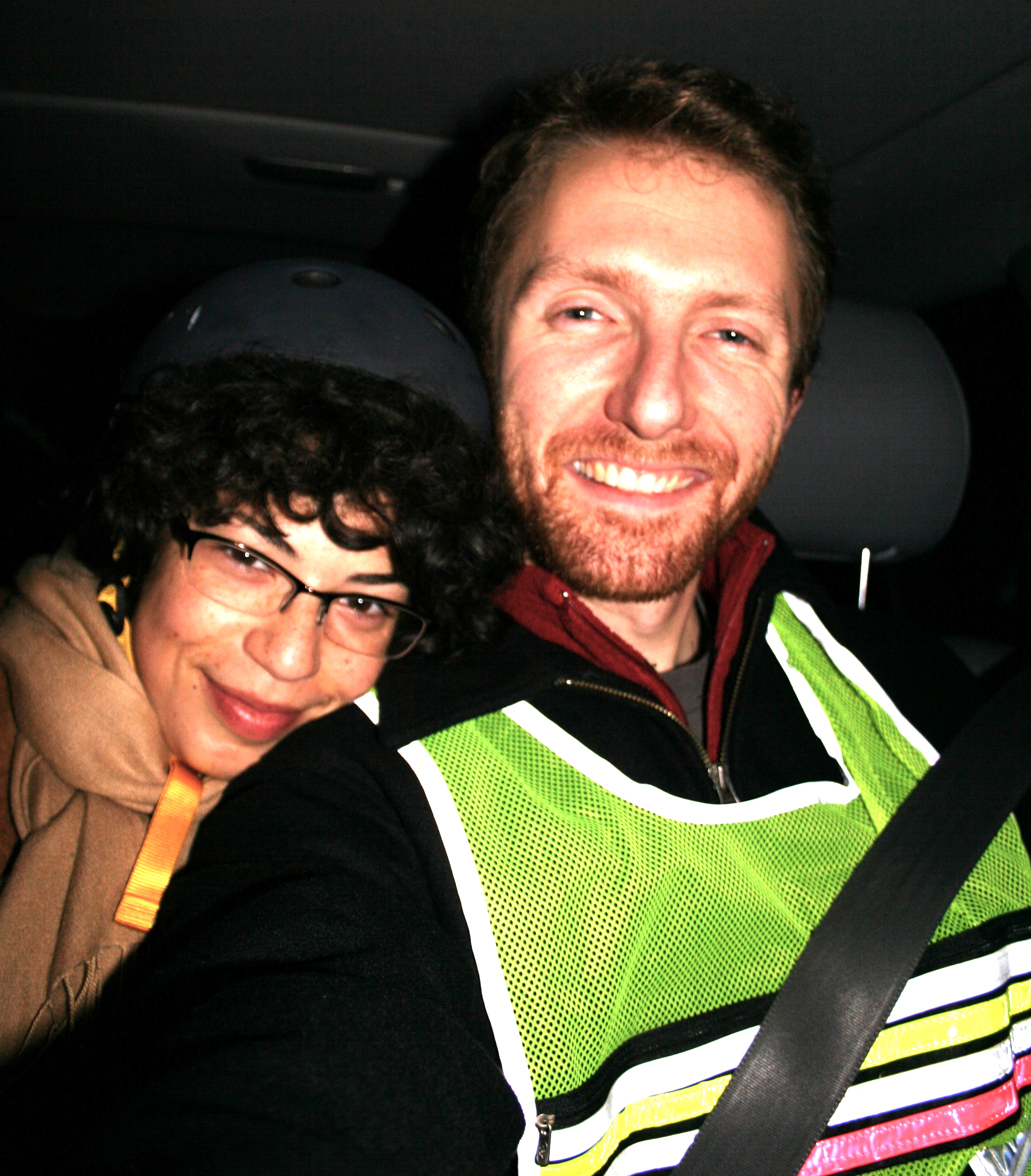
Ryan and I both happened to be in Sacramento again for this month’s Full Moon Walk, which turned into a full moon bike ride (hence his stylin’ reflector vest, and my hard-to-detect helmet) along the short stretch of levee that isn’t privatized.
The camera even began to see in the dark, thanks to a cloudless sky and a tripod on loan from my dear sweet mama.
Next month we’ll be in the Bay for sure. I hope you’ll join us if you’re around!



















 Kloncke