Bonus: Raspberry Jam Cookies

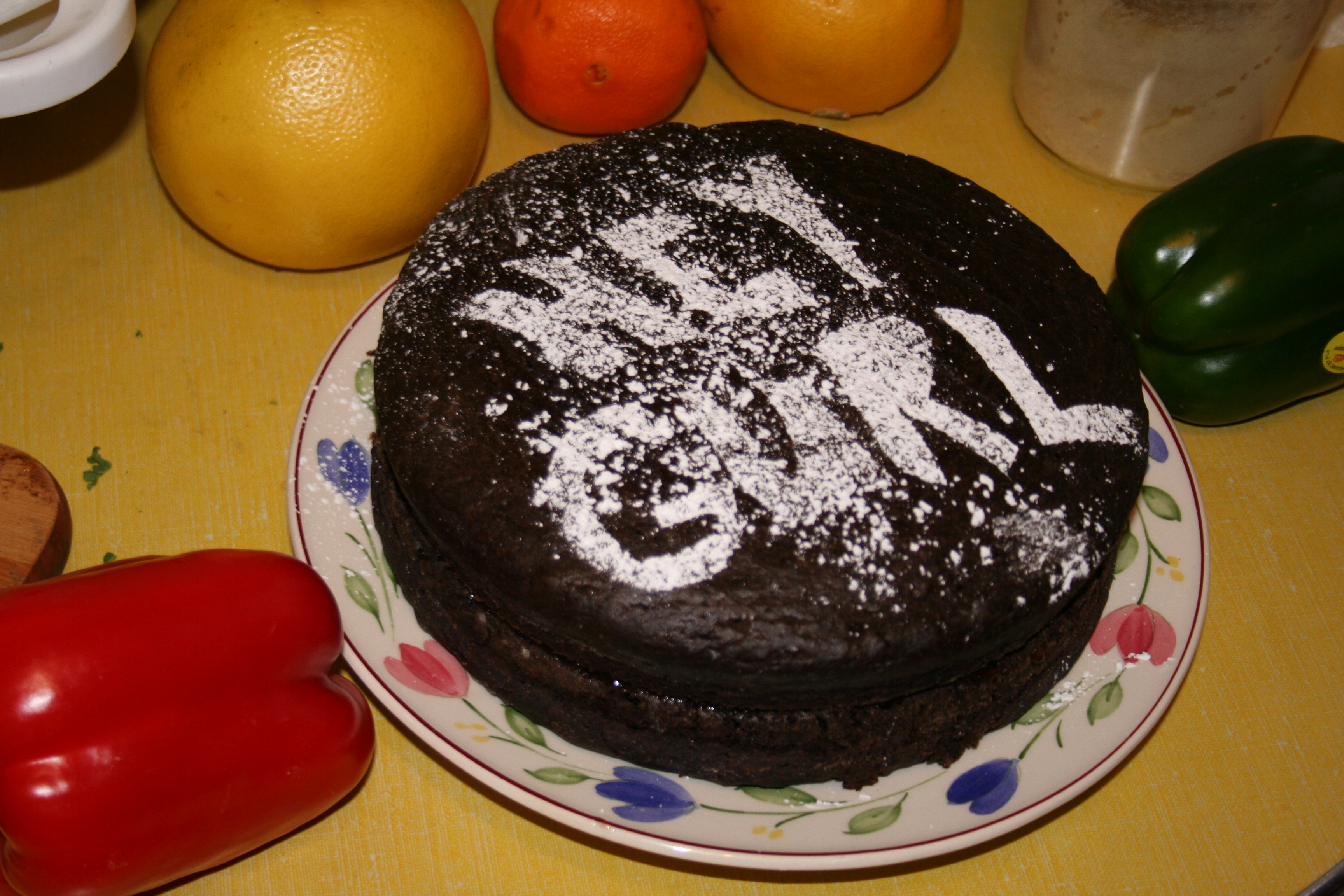
I’m not a baker, so this go-to cookie recipe fits my standards. Incredibly simple;* truly delicious. I tried to do it with rhubarb jam today, actually, but when I opened the jar there was a bit of mold inside. :( Next time!

I found this recipe about three years ago on The Post Punk Kitchen website, a great vegan cooking resource.  But this morning when I went to look it up, it was gone.

PPK has apparently undergone a site overhaul since last I checked.  Whereas before it was essentially just text (very, very useful text) on a dark red background with a few graphics, now it’s got a super-sexy layout loaded with stunning photos.  Even though my beloved Jam Thumbprint page got lost along the way, I can’t say I’m sorry for the progress.

And luckily, there’s Gmail archive: I’d typed and e-mailed the recipe to some friends following rave cookie reviews at a potluck.  Funny karma moment, huh?  Sharing with others = preserving for oneself.

Enjoy!

JAM THUMBPRINT COOKIES

1 cup almonds
1 cup rolled oats or oat flour
1 cup whole wheat pastry flour or all-purpose flour
pinch sea salt
1/4 teaspoon cinnamon
1/2 cup coconut , canola, olive or grapeseed oil. I like olive the best.
1/2 cup maple syrup
all-fruit jam (raspberry is nice, or blackberry…or some unusual berry!)

Preheat oven to 350 F. Lightly oil a cookie sheet.

Chop almonds into coarse meal. This can be done with a knife (which takes a long time and is messy) or in a food processor (or a blender, but a food processor is ideal) by pulsing a few times. For a chunkier cookie, grind the almonds only into small pieces.

Grind oats to flour in a small food processor, flour mill, or a blender. You can also use oat flour. For a chunkier cookie, don’t grind oats all the way.

Combine almonds, oats, flour, salt, and cinnamon.

In another bowl combine oil and maple syrup. Add to dry. Mix lightly.

Roll into walnut-sized balls. Place on an oiled cookie sheet. Press an indentation in the center with thumb.

Fill indentation with jam. Do not overfill, do not underfill.  What you see is what you get, basically – the jam shouldn’t overflow too much when heated, and the cookies shouldn’t spread a lot, so you can pack them in pretty close together on the sheet.

Bake 15-20 minutes, or until bottoms are lightly browned. Cool 10 minutes.

*I should note: simple with a food processor.  Which I now have at our new place.  Thanks, mama!  If you live near me and don’t have one I’d be happy to loan ours out.

“If You Can Serve Then You Can Poison.”

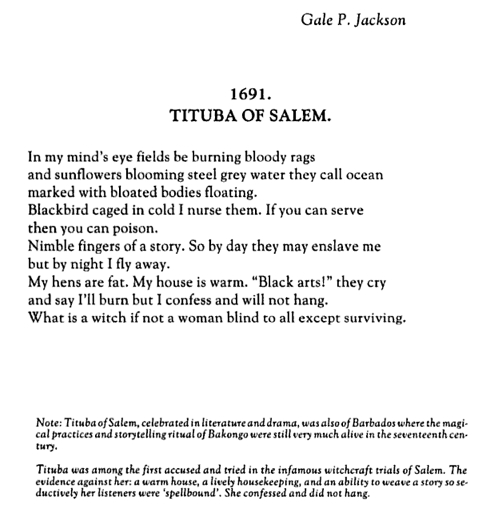
This semester in my MFA I have the profound good fortune of working with an amazing faculty member: poet, writer, and cultural historian Gale Jackson. Today in our twelve-person advising group, we worked together to respond to one of her poems — “1691. Tituba of Salem.” — which happened to be the first and only one I had already read.

* * * * * * * *

The whole poem is a deeply layered thing that I know I’ll continue to revisit. One line (now the title of this blog post) echoed as I was reading Detroit: I Do Mind Dying: A Study In Urban Revolution. (Remember when I mentioned that? Yep, ha, still makin’ my way through it.) Describing an opening sequence in Finally Got The News (a renowned documentary self-made by the League of Revolutionary Black Workers), I Do Mind Dying authors quote League leader John Watson:

You get a lot of arguments that black people are not numerous enough in America to revolt, that they will be wiped out. This neglects our economic position. . . . There are groups that can make the whole system cease functioning. These are auto workers, bus drivers, postal workers, steel workers, and others who play a crucial role in the money flow, the flow of materials, the creation of production. By and large, black people are overwhelmingly in those kinds of jobs. [116]

Of course, times and circumstances change. This brings new questions. What does US de-industrialization mean for the potential of workers in the United States to “poison” the system we serve? How does utter disposability, from the point of view of capital, affect the position of undocumented immigrant workers as they clandestinely serve, haunted by a terrorizing, racist, sexist campaign of economic opportunism that threatens to incarcerate, violate, and deport?

The rich, ongoing resistance of immigrant workers in the US testifies that this shifting terrain does not completely close down our opportunities for struggle. Disruption and destabilization are still possible.

* * * * * * *

I also wonder about the converse. Perhaps if we can poison, then we can also serve.

I mean this more in terms of the ways that I might poison my own life. The ways that I might relate to, and feed, my own internal sufferings. Day to day, in subtle ways. Clinging to high expectations. Beating myself up over mistakes. Fearing and worrying about the future. Indulging in fantasies and daydreams, even when they make me feel kind of sticky and queasy afterward. In general, surrendering my happiness to the mercy of my own thoughts.

Goenkaji says: there is nothing more harmful than our own untamed mind. And there is nothing more helpful, more beneficial, than our own trained mind, tamed mind. This observation comes up again and again in dhamma teachings — the idea of “turning the (monkey-) mind into an ally.”

So much in one post! Hope I haven’t overwhelmed you. Happy Monday, friends.

PS: You, like me, might want to support Gale and her important ongoing work as an artist. She’s more of an “analog girl in a digital world,” to borrow a phrase from Erykah, so since the PayPal button is out, over the next couple days we’re gonna put our heads together to find a simple way for y’all to make offerings and contributions (and/or purchase some of her breathtaking books!) from afar.

Good Goddard

Hey friends,

I don’t know if you remember, but I started going to art school.  Yeah, like a year ago.  I haven’t talked much about it, partly because I took a semester off in order to stay on at the Fools.  Now I’m back for my second residency in Vermont.  Residency is sort of a week-long, intensive, participatory, interdisciplinary art festival -slash- collaborative curriculum planning workshop.  It’s wonderful in all kinds of ways, for all kinds of reasons: including the absurdly beautiful setting.

I say “absurdly beautiful,” and I guess there really is this in-credible dimension, for me, being on campus — almost like being in a lucid dream. Running late for a secret book-making meeting earlier today, I decided to leave the plowed path and take a shortcut over a hill, to the front entrance of one of the little dorm buildings. Somehow I assumed that I would simply walk over the snow. Like it would mostly compress under my boots or something.

Instead, of course, I end up thigh high in powder (not saying much since my legs are short — but still). Do I stop and go back? No. Just kept sloshing through, like, Oh well, guess this is just part of walking in snowy places: stumble-hop-crashing around and getting all soaked in the legs.

My “snow-pas” (oh god, i know) happened to occur just outside the picture-window of the room where my friends were making books. I loved the jolly way they laughed.

What Do You See?

These images come from “Women of Egypt,” a Facebook collection by Leil-Zahra Mortada, someone I don’t know but to whom I’m grateful.

There are so many powerful photos emerging now. These three from Mortada’s album especially resonated with me. How we view the stories in them depends so much, I think, on our own (often complex) experiences with police, and our analysis of state violence.

Class Traitors, Class Transitions

I wonder whether Moses, after being kicked out of the palace and downgraded to the slave caste, ever felt nostalgic for his royal upbringing. Same for Siddhartha, who left his princehood by choice and became an ascetic. Did St. Francis of Assisi, who shunned his cloth merchant inheritance, ever miss strutting down a 13th-century street in a fly outfit? What was it like for St. Clare, a follower of Francis, to abandon her landowner life and found the Order of Poor Ladies?

These folks all share certain dimensions of class transition, along with some leanings toward class treason — though I hesitate to call any of them class traitors because, while they attempted to carve out alternative, anti-hegemonic lifestyles and communities for their followers, to my knowledge they did not explicitly, politically confront the existence of the class line itself. (Someone please correct me on this if I’m wrong!)

Lately in my own life, I’ve been noticing painful areas in my move away from liberalism (and/or nominal radicalism) toward a politic that actually centers the working class and the dispossessed. This process, for me, involves somewhat shameful, tender stuff.

Continue reading

Eat Dis Pilaf (No Offense to Edith Piaf)

I know, friends, I know. Almost every recipe I post basically amounts to: me quoting Heidi Swanson quoting someone else.

But, you know, most of the time in the kitchen I’m not shooting for originality. I’m shooting for total deliciousness.

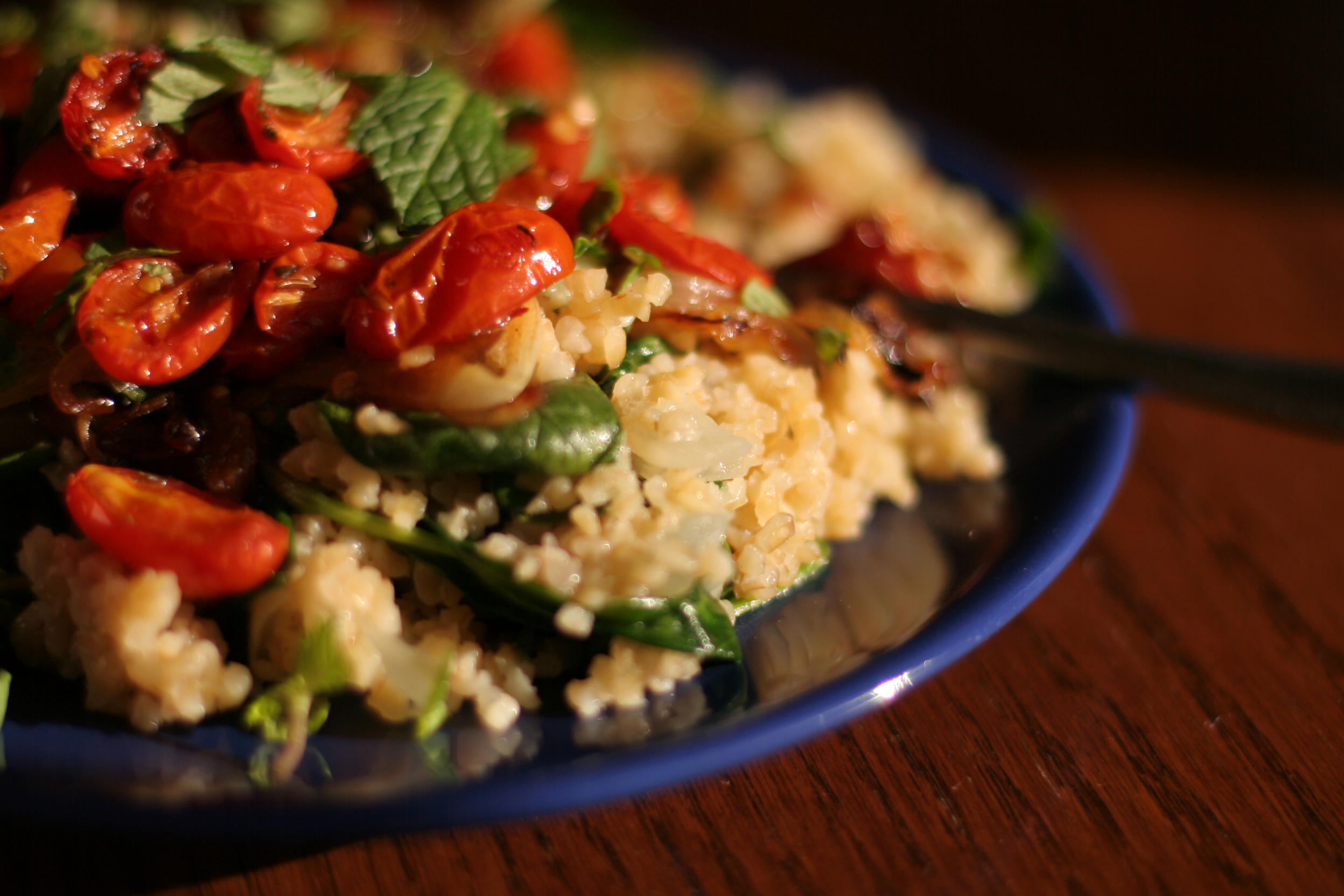
This bulgur pilaf with spicy harissa shrunken tomatoes, lemon-cinnamon caramelized onions, wilted spinach and minted yogurt fits the bill. Try it. You’ll see.

love,

katie