moving into new apartment; first time living alone at length. same pillows, same books, even some shoes and jackets that have stuck with me since high school. (what can i say — i had good taste, even then. :) houseplants have made it over safely. enjoying the new shower.
i had reservations about getting a place by myself. fears that i might stay cooped up, isolated, cut off, a prisoner to my own shyness. but more than that, i felt somehow wary of the luxury of a studio. was this yet another step toward bourgieness and sellout-dom? first a non-profit co-director job, now this? what’s next: a timeshare in Waikiki? am i turning into the following hilarious yet terrifying caricature?
Are you tired? No, I mean, really tired? You feel it in your bones, don’t you? In your sinews. It hurts to sit on the floor. No-one you’ve met in the activist milieu has expressed sexual interest in you for years. You’ve worked so very, very hard. Perhaps it’s time you made The Non-Profit Transition.
I mean, you’ve sacrificed so much of your life to this bullshit; why can’t you maybe do something for yourself, as well? Is that so bad? Partnering with Shell just means you’re hustling them for their money. You’re being realistic; your critics are being naive/haters/too young to understand. This workshop is presented in a series of lectures, including:
— Unlike You, I Deserve To Get Paid
— Actually This Politician Is Basically On Our Side
— You’ll Want Health Insurance Too When You’re My Age
— I’m Going To Radicalize This Organization From The Inside
— “Siri, How Do I Sell Out?” Embracing The Technology Fetish
Meeting Time/Location: All lectures are available as “TED Talk” Webinars to be viewed at your convenience on your iPad from the nursery room of your suburban ranch house.
stray neighborhood kitten
worries about inclinations toward selling out have come to visit more and more often these days. worries that boil down to: I Like The Wrong Things.
i date white men. (not by principle, just by ‘chance,’ though i know it’s not so simple.) i have many white friends. (same deal.) i like wine. i listen to Motown. i frequent coffeeshops like this. i seem to be on a path to becoming a professional! (professional at what? unclear.)
politically, i find myself drawn to making strategic alliances with non-profits. not cynical, i’m-shaking-your-hand-but-Fuck-You-is-written-on-my-forehead kind of alliances. but the kind where i actually try to learn from what certain non-profits do well, form trusting relationships, and at the same time be honest (and hopefully persuasive) about my political views on the limitations of non-profits, as much as possible.
non-profits and anti-oppression cultural workers hold things that speak to me, and yet a number of revolutionaries i most admire seem to write off non-profits entirely: approaching them, to borrow a metaphor from Junot Díaz, “as one might hold a baby’s beshatted diaper, as one might pinch a recently benutted condom.” so i worry that in reality i’m just being naïve, seduced by the old siren song of POC / feminist / queer / disabilities justice / cultural etc. etc. sparkle that will never ever, in my view, lead to the overthrow of capitalism, though i’ll be the first to testify it feels damn good to be surrounded by hella cute powerful brilliant social-justicey people who often fill concrete needs of poor and working-class communities.
if the appeal of Liking The Right Things (whether exclusively Black Love or a hard line against band-aid service work) were merely a matter of superficial “coolness” or fitting in (wearing the right clothes, speaking the right slang), it would be easier to shrug off. i’ve dealt with The Cool before.
but as i observed even then, The Cool (or the desire to Be Something) is sneaky. It practices pseudocopulation: disguising itself as the thing you’re really after.
Ophrys eleonorae and Ophrys lupercalis, a wild hybrid orchid, whose pollinator, a male solitary bee, is engaged here in pseudocopulation. Photograph: Christian Ziegler/Minden Pictures
what is it that i am after?
peeved that i’ve taken a break from petting
effectiveness?
integrity?
authenticity?
holistic integration?
sometimes it feels like i’m trying to scrub off the birthmarks of liberalism. other times it feels like i need space to be curious and happy about whatever it is that i feel curious and happy about, and trust that i will find ways of steering those interests back into a healthy political direction.
“guilty pleasures” doesn’t really capture the level of confusion here. it’s more like “incongruent interests.” or something similarly unsexy sounding.
do you have incongruent interests? what do you do with them? do they make you feel divided, well-rounded, mundane?
Via Umi of No Nukes Action: super eye-opening (for me) interview with Mari Matsumoto: Nuclear Energy and Reproductive Labor – The Task of Feminism. How events like the Fukushima disaster put pressure on the reproductive labor sector, in terms of securing radiation-free homes, food — even breastmilk — and protecting children, who are highly vulnerable to radiation. Also points to ACT-UP as inspiration: “AIDS activism has a very thorough resistance against healthcare authorities and pharmaceutical companies, which is exemplary for us.”
Matsumoto’s reflections make me wonder: if neoliberalism can use “disaster capitalism” to manipulate crises into opportunities for privatization and neocolonization, perhaps the Left can begin to see crises as opportunities for deliberate communization: amplifying people’s boldness, sense of collective working-class entitlement, and attempts to seize means of production and reproduction.
Disaster communism? Well, we might want to work on the phrasing, haha.
Raised fist via Colorlines“Maquila: Sweatshop” by Favianna Rodriguez
Janie found out very soon that her widowhood and property was a great challenge in South Florida. Before Jody had been dead a month, she noticed how often men who had never been intimates of Joe, drove considerable distances to ask after her welfare and offer their services as advisor.
“Uh woman by herself is uh pitiful thing,” she was told over and again. “Dey needs aid and assistance. God never meant ’em tuh try tuh stand by theirselves. You ain’t been used tuh knockin’ round and doin’ fuh yo’self, Mis’ Starks. You been well taken keer of, you needs uh man.”
Zora Neale Hurston, Their Eyes Were Watching God
The representation of her sources of language seems to be her principal concern, as she consciously shifts back and forth between her “literate” narrator’s voice and a highly idiomatic black [sic] voice found in wonderful passages of free indirect discourse. Hurston moves in and out of these distinct voices effortlessly, seamlessly … It is this usage of a divided voice, a double voice unreconciled, that strikes me as her great achievement, a verbal analogue of her double experiences as a woman in a male-dominated world and as a black person in a nonblack world, a woman writer’s revision of W.E.B. DuBois’s metaphor of “double-consciousness” for the hyphenated African-American.
Henry Louis Gates, Jr. in the Afterword
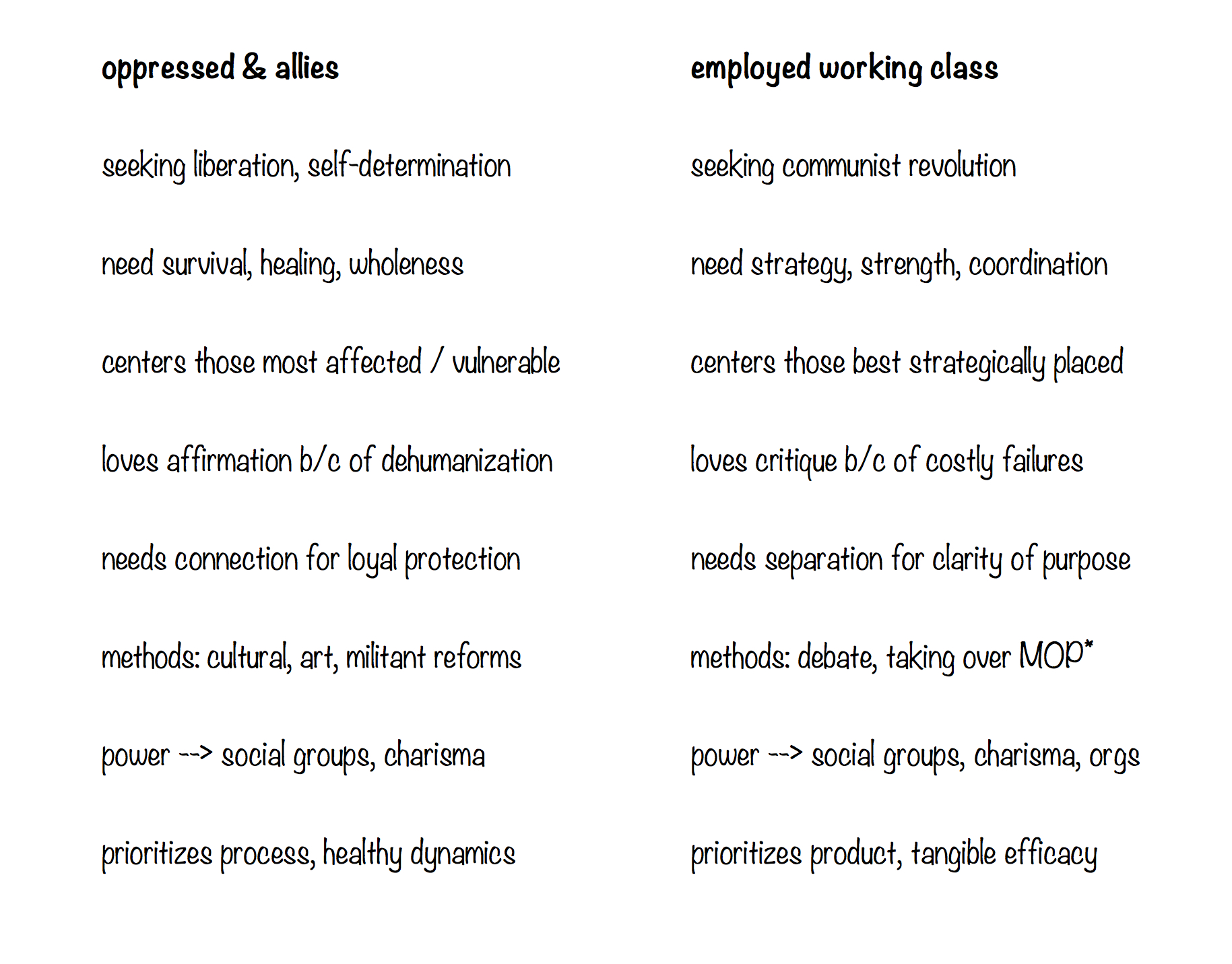
Binaries are false, and suck in many ways. Categories, even when there are more than two (black white yellow red brown; astrological signs) still inherently oversimplify. And yet, in the midst of an embattled year of trying to figure out where I belong within radical traditions, what a great relief it is to me to create two nice neat columns and try to map out some ideas. (Non-column schemas in the works.)
“Malcolm X” by Favianna Rodriguez“Everything Counts” by Favianna Rodriguez
These categories came as blessings from this weekend’s Everything For Everyone conference, a festival for radical anti-capitalists that was hosted in Seattle and attracted militants from across the country. In their closing plenary speeches, Mike Ely of the Kasama blog and Kali Akuno of the Malcolm X Grassroots Movement each raised the importance of “building alliances” between the oppressed and the employed working class.
But before I can think about building alliances, I want to try to understand the two groups. Who are they, exactly? How are they delineated — different from one another? As a first step I want to deeply and compassionately ‘interview’ these groups. Ask, in my mind, what they want. And to be clear, these groups and their characteristics Do Not Exist In The Real World in any sort of neat and tidy way. It’s just that the categories represent patterns I’ve witnessed in the Left/radical movements I’ve been around, and witnessed within myself, too.
*MOP = Means Of Production, the land, water, machines, and other material resources human beings use to keep ourselves alive, to reproduce our society.
These categories are not necessarily or always in opposition to one another! Which is what makes them tricky to puzzle out. I’ve seen revolutionaries try to reconcile them by pointing to certain common examples of overlap.
1. Indigenous/Latin@ Immigrants & Economically Displaced People
In the US, economically displaced workers from central and south america who toil at miserable jobs play a key role in the national economy. They are both “most affected” by and “vulnerable” to certain strands of racist, gender-oppressive, and economic persecution, and strategically positioned within the economy to fuck shit up for capitalism for real, as we’ve seen in beautiful explosions like the enormous immigrant strike on May Day 2006.
2. Queers Queer Liberation Is Class Struggle, a piece put out a minute ago by members of Unity and Struggle, lays out this argument super thoroughly, and in many dimensions: critique of the heteropatriarchal family, re-visibilizing the queer working class, exposing the ways labor disciplines our gender expressions, etc. One part I’ll come back to in a second:
I’ve heard vague calls for queers to [ally] with labor.
…
An “alliance” or “intersection” should not even be necessary, it is only made necessary by the fact that the union bureaucracy dominates “labor” and the gay elites dominate “queerness.” If we can break down these twin dominations then it will be much easier to build an “alliance” because most queers already are labor and many laborers are queer. This involves struggle and organizing.
3. Women
Women make up the majority of the world proletariat, comrades remind us. Furthermore, capitalism deploys patriarchy as a kind of leverage or bonus round for surplus labor, systematically labeling women’s work as “unskilled” and “domestic,” which conveniently justifies paying little or no wages for it. To organize for the liberation of women as a group, or even just “Black and Brown” women, the argument goes, is to make tremendous headway in organizing the working class as a whole.
But the working class is not a monolith. Over the weekend, for the first time in my memory, I heard revolutionary comrades start to use the term “employed working class” as a way of being more specific about which part of the working class they’re talking about. Before, I’d usually hear a broad-sweeping definition of the working class as “Those of us who have nothing to sell but our ability to work.” This broader definition, while sometimes helpful in pointing out what we share in common, and who our opposition is, frequently glosses over important strategic differences within the working class.
Some of us, whether because of racist systems of criminalization (got a felony? much harder finding a job), heteropatriarchal gender coercion (want to present transgressive gender or dramatically transition your gender at work? again, not easy in most cases), disabilities, or other reasons, cannot sell our ability to work. When the U&S piece says that “most queers already are labor and many laborers are queer,” this may be true, and yet transgender folks face double the average rate of unemployment in the US. Folks with non-normative gender or sexuality presentations are often only precariously employed.
Industrial Workers of the World
It is this harsh material reality that helps maintain informal economies (selling sex, drugs, under-the-table labor) and is also prompting large-scale experimentation in solidarity economies: ways of taking care of one another when the labor market rejects us. Networks of survival have always existed for those on the margins, but as Kali from MXGM pointed out, at this moment even more Black and Brown people are transitioning out of “surplus labor” populations (think: bringing in scabs of color to break up white strikes) into “disposable” populations, more like First Nations people and other resisters of genocide. No longer are Black folks needed in the US as a labor-substitute threat which helps maintain downward pressure on working conditions. Increasingly, this is a role brown migrant and undocumented workers play, terrorized under the threat of ICE. (again, i’m oversimplifying since black and brown aren’t always separate. Also, it’s possible that if and when the migrant surplus population organizes to strike as well, capital will call in a second reserve army: people in cages / prisons.)
The scale and speed of this process, marginalizing the criminalized and oppressed poor to the point of barring access to basics like food and shelter, is serious enough that oppressed groups are innovating systemic new ways of coping, or new versions of old forms. These innovations fit the logic of survival and sometimes even self-determination (Maker movement, urban farming), but rarely do they seem to translate into revolutionary threats to the capitalist system as a whole.
And this is where I often feel stuck, or torn. As a person of African descent in the US, should I set aside my people’s struggles simply because large numbers of us no longer occupy a central or strategic place as the employed working class, like we did in auto plants of Detroit in the 60s? Should revolutionary queers de-emphasize queer liberation just because anti-assimilationist queers are excluded from the formal labor market? Should people with disabilities that make wage labor impossible sit on the sidelines of revolutionary transformation? How will the dispossessed fight both to stay alive and to help make communist revolution in the US?
Arundhati Roy interviews guerilla fighters of the Communist Party of India (Maoist), 2010
I feel this double-consciousness within myself. I don’t know how to choose between, nor how to reconcile the two.
I read and read, but nothing seems to quite capture it. Blogs like Mia McKenzie’s Black Girl Dangerous exemplify the Self-Determination-Of-The-Oppressed logic, quite beautifully and sharply at times, as in her Open Letter to Folks of Color.
Despite your children being gunned down by cops like every single day, despite your mothers being sent to prison for “stealing” public education, despite your sisters dying in the heat of the desert while “sneaking” into a land that belongs to your own ancestors, not to mention being deported from that same land in record numbers, despite the CONSTANT beatings inflicted on your souls, you somehow still have souls. That’s fucking amazing. I mean, I’m not surprised. Your ancestors couldn’t have survived slavery and genocide without some damn serious sturdy genes. But still. It’s impressive.
I love you for all of these things.
From cultural workers and artists to Non-Profit-Industrial-Complex warriors, I see oppressed people and allies pouring heart and soul into defending and uplifting one another: trying to fight off reactionary laws, plant community gardens, bash back, feed bellies that need filling, pull teeth that need pulling. Not always doing it wisely, but coming on some level from different types of love.
Other pieces of McKenzie’s take a flip side of the POC-love coin, throwing a sharp tongue at ignorant white people and white queers. Today on a Facebook thread, two talented Bay Area queer revolutionaries called on McKenzie for “a bigger analysis” of white supremacy that “strives to look at the totality of the system, the capitalist patriarchal system, and the ways it has created and oppressed queers through placing us outside of the system.” Defying my categorized columns above, one of them argues, “Writing and writing our truths in particular is healing and important work. But I am also needing some strategy for liberation.”
But despite the brilliance that comes from so many writers, cultural workers, and organizers resisting oppression and developing new ways of being together, I have yet to see anywhere a strategy of communist revolution, even from revolutionaries in a Marxist tradition, that stems from an anti-oppression analysis, framework, and spirit more deeply rooted than the happenstance overlap of the oppressed and the employed working class. Folks in the anti-oppression liberation tradition tend to be amazing at critiquing the system, often with highly sophisticated analysis. Oppressed people articulate the cruel ironies of capitalism, a system that supposedly generates innovation and abundance but in practice murders, exploits, degrades and immiserates the majority of beings and the earth, reserving special forms of torture for different groups. This is true and important. But I don’t know how we propose to move from critique to strategy, without switching modes and focusing by default on the employed working class. I haven’t seen this done in the US. Have you?
I can’t reconcile the contradiction here. My impression is that many communist revolutionaries believe that the employed working class is in the best strategic position to overtake the means of production, a key step in making a worldwide revolution to overthrow capitalism and usher in a better system of social relations. This, then, becomes the focus of their strategy. Although many groups aim to “race, gender, and sexuality seriously,” this cannot ever equal the commitment of a Black person to the Black Liberation Movement, or a queer mujerista to the abolition of gender oppression.
“Distribution of the Arms” by Diego Rivera
Meanwhile, I am not sure what the focus of revolutionary strategy is for oppressed people seeking to overthrow oppression. A lot of the work seems to be in building faith in the worthiness of the oppressed (so systemically denied and crushed, ideologically and in the stupidity of everyday work — that’s real), building their/our autonomy, resisting attacks from capitalists and fellow working-class people, and having faith that they/we will discover for ourselves how to build new systems of social relations autonomously, even under capitalism. Eventually, we will transform society for the better. At the very least, we want to survive with dignity and exuberance.
I do not take this goal lightly. And yet, and still, I feel stuck.
When Skip Gates lauds Hurston for achieving unity of two unreconciled voices in her writing, he fails to mention that even within this double-ness, hierarchy persists. There is a reason that the white voice is the narrator (third person, omniscient) and the Black voice is the dialogue. Can you imagine reversing them? Can you imagine that a book with a Black-idiom omniscient narrator and white dialogue would make it in a white-controlled publishing market? Can you imagine it would sell in a white-dominated literary industry, as anything other than a curiosity (probably with porn themes)?
Similarly with revolutionary double-consciousness, I sense an implicit hierarchy. When people call for building alliances between the oppressed and the employed working class, I think oftentimes they really mean, organize the oppressed to support the employed working class so it can make the biggest moves to abolish class altogether.
I can empathize with this reasoning.
At this moment, I believe that the Employed Working Class perspective has a more plausible strategy for putting an end to the exploitative social relations of capitalism.
But this perspective seems extremely weak in its methods and strategy for sustaining healing and liberation from social oppressions that won’t automatically disappear even if we someday kick out capitalism. And it is therefore fundamentally limited in its ability to transform the world for the better. Not only limited, but self-undermining in its own quest for freedom, and tending to subordinate the struggles of the oppressed. They matter strategically only insofar as they link up to the employed working class.
This is not only a problem for the future, but a conflict right now.
Am I alone in thinking and feeling this? Do you agree? Disagree? Have you felt this revolutionary double-consciousness? Is Maoism an attempt to reconcile these two logics? What the fuck is even going on? Please help — I am rambling on too long. :)
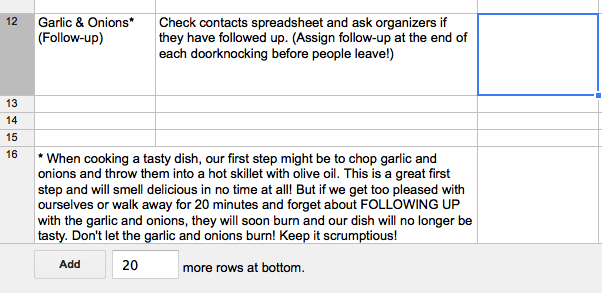
Am I great at making spreadsheets? No, not particularly. Not a clue how to do the math-based ones with functions and whatnot. But creating this sign-up schedule for our anti-foreclosure doorknocking was fun. I said it — FUN. Before your eyes glaze over completely, here are 5 reasons why I think tools like this are crucial for dope feminist horizontalist organizing.
1. Defining tasks aids transparency and learning. It’s like watching someone cook up an amazing moussaka, being like WTF How Did You Do That, and then they hand you a detailed recipe. And give you their phone number so they can walk you through it the first couple of times.
2. Signup sheets provide choice and accountability. You choose your task, and everyone else can see that you chose it. The person acting as Shift Coordinator can call you and remind you that you chose it, the day before you’re supposed to do it.
3. Listing the work makes it feel more manageable. Some people may not find relief and joy through lists, but I am the opposite of those people. Look! You can make sure everything can get done! It’s like a dotted-line map leading to the buried treasure of accomplishment and satisfaction!
4. You can describe the work however you want. Sometimes a little game or private joke can transform a boring chore into a delightful duty. I completely made up this Garlic & Onions allegory for no reason, but now I’m all rarin’ to go on the follow-up work. Don’t let them burn!
5. Counteracts Cliquey-ness. Related to #1. Sure, when the people you organize with are the people you live / party / smoke / sculpt / read / march / dance / sleep with, you can text each other on the the way to the doorknocking meetup and be like, Hey did u rmembr 2 print maps or shld i??? But if you want new people to feel well-oriented without having to penetrate the inner core of Cool Kids, spelling things out in writing can be a plus.
* * *
What organizing tools warm the cockles of your feminist heart? Where have you seen good ones employed? Some of my favorites have included: a massive chore chart, complete with a weighted points allocation system, for a 33-person live/eat co-op; a cartoon chore chart handmade by my housemate Noa (I still remember that the symbol for cleaning the [dish]rack was boobs); and the collective housekeeping signups used at the end of Goenka Vipassana retreats. I swoon over such systems! Seriously; skip the jewelry and just offer me a gorgeous spreadsheet. I will immediately go on a well-planned and -executed date with you.
Ignore the raping of Native women, the breeding and hoarding of slaves, the sale of young girls, assaults in prisons, assaults by la migra, assaults by soldiers on ‘enemies’ and fellows.
Ignore the hundreds of thousands of families being cheated, lied to, robbed, and pushed around by capital.
you see, intact neighborhoods mean something to me; mean more to me the more i reflect on my own family. i never grew up really knowing our neighbors, but my dad, now over 70 years old, is still best friends with the Jenkins brothers, from way back in the 1940s, in their stickball days. Over on Victory Drive, the Lonckes helped raise the Jenkins kids and the Jenkins helped raise the Lonckes. i’ve called them uncles all my life. and when i’m 70 i won’t have friends like that, connected to a street from childhood. but someone should.
i met some neighbors on my block this evening: just four streets north of the birthplace of the Black Panther Party.
a few have been in their houses upwards of forty years. Thelma. Verita. Denise’s mother, who has dementia. they’re the lucky ones. for every one who has stayed, many more have been pushed out. maybe a while ago, maybe recently.
this needs to end. people deserve sovereignty over our bodies, and over our homes. somehow we need to decommodify houses, and bodies, and land.
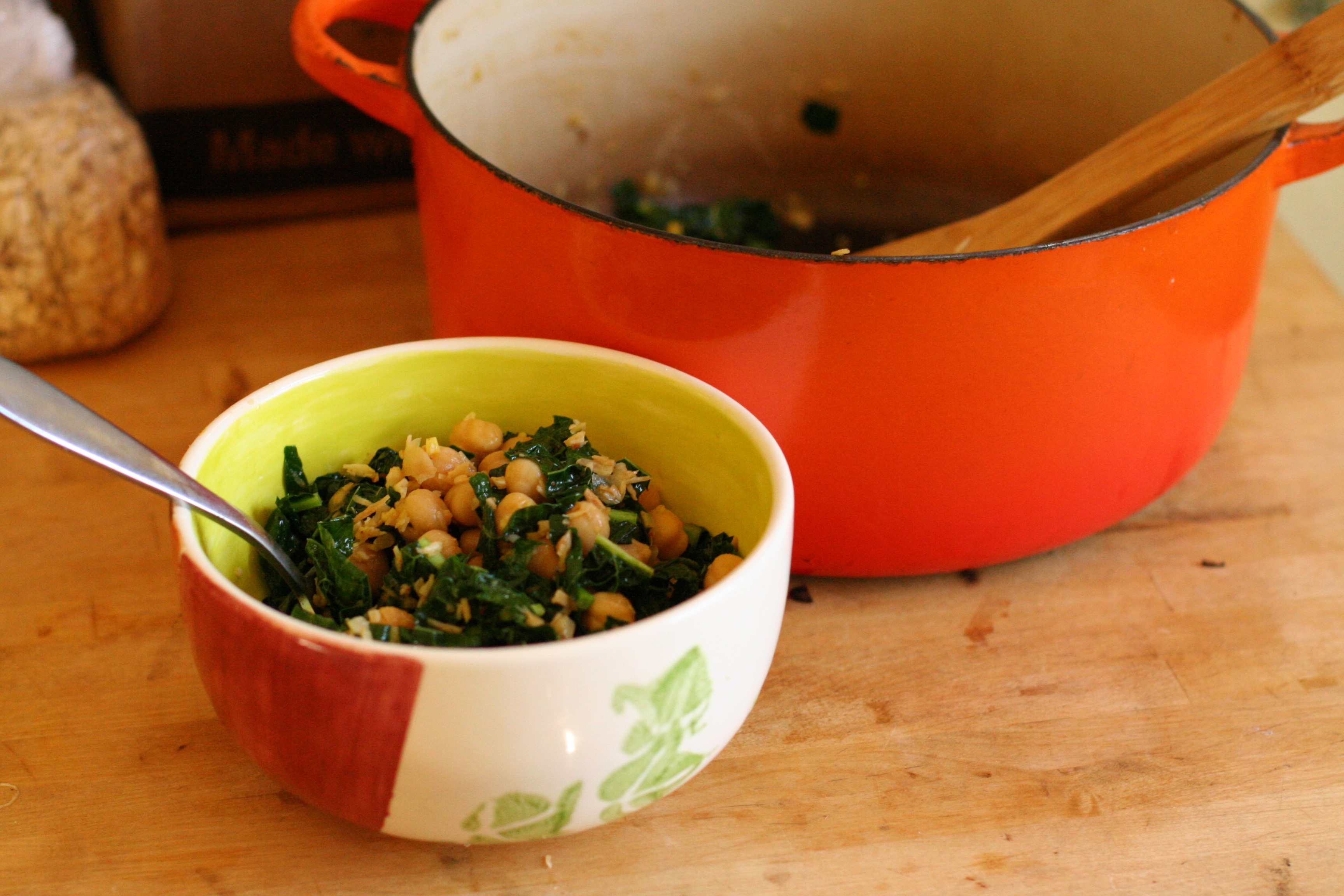
sometime this week when i get a chance, i wanna write about what we’re learning in the foreclosure-fighting study group. for now, it’s green that gets me through the week.
Kale and chickpeas with toasted coconut, ginger, and garlicA loud-clicking and uncatchable insect made a home in my bedroom for three days, until I finally nabbed him in my tea glass.
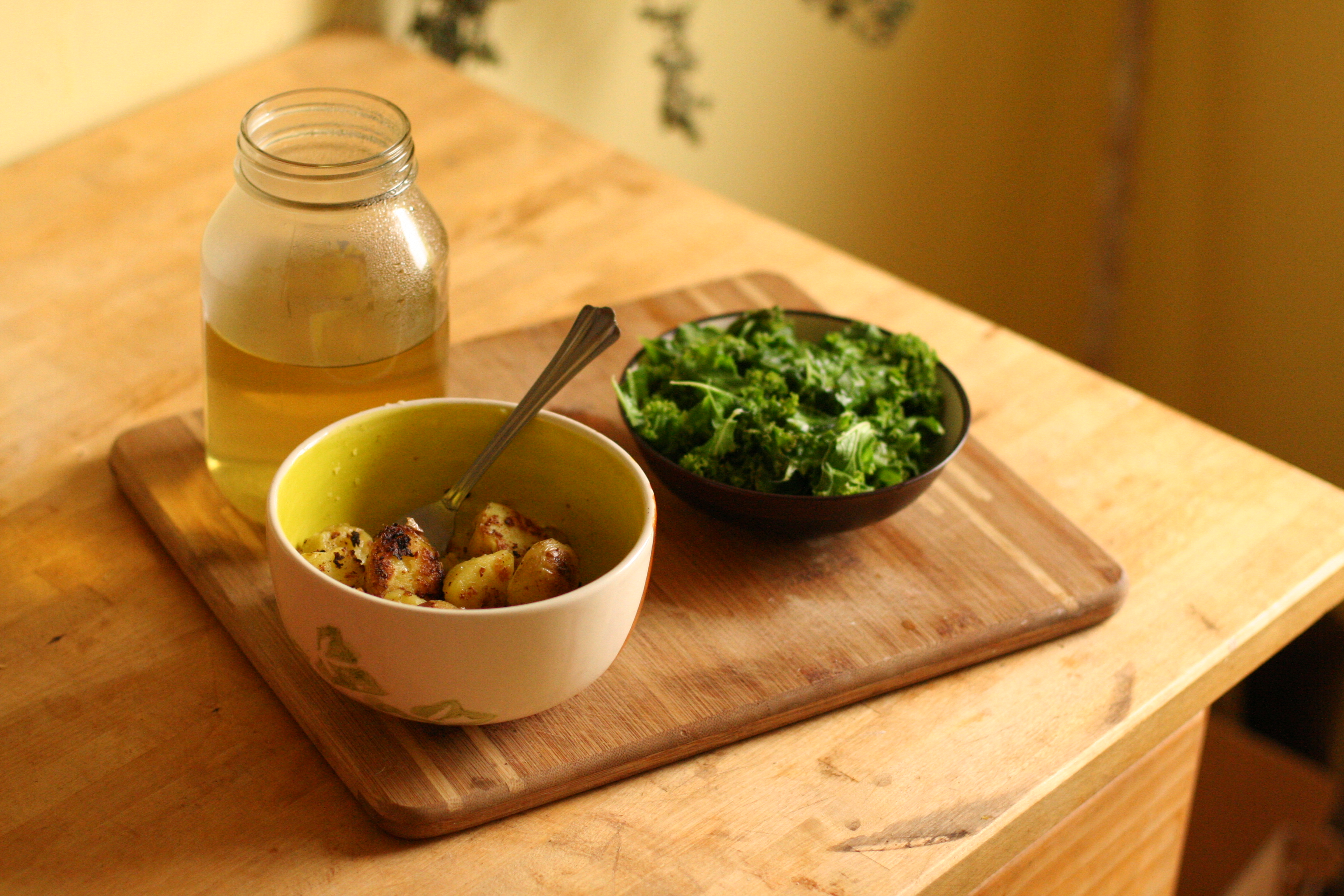
Breakfast this morning: genmai cha, little gold potatoes, and steamed kale.
Trigger Warning: discussions of fatphobia and sexual assault.
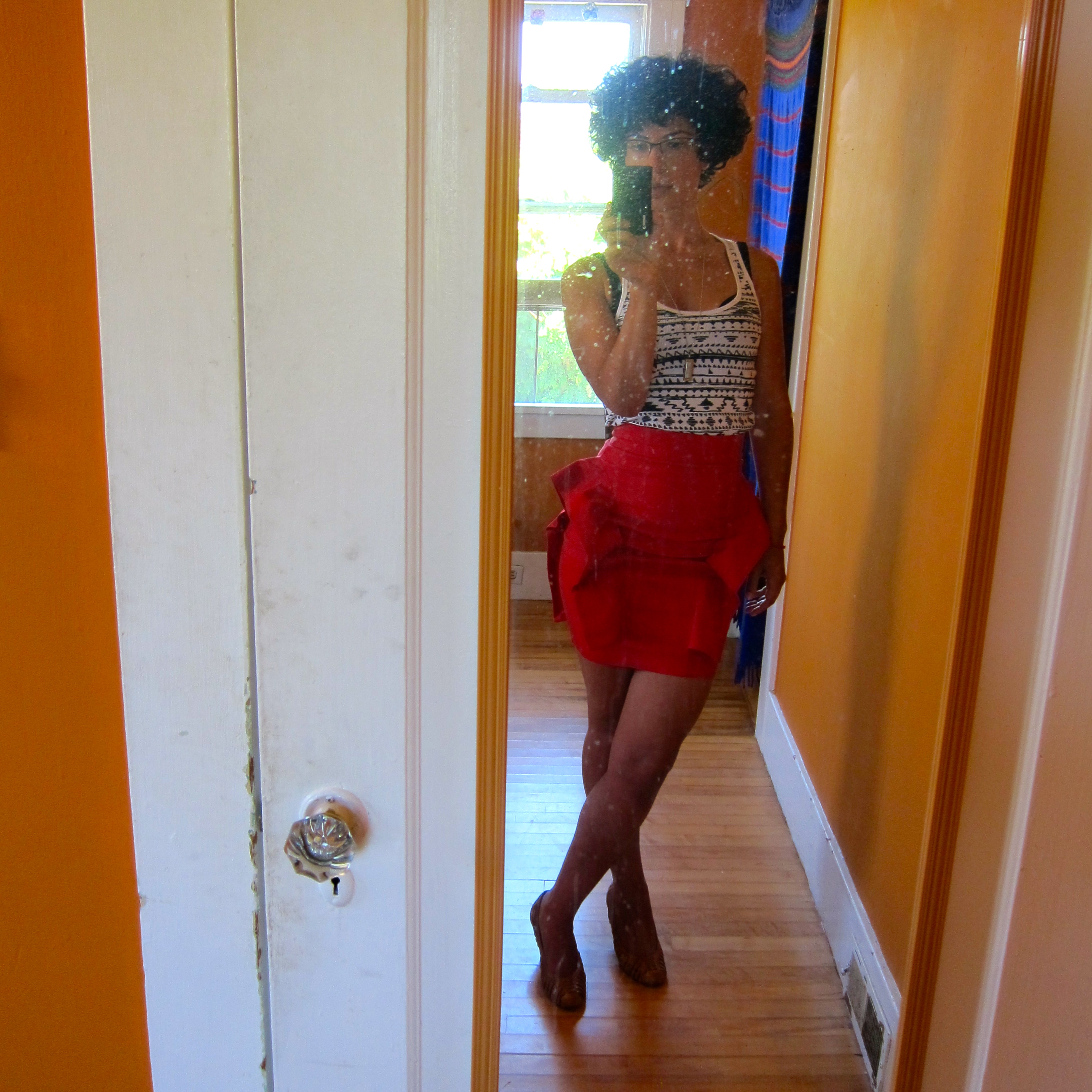
This week I made a What Not To Wear intervention on my own wardrobe. Based on my own preferences, but preferences I tend to sideline when I don’t really take the time to find separates that fit and interest me. Which leaves me with a closet full of stretched-out t-shirts in solid colors. Browsing the few stores I visited, I had to keep telling myself: no solid t-shirts. Only things that are nice and snug in the waist. And if something has to be solid, let it be an interesting fabric or shape. (Hence the red skirt.)
There are many reasons I shy away from dressing in a style I think of as “hard femme.”
Wanting to be taken seriously.
Wanting to avoid extra harassment.
Wanting to be able to hop a fence at a moment’s notice.
Wanting to bike around and sweat and cartwheel (difficult in heels and a pencil skirt).
Not wanting to confront my body image issues.
Not wanting to encourage fatphobia in myself or others: feeling a twinge of pleasure and the ghost of shame when people compliment me on losing weight.
At a certain point, after my 3 months living and working at the meditation center in Spain, I was even concerned that presenting my body in a more stereotypically “hot” or hard-femme way might cause more suffering for others: playing into a sex-saturated culture that doesn’t give us the tools to examine our own lust, or our own desire for approval.
Even as my internal debates swirl, I also realize (again, with some sadness) how fortunate I am that the styles I prefer are pretty much socially approved for the body that I have. On Fathers’ Day, my dad and I had a conversation about the violence that often happens when someone discovers that a person’s physical makeup, or sex, doesn’t fit with what they had expected, based on reading their gender. The discoverer becomes enraged. I am safe on the transphobic score, though I also know that the average US person would much more likely blame me if somebody ever raped me while I was wearing an outfit like this, versus a stretched-out t-shirt and wide-legged corduroys. In summer, when my skin is darker, the blame (or lack of compassion) might be worse.
Obstacles.
For right now, though, I am trying this on. Results so far (internally, and from others) have been mostly positive, supportive, fun. I actually felt extra confident doorknocking to fight foreclosures last night (not in the outfit above, but something along similar lines.)
on the cover of the Vol. 28 | No. 2 | Spring 2012 edition of Inquiring Mind:
Until you dig a hole, plant a tree, water it and make it survive, you haven’t done a thing. You are just talking.
—Wangari Maathai (1940-2011)
Speech at Goldman Awards, San Francisco, April 24, 2006
powerful to read this while learning about the cordones that emerged under Allende in Chile.
when the bourgeoisie launched a “bosses’ strike” (there’s a new one for me!) as a kind of pressuring – slash – refusal to cooperate with Allende’s lefty government, they planned to withhold the means of production (their own property) in order to force concessions. but instead, the wage-slave folks intimately familiar with those means of production — in factories, in agriculture, even in schools and shantytowns — combined forces to take over and run things themselves.

















 Kloncke