Hey folks, sorry for the signal loss! It’s been mad busy around here, partly because of the following little experiment I’m planning, with the help of some good friends. In short, for one afternoon I’m going to try to translate the blog “in real life” (IRL).
The only the IRL ‘blogger’ (or blogger-heavy) gatherings I’ve attended myself have been conferences. Media conferences; technology conferences; things like that. In this type of scene, bloggers from across the country (or among many countries) not only get to expound their theories before a live, half-listening-half-Tweeting audience, but can also lock screen-addled eyes with many writers theretofore befriended — or offended — exclusively online. I’ve seen drama erupt at these idea emporiums, but I’ve also witnessed cyberdenizens leap over tables to greet each other, practically converging midair in an embrace of mutual affection, admiration, and I-can’t-believe-it’s-really-you.
For my own shindig, though, I want to go in a different direction. Very chill, more like a housewarming or offbeat birthday party than a serious networking meet-and-greet. Although there are plentyofonlinewriters and creators I’d love to meet in person someday (and many wonderful ones I’ve already had the fortune to know), most everyone invited to Kloncke IRL are people I’ve known offline for a while. Here’s the email I sent out about it (well, a slightly less colorful version) to my local peeps. Faraway compas, I love you and wish you could be here! My address has been changed for this version because, well, I don’t want it circling around, you feel me? But I’m posting it here because I occasionally meet people in the Bay who’ve read Kloncke but don’t know me personally (yet). If that’s you, shoot me an email, and come on out next Saturday! Love to have you.
dear amazing wonderful human friends.
as most of you know, i make a blog called Kloncke.
i know you know about this blog because many of you have left rad, sweet, insightful, and sometimes hilarious comments there.
i appreciate this a whole lot. i appreciate YOU a whole lot!
and so, as a small means of saying thanks for reading, sharing, linking, and just being your fabulous selves, i want to warmly e-vite you to a gathering in my home, In Real Life (IRL).
what can you expect at such an event?
live incarnates of the cyber version; including:
vegetarian and vegan homemade treats
photographs, available by donation
group meditation
a reading of my recent guest column in make/shift magazine, on buddhism, feminism, and resistance
a “blogroll” table featuring your political, artistic, and spiritual lit to share or display (bring some!)
the colorful walls of our apartment
chillin and building with other lovely folks
Kloncke IRL
Saturday, October 15th 3–5pm (Reading at 4pm) 555 33rd Street, Oakland * * *
this event will be free (of course!) but please bring your own mug or thermos (for tea) and, if you can, a cushion to sit on. (we’ll also have a handful of chairs.) unfortunately our apartment is up one flight of stairs with no elevator or ramp; please let me know if this will be a problem for you, and we can try to work something out.
also, please arrive scent-free so my peeps with Multiple Chemical Sensitivities can come and enjoy themselves without getting sick!
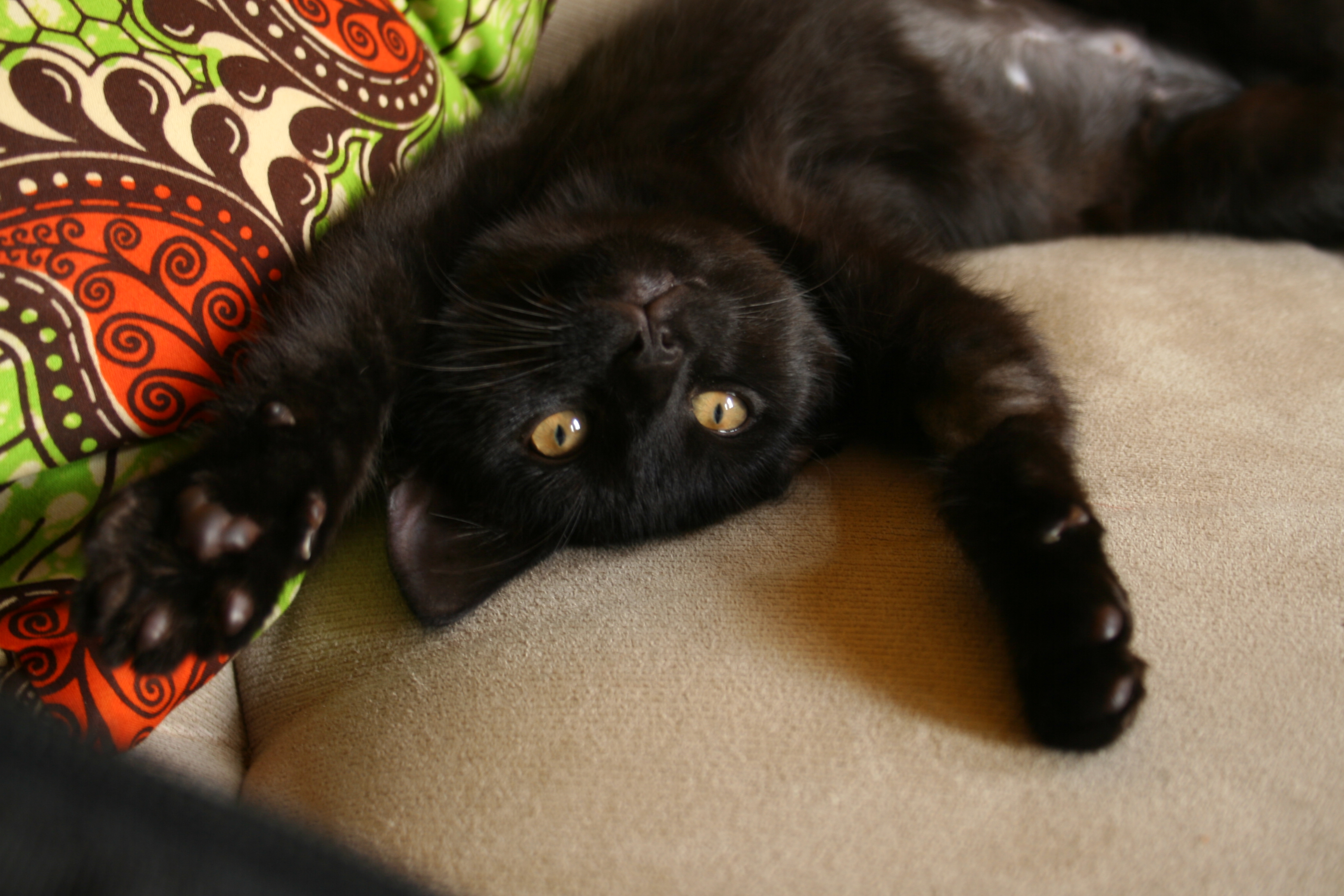
finally, Our place has limited space! Please RSVP so we can have a sense of numbers, and calculate how many walls to knock down.(j/k :) feel free to RSVP-plus-one or two, but don’t roll through with a whole posse. our kitten Eloise will be acting as bouncer, keeping careful track of the guest list.
__
thanks, love, take care, see you soon, be well, and call or e-mail me with any questions,
katie loncke
More to come this week online: the next Newsies post on how the courts are stacked against us, inspired by a frustrating but illuminating experience this morning before a judge. Stay tuned. :)
How many of you have seen Newsies? Easily the best Disney film ever made. Probably the best Disney film even conceivable. (How — how? — did this get greenlighted?) Based on the true events of the 1899 Newsboys’ Strike, it introduces the newsies as a “ragged army” of poor, plucky orphans and runaways who survive by slanging newspapers in the streets of New York. When journalism capitalists Joseph Pulitzer and William Randolph Hearst collude to expand profits by charging more money to the “distribution apparatus” (a.k.a. these teenage laborers), the newsies, outraged, take inspiration from locally organized trolley workers and decide to go on strike.
They also dance and sing, fabulously.
__
In a dazzling display of preternaturally sophisticated taste (or as part of a steady diet of musicals my mother supplied me at a young age), I became obsessed with this movie following its release in 1992, when I was six or seven years old. I remember sliding in the VHS (I think my parents had taped it from TV) and sitting on the carpet below the screen, transfixed by Jack Kelley (a young Christian Bale), Spot Collins (the dreamy dangerous one from Brooklyn), and the rest of the balletic, rough-and-tumble weyr. To this day, I can belt out any of its numbers and recite large swaths of dialogue.
But I am hardly alone in this devotion. Recent example: a few weeks ago at an outdoor beer garden, a friend of Ryan’s, visiting from Oregon, joined us in the opening bars of “Seize The Day” so tenderly and sparklingly that we drew astonished compliments from a nearby table. “What was that?” the woman marveled. “It was beautiful!”
Indeed, the enduring cultish popularity of Newsies has now inspired an adaptation for theater. Academy-Award-winning composer Alan Menken is teaming up with Harvey Fierstein to translate the turn-of-the-century David-and-Goliath tale from screen to stage. Unfortunately, however, it appears that the new version is doomed to be bled of much of its political nuance, in favor of (you guessed it) the romance angle. Fierstein explains:
“In a musical, there’s an old rule: You must follow the love story. It gives the audience somewhere to go and someplace to rest their hearts.”
This slated snoozeifying shift is tragic, not because its motivations are wrong, but because they are right. You do need a love story. Thing is, Newsies already has one. But rather than the typical hetero-sapfest, it is chiefly a love story of solidarity: of workers learning to trust, defend, celebrate and enjoy one another.
I’ll admit, at six years old I came at Newsies heart-first. The head came later. But it did come. And this film affords ample room to grow into, intellectually.
So, in honor of one of my favorite movies of all time, here goes a series of posts: on the real-life lessons we can draw from Newsies.
Lesson One: You’ll Have To Deal with the Scabs.
__
See that song up at the top?
Hear that part (around 0:50) where Boots asks Jack (the leader):
—”What’s to stop someone else from sellin’ our papers?”
—”Well we’ll talk wit’ em.”
—”Some of ’em don’t hear so good.”
—”So we’ll soak ’em!”
“Soaking” is newsie speak for “rolling up on,” or “beating up.” David immediately chimes in with the typical liberal nonviolent objection: No, we can’t be violent! It’ll give us a bad name!
How this violence vs. nonviolence conflict resolves itself through the film testifies to the realism that elevates the movie beyond fun to fascinating. Spoiler: They do use violence. Why? Because they have to, in order to maintain a hard picket line. And this bears out in the history of labor unions in the United States.
[My father] was a union man. There was a dual union— one for whites and one for blacks. He said we should have one big union but a white and a black is better than none. He was making big money—eight dollars a day. I used to brag that “My father makes eight dollars a day.” But he taught me that “you got to belong to the union, even if it’s a black union. If I wasn’t in the union I wouldn’t make eight dollars a day.”
New Orleans is a trade union town. My father had seen the longshoremen organize and they made a lot of money. Unions were not new to this city. And I mean they had unions! When they came out on strike, there were no scabs. You know why there were no scabs? Because you carried your gun. The pickets had guns and they would blow your brains out.
Real talk. And even though Newsies‘ slightly sanitized brawls depict fists, slingshots, and rotten fruit (the opposing side, with hired Pinkerton types, is armed with much more deadly weapons — chains, bats, and brass knuckles — and backed by police), not to mention the conspicuous absence of racial tensions among the workers, nonetheless, the movie does show them defending their strike from scabs through use of force. Not only shows, but cheers it.
* * *
Nowadays, though? Fighting scabs appears to be taboo: at least in mainstream media. Take the recent and relevant example of the ILWU strike up in Washington.
Longshore workers have shut down ports in the Pacific Northwest as they confront a scab grain terminal operation, block trains, dump grain shipments and stand up to a police attack on their picket lines.
Just two days ago, workers (including the local longshore president) and supporters (mostly women) blocked another train from entering the EGT grain terminal. Police responded with mass arrests and liberal application of pepper spray.
Bill Wagner / The Daily News. Law enforcement personnel wrestle ILWU Local 21 longshoreman Kelly Muller to the ground as they arrest protesters and try to clear the tracks so a Burlington Northern-Santa Fe grain train can pull into the EGT grain terminal at the Port of Longview on Wednesday morning.
For mounting these defenses, these workers are pilloried as “thugs” and “goons.” A CNN reporters openly laughed at them. Other reporters deny that the ILWU is fighting true scabs at all, claiming that this all boils down to pig-headed union-vs.-union beef. (David Macaray debunks that argument handily.)
Courts, meanwhile, find the ILWU in contempt: which happens in Newsies, too. In fact, one of the film’s greatest political strengths, in my mind, is how it shows the institutional and corporate-backed violence not only matching but outstripping the workers’ use of physical force. Put in this context of severe power imbalance and active repression, the viewer naturally sympathizes with the newsies’ self defense, even if it is technically “criminal.”
But we’ll save the legality subject for the next post in the series.
For now, I am curious, especially from the Buddhist/spiritual folks who live in commitment to nonviolence: how do you propose dealing with scabs? When workers organize to halt production and the company predictably pushes back, what levels of strategic property destruction and physical force, if any, do you find legitimate? Have you ever been in such a situation? (For the record: I haven’t.)
Share your thoughts, and take care. See you next week with more Disney labor lessons!
Concluding this spontaneous miniseries on companionship (or maybe not concluding it — who knows? — it’s spontaneous), we arrive at Ryan. You know, my partner, the guy from kale vs. flowers and Bad Good Romance. The other day, I read a passage from James Agee’s Southern novel A Death In the Family that reminded me of our household dynamic. Specifically, the ways that we negotiate gendered roles, try to both anticipate and discuss each others’ needs, and occasionally discover “dhamma,” or insights about the nature of things, right in the (dis)comfort of our own home.
In this scene from the book, Jay has just jolted awake in the dead of night thanks to a call from his brother Ralph, who drunkenly warns that their father may soon die from long-battled heart problems. Jay has decided to take the train up to his parents’ town, and he and his wife Mary, also awakened by the phone call, are getting him ready to leave.
“It may all be a false alarm. I know Ralph goes off his trolley easy. But we just can’t afford to take that chance.”
“Of course not, Jay.” There was a loud stirring as she got from bed.
“What you up to?”
“Why, your breakfast,” she said, switching on the light. “Sakes alive,” she said, seeing the clock.
“Oh, Mary. Get on back to bed. I can pick up something downtown.”
“Don’t be ridiculous,” she said, hurrying into her bathrobe.
“Honest, it would be just as easy,” he said. He liked night lunchrooms, and had not been in one since Rufus was born. He was very faintly disappointed. But still more, he was warmed by the simplicity with which she got up for him, thoroughly awake.
“Why, Jay, that is out of the question!” she said, knotting the bathrobe girdle. She got into her slippers and shuffled quickly to the door. She looked back and said, in a stage whisper, “Bring your shoes — to the kitchen.”
He watched her disappear, wondering what in the hell she meant by that, and was suddenly taken with a snort of silent amusement. She had looked so deadly serious, about the shoes. God, the ten thousand little things every day that a woman kept thinking of, on account of children. Hardly even thinking, he thought to himself as he pulled on his other sock. Practically automatic. Like breathing.
And most of the time, he thought, as he stripped, they’re dead right. Course they’re so much in the habit of it (he stepped into his drawers) that sometimes they overdo it. But most of the time if you think even for a second before you get annoyed (he buttoned his undershirt), there is good common sense behind it.
Ryan tells this funny joke sometimes about one method, half-conscious at most, by which person X tries to evade domestic work and pile it on a partner. “But you’re so good at [cooking, doing laundry, calming a fretful child]. If I do it, I’ll just fuck it up.” A passive-aggressive compliment-trap, which leaves the other person feeling obligated to do the thing they’re so much better at doing.
__
Obviously, this is one of the big problems with the naturalization of gender roles in heteronormative family requirements. Men are raised to believe that they don’t have to learn how to cook/clean/mend/mind children because women are so naturally good at it. Jay appears to have no clue that his wife was brought up to learn how to be a “good woman,” which means acquiring certain social and reproductive skills, including staying attuned to the needs of her socially-sanctioned husband and children. She might enjoy learning those skills; she might not. The point is, the skills aren’t endemic to her based on her gender. For a whole host of reasons that I won’t get into here, she’s not really free to self-determine her own gender identity and presentation, fertility, or (as a working-class person) the circumstances of her productive and reproductive labor.
So this is the background against which Ryan and I operate. Furthermore, Ryan works. I “work” from home on grad school (viz. this blog, or planning for EastBaySol). I spend more time at home so its levels of (un)tidiness affect me more, which makes me more inclined to change/correct them myself. Also, I like to cook more than he does. So he takes pains to counteract the assumption that just because I know how to cook, and even enjoy it, that this means it’s effortless for me, and that he’s entitled to its products, as though he were plucking a ripe plum from a backyard tree. And those times when I do wind up cooking more than 50%, he makes sure to do the bulk of the cleanup. Last week when I started washing dishes out of turn after lunch, he straight-up chased me out of the kitchen. Another morning as I slept he made breakfast and green tea, then came back to bed to cuddle me awake.
__
Maintaining mindfulness around housework distribution doesn’t have to be robotic or transactional. It’s actually a pretty emotional and tender process for us, and I think for a lot of people. The other day I was talking to a woman who lives with her girlfriend, and was telling me that even though her partner works longer hours than she does, they cook dinner together every night and split the remaining housework evenly. “I just knew I would be unhappy otherwise,” she said. I love that this negotiation takes the feeling of work into account, and not just some supposedly objective measurement of household labor — in joules, or whatever.
Jay and Mary’s middle-of-the-night crisis management takes a turn for the tender, too. I see many of my relationship dynamics reflected between them.
He sat on the bed and reached for one shoe.
Oh.
Yup.
He took his shoes, a tie, a collar and collar buttons, and started from the room. He saw the rumpled bed. Well, he thought, I can do something for her. He put his things on the floor, smoothed the sheets, and punched the pillows. The sheets were still warm on her side. He drew the covers up to keep the warmth, then laid them open a few inches, so it would look inviting to get into. She’ll be glad of that, he thought, very well pleased with the looks of it. He gathered up his shoes, collar, tie and buttons, and made for the [bathroom], taking special care when he passed the children’s door, which was slightly ajar.
On the morning ten years ago when we in Sacramento heard the news, I remember my dad driving me to school. Us listening to the radio. I didn’t really understand what was happening (then again, who did?), but I remember starting to cry when I realized that people in other parts of the world live in fear of bombings every day.
What does it mean to hope and pray for a better society, free from imperialist wars, patriarchy, racism, and class, without rejecting or wishing away the current reality?
To me, it means: now (the present) is the best and only time we have in which to try our hardest. To keep building toward the freedoms we wish for all beings.
We may not live to see it, but we can help create it.
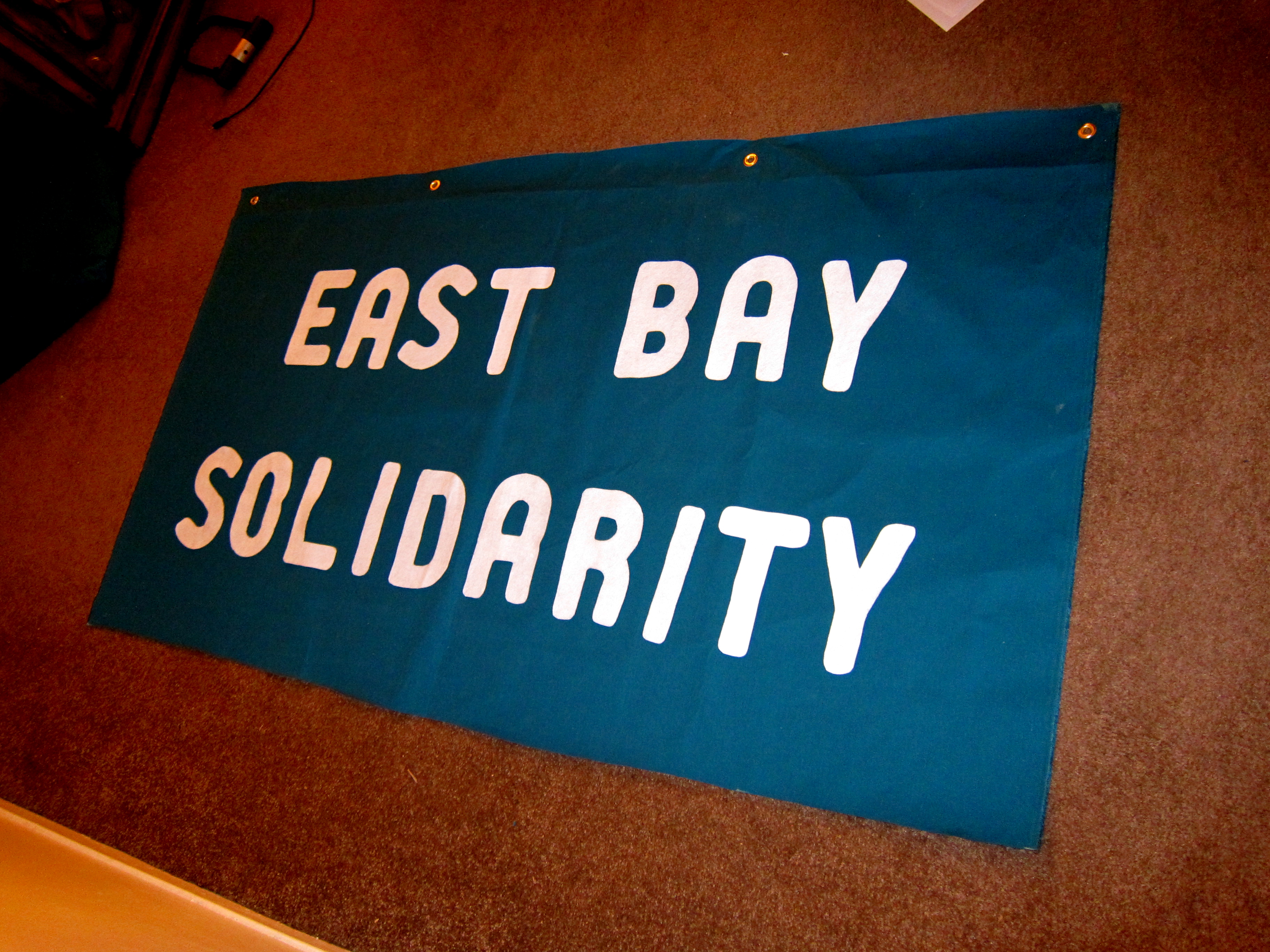
Spent today shopping for an East Bay Solidarity Network sign-making party, agonizing for an embarrassingly long time over what color (and heft) of banner fabric to get, and what color felt for the letters, and later (with William) what font to use. But now it’s finished — grommets and all — and looks F%*@IN’ SICK, if I do say so myself. :)
Between printing the letters, cutting them out, tracing them onto the white felt, and then cutting out the felt and gluing the letters onto the banner, our core organizers also called all the people on our phone tree to mobilize for the next action, coming up on Wednesday. Cooperating on mini-projects over weeks and months is cultivating a beautiful ease among us. We crack each other up; we respect each others’ opinions. We brew each other tea. (Louise, if you’re reading this: we will miss you!)
Next week, after the action, I’ll share photos of the fight-specific signs we made. Right now it’s time to sleep the deep, delicious sleep of the DIY-satisfied.
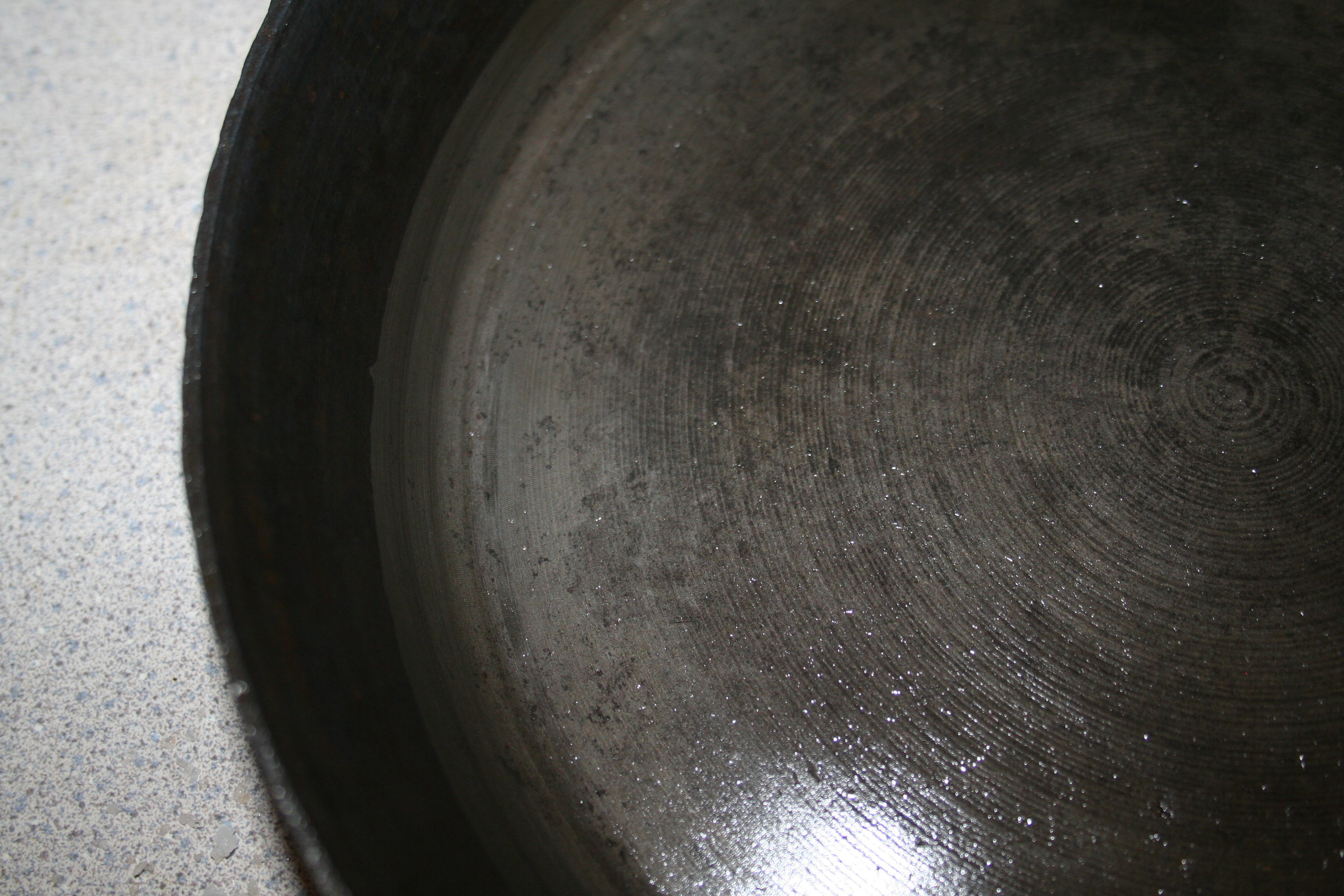
Having finished and submitted a grad school paper today, I am rewarding myself with another round of re-seasoning our cast-iron skillet.
Did you know that it’s virtually impossible to find out how to properly season one of these puppies just by looking it up on the Internet? Oh, sure, you’ll find instructions and opinions, but they differ wildly from person to person, sharing only the barest of fundamentals: you need to put oil in the pan and heat it up; then the pan will be smooth and non-stick.
But how? Why? Really?
Sheryl’s Blog explains. Fantastically. Scientifically. Read and be amazed.
When you’re meditating, the same process [of restraint] holds. People sometimes wonder why they can’t get their minds to concentrate. It’s because they’re not willing to give up other interests, even for the time being. A thought comes and you just go right after it without checking to see where it’s going. This idea comes that sounds interesting, that looks intriguing, you’ve got a whole hour to think about whatever you want. If that’s your attitude toward the meditation period, nothing’s going to get accomplished. You have to realize that this is your opportunity to get the mind stable and still. In order to do that, you have to give up all kinds of other thoughts. Thoughts about the past, thoughts about the future, figuring this out, planning for that, whatever: you have to put them all aside. No matter how wonderful or sophisticated those thoughts are, you just say no to them.
YES! Good Lord, it always seems like my best, most nuanced ideas come when I’m trying to meditate. And all I want to do is get up from the floor and go write them down. Or else I’ll forget! And this key conceptual innovation will be lost forever! People will die and movements will perish unless I fully formulate and record this thought!
Underlying this mildly desperate grasping, for me, anyway, is the notion that my ideas, my intellectual products, are my most important features and contributions. “Features” in the sense that they might make me more admirable; “contributions” in the sense that they might make me more useful. If an idea can be articulated, recorded, and disseminated, it will be worth more to a greater number of people than my 60 minutes of calm, settled mind, which are beneficial only to me.
But what Thanissaro Bhikkhu is getting at, I think, is that ways of being — i.e. patience, restraint, generosity, and dignity — can be equally important features and contributions.
I think that in some way, this is borne out through his article itself. He’s talking about patience and dignity, he’s using well-crafted language to describe it, which is lovely and useful. But it is our experiences of beneficial patience, restraint, dignity and generosity that leave more profound impressions on us, and on the ways we engage the world. Observing, emulating, and deliberately cultivating these qualities intervenes more significantly in culture (even on the level of our friendship groups, or workplaces, or organizing committees) than an eloquent description of their beauty.
If that doesn’t grab you, and you still think good ideas are the shit, consider this: a calm mind can act as a stronger foundation for discernment and discriminating thought. So even if we have to let go of some idea-streams in the short term, in the long term we may learn to call on a broader range of faculties in determining which ideas are worthy of extended investigation. We may find that we need to ‘chase’ good ideas less, and instead allow them to arise and show themselves in our minds.
I do have one quibble with Thanissaro’s article, though. While I completely agree that much of consumer culture pushes us toward instant gratification, I also think there are a few vital exceptions to this rule: examples of toxic, twisted imperatives toward “restraint” that illustrate important truths about economics, politics, and gender.
Exception 1: The Dieting Industry
__
Each year, people in the U.S. spend $40 billion on “weight loss programs and products.” On one hand, it’s true that “restraint” does not figure too overtly into the industry vocab. On the contrary, I think, we often see a marketing strategy of “indulgence.” The health bar that tastes like a candy bar! Sumptuous weight-loss meals prepared and delivered to your door!
Wrote This On a Plane to Houston, On My Way To Guatemala
I like to pretend sometimes,
that I got this hunching spine
from working so meticulously at my craft.
Each day carefully placing my toolbox on the table,
unfolding the lid and curling my soft pink fingers into their positions
to forge these words into some kind of weapon,
to whittle at these ideas until they pierce the chest.
I like to pretend sometimes
that this glow is a kiln,
I wipe my brow, and it makes no matter
that my hand comes away dry.
Because this feels like the work of a workman,
and I make like I’m adjusting my spectacles
and gripping my tweezers
as I deftly shift another syllable.
I like to pretend sometimes
that I’m just like that man I watched
crack firewood with ballet strokes,
cut grass finely with a dull machete,
coax coffeebeans to fall with massaging fingers,
like the spider spindling the fly.
Quick post, keepin it movin: today rolled with my hosts — Burlington boys — to the famous Bread and Puppet right in their home theater, in Glover, Vermont. Incredible. And they actually served free bread with (possibly vegan) aioli!
This slideshow requires JavaScript.
I’ll come back tomorrow and lay out some individual shots; it’s really worth it to see the details.





 Kloncke