My Top 5 Dhamma Books

For a long time now, I’ve avoided giving book recommendations on dhamma.  “Avoided” is too weak a word, really.  There’s been some sort of block.  It’s like I’ve been mentally and physically incapable of suggesting reading.

Part of this has to do with an awful experience I had with intellectualized Buddhism.  When I got to Harvard as an eager, wide-eyed freshman, the very first elective class I took was a seminar on Indo-Tibetan Buddhism.

Dry, dry, dry, dry, dry.

I never read another word on dhamma for the next four years.

On the flip side of things, as a bibliophile and generally thinking-trapped individual, I’m acutely aware of how easily one can become fascinated and hypnotized by Buddhist philosophy, without ever really putting any of it into practice.  So it sometimes feels false or misleading to recommend books, rather than just accompany someone in learning basic dhammic meditation training.

Bodhidharma, credited with bringing Zen Buddhism from Northern India to China. Dude is said to have cut his own eyelids off to stop himself from falling asleep while meditating.

But the truth is, even when people who are trained and do practice ask me for books, I’ve been slow and reluctant.  So today is an effort to shift that.

A couple words about this short list.  One, as you may notice, there is a lot of Mahayana, even though I’m down with the Hinayana.  What can I say?  When it comes to reading, I like what I like.  Two, there are no suttas or canonic/original texts.  Looking forward to diving into those in 2011.  Three, the significance of these books in my life has had less to do with intellectual edification, and more to do with flat-out inspiring me to practice.  There are many more fascinating Buddhist works, scholarship, biographies, etc. that have helped and educated me, but these are more along the lines of altering my worldview and day-to-day spiritual engagement.

So here we go: my top 5 dharma books, in chronological order of when I read them.

0.  Entering the Stream: An Introduction to the Buddha and His Teachings

Edited by Samuel Bercholz and Sherab Chödzin Kohn

A wonderful and diverse collection of essays and excerpts that got me psyched on both reading and sitting practice.

Includes work by Shunryu Suzuki Roshi (“Zen Mind, Beginner’s Mind” – classic), Bhikku Bodhi (with whom I walked across the Golden Gate Bridge last week; amazing), and other greats.


Continue reading

Oh, Blogging, Today You Are Difficult

And all I want to do is read and eat pesto soba noodles.

So I will quote extensively from Pema Chödrön (recent celebrated guest teacher in San Francisco) in one of her famous books, When Things Fall Apart.

These piece in particular helped me considerably during the street retreat last week.

It’s as if you just looked at yourself in the mirror, and you saw a gorilla.  The mirror’s there; it’s showing you, and what you see looks bad.  You try to angle the mirror so you will look a little better, but no matter what you do, you still look like a gorilla.  That’s being nailed by life, the place where you have no choice except to embrace what’s happening or push it away.

Most of us do not take these situations as teachings.  We automatically hate them.  We run like crazy.  We use all kinds of ways to escape—all addictions stem from this moment when we meet our edge and just can’t stand it.  We feel we have to soften it, pad it with something, and we become addicted to whatever it is that seems to ease the pain.  In fact, the rampant materialism that we see in the world stems from this moment.  There are so many ways that have been dreamt up to entertain us away from the moment, soften its hard edge, deaden it so we don’t have to feel the full impact of the pain that arises when we cannot manipulate the situation to make us come out looking fine. [13]

So many times, even in one single day, the situation is not the way I would like it to be.  I do not act or appear the way I would like to.  How do I respond in those moments?

I remain amazed at how much the pillars of (a) everyday metta practice and (b) sitting meditation help me to greet these gorillas, these frustrations and disappointments, with patience, curiosity, and more friendliness.  Not to excuse them, or take them out on other people, but just to hang out with them for a while.

Feelings of fraudulence.

Inconvenient sexual tension.

Restlessness.

Irritation.

Wanting political struggle in the Bay Area to be something other than it is.

Fearing being wrong more than I fear causing harm.

Realizing this.

Quite the gorilla.

Billie’s Wisdom, Rumi’s Insight

Good morning, heartache
You old gloomy sight
Good morning, heartache
Thought we said goodbye last night
I tossed and turned until it seemed you had gone
But here you are with the dawn

Wish I’d forget you
But you’re here to stay
It seems I met you
When my love went away
Now every day I start by saying to you
Good morning, heartache, what’s new?

Stop haunting me now
Can’t chase you no how
Just leave me alone
I’ve got those Monday Blues
Straight through Sunday blues

Good morning, heartache
Here we go again
Good morning heartache
You’re the one who knew me when
Might as well get used to you hanging around
Good morning, heartache — sit down

Stop haunting me now
Can’t chase you no how
Just leave me alone
I’ve got those Monday Blues
Straight through Sunday blues

Good morning, heartache
Here we go again
Good morning, heartache
You’re the one who knew me when
Might as well get used to you hanging around
Good morning, heartache — sit down

Reminds me of that famous poem by Rumi:

The Guest House

This being human is a guest house.
Every morning a new arrival.

A joy, a depression, a meanness,
some momentary awareness comes
as an unexpected visitor.

Welcome and entertain them all!
Even if they’re a crowd of sorrows,
who violently sweep your house
empty of its furniture,
still, treat each guest honorably.
He may be clearing you out
for some new delight.

The dark thought, the shame, the malice,
meet them at the door laughing,
and invite them in.

Be grateful for whoever comes,
because each has been sent
as a guide from beyond.

Sidewalk Sit

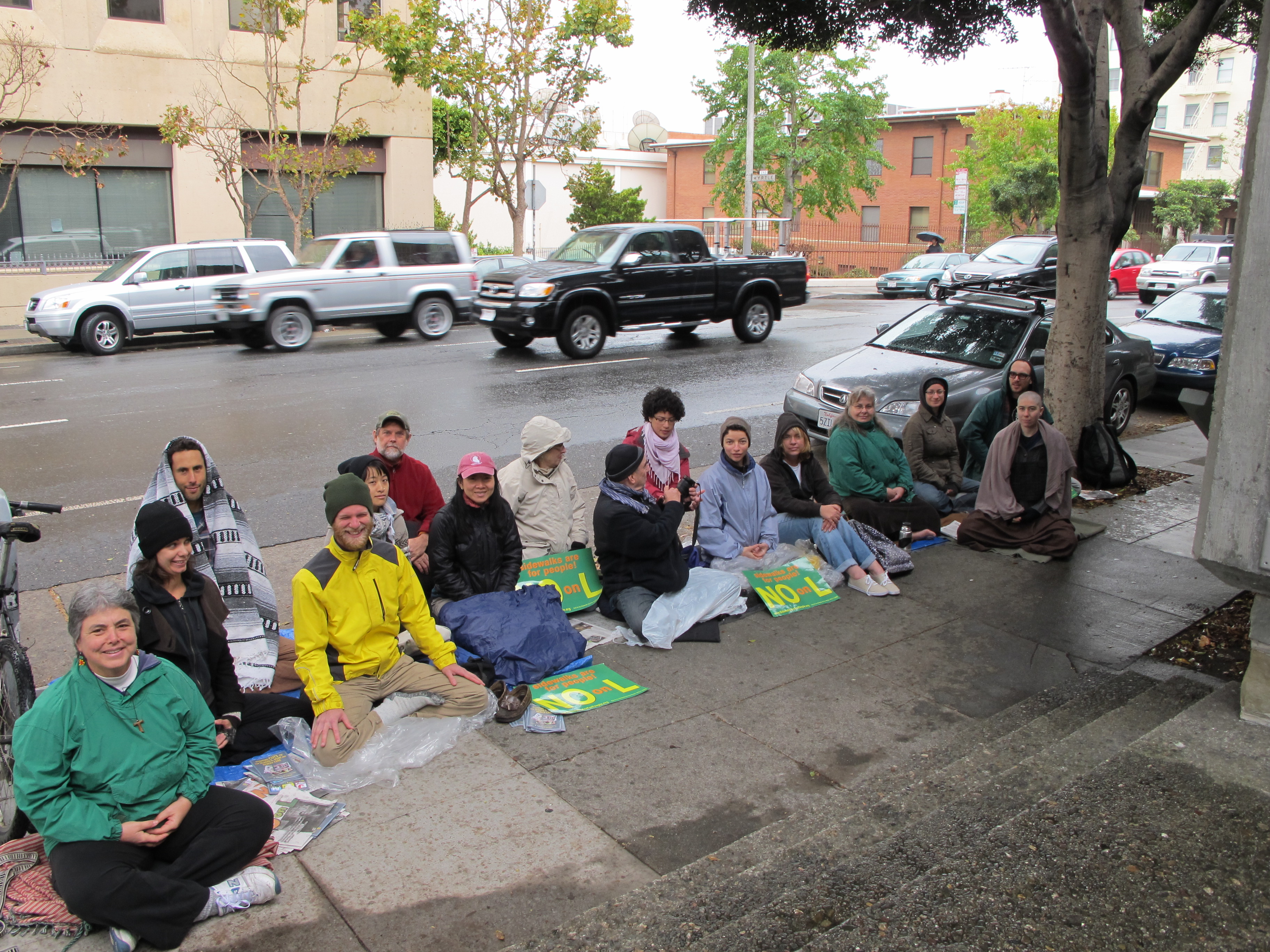
Sarah Weintraub, Michael Bedar, Tyson Casey and Michaela O'Connor Bono sitting off of O'Farrell Street, with a sign reading "sidewalks are for people; NO on L." photo by Sr. Carmen Barsody

Sorry I didn’t get a chance to post on Friday, folks — this weekend was a particularly busy one. Starting Friday evening, we (at the Faithful Fools) hosted about 16 participants in a three-day gathering for Buddhists and friends dedicated to social justice. “Working for Liberation,” we called it: the culmination of, oh, about six months of co-planning between me and the lovely Tyson Casey of the Buddhist Peace Fellowship, with guidance from Carmen of the Fools and Alan Senauke of Clear View Project (also vice-abbot of Berkeley Zen Center and author of the newly published The Bodhisattva’s Embrace: Dispatches from Engaged Buddhism’s Front Lines).

I wanna say more — much more — about the weekend, but I gotta run back to Sacramento. So for now I’ll leave you with these two images of our final weekend ‘activity’: a performative outreach effort in the Sidewalks Are For People Campaign, or “No on Prop L.” A grey, drizzly Sunday morning; chilly but thoroughly enjoyable.

Sixteen of the eighteen meditators sitting on wet Franklin Street sidewalks, sheltered under neighborhood trees. photo by Sonny of the UU Church


Happy Failures

Some of the smartest people I know — including my friend Ivan, and what I’ve read/heard by Suzuki Roshi — excel at failing.  They know how to fail in ways that allow the flow to continue, if you know what I’m saying.  The failure is not crippling, but just part of taking on a difficult challenge.  Generally speaking, I think that people with scientific minds (including serious meditators) are pretty good at failing happily.  Failing in ways that reveal new opportunities, even as they foreclose the ones we thought we wanted.

Endeavoring to improve on my ability to fail doesn’t mean tackling tasks that seem doomed from the start.  That would be too easy!  The kind of failure I’m talking about does not come cheap.  I am invested.  I want to succeed.  Each attempt, each step, is made with confidence, commitment, and openness.

Suzuki Roshi says that this is how we move toward enlightenment.  Through repeating small moments of enlightenment — those moments of a letting-go mind, a mind that is being, not chasing — while at the same time working hard to deepen and strengthen our practice.

I hope this is somewhat clear, what I’m trying to say.  As an example of a recent, happy failure of mine, I wanted to share a letter I wrote to all the people I’d talked to with an interest in building a disarm BART police campaign.  My intention in sending it was (1) to let folks know that I would no longer be pursuing the courses I’d proposed (for instance: organizing a direct action of civil disobedience for the day of Mehserle’s sentencing), and Why; and (2) to thank them for the inspiring connections we’d made in the course of the (eventual) failure.

It felt good to write this letter, not only because I have a lot of admiration and goodwill toward each of the recipients (including those with whom I disagree politically), but also because it was an exercise in observing and accepting reality as it is — rather than as I would like it to be.  A little inroad into rooting out dukkha.

I’d love to know your thoughts, resonances, and criticisms.

Hello everybody,

Hope this note finds you well!

Over the past couple of months, I’ve been talking with BART workers, Oscar Grant movement organizers, Oakland peacekeepers, Marxist feminists, reverends, priests, meditators, lawyers, non-profiters, poets, anarchists, communists, peace activists, radicals, progressives, friends, and random strangers about the possibility of coalescing a campaign toward disarming the BART police. I and others envisioned this as one small step in aiding a shift from weaponized, racist, capitalist-serving security culture toward community-controlled safety initiatives, dual power, and restorative justice.

Continue reading

Elaboration on the BARS Banner

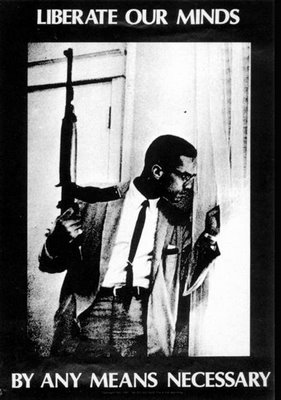
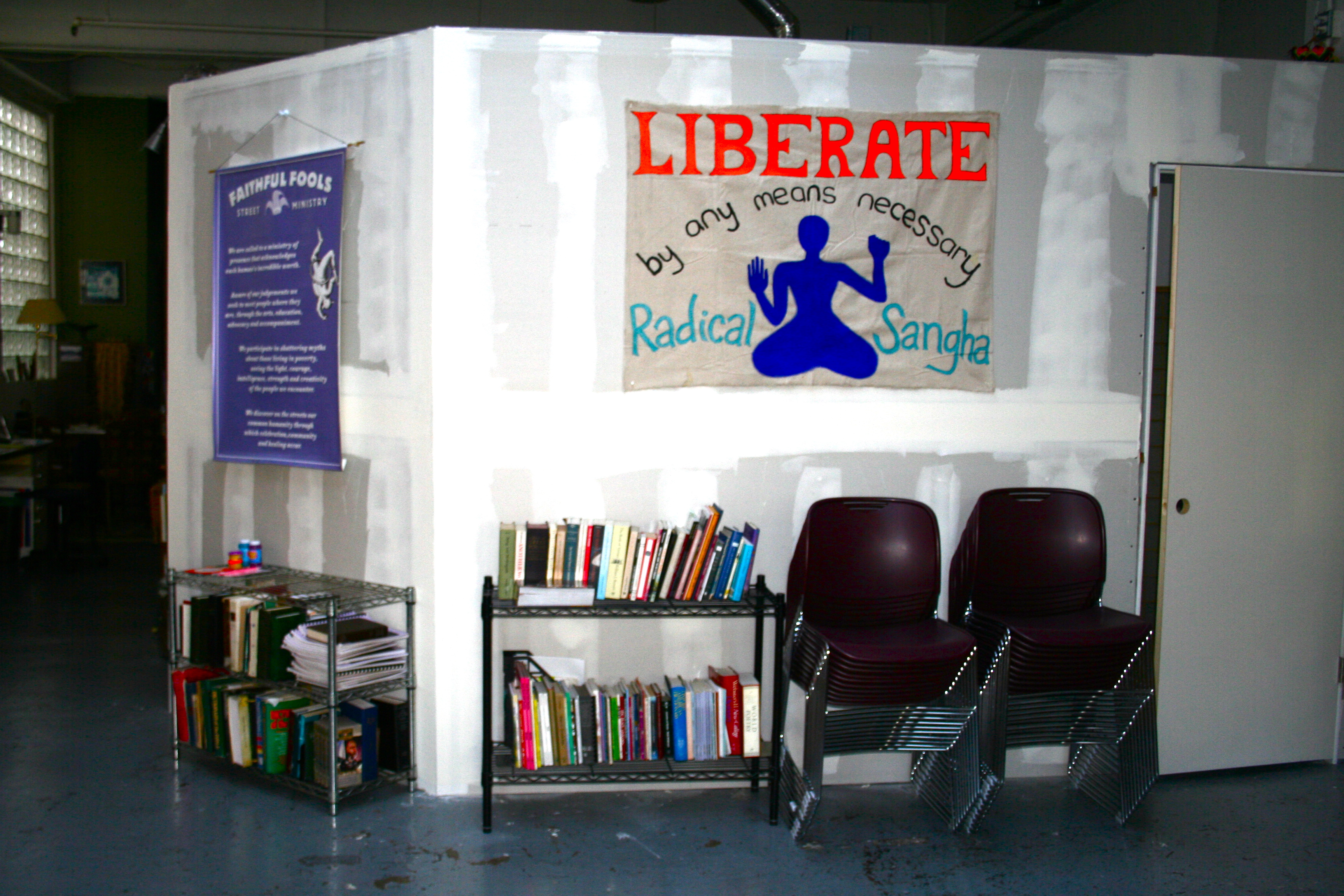
The Radical Sangha banner (also pictured in Monday’s post) has raised a few questions. This might be a good space to engage with some of them.

1. What’s a sangha?

I’ve heard a couple different translations for sangha, which is a Pali word. Loosely, it means something like “community.” In a Buddhist context, it’s one part of the Triple Gem in which practitioners take refuge. Triple Gem includes “buddha” (the historical Siddhatha Gotama from around 500 BC, as well as other buddhas or enlightened folks); “dhamma” (the teachings of the buddha; truth; or practices that lead to understanding truth through direct experience); and “sangha” (sometimes explained as an advanced practitioner to whom we might look for inspiration; other times explained more as a supportive community or assembly of practitioners). So sangha is a group of two or more people practicing dhamma, and helping one another to discover deeper and deeper truths about reality.

2. What’s your understanding of the phrase, ‘by any means necessary?’

Good question. I associate the phrase with Malcolm X and Black liberation movements that bucked norms by insisting that they had a right to use violence, among other tactics, to win their social freedom.

Put in a dhammic context for the banner, I love the apparent tension between the imperative to “Liberate,” and the famous militant phrase. The way I think about it, the Buddha himself did not rule out violence as a means to liberation. He didn’t rule out any means, and indeed gave a good honest try to many of the highest spiritual trainings available to him in his youth. He explored for himself (and encouraged all of his students to explore) the ways that mental negativity (almost always concomitant with doing acts of violence) undermines the quest for liberation from suffering.

What I would love to see among politically active dhamma practitioners in the Bay is a greater spirit of bold experimentation, in the tradition of the Buddha and other awakened folks. Too often we get stuck with a closed-case of nonviolence, or even pacifism. Too often this justifies and hides our fear of confrontation. Fear of conflict. Fear of pain.

And even among the dhammic people who exhibit extraordinary courage and commitment in the face of violent oppression — submitting to arrest and imprisonment for months or years at a stretch, over and over again — I still think we could use a little more of the “any means necessary” mentality. After all, the “necessary” part means what is necessary to win. Not just what feels good to us. Not just what mimics established forms. What works!  Right?

3. I recognize the fist, but what’s with the other hand?

Excusing, if you will, my mediocre drawing skills, the right hand of the figure is supposed to be an abhaya mudra: a gesture of friendly greeting, peace, benevolence, and the dispelling of fear.

For us to liberate (ourselves and each other) requires fortitude and oppositional stances; but it also calls for the special kind of fearlessness that comes from compassion. With compassion, free from delusion, we recognize the good in the opponent. We also see and tend lovingly to the hatred, fear, and greed within ourselves. This compassion inspires and guides our action just as much as strategy; just as much as the urgent wish to “smash” harmful systems.

——————————————

So there’s a little explanation of where I was coming from. Thoughts?  More questions?

love,

katie

Radical BBQ, Radical Sangha

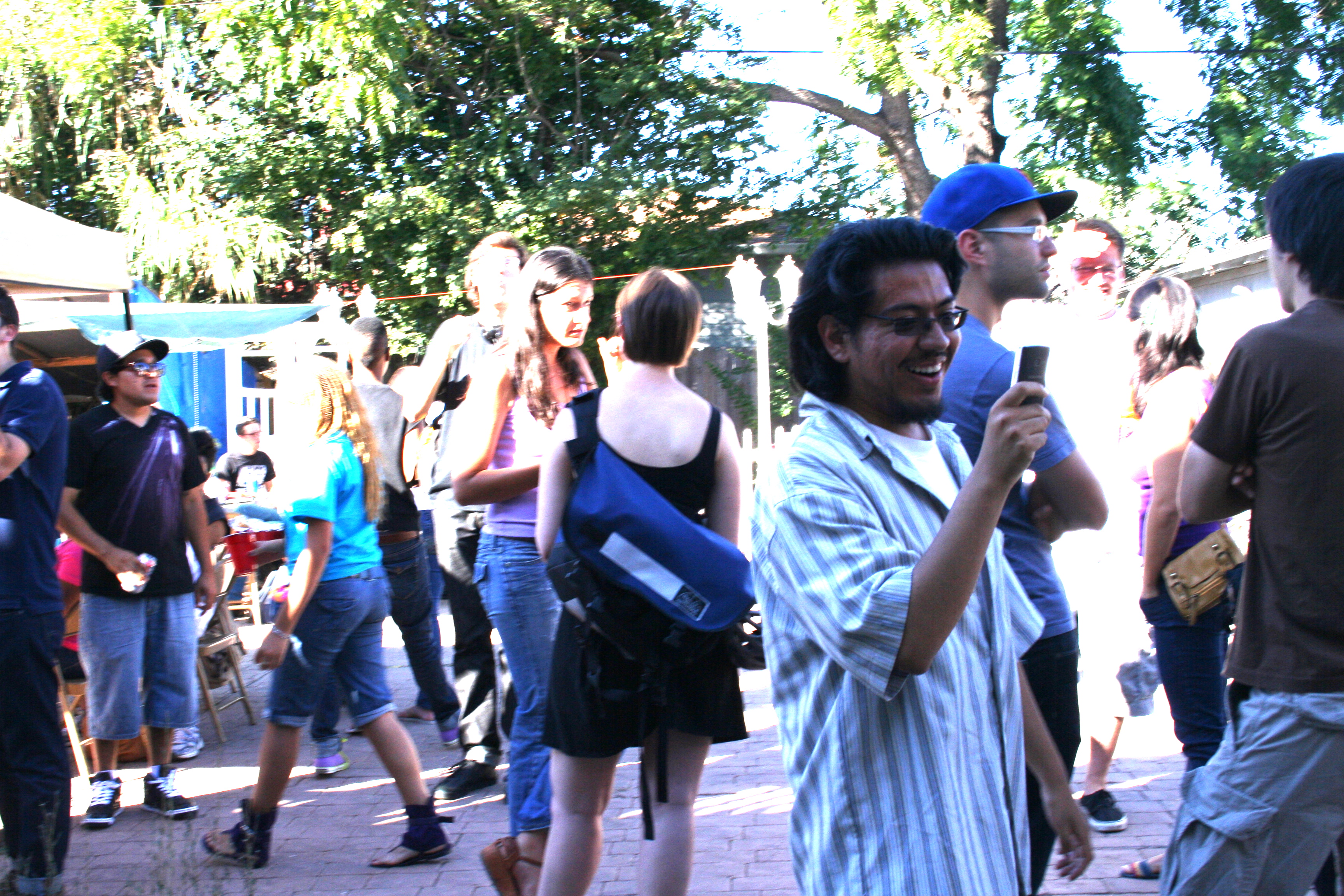
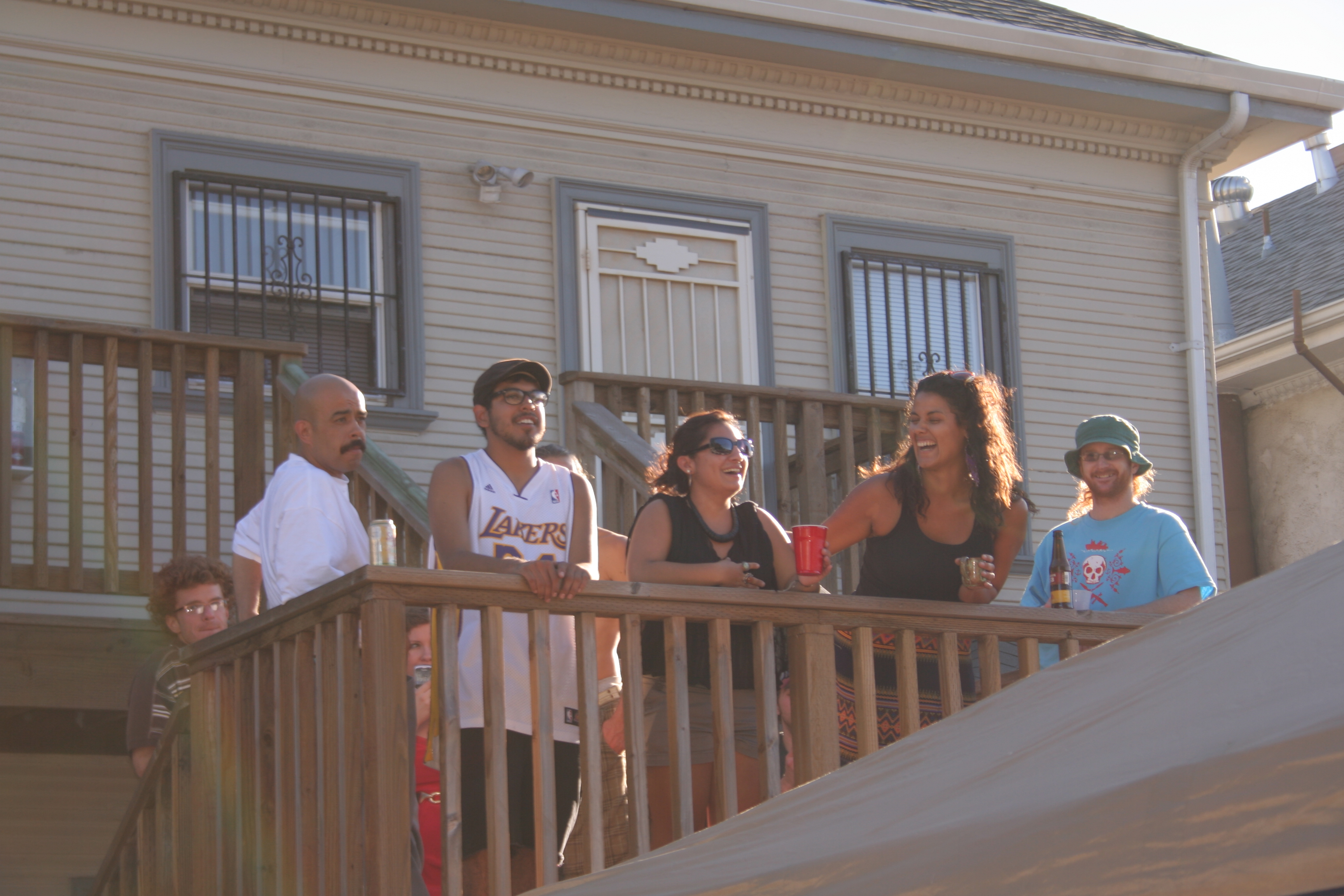
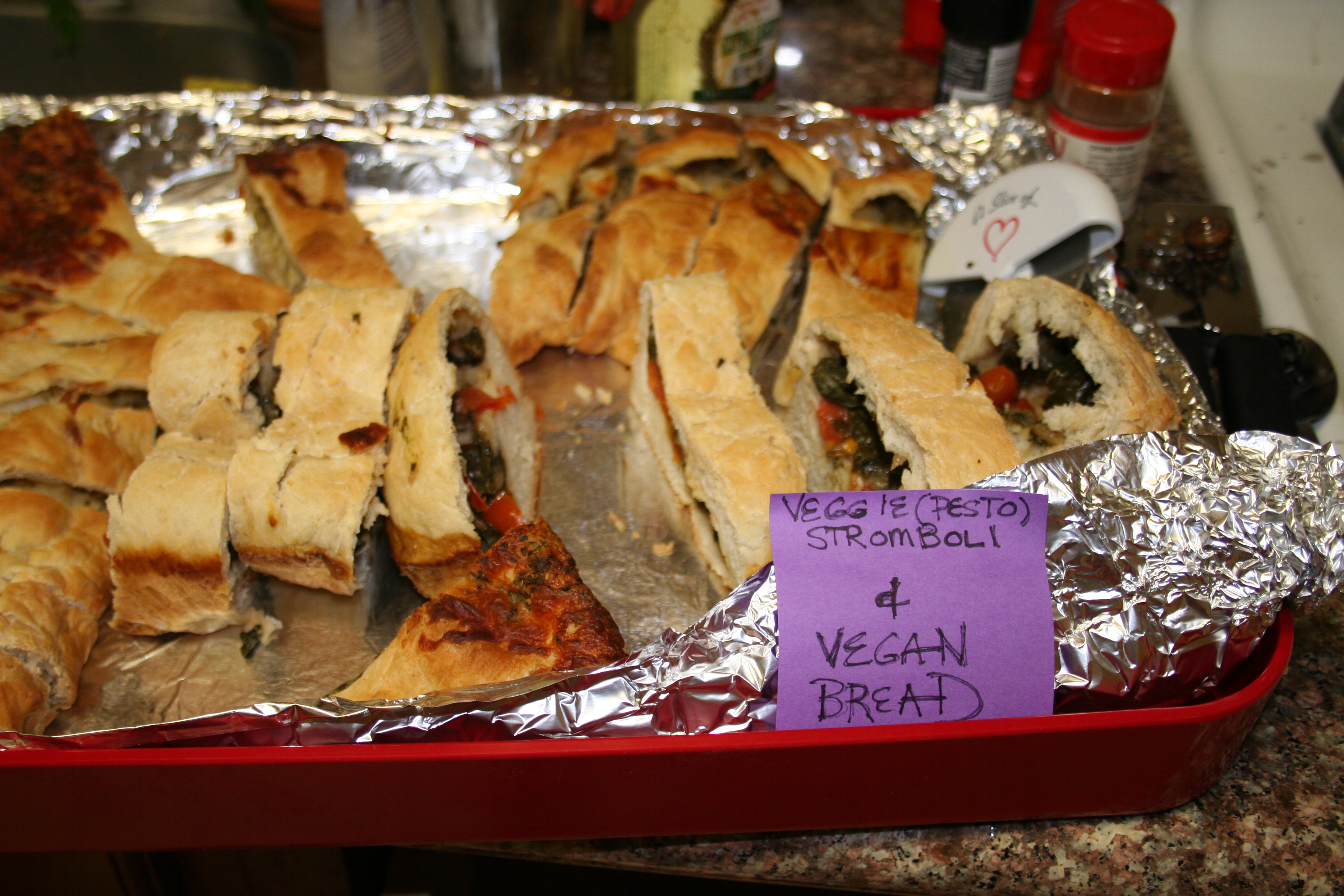
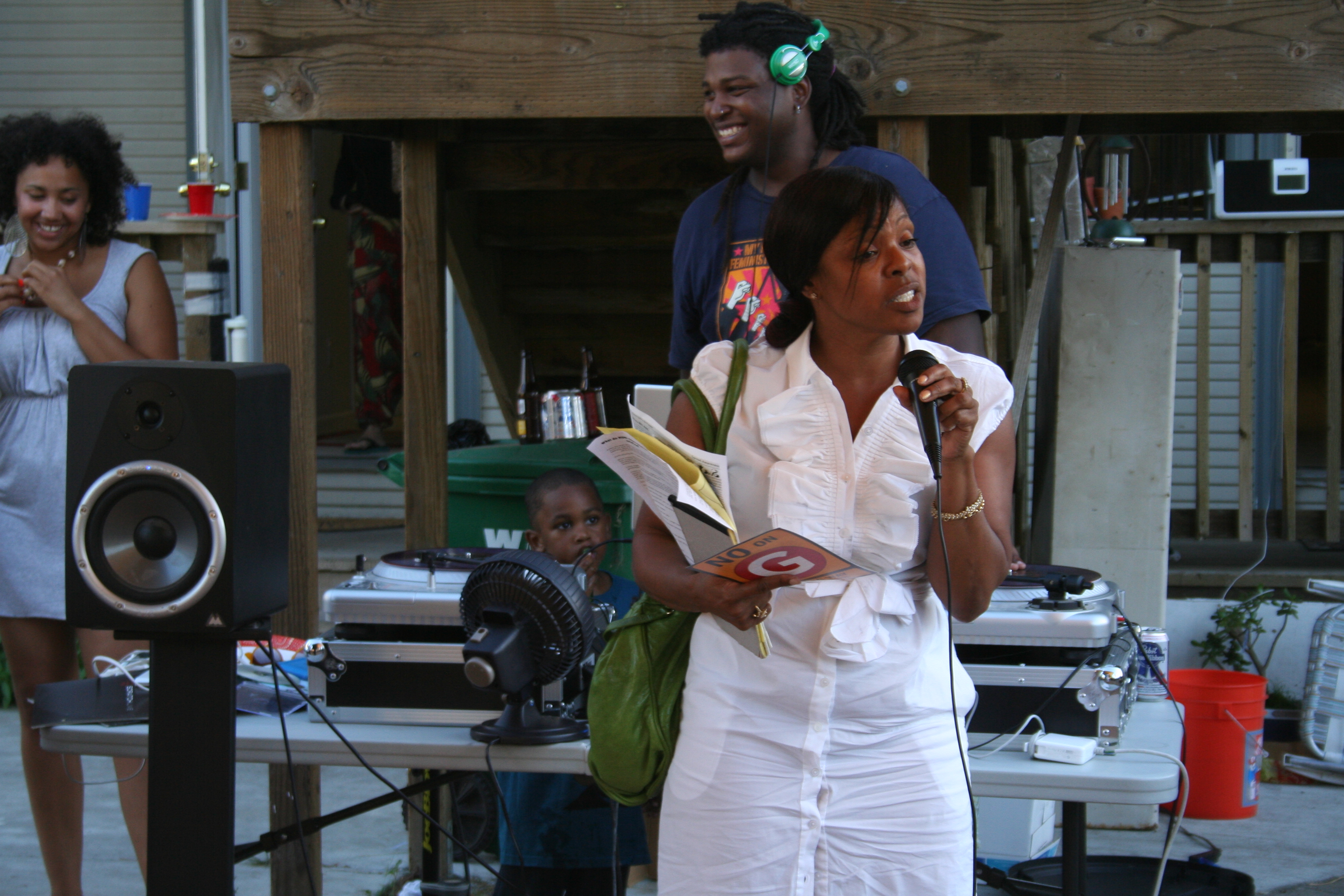
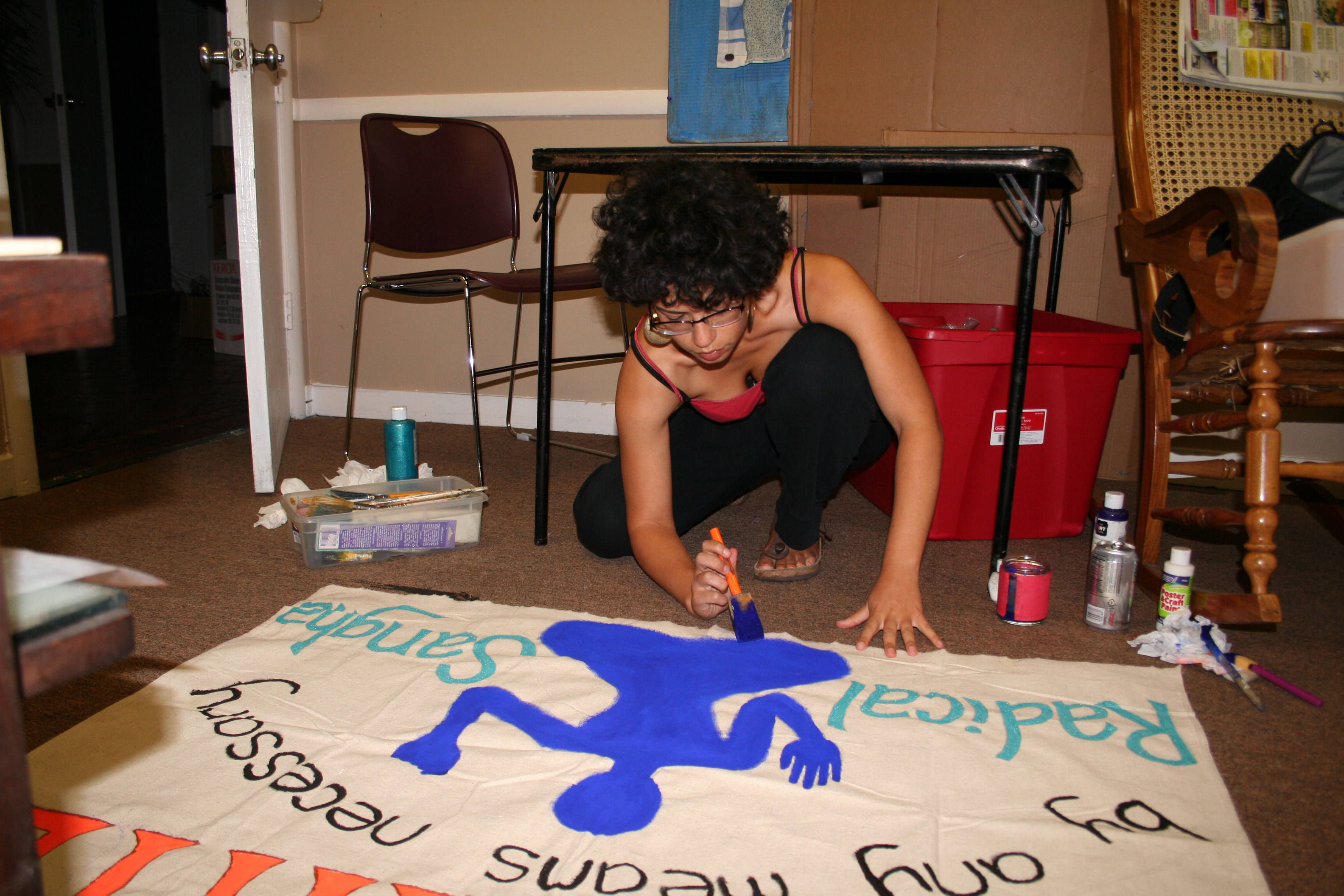
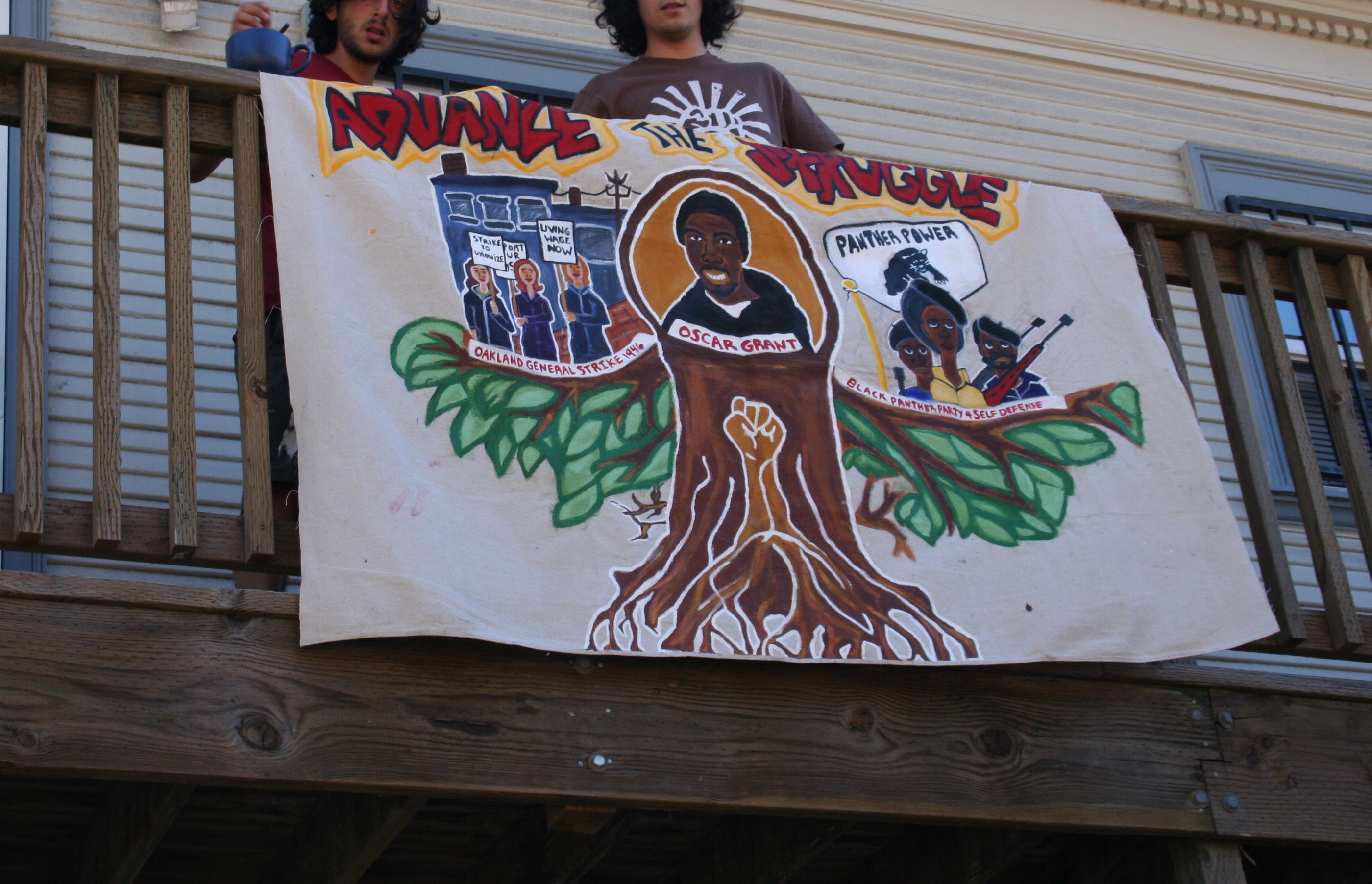
Some friends threw an utterly beautiful “Radical BBQ” yesterday in Oakland. Young and old, different races, different genders and presentations, fun, kind, relaxed, co-operative, joyful, political. Food (good heavens — Dani made these amazing stuffed stromboli and vegan bread from scratch); music and dancing; a speech from a MUNI driver (SF public transit) on the struggles they’re facing among the rank-and-file; wonderful art (check the Advance the Struggle banner: gorgeous). And they even provided art supplies for people to do their own thing. I took advantage and sketched out a small banner to use for Radical Sangha. Took it home and spent the night painting and finishing it up.

The banner may come in handy tomorrow evening, as the scheduled Radical Sangha will be meeting and then carpooling to San Quentin prison to join the protest of the first death-penalty execution in California in four years. Albert Greenwood Brown is scheduled to be killed by the state on Wednesday. The decision to resume executions (backed by Jerry Brown) was sudden, and has shocked a lot of folks who’ve been doing anti-death-penalty work for years. I only heard about it last Thursday, through folks in Oscar Grant organizing.

I’ll be writing up some thoughts and questions soon on tactics and strategy for radical organizing (sparked in part by an event the Faithful Fools catered yesterday: a talk by lifelong activist and frequent prisoner Father Louis Vitale, a Franciscan priest who works around anti-nuclear intervention and the School of the Americas Watch). Part of me feels ambivalent about attending a protest of the death penalty, with no clear mechanism for affecting this structural, state violence. But I also feel that with the proper perspective, and in tandem with different types of tactics and organizing, it can be a fruitful part of a holistic, loving, politicized life.

What really bugs me is that I won’t be able to make it to another dope event featuring my friend’s mom: An Evening of Solidarity with Women of Haiti. If you’re in the Bay area and not coming to the execution protest, think about hitting this up instead.

And a good Monday to y’all.

More Dangerous Compassion

I’m running around today with errands and work, following a long night of community dialogue/police brutality meetings yesterday. But quickly wanted to share this Huffington Post article: a summary of a weekend dialogue “exploring both the personal and the transpersonal challenges and possibilities of this question: How Can We Bring About a Compassionate Society?”

It’s another example, I think, of the specific problems I talked about in Dangers of Compassion.

Mystified mechanism:

As the hard inner work of contemplative practice transforms an individual, the ethical and altruistic qualities developed in such practices spill out into life with each and every action and interaction.

Root vs. Radical:

The path to a compassionate society arises from the intentions and actions of individuals within that society.

Social Change Relativism:

One small act of kindness and generosity … one act of tenderness … one act of selflessness … each of these moments makes a difference. No act is too small. Strung together, each kind gesture becomes a pearl that makes a beautiful strand of loving kindness with which to encircle self and other, close family, friends, coworkers, community, strangers and world.

Again, I sympathize with the idea that a lot of this compassion stuff is subtle, and can’t be ‘legislated.’ In a way, it really does depend on individual commitment and work. No one can cultivate compassion for us; we need to do it for ourselves.

But as I’ve emphasized, individuals do not exist in material and political vacuums. Pumping up our compassion while neglecting to develop our analysis and political program leaves us lopsided and spinning in circles. Like pushing a cart with one giant wheel and one tiny one.

Also want to note that I think that the Upaya Zen Center, where this “compassionate society” program took place, does beautiful work and includes wonderful people who clearly ‘get it,’ like Maia Duerr of Jizo Chronicles. So it’s not to say that the work of building a compassionate society is useless. (The two times I’ve seen Roshi Joan Halifax speak in person it made me want to run off and meditate 12 hours a day for three years or something — she’s that inspiring.)

Y’all know where I stand. Awakening takes devotion, and I respect that enormously. Bridging awakening with the desire to build a better society is where it’s at. And in order to do that, we have to step up our game on articulating precisely what kind of material society we want, and how we plan to get there.

Anyway, something to chew on for the weekend. Take care, everybody — see you Monday.

Reality Drama

—————————————————

Sometimes I really have fun subverting the “reality drama” genre, you know? Because the drama of reality isn’t always about sex, vices, arguments, competition, smack-talking, appraising, or unraveling. (In other words: getting what we want, and disparaging what we hate.) The drama of reality can also refer to explorations of the utterly mundane. Making ordinariness an occasion for attention. In this case, that might mean cooing like an idiot over a cat, and giving a sloppy, unnecessary video tour of the house you grew up in.

Arguably, the boring stuff does not qualify as “drama.” (After all, what’s the purpose of the word if it just encompasses everything?) But my point is that drama is not an objective category. It depends less on the particular content and more on the mind we bring to it.

We think of drama as being juicy, compelling, and maybe a little dirty. That’s what we expect, and in a way, that’s what we want. At the heart of drama is conflict. Non-drama is non-conflictual.

But fortunately for us everyday drama queens, there is a fundamental, inescapable basis for conflict underlying every single experience of our lives.

Continue reading

Ryan Starts 10 Days of Woah

[6:15pm Edit: Now with photos, continued below the jump]

It’s 5am in Sacramento, and I’m about to drive Ryan down to North Fork, California (about a 3 hour trip) to begin his first formal meditation instruction: a 10-day Goenkaji Vipassana course. Yup, that’s the same one I dove headlong into, totally unprepared, a year and a half ago in Barcelona. The wake-up-at-4-am, sit-10-hours-a-day, work-through-some-of-the-toughest-physical-and-psychological-pain-of-my-life-and-come-out-smiling retreat.

Shortly after that first course of mine, I got some sobering love-life advice from a wise (okay—somewhat creepy, and definitely trying to get in my pants, but nevertheless wise) 40something German meditator dude. Dude said: In a two-person relationship, if one person is progressing spiritually and the other is not, it will cause a painful imbalance that is exceptionally difficult to handle. Naturally, individuals have different strengths and interests in life, but when it comes down to it, a big gap in insight progression will probably spell incompatibility.

This makes sense to me. And also scares me. (And not because I presume that I’d be the one advancing.)

Fortunately, though, in the first partnership I enter after this combination-come-on-and-counsel, the partner not only has an intuitive grasp of a lot of dhammic principles (as I see it), but more importantly has a strong and genuine interest in deeply exploring reality, reducing needless suffering, and being guided by compassion.

I know. Super hot, right?

Wish him luck!

Continue reading