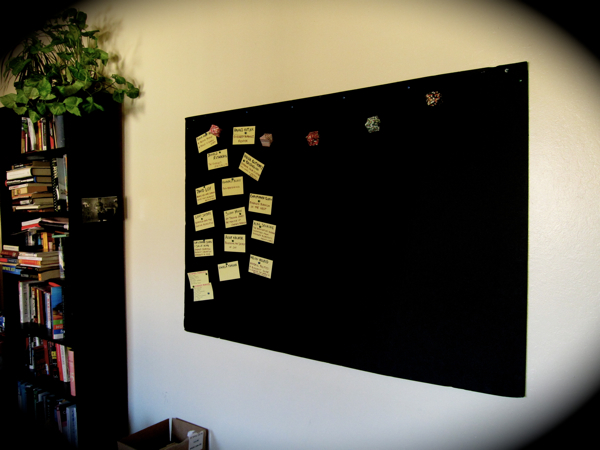
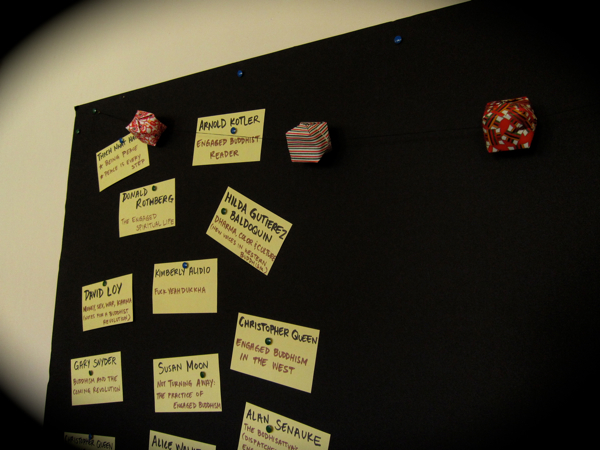
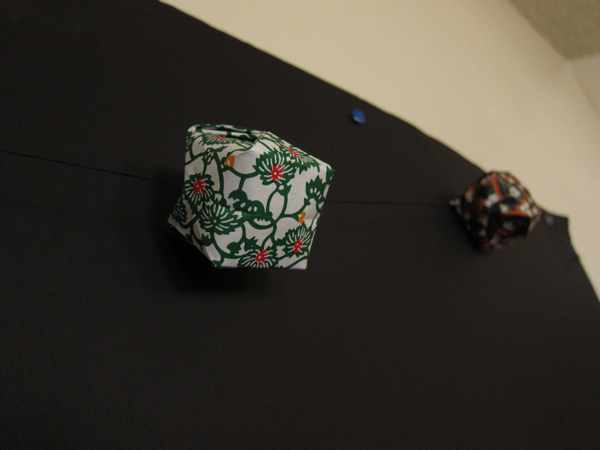
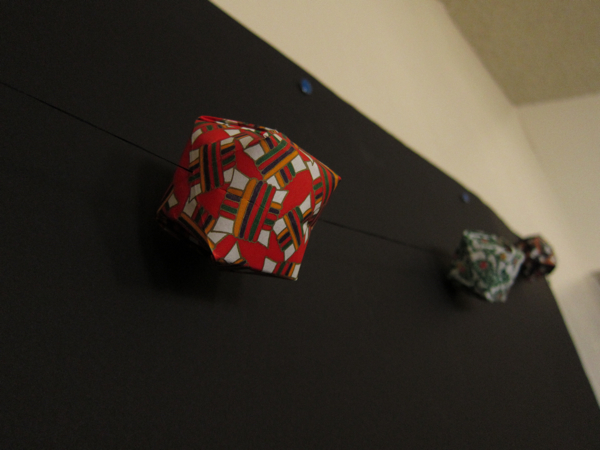
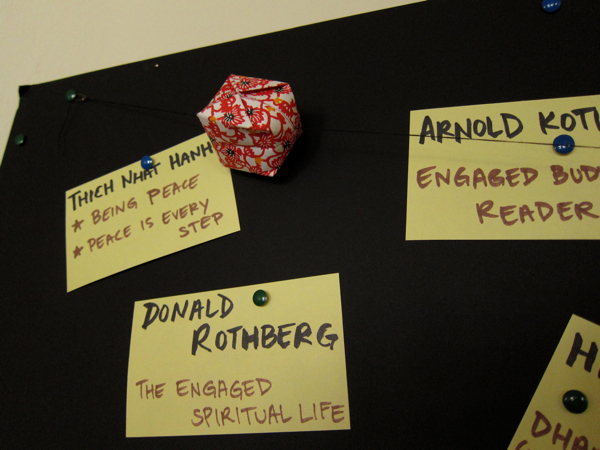
If you’re dorky like me, you might enjoy mapping ideas and authors onto foamcore, and adding origami balloons just for kicks.
__
Housemate Aneeta and I just began mapping a few days ago. Spatial funtimes with Socially Engaged Buddhism for me; radical history timeline for her (starting with themes of Palestine and capitalism). Maybe soon she’ll give me permission to post some photos of her map.
At this stage, these are seedling projects. I hope to be conversing with my map for the next year or so. We’ll check back in after a little while, and you can see how it changes and grows!
Also, I’m always on the lookout for great books, articles, videos, art, etc. about Socially Engaged Buddhism (loosely defined), so if you got ’em, send ’em my way plz!
Thich Nhat Hanh is quite literally a tree hugger. He embraces trunks, he caresses bark, he bows to roots and touches the soil. Thich Nhat Hanh is a person who loves trees.
One time, one of his most beloved arboreal friends, a linden tree at Plum Village, got caught in a storm and was nearly destroyed. Thich Nhat Hanh writes,
When I saw the linden tree after the storm, I wanted to cry. I felt the need to touch it, but I did not get much pleasure from that touching. I saw that the tree was suffering, and I resolved to find ways to help it.
When we resolve to help, we cultivate aspirations for the well being of others.
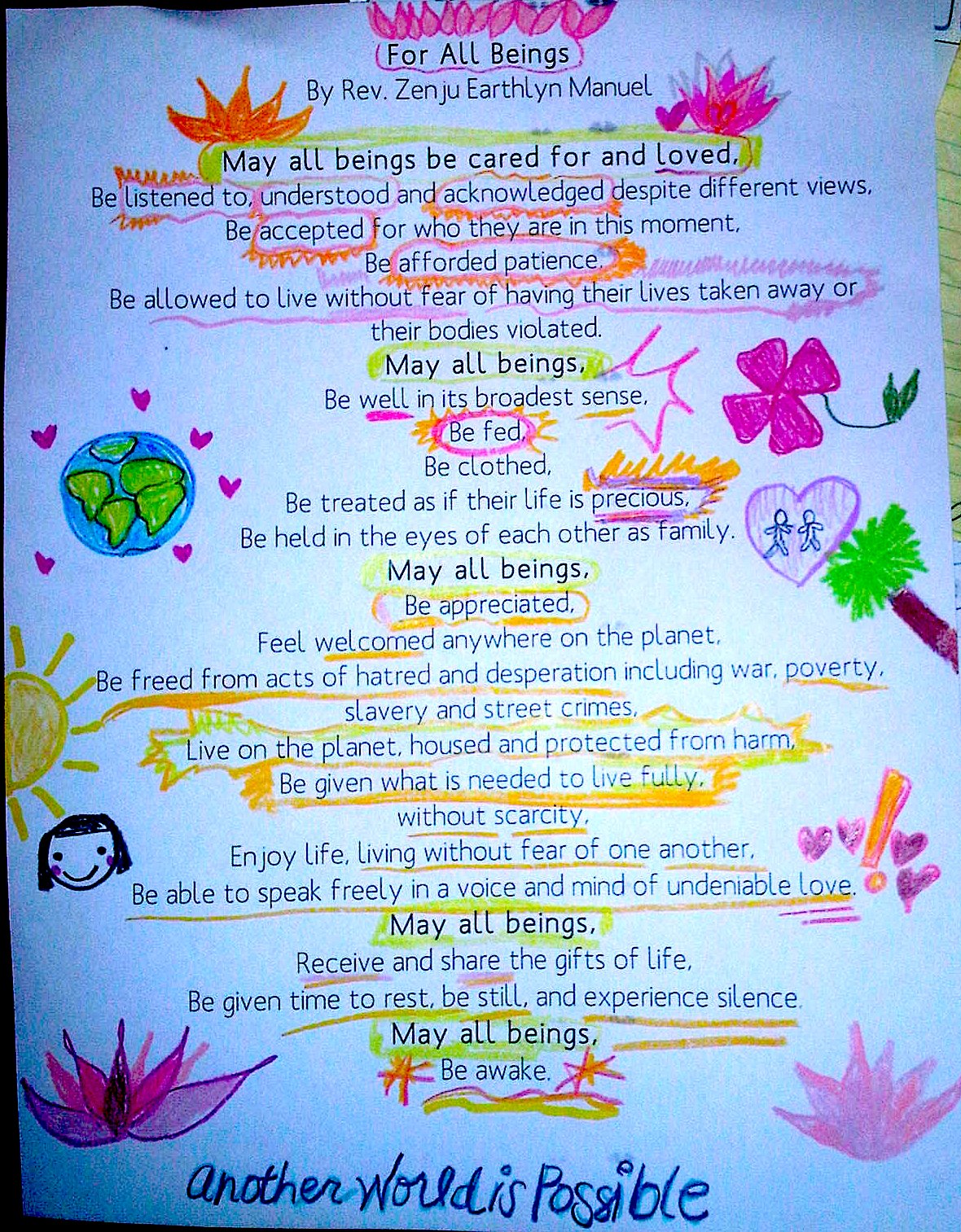
Buddhist culture seems full of these aspirations, no? Here’s a beautiful version — a poem by Rev. Zenju Earthlyn Manuel, based on the Metta Sutta — that my friend Anastasia posted on Facebook today.
__
Aspirations for a better world, for more well being. Yes.
But that’s not the whole story. Returning to the tale of the ailing linden in Plum Village, we find:
Fortunately, our friend Scott Mayer is a doctor for trees, and he took such good care of the linden tree that now it is even stronger and more beautiful than before.
A doctor for trees! We need aspirations, yes, and we also need effort and know-how!
To be a teacher and not join in struggle is a pedagogical contradiction.
Professing to care — even caring — is only part of our mission. An important part, yes, but I think that engaged Buddhism (loosely defined) might really benefit from some deep conversations about whether and how we are joining in struggle strategically and accountably. We actually want to heal this tree! (Slash society.) Is that going to happen through kinder capitalism? Is it going to happen through lifestyle activism, recycling our way to salvation? Is it going to happen by taking over the factories, the farms, the hospitals, demanding that we run them ourselves for people not profit, and then defending them from owners/capitalists who try to repossess them? Do we want a welfare state or no state at all?
We may share hopes for universal well-being, but how can we work together to make that happen if our efforts are at odds with each other?
Thich Nhat Hanh points to this effort/aspiration combo when he says,
We may need a doctor or a nurse to help, but we also need compassion and joy for the wound to heal quickly.
For emphasis in the engaged Buddhist context, I’d flip that around and say, “We may need compassion and joy, but we also need doctors and nurses.”
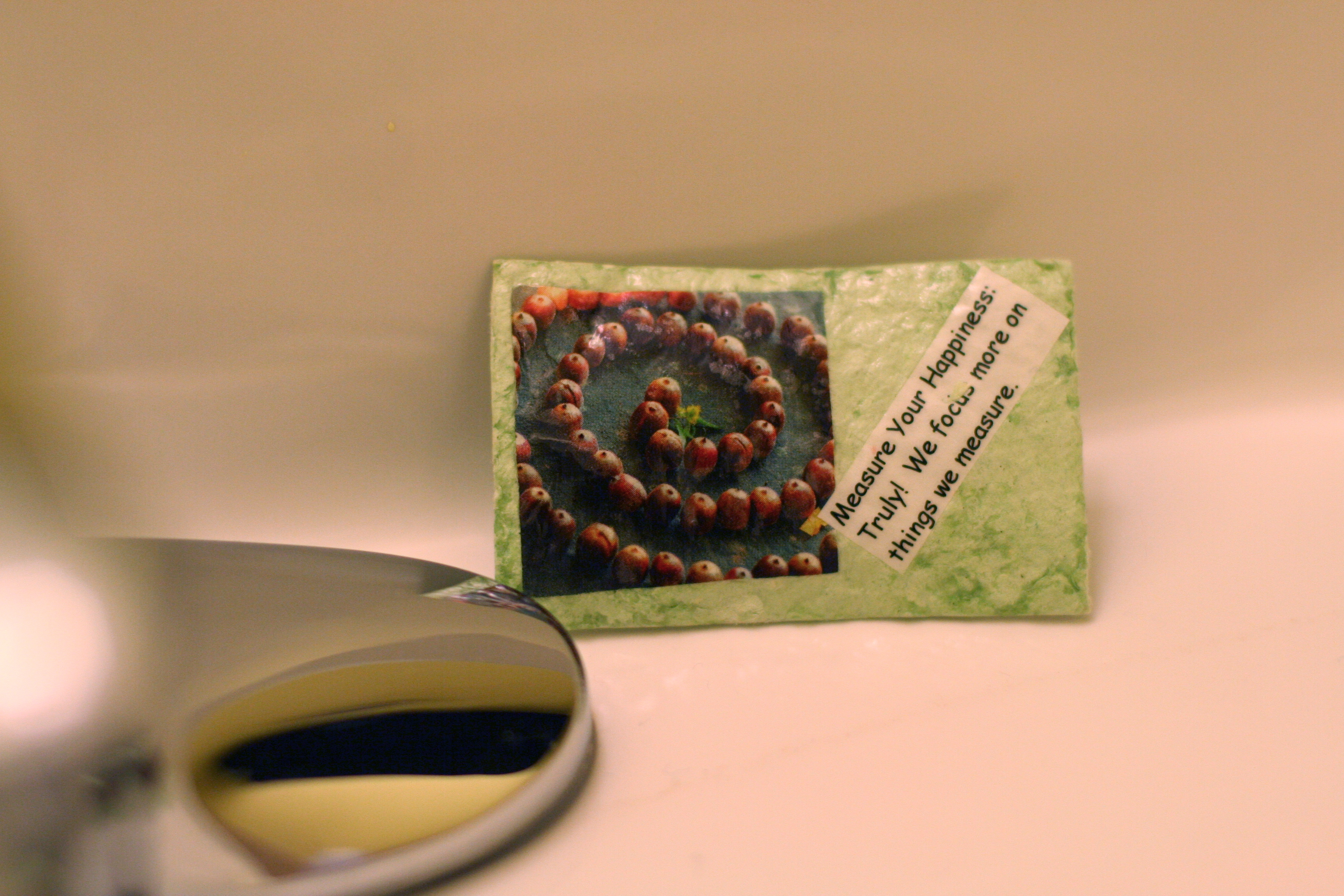
About halfway through residency, the above object appeared on the sink of the righthand hallway bathroom.
At first I dismissed it on grounds of New-Age typography. The fortune-cookie-style strip; the Comic-Sans-ish font; the capitalizing of every word in a sentence. Semi-watercolor background. Like every label of every decontextualized crystal, healing oil, or incense stick in Berkeley. Not to mention the spiral of prayer beads, disembodied and ornamental, like a hippy-fied Tiffany’s ad.
But a couple days later, I realized that I kind of agreed with the message. I’ve often thought it would be wise to chart one’s well-being, day by day, in order to study and understand emergent patterns over weeks and months. Visually relate to those ups and downs that seem at the time like all-too-fleeting highs and everlasting throes. Get to know the middle ground, too. Vicissitudes. Know what I mean?
Maybe it’s time for a new chart project. Thanks to whoever left this on the sink!
By the way, anyone got insight into the prayer beads, and how they might relate to “measuring happiness?” My impression was that they’re used for counting prayers, which seems different.
How do you greet someone who’s just spent nine days not making a sound?
Our housemate Aneeta (who, incidentally, also authors the simple, generous, deeply healing, and truth-tellingly politicized dharma blog In The Process of Being) returns today from her first residential meditation retreat. In my experience, though each time is different, emerging from the womb-crucible of the meditation center has usually felt giddy and tender, and I’m amazed at how much effort is required just to speak. I feel it in my vocal chords. Each word, laugh, or murmur of assent demands attention in order to be born.
So as much as I’m looking forward to hearing all about her experience, I don’t want to be all like, Come verbalize with me!!! the second she walks in.
Frosting and sprinkles, then, to ease the initial homecoming.
Today I’m honored and delighted to be featured on The Jizo Chronicles: award-winning Buddhist blog and home of the hella inspiring Maia Duerr. Maia is a wonderful writer and creator who knows how to craft big questions out of few words. After she e-mailed me the interview prompts, it took me weeks to reflect on them — finally prompting a sweet and gentle check-in from her, like, uh, you okay over there? :)
Anyway, I am enormously grateful to be walking the path with her, and to be included in this interview series with the likes of Arun from Angry Asian Buddhist, Ven. Bhikkhu Bodhi, and Roshi Joan Halifax. Check out the interview and feel free to leave thoughts, pushback, disagreements, elaborations, questions, etc.
I’ve been dealing with some depression in the last couple months, friends. Without going into too much detail, I’ll just summarize by saying that I lost sight of inspiration; all thoughts (most of which were negative) seemed completely real, solid, and inescapable; and I couldn’t remember how I make meaning in the world.
Highly unpleasant. Perfectionism played a large role here, too; I’ll come back to that in a minute.
Fortunately, over the years a number of great people have shared with me their tools and strategies for living with episodic or more chronic depression. Nothing like knowledge and loving, supportive relationships to lessen fears and ease internalized stigma.
Also fortunately, I have access to many resources for digging myself out — including free time.
What that wound up meaning, for me, was: forcing myself to do a lot of things that I reeeeeeeally did not feel like doing. Robot-style, I checked off my list.
Don’t deny it (in other words, be real with myself and Ryan about how I’m doing, even if I feel ashamed about it)
Apply for jobs (seek more structure in my day and more stability in moneyplans)
Accept invitations to hang out (even when all I want to do is stay home alone, sit on the couch, and valorize all my thoughts)
Seek parental insight on racism (ask my dad what he has done to cope with lifelong feelings of outsiderness and non-belonging)
Get under the sky (hike, see some trees, feel some air, find an arboreal newt at Butano State Park)
Try therapy (preferably with someone who knows about queer shit, POC shit, political shit, and how these relate to mental health)
Practice gratitude (this one didn’t actually work for me — the negative thoughts were just too loud and strong — but I did try)
Reach out (talk with friends who know me well, even if they’re far away and “talking” is via phone or email)
Exercise (since the bike-to-car transition, the old endorphin crank is getting real rusty)
On this last point, my friend Cat kindly clued me in to a free program through Yoga Journal: the 21 Day Yoga Challenge. Offering daily vegetarian recipes, guided meditations, and yoga instructional videos, it supports participants’ three-week quest for calm minds, open hips, and better bowel movements. Ideal for avoiding the crowds at Yoga To The People. (Despite living in what is probably the white yogi capitol of the world, with studios outnumbered only by Walgreens, I still haven’t found a cozy home base like Mandiram in Barcelona.) Online videos allow for sweatpants, bad attitude, and slovenly following of computer-screened orders.
The sessions were at first relatively numb and joyless. Stretch this, bend that, breathe, same-old same-old.
By now, Day 11, I am gobbling all kinds of YouTube yoga videos and practicing extra arm balances on my own. Falling all over the place, trying to build strength in my shoulders and core. One of my goals is to master the pincha mayurasana by the Day 21. Almost there (hopefully I’ll have a video or photo to share soon), and practicing feels delicious.
B K S Iyengar
In other words, playtime* is back — and that is a good thing. A very good thing.
What do I mean by playtime? Giving oneself permission to be curious, try things, make mistakes, and do weird shit that may or may not ‘add up’ to anything, but in the meantime is fun and/or fascinating. Scientifically, play appears to be critical to healthy childhood development, and among adults it’s vital to creativity. Even the big businesses are catching on, and you know they don’t waste labor costs on pure frivolity.
[Sidenote: I’m not totally sure about this, but I think it might be useful to distinguish between mindful and unmindful play. For instance, Ryan and I have been talking a lot about video games lately, and how they can become very addictive and life-force-sucking, rather than rejuvenating and relaxing (as one might imagine a “game” would be). Is it possible to play video games mindfully? Probably, but for a variety of reasons it seems awfully difficult to me, though I admit I am no expert. In any case, rather than labeling certain activities (i.e. yoga, music, sports, freewriting) as “mindful play” and excluding others, the main thing might be the quality of play, or the attitude one brings to the activity. No?]
Now, I’m not too keen on the “allegorical” school of yoga writing: always translating physical asanas into metaphors for everyday life, in a kind of pat, Chicken-Soup-For-The-Soul way — you feel me? I’m more on the medical/meditative tip (i.e. this posture supports thyroid function; and when keeping the attention on the breath and sensations, yoga becomes a very practical spiritual path). Therefore, the following observation about my own 11 days of yoga makes me feel a little squirmy. But I’ll say it anyway.
Remember how I mentioned that perfectionism contributed to my depression? As we know, perfectionism breeds rigidity. Failure and mediocrity seem to permeate everything; nothing is good enough. Except maybe the rare, unattainable genius of other people. But even then, they are probably geniuses at things that don’t matter very much. Awesome at yoga? Who cares; plus, where’s the critique of patriarchy. Brilliant writer? Idealist/individualistic and/or suicidal. Stellar organizer? Either too complicit with the state, or too unsystemic in thinking. Great politics? Where’s the disciplined application. This is what my mind said, over and over. Rigid.
And what’s the opposite of rigidity?
You guessed it: flexibility. Darn allegories.
So where my depression was closed, stagnant, and neurotic, yoga has brought openness, movement, and grounding in the body. I feel so. much. better.
Of course, it didn’t have to be yoga! Running, if I could stand it, might have offered similar benefits along the exercise lines. And it wasn’t only the yoga! There were hella other factors contributing, too. (Notably, Ryan’s constant, unwavering, loving support. Straight-up amazing.)
Nevertheless, there it is. Yoga helped me be more flexible, let go of rigid perfectionism, and remember how to play.
Hold up — I think I feel that gratitude practice starting to kick in.
* * * * * * * * * * *
* In light of fucked-up racist stereotypes, I just want to clarify that when I associate playtime and yoga, I don’t mean that yoga is somehow unserious, or that inversions like pincha mayurasana are childish and/or monkey-like acrobatics. That is some colonial-ass thinking, which is unfortunately not uncommon, hence the need to mention it. Rather, when I speak of play in my practice, I mean focus, immersion, an attitude of curiosity, ability to adjust, tweak and revise, recover buoyantly from errors, or even let go of the idea of error altogether. The same applies to the freewriting practice I recently resurrected for myself, called “morning pages”: an exercise from Julia Cameron’s The Artist’s Way.
I don’t want to fight my landlord
over who will pay for bed bug extermination.
I don’t want to feel relieved
when the infestation’s epicenter
turns out to be in the unit upstairs.
Those men are broke enough as it is,
trying to stay clean and sober and keep a job.
Can’t afford a thousand dollars
for liquid CO2.
I want a building, a block, a cityland
where everyone is secure
in a shelter they love
where no one feels pressed to salvage
a dubious mattress
unless they can take it to the free clinic
for thorough inspection and cleaning.
No big deal.
I want to be free and open
to share the pains of infestation:
we’re in this together.
I don’t want to fight my landlord.
I don’t want a landlord at all.
I want a world without them;
bed bugs we can handle.
Yesterday I watched Ella once again engage her Sisyphusean toy: a tempting pink ball encased inside a large plastic donut, with side-holes just large enough to accommodate a grasping paw.
__
Suddenly I wondered: is the ball’s ungettability upsetting to Ella, or does it just prolong the pleasure of the chase? In other words, does this game more closely resemble tanha, the craving that leads to suffering, or simply the jouissance of good old healthy exercise?
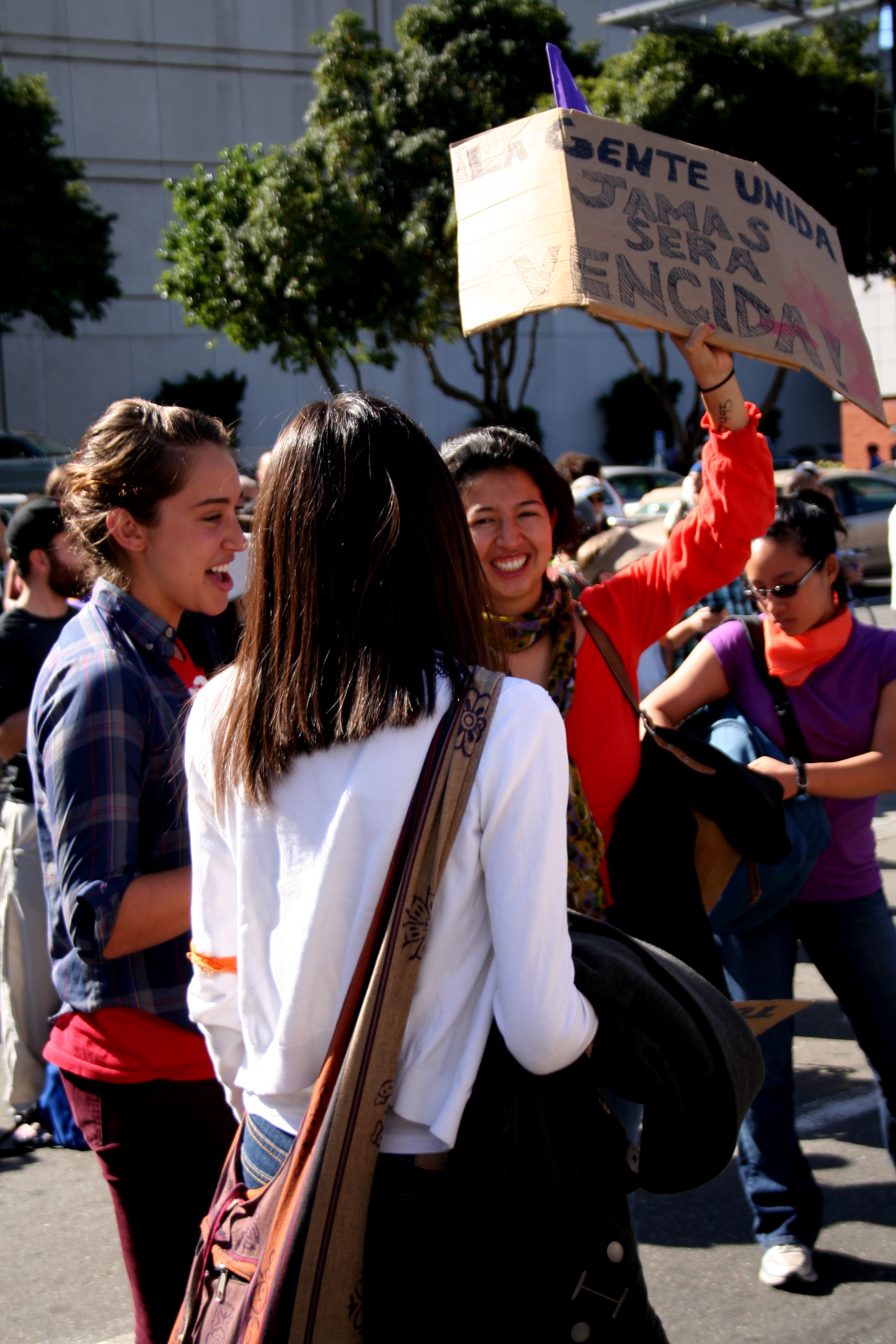
A few fotos from Wednesday: most from my own vantage point (between holding banners, wielding a bullhorn, and passing out flyers . . .) and a few from my friend Cat during the march on Bank of America.
Yesterday, before my eyes, Oakland turned a corner. A successful general strike (or, as Clarence Thomas of the ILWU Longshoremen’s union put it, “the closest thing this generation has seen,”) shut down capital and commerce around the Town, including the fifth largest port in the nation. (And, as I understand it, the port workers went home with pay!)









 Kloncke