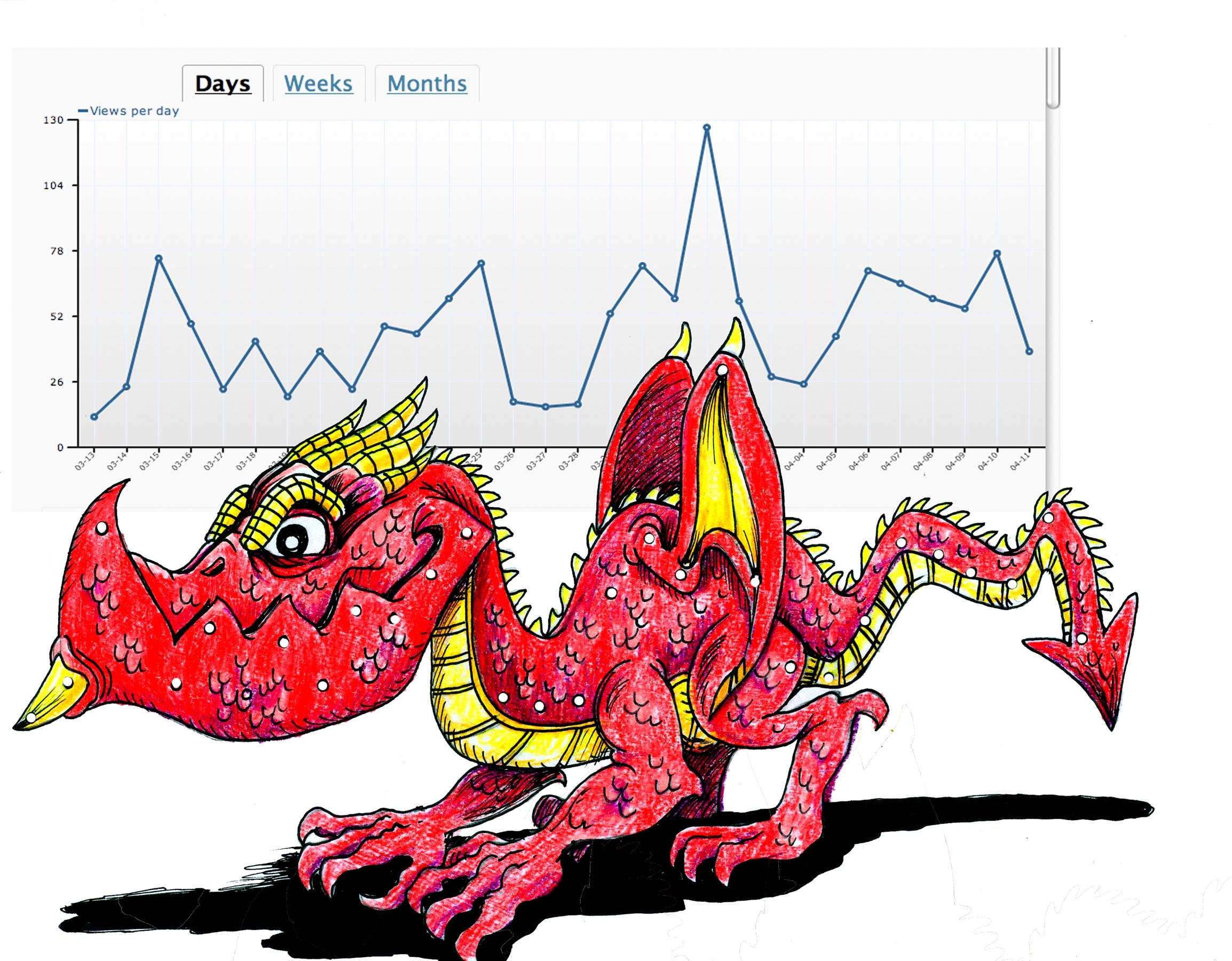
A stat counter is a common tool that lets bloggers see the number of people who visit their site. I learned about it back in 2005, when I first became acquainted with blogs, and have interacted with stat counters and traffic graphs in my bloggerly life ever since. Every day (ok let’s be real: practically every five minutes), I check my traffic chart on Kloncke to see how many people are reading. I glance at the line graph and its 15-day history, with the current day’s data point climbing ever upward until the stroke of midnight, when its ascending carriage takes a pumpkin-like tumble back down to zero. New day, new stats.
Within the past few months, I noticed myself monitoring my stat charts with increasing closeness and intensity. It became sort of embarrassingly compulsive. I checked my traffic at Gmail-like intervals (read: Too Frequently). And of course, my heart would soar and sink according to the graph’s altitude.
High: high.
Low: low.
Many page views: “My writing is helping people.”
Few views: “This blogging thing is just a narcissistic waste of time.”
Et cetera.
And then, the real kicker: auto-adjusting scale.
Let’s say I’ve been plugging along on my little blog for a month, and one day I get 25 views, the next day 30, the next day 7, and so on. The top of the y-axis represents the largest number of views in a single day: 150. The smallest, one notch above zero, is 3. Then, one day, the blog is viewed 170 times. What happens to the chart?
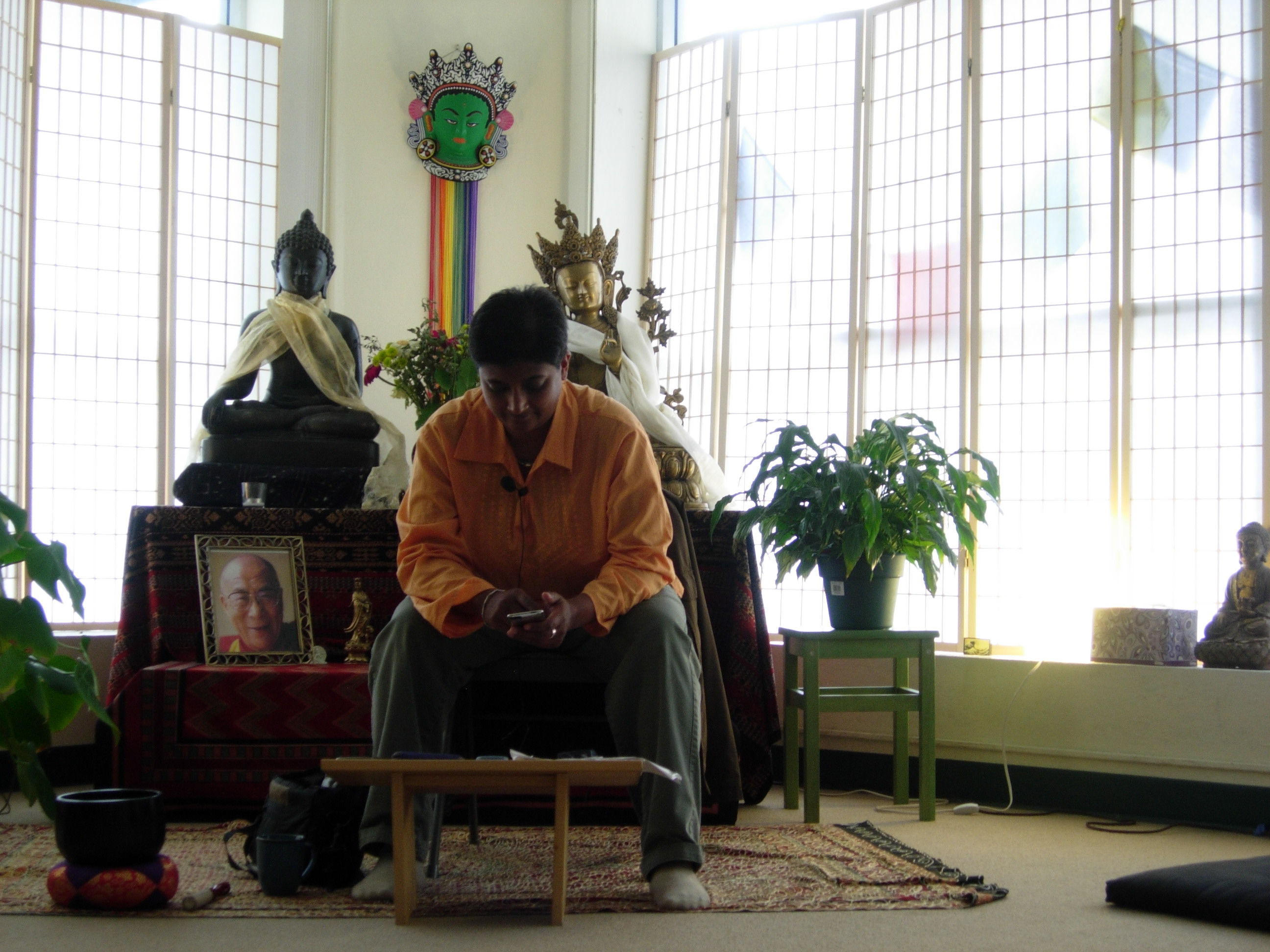
Anushka's techno-meditation: trying to stay mindful while using our favorite devices.
It’s been a looooong work day, friends, and there’s no time to get into the articles I was hoping to cover today (1, 2), but I want to offer a little teaser for a post that’s been brewing in my head for quite a while, and which began to peck its way out of its shell this Saturday, during a daylong workshop at the East Bay Meditation Center.
The beautifully conducted workshop, led by Anushka Fernandopulle, focused on Dharma & Technology: how we can apply the insights of the historical Buddha to our relationships with gadgets in our modern lives. I could go on about how dope the retreat was, including the fact that it, like all programming at EBMC, is offered on a dana (donation) basis. And how the participants all had fascinating and diverse experiences, concerns, and celebrations with their techno-tools. And how almost all of the participants were female-presenting women, which certainly surprised me. And how it helped me change my relationship with Facebook. All of that is so.
But one of the most exciting results, for me, was the final formation of this idea of mine for a project called Stat Dragons. The project is about dharma, blogging, craving, contentment, art, and yes, dragons. It involves talented illustrator friends of mine. And its first installment will premiere this week on Kloncke.
Many thanks to Anushka and all the fabulous workshop participants and volunteers. It was a wonderful environment in which to incubate my dragon egg.
Kind of like #followfriday, only more of a plain old celebration of the folks touching one Black girl’s heart this week.
Above, Miss Maxine, who slowly but surely welcomed me into her life after a rough start on Sunday. She’s almost as much of a delight as her owners, Chris and Donna.
Adrienne Maree Brown is just tremendous. Everybody should read her. You should read her. Like, starting now.
Aaron Tanaka is also tremendous. His blog is pretty much brand-new, but already one of my all-time favorites. Eclectic, on-point, funny, educational. Solid.
If you ever get the chance, spend some quality time with Carmen Barsody. Trust me on this one.
Last but not least, word has it that Advance the Struggle is about to publish a piece analyzing March 4th. Get excited!
Slowly making my way through the Faithful Fools’ canon. In a conversation about economics, Carmen recommended Lewis Hyde’s The Gift: Imagination and the Erotic Life of Property. Not even 50 pages in, and it’s already transforming the way I see my everyday life.
Basically, Hyde is interested in the material and spiritual benefits of gifts and gift economies, as opposed to capitalism and economies of exchanged commodities.
Given material abundance, scarcity must be a function of boundaries. If there is plenty of air in the world but something blocks its passage to the lungs, the lungs do well to complain of scarcity. The assumptions of market exchange may not necessarily lead to the emergence of boundaries, but they do in practice. When trade is ‘clean’ and leaves people unconnected, when the merchant is free to sell when and where he will, when the market moves mostly for profit and the dominant myth is not ‘to possess is to give’ but ‘the fittest survive,’ then wealth will lose its motion and gather in isolated pools. Under the assumptions of exchange trade, property is plagued by entropy and wealth can become scarce even as it increases. 23
Having lived for more than a year now with no income, depending somewhat on my savings but largely on the generosity of others (including the major generosity of the foundation that paid for my undergrad degree, allowing me to graduate from Harvard debt-free), I’m beginning to see firsthand the ways in which scarcity, that fundamental rule of the economics preached in Cambridge, truly is myth and perspective, not fact. I’m becoming what Khalil Gibran calls, in The Prophet, a “believer in life and the bounty of life”:
There are those who give little of the much which they have–and they give it for recognition and their hidden desire makes their gifts unwholesome.
And there are those who have little and give it all.
These are the believers in life and the bounty of life, and their coffer is never empty.
There are those who give with joy, and that joy is their reward.
And there are those who give with pain, and that pain is their baptism.
And there are those who give and know not pain in giving, nor do they seek joy, nor give with mindfulness of virtue;
They give as in yonder valley the myrtle breathes its fragrance into space.
Through the hands of such as these God speaks, and from behind their eyes He smiles upon the earth.
At this very moment, for instance, I’m sitting on a big, lovely, suede couch in a big, lovely, 4th-floor condo in the big, lovely Embarcadero neighborhood, enjoying cranberry juice and Pellegrino, as well as the company of an adorable terrier-greyhound named Maxine. I’ve been invited to help myself to anything and everything in the condo, and to have friends and loved ones over during the week to partake, as well. And more importantly, I’ve been invited into the lives of a wonderful, loving, giving couple: Chris and Donna. How did I get all this?
I got it by giving. I gave of my love, support, and time to Lori, by taking care of Buster — overnight for a few days, and now once a week in the afternoons. There’s no business relationship, she hasn’t hired me or anything, but she’s a true friend and I’m happy to offer what I can. She, in turn, takes me out for breakfast and tea, gives writerly feedback and advice on my blogging efforts, and stocks the freezer with frozen raspberries (my favorite) when I’m sitting Buster through the night. And then, when she heard that her co-worker Chris was looking for someone to care for Maxine while she and Donna vacationed in Hawaii, Lori recommended me. Chris and Donna had Lori and me over for dinner, and the rest is history.
This is just one example, but there are so many blessings in my life right now that trace directly back through gifts. Gifts of donations sustain the Faithful Fools. Dana (generosity — through financial support and volunteer labor) sustains the East Bay Meditation Center. An exchange of kind letters (one of my favorite types of gift) planted seeds for my current relationship. My family (including my eighty-something-year-old Oma) footed the first semester’s bill for my Masters program at Goddard. Unpaid organizers continue investing their blood, sweat, and tears into building power for workers. Everywhere I look, it seems, people are giving.
And what makes gifts “erotic” as property, as opposed to rational exchange commodities, is that they connect life, rather than separating it. Gifts bind us to one another, with a web of invisible umbilical cords. Sure, they can be abused, offered with the intention of obligating someone else, creating a debt. But then they’re not really gifts at all — just exchanges in disguise.
Even this blog, I realize, is a gift in its own way. Offered freely to whomever might find it useful. And for me, that’s what makes it more than a diary, a scrapbook, or journal (none of which I was ever any good at keeping). In the giving there is real contact. And abundance, too. I’ve connected and reconnected with such lovely people through Kloncke, and many of you continue to offer me your own wonderful gifts through comments, emails, letters, conversations, and encouragement. Not to mention the greatest use of the gift: not reciprocation, but taking inspiration to give to someone else. I’m reminded of my friend Ashley, who watched my Stevie Wonder video blog way back in the day and decided to call her grandparents, just to say hello. I’ll always remember that, you know?
So thanks, y’all, as always. For reading, for commenting, for linking, passing on, and participating in what Hyde might call an erotic connection:
Gift exchange and erotic life are connected…The gift is an emanation of Eros, and therefore to speak of gifts that survive their use is to describe a natural fact: libido is not lost when it is given away. Eros never wastes his lovers. When we give ourselves in the spirit of that god, he does not leave off his attentions; it is only when we fall to calculation that he remains hidden and no body will satisfy. Satisfaction derives not merely from being filled but from being filled with a current that will not cease. With the gift, as in love, our satisfaction sets us at ease because we know that somehow its use at once assures its plenty. 22
————————
Happy Wednesday!
love,
katie
————————
————————
Ps: special thanks to Kyle Maurer, one of my first true surprise-blog-reader friends, for your encouragement and warmth, and also for the Hojicha, which has warmed the bellies of many people in Fool’s Court and dwindled down to one last teapot’s worth. :)
Stumbled across this last night while foraging through YouTube. Timely. Just a couple days ago I was talking with some friends over breakfast about how to deal with anger. Raises big, complex questions about the best way to measure effectiveness. In the short run, expressing anger (i.e. fighting, verbally or physically) might seem like the best or even only way to counteract some harm that is occurring. This is especially true, as my domestic partner Noa pointed out, when dealing with institutional violence, which often masquerades as nonviolent, ‘neutral’ policy. Fighting openly against it, bringing forth the anger it engenders, is almost a necessary first step to naming the harm as harm: bringing symmetry through self-defense. (Or, more aptly, community-defense.)
But if we look closely and objectively at the effects of acting out our anger, we might arrive at different conclusions about its effectiveness. Even if it successfully puts a stop to a particular attack, what cost does it exact on our own psyche? Our own well-being? (After all, this is supposed to be self-defense, right? Not just from external factors, but from internal ones, too.)
TNH isn’t saying we should never get angry. Not at all. He argues that our actions actually become more clear-sighted and, yes, effective, when we can take the extra step of transforming our anger into another, positive energy, like compassion. This conversion neutralizes the toxic effects of raw anger, while conserving its power and precision. Or at least, that’s the claim. Some might find it difficult to believe. Isn’t some energy always lost through a conversion process? Don’t we risk getting stuck, mired and deactivated in all that inward focus?
I don’t have answers, really: I can only speak from my own experience. Which tells me that I’m just as likely, if not more so, to get stuck, mired, and deactivated in my own judgments, irritation, upset, fury, and depression. And also tells me that I’m most capable of speaking and acting with force and finesse when I’m coming from a place of caring, not rage.
An example. A couple weeks ago, I had a confrontation with the boyfriend of one of my Faithful Fools housemates. (We’ll call this boyfriend Rick.) Rick is currently homeless, which is one reason he spends a lot of time at Fools’ court with Kat. One particular week, though, we were hosting a dozen college students for their seven-day Alternative Spring Break and needed as much breathing room as possible. I had told Rick this, and that we would need him to steer clear of the Fools unless he was there for a public event. But one afternoon, mid-week, there he was in the living room, playing piano. He’d also been over the night before, staying with Kat, but I’d let that slide, understanding the desire to hang out and figuring he’d move on by morning.
Anyway, point is, by the time he was fiddling at the piano, I perceived that Rick was doing something that I (on behalf of other Fools, too) had asked him not to do. So I went over and inquired as to when he planned to leave.
He didn’t.
A fight ensues. I yell at Rick. Yell! Me! Mind you, this man is pushing 60: could easily be my father. But he isn’t listening, and I am pissed. Which, of course, means that I can’t listen very well, either.
Back and forth we go. Rick feels he had a right to be here — he’s with Kat. Kat, I remind him, was in on the decision to reserve the house for necessary personnel that week, and should have communicated that decision to him. Even if she hadn’t, I had told him directly. Rick feels that he should have been included in the decisionmaking process, since the outcome affected him. YOU DO NOT LIVE HERE, RICK, etc.
I can tell he’s getting heated too because his eyes are half-closed and sidecast, brows permanently arched. Can you look at me, please, Rick? I finally plead, hands on my hips. He’s still sitting on the piano bench. No, he says, not right now, I can feel myself getting angry and I’m trying to control myself because I like you, Katie, I really do…
And at that moment, I remember the fear inherent in anger. Sure, Rick is being obstinate, using his superior age as a tool for condescension, and generally, as I comment to him, making me feel disrespected in my own home. But there’s more beneath the stubbornness. Here he is, an older Black man clinging to a place of his own, a space to play his music and store his belongings and come home to. And now I, a young Black woman, come along and take it away. He gets the same messages from all sides, every day: “You don’t have the right to be here; get out.” Who wouldn’t want a little control, a little say, over the main place they spend their time?
So I take a chair, putting myself on his physical level, and listen. Not only tell him that I like him, too, but show it. I don’t back down, but I don’t shut down, either. I even joke and play a little. Eventually we come to a compromise; a couple hours later, he leaves. With a smile. And a compliment — he saw what I was made of today, he says, and he likes it.
And of course, we’re on better terms now than ever before. Every time I see him he gives me a kind of knowing grin, and makes some remark or another about my toughness. Buzzed from sangria at the Faithful Fools’ fundraising dinner that capped off the week, he advised Ryan: Marry that woman. She’s a keeper.
And I know I can be straight up with him without fearing the consequences. Confidence and compassion don’t have to undermine each other; they can grow together.
I think this is what TNH means when he talks about caring for our anger. The art of converting an enemy into a friend.
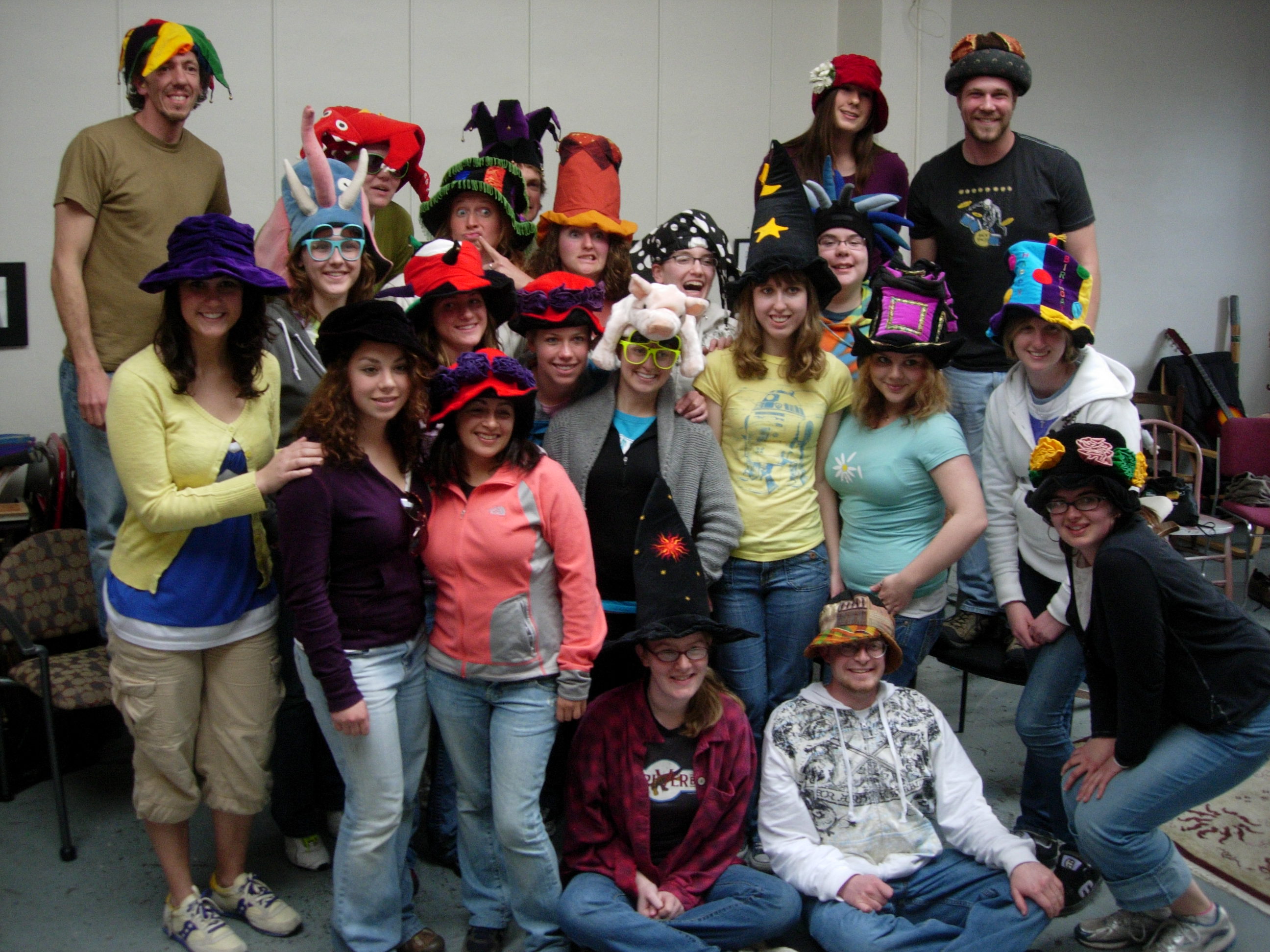
Part of my job is to help facilitate “street retreats,” which are the foundational practice of the Faithful Fools. Participants (typically people who are housed and roughly middle-class) spend a day walking the streets of the Tenderloin, eating lunch in one of the soup kitchens, and observing what arises in themselves. What fears, what judgments, what surprises. Yesterday, we hosted a retreat for 23 students from the University of Montana, sending them out into the streets with the day’s mantra: “What holds us separate? What keeps us separated? As we walk the streets, what still connects us?”
Now, I’ll be honest. I saw myself as very much separate from these people. Yes, my bias against “flyover country” reared its head. These middle-America white folks are about to be scandalized, I thought. Horrified at the unChristian hustles of the big-city neighborhood. Let’s just hope they don’t run into a trans sex worker.
I also had low expectations about the group reflection that would end the day. The Tenderloin is the most diverse neighborhood in one of the most diverse cities in one of the most diverse states. Would these Montannnins be open to seeing and appreciating its nuances?
And wouldn’t you know it. This turned out to be quite the brilliant, thoughtful, insightful, and yes, soulful group. Wonderful reflections. Courageous. Allowing themselves to be vulnerable with the rest of us, enthusiastic about all that they witnessed during the day, and eager to translate the learning back into their lives at school. Just fabulous.
And so, even though I spent the day indoors, making soup and bread for the post-reflection meal, I got my own taste of the street retreat: challenging my own judgments, and rediscovering the truth in the Faithful Fools’ credo: “On the streets we discover our common humanity.”
Loved this post from American Buddhist Perspective. Sometime this week I think I’ll finally have a minute to offer a list of my own favorite “mindful blogging” spaces. This entry is a prime example: a blogging praxis that creates a tight dialectical relationship between online and offline life, encouraging and enhancing mindfulness — present awareness, plus hopefully wisdom and compassion — in both.
Thanks, Google, for simply negating my last nine years of study and practice as a so-called Buddhist. Now that I am no longer following Buddha, what will I do? No white letters in cool blue bubbles fade in from the background to tell me.
Sorry Buddha, but the Google Ads in Buzz was uncool. I don’t mind them on websites (to a degree), I don’t mind them on blogs (you can find some here and buy me coffee by clickin ’em), but in buzz, they’re uncool.
In fact I’m not really sold on Buzz as a whole. I’m told that people are following me that I didn’t even know about. My girlfriend told me it forced her to follow me. I chuckle. That’s just so wrong. Who, or what algorithm at the world’s smartest company, is making these decisions?
Twitter (follow me….) has won my heart because most of my blogosphere friends are there. It allows a nice combination of headlines for our mutual blog posts, as well as something of a community chat function for discussion and banter. Not to mention news stories hand-selected by like-minded folks for me to read. Can’t beat that. If twitter is ever clogged with ads like my Buzz today, that too may need to go.
Facebook (add me…) still gets a fair amount of my daily attention, but is growing into a sort of bloated colorful cousin to twitter. I prefer twitter more (I find myself aimlessly meandering on facebook way too often) for its compact, quickly moving aesthetic. What it has and twitter lacks is all of my real (IRL) friends from over the years which makes any annoyances more than worth it. Besides, I should take the opportunities to be mindful in the colorful environment of facebook more seriously. Limiting my daily time. Being purposeful. Focused. And when meandering, just as in meditation, to simply catch it – gently – and ‘come back’ to my main page.
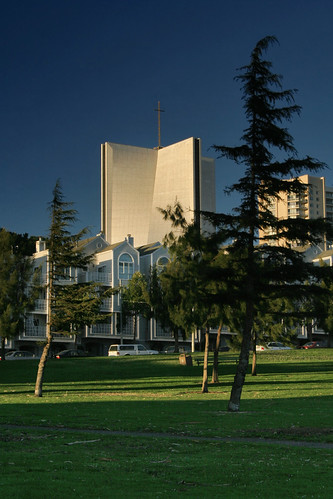
View of St. Mary's Cathedral, known among Fools as "Our Lady of the Maytag," from Jefferson Park (found on flickr)
A making-breakfast conversation with Noa this morning, discussing the health benefits of ghee (she clarified — no pun intended — some of my misconceptions), somehow Back-To-The-Futured me smack-dab into 2005, the summer I turned 19 on the way to McLeod Ganj. (As opposed to the summer I turned 19 on the way to Buenos Aires…)
As a result, my walk to work at the First Unitarian Universalist was entirely double-visioned. The church, nestled in the brood of huge Christian hubs up on Cathedral Hill, became a Tibetan monastery, perched on the face of a Himalayan foothill. The southward view from Jefferson Park, a steeply sloped dogwalking destination between Turk and Eddy, flickered between a beautiful vista of San Francisco’s Mission District and the famous exile village of Dharamsala. Even the fragrance of city cherry blossoms, soft and cleansing in the warming minutes before 9am, somehow evoked the fresh air after a monsoon rain.
How clean the sidewalks are here, I realized. How wide and empty the streets! No crowds!
McLeod Ganj, not my photo: I didn't have a camera in India
That is, until we descended from the Hill back into the Tenderloin, sending off a dozen Wyoming University students on a daylong Faithful Fools street retreat. Then, my memory’s eye moved southward along the subcontinent, to the areas in Kerala where I spent most of my 10 weeks. The hustle, the stagnancy, the dirt and color. All these contrasts. Saints and thieves, or more often, a little of both playing out in one body. Drunken yogis. Warrior monks. Our many, many aspects. I wanted to greet all of them, welcome them, let them know how thankful I am for this messy, chaotic, uncomfortable, precious life.





 Kloncke