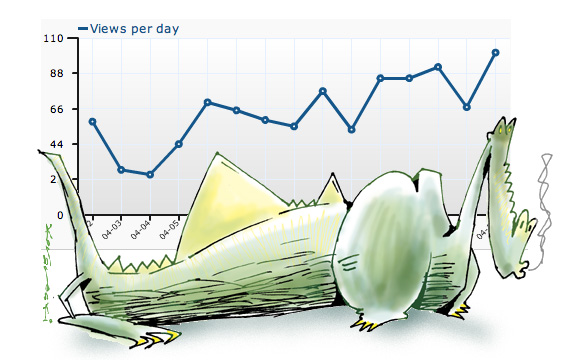
A lovely new stat dragon (first two here and here) by the fantastic John Kovaleski, another of my cohorts at Goddard. John is the kind of person you want on your life team: hilarious, kind, talented, hardworking, humble, and just the right amount of weird. Creator of the adorable “Bo Nanas” cartoon, he’s also working on a wonderful illustration installation project, “Used Books Unbound,” that involves drawing cleverly on the pages of books. It’s an honor to share this little green beast from John’s formidable brain!
And speaking of stat dragons, my original post (with the fabulous Bruce) is featured in this month’s issue of the Zen Peacemaker’s (ZP) online newsletter, Bearing Witness! (Sidebar, under “Resources For Mindful Technology Use.”) The May edition focuses on socially engaged Buddhism online, with some familiar topics (the digital divide; Twitter in Iran; Wisdom 2.0 — the book and the conference, where I tried to raise some economic issues) and some I’d never heard of (Second-Life demonstrations for Tibet; Burmese protest marches organized via Facebook). Ari Pliskin, ZP tech master and architect of these monthly newsletters, was a lovely houseguest here at the Fools last weekend when we both attended the Wisdom 2.0 Summit. An opportunity to get to know the good-hearted man behind the media. :)
Have a good weekend, everybody! More excitement in store for Monday.
When I was about ten, my very favorite outdoor colorscape was a kind of calm, rich, horizontal trio of soft gray, dark brown, and brilliant green. You know how we associate scent with memories? Color works the same way for me (and probably for many of you, too). One or two shades can evoke a whole time and place and mode of being. Clay red and robin’s-egg blue bring me back to a wet walk through a southern Indian suburb. Rusty orange is the color of Barcelona. And yellow is the color of my bedroom: for nearly a decade, whenever and wherever I’ve been able to paint my walls, they’ve always turned out some kind of buttercup or saffron.
Yesterday I reconnected with color thanks to some more helpful tips from Soren Gordhamer’s book Wisdom 2.0. He says that in order to take a real break from computer work, we should try to (a) reduce information intake, (b) breathe deeply, (c) go outside (important one for me to remember!), (d) move around, and (e) keep communication to a minimum (147-148). So we should not, for example, read an article or catch up on a webcomic or play a computer game or text a lover or watch a TV show, even for fun. The most effective resting happens when we relax our discursive mind altogether, and anchor ourselves in experiences beyond screens and words.
With that in mind, I decided that instead of rushing to take the bus home and return to my reading, I would take my camera and meander around the Western Addition on my way back to the Tenderloin.
Traditionally, the dharma outlines 5 precepts for laypeople to follow. They’re not commandments so much as helpful signposts to happiness and mental purity. The idea being that performing any of these actions requires generating mental negativities in one’s own mind, in addition to harming others. It’s an interesting non-dualistic take on morality, and in general I find the precepts useful to keep in mind. They are:
1. Avoid killing.
2. Avoid stealing.
3. Avoid speaking lies.
4. Avoid using sexuality in ways that harm others.
5. Avoid abusing intoxicants (mainly because it diminishes our ability to observe the other four.)
Ok, so far so good, the Buddhists have whittled it down from 10 to 5, or something. But I’ve got a few questions about number 2: the whole thieving thing.
See, it’s pretty obvious how to avoid the vulgar kinds of stealing: bank robbery, purse-snatching, embezzlement, etc.
But what do we do when we live on stolen land? In a country where, as Thea Lim of Racialicious points out, “if you live on native land, you benefit from native genocide”? And where “many First Nations people in Canada, [where Thea’s from], live under third world conditions in a first world country“?
“Surely,” she observes, “there is a political option to remedy this beyond shameful situation, between ignoring it and moving back to England.”
Are we discussing and exploring those options in dharma communities?
And furthermore, how do we relate to stealing when we live in an economic system that operates on the basis of unpaid labor? (Which is the origin of profit under capitalism.) Does that count as stealing? Are we then morally obligated to oppose it? Justified in occupying university buildings and factories? How do we see our dharma practice reflected in these systems and struggles?
These are my questions. I would love to hear your thoughts.
Hey friends! I’m really excited about this dana (generosity) drive for one of my oldest blogging inspirations, brownfemipower of Flip Flopping Joy. Her latest computer has died on her, and after decades (in blog-years) of providing brilliant, soulful commentary in a dope synthesis of journal/journalistic blogging on radical mamis, motherhood, U.S. immigration, wisdom, resistance, healing, and community, it’s high time she got a decent machine worthy of her gifts. The target amount to secure a MacBook Pro: $2000.
The reason I’m fundraising for so big of an amount is because I have been working on second hand/hand me down computers for about six years now–the entirety of my time blogging. And that means that I’ve gone through a ton of computers. I’ve had one catch on fire, one of them the cat broke, another one the little mouse nob in the middle of the keyboard doesn’t work anymore (so I have no mouse), and of course, this last one–the keyboard is broken.
And as if the opportunity for awesome radical POC artist solidarity and sharing weren’t enough, BFP is giving away gifts corresponding to the amount donated. Cards! Zines! Sur-prizes! Fabulous.
Trust me, I never thought I’d pick up any sort of self-help book. Even when I worked at Harvard Book Store and shelved the Personal Growth section, I don’t think I so much as thumbed through a single volume. But, as it turns out, some self-help books can teach us how to, like, help ourselves. It’s kinda nifty.
Specifically, this weekend I got my hands on a library copy of Soren Gordhamer’s little handbook, Wisdom 2.0, and it is actually, materially improving my life. Reminding me of many of the insights I came to independently last year about healthy Internet usage, and adding lots of practical tools to my existing repertoire. The snappy magazine tone isn’t my favorite — partly because it tends to veer into upper-class magazine generalizations, where the only external causes for stress are cranky co-workers and long lines at Starbucks, rather than, you know, institutional racism. For the most part, though, the content is solid. This piece, particularly, proved instantly helpful:
An old Zen saying reads:
When sitting, just sit. When standing, just stand. Above all, don’t wobble.
In our age, we might change this to:
When e-mailing, just email. When talking on your cell, just talk on your cell. Above all, don’t talk while emailing.
For most of us, the talking, working, or surfing online are not what is stressful; it’s the time we spend wobbling. It’s the multitasking and unconsciously switching back and forth between modes of communication…This can be exhausting and stressful when such transitions are done unconsciously and habitually. We can, however, learn to consciously change channels so instead of draining our energy by continuously multitasking, we move with ease from one mode to another. (27)
This means a few things for me. One, I’m re-adopting a practice I developed last summer, in Europe, of leaving open only one window on my laptop at a time. Just one at a time. Either my Internet browser, or my word processor, or iPhoto, or Skype, etc. This clears up a shocking amount of head space and lets me concentrate on one task at a time. Surprisingly, I find that this elevates not only focus, but also enthusiasm. I feel lighter and more at ease when I have a single task before me. I can even see my lovely green desktop photo behind my one window, instead of a cluttered layer of more programs.
If someone calls my cell phone, I pause and determine whether my time is better spent answering right now, or staying with my computer project and hitting them back later. If someone approaches me in person, or the kettle whistles, I take a moment to deliberately shift all of my attention to the real-time project. And far from slowing me down, this approach actually cuts down enormously on wasted time, and helps me spend my energies in a more pleasurable way.
That’s another thing: this book is reminding me that waiting can be pleasurable! Waiting for photos to upload, waiting for a page to refresh, waiting for a wireless connection to come through…simply by reworking my own mind, I experience them as moments of rest and alert relaxation, not impatience and weird greedy hypnosis. (Staring at the loading bar, anyone?)
Of course, there may be issues, like a colleague’s continual tardiness to meetings, which need to be addressed. However, if we do not blame the person for our discomfort, if we do not bring our dissatisfaction with our inner life into the issue, then we can more skillfully address the problem. We see that the situation provides an opportunity for learning, and we can address it without the extra frustration.
This does not mean that we can use this as an excuse for our own actions. The next time we are criticized by our manager for showing up late to a meeting, it is probably not best to reply, “Well, if you weren’t so uncomfortable with your inner life, this would not be a problem. Deal with yourself.”
It was during such a bright, cheerful pause in a French café last summer, while 20 photos took 10 minutes or so to upload, that the germ for this post (one of my favorites, I think) arose.
Anyhow, this little manual is certainly shaping up to be a pleasant surprise. (I’m about 2/3rds through.) And speaking of mildly embarrassing interests, it has even diminished my skepticism enough to warrant one more student registration for the Wisdom 2.0 Summit in Mountain View, coming up this very weekend. (Crazy — Ari Pliskin of Zen Peacemakers had mentioned it to me a while back, and I knew he would be in town for it, but none of that occurred to me last week when I found the book at the library and picked it up. Too odd a coincidence not to explore, even though it means dropping the bulk of my dog-sitting earnings on the conference fee.)
May your back and neck, forearms, eyes and mind be well this week, my dears, however much time you log in front of a screen.
xkcd gets a little Buddhist on us. This strip is a wonderful illustration of the concept of “maya,” or the illusion that makes up our subjective world.
Buddhist perspectives on this will vary according to tradition and individuals, of course, but the way I see it, to describe the world as illusory is not to claim that the world doesn’t exist. When we talk about attachment to illusion, what we’re really describing is the way we react to all sensory inputs (including thoughts) as though they were solid, permanent, and inherently meaningful. We grab onto them (or flee) for dear life. We press more buttons!!! It’s important!
But why? Just like the images on our computer screens, our experience is pixellated: reducible to smaller and smaller (or larger and larger) units that alter the meanings we ascribe to familiar phenomena. When we investigate the ultimate nature of these phenomena (including, most importantly and terrifyingly, our “selves”), we see that they are essenceless. There is no core meaning hidden among the quarks. Just impersonal vibrations; lights.
Now, I’m not saying that when somebody’s pointing a gun to my head, all I need to do is remember, “This gun is made of a bunch of atoms,” and all will be well. Apparent, superficial reality does matter, and we can’t escape or control it by intellectualizing it. What we can do is learn to live with reality, as reality — which means remaining awakened to the constant impersonal changes in our lives. Changes that our deep mind is constantly processing, reacting to with craving or aversion, while our proximate mind is busy spinning its own stories, going about the day executing a slightly more complex version of “pressing buttons to make the pattern of lights change however I want.”
When we quiet our mental chatter, gain some insight into the impermanence of phenomena, and train the mind to respond with equanimity, we create more spaciousness and freedom to respond, not react, to lights and pixels. Rather than fearing, hating, craving or ignoring them, we can interact with them with greater patience, wisdom, and skill.
Awakening, graduating from ardent button-pressing, isn’t simple, and it isn’t easy. Far as I can tell, it takes a loooong time, and much diligence. A month from now, I’ll head back down to North Fork, CA for my third 10-day silent Vipassana meditation course, which is the form of practice most useful to me in dealing with the pixel problem. 10-day courses are tough. The hardest work I’ve ever done, by far — and also the most rewarding.
Wishing us all well in developing practices to deal with our metal boxes. I mean lives.
It’s amazing to think back six months to when I first arrived in the Bay Area, with nothing to do but look for work. No major activities, no responsibilities to anyone. How can things change so much in six short months?
Faithful Fools: apprenticing with Tenderloin spiritual-realist matriarchs
Art school: blogging and theorizing; submitting monthly assignments
Political education: post- organizing for March 4th, now regrounding myself through study groups
Dharma: deepening my daily meditation, seeking out communities of advanced practitioners
Relationships: a partner, a posse, friends, family, and a few animals
Yeah, it’s feelin’ like a lot.
And I’ve been hanging on to the blogging for dear life, trying like heck to publish every weekday. But the truth is, that kind of frequency costs me the time to consider the meta-questions, to develop my nascent theories of mindful blogging. And that’s what I’m in grad school for, after all!
So for the next little while, I’ll be backing off on the daily posting, probably limiting it to three days a week. I’m genuinely surprised at how difficult this feels for me — how much of a sacrifice or failure it seems — given that, on multiple occasions, I’ve cheerfully abandoned the blog for months at a time. So, as Shaila Catherine might observe, this becomes my work for the moment: developing equanimity in letting go and switching up the schedule.
Spiritual practitioners thrive in unpredictable conditions, testing and refining the inner qualities of heart and mind. Every situation becomes an opportunity to abandon judgment and opinions and to simply give complete attention to what is. Situations of inconvenience are terrific areas to discover, test, or develop your equanimity. How gracefully can you compromise in a negotiation? Does your mind remain balanced when you have to drive around the block three times to find a parking space? Are you at ease waiting for a flight that is six hours delayed? These inconveniences are opportunities to develop equanimity. Rather than shift the blame onto an institution, system, or person, one can develop the capacity to opt to rest within the experience of inconvenience.
A welcome reminder. And a very helpful practice for those of us with wee control issues. Just yesterday, when I found myself spiraling downward into disappointment and resentment at canceled plans, I remembered equanimity. And my disappeared dinner date transformed into a chance to walk, for the very first time, around Oakland’s lovely Lake Merritt.
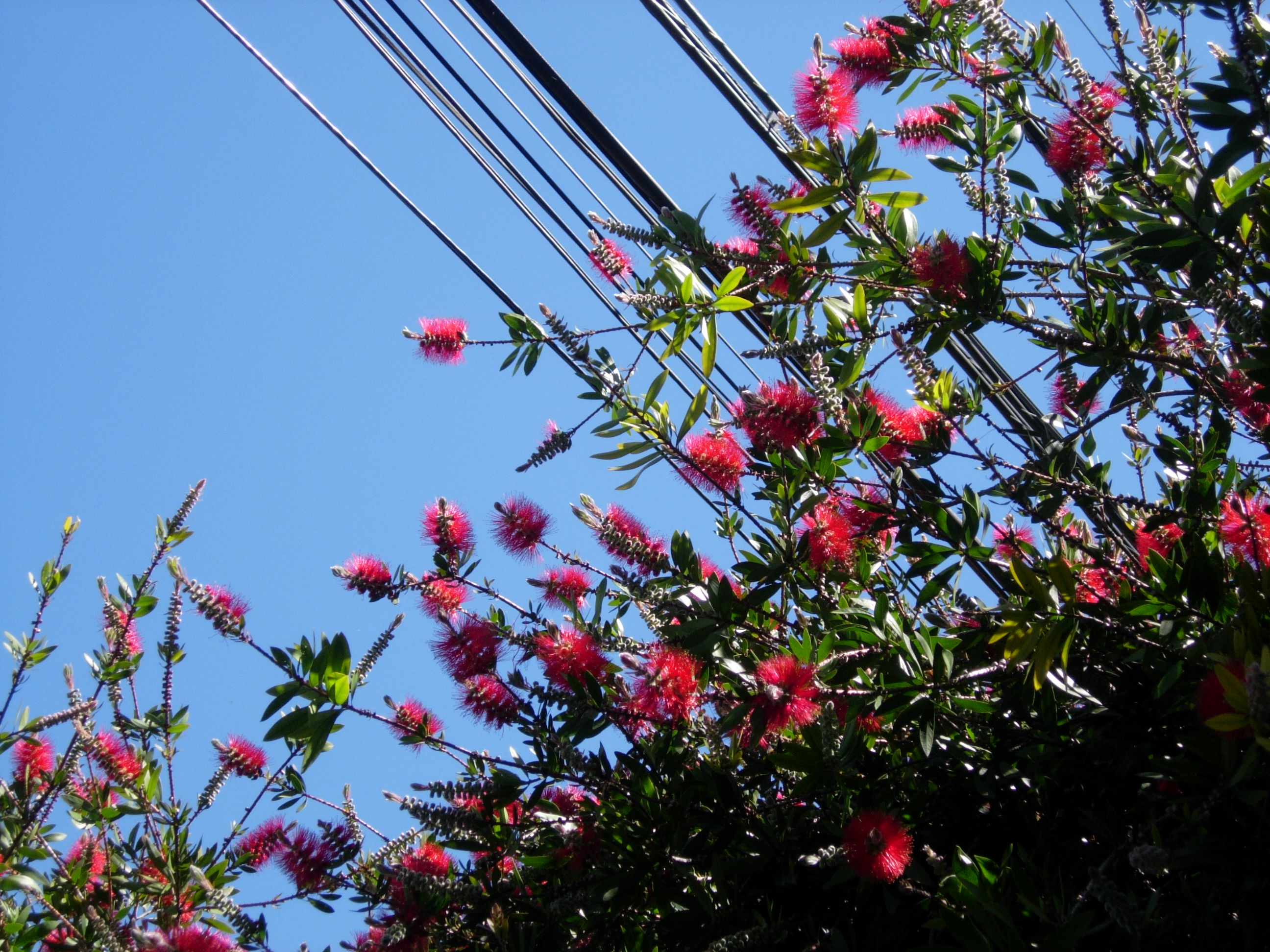
Gorgeous late afternoon and evening, complete with a sweet springtime surprise.
So who knows — maybe this downsizing of the blog will open up some other opportunities. Regardless, I’m happy for the chance to practice letting go.
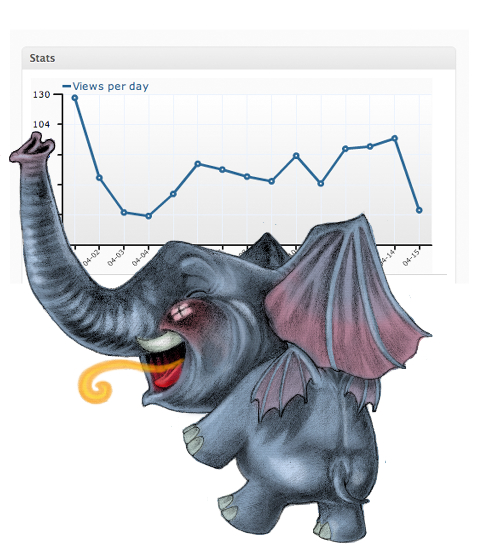
Adoring this elephantine addition to the Stat Dragon family. By the terrifically dope Aaron Zonka, who I met at a party where he was literally That Guy In The Corner Quietly Sketching Things Of Genius.
If you’re in the Bay Area, check out his series of fabulous art/music shows, “Under the Table Gallery.” Live performers, exhibitions for sale and viewing, snacks and libations, the whole deal. Next one is April 24th, 5-10pm, 248 Felton Street.
I try not to do too many reading-list posts, mainly because I know that most of us have our own gigantic stacks of reading to get to. But! These pieces are simply dope and exciting, and written or shared with me by people I like. Plus, the collection represents, in a way, some key themes in my life right now: feminism, political work, and spirituality. So!
The lovely and talented author of This Moi (elder sister of ei powell) has a guest post up at Jezebel on the Man To Man (M2M) phenomenon — as experienced by herself, a keen and observant young woman of color, during a trip to a shooting range.
And! The Advance the Struggle collective (AS) published their analysis of the March 4th day of action (for public education in California + beyond), which breaks down, in very useful, insightful ways, the dis/advantages of two different tendencies among the anti-capitalist players involved, and how to combine their strengths into a “genuine class struggle left.” Personally, it helped me clarify and contextualize my experience participating in the SF March 4th committee, which I found pretty frustrating overall. In hindsight, I now understand a lot of the key ideological splits that I couldn’t articulate at the time. As AS puts it, “the [clashes] of approaches to radicalizing consciousness were key determinants in differentiating the political forces in the movement.” Also nifty to see analyzed summaries of all the different major actions in Cali, as well as efforts in Seattle. Check it out.
This poem, which my boss read to me during our latest reflection session (yes, I’m lucky enough to have good poetry in my work meetings!) immediately resonated with a fear that’s been haunting me ever since I started deepening my meditation practice last year.
Tree
by Jane Hirshfield
———
———
It is foolish
to let a young redwood
grow next to a house.
Even in this
one lifetime,
you will have to choose.
That great calm being,
this clutter of soup pots and books —
Already the first branch-tips brush at the window.
Softly, calmly, immensity taps at your life.
Will it be possible for me to combine a lifelong commitment to practicing dharma (with the retreat experience and internal work required) while at the same time holding on to worldly commitments like partnerships and social justice work? Oftentimes I sense that someday, in this one lifetime, I’ll have to choose. Do you ever feel that way?
Finally, a little something by Ahmad Jamal, just because.
Happy Thursday, friends, and happy birthday Henry Mills!






 Kloncke