Jacob Lawrence, from the Toussaint L’Ouverture Series, “To Preserve Their Freedom.”
i don’t begrudge my friends and family their joy, but since 2008 i have lost my belief in a patriotism dressed up in charming blackness.
instead, may blackness continue to serve as an impetus toward universal freedom, fundamentally challenging all harmful power structures (including the u.s. government).
may blackness fill us with the vision, love, and spiritual strength necessary to fight for a classless society, a society of equals, where leaders are not idolized but trusted — and directly accountable.
much gratitude to all who have struggled and are struggling for real, worldwide liberation.
so humbling and exciting.
=====================
Top: “Steeped in African American history while growing up in Harlem during the Harlem Renaissance, Jacob Lawrence launched his career at age 21 with a 41-panel series about an important black hero, Touissant L’Ouverture, who led the slave rebellion to liberate Haiti from French rule. Years later, he reprised the series in screen print, including the dramatic ‘To Preserve Their Freedom,’ 1986, a reminder that American blacks were still not liberated.”
The worst thing about depression is how true your vision seems, like misery is the only correct perspective and everything you think when you’re happy is a sham. I didn’t even want to be happy anymore because I’d rather live in honest misery than fake bliss.
—Michelle Tea, Valencia
Yup. And then imagine being depressed and displaced from your longtime home on Valencia by pinkwashed gentrification.
Let me tell you a story from the meditation retreat last week.
One bright afternoon, lunch had ended and I was in the zone. Aware of each step, feeling the weight of the swinging doors and the giddy lightness in my legs after sitting on the floor so long, I glided out of the dining hall and turned to where the sky meets the hills.
I decided I wanted to sit at one of the old wooden picnic tables and watch the breeze ripple the sunnygolden grasses. This would put me even further in the zone. Deeper and deeper (that’s the root of the word “profound”: toward the fundus — bottom, or foundation).
To unlock the mysteries of my fundus, not just any old grass-gazing spot would do. Even in noble silence, I needed some extra solitude. A yogi VIP position. So I passed by the picnic tables occupied by one or two meditators, and chose the very last one in the row: empty, simple, and inviting.
Except for one slight problem.
____
If I were to sit on the bench of this lovely old rustic picnic table, the best, most poetic view of the hills would be slightly obscured by a leafy bush.
Undeterred, I came up with a solution. Instead of sitting on the bench, I would sit on the table top itself. Perfect! Ingenious! Mildly rebellious! At the very thought, I could feel my fundus draw nearer.
____
Eyes locked on that poetic spot in the hills, I felt my way around to the head of the table.
And as I gave a graceful hop up and back, pushing myself into the perfect perch, I noticed a sudden, unexpected sensation.
Splinters.
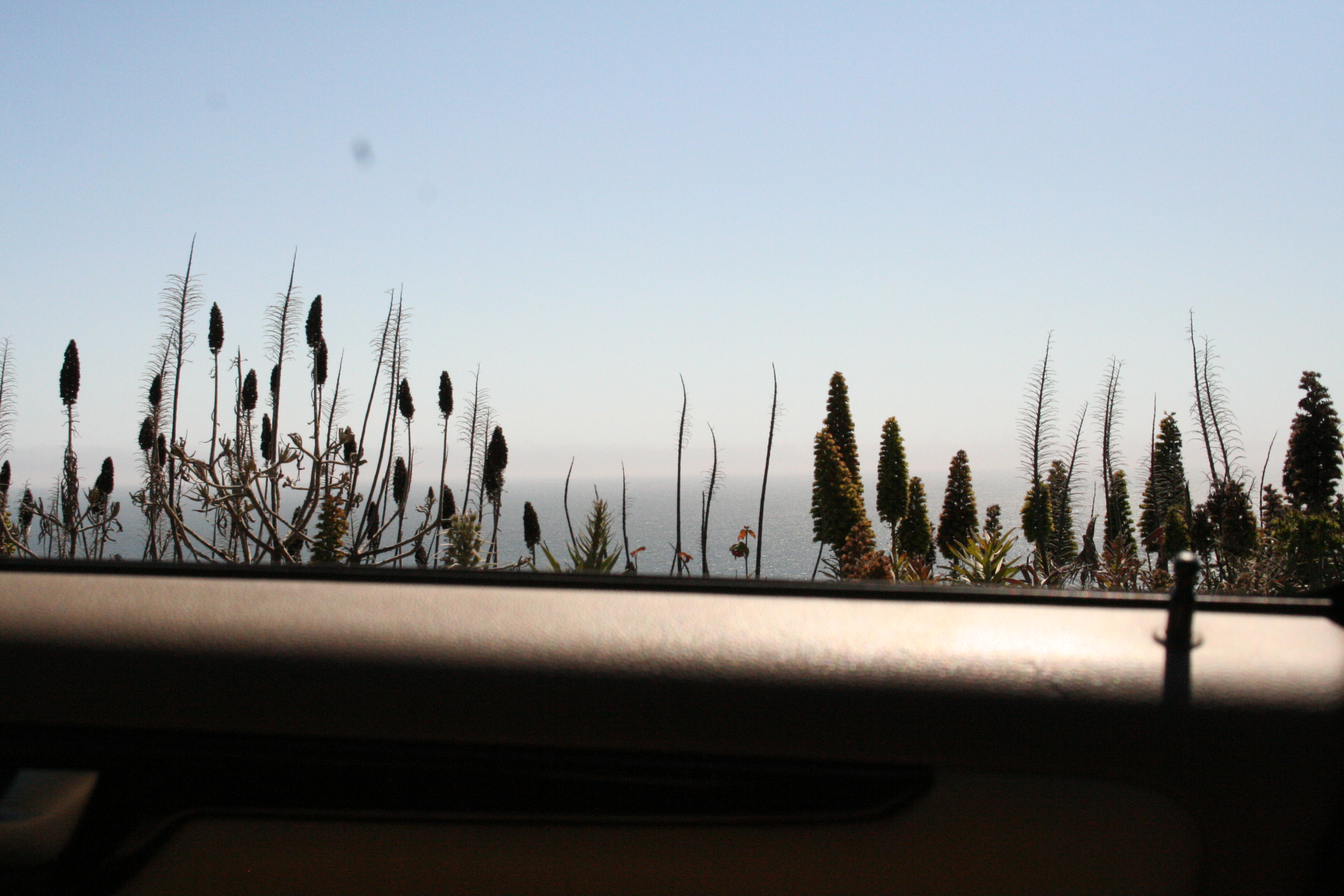
The Pacific Ocean is extremely cold in these parts.
Not stuck directly into the back of my legs, fortunately, but dozens of splinters, of various sizes, poking through my long skirt and sticking my skin.
And so, rather than grass-gazing meditation, the next forty-five minutes became a splinter-removing meditation.
Which, honestly, gave me as good and frank a look at my fundus as would anything.
__
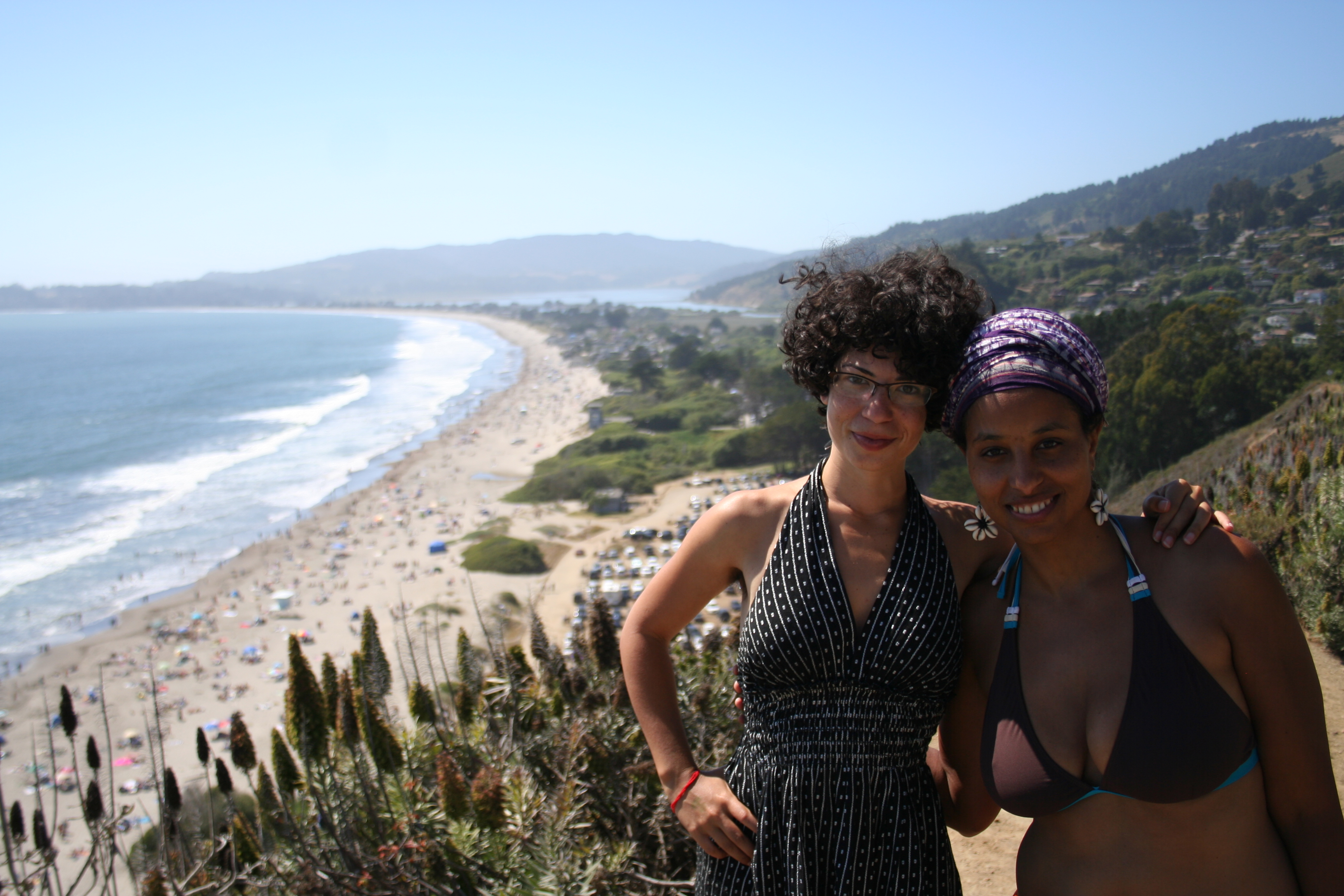
Now, Sierra and I, our spontaneous trip to Stinson Beach went the same, in a way. After a string of gray mornings, we awoke on a Saturday to a brilliant blue North Oakland sky. We had to get to some kind of water, we determined. So we packed a picnic and set out, across the Richmond bridge to Marin. Delicious drive. Not a whisper of a cloud anywhere.
Until the coast came into view.
Each of us felt the other’s heart sink as we saw it. A layer of fog thick as buttercream, like some cosmic cake decorator had piped icing right along the shore.
But that’s what’s amazing about traveling with a dhamma buddy. You are learning how to laugh at your own expectations. You remember the teachings: most of the time, we humans live our lives only through the angle of Gratification. We seek pleasure: the perfect view, sunshine at the beach. We remain oblivious to the second angle of reality — Danger (splinters, fog) — until it smacks us directly upside the head. Even then, we forget the next time, and the next. We always keep a fresh supply of disappointment.
__
But the third angle of reality — Freedom — releases us from the disappointment. We learn how to loosen our grip on our own expectations.
__
After debating turning around, Sierra and I decided to stay, eat our lunch, and see what happened next.
Liberated from the craving for immediate sunshine, we were free to notice other things. And we found that despite the fog, the sand was warm. And the chill was fading. And eventually, the clouds rolled out to sea completely.
Tough to feel deserving of any positive blogging recognition when my updates here have been so scattered the past few months. But as always, I’m honored and humbled by this shoutout from the wonderful engaged Buddhist writer and activist Maia Duerr. You know how some people are mad talented at giving compliments? Maia is one of those people. She’s so thoughtful and specific when she names what she appreciates about people’s work. You can tell she’s really moving with what they’re putting out; not just scattering praise for feel-good purposes. Of Kloncke.com, she writes
Katie Loncke’s blog is, to me, the perfect intersection of spirit, politics, and heart.
Is that sweet or what? Really tho.
And the best part about being tagged with this kind of blogly award? Passing it on. Since Maia put her own spin on the shoutout selection by limiting her list to women, I’m going to create my own parameters, too. My list consists only of people I know and build with (politically, spiritually) in person.
infaquerical: a term created by my friends Candy and Castro,* who did not identify with either monogamy or polyamory, and wanted a new framework for thinking and living their coupledom. After writing out the aspects of their relationship that matter to them, together they birthed this word.
in: indigenous
fa: familia (chosen, community, & biological)
que: queer, querida
r: revolutionary, radical
ical: magical
Since its inception, they’ve been using infaquerical as a touchstone as they navigate complexities of a nontraditional, gender-bending and anti-capitalist romance. Castro might say to Candy: querida, I really want to spend my time with you: it’s been a hard week and my instinct is to retreat with you into our little world. But since we’re in an infaquerical relationship I think it’s important for me to spend some time with my homies, rather than defaulting into monogamous isolation.
Or Candy (feminine-centered) might relish opening doors for Castro.
Or Castro (masculine-centered) might enjoy sitting on Candy’s lap in public.
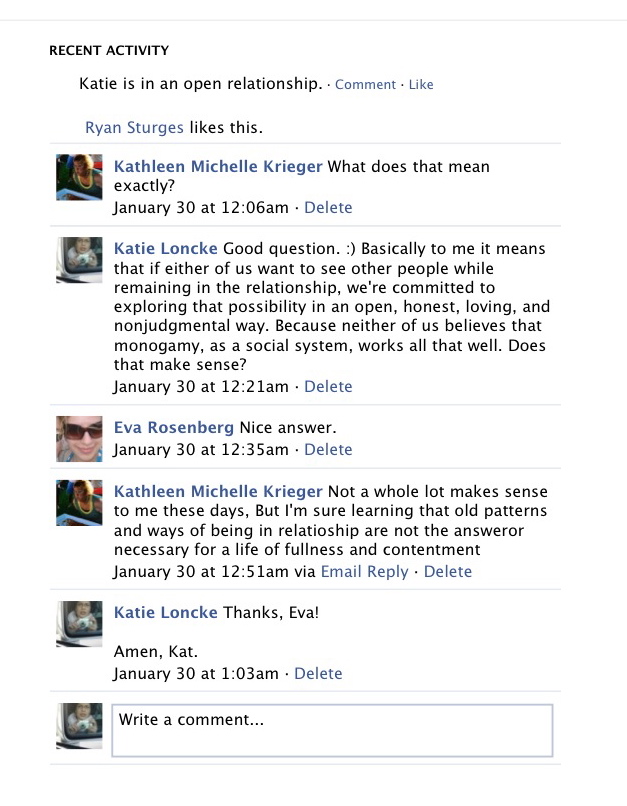
As you might imagine, I instantly fell in love with this dope-as-hell word. Not only for the meanings it carries, but for the process of intention that shaped it, and the ways it might live through people’s loving thoughts and actions. Reminds me a bit of the way Ryan and I attempted to (re)define our “Open Relationship” Facebook status in the early days.
Now, over two years later, Ryan and I have decided to end our time as a couple. And I think the way we’re doing it reflects the infaquerical qualities of our time together.
Non-blaming. It so happens that our breakup is nobody’s fault. If a couple (or group) decides to split up because one person wants to have children and the other(s) don’t, is anyone to blame? Ryan’s and my situation differs in specifics, but the gist is similar: our needs and desires just don’t happen to match up. Since we’ve spent over two years together responding to our conflicts with compassionate listening rather than defensive blaming, the breakup conversation, too, remained drama-free.
Supporting. In addition to harboring no resentment, we each have an inclination to actively (and carefully!) support one another. I say “carefully” because you know what? It’s easy for us sensitive-type humans to deceive ourselves, during a breakup, into thinking that the best form of support is sustained contact and connection. We want to show our former partner that we still care. So we stick around. (This has usually been my instinct, personally.) For some people this might work out well; I’ve seen it happen once or twice. But for many of us, “supporting” our former partner may actually mask our own desire to feel needed, wanted, and less-than-dispensable. More important than soothing them is ensuring they have the tools they need to heal independently. For cohabitants: do they have a place to go if they don’t want to stay at home with you? Can you stay with a friend for a while to make space for your partner? The stresses of making rent under capitalism can add a whole other level of stress to co-habitating couples splitting up. Can you have conversations about housing and property that stem from a place of “from each according to ability; to each according to need”? Instead of trying to be the main person emotionally supporting your former partner, can you enlist others? (Which brings us to:)
Community building. Typically when we think of a community supporting a couple, we might imagine a wedding (if we’re more mainstream) or a, Octavia-Butler-esque collective of people (and/or vampires), romantically and non-romantically involved, sharing resources and helping to raise the next generations. But it seems to me that for infaquerical relationships, the breakup is also an important moment to deepen community ties and trust. Especially when, as is the case with Ryan and me, the former partners share friends/comrades and important projects. Like Candy and Castro, Ryan and I have always felt it’s important to encourage each other to deepen friendships even while remaining anchored in a primary partnership. Now I see the fruits of this orientation. The day Ryan and I decided to separate, I later ran into one of his friends on the street, and as we were chatting it came quite naturally to me to ask this friend to check in on Ryan, to let him know that he’s loved and cared for. I know Ryan would do the same for me.
Enlightening. One of the most precious aspects of our relationship — and one that I’ll carry with me — was the way Ryan and I supported each other’s Buddhist practice. And as Thanissaro Bhikkhu says, “This is what we’ve been practicing for: the situations where the practice doesn’t come easily,” a.k.a. crises, or “storms.” A breakup like ours encourages us to cultivate paramis (positive qualities) of patience, generosity, acceptance, compassion, and determination. And while it may not hold true for everyone, I’ve noticed that for me, times of disorientation and big emotion (Pema Chödron famously calls this “groundlessness“) can actually flow spontaneously into deeper dhamma practice. When the mind and heart get overloaded, it can be easier to escape the tyranny of cognitive thought. Notice more sensations; notice the quality of change itself.
When green leaves turn in the wind
I vow with all beings
to enjoy the forces that turn me
face up, face down on my stem
~Robert Aitken Roshi, a senryu verse from The Dragon Who Never Sleeps
Naturally, separating from someone we love brings pain. Not tryna deny that sadness. Splitting up with Ryan means losing my best friend. But if I’ve learned anything from dharma and visionary politics, it’s that within crises — inside the instabilities: of gender, of capitalism, of heteropatriarchy, of the mind — we can also find opportunities for liberation.
With deepest gratitude to everyone who has loved and supported me and Ryan, as a couple and as independent people: you bring infaquerical to life!
love,
katie
–––––––––––––––––––––––––––––––
* Sweet corrections from Castro:
[M]y my housemate Ray, Candy and I all thought we should re-name and re-define our reality by creating an evolving framework and term that speaks to our lived experiences. So, infaquerical was a trio effort which is why it is also so wonderful because as Candy pointed out, the way we defined our reality included another person (Ray) not just the two of us.
In: Indigenous
fa: familia (chosen, community and biological)
que: querida/queer
r: radical/revolutionary
ical: magical
Infaquerical: a magical, radical, revolutionary and romantic relationship between two non-gendered conforming people; they live to restore humanity instead of living to make profit; have the desire to decolonize their mind and to abolish male supremacy; value familia (biological, chosen and communidad) and challenging male supremacist ways of thinking.
So amazing, right? Have you experienced or witnessed dynamics of infaquerical in your life? (Hehe, I know the answer is Yes because so many of y’all are dope livin-yr-politics messy queer feminist beauties) Please feel free to share testimony! I’ll be sure it makes its way back to Candy and Castro. :)
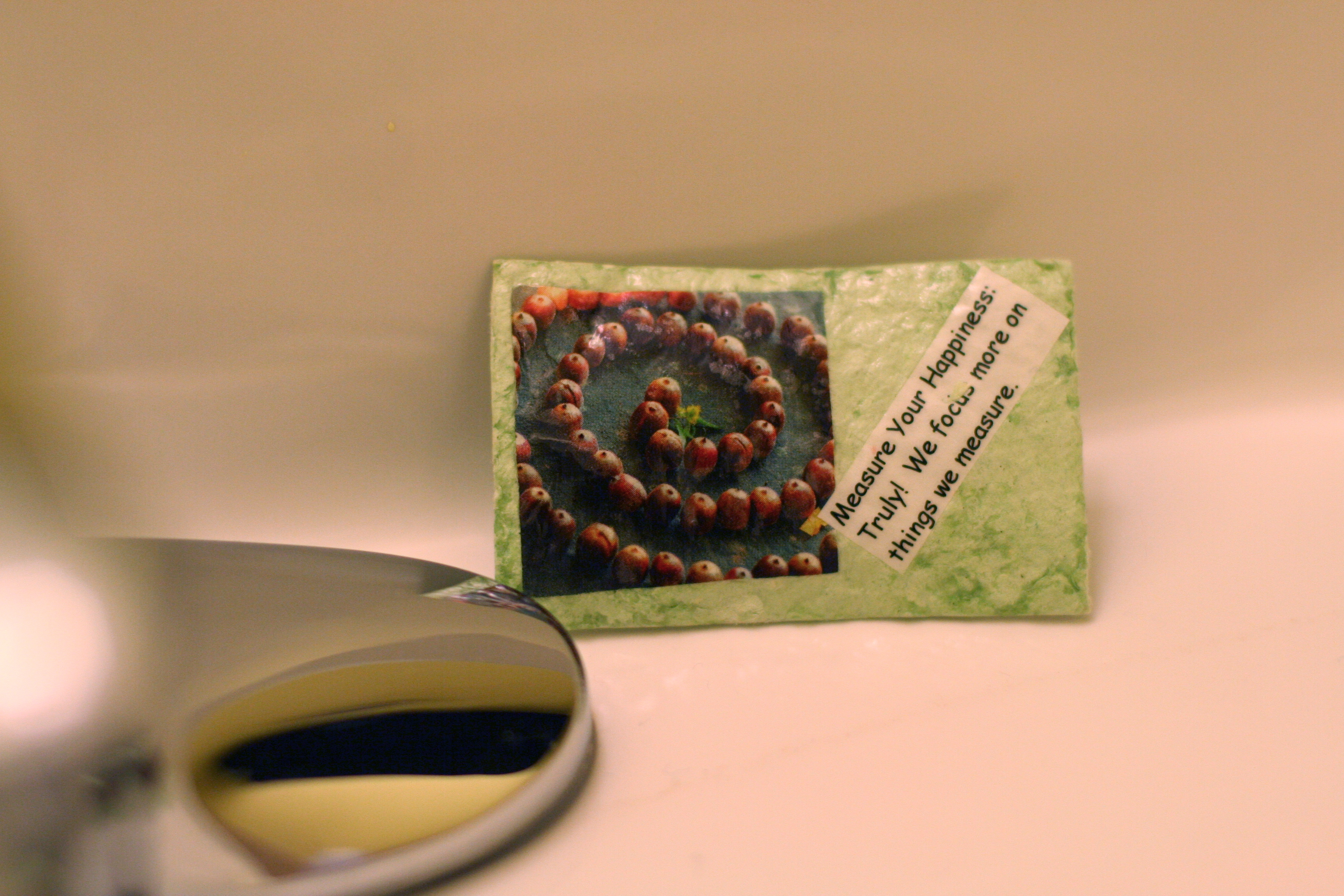
About halfway through residency, the above object appeared on the sink of the righthand hallway bathroom.
At first I dismissed it on grounds of New-Age typography. The fortune-cookie-style strip; the Comic-Sans-ish font; the capitalizing of every word in a sentence. Semi-watercolor background. Like every label of every decontextualized crystal, healing oil, or incense stick in Berkeley. Not to mention the spiral of prayer beads, disembodied and ornamental, like a hippy-fied Tiffany’s ad.
But a couple days later, I realized that I kind of agreed with the message. I’ve often thought it would be wise to chart one’s well-being, day by day, in order to study and understand emergent patterns over weeks and months. Visually relate to those ups and downs that seem at the time like all-too-fleeting highs and everlasting throes. Get to know the middle ground, too. Vicissitudes. Know what I mean?
Maybe it’s time for a new chart project. Thanks to whoever left this on the sink!
By the way, anyone got insight into the prayer beads, and how they might relate to “measuring happiness?” My impression was that they’re used for counting prayers, which seems different.
5. The workers at the General Hospital of Kilkis answer to this totalitarianism with democracy. We occupy the public hospital and put it under our direct and absolute control. The Γ.N. of Kilkis will henceforth be self-governed and the only legitimate means of administrative decision making will be the General Assembly of its workers.
. . .
7. The labour union of the Γ.N. of Kilkis will begin, from 6 February, the retention of work, serving only emergency incidents in our hospital until the complete payment for the hours worked, and the rise of our income to the levels it was before the arrival of the troika (EU-ECB-IMF). Meanwhile, knowing fully well what our social mission and moral obligations are, we will protect the health of the citizens that come to the hospital by providing free healthcare to those in need, accommodating and calling the government to finally accept its responsibilities, overcoming even in the last minute its immoderate social ruthlessness.
I’m ruminating on this today, thinking about play and experimentation in radical takeovers. Gratitude to Pete Hocking, Keith Hennessey, and the relational aesthetics folks (readin’ up on ’em here at Goddard) who are giving me some new perspectives to play with. May come back with some new ideas for EastBaySol. :)
As always, would love to hear your thoughts. Feel free to share!
I’ve been dealing with some depression in the last couple months, friends. Without going into too much detail, I’ll just summarize by saying that I lost sight of inspiration; all thoughts (most of which were negative) seemed completely real, solid, and inescapable; and I couldn’t remember how I make meaning in the world.
Highly unpleasant. Perfectionism played a large role here, too; I’ll come back to that in a minute.
Fortunately, over the years a number of great people have shared with me their tools and strategies for living with episodic or more chronic depression. Nothing like knowledge and loving, supportive relationships to lessen fears and ease internalized stigma.
Also fortunately, I have access to many resources for digging myself out — including free time.
What that wound up meaning, for me, was: forcing myself to do a lot of things that I reeeeeeeally did not feel like doing. Robot-style, I checked off my list.
Don’t deny it (in other words, be real with myself and Ryan about how I’m doing, even if I feel ashamed about it)
Apply for jobs (seek more structure in my day and more stability in moneyplans)
Accept invitations to hang out (even when all I want to do is stay home alone, sit on the couch, and valorize all my thoughts)
Seek parental insight on racism (ask my dad what he has done to cope with lifelong feelings of outsiderness and non-belonging)
Get under the sky (hike, see some trees, feel some air, find an arboreal newt at Butano State Park)
Try therapy (preferably with someone who knows about queer shit, POC shit, political shit, and how these relate to mental health)
Practice gratitude (this one didn’t actually work for me — the negative thoughts were just too loud and strong — but I did try)
Reach out (talk with friends who know me well, even if they’re far away and “talking” is via phone or email)
Exercise (since the bike-to-car transition, the old endorphin crank is getting real rusty)
On this last point, my friend Cat kindly clued me in to a free program through Yoga Journal: the 21 Day Yoga Challenge. Offering daily vegetarian recipes, guided meditations, and yoga instructional videos, it supports participants’ three-week quest for calm minds, open hips, and better bowel movements. Ideal for avoiding the crowds at Yoga To The People. (Despite living in what is probably the white yogi capitol of the world, with studios outnumbered only by Walgreens, I still haven’t found a cozy home base like Mandiram in Barcelona.) Online videos allow for sweatpants, bad attitude, and slovenly following of computer-screened orders.
The sessions were at first relatively numb and joyless. Stretch this, bend that, breathe, same-old same-old.
By now, Day 11, I am gobbling all kinds of YouTube yoga videos and practicing extra arm balances on my own. Falling all over the place, trying to build strength in my shoulders and core. One of my goals is to master the pincha mayurasana by the Day 21. Almost there (hopefully I’ll have a video or photo to share soon), and practicing feels delicious.
B K S Iyengar
In other words, playtime* is back — and that is a good thing. A very good thing.
What do I mean by playtime? Giving oneself permission to be curious, try things, make mistakes, and do weird shit that may or may not ‘add up’ to anything, but in the meantime is fun and/or fascinating. Scientifically, play appears to be critical to healthy childhood development, and among adults it’s vital to creativity. Even the big businesses are catching on, and you know they don’t waste labor costs on pure frivolity.
[Sidenote: I’m not totally sure about this, but I think it might be useful to distinguish between mindful and unmindful play. For instance, Ryan and I have been talking a lot about video games lately, and how they can become very addictive and life-force-sucking, rather than rejuvenating and relaxing (as one might imagine a “game” would be). Is it possible to play video games mindfully? Probably, but for a variety of reasons it seems awfully difficult to me, though I admit I am no expert. In any case, rather than labeling certain activities (i.e. yoga, music, sports, freewriting) as “mindful play” and excluding others, the main thing might be the quality of play, or the attitude one brings to the activity. No?]
Now, I’m not too keen on the “allegorical” school of yoga writing: always translating physical asanas into metaphors for everyday life, in a kind of pat, Chicken-Soup-For-The-Soul way — you feel me? I’m more on the medical/meditative tip (i.e. this posture supports thyroid function; and when keeping the attention on the breath and sensations, yoga becomes a very practical spiritual path). Therefore, the following observation about my own 11 days of yoga makes me feel a little squirmy. But I’ll say it anyway.
Remember how I mentioned that perfectionism contributed to my depression? As we know, perfectionism breeds rigidity. Failure and mediocrity seem to permeate everything; nothing is good enough. Except maybe the rare, unattainable genius of other people. But even then, they are probably geniuses at things that don’t matter very much. Awesome at yoga? Who cares; plus, where’s the critique of patriarchy. Brilliant writer? Idealist/individualistic and/or suicidal. Stellar organizer? Either too complicit with the state, or too unsystemic in thinking. Great politics? Where’s the disciplined application. This is what my mind said, over and over. Rigid.
And what’s the opposite of rigidity?
You guessed it: flexibility. Darn allegories.
So where my depression was closed, stagnant, and neurotic, yoga has brought openness, movement, and grounding in the body. I feel so. much. better.
Of course, it didn’t have to be yoga! Running, if I could stand it, might have offered similar benefits along the exercise lines. And it wasn’t only the yoga! There were hella other factors contributing, too. (Notably, Ryan’s constant, unwavering, loving support. Straight-up amazing.)
Nevertheless, there it is. Yoga helped me be more flexible, let go of rigid perfectionism, and remember how to play.
Hold up — I think I feel that gratitude practice starting to kick in.
* * * * * * * * * * *
* In light of fucked-up racist stereotypes, I just want to clarify that when I associate playtime and yoga, I don’t mean that yoga is somehow unserious, or that inversions like pincha mayurasana are childish and/or monkey-like acrobatics. That is some colonial-ass thinking, which is unfortunately not uncommon, hence the need to mention it. Rather, when I speak of play in my practice, I mean focus, immersion, an attitude of curiosity, ability to adjust, tweak and revise, recover buoyantly from errors, or even let go of the idea of error altogether. The same applies to the freewriting practice I recently resurrected for myself, called “morning pages”: an exercise from Julia Cameron’s The Artist’s Way.











 Kloncke