I don’t want to fight my landlord
over who will pay for bed bug extermination.
I don’t want to feel relieved
when the infestation’s epicenter
turns out to be in the unit upstairs.
Those men are broke enough as it is,
trying to stay clean and sober and keep a job.
Can’t afford a thousand dollars
for liquid CO2.
I want a building, a block, a cityland
where everyone is secure
in a shelter they love
where no one feels pressed to salvage
a dubious mattress
unless they can take it to the free clinic
for thorough inspection and cleaning.
No big deal.
I want to be free and open
to share the pains of infestation:
we’re in this together.
I don’t want to fight my landlord.
I don’t want a landlord at all.
I want a world without them;
bed bugs we can handle.
So many people have been writing and sharing wonderful views on Oakland’s General Strike — I thought I’d collect a few for my digital memory chest.
Where We Been
Grew up listening to him on KSFM 102.5 — now appreciating Davey D’s take on the day.
Mushim Ikeda-Nash, writer and one of the many dope teachers at East Bay Meditation Center, offers a perspective as a spiritual leader and involved Oakland parent.
Dope commenter, organizer, and now blogger in her own right, Huli breaks it down and offers a delightful new phrase: “peace bullies.”
A 10-year street medic, present for the attempted re-opening of the former Traveler’s Aid Society, supports liberating empty buildings and standing up to cops, but urges us to prioritize inclusive solidarity and sustainability, not spectacle.
Where We Goin
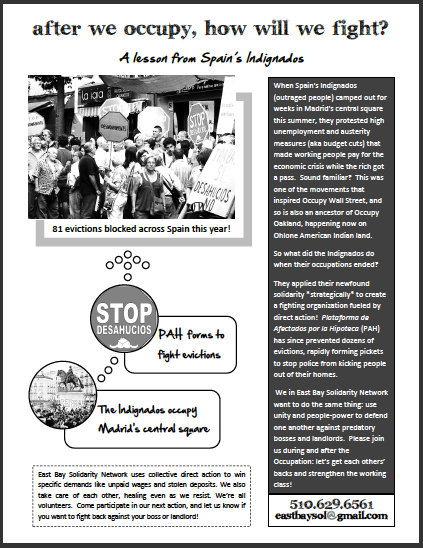
Ryan and I made this flyer a few weeks ago for East Bay Solidarity Network, to pass out at the Occupy/Decolonize Oakland encampment. (Click image to download & read)
Official, institutionalized groups like Causa Justa / Just Cause and ACCE have been doing some anti-foreclosure work since before #OWS. But I think that the movement now lends two vital long-term ingredients: (1) a crucial boost of irreverence for the law, and (2) more people power to defend this wave of “political disobedience.”
Despite some people’s insistence that occupiers are exercising “the right to assembly,” when it comes down to it, Oakland occupiers are maintaining an unpermitted encampment. We are disobeying laws not for the sake of flauting unwanted codes, but for the sake of building new wanted realities. And we have enough support —thousands and thousands of people — to keep on making moves.
The strain of positive lawlessness underlying the movement is, in my opinion, a good thing: especially if it means that we, the 99%, are asserting that the law institutionally favors the 1%, and thus is not a reliable mechanism for real change. And since nonprofits in this country, like big unions, are so bound up with legalism (in order to get grants/contracts, avoid lawsuits, and continue to exist as orgs), it’s important to have strong unofficial wings of mass movement, willing to take that extra step into illegal (but positive, life-affirming) territory.
At the same time, whenever we talk about positive lawlessness, the question arises: arrest risk. Real talk, hella people simply cannot afford to be arrested, cuz they’re already overcriminalized because of racism, transphobia, anti-migrant terrorism, family responsibilities, etc.! So it’s also important to continue having lower-arrest-risk actions, ideally led by people who aren’t trying to get arrested themselves. For instance, this march led by POOR magazine (Prensa Pobre), scheduled for this Thursday. From their web site:
We are asking the powerful Decolonize (Occupy) movements in the Bay Area to decolonize and march with us in solidarity with those of us in severe poverty who struggle to survive, raise our babies and face ongoing racist, classist laws legislations and false borders everyday on both sides of the bay as we present demands to the government offices that continue to racialize, criminalize, harass, evict and abuse us.
We will march and decolonize four govt spaces on both sides of the Bay – ICE, Welfare (DHS), HUD (Housing n Urban Development) & The Po’Lice in one day at the front of each of these buildings – we ARE not trying to endanger ANY poor peoples/migrante peoples with arrests as none of us can risk arrest.
POOR Magazine/Prensa POBRE/PoorNewsNetwork(PNN) is a poor people-led.indigenous peoples led grassroots, arts organization dedicated to providing revolutionary media access, education, art and advocacy to youth, adults and elders in poverty across Turtle Island.
__
It’s so encouraging to see issues like free education and housing coexisting with labor demands and greater organization of the working class across sectors. In the long-long-term view, as Advance the Struggle reminds us, we — not the politicians and policymakers — will occupy the means of production and begin to build the world we desire.
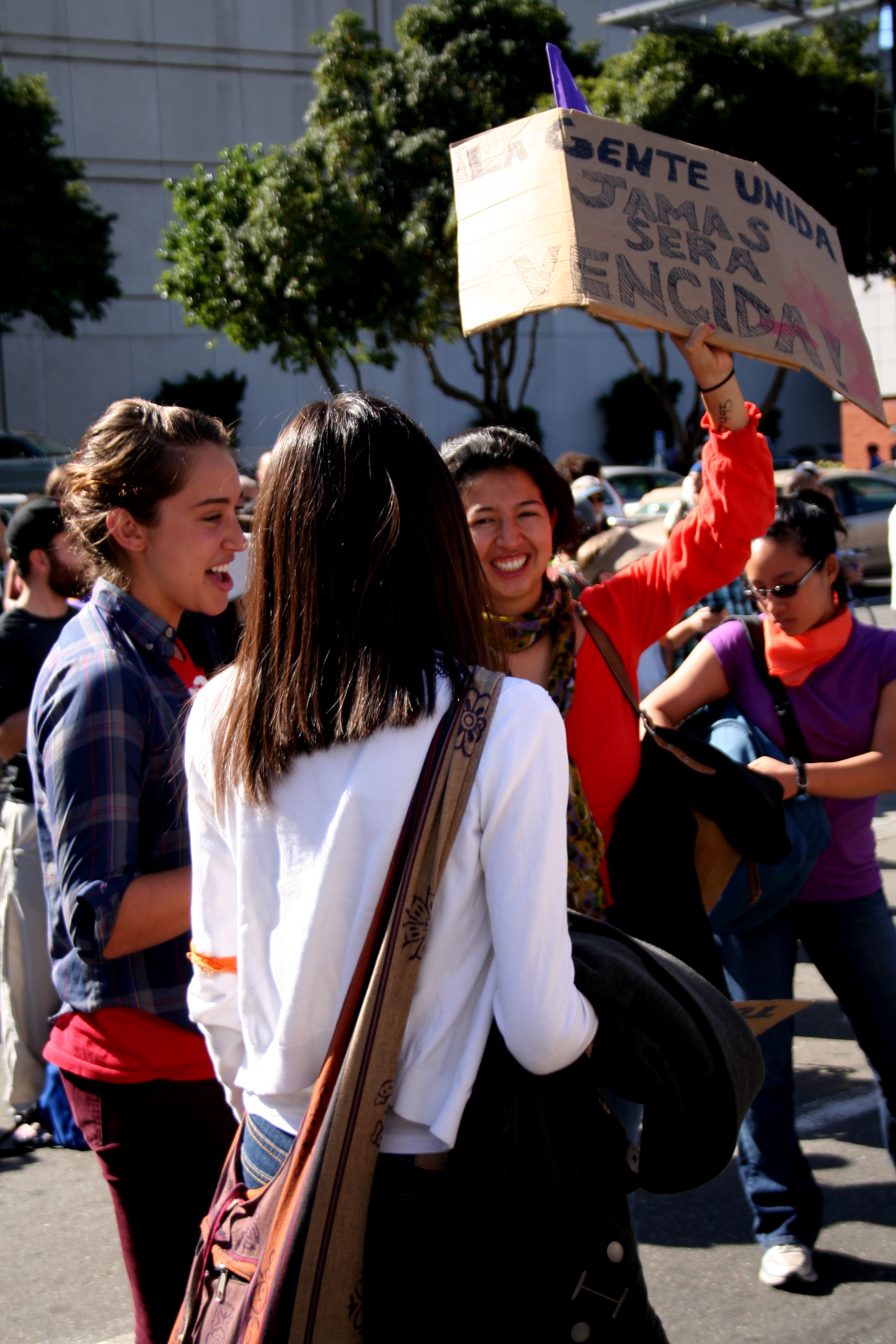
A few fotos from Wednesday: most from my own vantage point (between holding banners, wielding a bullhorn, and passing out flyers . . .) and a few from my friend Cat during the march on Bank of America.
Yesterday, before my eyes, Oakland turned a corner. A successful general strike (or, as Clarence Thomas of the ILWU Longshoremen’s union put it, “the closest thing this generation has seen,”) shut down capital and commerce around the Town, including the fifth largest port in the nation. (And, as I understand it, the port workers went home with pay!)
Busy, busy, busy. Good times. Exciting times. Overwhelming times.
Don’t have many words at the moment; feeling kinda worn out from an East Bay Solidarity Network picket this evening, plus helping a few friends move over the past couple days.
But I can’t let tomorrow’s historic event go without some autobiographical comment! Lol.
So here’s a visual offering of some of the beauty I’ve seen at the #occupy encampments in Oakland and Seattle. (I’ve briefly visited SF’s spot, too, but it was nighttime and my camera takes crappy photos at night.)
These are small-scale, low-key views, observed during the day when not too much was going on: so for the dramatic pics of the GA crowds, or OPD tear gas, or community art made out of torn-down fences, you’ll have to check the news or your favorite political Facebook friend’s feed. :)
This slideshow requires JavaScript.
Since these photos were taken, Oakland’s encampment has been raided, destroyed, and rebuilt. People have been severely injured (though thankfully not killed) by OPD’s “crowd control” methods, the aggressiveness of which reflects and extends their typical, too often lethal aggression in Oakland’s poor Black and brown communities.
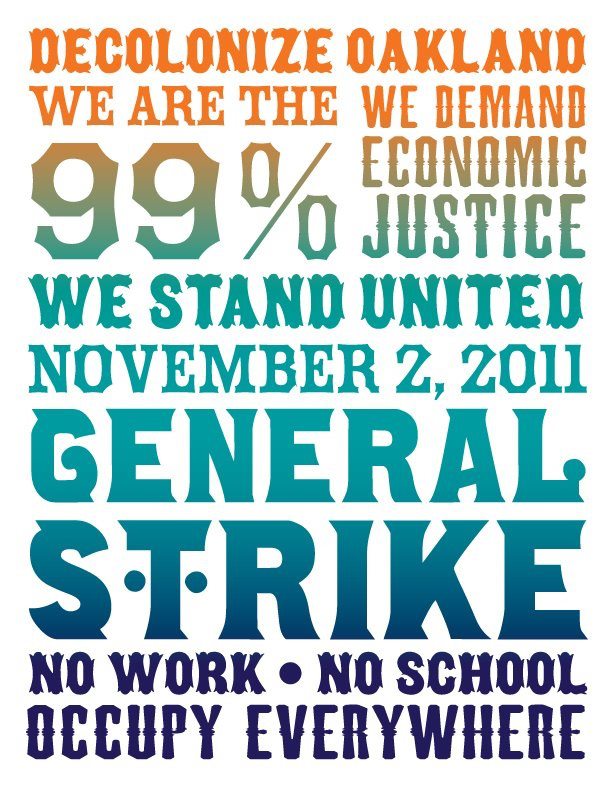
And since these photos were taken, thousands of Oaklanders have taken to the streets, participated in General Assemblies, and worked hard to build support for tomorrow’s General Strike. Solidarity demonstrations have cropped up as far away as Israel and Egypt. And tomorrow, workers will leave work, students will leave school, and we will remind the 1% (and remind ourselves) that WE are the ones who generate the wealth of billionaires, and WE — all of us — deserve food, water, clothing, shelter, clean air, medicine, childcare, freedom from police, deportation, and military terror, and total democratic control over the places we live and work every day. The time for asking for these things is over. It’s time to take them.
That’s all for now, friends. See you in the streets!
Hey folks, sorry for the signal loss! It’s been mad busy around here, partly because of the following little experiment I’m planning, with the help of some good friends. In short, for one afternoon I’m going to try to translate the blog “in real life” (IRL).
The only the IRL ‘blogger’ (or blogger-heavy) gatherings I’ve attended myself have been conferences. Media conferences; technology conferences; things like that. In this type of scene, bloggers from across the country (or among many countries) not only get to expound their theories before a live, half-listening-half-Tweeting audience, but can also lock screen-addled eyes with many writers theretofore befriended — or offended — exclusively online. I’ve seen drama erupt at these idea emporiums, but I’ve also witnessed cyberdenizens leap over tables to greet each other, practically converging midair in an embrace of mutual affection, admiration, and I-can’t-believe-it’s-really-you.
For my own shindig, though, I want to go in a different direction. Very chill, more like a housewarming or offbeat birthday party than a serious networking meet-and-greet. Although there are plentyofonlinewriters and creators I’d love to meet in person someday (and many wonderful ones I’ve already had the fortune to know), most everyone invited to Kloncke IRL are people I’ve known offline for a while. Here’s the email I sent out about it (well, a slightly less colorful version) to my local peeps. Faraway compas, I love you and wish you could be here! My address has been changed for this version because, well, I don’t want it circling around, you feel me? But I’m posting it here because I occasionally meet people in the Bay who’ve read Kloncke but don’t know me personally (yet). If that’s you, shoot me an email, and come on out next Saturday! Love to have you.
dear amazing wonderful human friends.
as most of you know, i make a blog called Kloncke.
i know you know about this blog because many of you have left rad, sweet, insightful, and sometimes hilarious comments there.
i appreciate this a whole lot. i appreciate YOU a whole lot!
and so, as a small means of saying thanks for reading, sharing, linking, and just being your fabulous selves, i want to warmly e-vite you to a gathering in my home, In Real Life (IRL).
what can you expect at such an event?
live incarnates of the cyber version; including:
vegetarian and vegan homemade treats
photographs, available by donation
group meditation
a reading of my recent guest column in make/shift magazine, on buddhism, feminism, and resistance
a “blogroll” table featuring your political, artistic, and spiritual lit to share or display (bring some!)
the colorful walls of our apartment
chillin and building with other lovely folks
Kloncke IRL
Saturday, October 15th 3–5pm (Reading at 4pm) 555 33rd Street, Oakland * * *
this event will be free (of course!) but please bring your own mug or thermos (for tea) and, if you can, a cushion to sit on. (we’ll also have a handful of chairs.) unfortunately our apartment is up one flight of stairs with no elevator or ramp; please let me know if this will be a problem for you, and we can try to work something out.
also, please arrive scent-free so my peeps with Multiple Chemical Sensitivities can come and enjoy themselves without getting sick!
finally, Our place has limited space! Please RSVP so we can have a sense of numbers, and calculate how many walls to knock down.(j/k :) feel free to RSVP-plus-one or two, but don’t roll through with a whole posse. our kitten Eloise will be acting as bouncer, keeping careful track of the guest list.
__
thanks, love, take care, see you soon, be well, and call or e-mail me with any questions,
katie loncke
More to come this week online: the next Newsies post on how the courts are stacked against us, inspired by a frustrating but illuminating experience this morning before a judge. Stay tuned. :)
As with most mainstream tales of the oppressed fighting back (see, most recently, The Help), in Newsies our young working-class heroes enlist the aid of a White Savior: New York Sun reporter Bryan Denton. Now, obviously, most of the newsies are white themselves, so the importance of the White Savior doesn’t lie in a racial differential in this case. But it matters, all the same, because Denton’s whiteness positions him to represent at least a modicum of institutional power. When he takes a sympathetic interest in the newsies’ organizing, he cinches their place in the mainstream media, otherwise impenetrable because Pulitzer has ordered a blackout on the newsies strike story among all the other local papers. Denton’s coverage not only keeps the pressure on Pulitzer and Hearst, but also gives the formerly nameless, faceless newsboys, accustomed to being treated like the scum of the earth, a nice little ego boost — and a set-up for one of the film’s most delightful musical numbers.
But the euphoria of fame and fan-twirling soon evaporate and, in a brilliant and illuminating twist, the newsies discover that the White Savior won’t actually save them. When Pulitzer bribes the owner of the Sun into dropping the story, Denton is reassigned — back to his previous role as the Sun‘s “ace war correspondent.” Feeling betrayed and furious, the newsies try to convince Denton to shrug off his orders, but he explains (accurately): “I’m a newspaper man. I have to have a paper to write for. I’d be blacklisted from every major newspaper in the country . . . you know, sometimes they don’t fire you.”
In other words: as a full-time professional activist, you’re only as radical as your indispensable funders. An apt lesson for today’s non-profit economy, no?
Which brings us to . . .
Lesson Two: Make Your Own Media
In order to win, the newsies need to generalize their strike, to include all the child laborers of New York. And to do that, they need a paper of their own.
Remember when I said that Newsies is a love story of solidarity? These lyrics say it all:
This is for kids shinin’ shoes in the street
With no shoes on their feet every day
This is for guys sweatin’ blood in the shops
While the bosses and cops look away
This is to even the score
This ain’t just newsies no more
This ain’t just kids with some pie in the sky
This is do it or die
This is war!
Once and for all
We’ll be there to defend one another
Once and for all
Every kid is our friend
Every friend a brother
Five thousand fists in the sky
Five thousand reasons to try
We’re goin’ over the wall
Better to die than to crawl
Either we stand or we fall
For once
Once and for all
Part of the mechanism for building widespread radical solidarity has to be independent control of our own literature and media. Because although mainstream media can come in handy as a short-term tool, there’s no way we can consistently rely on it to advance our program for systemic change at the root of capitalism, racism, patriarchy and political economy.
Clearly, there are a million examples of important stories of progressive struggles that don’t make the mainstream headlines. To focus on just one, let’s take the ongoing Occupy Wall Street thing.
Honestly I’m not totally certain, but it seems like the mainstream media was a little slow to pick up on this story. Broadcasts and documentation came to me, personally, through Facebook connections with people who were there, participating, from day one. Eventually, after some police brutality, big news centers started to cover it. And then we got this gorgeous aberration:
* * * * *
But as Newsies teaches us, don’t hitch your wagon to the Major Journalist’s star. As lovely and impassioned as O’Donnell’s piece is, the truth is he’s employed by MSNBC, and the minute they tell him to cut the shit, he will. (Or get canned.)
But that’s no reason to despair. After all, half of that segment consists of on-the-ground media made by people who are not journalists. Even before YouTube, radicals were scrounging for printing presses, strategically taking over community college media organs, and cultivating discourses locally and internationally. And these days, alternative media justice collectives are popping up left and right — while radical collectives continue to blog their hearts out.
Even better than a White-Savior journalist? Media for the movement, by the movement.
How many of you have seen Newsies? Easily the best Disney film ever made. Probably the best Disney film even conceivable. (How — how? — did this get greenlighted?) Based on the true events of the 1899 Newsboys’ Strike, it introduces the newsies as a “ragged army” of poor, plucky orphans and runaways who survive by slanging newspapers in the streets of New York. When journalism capitalists Joseph Pulitzer and William Randolph Hearst collude to expand profits by charging more money to the “distribution apparatus” (a.k.a. these teenage laborers), the newsies, outraged, take inspiration from locally organized trolley workers and decide to go on strike.
They also dance and sing, fabulously.
__
In a dazzling display of preternaturally sophisticated taste (or as part of a steady diet of musicals my mother supplied me at a young age), I became obsessed with this movie following its release in 1992, when I was six or seven years old. I remember sliding in the VHS (I think my parents had taped it from TV) and sitting on the carpet below the screen, transfixed by Jack Kelley (a young Christian Bale), Spot Collins (the dreamy dangerous one from Brooklyn), and the rest of the balletic, rough-and-tumble weyr. To this day, I can belt out any of its numbers and recite large swaths of dialogue.
But I am hardly alone in this devotion. Recent example: a few weeks ago at an outdoor beer garden, a friend of Ryan’s, visiting from Oregon, joined us in the opening bars of “Seize The Day” so tenderly and sparklingly that we drew astonished compliments from a nearby table. “What was that?” the woman marveled. “It was beautiful!”
Indeed, the enduring cultish popularity of Newsies has now inspired an adaptation for theater. Academy-Award-winning composer Alan Menken is teaming up with Harvey Fierstein to translate the turn-of-the-century David-and-Goliath tale from screen to stage. Unfortunately, however, it appears that the new version is doomed to be bled of much of its political nuance, in favor of (you guessed it) the romance angle. Fierstein explains:
“In a musical, there’s an old rule: You must follow the love story. It gives the audience somewhere to go and someplace to rest their hearts.”
This slated snoozeifying shift is tragic, not because its motivations are wrong, but because they are right. You do need a love story. Thing is, Newsies already has one. But rather than the typical hetero-sapfest, it is chiefly a love story of solidarity: of workers learning to trust, defend, celebrate and enjoy one another.
I’ll admit, at six years old I came at Newsies heart-first. The head came later. But it did come. And this film affords ample room to grow into, intellectually.
So, in honor of one of my favorite movies of all time, here goes a series of posts: on the real-life lessons we can draw from Newsies.
Lesson One: You’ll Have To Deal with the Scabs.
__
See that song up at the top?
Hear that part (around 0:50) where Boots asks Jack (the leader):
—”What’s to stop someone else from sellin’ our papers?”
—”Well we’ll talk wit’ em.”
—”Some of ’em don’t hear so good.”
—”So we’ll soak ’em!”
“Soaking” is newsie speak for “rolling up on,” or “beating up.” David immediately chimes in with the typical liberal nonviolent objection: No, we can’t be violent! It’ll give us a bad name!
How this violence vs. nonviolence conflict resolves itself through the film testifies to the realism that elevates the movie beyond fun to fascinating. Spoiler: They do use violence. Why? Because they have to, in order to maintain a hard picket line. And this bears out in the history of labor unions in the United States.
[My father] was a union man. There was a dual union— one for whites and one for blacks. He said we should have one big union but a white and a black is better than none. He was making big money—eight dollars a day. I used to brag that “My father makes eight dollars a day.” But he taught me that “you got to belong to the union, even if it’s a black union. If I wasn’t in the union I wouldn’t make eight dollars a day.”
New Orleans is a trade union town. My father had seen the longshoremen organize and they made a lot of money. Unions were not new to this city. And I mean they had unions! When they came out on strike, there were no scabs. You know why there were no scabs? Because you carried your gun. The pickets had guns and they would blow your brains out.
Real talk. And even though Newsies‘ slightly sanitized brawls depict fists, slingshots, and rotten fruit (the opposing side, with hired Pinkerton types, is armed with much more deadly weapons — chains, bats, and brass knuckles — and backed by police), not to mention the conspicuous absence of racial tensions among the workers, nonetheless, the movie does show them defending their strike from scabs through use of force. Not only shows, but cheers it.
* * *
Nowadays, though? Fighting scabs appears to be taboo: at least in mainstream media. Take the recent and relevant example of the ILWU strike up in Washington.
Longshore workers have shut down ports in the Pacific Northwest as they confront a scab grain terminal operation, block trains, dump grain shipments and stand up to a police attack on their picket lines.
Just two days ago, workers (including the local longshore president) and supporters (mostly women) blocked another train from entering the EGT grain terminal. Police responded with mass arrests and liberal application of pepper spray.
Bill Wagner / The Daily News. Law enforcement personnel wrestle ILWU Local 21 longshoreman Kelly Muller to the ground as they arrest protesters and try to clear the tracks so a Burlington Northern-Santa Fe grain train can pull into the EGT grain terminal at the Port of Longview on Wednesday morning.
For mounting these defenses, these workers are pilloried as “thugs” and “goons.” A CNN reporters openly laughed at them. Other reporters deny that the ILWU is fighting true scabs at all, claiming that this all boils down to pig-headed union-vs.-union beef. (David Macaray debunks that argument handily.)
Courts, meanwhile, find the ILWU in contempt: which happens in Newsies, too. In fact, one of the film’s greatest political strengths, in my mind, is how it shows the institutional and corporate-backed violence not only matching but outstripping the workers’ use of physical force. Put in this context of severe power imbalance and active repression, the viewer naturally sympathizes with the newsies’ self defense, even if it is technically “criminal.”
But we’ll save the legality subject for the next post in the series.
For now, I am curious, especially from the Buddhist/spiritual folks who live in commitment to nonviolence: how do you propose dealing with scabs? When workers organize to halt production and the company predictably pushes back, what levels of strategic property destruction and physical force, if any, do you find legitimate? Have you ever been in such a situation? (For the record: I haven’t.)
Share your thoughts, and take care. See you next week with more Disney labor lessons!
Three humor videos with fearsome subtexts: about “throwing away” our old material (and perceptions of self — hello Buddhism); economic violence and growing up poor and Black in a food desert in the U.S.; and . . . well, while there’s nothing inherently sad or scary about being hard of hearing / deaf / Deaf / fluent in sign language, but watching it pushes me to consider how, for every hearing person who enjoys and appreciates it, there are countless events that remain stubbornly inaccessible to non-hearing folks.
Case in point: the other two videos in this post.
If I’m being honest, I feel like I don’t have time to make transcripts for the other videos. If I’m being really honest, I mostly just don’t feel like doing it.
[Fast-forward an hour of wandering the internet aimlessly, feeling background-guilty about not writing transcripts, and noticing a stream of thoughts that justify why I don’t have to do it.]
[Now starting to write transcripts. Hey, this ain’t so bad. Kinda fun, actually. Helps that these two ppl are talented.]
Selected and /or outlined transcripts below the jump. Imperfect.








 Kloncke