To make it clear I am against discrimination of any kind, but to oppose the oppression without analysis of the fight back is not scientific and not conducive to progressive results. A similar case can be found in the debate over “Don’t Ask Don’t Tell.” (DADT) Of course I want equality but I also will not hold back in discussing that entering the army means entering an institution, bankrupt of morality, that serves as the state imperialist arm as it seeks to find capital through expansion, genocide, and exploitation. We must have open criticism to have a successful movement, because all oppression and exploitation is connected under the world capitalist system and we cannot afford to gain at the cost of others.
Does this now mean that I am against gay marriage and should join the West Borough Baptist Church as the claim that god hates fags? No. That’s the same foolishness and dogma, which draws these “pro gay”/ “anti gay” binaries, that has kept the discussion and critical thought at a minimum. This entire posting merely means that I am against the state objectification of social relations for the strengthening of capital. If people choose to couple monogamously that is their choice as is the opposite. However, bourgeois society has conditioned us to think negatively of the latter and believe that the former is perfected in a union under the state. And since the battle for liberation is also a battle for transformative thought, it is a dis-service to the movement to remain silent.
You keep using that word. I do not think it means what you think it means.
Last night, at a Berkeley fundraiser for the East Bay Meditation Center, prominent Insight meditation teacher Joseph Goldstein gave a general talk on Buddhism, and as he spoke in his gentle, warm, candid, funny, luminously clever way, I felt a familiar tightening in my stomach.
The talk started out like this. There is tremendous suffering in the world. It’s not hard to see. War, oppression and destruction. But if we look closely, we find that the root of that suffering is in the mind. Greed, fear, and hatred. And it’s not just “other people” who have this greed, fear, and hatred; it’s us, too. Therefore, using Buddhist teachings, we turn our attention inward toward the mind/heart, healing suffering from the inside out.
Later, when asked whether his Buddhist practice could be formulated into a plan for social change, Goldstein said Yes: through compassion. Not a simplistic type of compassion, but a compassion that is born out of nearness to suffering. This is more difficult than it sounds, he noted, because our deeply ingrained habit pattern is to try to push suffering away from ourselves. Get rid of it. But in order to have strong, profound compassion, we need to go toward suffering. Without romanticizing it, but seeing it for what it is.
Now, I like Joseph Goldstein. I saw him speak once before at the Cambridge Insight Meditation Center, and he’s hilarious and wise and a gifted storyteller. And on one level, I agree with what he said last night.
The problem, for me, was what went unsaid.
As Buddhists and dhamma practitioners, I would love to see us having more conversations about what compassion and social change actually look like: locally, on the ground, in practice. Because it’s too easy for us to invoke these words — compassion, inner work, social change — and assume that everyone is on the same page.
The truth is, we’re not all on the same page. And it’s not until after the event is over, on the subway ride home, when a gaggle of us start discussing in detail the relationship between inner and outer work, that these fundamental differences emerge, sharp and cold, like mountain peaks, from the soothing golden fog of Buddhist unity.
Here are a few of my disagreements with what I hear as spiritual liberalism, coming from my friends in dhamma. Again, even as we all work toward developing compassion and reducing global suffering, we have tremendously divergent views on what this means.
1. Mystified Mechanism.When we start doing the inner work of developing compassion and insight, our outer social justice work will automatically get good.
How? Sometimes folks talk about spirituality helping to reduce burnout, or converting the motivation of anger into the motivation of compassion. But while both are wonderful benefits, neither speaks to the testable effectiveness of the particular outer work itself.
2. Healing As (Total) Resistance.Smiling at strangers on the subway is resisting militarism.
Well, I disagree. Our healing work, spiritual work, and structural resistance work ought to inform each other, but they are not interchangeable substitutes. Mandela didn’t inspire a movement and challenge the status quo just by praying compassionately for the liberation of the oppressor. (Though he did that, too.)
3. Social Change Relativism.Together, a growing movement is working for peace and justice in the world. From green business to prison meditation to high-school conflict resolution programs on MTV, signs of hope and change abound.
Are all forms of progressive activism equally useful? No. But the shorthand of social change frequently obscures this fact. Coupled with a feel-good engagement paradigm, the ‘every little bit helps’ idea makes it very difficult to hold each other accountable for our political work and its actual outcomes.
4. Root vs. Radical.Radical political agendas fail to grasp the root cause of oppression: dualism. And ultimately, the best ways of overcoming dualism are through meditation and small-scale, intimate, interpersonal, compassion-building exercises.
Even if dualism is the “root cause” of oppression, that doesn’t make it the best or most actionable point for resistance, always. Besides: why is this idea of dualism so pervasive and tenacious, anyway? In large part because of the political and material structures (i.e. schools, economies, hierarchical religious institutions) that train human beings. Without changing the power relations governing those material structures, there’s little hope of giving non-dualistic living, and appreciation for inter-being, a real shot on a global scale.
5. Buddhopian Visions.Gandhi said it best: “Be the change you wish to see in the world.”
Often, this gets construed to mean: build the best alternative society you can, and slowly it will change the entire society. Especially in Buddhist communities that prize extended retreat time, a decade of study with a realized Asian master, and this sort of removal from everyday householder affairs, there’s a danger of trying to build our sanghas into utopias, and assuming that they will automatically radiate peace and well-being into the world. Might be true on an individual or small-group level, but why should we believe that we can scale up well-being from personal transformation to world peace, without specific strategies for tackling enormous material systems?
————————
Compassion lies at the core of the dhamma, one of its most beautiful and powerful dimensions. But when we treat it as self-evident in conversations about social liberation, putting it at the end of the sentence instead of the beginning, I fear we do great injustice to its meaning.
Looking forward to finding and contributing to a radical sangha in the Bay Area whose work extends beyond the healing, service, electoral-political and identity realms. (Where dhammic folks are already great and strong.) Any leads?
It’s worth reading the entire A/S thread, but I thought I’d copy my piece here since it speaks to my 9-month experience at the Faithful Fools. (Damn, that long already?) A truly wonderful, radically humanist group, rare among non-profits in terms of the depth of its sustained connection to individuals in a community.
Ever since I started living and working here, I’ve wondered what kind of political organizing might take shape in the TL. In San Francisco lately there’s been some solid direct action around occupying empty buildings on behalf of eviction victims and homeless folks. At the same time, most people I see here are basically just struggling to survive and heal. Which, as I say in the comment below, deserves respect and recognition.
Thanks for posting this here — and thanks to Deluche for writing it.
I’m appreciating all the analysis from Icarus and a comrade. Much to think about.
Apart from the political-economic analysis, another current I was seeing in the original post is some attention to the lived experience of tremendous suffering that is happening in “surplus populations” within US urban ghettos, and their overlap with the working class.
Like Deluche says, without blaming or taking out anger on individuals within surplus populations, we can see the ways that being forced to live outside of a formal, legal economy — chronically unemployed, corralled, imprisoned — would (a) foster desperation and (b) support self-medicating addictions, both of which extend a chain of violence.
I don’t know enough about proper definitions of “lumpenproletariat” or surplus populations to comment on Icarus’ objection to an overly narrow focus on drug dealers and sex workers. But to speak just on my own experience living and working in the Tenderloin neighborhood of SF with a homeless community: criminalized addiction, exploitative sex work (amplified by transphobia), and stigmatized mental illness are definitely major factors dominating the scene around here.
At the same time, along with this enormous suffering and harm is the potential for astonishing healing. I haven’t even been working here that long (9 months), and already I’ve seen some incredible, long-time-coming shifts. Folks choosing to move forward in addiction recovery, dealing with depression and PTSD, making beautiful art, showing great generosity to others, and getting their feet on the ground — largely because a group of people stood by them and for years showed committed care, love, and faith in the face of an entire society that tells them they’re worthless and, yes, “parasitic.”
This kind of healing, even on an individual or small community level, is quite inspiring. Can we allow it to inform revolutionary organizing? Can we allow it to illuminate the healing work already taking place (often un-compensated and un-heralded) within the working-class itself, buttressing its power for economic and social transformation?
Seems to me that it’s easier for folks to dis those with no labor-power leverage when we take revolution of capitalism as the sole redemptive struggle in life. In truth, revolutionaries interested in building a better society for humans, animals, and the earth might benefit from learning about the inter-related struggles and healing among the ‘lumpen.’
A sunset basketball game outside St. Mary's, volunteer headquarters for Common Ground Collective, Summer 2006
New Orleans, nine months post-Katrina. Within days of my wide-eyed arrival at the volunteer headquarters of Common Ground Collective, housed in an abandoned three-story school in the Upper 9th Ward, I learned that alongside all the vibrant, sun-browned enthusiasm for “solidarity, not charity,” and in addition to the haunted feeling of the classrooms — stopped clocks and wrecked bulletin boards; cots and duffel bags where desks and backpacks used to be — something was wrong.
For months, there had been a spate of sexual assaults against volunteers.
I joined a small ad hoc group of women to develop a policy for response and accountability. Didn’t really go anywhere.
For one thing, we were told (by male leaders) that “this is a war zone” and “we have more serious problems to deal with,” like Black men being rounded up or killed by state police. For another, we were advised (by male leaders) that the best way to deal with sexual assault was to tighten up security around the school. Not allow strangers on the premises. Issue makeshift ID cards to all registered volunteers. In other words, beware of random locals roaming in off the streets for a free meal, company, or a drink of water. This even though the vast majority of reported sexual assaults were white-on-white, volunteer-on-volunteer.
In a terrific article originally published in make/shift magazine, Courtney Desiree Morris cites this very same Common Ground conflict as an example not only of inadequate response to intimate violence in activist communities, but of dangerously fertile ground for informants and informant-style behavior.
Self portrait in St. Mary's
Informants are sent by the state (FBI, CIA, etc.) to infiltrate radical political groups, gather information, and stir up trouble from the inside. (Case in point, Morris writes: white activist Brandon Darby, whose exposure as an FBI informant I remember particularly well, since he had worked closely with some of my friends at Common Ground before moving on to Austin.)
And in some respects, gender oppression acts like a miner’s canary for infiltration, signaling danger to the entire group.
Because of the pre-existing social terrain, Morris observes, if infiltrators are going to disrupt, poison, and commandeer, chances are they’ll do it in ways that intentionally or unintentionally reinforce heterosexist culture. Ways that are anti-woman, anti-queer, domineering and transphobic. Even if that’s not their primary goal, it comes with the territory — thanks to the patriarchal leadership styles, both stark and subtle, pervading much of Leftist culture. Sexist, racist harm is an almost inevitable byproduct of any serious state attempt to corrode radical communities from the inside out.
Besides, even if they’re not employed by the state, when people enact gender violence in revolutionary communities they are achieving the state’s objectives all the same. As Morris puts it,
Most of those guys probably weren’t informants. Which is a pity because it means they are not getting paid a dime for all the destructive work they do. We might think of these misogynists as inadvertent agents of the state. Regardless of whether they are actually informants or not, the work that they do supports the state’s ongoing campaign of terror against social movements and the people who create them. When queer organizers are humiliated and their political struggles sidelined, that is part of an ongoing state project of violence against radicals. When women are knowingly given STIs, physically abused, dismissed in meetings, pushed aside, and forced out of radical organizing spaces while our allies defend known misogynists, organizers collude in the state’s efforts to destroy us.
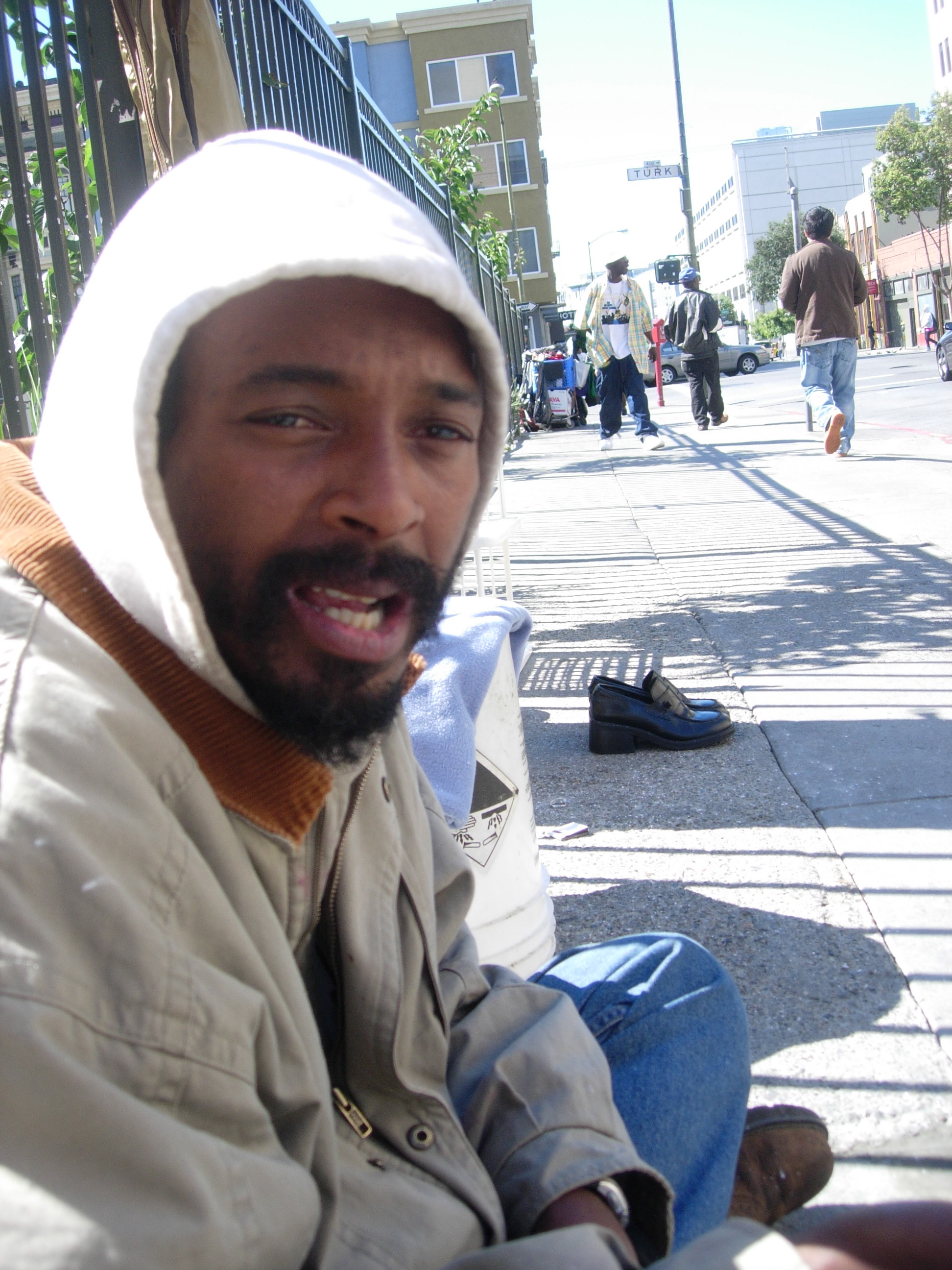
A little before 10 this morning I’m headed down the block to the donut shop to pick up our weekly Thursday dozen-and-a-half for interfaith Bible Study. And on my way back, just a few doors down from home, I see a man sitting on the sidewalk, spreading pennies on the ground and dusting them with baby powder.
“Fresh, clean pennies! One for a nickel!”
I couldn’t help but laugh. Now who could pass up a deal like that? So I ran inside, grabbed a nickel and my camera, and was treated to a long conversation with the salesman, a sweet guy and born storyteller who calls himself Hobo Joe.
Turns out we'd met on the block before and warmly recognized each other. Love when that happens.
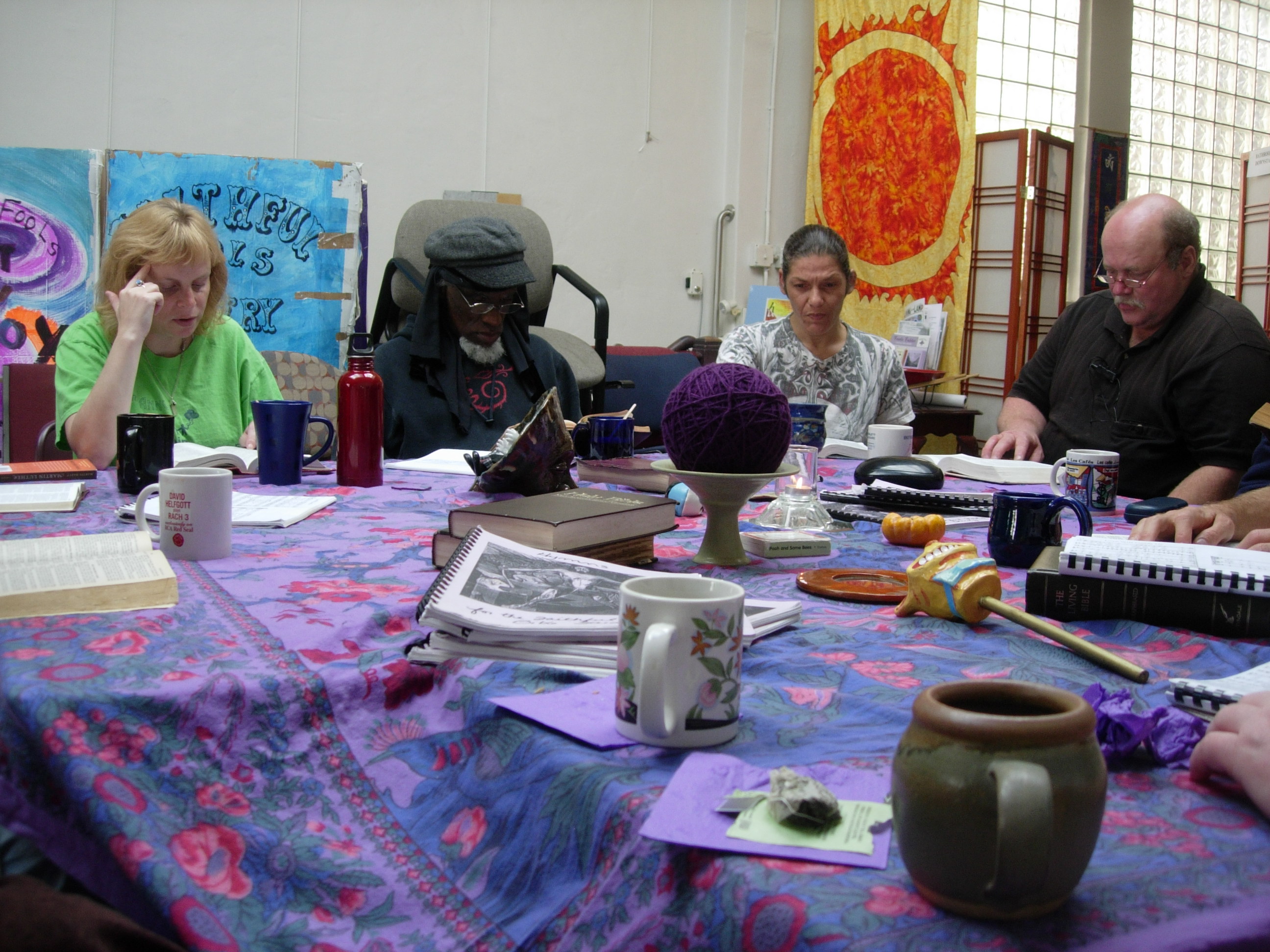
And Bible Study was beautiful, too: all the familiar faces, laughing and singing and sharing from our various Christian, Jewish, Buddhist, pagan, and Unitarian Universalist perspectives.
For those who’ve recently tuned into Kloncke, I should explain that I both live and work at this community center/homeless outreach nonprofit/street ministry called Faithful Fools. So Thursday morning Interfaith Bible Study (which follows the morning meditation in our downstairs Street Zendo) is both work and home for me.
From left: Abby, Ra Mu, Gina, and Bobby
Don’t know what brought it on, but I felt especially lucky and honored to be here this morning.
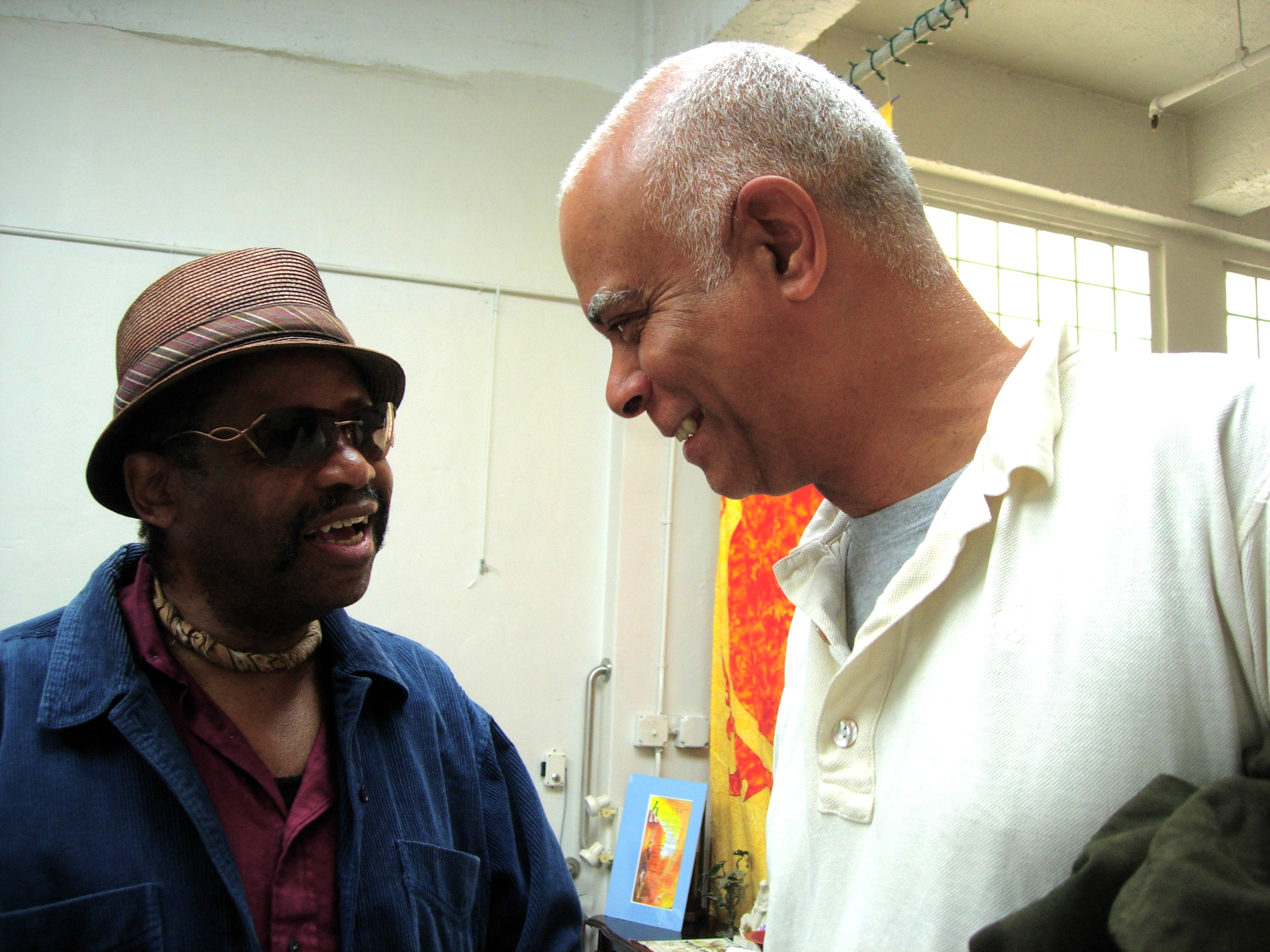
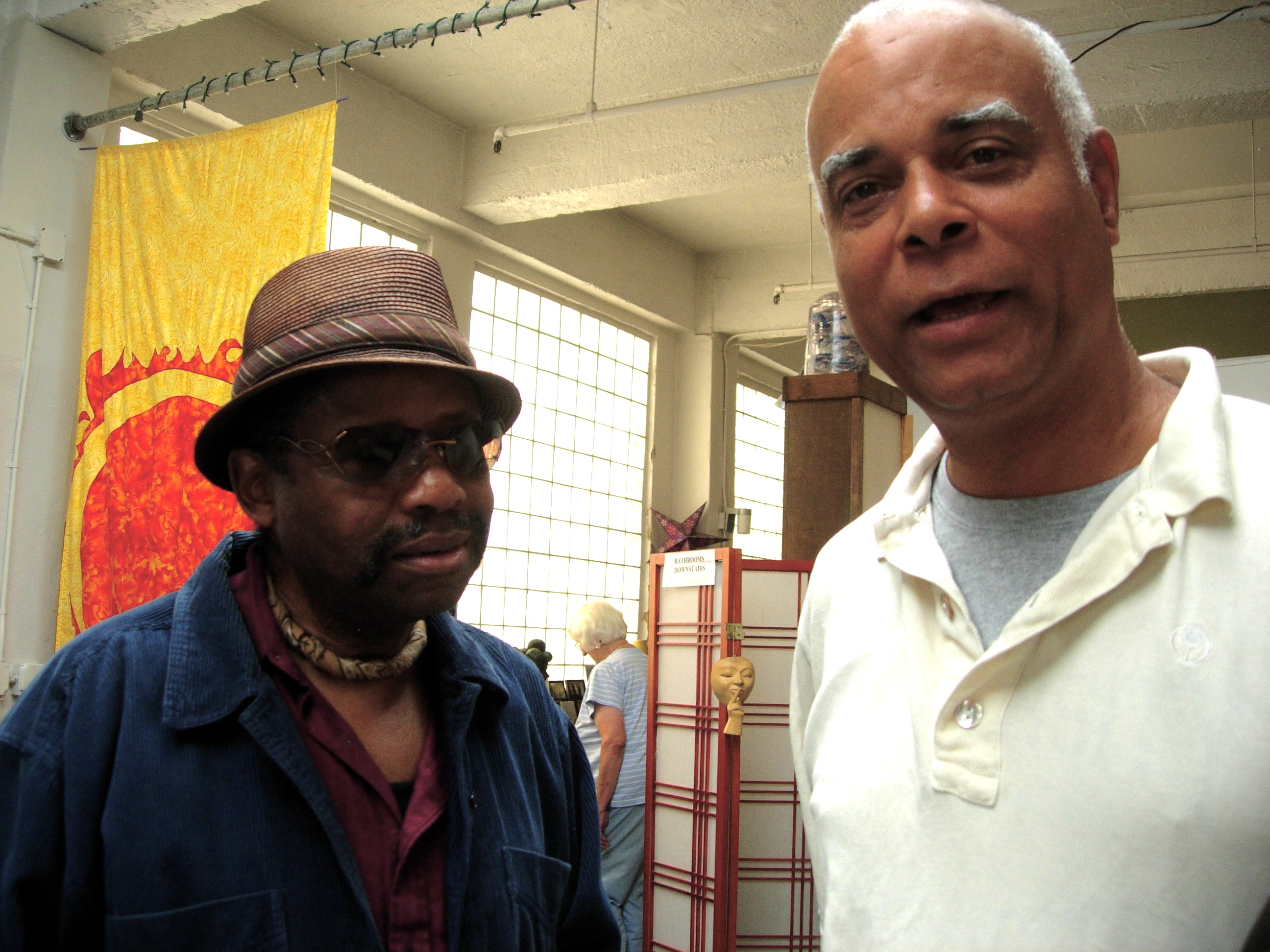
JR and Charles causin trouble as usualTwo great artists, philosophers, theologians, and very cool cats.
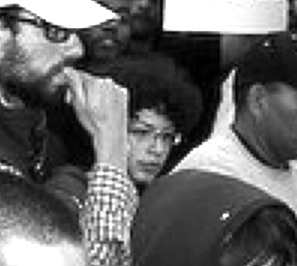
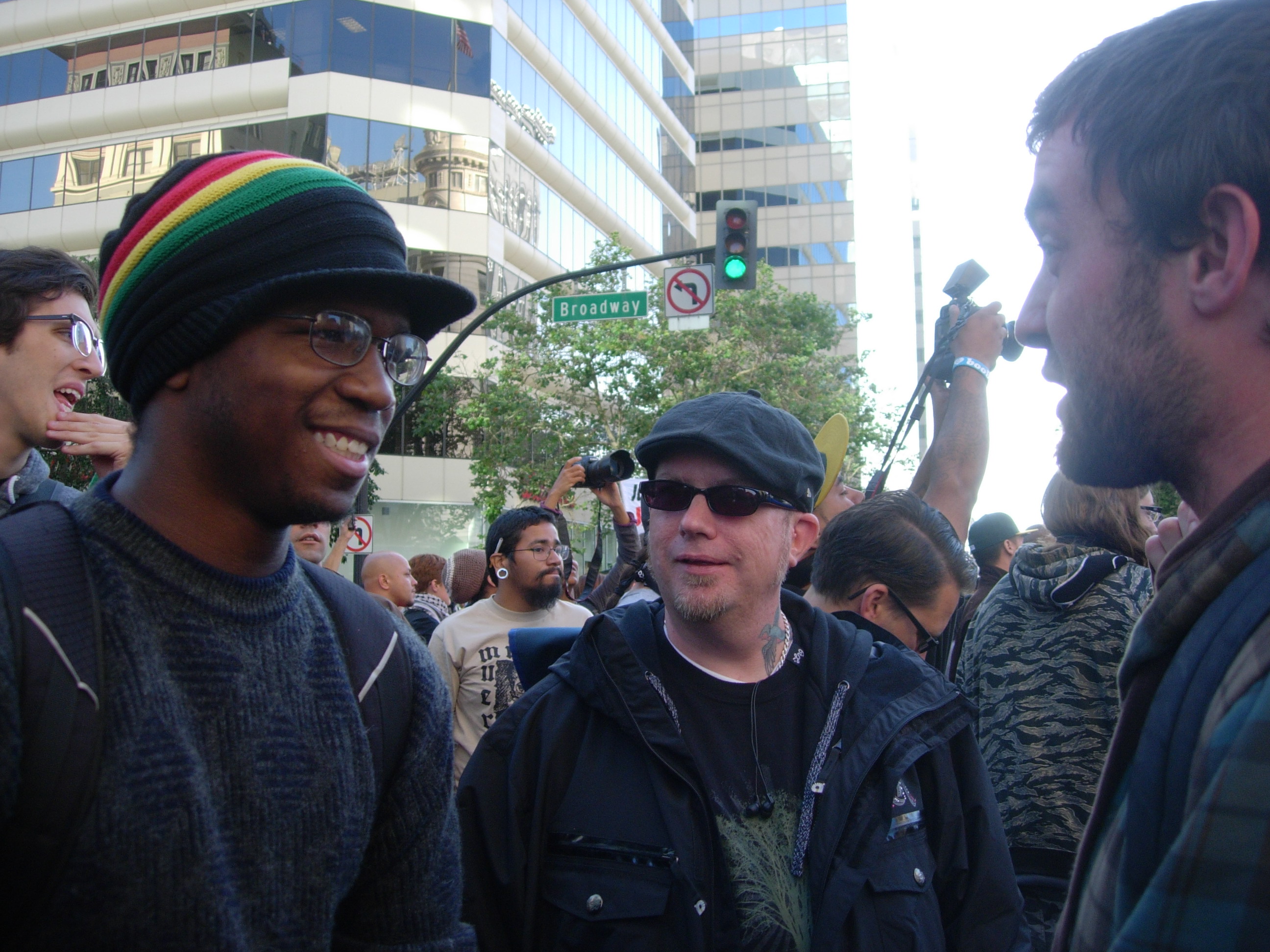
Me last week at the Mehserle verdict demonstration, among a crowd facing an enormous swarm of riot police; my dad in 1969 at Cornell University, when a group of Black students armed themselves and took over a campus building.
Not that the two situations are comparable in terms of danger, of course — it’s a miracle the Willard Straight Takeover didn’t explode into a bloodbath, whereas in Oakland, despite all the state weaponry, I never really believed that the cops would kill us right there on the spot.
But what an uncanny visual of a family lineage — the twin furrowed brows, the calm mouths, the keen watchfulness. Taking it in. Trying to solve the problem at hand, to find a peaceful but effective way forward.
There’s a story here about non-dualistic inheritance: a story about how none of us is really our own discrete self. How each individual, living in the present moment, also spans generations into the past. Reading Thich Nhat Hanh’s Teachings On Love last year brought this idea home for me for the first time. The subtle ways we manifest traumas, neuroses, wounds, strengths, and gifts from our ancestors.
Cross-posted at Feministe. As the verdict approaches, I find myself thinking more and more about the relationships between state violence and intimate violence. In what ways our focus on state violence, and mechanisms for resisting it, jive and don’t jive with methods for dealing with intimate violence. Aaron Tanaka made a wonderful comment on the original post — as always, Aaron, I’m truly grateful for your insights and questions, and their organic connection to the great work you do.
Just yesterday, only 20 minutes after a conversation about police alternatives, as my friend Noa was dropping me off at home, we found ourselves in an impromptu cop watch. Four officers were arresting three men on my block — two of whom I recognized as regulars on the corner, and one with whom I’ve tossed a football across Hyde Street traffic. When I saw the cops lining the men up against the fence, I just stepped out of Noa’s car onto the sidewalk and inserted myself. After one of the officers attempted to intimidate Noa by calling in her plate number (we’d been stopped and talking in the car inside a red parking zone), she drove around the block, parked, came back and joined me for the next half hour as we watched these three men get yelled at, cuffed, and loaded into a police van.
I’ll maybe write up a full summary tomorrow, because the effect of our intervention on the cops’ behavior was pretty interesting, as well as the conversation we struck up with two male officers. For now, here’s my Feministe piece from Sunday.





 Kloncke