[Today, former BART police officer Johannes Mehserle was sentenced to 2 years in prison, with 146 days already served, for the involuntary manslaughter of Oscar Grant. The Grant case marked the first time in California’s history that a peace officer was tried for murder.]
Whereas
We as women, transgender people, two-spirit people, queers, gender-oppressed people, and allies of the Bay Area mourn the loss of Oscar Grant;
Whereas we recognize that this young man was just one of countless victims of police violence;
Whereas we understand and experience police repression, particularly in poor, queer, and working-class communities of color;
Whereas we know that police violence both enables and enacts rape, brutalization, and degradation;
Whereas police violence compounds the dangers we face in domestic violence, sex trafficking, and homophobic and transphobic hate crimes;
Whereas police enforce the criminalization of our disabilities, addictions, and mental illnesses;
Whereas police enforce the criminalization of our skin color, sexualities, style of dress and speech, gender identities, religious practices, and nations of origin;
Whereas police violently enforce our subservience to an economy that enriches elites, while slaughtering, starving, sickening, and stealing from us as workers, child-rearers, and culture creators;
Whereas the rich and influential deploy police to violently crush our efforts toward self-determination, from queer social spaces to workplace strikes;
Whereas the rich and influential deploy police to kill or capture our leaders and heroes, like the recently deceased political prisoner Marilyn Buck;
Whereas police are employed to do as they are ordered;
Whereas police violence comes 10% from individual bigotry and improper training, and 90% from a capitalist state system designed to protect property, not people;
Whereas such a property-focused police system, controlled by the rich and influential, enacts and supports gender-based and sexual violence;
And Whereas such a system can never be adequately reformed, based as it is in the fundamental inequality borne of a patriarchal capitalist system:
We maintain compassion for individual police officers who both experience and inflict suffering; who face and enforce mortal danger.
We vow, in the effort to end sexist violence throughout the world, to eradicate the police system of the United States as we know it; and to transcend the misogynist capitalist system that demands this type of policing.
We undertake this mission with no hatred in our hearts toward individual police officers or those who support the police system.
We accept this responsibility out of love for all people, and the unquenchable desire for universal freedom and equality.
In the service of this calling, we will sing, strike, fuck, fight, rest, write, rebel, and rebuild until we achieve liberation for all beings.
And all I want to do is read and eat pesto soba noodles.
So I will quote extensively from Pema Chödrön (recent celebrated guest teacher in San Francisco) in one of her famous books, When Things Fall Apart.
These piece in particular helped me considerably during the street retreat last week.
It’s as if you just looked at yourself in the mirror, and you saw a gorilla. The mirror’s there; it’s showing you, and what you see looks bad. You try to angle the mirror so you will look a little better, but no matter what you do, you still look like a gorilla. That’s being nailed by life, the place where you have no choice except to embrace what’s happening or push it away.
Most of us do not take these situations as teachings. We automatically hate them. We run like crazy. We use all kinds of ways to escape—all addictions stem from this moment when we meet our edge and just can’t stand it. We feel we have to soften it, pad it with something, and we become addicted to whatever it is that seems to ease the pain. In fact, the rampant materialism that we see in the world stems from this moment. There are so many ways that have been dreamt up to entertain us away from the moment, soften its hard edge, deaden it so we don’t have to feel the full impact of the pain that arises when we cannot manipulate the situation to make us come out looking fine. [13]
So many times, even in one single day, the situation is not the way I would like it to be. I do not act or appear the way I would like to. How do I respond in those moments?
I remain amazed at how much the pillars of (a) everyday metta practice and (b) sitting meditation help me to greet these gorillas, these frustrations and disappointments, with patience, curiosity, and more friendliness. Not to excuse them, or take them out on other people, but just to hang out with them for a while.
Feelings of fraudulence.
Inconvenient sexual tension.
Restlessness.
Irritation.
Wanting political struggle in the Bay Area to be something other than it is.
Fearing being wrong more than I fear causing harm.
I probably won’t be updating Kloncke for the next week or so, and that’s because, for my second time, I’ll be joining the Faithful Fools in their annual Street Retreat: seven days and nights living, sleeping, and reflecting in the streets of the Tenderloin neighborhood, in San Francisco.
Coming to terms with the street retreat as a reflective and humanizing practice has been difficult for me. To be honest, I still feel significant resistance to the idea. Fortunately, though, over the past few weeks I’ve been able to sit with this resistance and discomfort (a time when the dhamma practice has come in handy), talk with friends and other Fools about it, and work through it in a positive way.
Before getting into my reservations and reconciliations, here’s a nice, basic description of what the street retreat, from fellow Fool intern Josh Mann:
Starting this Saturday, I will be participating in my first week-long Street Retreat through the Faithful Fools. I’ll be leaving my money, cell phone, and keys behind and taking a sleeping bag and backpack. I plan to sleep outside and eat mostly in soup kitchens, and I anticipate a lot of searching for public bathrooms. Twice a day, I’ll be meeting up with eight to ten other people to reflect on the experience. And, some of us will be sleeping as a group.
Part of the mission of the Faithful Fools is to “participate in shattering myths about those living in poverty” and to help people discover what is common to all of us regardless of our economic standing or housing status. As a Street Retreat participant, I am asked to reflect throughout the retreat on what keeps me separate from others as well as what connects me.
Ever since my first term in college, I have felt compelled to engage the social issues of poverty and hunger, and I expect that this retreat will help me better understand these issues including the way that public policies, laws, and urban planning affect people with little to no money.
At the same time, the founders of the Faithful Fools put great emphasis on the fact that we are not pretending to be homeless. I will begin the retreat knowing that it has a specific end time on Saturday, October 30th. It also seems important for me to acknowledge that I go as an able-bodied, college-educated U.S. citizen who is white, male, and straight, which will no doubt be a factor in both how other people respond to me and how I experience the streets.
Please keep me in your thoughts this week. I seek to know my own heart, and I need all of the help I can get. I also invite you to participate with me in some way or another wherever you are. I recommend setting aside a little time one day to wander and see who and what you encounter. The spirit of this retreat as I understand it is to meet more deeply the people and places that we sometimes hurry past.
So there’s a little bit of background. As you can see, the retreat is not a study or experiment, nor is it a gimmick for “playing homeless.” The spirit is one of renunciation. We wouldn’t fast in order to “understand what it’s like to be a starving person,” but in order to push and expand our own views of the world we inhabit right now, as we are. It’s not about appropriating or trying on someone else’s experience (the simplistic idea of “standing in someone else’s shoes”), but about peeling off the layers of ourselves, the skins thickened by routine and dualism, that pervert our own views of reality — including our views of ourselves.
What had been bugging me so much, I think (and it disturbed me so strongly that I very nearly backed out of the whole thing), wasn’t the idea of the street retreat itself, but its purported connections to mechanisms of social transformation. I’ve talked on this blog before about what I see as the dangers of believing in a method for changing the world one mind at a time. This approach rightly observes that human social “systems” are made up of individual people, but wrongly induces that these systems are therefore merely the sum of their parts, and that persistent hearts-and-minds education can eventually (through influencing voters and “those in power”) translate into large-scale fundamental social improvements.
I disagree with this approach for various reasons; now isn’t the time to go into ’em. Suffice it to say, now that I’ve managed to decouple the reflective, community side of the street retreat from positive claims about its structural effectiveness, I feel a bit calmer about participating.
One common concern about street retreats is that we are “taking away resources” from people who need them, by eating in soup kitchens and sometimes sleeping in shelters (if we can get in). I sympathize with the concern here, but the way I see it is: we do far more to support poverty and homelessness through our everyday complacency with the capitalist system than we could possibly do by individually taking a couple dozen free meals. The scarcity (of beds, less frequently of food) is artificial.
Another frequent worry, especially from my dad: YOU ARE GOING TO GET YOURSELF KILLED. IT IS DANGEROUS OUT THERE.
Don’t worry, papa. (And others.) From my observation over the past year, there is little danger of random violence on the streets of the Tenderloin. The main types of violence we see here are (1) interpersonal violence among acquaintances, (2) low-level police violence in the form of harassment and enabling rape culture, and (2) structural violence, like the abovementioned artificial scarcity that keep families homeless while apartment buildings sit vacant for years, or the racist, sexist, homophobic criminalization of mental illness and drug addiction.
I guess both of these ‘responses,’ intended to allay fears, kind of sidestep the issues by pointing out how they are dwarfed by larger problems. Well, that’s sort of how it goes for me, at the moment. We’ll see if any more insights come during the week.
Wish me luck! I will try to log some time on the computers in the public library, but the lines are generally long, the connections slow, and the time limits brief.
Some of the smartest people I know — including my friend Ivan, and what I’ve read/heard by Suzuki Roshi — excel at failing. They know how to fail in ways that allow the flow to continue, if you know what I’m saying. The failure is not crippling, but just part of taking on a difficult challenge. Generally speaking, I think that people with scientific minds (including serious meditators) are pretty good at failing happily. Failing in ways that reveal new opportunities, even as they foreclose the ones we thought we wanted.
Endeavoring to improve on my ability to fail doesn’t mean tackling tasks that seem doomed from the start. That would be too easy! The kind of failure I’m talking about does not come cheap. I am invested. I want to succeed. Each attempt, each step, is made with confidence, commitment, and openness.
Suzuki Roshi says that this is how we move toward enlightenment. Through repeating small moments of enlightenment — those moments of a letting-go mind, a mind that is being, not chasing — while at the same time working hard to deepen and strengthen our practice.
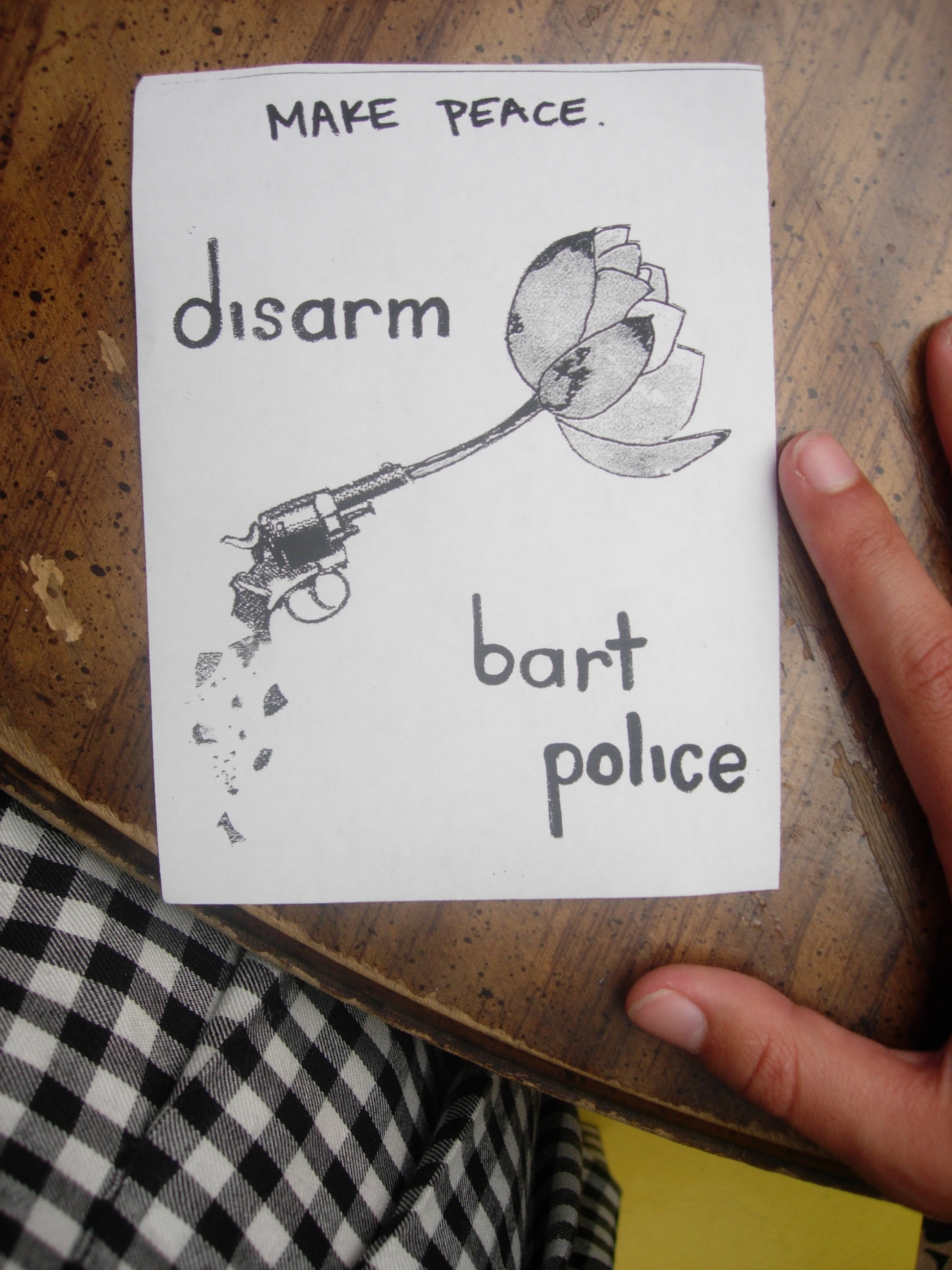
I hope this is somewhat clear, what I’m trying to say. As an example of a recent, happy failure of mine, I wanted to share a letter I wrote to all the people I’d talked to with an interest in building a disarm BART police campaign. My intention in sending it was (1) to let folks know that I would no longer be pursuing the courses I’d proposed (for instance: organizing a direct action of civil disobedience for the day of Mehserle’s sentencing), and Why; and (2) to thank them for the inspiring connections we’d made in the course of the (eventual) failure.
It felt good to write this letter, not only because I have a lot of admiration and goodwill toward each of the recipients (including those with whom I disagree politically), but also because it was an exercise in observing and accepting reality as it is — rather than as I would like it to be. A little inroad into rooting out dukkha.
I’d love to know your thoughts, resonances, and criticisms.
Hello everybody,
Hope this note finds you well!
Over the past couple of months, I’ve been talking with BART workers, Oscar Grant movement organizers, Oakland peacekeepers, Marxist feminists, reverends, priests, meditators, lawyers, non-profiters, poets, anarchists, communists, peace activists, radicals, progressives, friends, and random strangers about the possibility of coalescing a campaign toward disarming the BART police. I and others envisioned this as one small step in aiding a shift from weaponized, racist, capitalist-serving security culture toward community-controlled safety initiatives, dual power, and restorative justice.
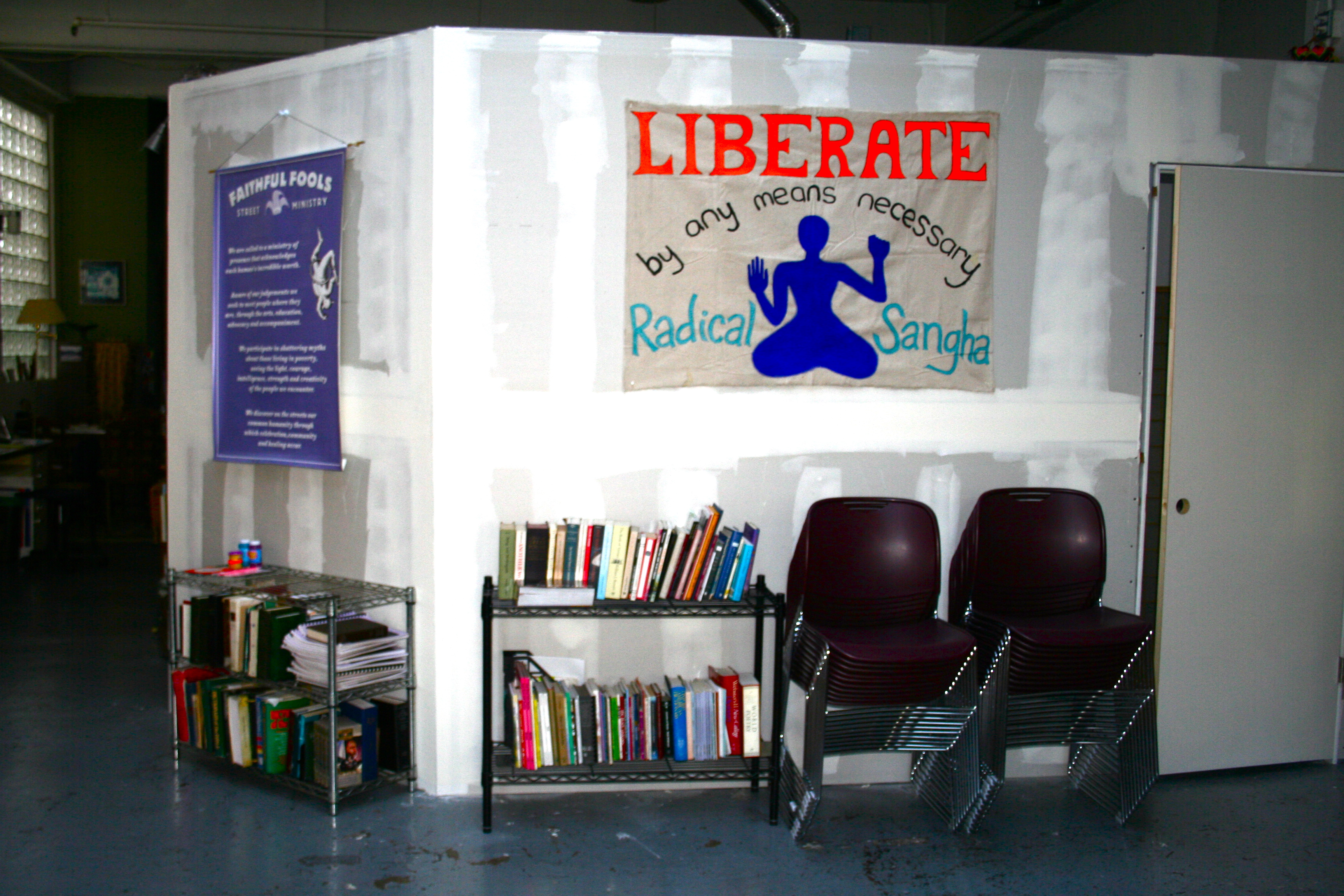
The Radical Sangha banner (also pictured in Monday’s post) has raised a few questions. This might be a good space to engage with some of them.
1. What’s a sangha?
I’ve heard a couple different translations for sangha, which is a Pali word. Loosely, it means something like “community.” In a Buddhist context, it’s one part of the Triple Gem in which practitioners take refuge. Triple Gem includes “buddha” (the historical Siddhatha Gotama from around 500 BC, as well as other buddhas or enlightened folks); “dhamma” (the teachings of the buddha; truth; or practices that lead to understanding truth through direct experience); and “sangha” (sometimes explained as an advanced practitioner to whom we might look for inspiration; other times explained more as a supportive community or assembly of practitioners). So sangha is a group of two or more people practicing dhamma, and helping one another to discover deeper and deeper truths about reality.
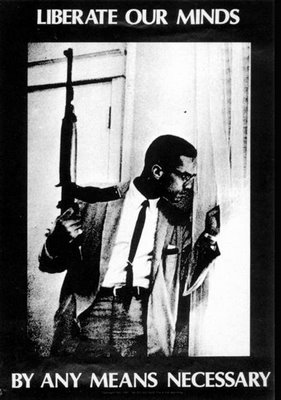
2. What’s your understanding of the phrase, ‘by any means necessary?’
Good question. I associate the phrase with Malcolm X and Black liberation movements that bucked norms by insisting that they had a right to use violence, among other tactics, to win their social freedom.
Put in a dhammic context for the banner, I love the apparent tension between the imperative to “Liberate,” and the famous militant phrase. The way I think about it, the Buddha himself did not rule out violence as a means to liberation. He didn’t rule out any means, and indeed gave a good honest try to many of the highest spiritual trainings available to him in his youth. He explored for himself (and encouraged all of his students to explore) the ways that mental negativity (almost always concomitant with doing acts of violence) undermines the quest for liberation from suffering.
What I would love to see among politically active dhamma practitioners in the Bay is a greater spirit of bold experimentation, in the tradition of the Buddha and other awakened folks. Too often we get stuck with a closed-case of nonviolence, or even pacifism. Too often this justifies and hides our fear of confrontation. Fear of conflict. Fear of pain.
And even among the dhammic people who exhibit extraordinary courage and commitment in the face of violent oppression — submitting to arrest and imprisonment for months or years at a stretch, over and over again — I still think we could use a little more of the “any means necessary” mentality. After all, the “necessary” part means what is necessary to win. Not just what feels good to us. Not just what mimics established forms. What works! Right?
3. I recognize the fist, but what’s with the other hand?
Excusing, if you will, my mediocre drawing skills, the right hand of the figure is supposed to be an abhaya mudra: a gesture of friendly greeting, peace, benevolence, and the dispelling of fear.
For us to liberate (ourselves and each other) requires fortitude and oppositional stances; but it also calls for the special kind of fearlessness that comes from compassion. With compassion, free from delusion, we recognize the good in the opponent. We also see and tend lovingly to the hatred, fear, and greed within ourselves. This compassion inspires and guides our action just as much as strategy; just as much as the urgent wish to “smash” harmful systems.
——————————————
So there’s a little explanation of where I was coming from. Thoughts? More questions?
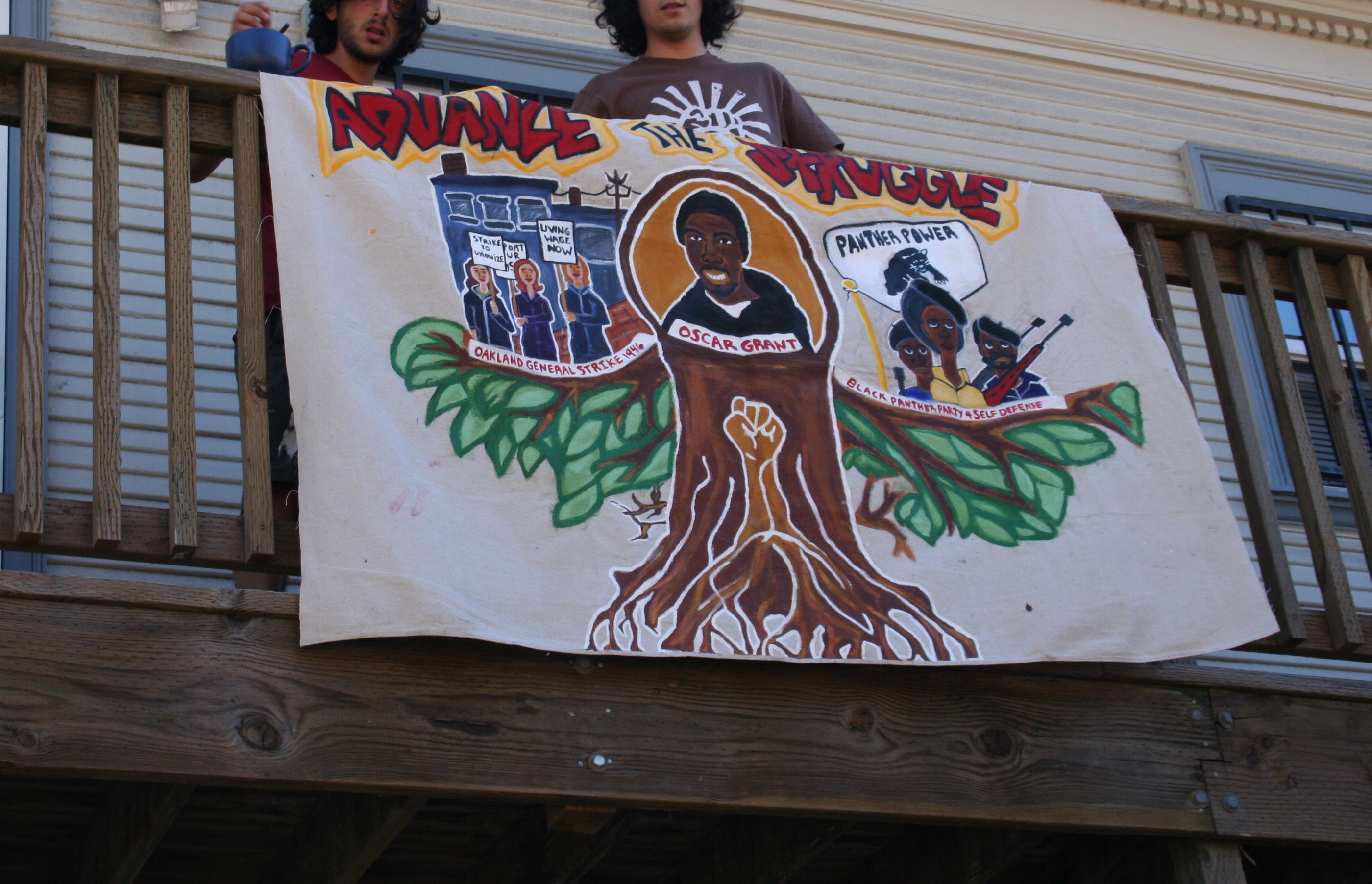
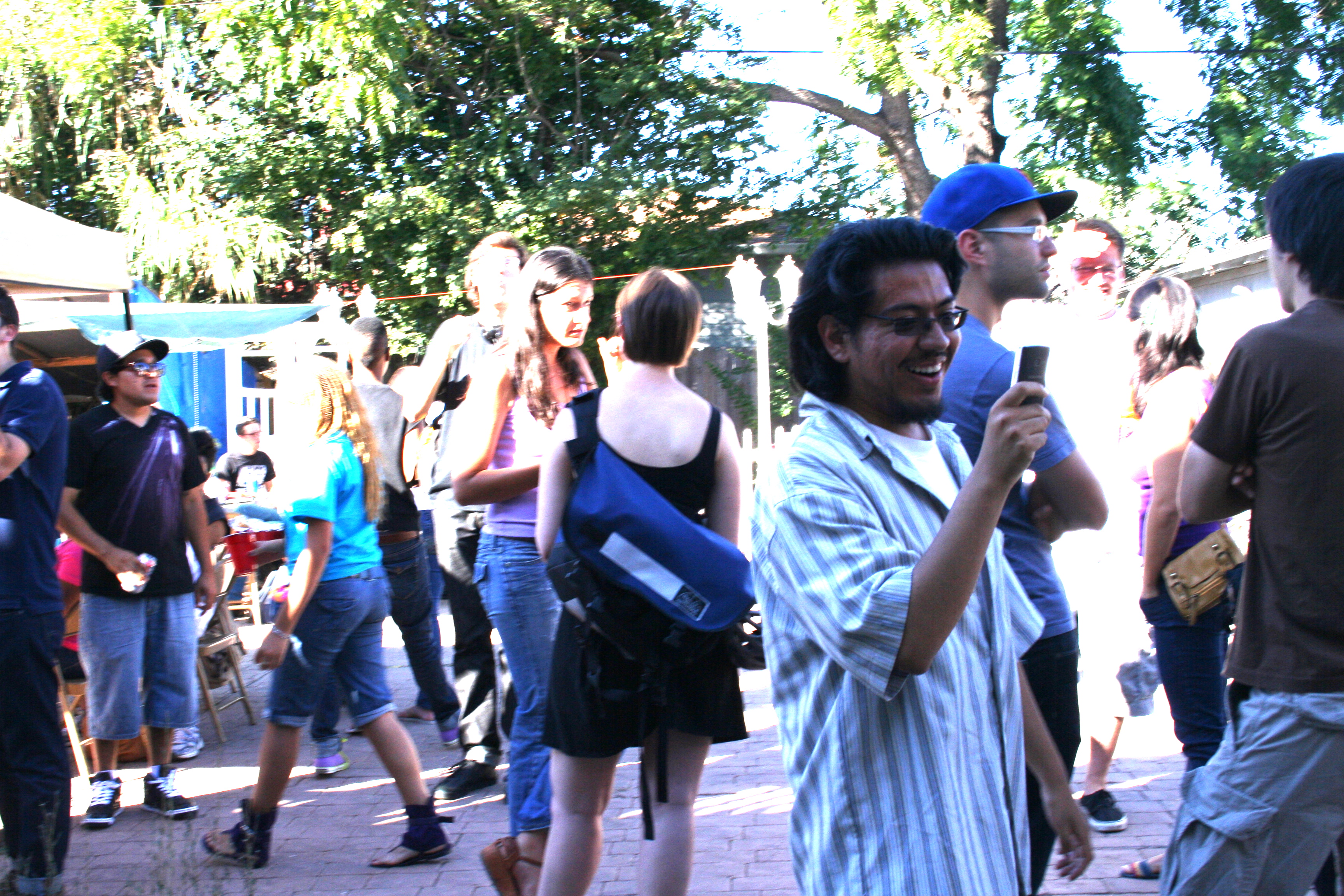
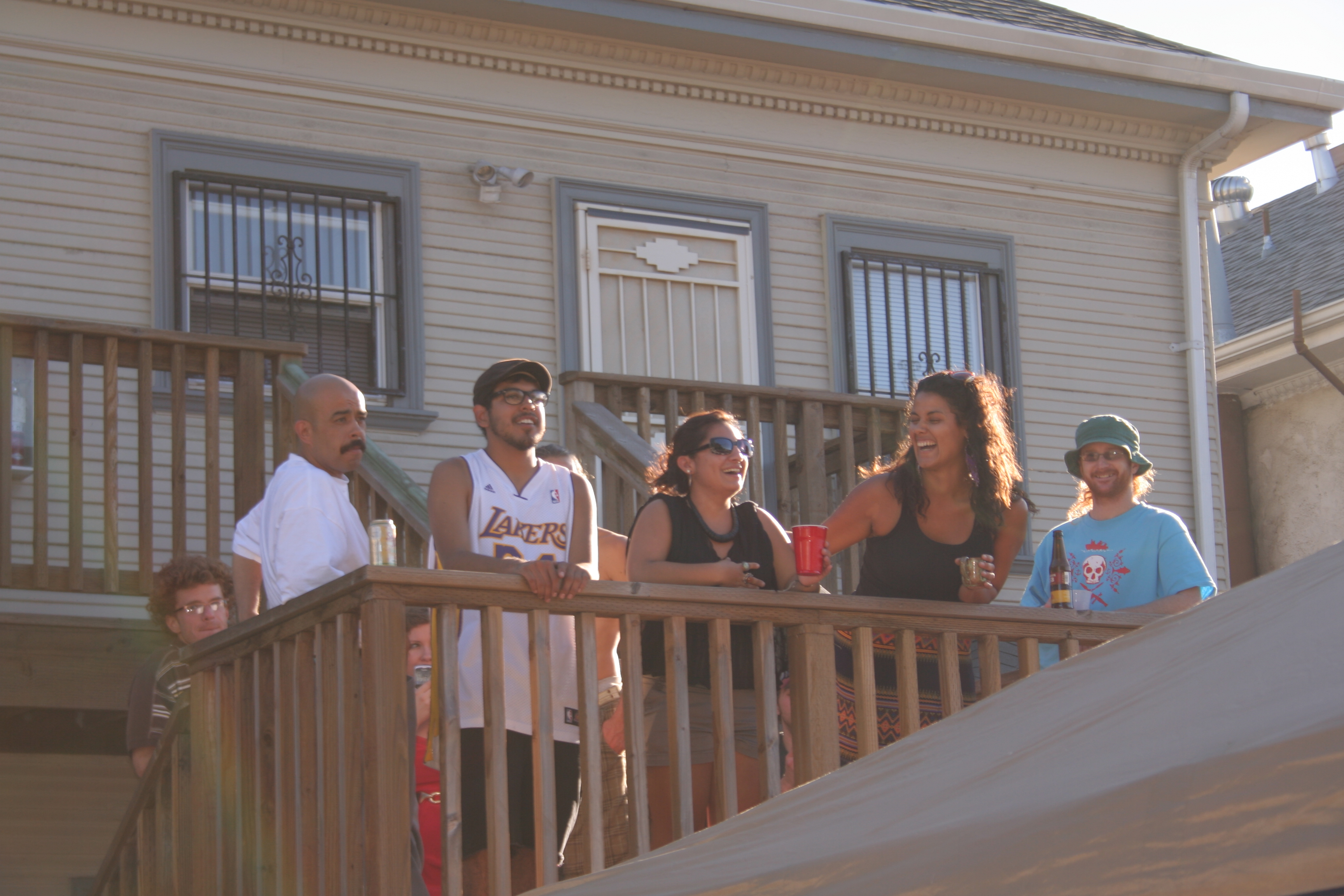
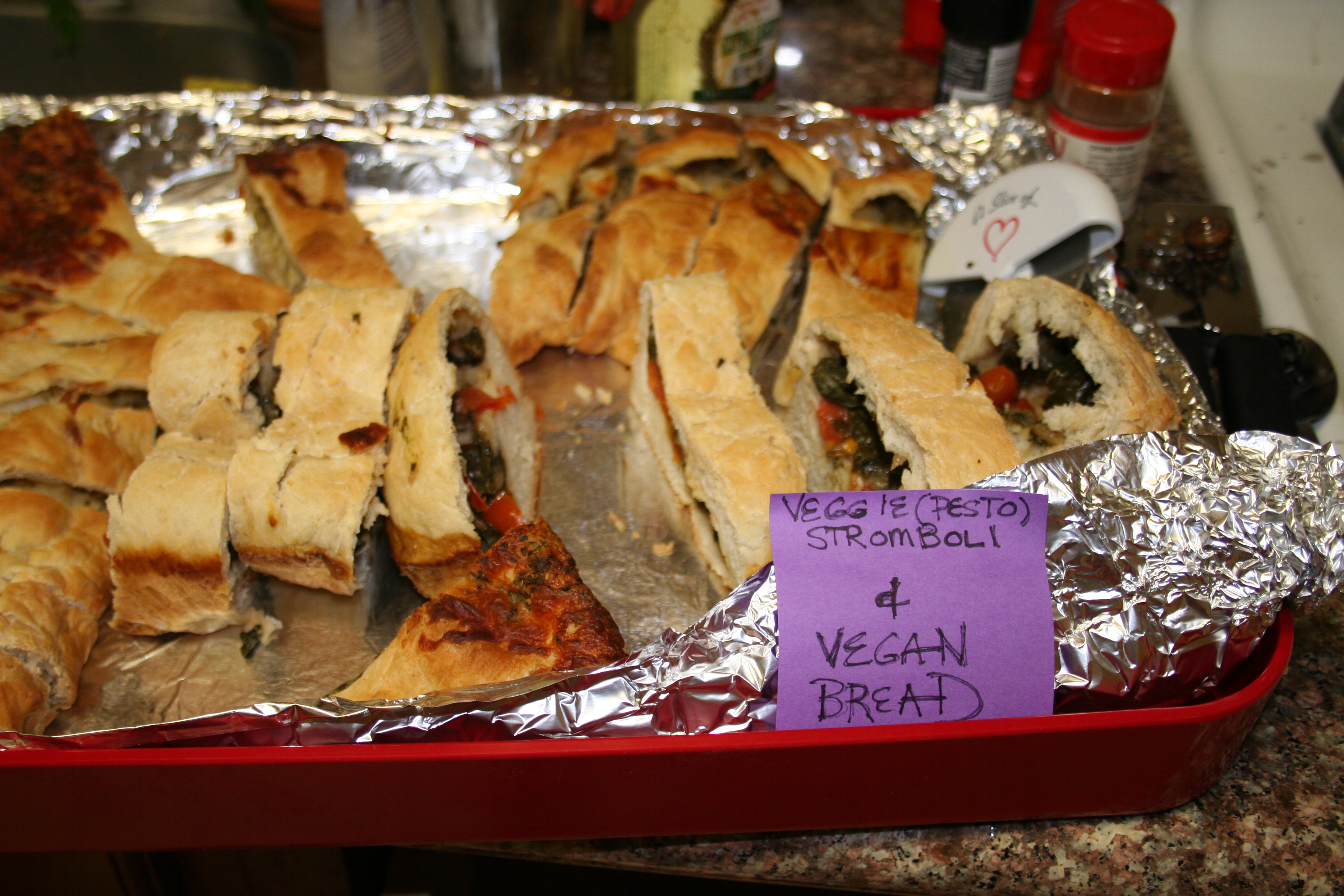
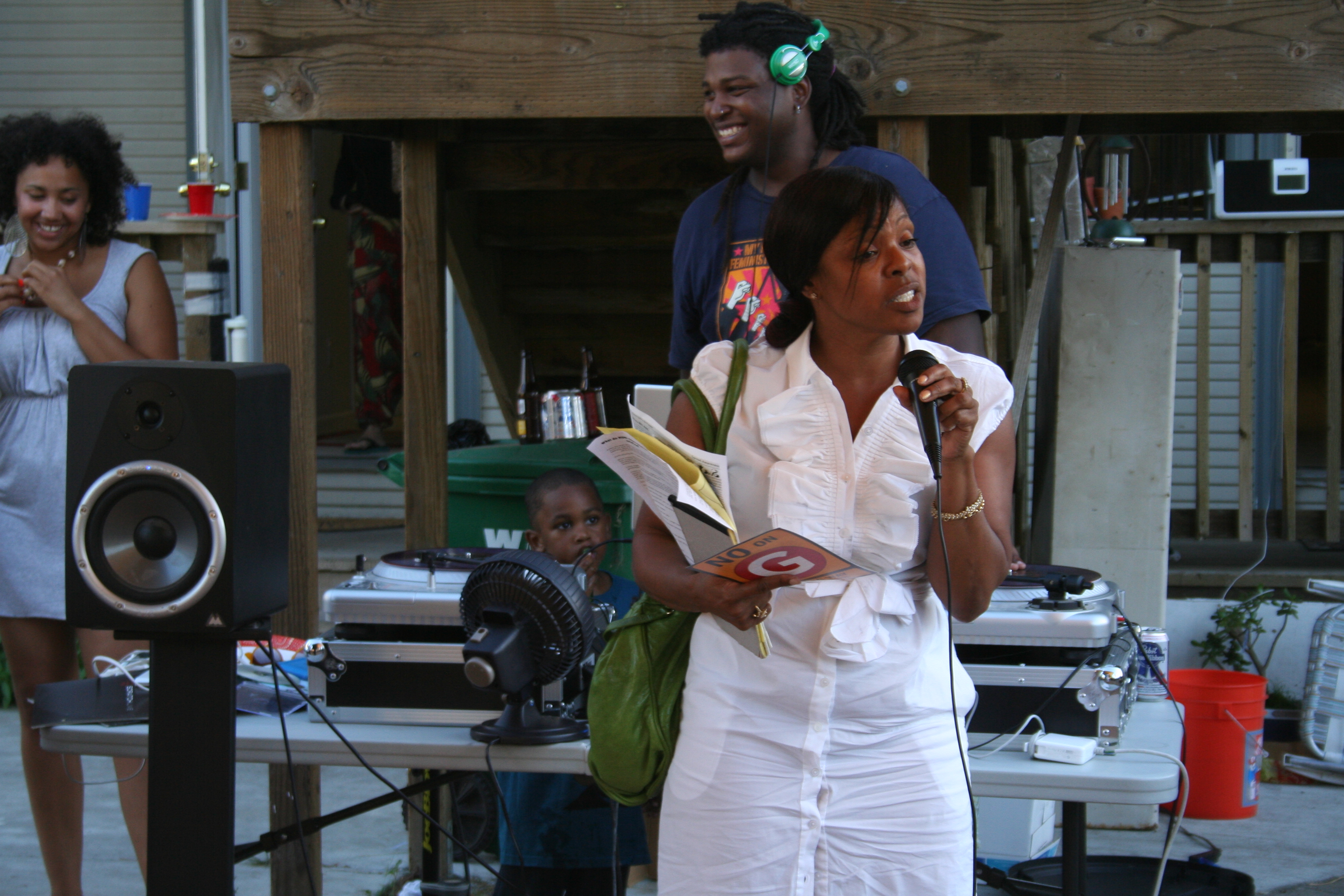
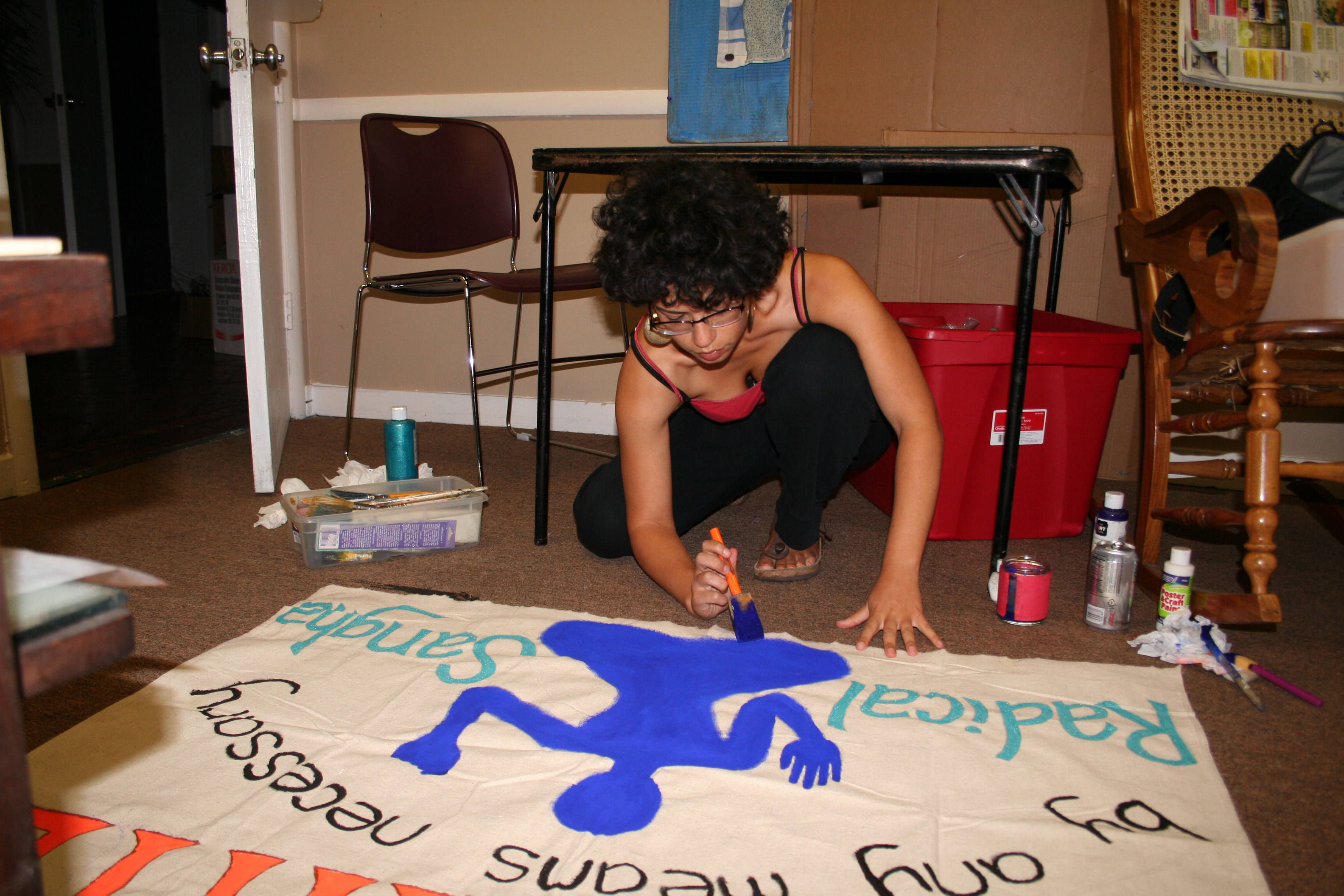
Some friends threw an utterly beautiful “Radical BBQ” yesterday in Oakland. Young and old, different races, different genders and presentations, fun, kind, relaxed, co-operative, joyful, political. Food (good heavens — Dani made these amazing stuffed stromboli and vegan bread from scratch); music and dancing; a speech from a MUNI driver (SF public transit) on the struggles they’re facing among the rank-and-file; wonderful art (check the Advance the Struggle banner: gorgeous). And they even provided art supplies for people to do their own thing. I took advantage and sketched out a small banner to use for Radical Sangha. Took it home and spent the night painting and finishing it up.
The banner may come in handy tomorrow evening, as the scheduled Radical Sangha will be meeting and then carpooling to San Quentin prison to join the protest of the first death-penalty execution in California in four years. Albert Greenwood Brown is scheduled to be killed by the state on Wednesday. The decision to resume executions (backed by Jerry Brown) was sudden, and has shocked a lot of folks who’ve been doing anti-death-penalty work for years. I only heard about it last Thursday, through folks in Oscar Grant organizing.
I’ll be writing up some thoughts and questions soon on tactics and strategy for radical organizing (sparked in part by an event the Faithful Fools catered yesterday: a talk by lifelong activist and frequent prisoner Father Louis Vitale, a Franciscan priest who works around anti-nuclear intervention and the School of the Americas Watch). Part of me feels ambivalent about attending a protest of the death penalty, with no clear mechanism for affecting this structural, state violence. But I also feel that with the proper perspective, and in tandem with different types of tactics and organizing, it can be a fruitful part of a holistic, loving, politicized life.
What really bugs me is that I won’t be able to make it to another dope event featuring my friend’s mom: An Evening of Solidarity with Women of Haiti. If you’re in the Bay area and not coming to the execution protest, think about hitting this up instead.
I wanted to write and tell you that directly but I can’t find any contact info. So if you are reading this, please know that I am sending you all kinds of mental hugs and mental bows and mental incense and mental plantains (yum!), and thanking you so very deeply for your work and inspiration.
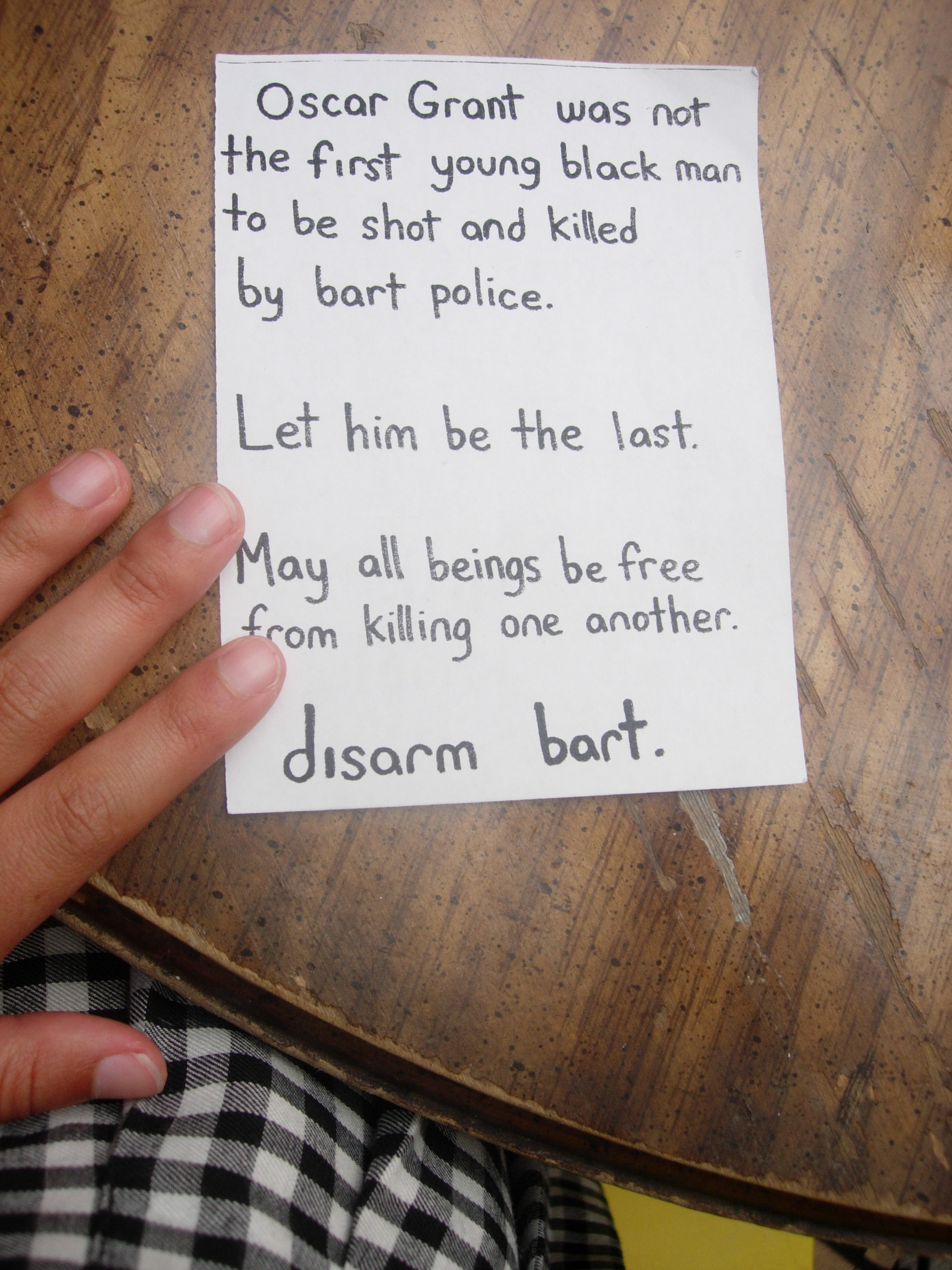
Simple, clean, sincere. Inspired by Burmese monastics who, when demonstrating in the streets against the military, chant: “May all beings be free from killing one another. May all beings be free from torturing one another…”
[Update: I forgot to mention, but if you’re in the bay area and are interested in passing out some flyers on your BART travels, hit me up at katie (dot) loncke (at) gmail (dot) com and I’ll get you a batch! Or, even better — take some inspiration and make your own, and let the rest of us know about it.]
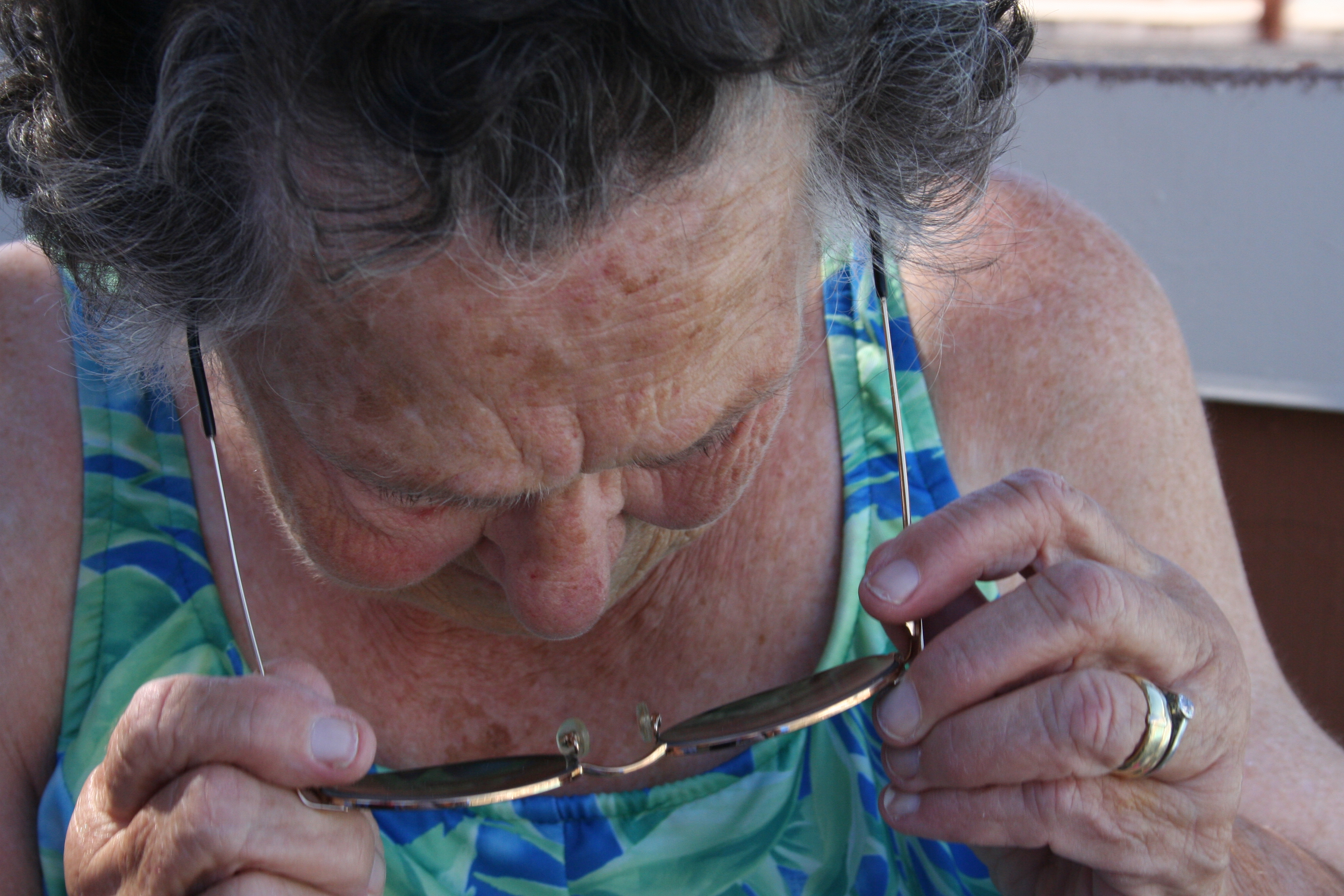
Oma, my maternal grandmother, during our weeklong visit this month. She is a goofball.
I thought I knew Oma’s stories. Back in middle and high school, when we were tasked with writing oral histories or interviewing elders, Oma was my go-to source. Growing up poor in Vienna. Marrying a camp-surviving Jewish man 20 years her senior, after the war. Emigrating in 1949 on a refugee boat and landing in New Orleans on Labor Day, only to wait another day on the ship because all the dock workers were on holiday. Being overawed at the opulence of Safeway on her first US grocery shopping trip. Discovering with horror that the racism she thought she had escaped was still being visited here on Blacks and “foreigners.” Even in America.
This story never made it into my school reports, though. I don’t remember when she started telling it (meaning, most likely, at what age she felt I was old enough to hear it). But now she repeats it on every visit. (What a perfect jigsaw-fit for aging: losing her short-term memory while vividly recalling her childhood. The ‘intelligent design’ of transmitting elder wisdom, huh?)
It goes like this.
*Trigger warning: rape, war, threatening with weapons, and vicarious trauma.*
As Maia at The Jizo Chronicles also notes, in US media, the deafening silence around Pakistan’s tragedy continues.
Death and disaster are a part of life, of course, but catastrophes are compounded by structural and personal oppression, and a lack of self-determination.


 Excusing, if you will, my mediocre drawing skills, the right hand of the figure is supposed to be an abhaya mudra: a gesture of friendly greeting, peace, benevolence, and the dispelling of fear.





 Kloncke