It’s been a long time since I’ve talked about metta. Many of you are familiar with it, but for those who aren’t: metta is a particular type of meditation practice that focuses on cultivating and exuding loving-kindness. Which might sound like trying to muscle a halo onto your own head, striving to become all saintly and luminous and stuff, but actually has much more to do with focusing attention on others: wishing them well.
I like the above video not primarily for its message of metta-as-problem-solver (although I have definitely experienced moments where my metta practiced seemed to lubricate and ease a tense situation), but mostly for the way Ven. Balacitta’s articulation encapsulates the practice: wishing that others be free of enmity, be calm and happy, and be able to take care of themselves well.
Crucially, it seems clear to me that his wish for others to be “calm” is not a front for wishing for them to agree with him, or to become passive. The practice is not about wanting conflict to magically disappear. And even though the focus is on kindness, friendliness, and well-being, in my own experience it is impossible to separate these from the realities of suffering and animosity. Although metta is different from the Tibetan tonglen practice (a “training in altruism” in which one “visualizes taking onto oneself the suffering of others on the in-breath, and on the out-breath giving happiness and success to all sentient beings,” and thus focuses equally on suffering and well-being), metta also inherently contains both positive and negative aspects.
Lately I’ve been returning to metta a lot more. Tremendously helpful. Conflict has arisen between me and my dad, which has been very painful for me (I won’t go into detail), and metta helps me to re-ground in wishing well-being for him, and for myself. Again, this doesn’t mean glossing over harm and dissonance, but fostering my own outward vectors of deep friendliness.
It’s a tough question. Metta is by no means a mandatory practice for all situations. And focusing solely on loving-kindness, without also seriously analyzing and militantly opposing the oppressive forces at work, is not an approach I can get down with.
On the other hand, what happens when metta and militancy combine?
Yes, let’s leave it there for now. What happens when metta and militancy combine? Can we imagine that? Do we see examples of it in our own political work? Do we see areas, in ourselves, where one or the other might benefit from conscious cultivation?
* * * * * * * * *
Thanks in advance for donating to free Jesse, the above-linked genderqueer student protester who was arrested while fighting for trans and queer rights on campus (at Laney College, where Ryan also goes, and has been part of this organizing). As of now, they are still being held on multiple false charges. Anything you can give is much appreciated.
Yesterday morning, the street in our neighborhood where organizing saved a woman's house
What a week, folks. A week that included:
Going to a reading discussion about the League of Revolutionary Black Workers (the subject of Detroit: I Do Mind Dying), attended by two former League members (one of whom worked thirty years on an auto assembly line…..DAMN), still fiery and utterly inspiring
Flyer from a similar LRBW event
Huffing, puffing, and grinning up Berkeley hills on my gorgeous new bike
Feeling grateful for warm, dry, cozy home-shelter from the winter rain
Showing up with Ryan at a 6am anti-eviction action, a few blocks from our apartment, to find out that it had already won: once the media started contacting Wells Fargo for comment, they backed down (for now) from taking away this woman’s home
That’s it for me, folks. Hope your week was filled with ups, as well as downs — but most of all, spaciousness enough for both. See you Monday!
Friends, I’m gonna try an experiment. Rather than pour out a long story about today’s topic (non-monogamy and polyamory), I’m just going to give a brief thumbnail sketch — and we can see where the comment thread takes us.
As some of y’all may have noticed on Facebook, Ryan and I (with our Bad Good Romance) have been in an open relationship for over a year. In the past, when asked “What’s that all about,” I’ve explained that rather than a declaration about having other lovers, it’s more an expression of commitment to exploring our desires in a non-judgmental, loving, honest way that doesn’t assume monogamy is the best path to a healthy relationship — for us or for others.
A little more background on the situation is that I identify (and have for years) as someone with polyamorous tendencies. I can feel happy and fulfilled with multiple lovers at once. Also, I’m happy for my lovers when I know they’re enjoying sex and companionship with other people. (Note: this is only true when things between my lover and me are going well. If things between us are souring, then I typically feel super jealous of the other sweethearts in their life.)
Ryan, on the other hand, has always operated on the monogamous side of things. By this I mean: when he’s with a partner, he’s not interested in being with other lovers; and it’s painful to him to know that someone he loves, and who loves him, also wants to romance somebody else. At the same time, he’s deeply respectful and even admiring of polyamory, and investigates questions of (non)monogamy both through reading (like the classic “Poly Primer” [as make/shift’s crossword puzzle clue called it] The Ethical Slut, which Ryan had read even before we met) and by deeply reflecting on his own feelings, perceptions, and experiences.
Up til now, our difference in orientation hasn’t mattered much for us. But recently, one of my favorite former lovers (what one might call an “ex-boyfriend”) moved from the Midwest to Berkeley, a short ways from our house. After a rocky past and more than a year without seeing each other or really communicating at all, he and I now find ourselves spending time together. An entire afternoon last week; something like fourteen hours yesterday.
And so, Ryan and I have been doing a lot of processing. Each of us feels scared of limiting or hurting the other one. But we don’t want to break up, either. Not an easy place. We both agree that polyamory seems like a positive practice, a good way to live. But for people who naturally gravitate toward exclusive relationships, walking this new path ain’t easy — and may not ultimately be worth the hurt.
At the same time, the way we hold one another — mentally and physically — throughout these painful talks only underscores how much, and how well, we love each other. This is non-violent communication from the heart, organically: expressing pain, grief, fear and heartache without blaming; taking physical space and declining touch when we need to; listening; not escalating; acknowledging and validating each other; taking the time and space to do all this properly; being physically affectionate when we both feel ready; and committing to follow through on what we decide, together, as the best way to move forward.
Folks, I’m going through it a little bit this week. Just a lot of complex stuff coming up. Haven’t found the right words for sharing it here, yet. But in the meantime, this video of my friend and fellow Goddardite — vocalist, composer, interfaith priestess, and cultural worker Imani Uzuri — made me smile today in a full, full way. Not only does Imani bless the world with mad artistic skills (including, but not limited to, the most moving voice I’ve ever heard in person in my whole entire life: no lie), she also illuminates the people around her with her spiritual reflections, historical insights, unbeatable hilarity, and genuine compassion.
Here, she reminds us of the importance of exploring and loving our always-complex selves. It reminds me of an essay I read yesterday in the current issue of make/shift: a piece by Alexis Pauline Gumbs called “M/Othering Ourselves: A Black Feminist Genealogy, Or, The Queer Thing.” The essay in turn takes its inspiration from a line from Audre Lorde: “We can learn to mother ourselves.” Gumbs asks:
What would it mean for us to take the word mother less as a gendered identity and more as a possible action, a technology of transformation that those people who do the most mothering labor are teaching us right now?
I hear this question (and its associated family of questions) echoed in Imani’s 120-second share. (And enacted, unwittingly, in the sweet out-takes in the final few seconds.)
Imani’s work itself is powerful enough; being in her presence during Goddard residencies, and seeing the mind, soul, and radical self-mothering behind the music, has been an extraordinary gift to me. She’s real and grounded, as well as spiritually developed and crazy talented. Quite the combo. Check her out, and join me in celebrating the friends who inspire us, even unknowingly, while we’re slogging along.
I wonder whether Moses, after being kicked out of the palace and downgraded to the slave caste, ever felt nostalgic for his royal upbringing. Same for Siddhartha, who left his princehood by choice and became an ascetic. Did St. Francis of Assisi, who shunned his cloth merchant inheritance, ever miss strutting down a 13th-century street in a fly outfit? What was it like for St. Clare, a follower of Francis, to abandon her landowner life and found the Order of Poor Ladies?
These folks all share certain dimensions of class transition, along with some leanings toward class treason — though I hesitate to call any of them class traitors because, while they attempted to carve out alternative, anti-hegemonic lifestyles and communities for their followers, to my knowledge they did not explicitly, politically confront the existence of the class line itself. (Someone please correct me on this if I’m wrong!)
Lately in my own life, I’ve been noticing painful areas in my move away from liberalism (and/or nominal radicalism) toward a politic that actually centers the working class and the dispossessed. This process, for me, involves somewhat shameful, tender stuff.
If you didn't know already, a "lurker" is someone who reads a blog but rarely or never comments. De-lurking means making your presence known. Lately I've been blessed with some particularly fabulous de-lurkings.One in the form of the above snail-mail card from my friend Jane in New York (hey Jane!).One from a fellow organizer in the illegal gender-oppressive firing campaign. (Whatup, Nick: I am stoked to start reading your highly-recommended blog on caring labor.)Another from amazing coeditor and copublisher of make/shift magazine, Jessica Hoffmann.* (Seriously, that note's thoughtfulness sent me into a semi-shock stupor for an entire night.)A writer and dharma teacher I admire a whole lot, Mushim Ikeda-Nash, de-lurked to me last week, and then followed up with a piece of much-appreciated constructive criticism. (Actually about a post I wrote on Feministe; so I'll have to be in touch with them about updating it. Thanks, Mushim!)And then there's this (not exactly a conscious de-lurk, but I found it among my incoming links):
Karen, I have no idea who you are (do I?), but thank you. Let’s be friends. :)
Really though, not to get all mushed out on y’all, but it’s truly amazing to know that what I do here helps other people out. Even a little bit.
With so much gratitude to everybody who shows up here to read, reflect, and respond,
katie
—————————
*As of this posting, I’m delighted to say I just had a lovely, laughter-filled walk around Lake Merritt with Jess Hoffman, and man is she kind and smart and cool. (But not in the too-cool-for-you kind of way. Cuz I guess that would cancel out the “kind” part.) Jess, if you’re reading, thanks again!
[Update 5:44pm: Elise, I almost forgot you! Folks, Elise is a bad-ass, hilarious lady with sick dance moves and mad Facebook commenting skills. So good to meet you at Jamal’s party, girl!]
Alan’s got a lovely piece up at Clear View Blog (digging his jaunty-angled question: what would MLK, Malcolm X, and Paul Robeson think about being put on U.S. postage stamps?) that points to the connections between big-L Love and the effort to, in King’s words, “defeat evil systems.”
Compassion and militancy. Neither can substitute for the other. If you’ve got militancy but don’t practice compassion, your friends and comrades — the people upon whom you most rely, politically and personally — prob’ly won’t enjoy being around you. Not in the long term, anyway. And if you’ve got compassion but no critical analysis of “evil systems,” or meaningful program to defeat them, you are, as Ryan points out, utopian.
Combine the two, compassion and militancy, and you’ll get something powerful. But you’ll also get problems.
Frederick Douglas famously asked, “What to the slave is the Fourth of July?” We might do well to extend the same skepticism to today’s hallowed, lovey-dovey vacation day.
Beneath the hype, MLK day can serve as a reminder that people who advance the fight for radical liberation, using their own compassion and militancy, are undoubtedly risking their lives.
So if you’re among them, thank you for your courage. May the earth continue to bless you with beauty every day. May you sometimes have a sweet picnic by the lake.
As per our plan, for our one-year dating anniversary, Ryan and I made our own hot sauce. It took 20 roasted habañeros (a.k.a. Scotch Bonnet peppers), four cloves of roasted garlic, and some elusive smoked paprika to blend up this incredibly delicious condiment. (Full recipe below, slightly tweaked from one we found online.) Some of the habs came straight from Ryan’s dad’s backyard garden — part of how we cooked up this idea in the first place.
And after it was finished, we took one of the two bottles on a journey down to the Mission for some pupusas.
This slideshow requires JavaScript.
Celebrating an extraordinary year with this wonderful person, near the annual TransgenderDay Of Remembrance, I was especially aware of the privileges and basic safety that we enjoy in our loving partnership. We are a legibly cisgender, hetero, same-age couple, both U.S. citizens, living in a time of war but unaffected by it directly. We live in a time and place where interracial relationships are largely accepted and even commonplace; where open relationships are at least acknowledged, if frequently maligned or misunderstood; and where I am not likely, as a woman, to be openly attacked for asserting my own sexuality, and seeking control over my own reproductivity.
I truly wish that loving — and simply living with integrity, with basic safety — did not require so much courage from so many people.
May my life’s work, and Ryan’s, contribute to bringing about conditions that encourage everyone to love in the best ways we know how.
———————————————————
Habañero Hot Sauce Recipe

20 habañero peppers
3-5 cloves of garlic
1/2 cup distilled white vinegar
2-3 Tbsp lemon juice
1 tsp smoked paprika
1 tsp brown sugar (we used light brown)
1 tsp salt
1/2 tsp chili powder

Equipment: Oven, baking sheet, food processor.

Set oven to 350º.
Peel and halve garlic.
Cut off stem tops and halve peppers (keeping the seeds).
Roast together on an oiled baking sheet until golden brown
and smelling amazing (about 20 minutes).

Add peppers and garlic to the food processor with dry ingredients.
Pulse to combine.
Slowly pour in wet ingredients while blending.*
When you've got a smooth, uniform consistency, adjust to taste.**

Bottle (we used a couple old hot sauce bottles) and refrigerate.

*Adding liquid too soon may result in splashing, necessitating turkey-baster triage.
**Ignore any eggings-on, and taste only a tiny bit at a time.  Think twice before,
for instance, dipping a hunk of bread in the hot sauce as though it were hummus.
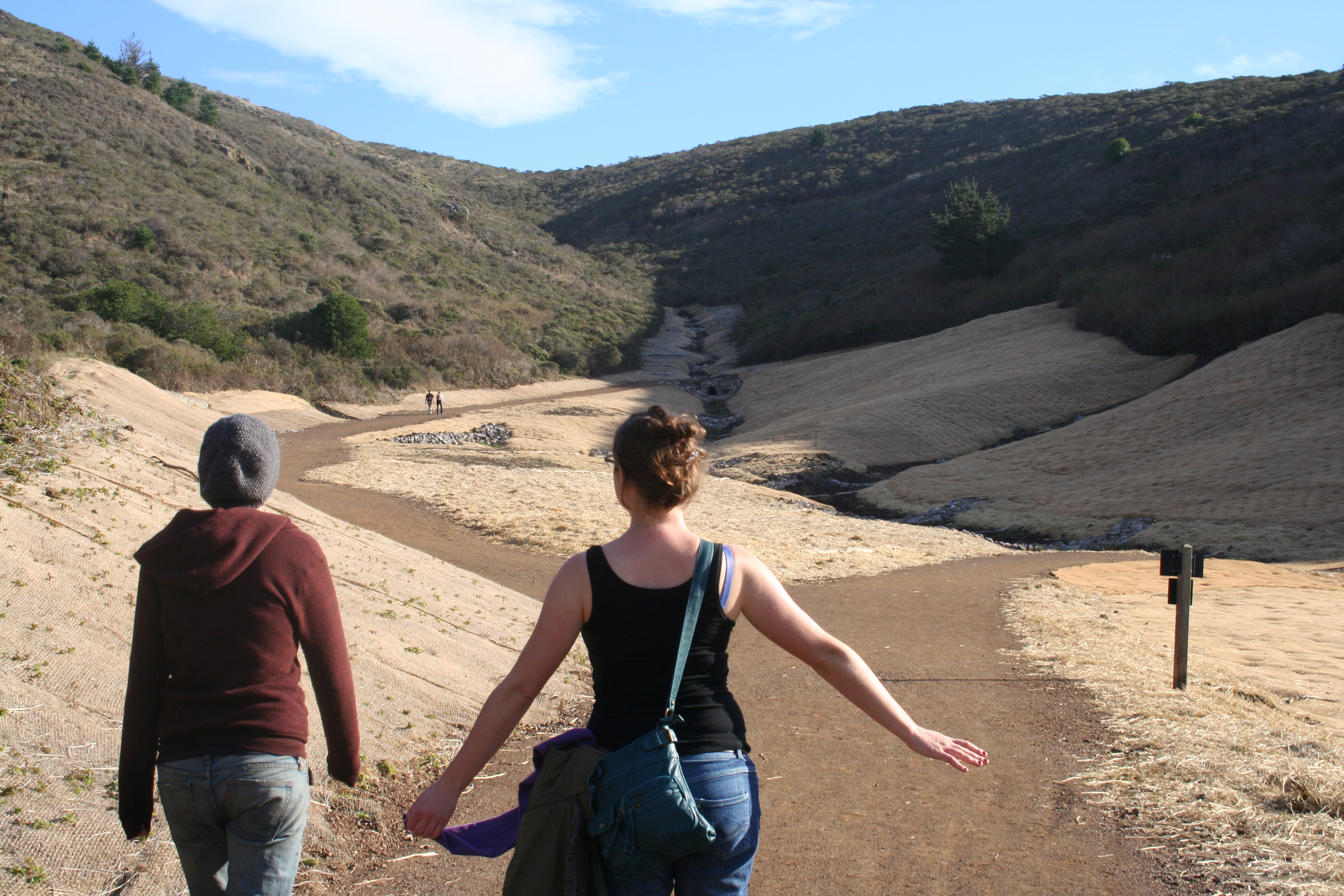
Saturday I crossed the Golden Gate Bridge to spend the day (and overnight) at San Francisco Zen Center’s Green Gulch Farm with my friends Michaela and Sarah. Michaela, a newly ordained priest, has lived on the farm for the last 5 years, and since ordination in September, will undergo 4 more years of training before becoming … a more official priest! Or something. I’m not quite sure how the Zen works. And Sarah, who has taken her lay vows, is not only the executive director of Buddhist Peace Fellowship, but also a true SFZC baby, raised by Zen teacher parents among its three campuses: Green Gulch, Tassajara, and City Center.
Anyhow, the two of them go way back, and it was a delight to spend a while walking, joking, thinking out loud, and generally hangin out with these amazing, brilliant, passionate dharma sisters. And the setting, while old-hat to them in some ways, for me was … well. Green Gulch — a functioning subsistence-plus-sales farm, as well as a practice center, located in one of the wealthiest counties in the US — has its issues, is evolving, is imperfect. And has its gorgeousness, my, my.
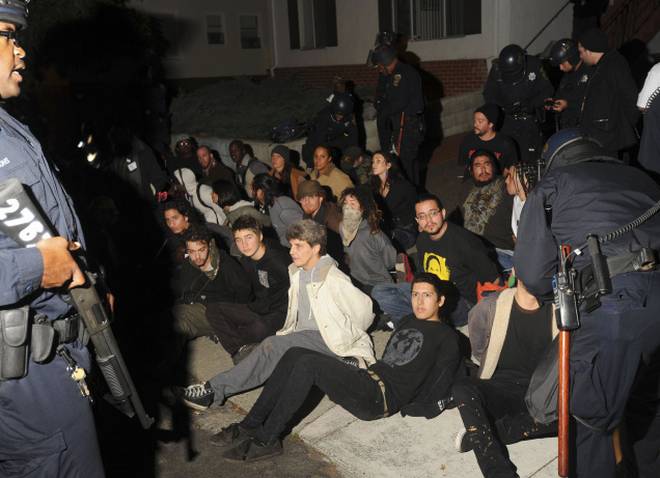
Protesters are arrested in Oakland. Note the giant gun in the officer’s hand on the left. Image from The Hindu.
Paramis, or Paramitas, also called the Ten Perfections, are qualities that dhammic practitioners try to cultivate on the path to enlightenment.
I found myself thinking about the Paramis throughout a long Friday night and Saturday, when I was arrested, along with 152 others, for “unlawful assembly”: marching in the streets of Oakland to protest police violence and impunity. I was held in custody for about 20 hours; some people still haven’t been released. (Please consider donating to legal aid for protester defense.)
A concrete detention cell might seem like a strange setting for reflecting on the attributes leading to Buddhahood. A far cry from the bucolic campuses of well-funded meditation centers. On the other hand, many people have famously developed their spiritual practice while incarcerated, or even while being tortured. I’m not saying that every setting is equally optimal for developing every part of dhammic practice. But once you’ve learned some of the basics in a more controlled, safe environment, it’s interesting to see how they can manifest in non-stereotypical situations.
Generosity (dana)
He straps on a second backpack, belonging to his friend, who doesn’t have papers, to afford more mobility for avoiding arrest.
They trade jokes and soggy jail cookies. They offer room for one another on the concrete benches of the cramped holding cell.
Lawyers work for free to get the protesters out of jail. The work can take months, for folks facing trumped-up charges.
FIRST PRECEPT
Aware of the suffering caused by the destruction of life, I vow to cultivate compassion and learn ways to protect the lives of people, animals, plants, and minerals. I am determined not to kill, not to let others kill, and not to condone any act of killing in the world, in my thinking, and in my way of life.
SECOND PRECEPT
Aware of the suffering caused by exploitation, social injustice, stealing, and oppression, I vow to cultivate loving kindness and learn ways to work for the well-being of people, animals, plants, and minerals. I vow to practice generosity by sharing my time, energy, and material resources with those who are in real need. I am determined not to steal and not to possess anything that should belong to others. I will respect the property of others, but I will prevent others from profiting from human suffering or the suffering of other species on Earth.
Renunciation (nekkhamma)
In jail, they give us plasticized bologna and surprisingly good oranges. Over twelve hours later, they’ve given nothing else. We practice responding to this harm without suffering. We practice fasting. We explore the limits of our basic needs.
In jail, when we ask at 5am how much longer they think we’ll be here, we are told: Ask me how much longer, and I’ll hold you here an extra hour. Ask me again, and I’ll hold you two more hours. We practice responding to this harm without suffering. We practice abiding. We explore the limits of our basic needs.
Knowing the risks, we have nevertheless stood up for what we believe. Some of us are better accustomed to making do in these conditions. All of us are being reminded that we are more than our comforts.
Wisdom (pañña)
This is a complex one. Can we understand the nature of impermanence, egolessness, and unsatisfactoriness of phenomena? Can we respond to the relative world of material harm, while still practicing diligently on our inner liberation from needless suffering?
As the zip-tie handcuffs cut off circulation and my shoulders begin to ache and tingle, I summon my meditation practice, explore the pain, and try my best to observe the present moment with equanimity. After three hours or so, the handcuffs are cut off.
Effort/Strength (viriya)
As we are blocked in by riot police, some with machine guns, on a residential Oakland street, we keep chanting:
WE ARE ALL OSCAR GRANT!
As we are handcuffed and lined up seated on the pavement, we keep chanting:
WE ARE ALL OSCAR GRANT!
As my 20-hour family sits in our women’s holding cell, hour after long hour, we cheer and applaud as each individual is released. The cops try to intimidate us, say they’ll keep us there longer if we keep up the noise. Same for the adjacent women’s cell, where we can hear them yelling. We all keep on celebrating. And together we chant:
WE ARE ALL OSCAR GRANT!
Patience (khanti)
Patience is best when combined with sound strategy. Do I hope to move beyond marches? Yes. Do I want to help grow the movement against police violence, proliferating it in different sectors with the power to disrupt the economy in big ways? Yep. Do I want to simultaneously develop community-based safety systems that are actually accountable, healthy, and responsive to the needs of participants? Hell yes. Will all this take time? You bet. Waiting it out in jail is only one small part of the process.
Truthfulness (sacca)
Bearing witness directly is a wonderful antidote to media spin and misinformation. Contrary to sensationalist reporting, this was not a violent, roaming mob. We were trying to march to the Fruitvale station where Oscar Grant was killed, and menacing riot police hemmed us in at every turn, so we improvised the route. This is not marauding; it is a snake march. Which authorities don’t like very much, because they are not in total control of it.
Again, contrary to reporting, the purpose of our demonstration was not to wreak havoc. The super, super, nearly total majority of people, including every single person I knew, damaged no property. And even those who may have, engaged in no violence that I saw. Property destruction is very different from violence. And even though I don’t support the former in this case, I don’t want it irresponsibly conflated with the latter, the way the mainstream media consistently has in its coverage of the Oscar Grant case.
You know what’s violent? Denying a woman in custody access to her chemotherapy treatment. She was only one of many people I witnessed being denied medical attention — to antidepressants, to necessary medications. And when the woman who was ill from missing her chemo finally got transferred to a cell with a pay phone, called the National Lawyers Guild to tell them what was happening, and half an hour later the cell door rolled open . . . the cops berated her for “costing them a lot of time and money,” and informed her that because of what she’d done, they would delay her release.
Another interesting element around truth: When they had us cornered, just before they arrested us, the police declared a crime scene and instructed everyone from the press to disperse, while still preventing the rest of us (who wanted to go peacefully) from leaving. Nearly all the professional journalists crossed the police line to depart. Kind of chilling, given that the event that catalyzed all this was documentation of an act of police violence against an unresisting, restrained person.
A final truth: From what I saw, and this is only my own personal impression, many of these cops appear to be deeply scarred people. The one who kept me in line on the arrest scene before we boarded the paddy wagons wouldn’t even look me in the eye at first. The internal damage and delusion of a jailer is cyclical: one must already be suffering in order to lock someone up and deny them food or medicine for twelve hours (whether the denial is polite and bureaucratic or spiteful and direct is largely irrelevant). And participating in that process itself produces more delusion, more scarring, more habit patterns.
But though I was initially disappointed at being categorized as an extremist, as I continued to think about the matter I gradually gained a measure of satisfaction from the label. Was not Jesus an extremist for love: “Love your enemies, bless them that curse you, do good to them that hate you, and pray for them which despitefully use you, and persecute you.” . . . Perhaps the South, the nation and the world are in dire need of creative extremists.
Lovingkindness (metta)
Much gratitude to all my fellow detainees who made my time in custody human and even fun.
Much gratitude to all who have offered their support from the outside.
Much gratitude to all those who continue to oppose oppression, even when doing so is unpopular.
May all beings be safe. May no human be trapped in a cage. May no human be psychologically conditioned to harm others in an effort to make themselves feel more powerful and secure. May we abolish prisons and end policing as we know it, replacing them with participatory processes that care for people and treat all living beings with dignity.
May you be safe. May you be happy. May you be free.


















 Kloncke