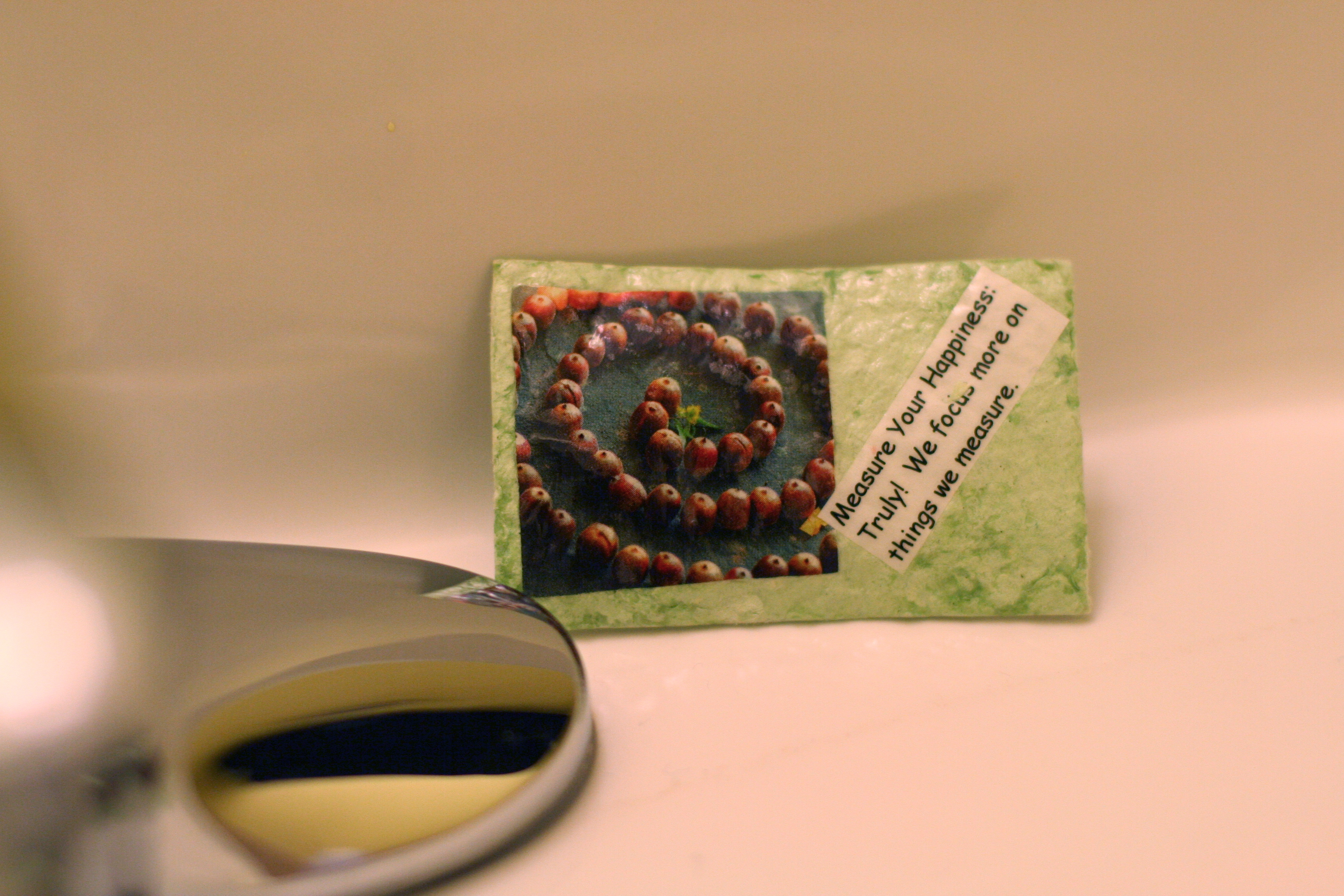
About halfway through residency, the above object appeared on the sink of the righthand hallway bathroom.
At first I dismissed it on grounds of New-Age typography. The fortune-cookie-style strip; the Comic-Sans-ish font; the capitalizing of every word in a sentence. Semi-watercolor background. Like every label of every decontextualized crystal, healing oil, or incense stick in Berkeley. Not to mention the spiral of prayer beads, disembodied and ornamental, like a hippy-fied Tiffany’s ad.
But a couple days later, I realized that I kind of agreed with the message. I’ve often thought it would be wise to chart one’s well-being, day by day, in order to study and understand emergent patterns over weeks and months. Visually relate to those ups and downs that seem at the time like all-too-fleeting highs and everlasting throes. Get to know the middle ground, too. Vicissitudes. Know what I mean?
Maybe it’s time for a new chart project. Thanks to whoever left this on the sink!
By the way, anyone got insight into the prayer beads, and how they might relate to “measuring happiness?” My impression was that they’re used for counting prayers, which seems different.
Do you create by hand? Do you create with words? Or both?
Yesterday and today, my faculty advisor has observed that although we humans make meaning in verbal and physical ways, for a variety of social reasons authority figures often overcultivate one side or the other. (Or neither, I might add.) Many of us are taught, through schooling, that what we type with our fingers or say with our mouths is more important than what we can make with our hands or sculpt with our bodies.
There’s some overlap here, of course, in that writing (or typing) is an action that lives in our hands. But my advisor’s point is that too often, that’s as far as it goes. Unless we also engage in other activities and ways of thinking (in terms of movement, in terms of texture, in terms of light or temperature or dimension), our writing and meaningmaking will be limited to our hands, rather than involving our entire bodies.
The moment he said this, I got it. When I was younger, before writing took over as the only mode of learning in school (did I create a single physical object in college?), I used to think and create with my hands. I used to make things by hand.
* * * * * *
My mother, being a sentimental soul, and having only one child, has trouble throwing my old things away. The garage of my childhood home is lined with boxes containing elementary school spelling tests, middle-school science papers, and God knows what else. My bedroom, though not exactly as I left it at 17, feels less transformed (say, into a study) than strategically looted, with some walls and drawers empty and others left intact, housing various middle-to-high-school artifacts.
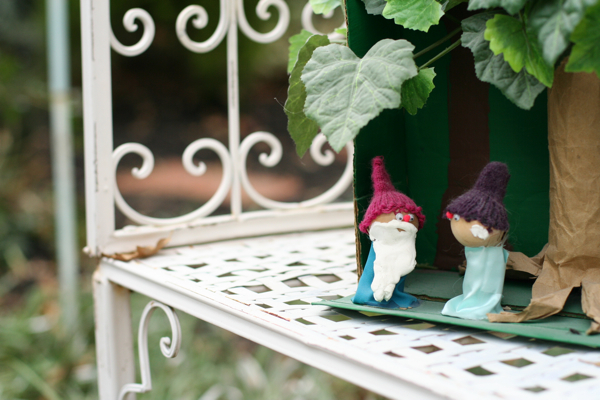
Pretty much every time I visit my parents, I use the desktop computer at least once. And pretty much every time I use the desktop computer, I notice and smile at the following diorama, perched on a nearby shelf in the cluttered study, and crafted by Yours Truly in about the fifth or sixth grade.
This slideshow requires JavaScript.
Thorin thinks that Bilbo should climb to the top of the tree and see if he can see any end to the forest. Bilbo reluctantly climbs up a tree and breaks through the canopy to the bright light of the sun. He sees thousands of butterflies and looks at “the black emperors for a long time and enjoyed the feel of the breeze in his hair and on his face.” [from The Hobbit, Chapter 8, pg. 148.]
Turns out, I used to love making all kinds of things when I was young. In eighth grade, I was supposed to present a visual aid about immigration to the US at the beginning of the 20th century. I wound up making a simple Rube Goldberg device: on one side of the machine there’s a tiny bucket where you place more and more stick figurines (representing immigrants). When the bucket gets heavy enough, it tips a see-saw that flips a gate, a marble rolls down a pathway and trips something else, and I forget exactly how the rest of it worked but in the end another tiny bucket flips over and out fall all these illustrations of ‘consequences of immigration’ (i.e. tenements, rats, spread of disease, and whatever else our history book told us).
But midway through high school or so, the making of things by hand fell away. It would be years before I rediscovered it: first through cooking, then letter writing, and now bootleg carpentry and picket-sign design. I hesitate to call these activities “making meaning” (sounds so lofty and . . . well . . . discursive), but at least they live in the same neighborhood.
How about you? Do you regularly use your hands to make meaning — playing music, painting, sculpting, deejaying? Or maybe even your entire body, through dance? Or are you mostly brain-mouth-and-keyboard -bound, like me?
5. The workers at the General Hospital of Kilkis answer to this totalitarianism with democracy. We occupy the public hospital and put it under our direct and absolute control. The Γ.N. of Kilkis will henceforth be self-governed and the only legitimate means of administrative decision making will be the General Assembly of its workers.
. . .
7. The labour union of the Γ.N. of Kilkis will begin, from 6 February, the retention of work, serving only emergency incidents in our hospital until the complete payment for the hours worked, and the rise of our income to the levels it was before the arrival of the troika (EU-ECB-IMF). Meanwhile, knowing fully well what our social mission and moral obligations are, we will protect the health of the citizens that come to the hospital by providing free healthcare to those in need, accommodating and calling the government to finally accept its responsibilities, overcoming even in the last minute its immoderate social ruthlessness.
I’m ruminating on this today, thinking about play and experimentation in radical takeovers. Gratitude to Pete Hocking, Keith Hennessey, and the relational aesthetics folks (readin’ up on ’em here at Goddard) who are giving me some new perspectives to play with. May come back with some new ideas for EastBaySol. :)
As always, would love to hear your thoughts. Feel free to share!
I’ve been dealing with some depression in the last couple months, friends. Without going into too much detail, I’ll just summarize by saying that I lost sight of inspiration; all thoughts (most of which were negative) seemed completely real, solid, and inescapable; and I couldn’t remember how I make meaning in the world.
Highly unpleasant. Perfectionism played a large role here, too; I’ll come back to that in a minute.
Fortunately, over the years a number of great people have shared with me their tools and strategies for living with episodic or more chronic depression. Nothing like knowledge and loving, supportive relationships to lessen fears and ease internalized stigma.
Also fortunately, I have access to many resources for digging myself out — including free time.
What that wound up meaning, for me, was: forcing myself to do a lot of things that I reeeeeeeally did not feel like doing. Robot-style, I checked off my list.
Don’t deny it (in other words, be real with myself and Ryan about how I’m doing, even if I feel ashamed about it)
Apply for jobs (seek more structure in my day and more stability in moneyplans)
Accept invitations to hang out (even when all I want to do is stay home alone, sit on the couch, and valorize all my thoughts)
Seek parental insight on racism (ask my dad what he has done to cope with lifelong feelings of outsiderness and non-belonging)
Get under the sky (hike, see some trees, feel some air, find an arboreal newt at Butano State Park)
Try therapy (preferably with someone who knows about queer shit, POC shit, political shit, and how these relate to mental health)
Practice gratitude (this one didn’t actually work for me — the negative thoughts were just too loud and strong — but I did try)
Reach out (talk with friends who know me well, even if they’re far away and “talking” is via phone or email)
Exercise (since the bike-to-car transition, the old endorphin crank is getting real rusty)
On this last point, my friend Cat kindly clued me in to a free program through Yoga Journal: the 21 Day Yoga Challenge. Offering daily vegetarian recipes, guided meditations, and yoga instructional videos, it supports participants’ three-week quest for calm minds, open hips, and better bowel movements. Ideal for avoiding the crowds at Yoga To The People. (Despite living in what is probably the white yogi capitol of the world, with studios outnumbered only by Walgreens, I still haven’t found a cozy home base like Mandiram in Barcelona.) Online videos allow for sweatpants, bad attitude, and slovenly following of computer-screened orders.
The sessions were at first relatively numb and joyless. Stretch this, bend that, breathe, same-old same-old.
By now, Day 11, I am gobbling all kinds of YouTube yoga videos and practicing extra arm balances on my own. Falling all over the place, trying to build strength in my shoulders and core. One of my goals is to master the pincha mayurasana by the Day 21. Almost there (hopefully I’ll have a video or photo to share soon), and practicing feels delicious.
B K S Iyengar
In other words, playtime* is back — and that is a good thing. A very good thing.
What do I mean by playtime? Giving oneself permission to be curious, try things, make mistakes, and do weird shit that may or may not ‘add up’ to anything, but in the meantime is fun and/or fascinating. Scientifically, play appears to be critical to healthy childhood development, and among adults it’s vital to creativity. Even the big businesses are catching on, and you know they don’t waste labor costs on pure frivolity.
[Sidenote: I’m not totally sure about this, but I think it might be useful to distinguish between mindful and unmindful play. For instance, Ryan and I have been talking a lot about video games lately, and how they can become very addictive and life-force-sucking, rather than rejuvenating and relaxing (as one might imagine a “game” would be). Is it possible to play video games mindfully? Probably, but for a variety of reasons it seems awfully difficult to me, though I admit I am no expert. In any case, rather than labeling certain activities (i.e. yoga, music, sports, freewriting) as “mindful play” and excluding others, the main thing might be the quality of play, or the attitude one brings to the activity. No?]
Now, I’m not too keen on the “allegorical” school of yoga writing: always translating physical asanas into metaphors for everyday life, in a kind of pat, Chicken-Soup-For-The-Soul way — you feel me? I’m more on the medical/meditative tip (i.e. this posture supports thyroid function; and when keeping the attention on the breath and sensations, yoga becomes a very practical spiritual path). Therefore, the following observation about my own 11 days of yoga makes me feel a little squirmy. But I’ll say it anyway.
Remember how I mentioned that perfectionism contributed to my depression? As we know, perfectionism breeds rigidity. Failure and mediocrity seem to permeate everything; nothing is good enough. Except maybe the rare, unattainable genius of other people. But even then, they are probably geniuses at things that don’t matter very much. Awesome at yoga? Who cares; plus, where’s the critique of patriarchy. Brilliant writer? Idealist/individualistic and/or suicidal. Stellar organizer? Either too complicit with the state, or too unsystemic in thinking. Great politics? Where’s the disciplined application. This is what my mind said, over and over. Rigid.
And what’s the opposite of rigidity?
You guessed it: flexibility. Darn allegories.
So where my depression was closed, stagnant, and neurotic, yoga has brought openness, movement, and grounding in the body. I feel so. much. better.
Of course, it didn’t have to be yoga! Running, if I could stand it, might have offered similar benefits along the exercise lines. And it wasn’t only the yoga! There were hella other factors contributing, too. (Notably, Ryan’s constant, unwavering, loving support. Straight-up amazing.)
Nevertheless, there it is. Yoga helped me be more flexible, let go of rigid perfectionism, and remember how to play.
Hold up — I think I feel that gratitude practice starting to kick in.
* * * * * * * * * * *
* In light of fucked-up racist stereotypes, I just want to clarify that when I associate playtime and yoga, I don’t mean that yoga is somehow unserious, or that inversions like pincha mayurasana are childish and/or monkey-like acrobatics. That is some colonial-ass thinking, which is unfortunately not uncommon, hence the need to mention it. Rather, when I speak of play in my practice, I mean focus, immersion, an attitude of curiosity, ability to adjust, tweak and revise, recover buoyantly from errors, or even let go of the idea of error altogether. The same applies to the freewriting practice I recently resurrected for myself, called “morning pages”: an exercise from Julia Cameron’s The Artist’s Way.
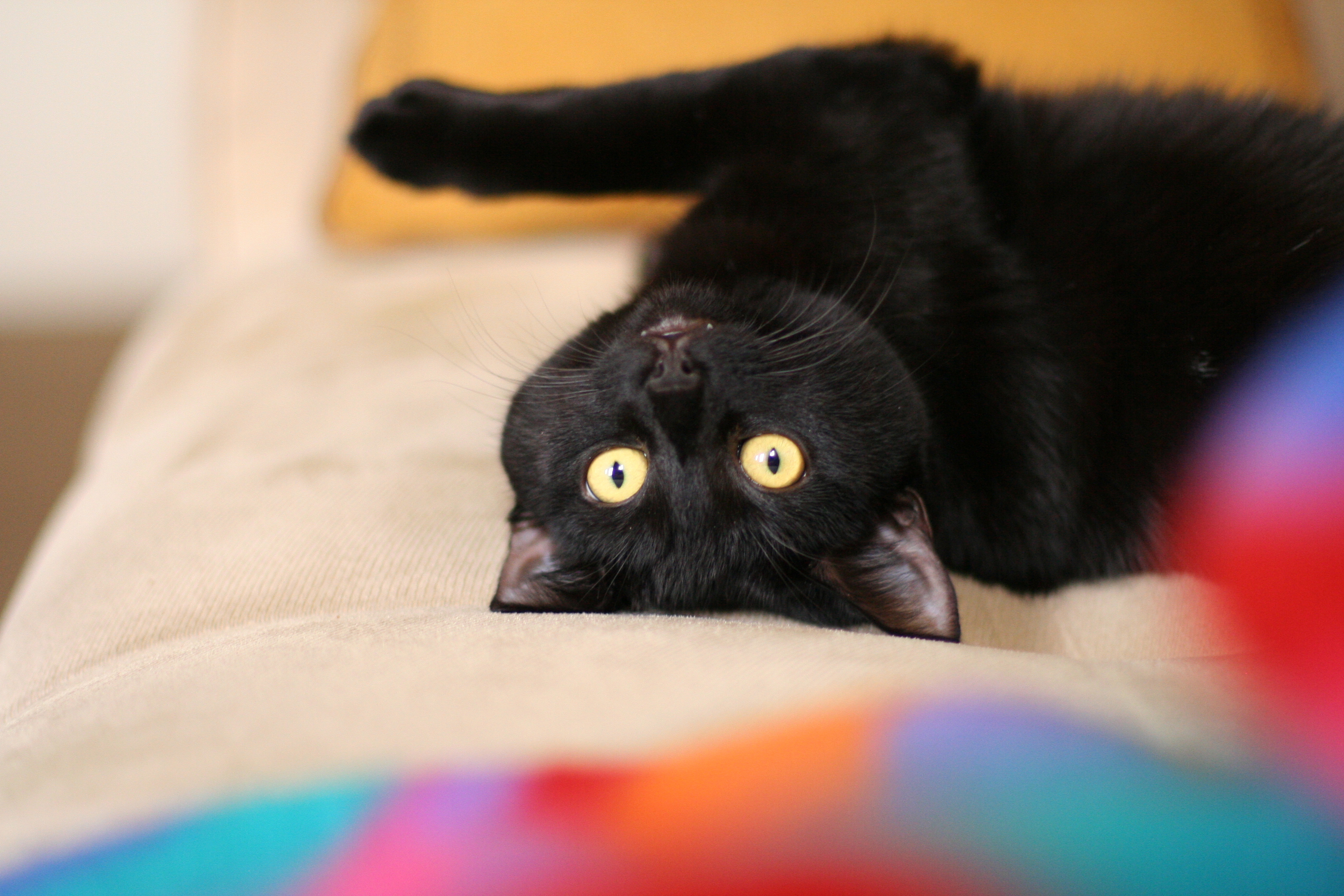
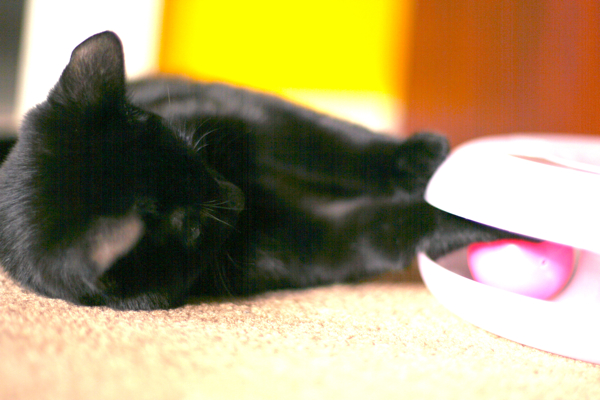
Yesterday I watched Ella once again engage her Sisyphusean toy: a tempting pink ball encased inside a large plastic donut, with side-holes just large enough to accommodate a grasping paw.
__
Suddenly I wondered: is the ball’s ungettability upsetting to Ella, or does it just prolong the pleasure of the chase? In other words, does this game more closely resemble tanha, the craving that leads to suffering, or simply the jouissance of good old healthy exercise?
Yesterday, before my eyes, Oakland turned a corner. A successful general strike (or, as Clarence Thomas of the ILWU Longshoremen’s union put it, “the closest thing this generation has seen,”) shut down capital and commerce around the Town, including the fifth largest port in the nation. (And, as I understand it, the port workers went home with pay!)
Hey folks, sorry for the signal loss! It’s been mad busy around here, partly because of the following little experiment I’m planning, with the help of some good friends. In short, for one afternoon I’m going to try to translate the blog “in real life” (IRL).
The only the IRL ‘blogger’ (or blogger-heavy) gatherings I’ve attended myself have been conferences. Media conferences; technology conferences; things like that. In this type of scene, bloggers from across the country (or among many countries) not only get to expound their theories before a live, half-listening-half-Tweeting audience, but can also lock screen-addled eyes with many writers theretofore befriended — or offended — exclusively online. I’ve seen drama erupt at these idea emporiums, but I’ve also witnessed cyberdenizens leap over tables to greet each other, practically converging midair in an embrace of mutual affection, admiration, and I-can’t-believe-it’s-really-you.
For my own shindig, though, I want to go in a different direction. Very chill, more like a housewarming or offbeat birthday party than a serious networking meet-and-greet. Although there are plentyofonlinewriters and creators I’d love to meet in person someday (and many wonderful ones I’ve already had the fortune to know), most everyone invited to Kloncke IRL are people I’ve known offline for a while. Here’s the email I sent out about it (well, a slightly less colorful version) to my local peeps. Faraway compas, I love you and wish you could be here! My address has been changed for this version because, well, I don’t want it circling around, you feel me? But I’m posting it here because I occasionally meet people in the Bay who’ve read Kloncke but don’t know me personally (yet). If that’s you, shoot me an email, and come on out next Saturday! Love to have you.
dear amazing wonderful human friends.
as most of you know, i make a blog called Kloncke.
i know you know about this blog because many of you have left rad, sweet, insightful, and sometimes hilarious comments there.
i appreciate this a whole lot. i appreciate YOU a whole lot!
and so, as a small means of saying thanks for reading, sharing, linking, and just being your fabulous selves, i want to warmly e-vite you to a gathering in my home, In Real Life (IRL).
what can you expect at such an event?
live incarnates of the cyber version; including:
vegetarian and vegan homemade treats
photographs, available by donation
group meditation
a reading of my recent guest column in make/shift magazine, on buddhism, feminism, and resistance
a “blogroll” table featuring your political, artistic, and spiritual lit to share or display (bring some!)
the colorful walls of our apartment
chillin and building with other lovely folks
Kloncke IRL
Saturday, October 15th 3–5pm (Reading at 4pm) 555 33rd Street, Oakland * * *
this event will be free (of course!) but please bring your own mug or thermos (for tea) and, if you can, a cushion to sit on. (we’ll also have a handful of chairs.) unfortunately our apartment is up one flight of stairs with no elevator or ramp; please let me know if this will be a problem for you, and we can try to work something out.
also, please arrive scent-free so my peeps with Multiple Chemical Sensitivities can come and enjoy themselves without getting sick!
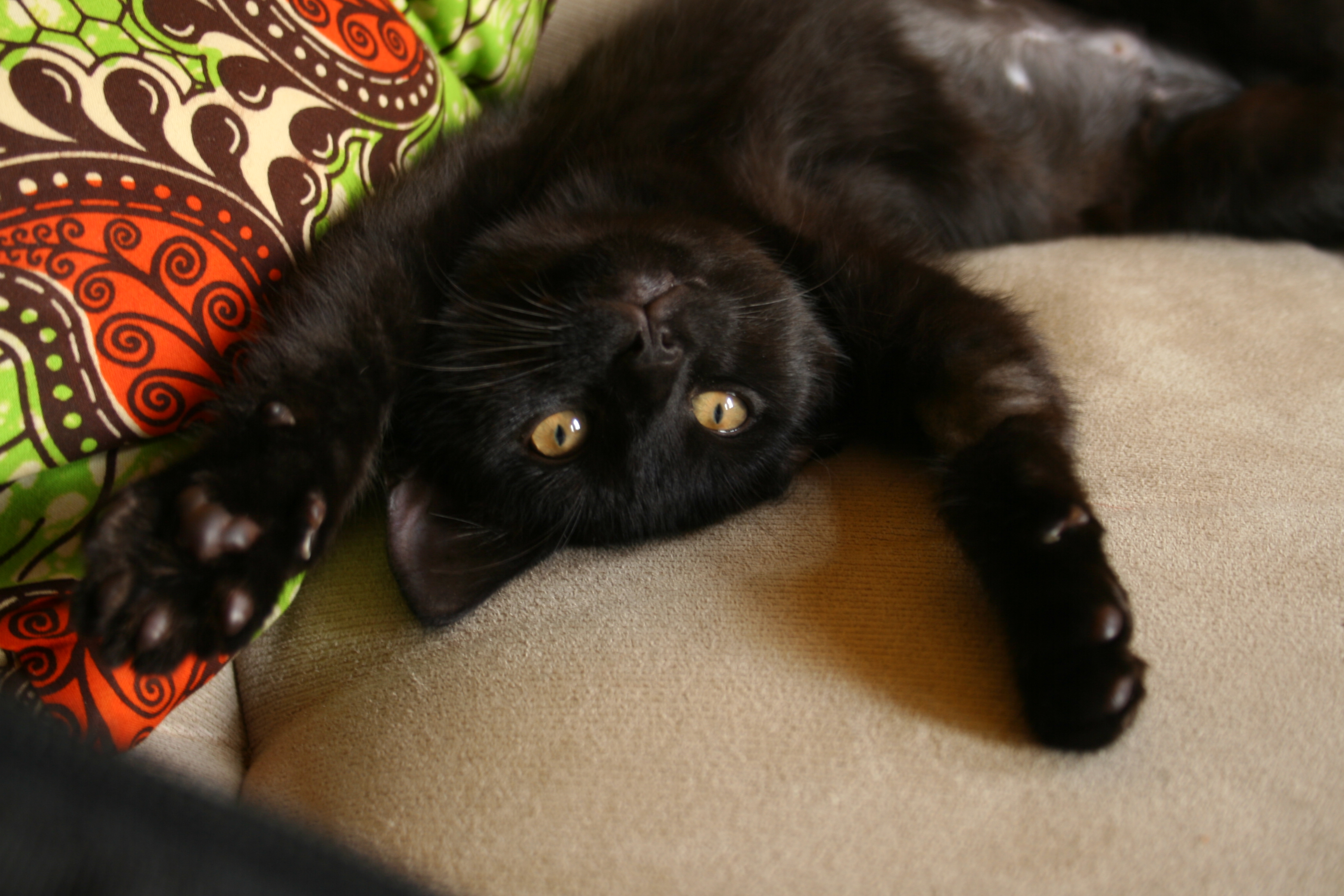
finally, Our place has limited space! Please RSVP so we can have a sense of numbers, and calculate how many walls to knock down.(j/k :) feel free to RSVP-plus-one or two, but don’t roll through with a whole posse. our kitten Eloise will be acting as bouncer, keeping careful track of the guest list.
__
thanks, love, take care, see you soon, be well, and call or e-mail me with any questions,
katie loncke
More to come this week online: the next Newsies post on how the courts are stacked against us, inspired by a frustrating but illuminating experience this morning before a judge. Stay tuned. :)
How many of you have seen Newsies? Easily the best Disney film ever made. Probably the best Disney film even conceivable. (How — how? — did this get greenlighted?) Based on the true events of the 1899 Newsboys’ Strike, it introduces the newsies as a “ragged army” of poor, plucky orphans and runaways who survive by slanging newspapers in the streets of New York. When journalism capitalists Joseph Pulitzer and William Randolph Hearst collude to expand profits by charging more money to the “distribution apparatus” (a.k.a. these teenage laborers), the newsies, outraged, take inspiration from locally organized trolley workers and decide to go on strike.
They also dance and sing, fabulously.
__
In a dazzling display of preternaturally sophisticated taste (or as part of a steady diet of musicals my mother supplied me at a young age), I became obsessed with this movie following its release in 1992, when I was six or seven years old. I remember sliding in the VHS (I think my parents had taped it from TV) and sitting on the carpet below the screen, transfixed by Jack Kelley (a young Christian Bale), Spot Collins (the dreamy dangerous one from Brooklyn), and the rest of the balletic, rough-and-tumble weyr. To this day, I can belt out any of its numbers and recite large swaths of dialogue.
But I am hardly alone in this devotion. Recent example: a few weeks ago at an outdoor beer garden, a friend of Ryan’s, visiting from Oregon, joined us in the opening bars of “Seize The Day” so tenderly and sparklingly that we drew astonished compliments from a nearby table. “What was that?” the woman marveled. “It was beautiful!”
Indeed, the enduring cultish popularity of Newsies has now inspired an adaptation for theater. Academy-Award-winning composer Alan Menken is teaming up with Harvey Fierstein to translate the turn-of-the-century David-and-Goliath tale from screen to stage. Unfortunately, however, it appears that the new version is doomed to be bled of much of its political nuance, in favor of (you guessed it) the romance angle. Fierstein explains:
“In a musical, there’s an old rule: You must follow the love story. It gives the audience somewhere to go and someplace to rest their hearts.”
This slated snoozeifying shift is tragic, not because its motivations are wrong, but because they are right. You do need a love story. Thing is, Newsies already has one. But rather than the typical hetero-sapfest, it is chiefly a love story of solidarity: of workers learning to trust, defend, celebrate and enjoy one another.
I’ll admit, at six years old I came at Newsies heart-first. The head came later. But it did come. And this film affords ample room to grow into, intellectually.
So, in honor of one of my favorite movies of all time, here goes a series of posts: on the real-life lessons we can draw from Newsies.
Lesson One: You’ll Have To Deal with the Scabs.
__
See that song up at the top?
Hear that part (around 0:50) where Boots asks Jack (the leader):
—”What’s to stop someone else from sellin’ our papers?”
—”Well we’ll talk wit’ em.”
—”Some of ’em don’t hear so good.”
—”So we’ll soak ’em!”
“Soaking” is newsie speak for “rolling up on,” or “beating up.” David immediately chimes in with the typical liberal nonviolent objection: No, we can’t be violent! It’ll give us a bad name!
How this violence vs. nonviolence conflict resolves itself through the film testifies to the realism that elevates the movie beyond fun to fascinating. Spoiler: They do use violence. Why? Because they have to, in order to maintain a hard picket line. And this bears out in the history of labor unions in the United States.
[My father] was a union man. There was a dual union— one for whites and one for blacks. He said we should have one big union but a white and a black is better than none. He was making big money—eight dollars a day. I used to brag that “My father makes eight dollars a day.” But he taught me that “you got to belong to the union, even if it’s a black union. If I wasn’t in the union I wouldn’t make eight dollars a day.”
New Orleans is a trade union town. My father had seen the longshoremen organize and they made a lot of money. Unions were not new to this city. And I mean they had unions! When they came out on strike, there were no scabs. You know why there were no scabs? Because you carried your gun. The pickets had guns and they would blow your brains out.
Real talk. And even though Newsies‘ slightly sanitized brawls depict fists, slingshots, and rotten fruit (the opposing side, with hired Pinkerton types, is armed with much more deadly weapons — chains, bats, and brass knuckles — and backed by police), not to mention the conspicuous absence of racial tensions among the workers, nonetheless, the movie does show them defending their strike from scabs through use of force. Not only shows, but cheers it.
* * *
Nowadays, though? Fighting scabs appears to be taboo: at least in mainstream media. Take the recent and relevant example of the ILWU strike up in Washington.
Longshore workers have shut down ports in the Pacific Northwest as they confront a scab grain terminal operation, block trains, dump grain shipments and stand up to a police attack on their picket lines.
Just two days ago, workers (including the local longshore president) and supporters (mostly women) blocked another train from entering the EGT grain terminal. Police responded with mass arrests and liberal application of pepper spray.
Bill Wagner / The Daily News. Law enforcement personnel wrestle ILWU Local 21 longshoreman Kelly Muller to the ground as they arrest protesters and try to clear the tracks so a Burlington Northern-Santa Fe grain train can pull into the EGT grain terminal at the Port of Longview on Wednesday morning.
For mounting these defenses, these workers are pilloried as “thugs” and “goons.” A CNN reporters openly laughed at them. Other reporters deny that the ILWU is fighting true scabs at all, claiming that this all boils down to pig-headed union-vs.-union beef. (David Macaray debunks that argument handily.)
Courts, meanwhile, find the ILWU in contempt: which happens in Newsies, too. In fact, one of the film’s greatest political strengths, in my mind, is how it shows the institutional and corporate-backed violence not only matching but outstripping the workers’ use of physical force. Put in this context of severe power imbalance and active repression, the viewer naturally sympathizes with the newsies’ self defense, even if it is technically “criminal.”
But we’ll save the legality subject for the next post in the series.
For now, I am curious, especially from the Buddhist/spiritual folks who live in commitment to nonviolence: how do you propose dealing with scabs? When workers organize to halt production and the company predictably pushes back, what levels of strategic property destruction and physical force, if any, do you find legitimate? Have you ever been in such a situation? (For the record: I haven’t.)
Share your thoughts, and take care. See you next week with more Disney labor lessons!







 Kloncke