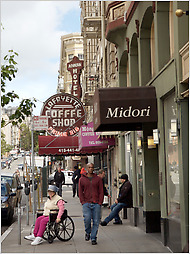
Touring the TL, Screwing Over Its People

by Thor Swift for the NYT

I honestly don’t have much to say about this article from the NYT (lead photo taken directly in front of our home at Fools’ Court) on a potential new tourism trade in San Francisco’s Tenderloin (TL) district.  The backward priorities, exploitation, and opportunism seem pretty obvious to me.

Encouraging adventure-seeking San Franciscans to visit may be easier than selling the Tenderloin to tourists, city tourism officials say. Laurie Armstrong, a spokeswoman for the San Francisco Convention and Visitors Bureau, called the recent efforts “a step in the right direction,” but added that it was a “very, very long road” to make the neighborhood appealing.

Appealing to whom?  Not the people who live here, but outsiders — with money to spend.  The bright side here, I suppose, is exposing the persistence of the trickle-down mentality that drives city planning.  Promoting tourism will supposedly help businesses, which will supposedly help…homeless folks?  Not likely.  Most stores around here won’t even let you in to use the bathroom if you look like you’ve spent the night on the streets.  Which might appear to be the case even if you do sleep inside, in a shelter or SRO: single-resident occupancy.

Just a couple days ago, at the feminist Marxist study group at the Faithful Fools, we talked with Diane, a longtime visitor to the Fools, about her experiences living in an SRO.  It’s sort of like a jail, she said with a chuckle.  You’re permitted a limited number of visits every month.  (8 per month is the max at her place, she thinks.)  Since you can’t have more than 3 people per room, a single mother with three children is out of luck.  There are no kitchen facilities, turn-of-the-century wiring (making personal cooking devices surefire circuit overloaders), and one communal microwave for all 150 tenants.  You’re supposed to get 24 hour’s notice before anyone comes to inspect your room, but managers rarely honor rules like that.

Diane teaching Ryan some dance moves.

Not to say that SROs are no better than sleeping in doorways.  But investing in them as tourist attractions?  How exactly is this helping to create, as Gavin Newsom claims, “a positive identity for the Tenderloin”?  Why not tax rich people (a.k.a. wealthy tourists and corporations) and put funding directly into improving and expanding housing?  Making it a human right in practice, not just in theory?  Of course, the city instead assists landlords who evict low-income tenants in order to turn rental units into condominiums (through legislation like the Ellis Act, which Diane was explaining to us). Meanwhile, the thousands of housing units currently vacant could easily eliminate homelessness altogether.

Forget appealing to tourists.  Personally, I’d rather the folks of the TL follow the lead of Homes Not Jails, who just a week ago occupied a vacant building, resisting eviction and declaring the duplex public property.  Organizing in opposition to state-supported capitalist institutional violence would give the Tenderloin a much more “positive identity,” in my mind, than million-dollar slum museums and “hundreds of [fucking] plaques on buildings throughout the neighborhood.”

Friends On Friday

friend of the furry variety

Kind of like #followfriday, only more of a plain old celebration of the folks touching one Black girl’s heart this week.

Above, Miss Maxine, who slowly but surely welcomed me into her life after a rough start on Sunday.  She’s almost as much of a delight as her owners, Chris and Donna.

Adrienne Maree Brown is just tremendous.  Everybody should read her.  You should read her.  Like, starting now.

Aaron Tanaka is also tremendous.  His blog is pretty much brand-new, but already one of my all-time favorites.  Eclectic, on-point, funny, educational.  Solid.

If you ever get the chance, spend some quality time with Carmen Barsody.  Trust me on this one.

Last but not least, word has it that Advance the Struggle is about to publish a piece analyzing March 4th.  Get excited!

And have a fantastic weekend.

————–

love,

katie

Trans Resistance, Bloggers’ Rights, and My Best Rainy-Day Soup

After the happy madness of last week (school deadlines, dog-sitting, asleep by midnight and up by 4 some mornings for work, the Fools’ annual fundraising dinner — which involved, among other delights, facepaint, paella, and what seemed like six hours of assembling empanaditas), I’m ready to welcome the relative calm and spaciousness of April.  Off to a great start yesterday, with the second gathering of a super-solid and heartwarming Marxist feminist study group, right up in the Fools’ Court.

Today, I’m re-anchoring myself with a few staples.

  • A leisurely morning with Ryan.
  • Reading. (Check this great article, “The Nonprofit Industrial Complex and Trans Resistance”  — thanks to Eva for the tip!)
  • Meditating.
  • Feasting on the veggie soup I made last night in a fit of domesticity following a week of no home cooking.
  • Maybe a little yoga.
  • And as a bonus, a lecture at Golden Gate Law School on bloggers’ rights.  (Which is especially neat since I got a sweet little reminder/invite from a couple of friends I made when teaming up with the law school’s ACLU club in the buildup organizing for SF March 4th.)

Nothing big; all good.

Hope your week’s off to a lovely start, too!

Friendly Flirtations

For a couple of years now I’ve been conscientiously experimenting with different responses to lines from men on the street or in public places.  Ignoring them, getting pissed, smiling and walking on, smiling and saying thanks.  Lots of female-bodied friends of mine experience unsolicited hollering from men, and we all have our own way of dealing with it to best preserve our personal mental health.  (Though this also gets wrapped up, at times, with a sense of social responsibility to make public spaces safer and more comfortable for all women…)

If you ask me, building sex-positive cultures doesn’t mean suppressing the urge to play, but challenging and reformulating our own basic notions of sex as a contest, power struggle, necessary outlet, or primary source of self-worth.  From that perspective, the American Apparel posters in my neighborhood, and the extent to which I allow them to impact my sense of self, might prove more dehumanizing than the dude on the corner who tells me I’m beautiful.

In my case, I rely a lot on my gut instincts rather than a strict rule, but tend to lean toward friendliness since (a) smiling feels better to me than scowling, and (b) ultimately what I want are real relationships with all kinds of people.  Finding a way to push past the sexualized overtones, especially with some of the men I see around my block on the regular, opens up more spaciousness, an opportunity for better connection.

Anyway, I love hearing, from folks of all sorts of genders, the different forms and levels of stranger flirtation that can actually feel fun and sweet. Here, two music videos (classix!) that show what respectful play might sound like.  (Hint: asking questions seems to be a key theme.)  Hat tips to Ryan and Jamal for the YouTubeage, and Noa for recent great conversations on this complex topic.

[Ps: lead-in track, “Ladies Love Cool JB (Innerlube Two),” from homo-hop pioneers D/DC: self-described “bourgeois, boho, post-post-modern, African-American, homie-sexual, counter-hegemonic, anti-imperialist, Renaissance Negroes stalling your cipher.”]

The “8” Of Section 8

It’s been a bit of a rough week, folks. Tuesday I woke up at 6:30am — it was Sharon’s big day. She had made it to the top of the Section 8 housing list, and for the first time in her forty-odd years of life, she was going to have a place of her own.  So we hoped.

The Section 8 Housing Choice Voucher Program subsidizes rent for families and individuals. As far as I can tell, it’s like a semi-privatized version of public housing, much like the whole school-voucher privatization schemes. The government pays landlords to house the otherwise-homeless, rather than building public units with state funding.

But what really blew my mind about Section 8 was the wait list. According to the Housing Authority, approval for an applicant takes between six months and eight years.

Eight years.

EIGHT YEARS.

Sharon, Melissa and I spent four hours Tuesday morning jumping through all the necessary hoops, until we could progress no further for the day. The next step, since Sharon does not have a spotless criminal record from the last 10 years (not too unusual for the chronically homeless and near-homeless, trying to survive), is collecting letters from interested parties testifying to her upstanding character.

Shelter: a privilege reserved for the righteous?

Time for bed. Night, y’all.

California Dying (And Awakening)

This week in The Nation:

"Homeless in Fresno: Guillermo Torrez ended up on the streets after he lost his construction job and his family's home was foreclosed." Photo credit Matt Black

The lethal and typically capitalist governance of California is manifesting, statewide, in a virtual strangulation of the poor.

VMH [in Los Angeles] has provided counseling and medication to impoverished children and adults since 1957. But in August, shortly after the new facility opened, the clinic lost most of its funding for adult services when the state and county yanked their dollars, triggering huge matching-fund losses from the federal government. Eighty percent of the counseling staff, including nearly all of the site’s adult counselors, were laid off. Kids still receive some counseling, but the walls of the rooms in which they are seen by staff are bare–the clinic ran out of funds before it could decorate them–and the doors have paper signs taped to them instead of brass plaques.Nowadays, VMH’s adult clients are treated exclusively with medication. And the indigent mentally ill–whose treatment had been paid for by LA County, which in turn received money from the state–are turned away at the door. Many of them end up sleeping on park benches near the clinic. “These are the chronically mentally ill,” says psychologist Janie Strasner glumly, “who will end up being the raving lunatics on the street.”

What makes this all the more troubling is that Glendale isn’t an outstandingly poor neighborhood, Los Angeles isn’t a poor city and California certainly isn’t a poor state. And yet something is seriously wrong with the organism that is California. The state’s savage budget cuts–$26 billion in 2009, an expected shortfall over the next year that could reach $20 billion–now serve as anti-stimulus to the federal stimulus package. Its basic educational, public safety and social service infrastructure is crumbling. As a self-sustaining political system, as a set of relationships between local and state governments, as a revenue-raising and revenue-spending mechanism, California is deeply damaged. And the impact of that damage is hitting an awful lot of people awfully hard.

And we’re seeing the same brutal impact in the Tenderloin of San Francisco.  From the Faithful Fools’s 2009 Annual Report:

As concern was high over the precarious economic reality and the ever-rampant budget cuts and elimination of vital services, we recognized the importance of being a small, grassroots, heart-driven organization. We had the ability to remain constant in people’s lives when their city or state funded supportive services disappeared. We helped bridge food needs, financial resources and the direct labor necessary to find out what was still available for people and then walked the maze to link them up. We saw the direct face of balancing the budget on the backs of the poor and disabled people as they were notified three different times in the year of a reduction in their monthly checks. The cuts were an average of $70 per person. One fellow who serves on the Tom Waddell Community Advisory Board with us said, “that’s a week’s worth of food for me!”

It’s a deadly time.  But sometimes the threat of death is just what is needed to spark an awakening.  Which, in California’s case, hopefully means a rapidly evolving consciousness of our shared situations, and renewed energy for collective, compassionate struggle.

Grief, Addiction, and Cooking Kale

Today I showed Karen* how to cook kale.  Nothing fancy.  She’d seen me whip up a pan of it to throw into a bowl of leftover minestrone soup for lunch.  She watched me eat my strange mash-up and said, “Katie, you think if I ate healthy stuff like you that I might feel better and be more calm?”

It’s been a tough couple of weeks for Karen.  After dropping out of her rehab program, she found herself back on the streets, cold, with nowhere to go.  Having lost her husband to cancer this summer, she struggles to confront the agonies of grief, on top of mental illness, without turning to her crack or heroin habits for escape.

Karen’s full story is not mine to tell, and I won’t attempt it.  But since it’s my door she shows up at when she’s hit bottom (because it is also the door of the street ministry where I live and work — with only one other staff person this month, while the rest are in Nicaragua), lately her life has intersected with mine in deep, complex, ways.  So complex that in this, my third attempt to write about it, I still don’t really know what to say.

But I can start here, with a bowl of kale, and what it meant to me today.  When Karen asked me to show her how to fix it, the request was partly a gesture of peace.  In her misery, terror and desperation lately, she hasn’t always been kind to me, you know?  Which is natural, and even helpful, in a way.  Observing my own responses to the slights and blowups is some of the best meditative practice I can think of.  Not easy.  Very helpful.  Especially learning when to check my own neurotic impulses to ‘offer wise advice,’ realizing instead that I’m just not the one she can hear it from at that moment.  Someone else might be, but I’m not, and that’s okay.  A practice like that allows me to (a) examine and (b) alleviate the pressure I put on myself to “help” or “perform” in particularly visible ways.  Without that pressure, I am free to notice the “spaciousness” of the situation, as Chögyam Trungpa Rinpoche would say.  Which means more calm and more intelligence — unforced, fluid.

And, as today reminded me, I’m not the only one who benefits from this fluid intelligence.  I’m beginning to get wise to a major role I can play here at the Faithful Fools (again, a street ministry): what I’ve dubbed a “stabilizer.”  Someone who can absorb some of the trauma, tension, and stress without adding too much of their own into the mix.  Remain sensitive but unruffled.  Just be there.  Listen.  I suppose that some people might be loud, active stabilizers (not sure if, in practice, this is an oxymoron), but my style is definitely quiet.  Unassuming.  Just doing my own thing, participating earnestly without getting drawn into all the tangles.  I do it for myself, certainly, as a well-being measure.  And it might just be catching on, too.  Slowly.

That’s another dimension of the cooking demo request: Karen sees something in me that she likes and wants for herself.  I’m content, she says.  I take care of myself.  I feed myself good, healthy, scrumptious food.  And while her interest is sweet and even flattering in a way, the best part is that it shows she values herself.  She wants to take care of herself, to really learn how to do it.  (Which is a long way from some of the extreme, ominous, grasping things she’s said in the last week.)

At the same time, I’m not trumpeting a triumph here.  Frankly, a third reason Karen asked me to show her how to make kale is that she’s still so strung out that she needs to keep herself occupied, moving, at all times.  Diversionary cooking may be healthy, but it’s still diversionary.  Until she can learn to consistently turn to life-affirming supports during the hard times, Karen may stay stuck in her cycle of addiction, disillusioned over and over again.  Plus, on my end of things, I’m still open to (at times, haunted by) the possibility that all this “stabilizer” talk is just so much self-justification, with no lasting beneficial effects.  A false sense of progress.  Perhaps.

But for now, a few things I can say.

No one at the Fools has given up on Karen or canceled her friendship, and no one will.

I am now able to face these crises with a greater sense of bounty, borne of the work of 2009 and meant to be shared.

And kale, as always, is delicious.

—    —    —

*not her real name.

Nesting: Hyde Street

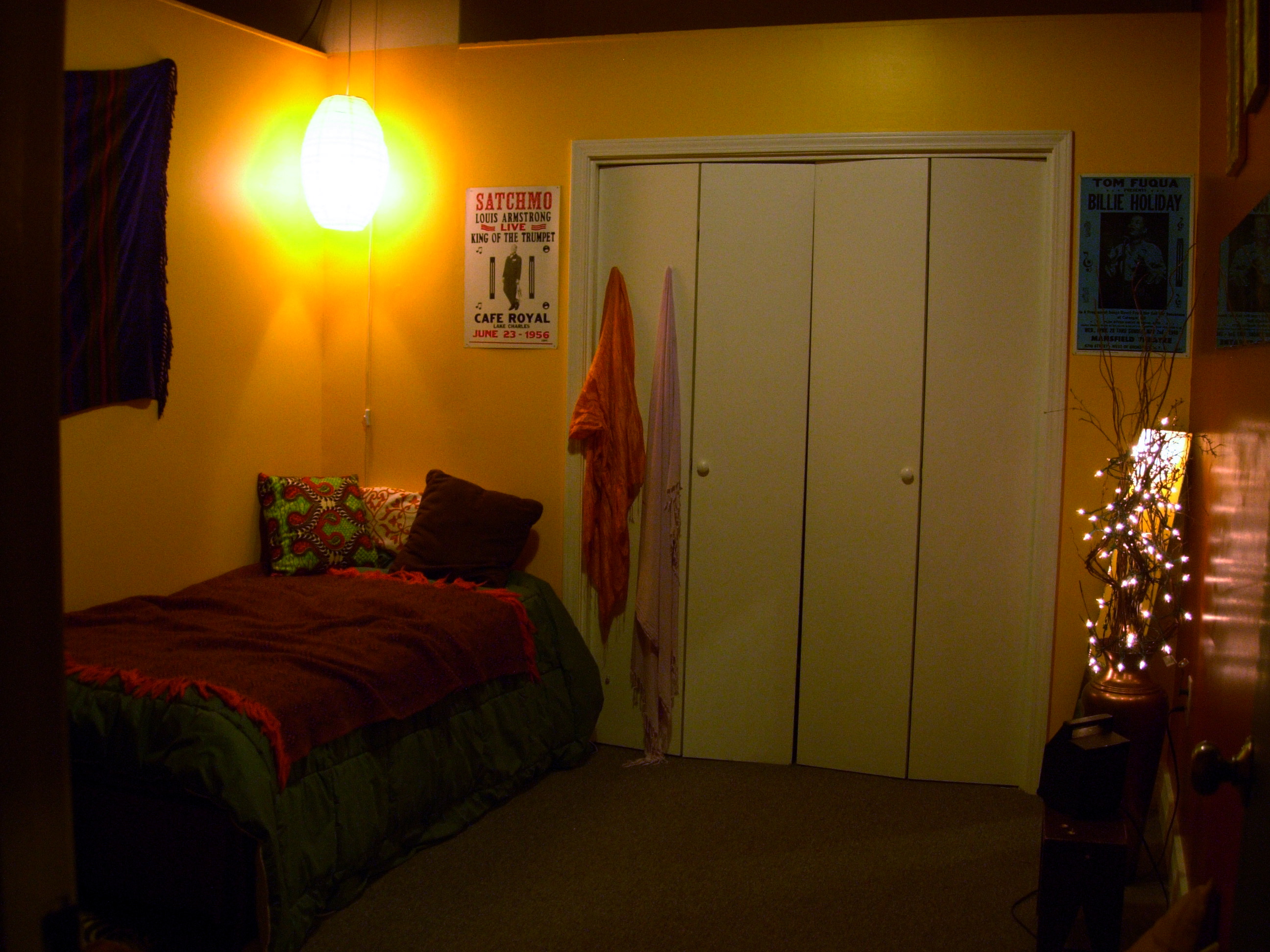
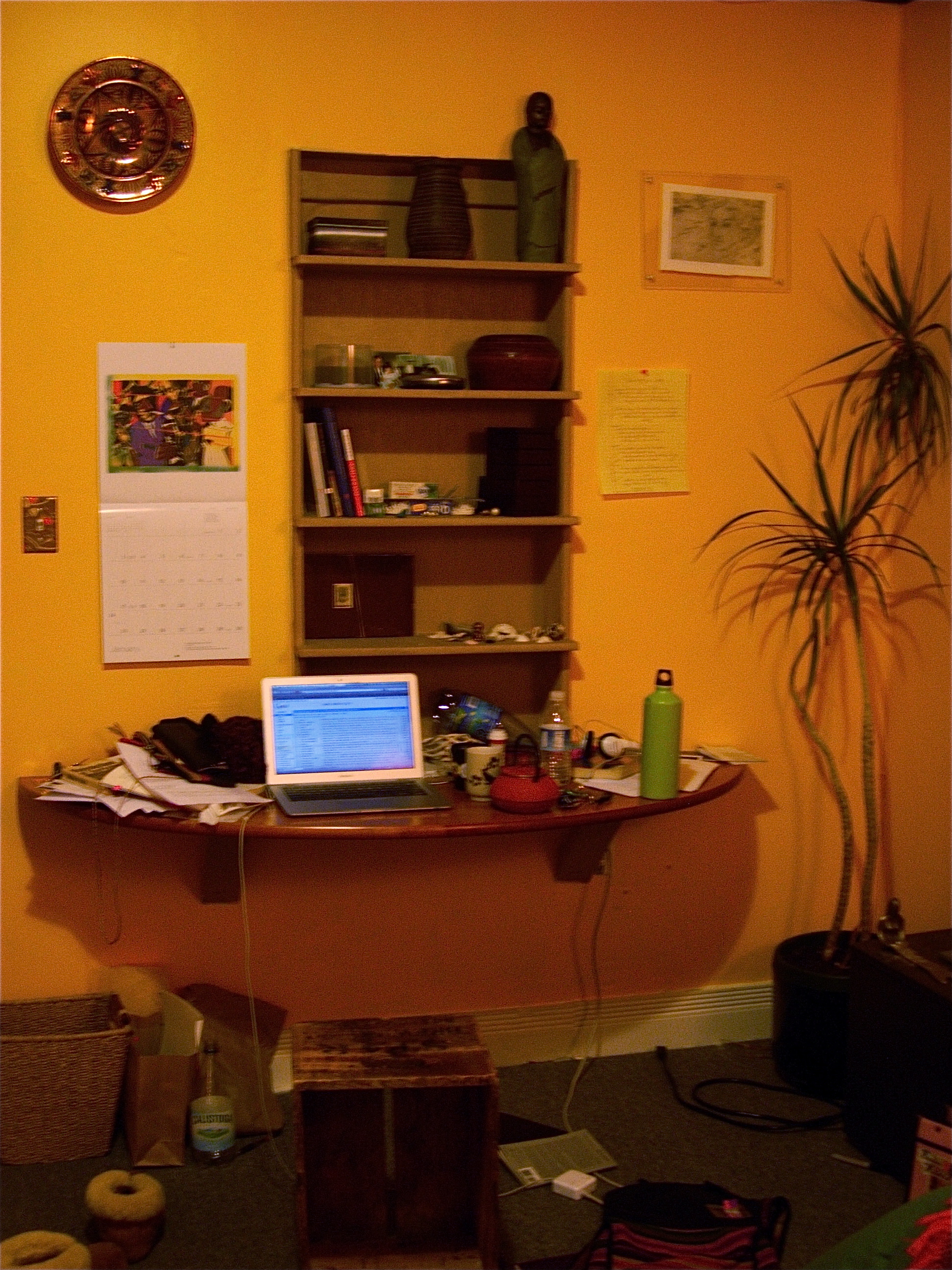
All 3.7 walls of my bedroom at the street ministry.

My friend Jerell taught me how to paint properly, and the two of us finished up this room together when I moved in two months ago.

It’s coming along quite nicely, I think. (Sorry though, I still haven’t figured out how to take good photos in low light…)

At least the mess is confined to the desk area.
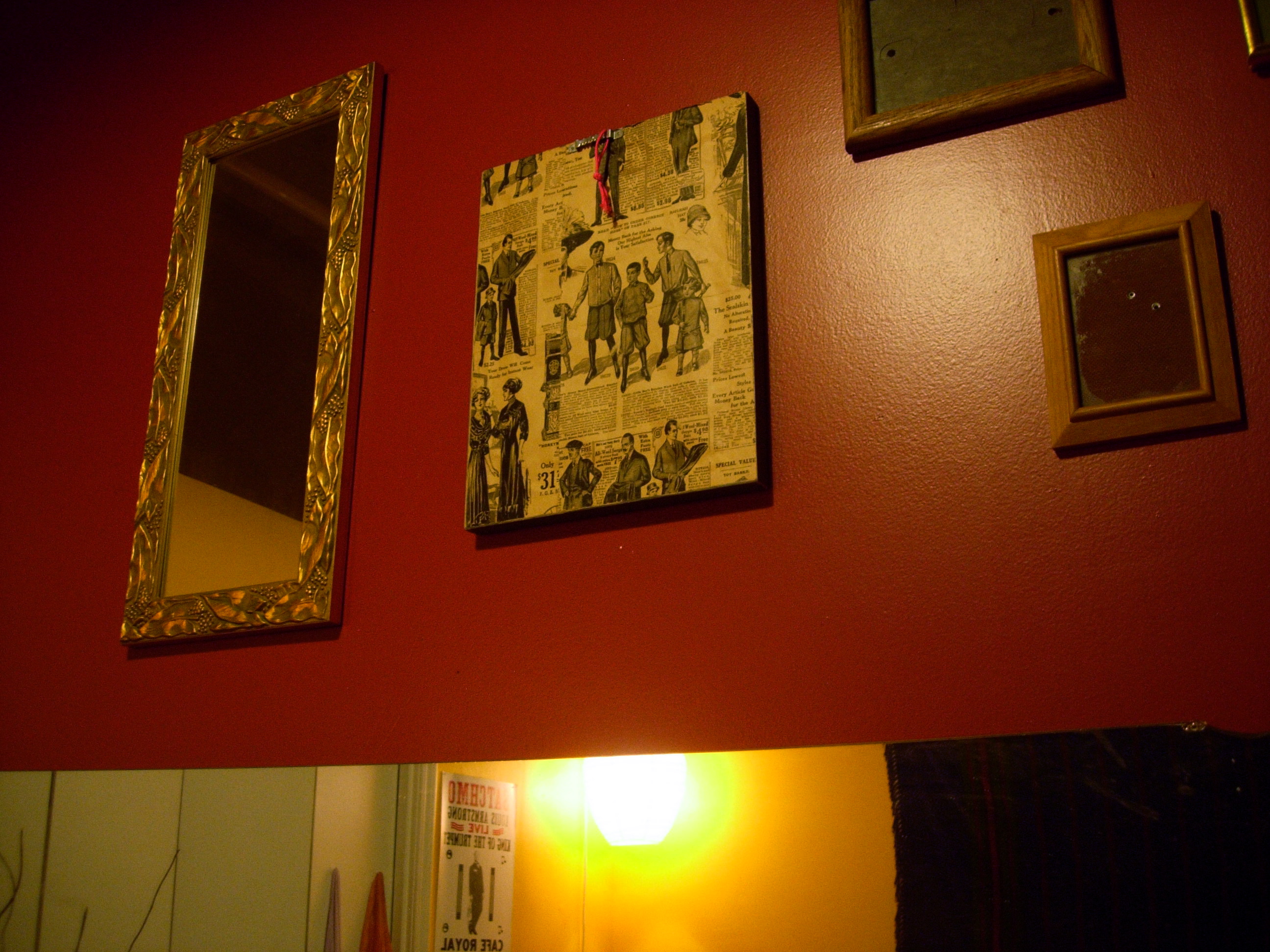
A collection of blanks.
Empty plaques: attesting to my high achievements in nothingness. ;)