As you may have inferred from the above, Dana Heffern’s work as an artist is bad-ass and complex. She’s another of my cohorts in the Goddard Interdisciplinary Arts MFA program — a true blessing to have as a peer. One of those bold workers who gets to you at a head and gut level: often through something like a parody or twist that makes the familiar strange, thus helping us to confront our assumptions.
I heard this radio piece on Tuesday morning because Sharon* wanted to listen to the voice of her late husband. She was a bit of a nervous wreck (understandably) because later that day she and Carmen would be appearing before a judge who would decide whether or not Sharon qualifies for disability benefits. With all the tumult of the past year — losing her husband, quitting a rehab program prematurely, entering a better program only to have her housing number come up in the lottery, which meant choosing between completing rehabilitation and having a place to stay when she got out (I know, right?) — this decision felt particularly momentous. She’d been trying for over a year to secure this income in addition to government assistance, since she can’t hold a job because of her psychological disabilities.
Witnessing our welfare system firsthand through accompanying folks in the Tenderloin is a tremendous eye-opener for me, for sure. I knew the system was fucked in a thousand ways, including bureaucracy and stigma, but it’s another thing entirely to stand beside someone as they endure the process. In justifying her need for support by proving her incapacity to work, Sharon had to prove that she was off drugs (because people with disabilities and addictions don’t deserve support?) and recount all the traumas she has suffered in her life, from being born to a mother addicted to heroin, to being molested by her foster family, to being raped while working as a prostitute. Rather than a celebration of her incredible resilience and survival, the testimony had to be crafted to emphasize inability, incapacity, pathology.
“Break a leg” I said as I dropped her and Carmen off at a downtown Starbucks, where they would meet with her lawyer to review before the hearing. “Yeah,” she cracked, “maybe that would help my case.”
Hey friends! Sorry I dropped off the face of the earth so suddenly! I went into another Vipassana meditation retreat (my third so far under S. N. Goenka), and by the time I realized I’d forgotten to update the blog about it, it was too late: no phone, internet, reading, writing, or speaking for ten long days. Thanks to everyone who’s visited and written to me in the meantime — a number of delightful messages and comments when I arrived home to San Francisco. Mmmm.
For the first day or two since returning from the retreat, I’d been experiencing something of a blockage. A mild panic or depression that left me feeling that all the activities and avenues I had been struggling to juggle up until the meditation course — work at the Faithful Fools; grad school and blogging; political study; and day-to-day dharma practice — were far too hazy, murky, massive, or complicated for me to ever significantly impact or contribute to any of them. It’s been a long time since I felt such strong pessimism and self-doubt, and the timing — directly after a Vipassana retreat, which usually leaves me feeling giddy and abundant — added to the confusion.
Fortunately, I had just spent almost two weeks focusing at a deep level on the reality of change. So I did the best that I could do: watched and waited. Tried not to spin out or magnify things unnecessarily. Felt and explored the negativity, stayed curious about it, rather than trying to push it away.
And wouldn’t you know — it worked! Today my feet started coming back under me, thanks to some conversations with Ryan as well as three key pieces of media: one video, one book, and one radio segment.
I’ll share the book and the radio spot in the next few days. The video, below, is an independent documentary made for this year’s East Bay Meditation Center annual fundraiser. Seeing it today for the first time since early February, when it debuted at the event with Alice Walker and Jack Kornfield, reminded me just how much this organization inspires me, and how fortunate I am to be able to take part in it. (Even participating in the documentary making was great! Met some wonderful fellow members, and the filmmaker was tremendous, too.)
No more introduction necessary, really. Enjoy! And if you feel so moved, join in.
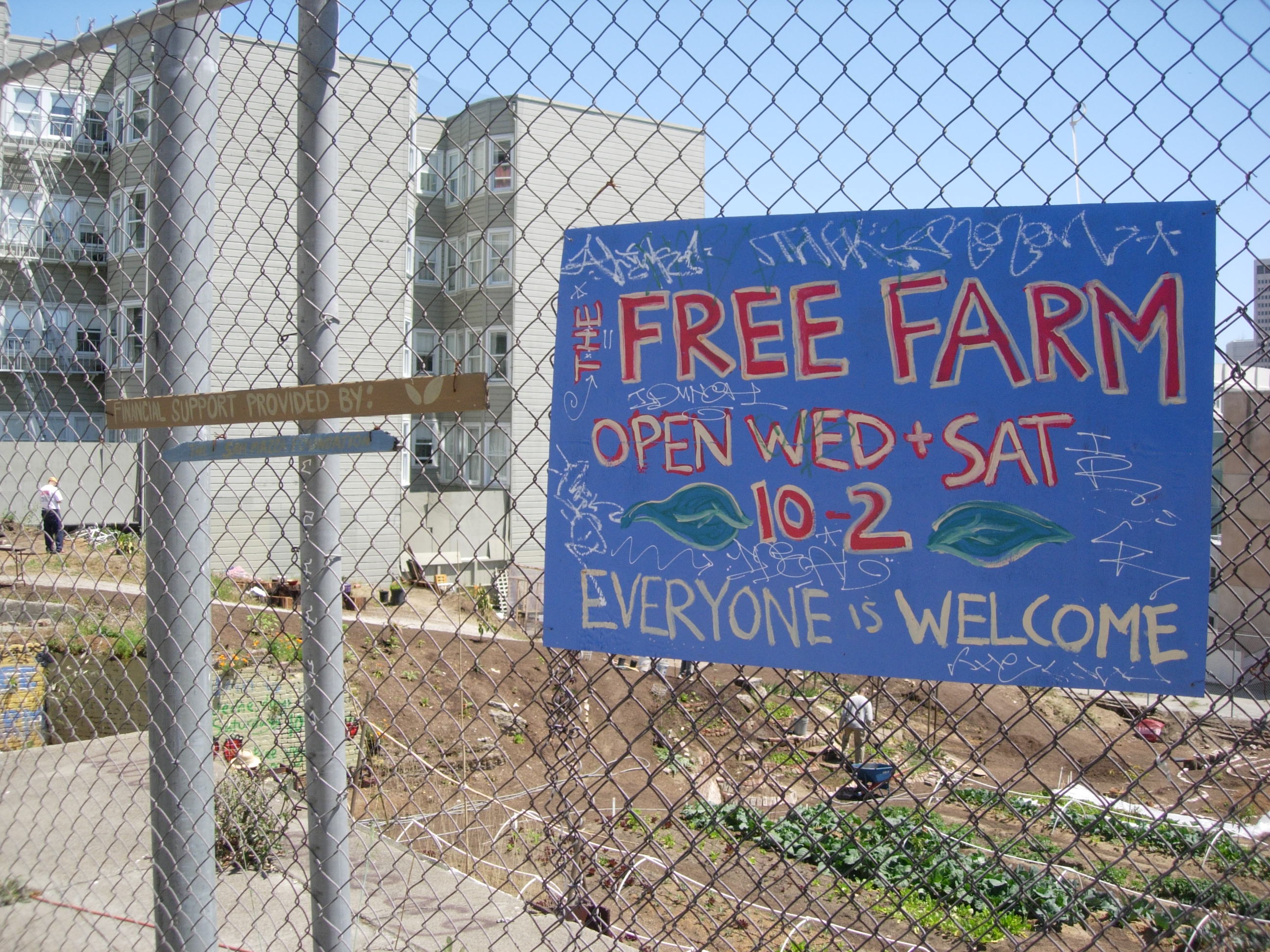
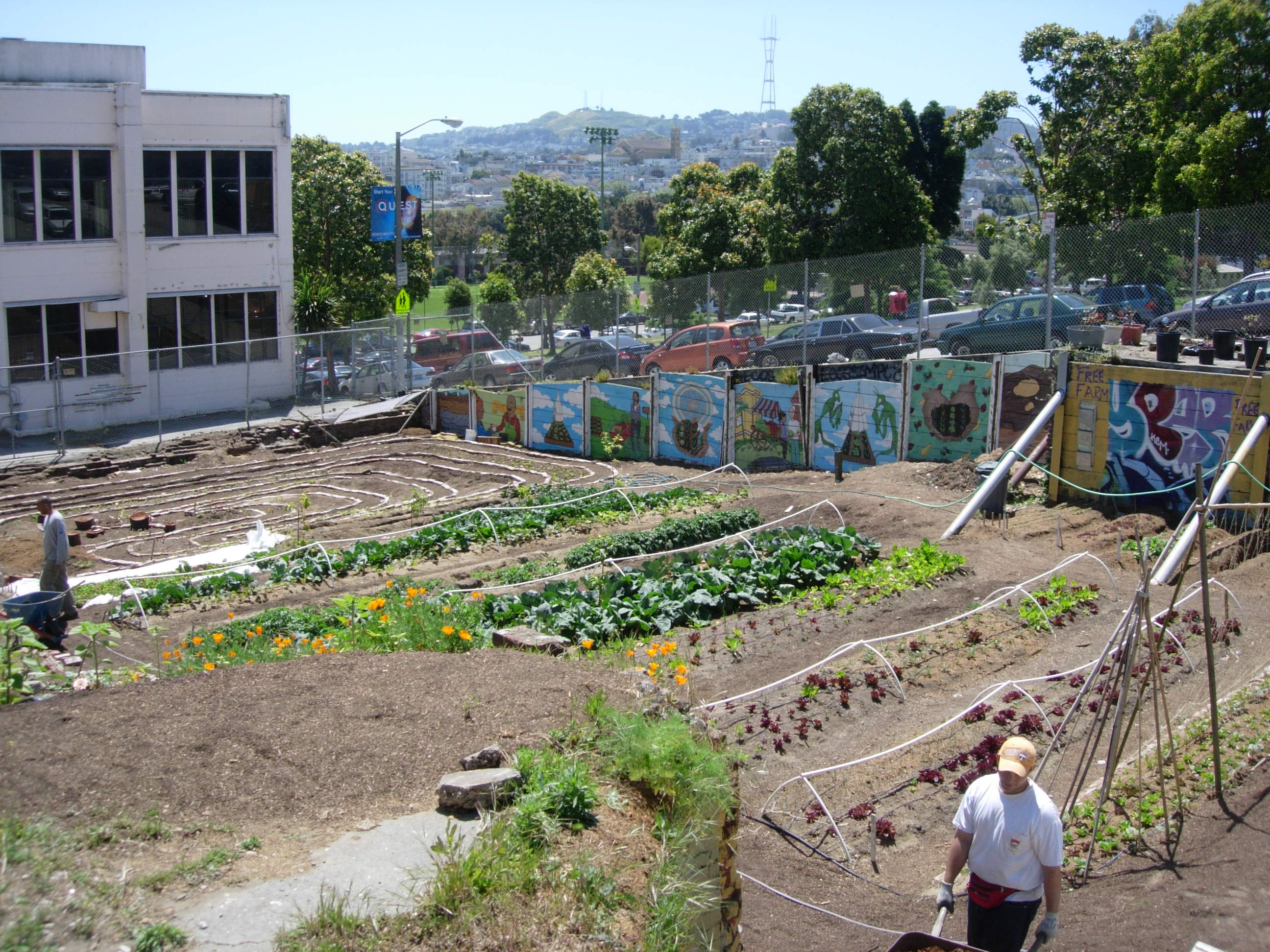
The Free Farm lives on Gough and Eddy, five blocks down from our home at Faithful Fools. It’s being built on a vacant lot where a big church burned down fifteen years ago. The first plantings happened only a few months after I arrived at the Fools, if I remember right. Welcome ministry, an anti-poverty group up on Sacramento Street, has spearheaded the community project, and borrowed our Fools van on a few occasions to haul manure and mural installations. In short, I feel a heart connection to this effort and its facilitators, who are close friends of the Fools and deeply Foolish themselves, in many respects. Reverend Megan Roher, head of Welcome, has made a number of FF street retreats. She is legendary for her ability to rake in the busking dough, singing and performing in the subway stations.
Last Wednesday, a brief visit to the Free Farm — with its beautiful volunteer growers, homed and homeless, some inebriated, all open-hearted — proved just what I needed to kick-start a wondrous afternoon.
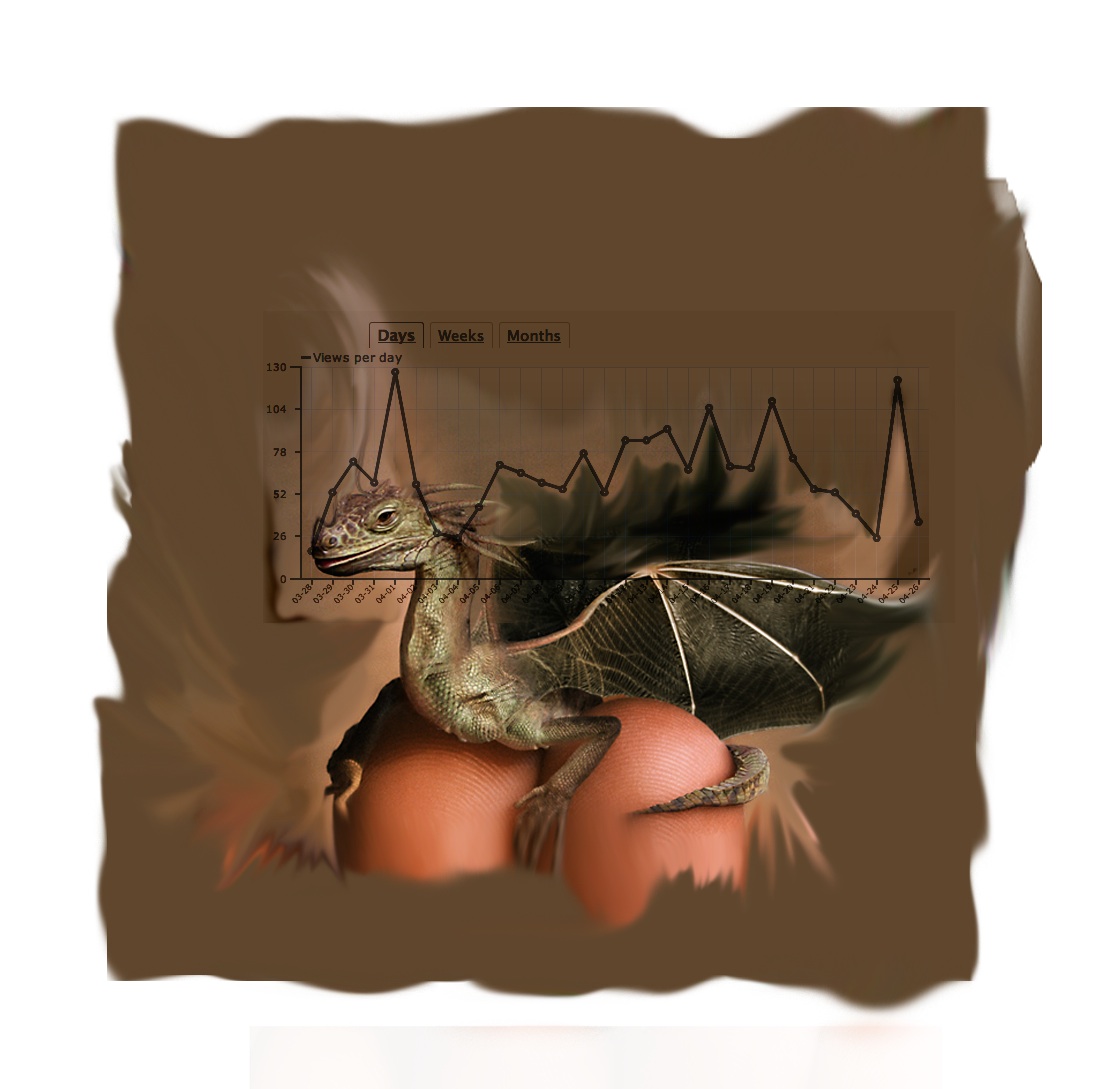
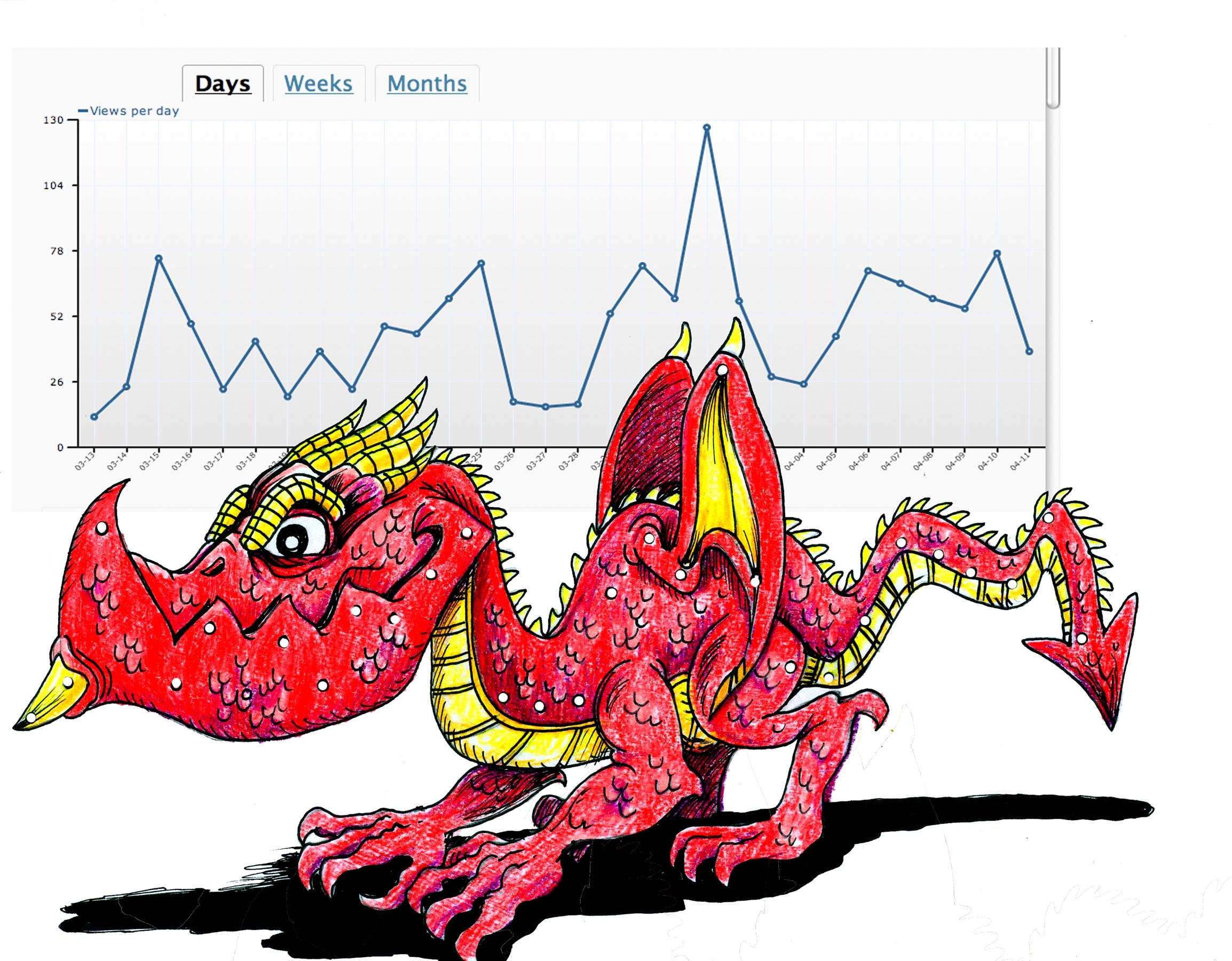
A lovely new stat dragon (first two here and here) by the fantastic John Kovaleski, another of my cohorts at Goddard. John is the kind of person you want on your life team: hilarious, kind, talented, hardworking, humble, and just the right amount of weird. Creator of the adorable “Bo Nanas” cartoon, he’s also working on a wonderful illustration installation project, “Used Books Unbound,” that involves drawing cleverly on the pages of books. It’s an honor to share this little green beast from John’s formidable brain!
And speaking of stat dragons, my original post (with the fabulous Bruce) is featured in this month’s issue of the Zen Peacemaker’s (ZP) online newsletter, Bearing Witness! (Sidebar, under “Resources For Mindful Technology Use.”) The May edition focuses on socially engaged Buddhism online, with some familiar topics (the digital divide; Twitter in Iran; Wisdom 2.0 — the book and the conference, where I tried to raise some economic issues) and some I’d never heard of (Second-Life demonstrations for Tibet; Burmese protest marches organized via Facebook). Ari Pliskin, ZP tech master and architect of these monthly newsletters, was a lovely houseguest here at the Fools last weekend when we both attended the Wisdom 2.0 Summit. An opportunity to get to know the good-hearted man behind the media. :)
Have a good weekend, everybody! More excitement in store for Monday.
When I was about ten, my very favorite outdoor colorscape was a kind of calm, rich, horizontal trio of soft gray, dark brown, and brilliant green. You know how we associate scent with memories? Color works the same way for me (and probably for many of you, too). One or two shades can evoke a whole time and place and mode of being. Clay red and robin’s-egg blue bring me back to a wet walk through a southern Indian suburb. Rusty orange is the color of Barcelona. And yellow is the color of my bedroom: for nearly a decade, whenever and wherever I’ve been able to paint my walls, they’ve always turned out some kind of buttercup or saffron.
Yesterday I reconnected with color thanks to some more helpful tips from Soren Gordhamer’s book Wisdom 2.0. He says that in order to take a real break from computer work, we should try to (a) reduce information intake, (b) breathe deeply, (c) go outside (important one for me to remember!), (d) move around, and (e) keep communication to a minimum (147-148). So we should not, for example, read an article or catch up on a webcomic or play a computer game or text a lover or watch a TV show, even for fun. The most effective resting happens when we relax our discursive mind altogether, and anchor ourselves in experiences beyond screens and words.
With that in mind, I decided that instead of rushing to take the bus home and return to my reading, I would take my camera and meander around the Western Addition on my way back to the Tenderloin.
Trust me, I never thought I’d pick up any sort of self-help book. Even when I worked at Harvard Book Store and shelved the Personal Growth section, I don’t think I so much as thumbed through a single volume. But, as it turns out, some self-help books can teach us how to, like, help ourselves. It’s kinda nifty.
Specifically, this weekend I got my hands on a library copy of Soren Gordhamer’s little handbook, Wisdom 2.0, and it is actually, materially improving my life. Reminding me of many of the insights I came to independently last year about healthy Internet usage, and adding lots of practical tools to my existing repertoire. The snappy magazine tone isn’t my favorite — partly because it tends to veer into upper-class magazine generalizations, where the only external causes for stress are cranky co-workers and long lines at Starbucks, rather than, you know, institutional racism. For the most part, though, the content is solid. This piece, particularly, proved instantly helpful:
An old Zen saying reads:
When sitting, just sit. When standing, just stand. Above all, don’t wobble.
In our age, we might change this to:
When e-mailing, just email. When talking on your cell, just talk on your cell. Above all, don’t talk while emailing.
For most of us, the talking, working, or surfing online are not what is stressful; it’s the time we spend wobbling. It’s the multitasking and unconsciously switching back and forth between modes of communication…This can be exhausting and stressful when such transitions are done unconsciously and habitually. We can, however, learn to consciously change channels so instead of draining our energy by continuously multitasking, we move with ease from one mode to another. (27)
This means a few things for me. One, I’m re-adopting a practice I developed last summer, in Europe, of leaving open only one window on my laptop at a time. Just one at a time. Either my Internet browser, or my word processor, or iPhoto, or Skype, etc. This clears up a shocking amount of head space and lets me concentrate on one task at a time. Surprisingly, I find that this elevates not only focus, but also enthusiasm. I feel lighter and more at ease when I have a single task before me. I can even see my lovely green desktop photo behind my one window, instead of a cluttered layer of more programs.
If someone calls my cell phone, I pause and determine whether my time is better spent answering right now, or staying with my computer project and hitting them back later. If someone approaches me in person, or the kettle whistles, I take a moment to deliberately shift all of my attention to the real-time project. And far from slowing me down, this approach actually cuts down enormously on wasted time, and helps me spend my energies in a more pleasurable way.
That’s another thing: this book is reminding me that waiting can be pleasurable! Waiting for photos to upload, waiting for a page to refresh, waiting for a wireless connection to come through…simply by reworking my own mind, I experience them as moments of rest and alert relaxation, not impatience and weird greedy hypnosis. (Staring at the loading bar, anyone?)
Of course, there may be issues, like a colleague’s continual tardiness to meetings, which need to be addressed. However, if we do not blame the person for our discomfort, if we do not bring our dissatisfaction with our inner life into the issue, then we can more skillfully address the problem. We see that the situation provides an opportunity for learning, and we can address it without the extra frustration.
This does not mean that we can use this as an excuse for our own actions. The next time we are criticized by our manager for showing up late to a meeting, it is probably not best to reply, “Well, if you weren’t so uncomfortable with your inner life, this would not be a problem. Deal with yourself.”
It was during such a bright, cheerful pause in a French café last summer, while 20 photos took 10 minutes or so to upload, that the germ for this post (one of my favorites, I think) arose.
Anyhow, this little manual is certainly shaping up to be a pleasant surprise. (I’m about 2/3rds through.) And speaking of mildly embarrassing interests, it has even diminished my skepticism enough to warrant one more student registration for the Wisdom 2.0 Summit in Mountain View, coming up this very weekend. (Crazy — Ari Pliskin of Zen Peacemakers had mentioned it to me a while back, and I knew he would be in town for it, but none of that occurred to me last week when I found the book at the library and picked it up. Too odd a coincidence not to explore, even though it means dropping the bulk of my dog-sitting earnings on the conference fee.)
May your back and neck, forearms, eyes and mind be well this week, my dears, however much time you log in front of a screen.
It’s amazing to think back six months to when I first arrived in the Bay Area, with nothing to do but look for work. No major activities, no responsibilities to anyone. How can things change so much in six short months?
Faithful Fools: apprenticing with Tenderloin spiritual-realist matriarchs
Art school: blogging and theorizing; submitting monthly assignments
Political education: post- organizing for March 4th, now regrounding myself through study groups
Dharma: deepening my daily meditation, seeking out communities of advanced practitioners
Relationships: a partner, a posse, friends, family, and a few animals
Yeah, it’s feelin’ like a lot.
And I’ve been hanging on to the blogging for dear life, trying like heck to publish every weekday. But the truth is, that kind of frequency costs me the time to consider the meta-questions, to develop my nascent theories of mindful blogging. And that’s what I’m in grad school for, after all!
So for the next little while, I’ll be backing off on the daily posting, probably limiting it to three days a week. I’m genuinely surprised at how difficult this feels for me — how much of a sacrifice or failure it seems — given that, on multiple occasions, I’ve cheerfully abandoned the blog for months at a time. So, as Shaila Catherine might observe, this becomes my work for the moment: developing equanimity in letting go and switching up the schedule.
Spiritual practitioners thrive in unpredictable conditions, testing and refining the inner qualities of heart and mind. Every situation becomes an opportunity to abandon judgment and opinions and to simply give complete attention to what is. Situations of inconvenience are terrific areas to discover, test, or develop your equanimity. How gracefully can you compromise in a negotiation? Does your mind remain balanced when you have to drive around the block three times to find a parking space? Are you at ease waiting for a flight that is six hours delayed? These inconveniences are opportunities to develop equanimity. Rather than shift the blame onto an institution, system, or person, one can develop the capacity to opt to rest within the experience of inconvenience.
A welcome reminder. And a very helpful practice for those of us with wee control issues. Just yesterday, when I found myself spiraling downward into disappointment and resentment at canceled plans, I remembered equanimity. And my disappeared dinner date transformed into a chance to walk, for the very first time, around Oakland’s lovely Lake Merritt.
Gorgeous late afternoon and evening, complete with a sweet springtime surprise.
So who knows — maybe this downsizing of the blog will open up some other opportunities. Regardless, I’m happy for the chance to practice letting go.
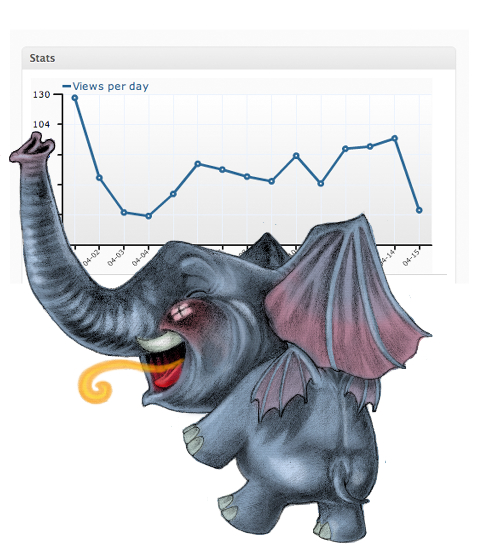
Adoring this elephantine addition to the Stat Dragon family. By the terrifically dope Aaron Zonka, who I met at a party where he was literally That Guy In The Corner Quietly Sketching Things Of Genius.
If you’re in the Bay Area, check out his series of fabulous art/music shows, “Under the Table Gallery.” Live performers, exhibitions for sale and viewing, snacks and libations, the whole deal. Next one is April 24th, 5-10pm, 248 Felton Street.
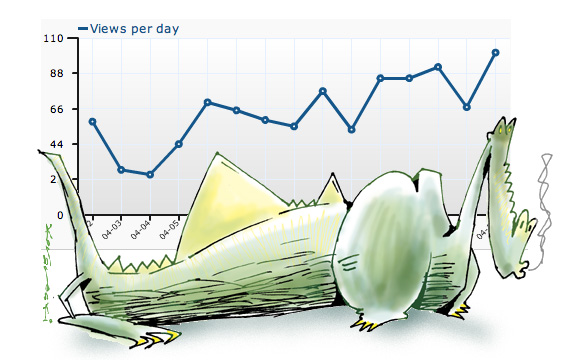
A stat counter is a common tool that lets bloggers see the number of people who visit their site. I learned about it back in 2005, when I first became acquainted with blogs, and have interacted with stat counters and traffic graphs in my bloggerly life ever since. Every day (ok let’s be real: practically every five minutes), I check my traffic chart on Kloncke to see how many people are reading. I glance at the line graph and its 15-day history, with the current day’s data point climbing ever upward until the stroke of midnight, when its ascending carriage takes a pumpkin-like tumble back down to zero. New day, new stats.
Within the past few months, I noticed myself monitoring my stat charts with increasing closeness and intensity. It became sort of embarrassingly compulsive. I checked my traffic at Gmail-like intervals (read: Too Frequently). And of course, my heart would soar and sink according to the graph’s altitude.
High: high.
Low: low.
Many page views: “My writing is helping people.”
Few views: “This blogging thing is just a narcissistic waste of time.”
Et cetera.
And then, the real kicker: auto-adjusting scale.
Let’s say I’ve been plugging along on my little blog for a month, and one day I get 25 views, the next day 30, the next day 7, and so on. The top of the y-axis represents the largest number of views in a single day: 150. The smallest, one notch above zero, is 3. Then, one day, the blog is viewed 170 times. What happens to the chart?




 Kloncke