The General Strike worked in Nigeria! Beautiful testament to who really constitutes the foundation of the world economy: not politicians or businesspeople (so-called “innovators”), but workers and ordinary people (who continually innovate new ways of asserting power against bosses, patriarchs, and state oppression).
Thank you, friends in Nigeria, for inspiring the rest of us! May we continue to develop and use our collective material power, worldwide, and discover together how to replace capitalism with a system that promotes freedom, equality, compassion, and positive interdependence among humans, animals, and the earth (and maybe robots; who knows ;) ).
Also, smiled at this seemingly pro-queer shoutout from Femi:
Later in his office, Mr. Kuti shouted at his television as he watched the labor leaders announce the end of the strike. “I told you those people would back down,” he said to his aides, looking up from the screen. As for the government, he said, “They prosecute people for being gay, but there is no law against stealing 14 million.”
I don’t want to fight my landlord
over who will pay for bed bug extermination.
I don’t want to feel relieved
when the infestation’s epicenter
turns out to be in the unit upstairs.
Those men are broke enough as it is,
trying to stay clean and sober and keep a job.
Can’t afford a thousand dollars
for liquid CO2.
I want a building, a block, a cityland
where everyone is secure
in a shelter they love
where no one feels pressed to salvage
a dubious mattress
unless they can take it to the free clinic
for thorough inspection and cleaning.
No big deal.
I want to be free and open
to share the pains of infestation:
we’re in this together.
I don’t want to fight my landlord.
I don’t want a landlord at all.
I want a world without them;
bed bugs we can handle.
So many people have been writing and sharing wonderful views on Oakland’s General Strike — I thought I’d collect a few for my digital memory chest.
Where We Been
Grew up listening to him on KSFM 102.5 — now appreciating Davey D’s take on the day.
Mushim Ikeda-Nash, writer and one of the many dope teachers at East Bay Meditation Center, offers a perspective as a spiritual leader and involved Oakland parent.
Dope commenter, organizer, and now blogger in her own right, Huli breaks it down and offers a delightful new phrase: “peace bullies.”
A 10-year street medic, present for the attempted re-opening of the former Traveler’s Aid Society, supports liberating empty buildings and standing up to cops, but urges us to prioritize inclusive solidarity and sustainability, not spectacle.
Where We Goin
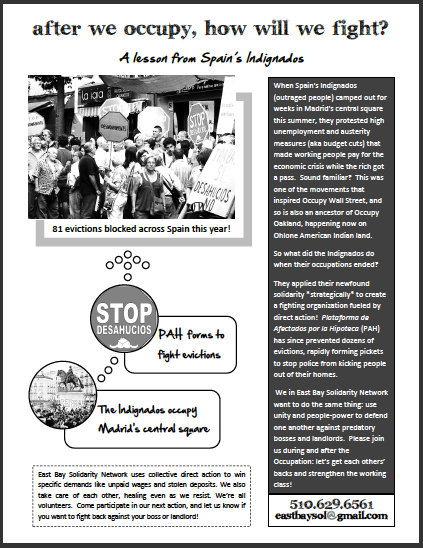
Ryan and I made this flyer a few weeks ago for East Bay Solidarity Network, to pass out at the Occupy/Decolonize Oakland encampment. (Click image to download & read)
Official, institutionalized groups like Causa Justa / Just Cause and ACCE have been doing some anti-foreclosure work since before #OWS. But I think that the movement now lends two vital long-term ingredients: (1) a crucial boost of irreverence for the law, and (2) more people power to defend this wave of “political disobedience.”
Despite some people’s insistence that occupiers are exercising “the right to assembly,” when it comes down to it, Oakland occupiers are maintaining an unpermitted encampment. We are disobeying laws not for the sake of flauting unwanted codes, but for the sake of building new wanted realities. And we have enough support —thousands and thousands of people — to keep on making moves.
The strain of positive lawlessness underlying the movement is, in my opinion, a good thing: especially if it means that we, the 99%, are asserting that the law institutionally favors the 1%, and thus is not a reliable mechanism for real change. And since nonprofits in this country, like big unions, are so bound up with legalism (in order to get grants/contracts, avoid lawsuits, and continue to exist as orgs), it’s important to have strong unofficial wings of mass movement, willing to take that extra step into illegal (but positive, life-affirming) territory.
At the same time, whenever we talk about positive lawlessness, the question arises: arrest risk. Real talk, hella people simply cannot afford to be arrested, cuz they’re already overcriminalized because of racism, transphobia, anti-migrant terrorism, family responsibilities, etc.! So it’s also important to continue having lower-arrest-risk actions, ideally led by people who aren’t trying to get arrested themselves. For instance, this march led by POOR magazine (Prensa Pobre), scheduled for this Thursday. From their web site:
We are asking the powerful Decolonize (Occupy) movements in the Bay Area to decolonize and march with us in solidarity with those of us in severe poverty who struggle to survive, raise our babies and face ongoing racist, classist laws legislations and false borders everyday on both sides of the bay as we present demands to the government offices that continue to racialize, criminalize, harass, evict and abuse us.
We will march and decolonize four govt spaces on both sides of the Bay – ICE, Welfare (DHS), HUD (Housing n Urban Development) & The Po’Lice in one day at the front of each of these buildings – we ARE not trying to endanger ANY poor peoples/migrante peoples with arrests as none of us can risk arrest.
POOR Magazine/Prensa POBRE/PoorNewsNetwork(PNN) is a poor people-led.indigenous peoples led grassroots, arts organization dedicated to providing revolutionary media access, education, art and advocacy to youth, adults and elders in poverty across Turtle Island.
__
It’s so encouraging to see issues like free education and housing coexisting with labor demands and greater organization of the working class across sectors. In the long-long-term view, as Advance the Struggle reminds us, we — not the politicians and policymakers — will occupy the means of production and begin to build the world we desire.
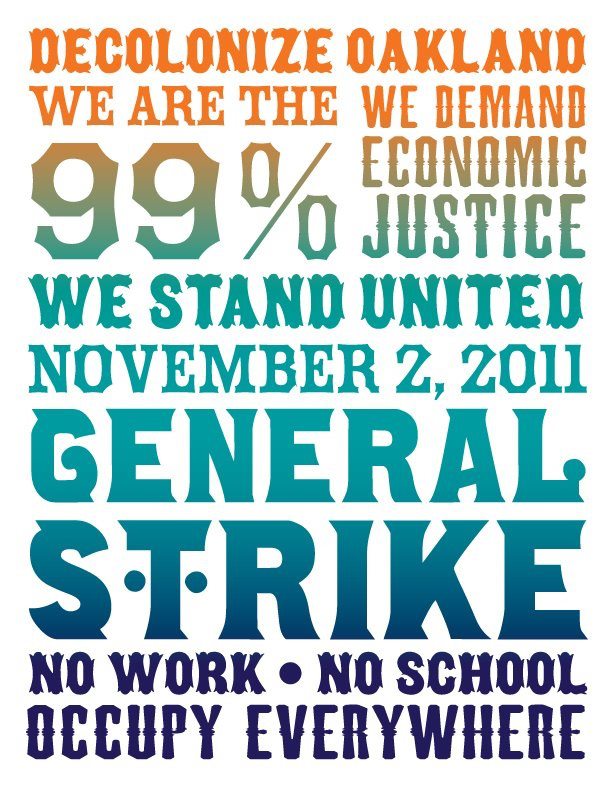
Yesterday, before my eyes, Oakland turned a corner. A successful general strike (or, as Clarence Thomas of the ILWU Longshoremen’s union put it, “the closest thing this generation has seen,”) shut down capital and commerce around the Town, including the fifth largest port in the nation. (And, as I understand it, the port workers went home with pay!)
Busy, busy, busy. Good times. Exciting times. Overwhelming times.
Don’t have many words at the moment; feeling kinda worn out from an East Bay Solidarity Network picket this evening, plus helping a few friends move over the past couple days.
But I can’t let tomorrow’s historic event go without some autobiographical comment! Lol.
So here’s a visual offering of some of the beauty I’ve seen at the #occupy encampments in Oakland and Seattle. (I’ve briefly visited SF’s spot, too, but it was nighttime and my camera takes crappy photos at night.)
These are small-scale, low-key views, observed during the day when not too much was going on: so for the dramatic pics of the GA crowds, or OPD tear gas, or community art made out of torn-down fences, you’ll have to check the news or your favorite political Facebook friend’s feed. :)
This slideshow requires JavaScript.
Since these photos were taken, Oakland’s encampment has been raided, destroyed, and rebuilt. People have been severely injured (though thankfully not killed) by OPD’s “crowd control” methods, the aggressiveness of which reflects and extends their typical, too often lethal aggression in Oakland’s poor Black and brown communities.
And since these photos were taken, thousands of Oaklanders have taken to the streets, participated in General Assemblies, and worked hard to build support for tomorrow’s General Strike. Solidarity demonstrations have cropped up as far away as Israel and Egypt. And tomorrow, workers will leave work, students will leave school, and we will remind the 1% (and remind ourselves) that WE are the ones who generate the wealth of billionaires, and WE — all of us — deserve food, water, clothing, shelter, clean air, medicine, childcare, freedom from police, deportation, and military terror, and total democratic control over the places we live and work every day. The time for asking for these things is over. It’s time to take them.
That’s all for now, friends. See you in the streets!
Hey folks, sorry for the signal loss! It’s been mad busy around here, partly because of the following little experiment I’m planning, with the help of some good friends. In short, for one afternoon I’m going to try to translate the blog “in real life” (IRL).
The only the IRL ‘blogger’ (or blogger-heavy) gatherings I’ve attended myself have been conferences. Media conferences; technology conferences; things like that. In this type of scene, bloggers from across the country (or among many countries) not only get to expound their theories before a live, half-listening-half-Tweeting audience, but can also lock screen-addled eyes with many writers theretofore befriended — or offended — exclusively online. I’ve seen drama erupt at these idea emporiums, but I’ve also witnessed cyberdenizens leap over tables to greet each other, practically converging midair in an embrace of mutual affection, admiration, and I-can’t-believe-it’s-really-you.
For my own shindig, though, I want to go in a different direction. Very chill, more like a housewarming or offbeat birthday party than a serious networking meet-and-greet. Although there are plentyofonlinewriters and creators I’d love to meet in person someday (and many wonderful ones I’ve already had the fortune to know), most everyone invited to Kloncke IRL are people I’ve known offline for a while. Here’s the email I sent out about it (well, a slightly less colorful version) to my local peeps. Faraway compas, I love you and wish you could be here! My address has been changed for this version because, well, I don’t want it circling around, you feel me? But I’m posting it here because I occasionally meet people in the Bay who’ve read Kloncke but don’t know me personally (yet). If that’s you, shoot me an email, and come on out next Saturday! Love to have you.
dear amazing wonderful human friends.
as most of you know, i make a blog called Kloncke.
i know you know about this blog because many of you have left rad, sweet, insightful, and sometimes hilarious comments there.
i appreciate this a whole lot. i appreciate YOU a whole lot!
and so, as a small means of saying thanks for reading, sharing, linking, and just being your fabulous selves, i want to warmly e-vite you to a gathering in my home, In Real Life (IRL).
what can you expect at such an event?
live incarnates of the cyber version; including:
vegetarian and vegan homemade treats
photographs, available by donation
group meditation
a reading of my recent guest column in make/shift magazine, on buddhism, feminism, and resistance
a “blogroll” table featuring your political, artistic, and spiritual lit to share or display (bring some!)
the colorful walls of our apartment
chillin and building with other lovely folks
Kloncke IRL
Saturday, October 15th 3–5pm (Reading at 4pm) 555 33rd Street, Oakland * * *
this event will be free (of course!) but please bring your own mug or thermos (for tea) and, if you can, a cushion to sit on. (we’ll also have a handful of chairs.) unfortunately our apartment is up one flight of stairs with no elevator or ramp; please let me know if this will be a problem for you, and we can try to work something out.
also, please arrive scent-free so my peeps with Multiple Chemical Sensitivities can come and enjoy themselves without getting sick!
finally, Our place has limited space! Please RSVP so we can have a sense of numbers, and calculate how many walls to knock down.(j/k :) feel free to RSVP-plus-one or two, but don’t roll through with a whole posse. our kitten Eloise will be acting as bouncer, keeping careful track of the guest list.
__
thanks, love, take care, see you soon, be well, and call or e-mail me with any questions,
katie loncke
More to come this week online: the next Newsies post on how the courts are stacked against us, inspired by a frustrating but illuminating experience this morning before a judge. Stay tuned. :)
How many of you have seen Newsies? Easily the best Disney film ever made. Probably the best Disney film even conceivable. (How — how? — did this get greenlighted?) Based on the true events of the 1899 Newsboys’ Strike, it introduces the newsies as a “ragged army” of poor, plucky orphans and runaways who survive by slanging newspapers in the streets of New York. When journalism capitalists Joseph Pulitzer and William Randolph Hearst collude to expand profits by charging more money to the “distribution apparatus” (a.k.a. these teenage laborers), the newsies, outraged, take inspiration from locally organized trolley workers and decide to go on strike.
They also dance and sing, fabulously.
__
In a dazzling display of preternaturally sophisticated taste (or as part of a steady diet of musicals my mother supplied me at a young age), I became obsessed with this movie following its release in 1992, when I was six or seven years old. I remember sliding in the VHS (I think my parents had taped it from TV) and sitting on the carpet below the screen, transfixed by Jack Kelley (a young Christian Bale), Spot Collins (the dreamy dangerous one from Brooklyn), and the rest of the balletic, rough-and-tumble weyr. To this day, I can belt out any of its numbers and recite large swaths of dialogue.
But I am hardly alone in this devotion. Recent example: a few weeks ago at an outdoor beer garden, a friend of Ryan’s, visiting from Oregon, joined us in the opening bars of “Seize The Day” so tenderly and sparklingly that we drew astonished compliments from a nearby table. “What was that?” the woman marveled. “It was beautiful!”
Indeed, the enduring cultish popularity of Newsies has now inspired an adaptation for theater. Academy-Award-winning composer Alan Menken is teaming up with Harvey Fierstein to translate the turn-of-the-century David-and-Goliath tale from screen to stage. Unfortunately, however, it appears that the new version is doomed to be bled of much of its political nuance, in favor of (you guessed it) the romance angle. Fierstein explains:
“In a musical, there’s an old rule: You must follow the love story. It gives the audience somewhere to go and someplace to rest their hearts.”
This slated snoozeifying shift is tragic, not because its motivations are wrong, but because they are right. You do need a love story. Thing is, Newsies already has one. But rather than the typical hetero-sapfest, it is chiefly a love story of solidarity: of workers learning to trust, defend, celebrate and enjoy one another.
I’ll admit, at six years old I came at Newsies heart-first. The head came later. But it did come. And this film affords ample room to grow into, intellectually.
So, in honor of one of my favorite movies of all time, here goes a series of posts: on the real-life lessons we can draw from Newsies.
Lesson One: You’ll Have To Deal with the Scabs.
__
See that song up at the top?
Hear that part (around 0:50) where Boots asks Jack (the leader):
—”What’s to stop someone else from sellin’ our papers?”
—”Well we’ll talk wit’ em.”
—”Some of ’em don’t hear so good.”
—”So we’ll soak ’em!”
“Soaking” is newsie speak for “rolling up on,” or “beating up.” David immediately chimes in with the typical liberal nonviolent objection: No, we can’t be violent! It’ll give us a bad name!
How this violence vs. nonviolence conflict resolves itself through the film testifies to the realism that elevates the movie beyond fun to fascinating. Spoiler: They do use violence. Why? Because they have to, in order to maintain a hard picket line. And this bears out in the history of labor unions in the United States.
[My father] was a union man. There was a dual union— one for whites and one for blacks. He said we should have one big union but a white and a black is better than none. He was making big money—eight dollars a day. I used to brag that “My father makes eight dollars a day.” But he taught me that “you got to belong to the union, even if it’s a black union. If I wasn’t in the union I wouldn’t make eight dollars a day.”
New Orleans is a trade union town. My father had seen the longshoremen organize and they made a lot of money. Unions were not new to this city. And I mean they had unions! When they came out on strike, there were no scabs. You know why there were no scabs? Because you carried your gun. The pickets had guns and they would blow your brains out.
Real talk. And even though Newsies‘ slightly sanitized brawls depict fists, slingshots, and rotten fruit (the opposing side, with hired Pinkerton types, is armed with much more deadly weapons — chains, bats, and brass knuckles — and backed by police), not to mention the conspicuous absence of racial tensions among the workers, nonetheless, the movie does show them defending their strike from scabs through use of force. Not only shows, but cheers it.
* * *
Nowadays, though? Fighting scabs appears to be taboo: at least in mainstream media. Take the recent and relevant example of the ILWU strike up in Washington.
Longshore workers have shut down ports in the Pacific Northwest as they confront a scab grain terminal operation, block trains, dump grain shipments and stand up to a police attack on their picket lines.
Just two days ago, workers (including the local longshore president) and supporters (mostly women) blocked another train from entering the EGT grain terminal. Police responded with mass arrests and liberal application of pepper spray.
Bill Wagner / The Daily News. Law enforcement personnel wrestle ILWU Local 21 longshoreman Kelly Muller to the ground as they arrest protesters and try to clear the tracks so a Burlington Northern-Santa Fe grain train can pull into the EGT grain terminal at the Port of Longview on Wednesday morning.
For mounting these defenses, these workers are pilloried as “thugs” and “goons.” A CNN reporters openly laughed at them. Other reporters deny that the ILWU is fighting true scabs at all, claiming that this all boils down to pig-headed union-vs.-union beef. (David Macaray debunks that argument handily.)
Courts, meanwhile, find the ILWU in contempt: which happens in Newsies, too. In fact, one of the film’s greatest political strengths, in my mind, is how it shows the institutional and corporate-backed violence not only matching but outstripping the workers’ use of physical force. Put in this context of severe power imbalance and active repression, the viewer naturally sympathizes with the newsies’ self defense, even if it is technically “criminal.”
But we’ll save the legality subject for the next post in the series.
For now, I am curious, especially from the Buddhist/spiritual folks who live in commitment to nonviolence: how do you propose dealing with scabs? When workers organize to halt production and the company predictably pushes back, what levels of strategic property destruction and physical force, if any, do you find legitimate? Have you ever been in such a situation? (For the record: I haven’t.)
Share your thoughts, and take care. See you next week with more Disney labor lessons!
Concluding this spontaneous miniseries on companionship (or maybe not concluding it — who knows? — it’s spontaneous), we arrive at Ryan. You know, my partner, the guy from kale vs. flowers and Bad Good Romance. The other day, I read a passage from James Agee’s Southern novel A Death In the Family that reminded me of our household dynamic. Specifically, the ways that we negotiate gendered roles, try to both anticipate and discuss each others’ needs, and occasionally discover “dhamma,” or insights about the nature of things, right in the (dis)comfort of our own home.
In this scene from the book, Jay has just jolted awake in the dead of night thanks to a call from his brother Ralph, who drunkenly warns that their father may soon die from long-battled heart problems. Jay has decided to take the train up to his parents’ town, and he and his wife Mary, also awakened by the phone call, are getting him ready to leave.
“It may all be a false alarm. I know Ralph goes off his trolley easy. But we just can’t afford to take that chance.”
“Of course not, Jay.” There was a loud stirring as she got from bed.
“What you up to?”
“Why, your breakfast,” she said, switching on the light. “Sakes alive,” she said, seeing the clock.
“Oh, Mary. Get on back to bed. I can pick up something downtown.”
“Don’t be ridiculous,” she said, hurrying into her bathrobe.
“Honest, it would be just as easy,” he said. He liked night lunchrooms, and had not been in one since Rufus was born. He was very faintly disappointed. But still more, he was warmed by the simplicity with which she got up for him, thoroughly awake.
“Why, Jay, that is out of the question!” she said, knotting the bathrobe girdle. She got into her slippers and shuffled quickly to the door. She looked back and said, in a stage whisper, “Bring your shoes — to the kitchen.”
He watched her disappear, wondering what in the hell she meant by that, and was suddenly taken with a snort of silent amusement. She had looked so deadly serious, about the shoes. God, the ten thousand little things every day that a woman kept thinking of, on account of children. Hardly even thinking, he thought to himself as he pulled on his other sock. Practically automatic. Like breathing.
And most of the time, he thought, as he stripped, they’re dead right. Course they’re so much in the habit of it (he stepped into his drawers) that sometimes they overdo it. But most of the time if you think even for a second before you get annoyed (he buttoned his undershirt), there is good common sense behind it.
Ryan tells this funny joke sometimes about one method, half-conscious at most, by which person X tries to evade domestic work and pile it on a partner. “But you’re so good at [cooking, doing laundry, calming a fretful child]. If I do it, I’ll just fuck it up.” A passive-aggressive compliment-trap, which leaves the other person feeling obligated to do the thing they’re so much better at doing.
__
Obviously, this is one of the big problems with the naturalization of gender roles in heteronormative family requirements. Men are raised to believe that they don’t have to learn how to cook/clean/mend/mind children because women are so naturally good at it. Jay appears to have no clue that his wife was brought up to learn how to be a “good woman,” which means acquiring certain social and reproductive skills, including staying attuned to the needs of her socially-sanctioned husband and children. She might enjoy learning those skills; she might not. The point is, the skills aren’t endemic to her based on her gender. For a whole host of reasons that I won’t get into here, she’s not really free to self-determine her own gender identity and presentation, fertility, or (as a working-class person) the circumstances of her productive and reproductive labor.
So this is the background against which Ryan and I operate. Furthermore, Ryan works. I “work” from home on grad school (viz. this blog, or planning for EastBaySol). I spend more time at home so its levels of (un)tidiness affect me more, which makes me more inclined to change/correct them myself. Also, I like to cook more than he does. So he takes pains to counteract the assumption that just because I know how to cook, and even enjoy it, that this means it’s effortless for me, and that he’s entitled to its products, as though he were plucking a ripe plum from a backyard tree. And those times when I do wind up cooking more than 50%, he makes sure to do the bulk of the cleanup. Last week when I started washing dishes out of turn after lunch, he straight-up chased me out of the kitchen. Another morning as I slept he made breakfast and green tea, then came back to bed to cuddle me awake.
__
Maintaining mindfulness around housework distribution doesn’t have to be robotic or transactional. It’s actually a pretty emotional and tender process for us, and I think for a lot of people. The other day I was talking to a woman who lives with her girlfriend, and was telling me that even though her partner works longer hours than she does, they cook dinner together every night and split the remaining housework evenly. “I just knew I would be unhappy otherwise,” she said. I love that this negotiation takes the feeling of work into account, and not just some supposedly objective measurement of household labor — in joules, or whatever.
Jay and Mary’s middle-of-the-night crisis management takes a turn for the tender, too. I see many of my relationship dynamics reflected between them.
He sat on the bed and reached for one shoe.
Oh.
Yup.
He took his shoes, a tie, a collar and collar buttons, and started from the room. He saw the rumpled bed. Well, he thought, I can do something for her. He put his things on the floor, smoothed the sheets, and punched the pillows. The sheets were still warm on her side. He drew the covers up to keep the warmth, then laid them open a few inches, so it would look inviting to get into. She’ll be glad of that, he thought, very well pleased with the looks of it. He gathered up his shoes, collar, tie and buttons, and made for the [bathroom], taking special care when he passed the children’s door, which was slightly ajar.
The owner of this business, which desecrated a 3,500-year-old Ohlone shellmound in order to construct its offices, now wants to build a vacation home on other sacred indigenous land: this time on Rattlesnake Island in Lake County, CA.
Don’t have much time to chat today, friends, but those of you who’ve been following Kloncke for a while will know just how jazzed I am that brownfemipower (a.k.a. bfp) is guest-blogging at Feministe. She’s taking an in-depth material look at her home state of Michigan, or, in her words:
While I’m here, I’ll be working to contextualize all the big words: “post-industrialization,” “nationalism,” “white supremacist heteropatriarchy,” “decay porn,” “borders,” “distribution systems,” etc within a framework that centers Detroit, Michigan, and the US Midwest.
Or I may just wind up posting pretty pictures. Who knows. :D
In her first post offering background on the region, bfp begins with a brief overview of the indigenous peoples from whom the land was stolen.
It’s important to know about Michigan’s history of colonization because indigenous peoples in Michigan are still still struggling with the vestiges of colonization. They are also leaders in the fight against corporate violence against the land and the people. There is often a false idea that the violences of industrialization play out almost exclusively in urban areas. But those serene lakes and beautiful mountains we all like going to for our week vacation are the same places that keep the urban factories up and running.
Yep, primitive accumulation, and capitalists’ access to natural resources, has everything to do with imperialism, colonization, genocide, enslavement, and misogyny and heteropatriarchy. Advance the Struggle had a good post a while back touching on this link between pro-communist struggle and indigenous land defense, using as an illustrative example the recently successful defense of Sogorea Te / Glen Cove, up in Vallejo (photos of the encampment at the end of that post) — in which Ryan, I, and other East Bay Solidarity friends played a very small supportive role.
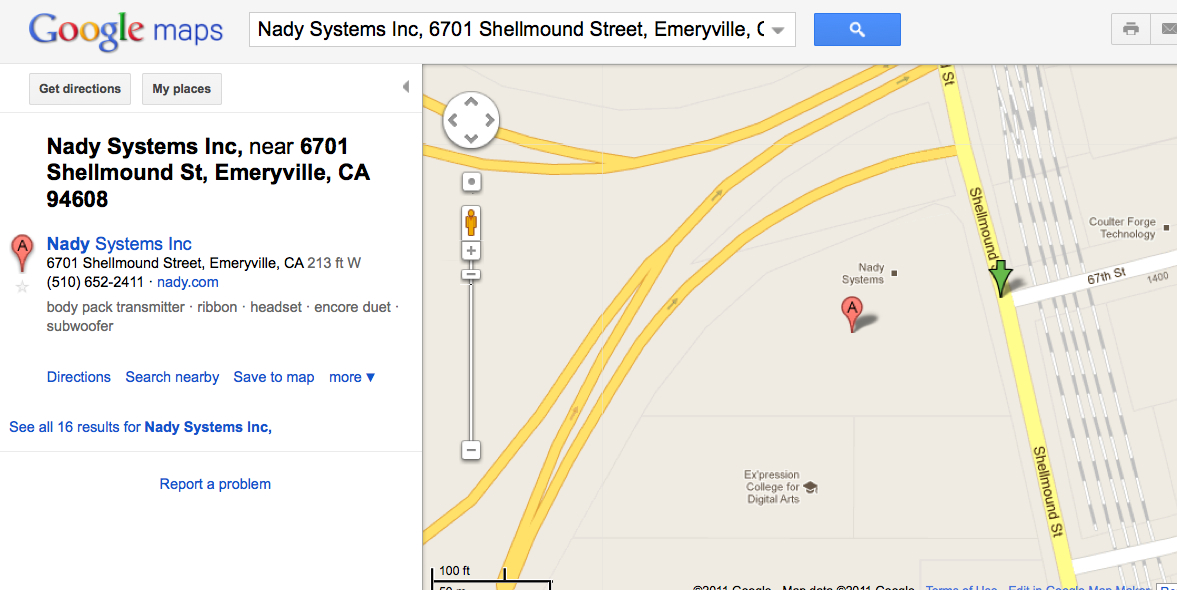
Now it looks like we and EastBaySol may have another opportunity to support the defense of indigenous sacred land from bourgeois development. (The aggressor’s business, Nady Electronics, has offices in Emeryville, about a mile away from Ryan’s and my apartment, located right on top of an Ohlone sacred shellmound. The guy just won’t let up, apparently.) I received this press release in my email today. The money quote:
Supervisor Comstock, the Lake County Board Supervisor who cast the deciding vote, commented, “I’m a huge proponent of private property rights.” He added, “My family’s been living in Lake County for 150 years- you can’t get more native than that”.
Yet another example of institutional white supremacy and heteropatriarchy supporting the accumulation of capital & resources to the (historically white, patriarchal) ruling class. Time to remind this dude, through direct action and defense, that yes, you can get more native than that. Entire press release after the jump.








 Kloncke