Valentine’s Day sometimes brings chocolates and sometimes flowers. But Valentine’s Day in Oakland, California, brought angry women out to the Mi Pueblo supermarket in the heart of the barrio. There they tried to speak to the chain’s owner, Juvenal Chavez, not about love, but about the sexual harassment of women who work there.
Mi Pueblo worker Laura Robledo’s story, in her own words:
Hello, my name is Laura Robledo. I am a single mother of three children. Last October I started working for Mi Pueblo Foods at the McLaughlin Avenue Store, in San Jose. Recently I was suspended and later-on fired for alleged misbehavior.
During the first few weeks of employment, a co-worker began to sexually harass me on a constant basis.
The company allegedly conducted an investigation on this matter finding no apparent cause for disciplinary action against the alleged harasser. It seems that the individual that harassed me still works at Mi Pueblo. This makes me feel humiliated.
I believe management fired me because I decided not to remain silent. There could be more women that have been sexually harassed but are too afraid to speak up.
Last December I attempted to hand deliver a letter to Juvenal Chavez, the owner of Mi Pueblo Foods. But I was stopped by several male security guards at the entrance of Mi Pueblo headquarters in San Jose. In this letter I challenge Mr. Chavez to talk to me in person so I can tell him what it really means for female employees to work at Mi Pueblo Foods.
On Valentine’s Day, 2013, supported by members of local group Dignity & Resistance; workers organizing in Walmart retail stores; and union members and staff of UFCW, Laura again tried to deliver her letter, and again security guards blocked the way. Undeterred, workers and community members will continue finding ways to fight not only sexual harassment in Mi Pueblo Foods, but also discrimination against African-Americans, e-verify attacks on undocumented workers, and attacks on workers who wish to form a union at Mi Pueblo.
================================
If I could instantly acquire two new digital skills, they would be:
Knowing How To Code
Knowing How To Make Good Videos.
As it stands, I know zero about the former, and above is my latest attempt at generating media from an action around the Mi Pueblo Grocery fight, an ongoing campaign that I’ve been working on for some months here in Oakland.
Learning, slowly learning.
The action was nice, if a little gender-simplistic. (Queers and gender-nonconforming folks, if they can get work at all, also face hella sexual harassment on the job; it’s not just women.)
Still, the fierce women trabajadoras in the video inspire me.
Moving, patiently and persistently. Patiently and persistently.
Bro-Dependency is a new Comedy Central miniseries of shorts about two dumb bros, and it’s brilliant. I, a reluctant TV watcher (so addicting! nothing else in my life gets done), have so far replayed the first video, “Tacos,” three times. For me, the show could intellectually, culturally, and humorously rival Awkward Black Girl. From the casual racism and misogyny lying around like dirty gym socks (a mess both subtle and potent), to the obnoxious yet painfully fragile hetero-masculinity of its two heroes dudes, BD’s pitch-perfect acting, strong writing and sharp editing capture those ineffable qualities of bro-ness immediately recognizable to anyone who’s ever attended a frat party and felt like strangling themselves with a resistance band.
For example. On first look, Anderson’s laugh-cry (which was so effective in “Tacos” that it seems to have become a running joke for the series, with somewhat diminishing returns) might just seem to paint him as hollow and shallow. But I think this is more about nurture than nature: the sociology of bro-ness, beyond individual vacuousness. These guys spend so much time mocking and belittling what’s painful to others (like harassing the young man on the bike, or — personal-experience beef — laughing off feminism and spouting constant rape jokes) that when something deeply painful happens to them, they have ZERO IDEA how to handle it gracefully.
And although the idiocy is clear, it’s not so absurd or totalizing that we can write these people off. We, too, have our own avoidance maneuvers. Whether our veneer consists of sarcasm or spiritual materialism, when we focus overmuch on commanding, controlling, and dominating what’s around us we become kinda clueless in the face of internal crisis.
More thoughts later, maybe, but for now, can’t wait to see where this show goes. Mad potential, yo.
like when your neighbor texts you because she knows you’ve been gone from the apartment going on two weeks, and is concerned that your car might get a street-sweeping ticket. touched, you say Thanks so much, I was gonna ask someone to move it for me, but maybe u could, and use it to do laundry or summ? and she says Sure I. Can Move it for you, and it would be great if i could do my laundry. Lol time to wash the blankets and pillows. (you can hear her South Carolina laugh.) and you tell her how to get the spare set of car keys from the drawer of your nightstand — Heads-up so you’re not too shocked, there’s a vibrator in there along with a floral-patterned hammer and other important tools, lol.
Lol, cool, she says. Oh and I hope you’re out of danger of that storm.
=================
you think of Audre Lorde and the histories of black and mixed women caring for each other, the complexities of having access to a car, not having access to a car, to light-skin privilege, to thin-body privilege, to neighborliness, to a neighborhood where neither of you grew up.
you think of Silvia Federici and the work and planning that goes into keeping a household, from watering the plants to washing the pillows to checking on neighbors to planning the porch-evening-six-pack-of-beer thank-you, which you know your neighbor well enough to feel confident that she will enjoy.
It has not been simple for black people living in this country to know love. Defining love in The Road Less Traveled as “the willingness to extend one’s self for the purpose of nurturing one’s own or another’s personal growth,” M. Scott Peck shares the prophetic insight that love is both “an intention and an action.” Using this definition of love, and applying it to black experience, it is easy to see how many black folks historically could only experience themselves as frustrated lovers, since the conditions of slavery and racial apartheid made it extremely difficult to nurture one’s own or another’s spiritual growth. Notice, that I say, difficult, not impossible. Yet, it does need to be acknowledged that oppression and exploitation pervert, distort, and impede our ability to love.
Slowly, painfully, I’m studying Russian revolutionary history. I know it’s important, and I wish I could tell you I was enthralled, but the truth is I’m mostly confused by all the terminology (“defencists?”), slightly jumbled chronologically, and easily distracted by Facebook and the neighborhood kitten outside my apartment. Plus I’m sick, as evidenced by the Everest of crumpled tissues on my coffee table. (Don’t worry; I’ll clean it before you come over.)
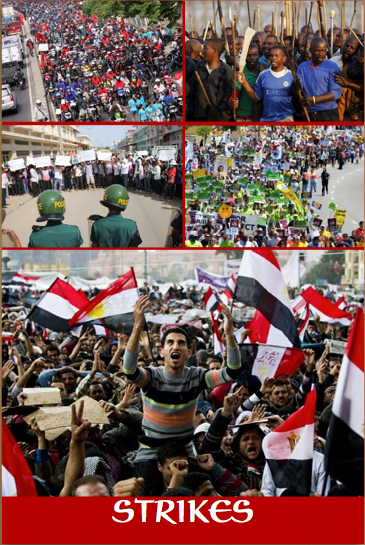
Clockwise from top left: general strike in Indonesia; miners’ strike in South Africa; WalMart strike in U.S.A.; strikes in Egypt; Cambodian garment workers’ strike protesting sexual harassment.
Anyway. One of the things I’m learning in my intermittent reading bursts is the difference between economic and political strikes. Far as I can tell, economic strikes are the more common ones, where workers stop production in order to force owners to give them higher wages, or health care, safer conditions on the job, the firing of a racist or sexist manager, etc. Economic strikes generally happen within a specific company, since you’re trying to lessen the acuteness with which that company exploits you.
Political strikes, on the other hand, have to be bigger, because the target isn’t just one company, but broader policy or the government itself. Strikes for the 8-hour work day, ending child labor, or trying to force a government to end a war, change regimes, or block austerity measures must necessarily grow huge and widespread to have a chance of succeeding. Only then can “organized labor become a political actor.”
This is basically what I gather, and in Russian history they have these pretty cool charts showing the breakdown of economic and political strikes around the time of revolutions in 1905 and 1917. Moreover, the two types are related: at least according to Lenin, political strikes need a strong foundation of tangible economic gains in order to win popular backing from the working class.
In a political strike, the working class comes forward as the advanced class of the whole people. In such cases, the proletariat plays not merely the role of one of the classes of bourgeois society, but the role of guide, vanguard, leader. The political ideas manifested in the movement involve the whole people, i.e., they concern the basic, most profound conditions of the political life of the whole country. This character of the political strike, as has been noted by all scientific investigators of the period 1905–07, brought into the movement all the classes, and particularly, of course, the widest, most numerous and most democratic sections of the population, the peasantry, and so forth.
On the other hand, the mass of the working people will never agree to conceive of a general “progress” of the country without economic demands, without an immediate and direct improvement in their condition. The masses are drawn into the movement, participate vigorously in it, value it highly and display heroism, self-sacrifice, perseverance and devotion to the great cause only if it makes for improving the economic condition of those who work. Nor can it be otherwise, for the living conditions of the workers in “ordinary” times are incredibly hard. As it strives to improve its living conditions, the working class also progresses morally, intellectually and politically, becomes more capable of achieving its great emancipatory aims.
One of the perverse truths of capitalist industrialization, though, is that in striving to survive, or even improve its living conditions, the working class also becomes the mechanism (though not the cause — that’s still capitalism) of environmental destruction.
Oh crap. They have started fracking like crazy in NE Ohio, all around the area where my parents and family live, and everyone is going crazy with visions for new prosperity. It’s the new gold rush there, with lots of new jobs having been created. But I have been having this scary feeling about it, and here it is. Sharing.
Talk about a rock and a hard place.
The way our capitalist class society jams, capital needs to extract surplus value (profit) from workers in order to expand itself and keep growing. That’s what “drives” the economy. To ensure a steady supply of people from whom to extract surplus value, the owning class needs plenty of workers: the proletariat. These workers (or non-workers, the unemployed proletariat) don’t have private homesteads to grow our kale, build our huts, weave our blankets and sustain ourselves, so we need jobs and money in order to eke out an existence.
Pretty much since this coercive system took over the world’s economies (replacing other, differently coercive systems), people who need to sell their labor-power to live have been taking on dangerous and unhealthy jobs — from crab fishing to combat, mining to manicures, un-self-determined sex work, etc. You do what you gotta do to get by under capitalism.
But some of these environmental dangers smell to me like a whole new type of terrifying. Like, Unit 4 of the Fukushima Daiichi nuclear power facility has already sunk 31.5 inches since the earthquake and tsunami, and if it collapses, could cause a fire in the atmosphere. Bad news for Japan; bad news, evidently, for everywhere the sky reaches.
Could Japanese labor have organized itself as a biocentric actor and refused to construct nuclear power plants in the first place? Obviously we’ve seen locals intervening against nuclear energy, and indigenous people resisting the accumulation of their land for ecocidal and literally shitty exploitation. Realistically, though, when it comes to organized labor, it seems next to impossible (please tell me I’m wrong!) to collectively reject employment in entire industries on the basis of their longer-term environmental consequences — no matter how mind-numbingly horrible those consequences may be. As Stephanie McMillian writes on Kasama, no one wants to champion short-term sacrifices. Socialist / communist struggle is supposed to be Helpful now and lead to Splendor later, right?
Yeah, so…about that post-revolutionary socialist productivity…
On the left, the theory of productive forces has led to a widespread productivist/mechanical view of reaching socialism: by developing and fully mechanizing production, we will reach abundance and the end of labor itself. It is increasingly obvious that this scenario is at odds with the reality around us, yet there is a general reluctance to tell the truth: that a lot of production, everything not necessary for survival, simply has to end. No one likes being the person who brings the bad news that we have to make do with less. It’s harder to organize around.
And so the idea of socialism, the common ownership of the means of production and equitable distribution of goods, also doesn’t go far enough. We need to change our relationship with the natural world. It is not there for us to use, but instead we are part of it and depend on its overall health. We need to define a different relationship with it than as a set of resources. A sustainable economy can only involve production that is subordinate to nature and that fits within its physical limits to reproduce itself — that is determined not by human desires and whims, but by our actual needs, which are dependent on a healthy planet above all.
Okay, so maybe it depends how we define post-revolutionary Splendor. Current U.S. middle-class standards: clearly unsustainable if generalized. But still, hopefully there will be enough for everyone, and everyone will be able to access what feels like enough. (Questions of contentment and scarcity in Marxism is a whole nother subject I’m working on for later.)
That hope for abundance, though, seems to wane more and more each day, while a sense of urgency escalates. It seems that the historical task of the working class may not only be organizing to overthrow capitalism, but also (and there is definitely overlap here) organizing to help stop the irrevocable fucking up of the planet, ASAP. Coral reefs and their food supply supporting millions of poor people? Doomed. Lungs of the earth? Wheezing. Edible biodiversity? Less than robust. Drinkable water? …okay now I’m depressing myself.
So fill me in. Do you know of any examples of what I’m provisionally calling environmental strikes? Meaning: not labor struggles over immediate safety conditions in the workplace, but more on the level of political strikes in that they attempt to impact entire environmentally destructive industries or operations, perhaps with a broad or long-term perspective in mind?
Do tell.
Jellyfish succeed where anti-nuclear organizing fails: at least four nuclear power plants in Japan, Israel, and Scotland have had to close because of millions of jellyfish clogging their filtration or cooling systems.










 Kloncke
