Western Socially Engaged Buddhism: At What Cost?

sigh.

When I discovered the website for the Zen Peace Center’s Symposium for Western Socially Engaged Buddhism, coming up this summer, I got all excited.  Spiritual and social liberation!  Sharing strategies!  All about it.

Then I saw the price tag.

$600 for tuition, breakfast, and lunch.  Dinner and lodging not included.  (Not to mention the cost for me to travel to Massachusetts.)

Six hundred dollars?  Probably closer to a thousand, all told?  Now where’s the social engagement in that?

Of course, this is not a dilemma unique to the Zen Peacemakers.  As nathan and I have been discussing lately, it’s a huge challenge to make a sangha’s economy reflect its philosophies.  And when I called the ZPs to inquire about a sliding scale or some other option, it was clear that they were at least considering the contradiction between the symposium’s mission and its prohibitive costs.  Within a couple of months, they had designed and posted a volunteer application, which would cover the cost of tuition — though still leaving the problem of travel and lodging.  My new friend Ari, ZP assistant to Bernie Glassman, says they’re also pursuing possibilities for free places to stay: either camping on the property or staying with local sangha members.  If you’re interested in attending, hit up the volunteer app!  (Unless, of course, you can afford to pay — in which case you’d be helping make things more affordable for the rest of us.)

It’s important to keep in mind, I think, that the point of keeping entry costs low isn’t only a matter of accessibility.  Of course, we want to make teachings and community-building events available to poor and working-class folks.  But for a group explicitly interested in social justice or “social engagement,” there is also the problem of reproducing oppressive, class-based structures.  Inclusion is not enough: we need transformation.

For example: what does it mean when social justice -oriented sanghas establish endowment funds, which invest donors’ contributions into the financial market, strengthening the capitalist structures that exploit and crush workers?

We don’t need to rely on this model.  Check out this definition of a “dana economy” from the rad-sounding Eco-Dharma Center:

All our events are offered in the spirit of dana, a Sanskrit/pali term meaning giving and gift. The ethical practice of generosity expresses the transcendence of separate selfhood and constitutes a basic ethos at the heart of creative community. The economic forms of consumerism and capitalism highly condition our relationships in the world – encouraging us to experience ourselves as discrete subjective entities, producers or consumers, insulated from responsive engagement with others. Rather than emulate this, it is our intention to support economic relationships which contribute towards a culture of sharing.

We do not intend to enter into relationship with you as the providers of a service for a consumer. We intend to enter into a wholehearted human relationship with you, as co-producers and collaborators in the transformation of ourselves and our world. To support this intention we ask for contributions to make this work possible, rather than offering our work as a service to be bought. The basic principle of the Dana Economy is, “give what you can, take what you need”.

The suggested donations in our programme reflect the very basic income required to make the events viable. We do not have any independent means of financing the events and we do need that those attending offer financial support to make the events financially viable. If you can offer more, please do. If the incoming donations for an event are insufficient we will be unable to give them freely. So, please look at the suggested contributions and enter into the spirit of this approach by giving what you can. We are also willing to discuss donations in the form of skill sharing and offers of work to support the project.

(from http://www.ecodharma.com, on "radical ecology")

I know we need to be realistic, and as Ari reminded me, most sanghas do not dedicate themselves exclusively to offering retreats, a la Goenkaji’s Vipassana centers, so that’s not a viable model for everyone.  And I want to emphasize that I’m not trying to guilt-trip anybody.  Rather, I’m eager to talk more, and more openly, about the real costs of maintaining sanghas, and how we can reproduce and sustain radical dana economies: economies of insight and generosity. I’d love to hear y’all’s thoughts.

In addition to volunteering in order to earn my way at the Symposium, I’m hoping to host a workshop on using the Internet as a tool of dharma.  So wish me luck!  Seems like it’s a popular subject these days, and I’m psyched to hear how others are theorizing it.

Meanwhile, here’s a bit of info on the ZP’s newsletter — for which they often solicit contributions.  I checked out the issue on prison meditation this month, and there were a number of really solid articles.  (Also made me that much more eager to see Dhamma Brothers: a documentary on the introduction of a Goenka-style 10-day silent Vipassana course into an Alabama prison.)

Take care, y’all!

— — — — —

Zen Master Bernie Glassman and the Zen Peacemakers invite you to enjoy

BEARING WITNESS:

A Newsletter for Western Socially Engaged Buddhism

The Zen Peacemakers founder, Bernie Glassman has created the a clearinghouse on Socially Engaged Buddhism in the West. We are pleased to invite you to receive our FREE monthly online publication.

You will learn about:

·      Who?: Profiles, links and articles on the individuals and groups practicing service and working for social justice as Buddhist practice

·      What?: Emerging service projects and social actions, including opportunities to train and get involved

·      Why?: The history, ethical bases and philosophies that inspire the global movement of Buddhist communities towards social engagement

Previous issues include Bernie’s meeting with His Holiness the Dalai Lama as well as surveys of Buddhist chaplaincy programs and work in prisons.  You are invited to e-mail submissions for our March issue featuring Dharma-based mental health programs to editor@zenpeacemakers.com.  For your free subscription, please go to: http://www.zenpeacemakers.org/subscribe

We are also building two related directories:

Groups and Activists

&

Learning Resources

It’s easier than ever to access information and to get involved!

The Trans/Woman (Blogger) Question

At right is the cover of a book recently compiled by my Uncle John: a collection of the letters, writings, and photos of his godmother, Nellie Briscoe Perry.  His introduction to the book names the “why’s” of the project:

This compilation of writings is my way of sharing with others a rare opportunity to 1) learn about the lifestyle of African-Americans living in the historic Shaw district of Washington, D.C., which was rich in culture and the arts in the 1940s; 2) understand how the events of the early 1940s impacted all walks of life; and 3) know the feelings and thoughts of an African-American woman as she lived through and was affected by the events of those times.  Most of the contents of this book are in Nellie’s own words.  So too is the title, Forever Waiting, which was a loving message she used to end many letters to her future husband, Mutt.  You are invited to take this journey and hopefully find it to be an enlightening and enriching experience.

This week, Uncle John (known affectionately to me as “Tall Meat”) will be meeting with the Historical Society of Washington, D.C., which is interested in housing the letters and photos in their collection.  What were once personal articles will now become public pieces of shared history.

I haven’t had a chance to read the book yet, and nonetheless it’s been heavy on my mind the last few days.  Mainly, I wonder: what if Nellie’s documentation and communication didn’t take the form of old letters, but a modern blog?  Would their social value and interest change?  Diminish?  In general, when do we treasure personal communications, diaries, and scrapbooks, and when do we dismiss them as trivia or junk?  What makes the difference?

Continue reading

The “8” Of Section 8

It’s been a bit of a rough week, folks. Tuesday I woke up at 6:30am — it was Sharon’s big day. She had made it to the top of the Section 8 housing list, and for the first time in her forty-odd years of life, she was going to have a place of her own.  So we hoped.

The Section 8 Housing Choice Voucher Program subsidizes rent for families and individuals. As far as I can tell, it’s like a semi-privatized version of public housing, much like the whole school-voucher privatization schemes. The government pays landlords to house the otherwise-homeless, rather than building public units with state funding.

But what really blew my mind about Section 8 was the wait list. According to the Housing Authority, approval for an applicant takes between six months and eight years.

Eight years.

EIGHT YEARS.

Sharon, Melissa and I spent four hours Tuesday morning jumping through all the necessary hoops, until we could progress no further for the day. The next step, since Sharon does not have a spotless criminal record from the last 10 years (not too unusual for the chronically homeless and near-homeless, trying to survive), is collecting letters from interested parties testifying to her upstanding character.

Shelter: a privilege reserved for the righteous?

Time for bed. Night, y’all.

California Dying (And Awakening)

This week in The Nation:

"Homeless in Fresno: Guillermo Torrez ended up on the streets after he lost his construction job and his family's home was foreclosed." Photo credit Matt Black

The lethal and typically capitalist governance of California is manifesting, statewide, in a virtual strangulation of the poor.

VMH [in Los Angeles] has provided counseling and medication to impoverished children and adults since 1957. But in August, shortly after the new facility opened, the clinic lost most of its funding for adult services when the state and county yanked their dollars, triggering huge matching-fund losses from the federal government. Eighty percent of the counseling staff, including nearly all of the site’s adult counselors, were laid off. Kids still receive some counseling, but the walls of the rooms in which they are seen by staff are bare–the clinic ran out of funds before it could decorate them–and the doors have paper signs taped to them instead of brass plaques.Nowadays, VMH’s adult clients are treated exclusively with medication. And the indigent mentally ill–whose treatment had been paid for by LA County, which in turn received money from the state–are turned away at the door. Many of them end up sleeping on park benches near the clinic. “These are the chronically mentally ill,” says psychologist Janie Strasner glumly, “who will end up being the raving lunatics on the street.”

What makes this all the more troubling is that Glendale isn’t an outstandingly poor neighborhood, Los Angeles isn’t a poor city and California certainly isn’t a poor state. And yet something is seriously wrong with the organism that is California. The state’s savage budget cuts–$26 billion in 2009, an expected shortfall over the next year that could reach $20 billion–now serve as anti-stimulus to the federal stimulus package. Its basic educational, public safety and social service infrastructure is crumbling. As a self-sustaining political system, as a set of relationships between local and state governments, as a revenue-raising and revenue-spending mechanism, California is deeply damaged. And the impact of that damage is hitting an awful lot of people awfully hard.

And we’re seeing the same brutal impact in the Tenderloin of San Francisco.  From the Faithful Fools’s 2009 Annual Report:

As concern was high over the precarious economic reality and the ever-rampant budget cuts and elimination of vital services, we recognized the importance of being a small, grassroots, heart-driven organization. We had the ability to remain constant in people’s lives when their city or state funded supportive services disappeared. We helped bridge food needs, financial resources and the direct labor necessary to find out what was still available for people and then walked the maze to link them up. We saw the direct face of balancing the budget on the backs of the poor and disabled people as they were notified three different times in the year of a reduction in their monthly checks. The cuts were an average of $70 per person. One fellow who serves on the Tom Waddell Community Advisory Board with us said, “that’s a week’s worth of food for me!”

It’s a deadly time.  But sometimes the threat of death is just what is needed to spark an awakening.  Which, in California’s case, hopefully means a rapidly evolving consciousness of our shared situations, and renewed energy for collective, compassionate struggle.

SF Annual Homeless Dead Memorial

Reverend Hope at the Memorial Service For All Our Homeless Dead.

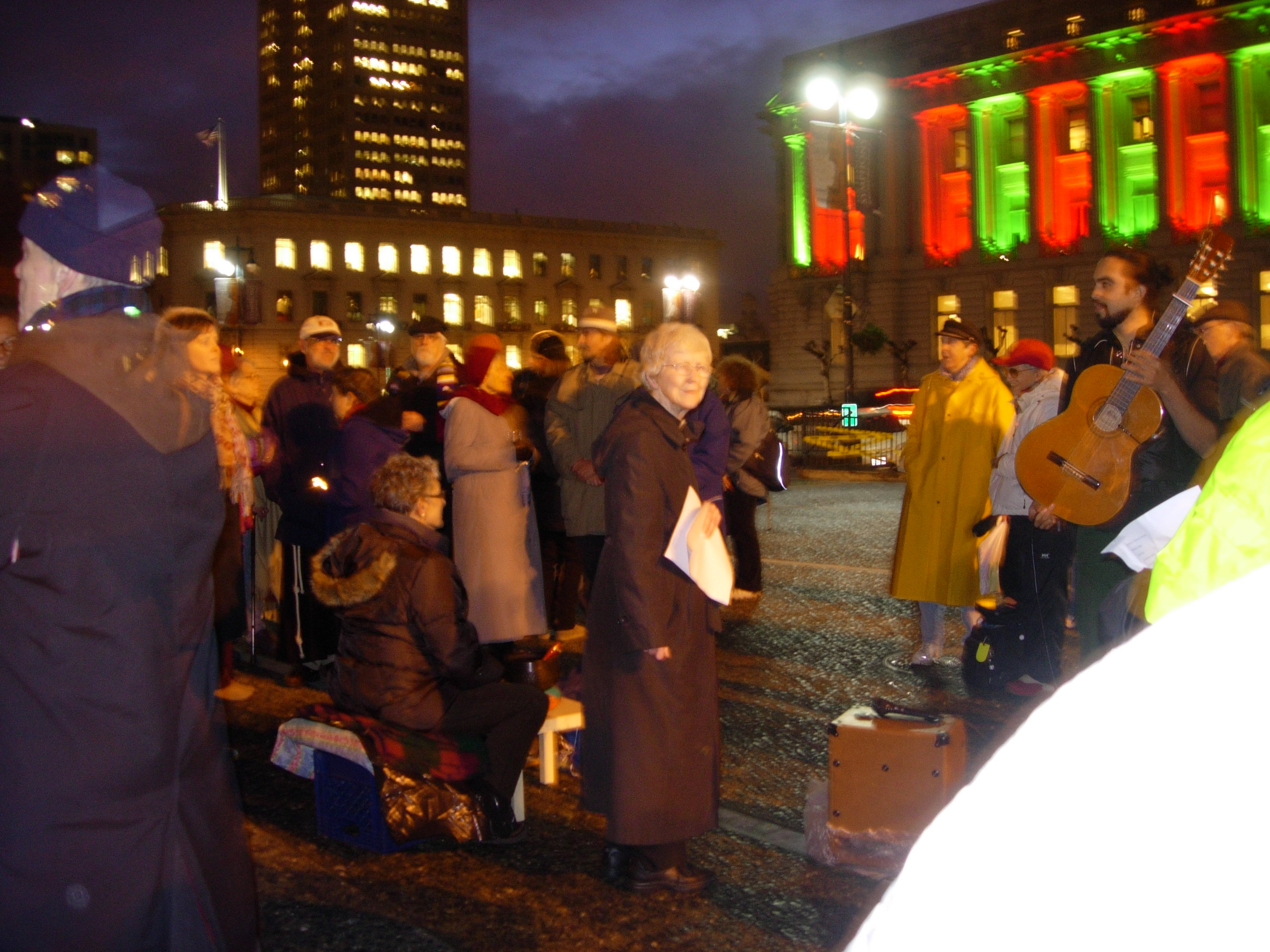
Last night, for the nineteenth time in as many years, San Franciscans assembled in front of City Hall for the Interfaith Memorial Service For All Our Homeless Dead, organized by Reverend Glenda Hope with SF Network Ministries, along with the Coalition On Homelessness.  Half a dozen laypeople and religious leaders — a rabbi; a Zen Buddhist nun; a housing activist; a Franciscan sister (my boss and roommate, Carmen); and more — presented poems and eulogies, mourning the dead and calling for justice for the living.  Alternating with the speeches, one person from a given neighborhood would read aloud a list of names: the recorded deaths of homeless people in that area, in 2009.  I think there were between 50 and 60, maybe more.  A singing bowl rang after each name spoken, including, hauntingly, a few nameless: John Doe Number 64 (ding), John Doe Number 67 (ding), John Doe Number 95 (ding) . . .

Evidently, over the years it’s become increasingly difficult or complicated to access information on homeless mortality.  In addition, the deaths of people living in single-resident occupancy housing (or SRO’s — basically hotel rooms) are not recorded.  So the actual death toll among the very poor or destitute is far greater than our reading reflected.

A man sang in a beautiful soprano; the lists of names were ceremonially burned.  All told, about 80 people gathered in the cold near-rain.  And though the memorial itself was lovely, the most moving part for me was knowing that this frail reverend, emceeing in a barely audible voice, has faithfully assembled people here on every winter solstice since 1980.  Almost twenty years of bearing witness this way, in this same place.

Pillow Talk, Pillow Action

Goodness gracious, people. A lot has happened for me since September. In college towns, big cities, and on tropical islands. With old friends, new friends, mentors, lovers, family, and the lifelong “domestic partner.” Painting bedrooms, taking walks, cooking soup, learning stick-shift, finding a twin spirit in my high school crush, getting (a) into art school and (b) certified in scuba diving. Another 10-day Vipassana course (this one in North Fork, California). Sleeping on the streets of San Francisco. Living and working in a street ministry. And all the while, continuing to open, open, open up.

Part of me feels like apologizing, and trying to atone for the extended absence by crafting some sort of meaningful, powerful narrative about the last three or four months. (Autumn. Wow. All of autumn.) The most insightful insights, the most surprising surprises, the most splendid splendors. But instead, in classic Kloncking fashion, I think it’s best to begin with the tangible. And colorful. And close to home. Less talk, more action.

I bought these gorgeous fabrics this summer, from a very kind, friendly shopkeeper near my flat in Barcelona. When my folks came out to visit me, my mom and I decided we’d use them for a pillowcase project. She taught me how to do it while I was home for Thanksgiving. Specifically, how to add on the invisible zippers. (Invisible yet pink! Ha!)

I wish I had thought to take some pictures during the sewing process because the best part of all was watching my mother as she modeled the stitching for me, guiding the fabric through the electric machine with such rhythm and confidence and obvious pleasure. Sewing was one of her main hobbies for most of her life — she made, mended and/or altered much of her own clothing. Her mother (my Oma) was a factory seamstress, too. So mama certainly knows her way around a Singer, even though hers mostly lies dormant these days.

It was beautiful to witness her work — like watching a cheery old former minor-league shortstop play catch with his grandkids. Graceful muscle memory. Alacrity. Plus, she’s an excellent teacher for a novice like me. I’m quite proud of our results.

It’s good to be back, friends!  Hope you’re well.  More to come.  Ps: many thanks to Kyle, who unknowingly gave me the push I needed to get this thing going again.  De-lurking in person is even more fabulous.

To Zion

A few times lately, in conversation, I’ve mentioned that in my opinion Lauryn Hill is one of the greatest artists of our time.  The story of her life is complex and sad in many ways — reflecting so much personal torment, as well as the dehumanizing commodification that saturates popular commercial arts — but one thing is clear: rare is the musician who combines such virtuosic technical ability with such profound emotional expression.  For me, she’s right up there with Miles Davis, with Stevie Wonder, with the best of them.

Here’s one of my favorites.  Enjoy, and enjoy the weekend — see y’all on Monday!

Friends, Meet “Advance The Struggle”

Advance The Struggle: Bay Area Radical Perspectives

Last night was a night of dealing with domestic abuse.  (A friend of a friend.)  So today I’m tired and needing some solitude, reading, and yoga.  But I wanted to share real quick this inspiring website, Advance The Struggle, which my friend Ryan, from San Francisco, was kind enough to introduce to me here.

Click here for pamphlet

The blog focuses on marxist politics — analysis and praxis — in a thoughtful, energetic, well-balanced way.  And this pamphlet they produced (worth viewing as a PDF, if you can, for all the stunning artwork), is a great place to start: an insightful commentary on the radical organizing vacuum following the police murder of Oscar Grant back in January.  Follow it up with the response article by Bring The Ruckus, super useful, in my opinion, for adding the concept of “strategic and lasting” institutions, or “dual power.”  Selma James’ 1975 essay, “Sex, Race and Class,” reprinted in full, is another good read.  And of course, don’t forget to check out the comments on the posts — there’s fruitful discussion in there, too.

I’ll share my own thoughts and responses tomorrow, or when I’m feeling up to it.  Maybe link it to Glenn Greenwald’s must-read rundown of the CIA’s 2004 Inspector General Report, recently released, on the U.S. torture of suspected terrorists. Meantime, if you’re feeling what they’re saying on A/S, click and comment allá!

Take care, y’all.

love,

katie

Gettin’ Her Due

From NY Daily News
From NY Daily News

Love this story. Hip-hop pioneer Roxanne Shante, the breakthrough female artist behind the hit song “Roxanne’s Revenge,” has succeeded in forcing an unwilling Warner Brothers Music company to honor its contractual agreement to fund her continuing education. Having earned a PhD in psychology from Cornell, Dr. Shante now practices therapy in urban Black communities.

From NY Daily News:

[Warner Brothers] finally agreed to honor the contract when Shante threatened to go public with the story.

Shante earned her doctorate in 2001, and launched an unconventional therapy practice focusing on urban African-Americans – a group traditionally reluctant to seek mental health help.

“People put such a taboo on therapy, they feel it means they’re going crazy,” she explained. “No, it doesn’t. It just means you need someone else to talk to.”

Shante often incorporates hip-hop music into her sessions, encouraging her clients to unleash their inner MC and shout out exactly what’s on their mind.

“They can’t really let loose and enjoy life,” she said. “So I just let them unlock those doors.”

Shante, 38, is also active in the community. She offers $5,000 college scholarships each semester to female rappers through the nonprofit Hip Hop Association.

She also dispenses advice to young women in the music business via a MySpace page.

“I call it a warning service, so their dreams don’t turn into nightmares,” she said.

Fabulous.  Now if we can just secure access to higher ed for folks without Warner Bros. contracts…

And here’s the 1984 single — a response to UTFO’s “Roxanne Roxanne” — that changed the game.

Email 3, Part 3: Spiritual Economy

From email update March 30th:

SPIRITUAL ECONOMY

I was amazed to learn that the entire operation budget for Dhamma Neru comes directly from student donations. No grant proposals, no NGOs, nada. To me, this is wonderfully inspiring as an example of compassion in economy — compassion based on direct, personal experience. Nobody pressures or shames you into giving, and nobody rewards you by putting your name on a building. Funding isn’t subject to nonprofit fads, nor contingent upon the program’s success in producing X number of enlightened beings per year. Always, the best motivation to give is born of direct, continued experience. Of course, in life we should help distribute resources that we don’t use directly (like sponsoring a soup kitchen that doesn’t feed us, or an accompanier for threatened organizers in Guatemala). Still, it’s quite special when the impetus to give comes from thinking, I have personally benefited from this, I continue to reap its benefits to this day, and I wish to share its benefits with other people who want to learn. Solid. Besides, I like the fact that “dana,” or donation in Pali language, can come in many forms, not just money: from a handful of fertile soil for the garden, to an afternoon of scrubbing toilets and sinks.