The Environmental Strike?

Slowly, painfully, I’m studying Russian revolutionary history.  I know it’s important, and I wish I could tell you I was enthralled, but the truth is I’m mostly confused by all the terminology (“defencists?”), slightly jumbled chronologically, and easily distracted by Facebook and the neighborhood kitten outside my apartment.  Plus I’m sick, as evidenced by the Everest of crumpled tissues on my coffee table.  (Don’t worry; I’ll clean it before you come over.)
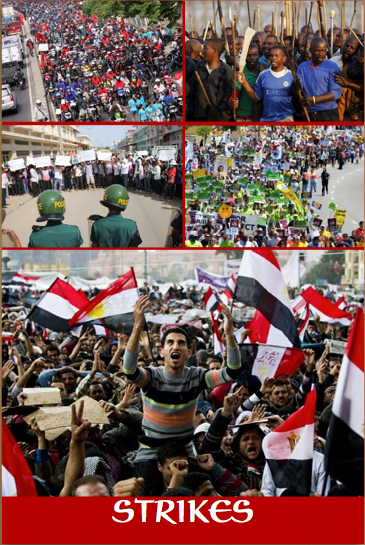
Clockwise from top left: general strike in Indonesia; miners’ strike in South Africa; WalMart strike in U.S.A.; strikes in Egypt; Cambodian garment workers’ strike protesting sexual harassment.

Anyway.  One of the things I’m learning in my intermittent reading bursts is the difference between economic and political strikes.  Far as I can tell, economic strikes are the more common ones, where workers stop production in order to force owners to give them higher wages, or health care, safer conditions on the job, the firing of a racist or sexist manager, etc.  Economic strikes generally happen within a specific company, since you’re trying to lessen the acuteness with which that company exploits you.

Political strikes, on the other hand, have to be bigger, because the target isn’t just one company, but broader policy or the government itself.  Strikes for the 8-hour work day, ending child labor, or trying to force a government to end a war, change regimes, or block austerity measures must necessarily grow huge and widespread to have a chance of succeeding.  Only then can “organized labor become a political actor.”

This is basically what I gather, and in Russian history they have these pretty cool charts showing the breakdown of economic and political strikes around the time of revolutions in 1905 and 1917.  Moreover, the two types are related: at least according to Lenin, political strikes need a strong foundation of tangible economic gains in order to win popular backing from the working class.

In a political strike, the working class comes forward as the advanced class of the whole people. In such cases, the proletariat plays not merely the role of one of the classes of bourgeois society, but the role of guide, vanguard, leader. The political ideas manifested in the movement involve the whole people, i.e., they concern the basic, most profound conditions of the political life of the whole country. This character of the political strike, as has been noted by all scientific investigators of the period 1905–07, brought into the movement all the classes, and particularly, of course, the widest, most numerous and most democratic sections of the population, the peasantry, and so forth.

On the other hand, the mass of the working people will never agree to conceive of a general “progress” of the country without economic demands, without an immediate and direct improvement in their condition. The masses are drawn into the movement, participate vigorously in it, value it highly and display heroism, self-sacrifice, perseverance and devotion to the great cause only if it makes for improving the economic condition of those who work. Nor can it be otherwise, for the living conditions of the workers in “ordinary” times are incredibly hard. As it strives to improve its living conditions, the working class also progresses morally, intellectually and politically, becomes more capable of achieving its great emancipatory aims.

One of the perverse truths of capitalist industrialization, though, is that in striving to survive, or even improve its living conditions, the working class also becomes the mechanism (though not the cause — that’s still capitalism) of environmental destruction.

Last week, when I posted on Facebook an article about how fracking releases radioactive substances that remain hazardous to life for 16,000 years,  my friend Nichola responded,

Oh crap. They have started fracking like crazy in NE Ohio, all around the area where my parents and family live, and everyone is going crazy with visions for new prosperity. It’s the new gold rush there, with lots of new jobs having been created. But I have been having this scary feeling about it, and here it is. Sharing.

Talk about a rock and a hard place.

The way our capitalist class society jams, capital needs to extract surplus value (profit) from workers in order to expand itself and keep growing.  That’s what “drives” the economy.  To ensure a steady supply of people from whom to extract surplus value, the owning class needs plenty of workers: the proletariat.  These workers (or non-workers, the unemployed proletariat) don’t have private homesteads to grow our kale, build our huts, weave our blankets and sustain ourselves, so we need jobs and money in order to eke out an existence.

Pretty much since this coercive system took over the world’s economies (replacing other, differently coercive systems), people who need to sell their labor-power to live have been taking on dangerous and unhealthy jobs — from crab fishing to combat, mining to manicures, un-self-determined sex work, etc.  You do what you gotta do to get by under capitalism.

But some of these environmental dangers smell to me like a whole new type of terrifying.  Like, Unit 4 of the Fukushima Daiichi nuclear power facility has already sunk 31.5 inches since the earthquake and tsunami, and if it collapses, could cause a fire in the atmosphere.  Bad news for Japan; bad news, evidently, for everywhere the sky reaches.

Could Japanese labor have organized itself as a biocentric actor and refused to construct nuclear power plants in the first place?  Obviously we’ve seen locals intervening against nuclear energy, and indigenous people resisting the accumulation of their land for ecocidal and literally shitty exploitation. Realistically, though, when it comes to organized labor, it seems next to impossible (please tell me I’m wrong!) to collectively reject employment in entire industries on the basis of their longer-term environmental consequences — no matter how mind-numbingly horrible those consequences may be.  As Stephanie McMillian writes on Kasama, no one wants to champion short-term sacrifices.  Socialist / communist struggle is supposed to be Helpful now and lead to Splendor later, right?

Yeah, so…about that post-revolutionary socialist productivity…

On the left, the theory of productive forces has led to a widespread productivist/mechanical view of reaching socialism: by developing and fully mechanizing production, we will reach abundance and the end of labor itself. It is increasingly obvious that this scenario is at odds with the reality around us, yet there is a general reluctance to tell the truth: that a lot of production, everything not necessary for survival, simply has to end. No one likes being the person who brings the bad news that we have to make do with less. It’s harder to organize around.

And so the idea of socialism, the common ownership of the means of production and equitable distribution of goods, also doesn’t go far enough. We need to change our relationship with the natural world. It is not there for us to use, but instead we are part of it and depend on its overall health. We need to define a different relationship with it than as a set of resources. A sustainable economy can only involve production that is subordinate to nature and that fits within its physical limits to reproduce itself — that is determined not by human desires and whims, but by our actual needs, which are dependent on a healthy planet above all.

Okay, so maybe it depends how we define post-revolutionary Splendor.  Current U.S. middle-class standards: clearly unsustainable if generalized.  But still, hopefully there will be enough for everyone, and everyone will be able to access what feels like enough.  (Questions of contentment and scarcity in Marxism is a whole nother subject I’m working on for later.)

That hope for abundance, though, seems to wane more and more each day, while a sense of urgency escalates.  It seems that the historical task of the working class may not only be organizing to overthrow capitalism, but also (and there is definitely overlap here) organizing to help stop the irrevocable fucking up of the planet, ASAP.  Coral reefs and their food supply supporting millions of poor people?  Doomed.  Lungs of the earth?  Wheezing.  Edible biodiversity?  Less than robust.  Drinkable water?  …okay now I’m depressing myself.

So fill me in.  Do you know of any examples of what I’m provisionally calling environmental strikes?  Meaning: not labor struggles over immediate safety conditions in the workplace, but more on the level of political strikes in that they attempt to impact entire environmentally destructive industries or operations, perhaps with a broad or long-term perspective in mind?

Do tell.

Jellyfish succeed where anti-nuclear organizing fails: at least four nuclear power plants in Japan, Israel, and Scotland have had to close because of millions of jellyfish clogging their filtration or cooling systems.

Solar Oven

winter is coming.
winter is coming.
winter is coming and this august-born body
never did like the cold.
bad circulation
deadens my brown fingers
turns them the greenish-white
of hospital walls.

winter is coming
and i quietly beg my freckles to stay.
me and my freckles leave the hearthless apartment
to sit in my parked car, huddled
like a batch of hopeful chocolate chip cookies
in a fifth grader’s solar oven.

i hate winter.
i want heat all the time!
almost all the time.
i want enough heat to make me happy.

when winter comes i layer up
then shrink from the inside
like an old pea shriveled in its pod
like the illinois corn disastrously shriveling in its husk
as we speak,
as meantime the miners of south africa steel themselves
against the next ANC attack
and most of africa rustles inchoate
against the next round of land grabs
and everyone can see the thick-tongued famines approach.

one night
not long ago,
i was walking my parents’ dog
a dog i don’t particularly like
though dogs in general aren’t really my thing.
well i was walking the dog
in the quiet nighttime suburbs of Sacramento
and all of a sudden i looked at a lawn and thought:
“goodbye, grass”
and even though i know lawns are awful,
i felt tender toward this one
and a little tender toward the dog.
then i thought:
“this feels like a melancholy indie film.”

winter is coming
and my oven has been broken for weeks.
i told the benevolent slumlord, who replied with the usual
benevolent slumlord promises.
bugging him seems risky
since i want his permission to paint the walls
the same golden yellow i always paint
to warm up my heart when i’m indoors
and not enwindowed in a winter car.
so my oven stays broken
and i have no backup solar version
no cob alternative
i am too pessimistic, lazy, and single to attempt to construct either one.
i just want to laze in the day-drenched summer forever
on a planet full of native grass and coral reefs
a planet free of shit-snow on sacred mountains
a planet with its own miracle of clean water
and enough for everyone.

unfortunately for me,
for us,
winter is coming
resentment won’t stop it
so i guess we had better get creative.

My First Marxist Feminist Rhyme

Yesterday: amazing political art by Young Gifted and Black, Isis Rising, and all kinds of other phenomenal hip-hop and soul-flavored performances at the Life Is Living festival yesterday in West Oakland (including an extended Nina Simone tribute that, during Jennifer Johns‘s take on Sinnerman, evoked a cathartic tear or two from the wildly dancing audience). On my way out of the park I watched this rhyme unfold in my head.

It started with the tradeoff of wages and prices, then meandered to attacks on reproductive care (thanks for that presentation, Becca!), the false liberation of muslim women thru u.s. imperialist war, and nuclear energy and fukushima (shouts to Umi for alerting me to the feminist working-class issues there).

So here you go — an extremely extremely rough experiment, something that will probably never amount to anything polished. Still, it represents my gratitude for all that I’m learning, every day, from comrades, artists, thinkers, ancestors, and people in struggle.

lyrics
=======
what they give to us in wages
they take back in price raises
and when prices go down
ain’t no jobs to go around
class war is the struggle of haves and have nots
the haves got cops and the nots get locked up
knocked up
patriarchy ain’t always a black eye
it’s that guy
cuttin reproductive care statewide
stay wise
stay apprised
don’t believe in state lies
women’s liberation ain’t no bombs in the sky
ain’t no nuclear sites
claimin power for the people
but indigenous displacement
and radiation is the payment
that’s why i send love to mothers in fukushima
and the elders volunteering
for the deadly job of cleanup

Nuclear Meltdowns As A Feminist Rupture

Via Umi of No Nukes Action: super eye-opening (for me) interview with Mari Matsumoto: Nuclear Energy and Reproductive Labor – The Task of Feminism. How events like the Fukushima disaster put pressure on the reproductive labor sector, in terms of securing radiation-free homes, food — even breastmilk — and protecting children, who are highly vulnerable to radiation. Also points to ACT-UP as inspiration: “AIDS activism has a very thorough resistance against healthcare authorities and pharmaceutical companies, which is exemplary for us.”

Matsumoto’s reflections make me wonder: if neoliberalism can use “disaster capitalism” to manipulate crises into opportunities for privatization and neocolonization, perhaps the Left can begin to see crises as opportunities for deliberate communization: amplifying people’s boldness, sense of collective working-class entitlement, and attempts to seize means of production and reproduction.

Disaster communism? Well, we might want to work on the phrasing, haha.

Green Green Green

sometime this week when i get a chance, i wanna write about what we’re learning in the foreclosure-fighting study group. for now, it’s green that gets me through the week.

Kale and chickpeas with toasted coconut, ginger, and garlic
A loud-clicking and uncatchable insect made a home in my bedroom for three days, until I finally nabbed him in my tea glass.

__

__

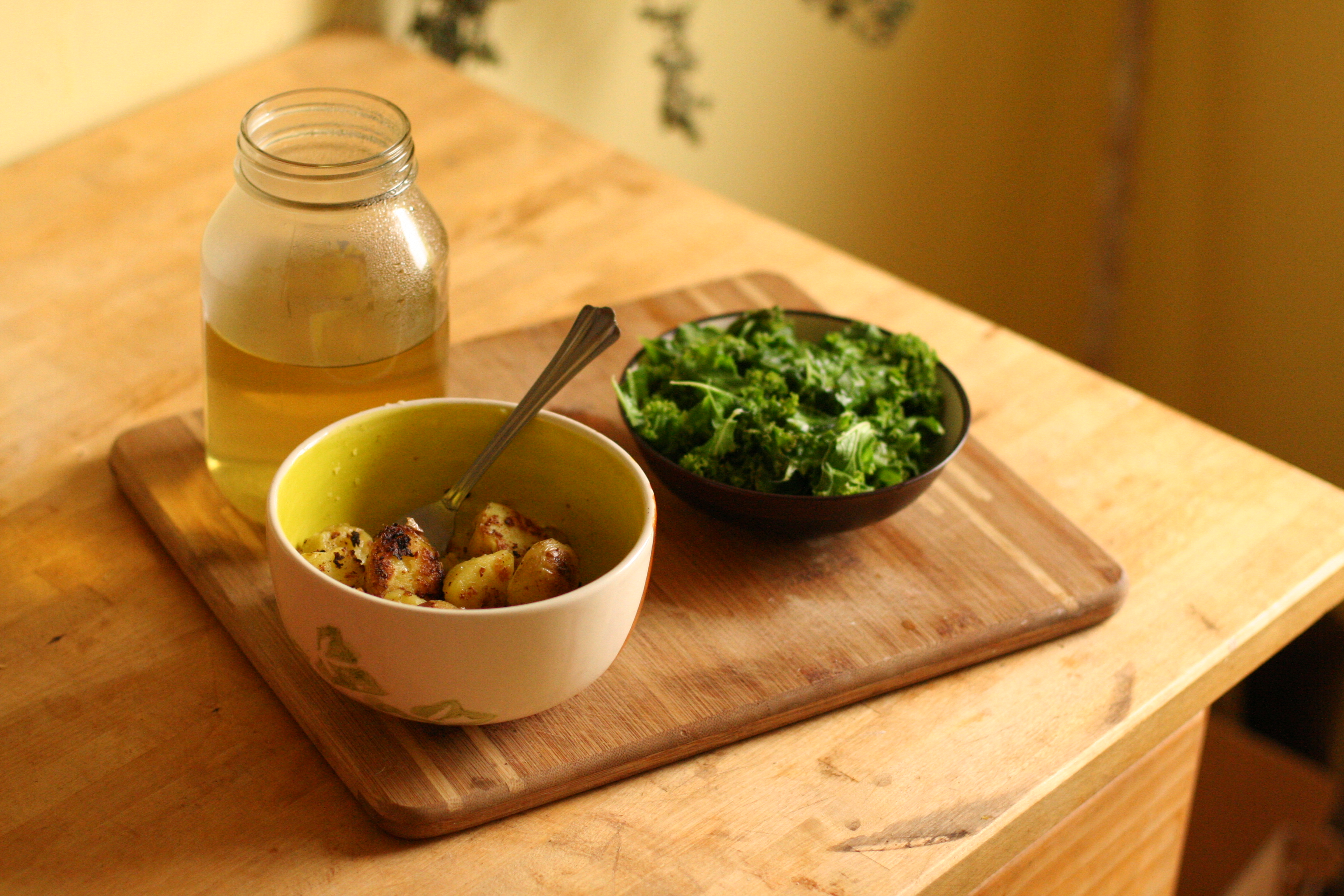
Breakfast this morning: genmai cha, little gold potatoes, and steamed kale.

First Home Dinner After Retreat

potatos
__

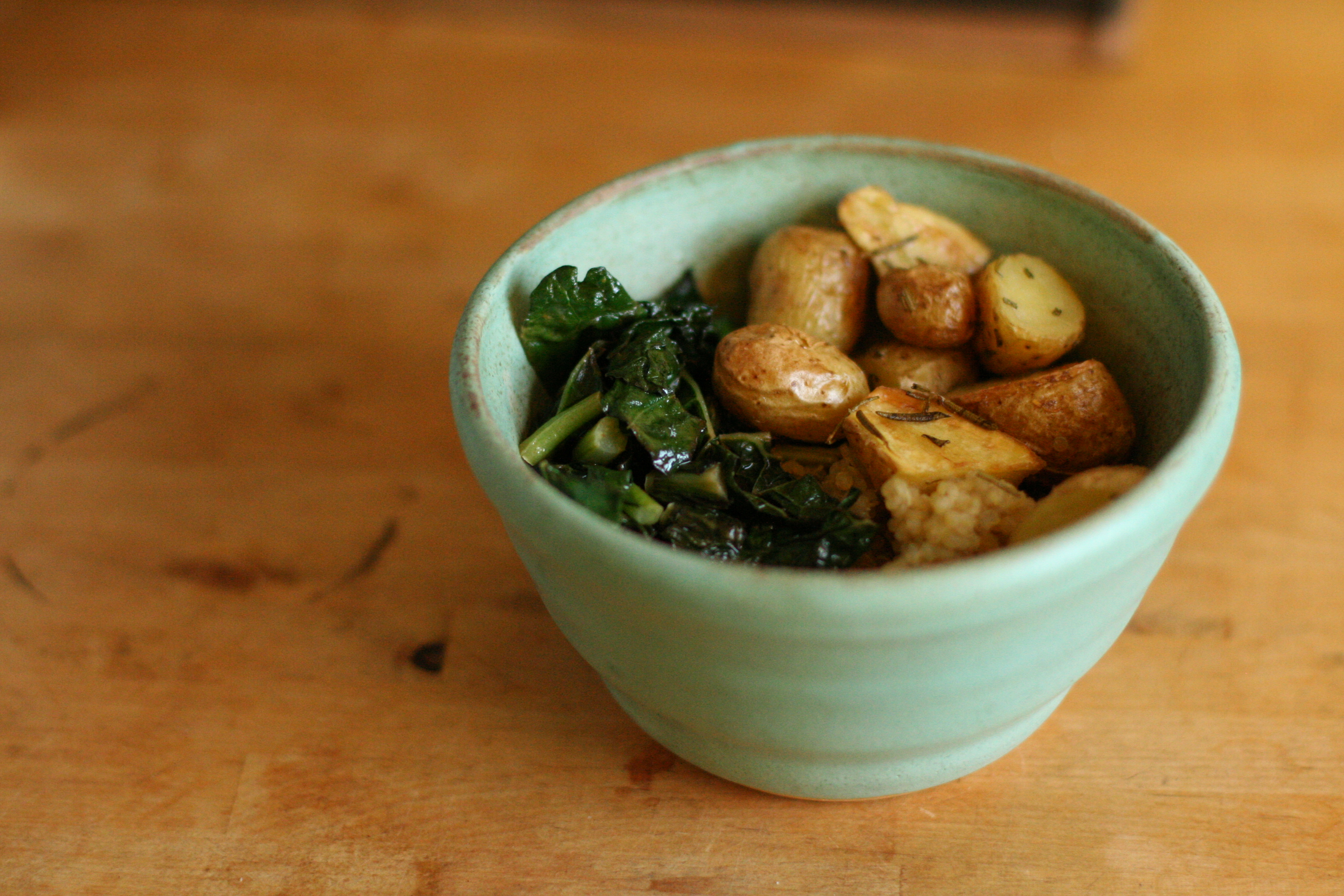
Back from retreat: new house, new kitchen. Usual suspects: quinoa, kale, lemon, garlic. Each small potato wrinkles perfectly and tastes like a dream. Rosemary fresh from the new backyard.

Leora, Noa, Cat, Nuria, many others with whom I’ve cooked: I love feeling you with me at the stove and cutting boards.

Aneeta, I thought of your eating meditation. “Thank you.” [next mouthful.] “Thank you.”

This earth, and all the people who work to farm and harvest it: you amaze me. Things are bad right now, I know. I love you and want us to be free. Let’s keep trying to make it happen.

*      *      *

cooking — simple cooking — is becoming something of a devotional practice for me. i’m realizing more and more that food is a miracle, even while the process of creating it for human consumption is full of exploitation and suffering.

by the time food reaches me, it is caked with the invisible pain of others, saturated with the grim labor of thousands. this accumulated degradation is harder to remove than the wax off an apple, or the gerrymandered genes from a cup of Monsanto rice.

but maybe, somewhere along the line, the food has also been blessed by the whispers and motions of resistance. maybe the diggers of these potatoes are meeting secretly, to organize. maybe the truckers and dock workers are forming alliances. maybe the grocers in the produce section are imagining a world where the beets belong to everyone.

so i want to treat the food with love, to honor not only the bad, but the good and neutral of its past. may it fuel me, and others, toward collective liberation.

“You Are Just Talking”

“Acacia tree on the grassland,” © autan under Creative Commons http://creativecommons.org/licenses/by-nc-nd/2.0/

on the cover of the Vol. 28 | No. 2 | Spring 2012 edition of  Inquiring Mind:

Until you dig a hole, plant a tree, water it and make it survive, you haven’t done a thing. You are just talking.

—Wangari Maathai (1940-2011)
Speech at Goldman Awards, San Francisco, April 24, 2006

powerful to read this while learning about the cordones that emerged under Allende in Chile.

when the bourgeoisie launched a “bosses’ strike” (there’s a new one for me!) as a kind of pressuring – slash – refusal to cooperate with Allende’s lefty government, they planned to withhold the means of production (their own property) in order to force concessions. but instead, the wage-slave folks intimately familiar with those means of production — in factories, in agriculture, even in schools and shantytowns — combined forces to take over and run things themselves.

Continue reading

Beaches and Riches

__

You may have noticed: Kloncke has gone fallow. The reasons are many. Organizing, relationships, new job. Transitions. I haven’t been writing much at all. Creating and co-creating has been very verbal, with lots of processing, planning, and preparing.

Back here on this blog, I feel tongue-tied. Not in a bad way, necessarily. Just kind of in the way that I was never really one to scream on roller coasters. When the ups and downs of life feel huge and pronounced, I have nothing more to say.

__
__

Mostly I feel grateful.

This winter when things got difficult, I fell into a funk. Now, with the sun out, and the possibility of a day at the beach with a new friend, the obstacles feel more surmountable. Richer, even.

Lately I’ve been wondering more about what my role might be.

What is my particular purpose and contribution in the various projects I’m doing?

What kind of team member am I?  And what kind of team do I want to play for?

There is a lot of privilege in these questions, especially when it comes to livelihood.  I have many more options, as far as jobs go, than most people in the world — especially in this economy, and because of my higher ed scholarship, which has made me miraculously debt-free.

__

On the other hand, to the extent that privilege means Easier To Land A Cozy Job, it doesn’t necessarily lead to a better life.

Less stressful, yes.

More effectively revolutionary?

Contributing to co-creating the kind of world we want, for ourselves and others?

Today at work, we had a conversation about right livelihood, though not in those terms — one of the people is Christian, and I’m not sure whether she thinks of the issue according to Buddhist principles. Anyway, the Christian person said that many of her friends are quitting their jobs (and in this economy!) because they can’t stand it any longer: being complicit in whatever it is that their job is doing. (Exploiting someone, somewhere. You barely need to scratch the surface to find it, most of the time.) They just couldn’t take being a part of that company. And no hope of trying to change it from the inside.

__
__
__

And yet, we reflected, most people are lucky to get any job whatsoever.

And, what if you use your position in your job in order to organize?

Rather than trying to reform the company, what about strategically positioning oneself to connect, worker to worker? And beyond — into communities and other workplaces affected by the work? (Teachers and students organizing with parents; miners and loggers acting in solidarity with people indigenous to the land being exploited.)

And that’s not to say that workplace organizing is easy. Especially revolutionary workplace organizing that aims beyond standard-of-living reforms and tries to challenge the toxic structures of racist, heteropatriarchal capitalism.

__
__
__

But that’s why I think that maybe — maybe — the true privilege is to live in a time and place where healing and resisting with comrades is possible. Whether through paid work or unpaid work.

Just thoughts.

Hope you’re well, friends. And thank you, Rich, for this marvelous day at the beach. :)