I’m not really sure why it took me so long to get into zines. Even now I’m not particularly ‘into’ them, to tell the truth — which is strange, considering that I love handmade objects, and I obviously love informal self-publishing. True zine-ophiles (ha! xenophiles!) might cringe at overly broad definitions of the form, but to a layperson like me, the essence of zines seems to be (a) self-manufacture and (b) text and images. Why wouldn’t a blog count? (Unless, of course, you’re a stickler about the handmade-object thing, which, really, I wouldn’t blame you, because as I said, I have a crush on handmade objects.)
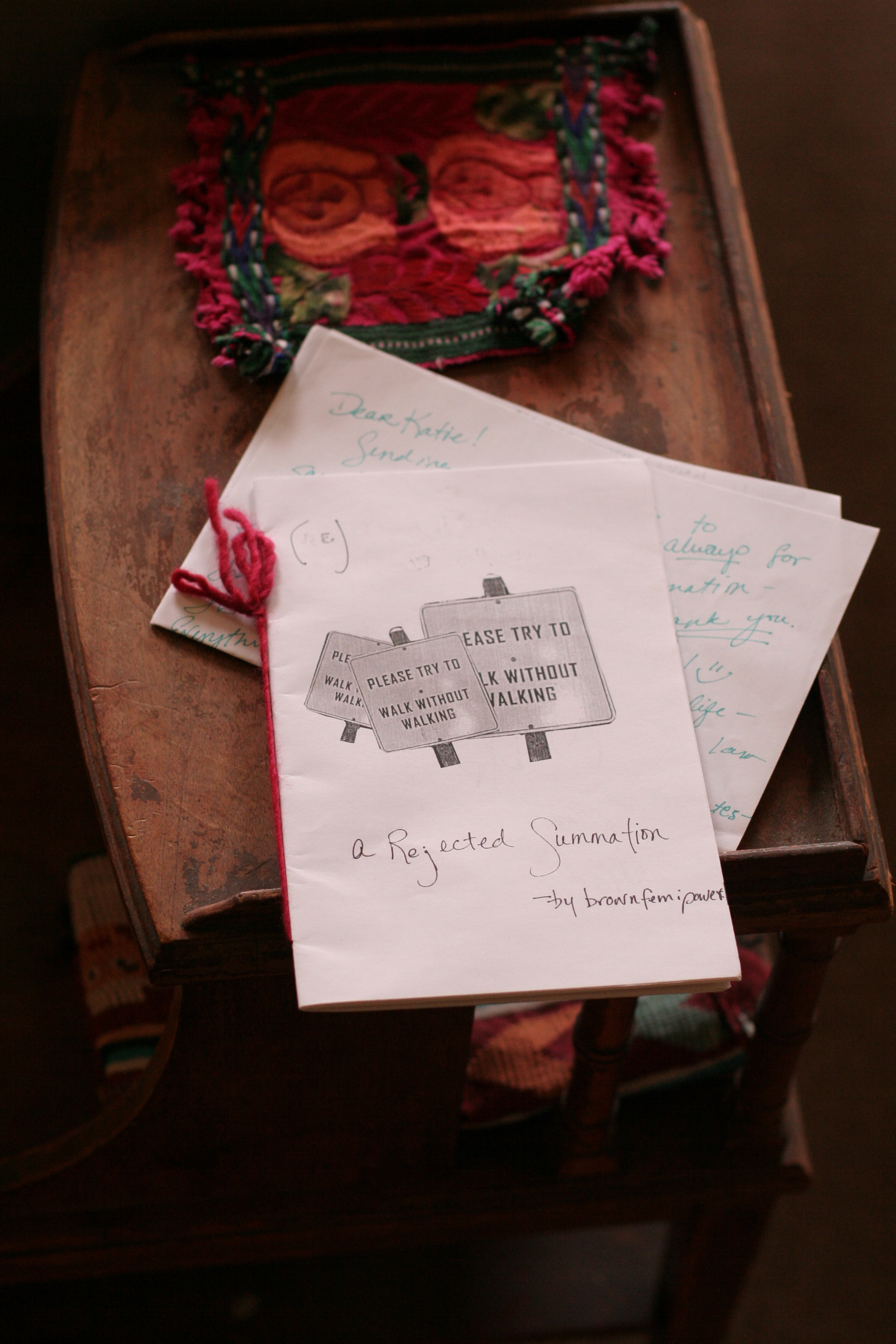
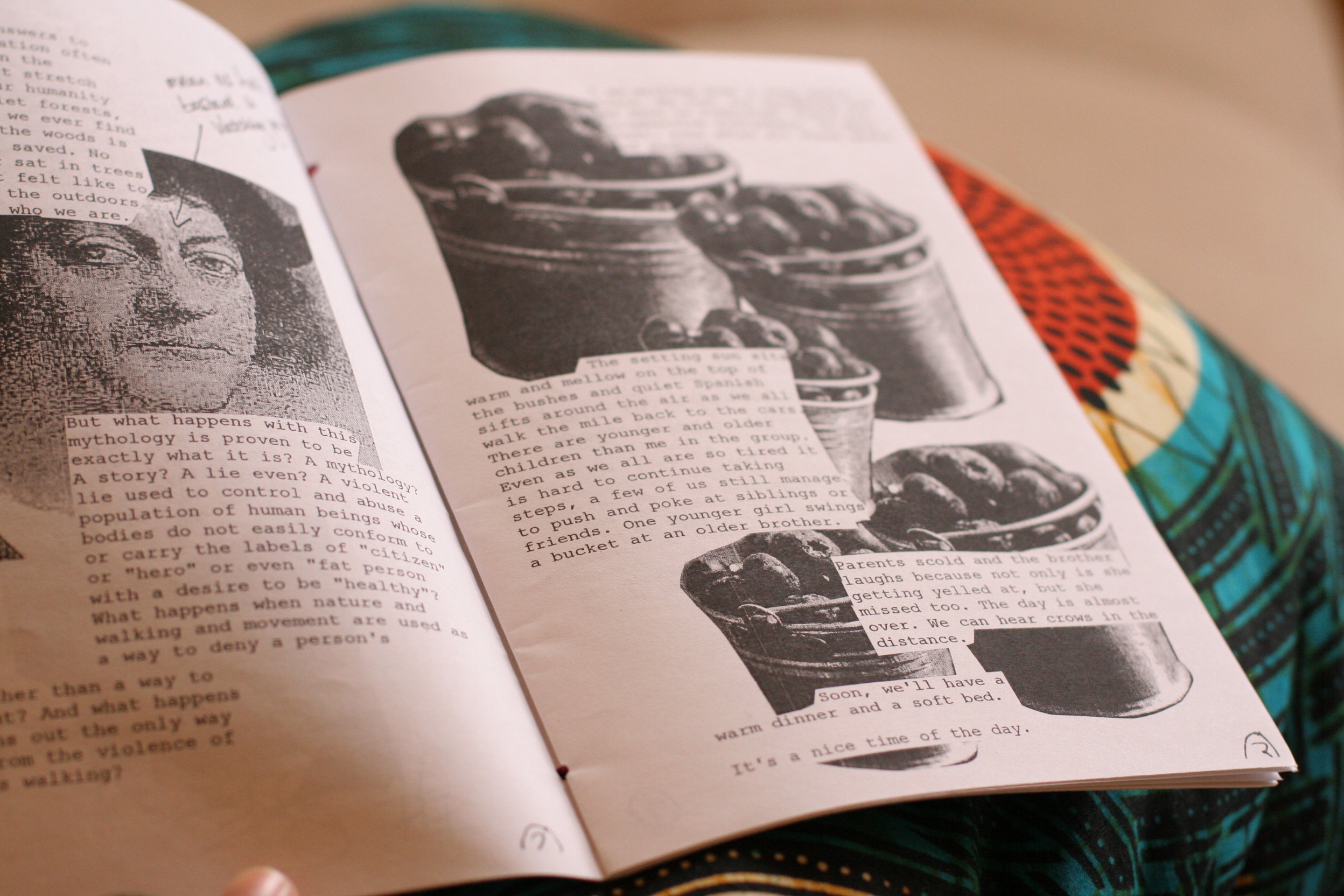
Today’s zine captured my heart immediately, not only because it was made by one of my all-time favorite bloggers / writers, who goes by brownfemipower (or bfp for short), but also because it arrived at my home in the mail as a gift, all the way from Ypsilanti, Michigan, accompanied by a beautiful note in sky-blue ink.
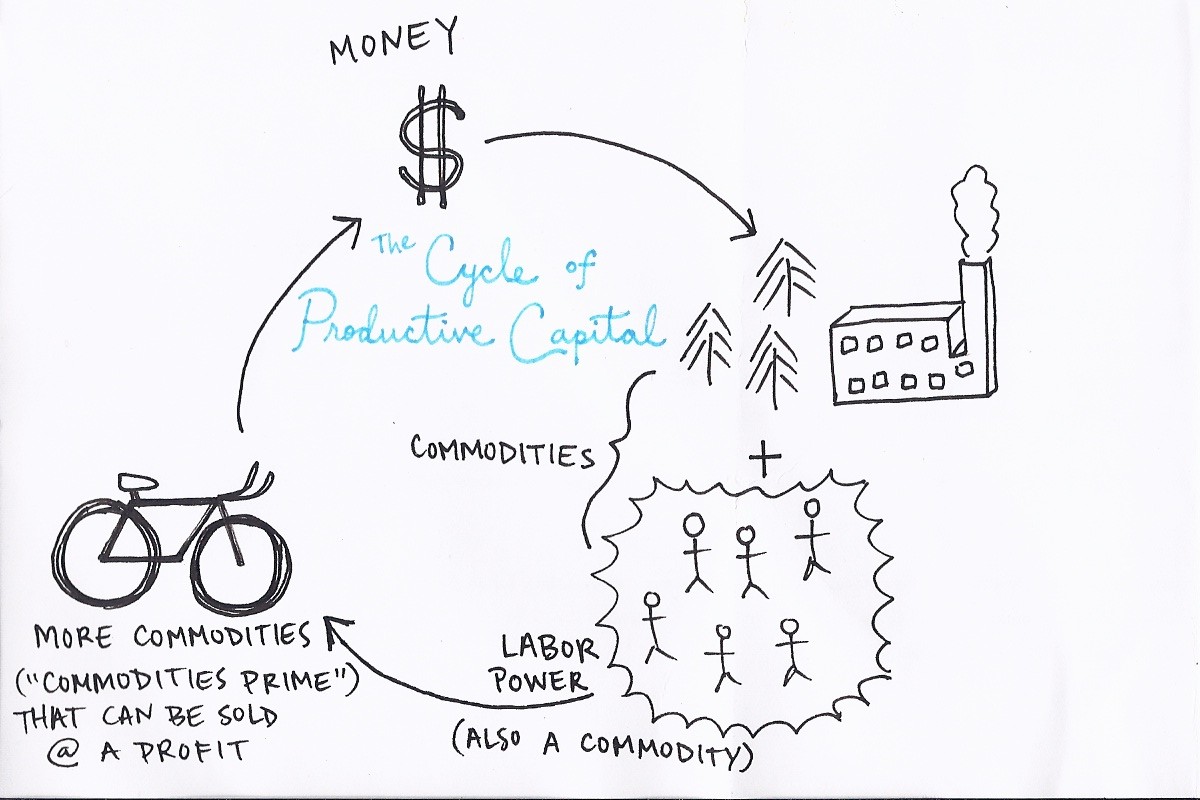
Some days all I can really manage to do is make an omelet. Not that I'm fishing for compliments — I'm aware and confident that this was a fucking phenomenal omelet, filled with beet greens sautéed with garlic, lemon zest, great-tasting olive oil, balsamic vinegar, and just a touch of brown sugar, then rounded out with grape tomatoes and goat milk blue cheese, and finished with cilantro. Tremendous. One for me, one for Ryan. And our kitchen conversation during the omelet forging somehow led to me drawing the following charts about the Cycle of Productive Capital:
Both of these charts represent my still-dim comprehension of the concept, and if someone else has better charts or corrections to add, please share! Minimally, this illustration should probably be in the shape of a spiral to show how M'>M, and the extra (profit) gets re-invested? I dunno.
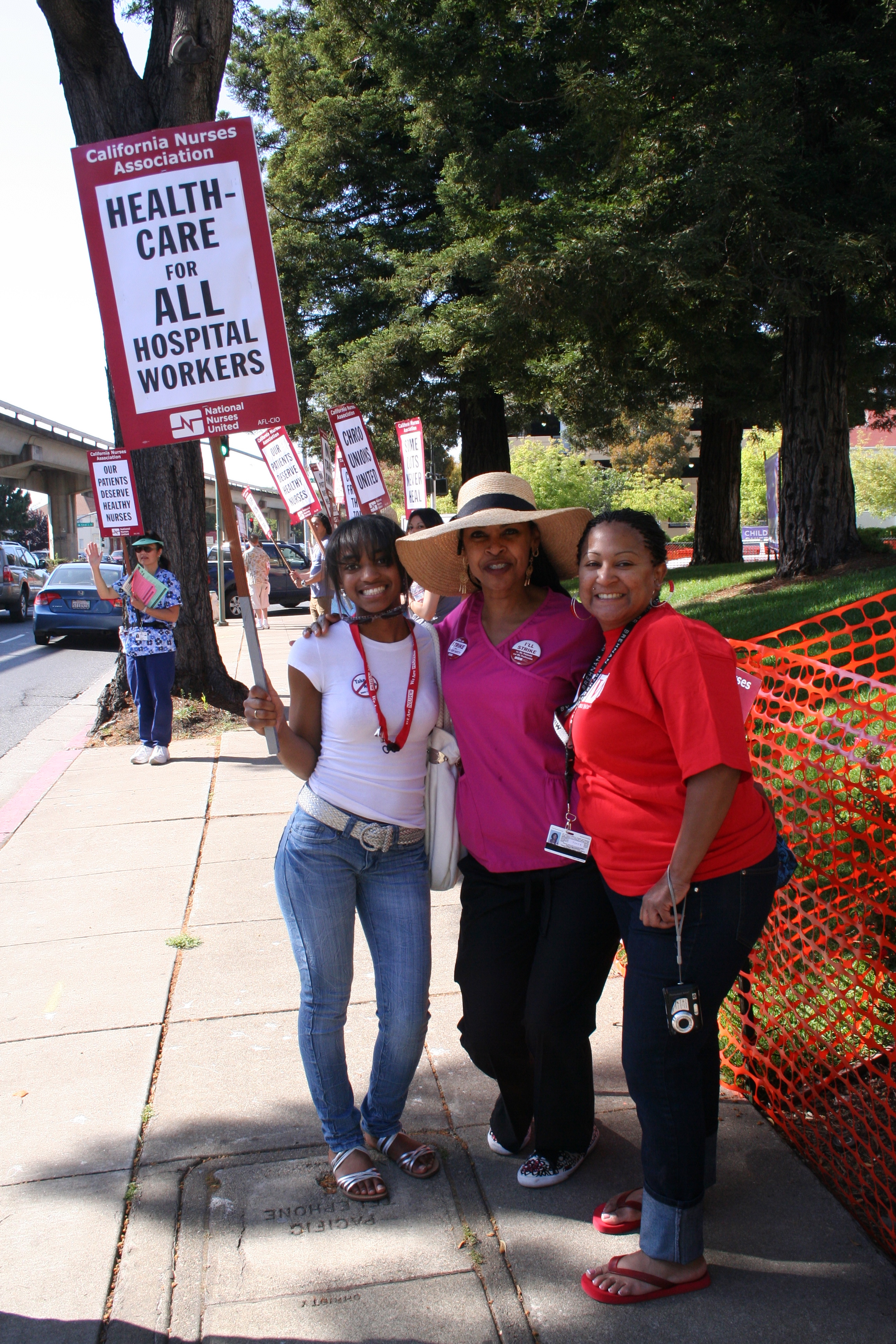
Some images from a 5-day strike at the Children’s Hospital just a few blocks from where Ryan, Mai and I live. The contracts that the bosses are trying to push would include so many “takeaways” (cuts to previously held benefits) that nurses who work in the hospital would no longer be able to afford to bring their own children there for treatment.
Ryan and I chatted up a lot of the workers for a while, and thanked them for setting an inspiring example by actually going out on strike and fighting back. Lots of positive energy, aided, I think by the freshness of the action (it was the first of the 5 days) and a steady stream of honks of encouragement from folks driving down Martin Luther King Jr Way.
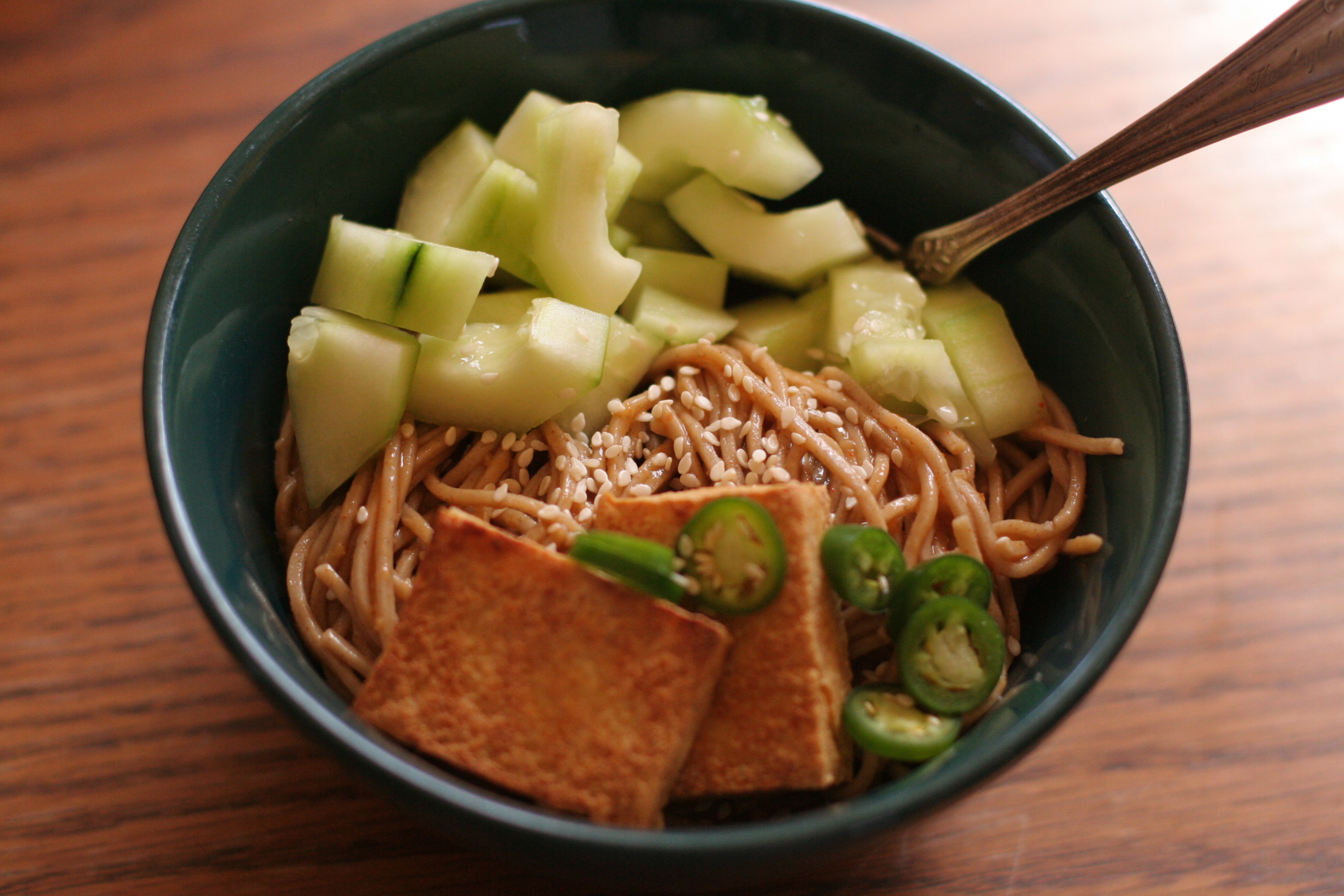
ahhhhhhh bowl o' otsuRyan's perfectly pan-fried tofuRyan's lovely diced cucumbers
Celebrating our usable kitchen, now that the water’s back on in the building, Ryan and I busted out a batch of otsu. With practice, we’ve refined our skills: his tofu frying is money, I’ve learned not to toss the cucumbers in with the soba noodle salad (to keep them bright green: they turn a murky brown when coated with the red cayenne) and my ginger-lemon-cayenne-honey-sesame dressing is extra-fly these days thanks to improved emulsifying techniques. Grateful to keep cooking and learning.
Check the latest at the EastBaySol blog — we had a fun, spirited picket that brought together militant workers from domestics to teachers to students to hotel and warehouse workers. I don’t have a photo of the flyer we used but I’ll try to get one and add it soon.
PICKETING AOII
This slideshow requires JavaScript.
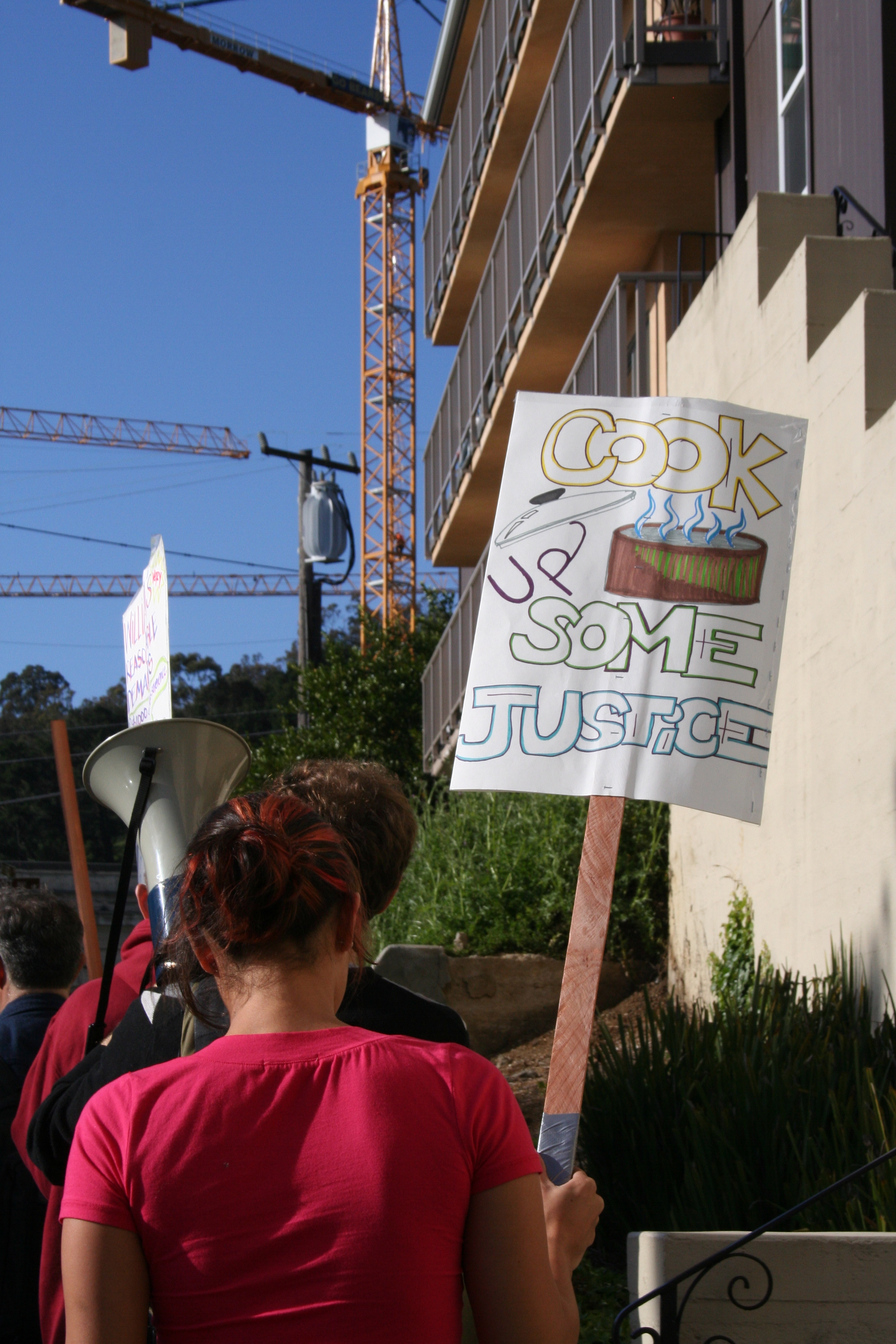
Monday afternoon Bay Sol East kept up the fight in solidarity with former sorority “houseboy” William over in Berkeley, staging an informational picket at Alpha Omicron Pi’s weekly meeting. With handmade signs, a bullhorn, and half-sheet flyers for the sorority sisters, our group of a dozen or so created quite a spectacle on the quiet hillside street. Chants called for “Justice For Domestic Workers!” and urged AO∏ to “Exceed the Expectation” (their motto) and “Cease the Exploitation!”
To cap off the action, we collectively delivered a petition signed by 82 neighbors who support our fight. We’re grateful to local student co-ops for their enthusiasm!
In an extra-special demonstration of solidarity, we were joined on the line by a leader from the ongoing boycott at the Hotel Frank in San Francisco, as well as two visiting members of ¡Ella Pelea!, an Austin-based organization of “students and community members, both queer and straight, multi-gendered and multi-racial” who are fighting for democratic control over the University of Texas Austin. All told, our group included warehouse workers, teachers, students, hotel workers, grocery workers, mothers, writers, and more — demonstrating the diversity of labor that’s possible with a solidarity network model.
If you didn’t get an email or phone call about this action and wanted to receive one, our bad! We’re working hard to get our phone tree to reliably bear fruit. Feel free to send us a strongly worded email demanding that we hit you up next time.
Sorry for the late post again — feeling pretty drained, with a lot of heavy stuff coming up this week. But! I am buoyed, so soulfully buoyed, by my mama, my partner, my peeps in organizing from the Bay to Seattle, friends near and far, the Oakland sunlight, the air, and troves of loving, radical praxis that I’m discovering, really trying on, for the first time.
The primary situation I’ve been directly engaging today is delicate and requires confidentiality. So instead of talking about my own ish, I just want to point to a resource that’s been a true blessing for me: the transformative justice (TJ) work of Philly Stands Up! (PSU), a volunteer collective in West Philadelphia.
What is TJ? From their web site, here’s PSU’s explanation:
Transformative Justice has no one definition. It is a way of practicing alternative justice which acknowledges individual experiences and identities and works to actively resist the state’s criminal injustice system.
Transformative Justice recognizes that oppression is at the root of all forms of harm, abuse and assault. As a practice it therefore aims to address and confront those oppressions on all levels and treats this concept as an integral part to accountability and healing. Generation FIVE does a great job of laying out the main goals, principles and questions of Transformative Justice. These are their words:
The goals of Transformative Justice are:
Safety, healing, and agency for survivors
Accountability and transformation for people who harm
Community action, healing, and accountability
Transformation of the social conditions that perpetuate violence – systems of oppression and exploitation, domination, and state violence
The principles of a Transformative Justice approach to addressing all forms of violence include:
Liberation
Shifting power
Accountability
Safety
Collective Action
Respect Cultural Difference/ Guard against Cultural Relativism
Sustainability
Transformative Justice invites us to ask:
How do we build our personal and collective capacity to respond to trauma and support accountability in a transformational way?
How do we shift power towards collective liberation?
How do we build effective and sustainable movements that are grounded in resilience and life-affirming power?
PSU, Generation FIVE, INCITE! Women of Color Against Violence, and other like-minded TJ groups are helping to co-construct, through community, some of the most exciting, uplifting, and inspiring praxical contributions to “collective liberation” that I have seen in a long time.
“Liberation” is a big, important, but tough-to-pin-down word for this blog, and it may not mean the same thing in dhammic/Buddhist and radical political/power contexts. Liberation from suffering in samsara requires different strategies and approaches (8-Fold Path as Buddha’s “program”? :) than liberation from capitalist imperialist heteropatriarchy. And yet, to my mind, especially in the realm of sila (morality, or basically how to live a “good” and wholesome life), there is room for tremendous, tremendous overlap.
Thanks to a workshop and texts from PSU and AORTA (Anti-Oppression Resource and Training Alliance), this afternoon I sensed some possibilities for synthesis between these two paths. A meticulous practice of compassion recommended by an erstwhile Indian prince over 2500 years ago, and a working model for confronting intimate violence — forged from the crucibles of so many struggles against racist heteropatriarchy, the State, and their interwoven, often co-morphous manifestations.
Buddhist suttas warn practitioners against heavy-handedness in concentration training (the focus should neither be too loose, nor too tight), and meditation teachers urge us over and over to be “firm yet gentle” with our chattering monkey minds, gradually teaching ourselves to rest our attention on the meditation object (in my tradition, that’s usually the breath). Is this mere people-pleasing packaging? Some sort of dogmatic or (what is probably the same thing) careless Middle Way-ism? No. The firm-yet-gentle combo doesn’t just sound nice and “balanced” — it points to an actually hospitable environment for difficult intentional transformation. Too gentle, and we get lazy, restless, defensive, or shut-down. Too firm, and we become dogmatic, dulled, judgmental, tightly-wound, and generally prone to missing the whole “compassion” boat, or burning out altogether.
Similar principles, it seems to me, apply to TJ work. If our goal is to foster transformation, we need to be firm yet gentle — not too loose, and not too tight. This is a radical departure from the punitive model of justice on which the US legal system is based (and irregularly, prejudicially, oppressively applied). It invites us, as the above definition says, to “respond” to trauma, not react. Rather than “cracking down” on people who commit violent behaviors, we stop excusing, minimizing, and supporting those behaviors. We work instead to “water the good seeds” (as Thich Nhat Hanh says of inclinations in the mind) of meaningful accountability (in other words, a process with real milestones, material structure, boundaries, consequences, goals, etc.) and support.
Is this all making sense? So very new and tender shoots, these are. I’m no urban gardener but I’m trying the best I can.
Check out the zine by Philly Stands Up!, “A Stand Up Start Up.” Let me know what you think.
take care, friends,
katie
———————————————————— Update: For a great list of oppression-denying and -compounding behaviors (“excusing, minimizing, and supporting”), I’ve added a link to a post by NellaLou on “Sex and the Sangha,” looking in part at the various types of responses to the recent exposure of some Zen teachers’ sexual misconduct with their students. It’s a really wonderful resource for naming the harmful and frustrating apologistic dynamics that often accompany the outing of intimate abuse, and NellaLou also points toward restorative justice as an alternative model. Thanks, NellaLou!
It’s been a rough few days, folks. A really rough few days. No running water in the apartment — and that’s the least of it.
Despite the plumbing obstacles, I managed to whip up a batch of cookies for a cookbook signing -slash- potluck by my culinary crush Heidi Swanson. Her new book, Super Natural Every Day, has already made the NYT Bestseller list after like a week on the market. I didn’t even have time to let the hot cookies cool down before popping two dozen of them into two empty egg cartons (an impromptu innovation in pastry transport) and hopping on my bike to dash across the border to Berkeley.
Those that didn’t make the carton cut found their way over to my friend Noa’s place, with its lovely succulents.
When things fall apart, I’m grateful for generous, loving, and and precious friends, and for cooking. At times when I’m feeling down, or, even more precisely, when I’m focusing very intently on uncomfortable and difficult emotions and experiences, my appetite plummets and gets very particular. I crave fruit and whole-milk yogurt, water, leafy greens, things like that. (Again, this is when I’m bringing mindfulness and patience to the difficulties. When I’m flat-out stressed, and especially rushed, it’s a whole ‘nother matter, and that’s when I turn to the sugar, the French fries, the “numbing” foods, as Noa calls them — not pejoratively, but descriptively.) I feel lucky and privileged that I’m able to feed my healthier, deeper cravings as they arise. So in this case, with little appetite for anything that wasn’t recently growing on a tree, I wasn’t as keen to devour these delightfully tart versions of my favorite jam thumbprint cookies. But the act of creating food for others is grounding and healing, too.
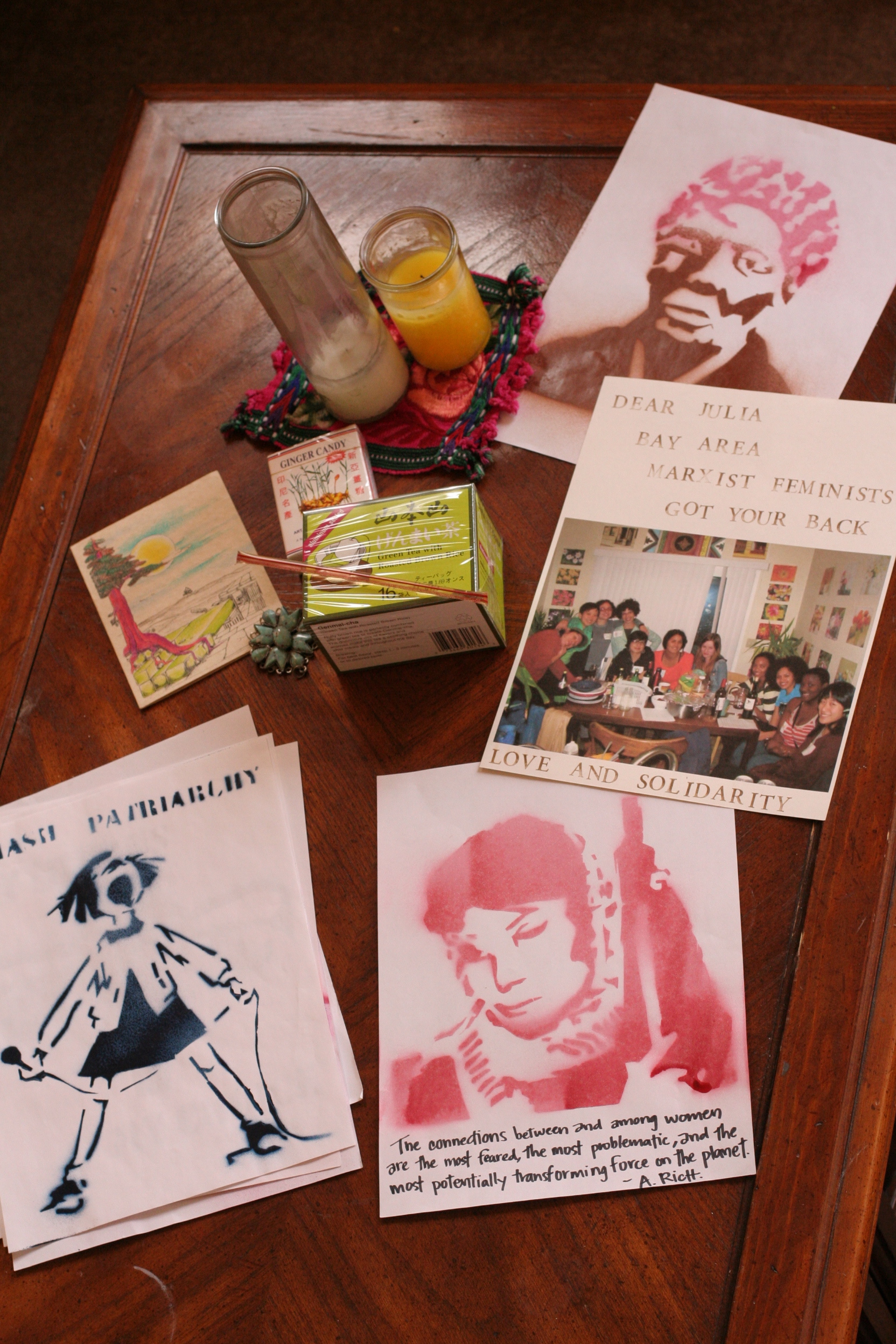
Last week, our Marxist Feminist study group assembled some offerings for a care package. A comrade of ours in LA (close friend to some, known through her work to others) has been going through a difficult time lately, and we wanted to send a small token of appreciation for her strength, amazing organizing work, and general fabulousness.
Handmade stencils, a card, a poem, ginger candy, green tea with a honey stick, a necklace pendant, and a hand-stamped group photo from our inter-state Marxist Feminist gathering a few months back. The finishing touch will be a batch of cookies I’ll bake up tomorrow.
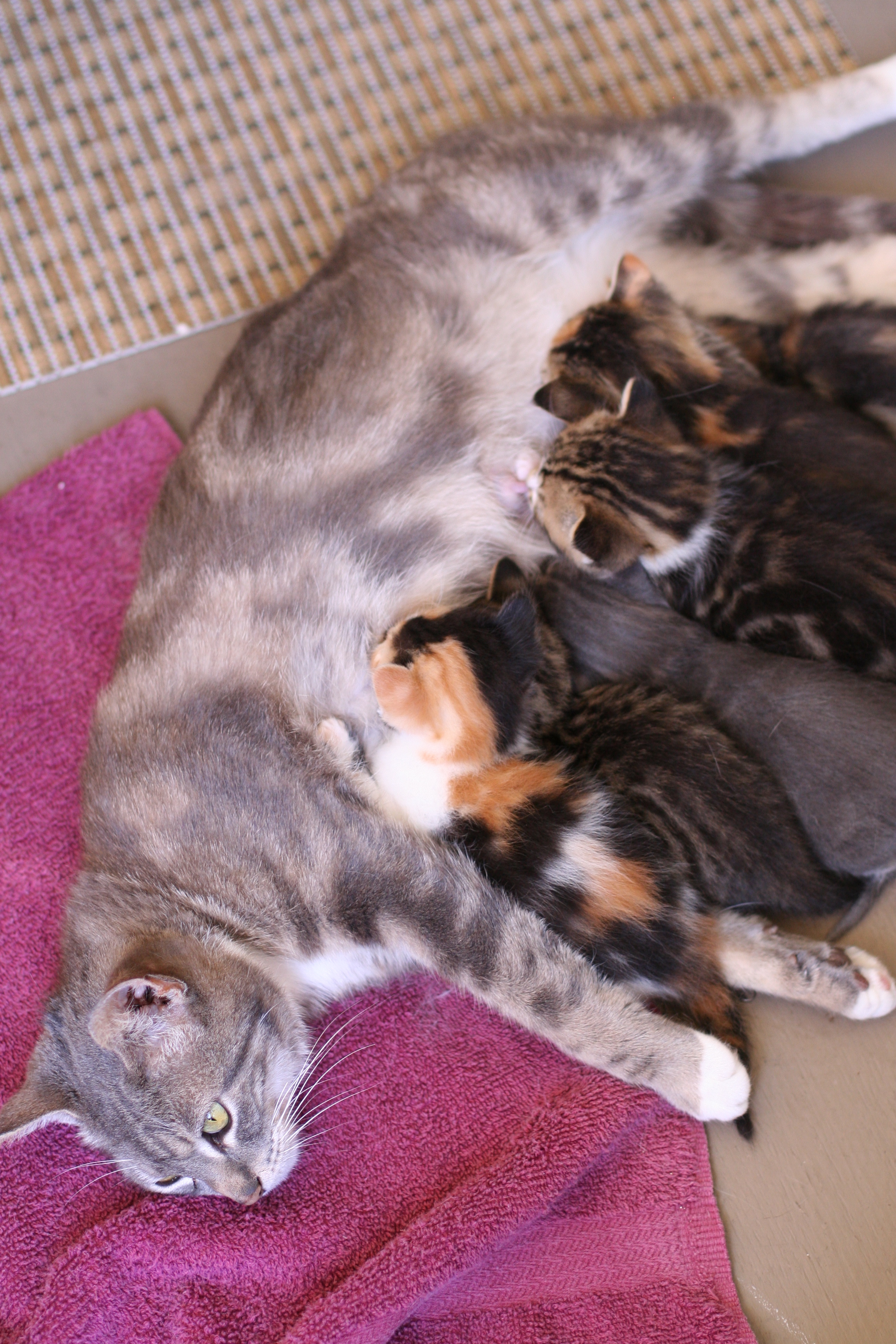
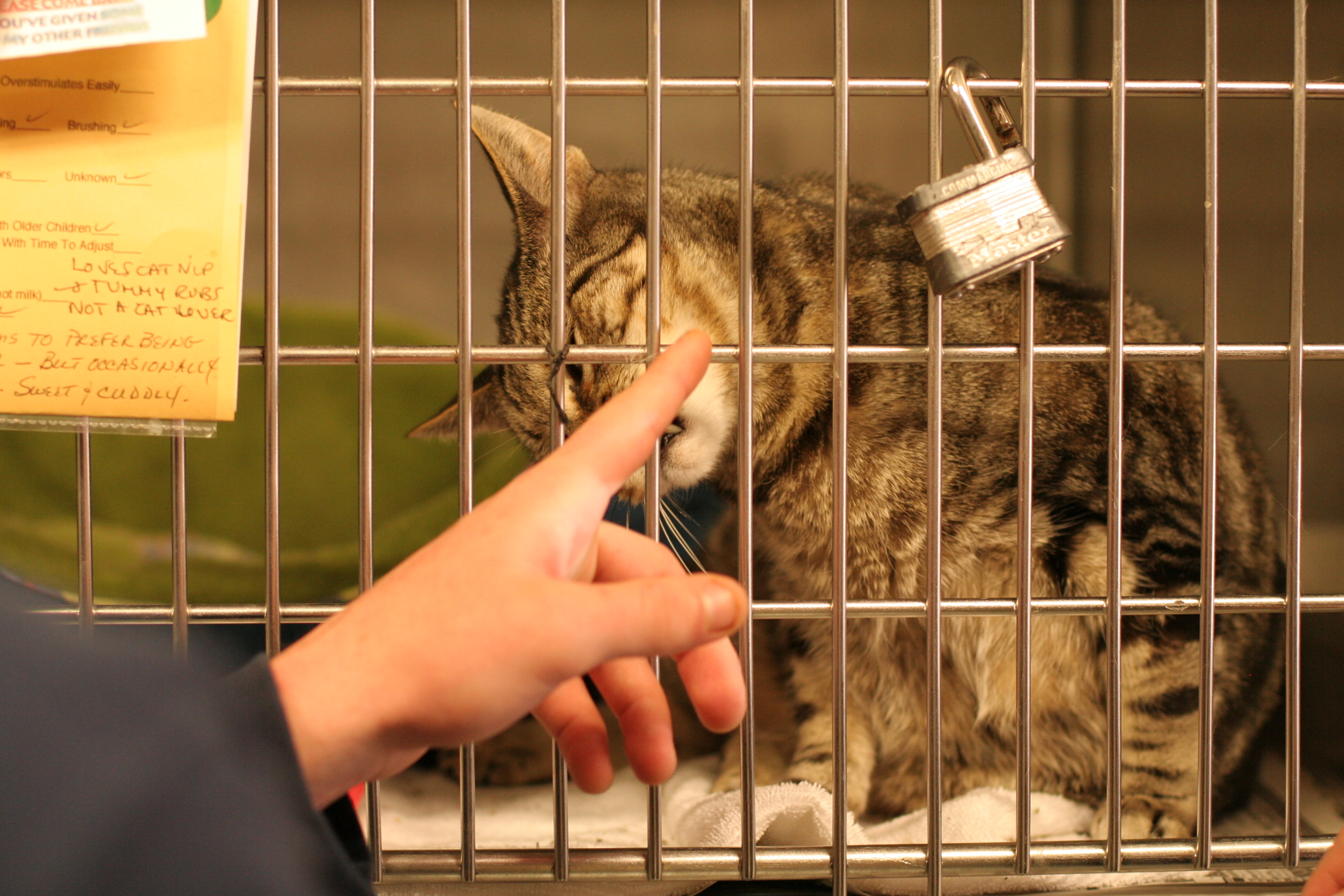
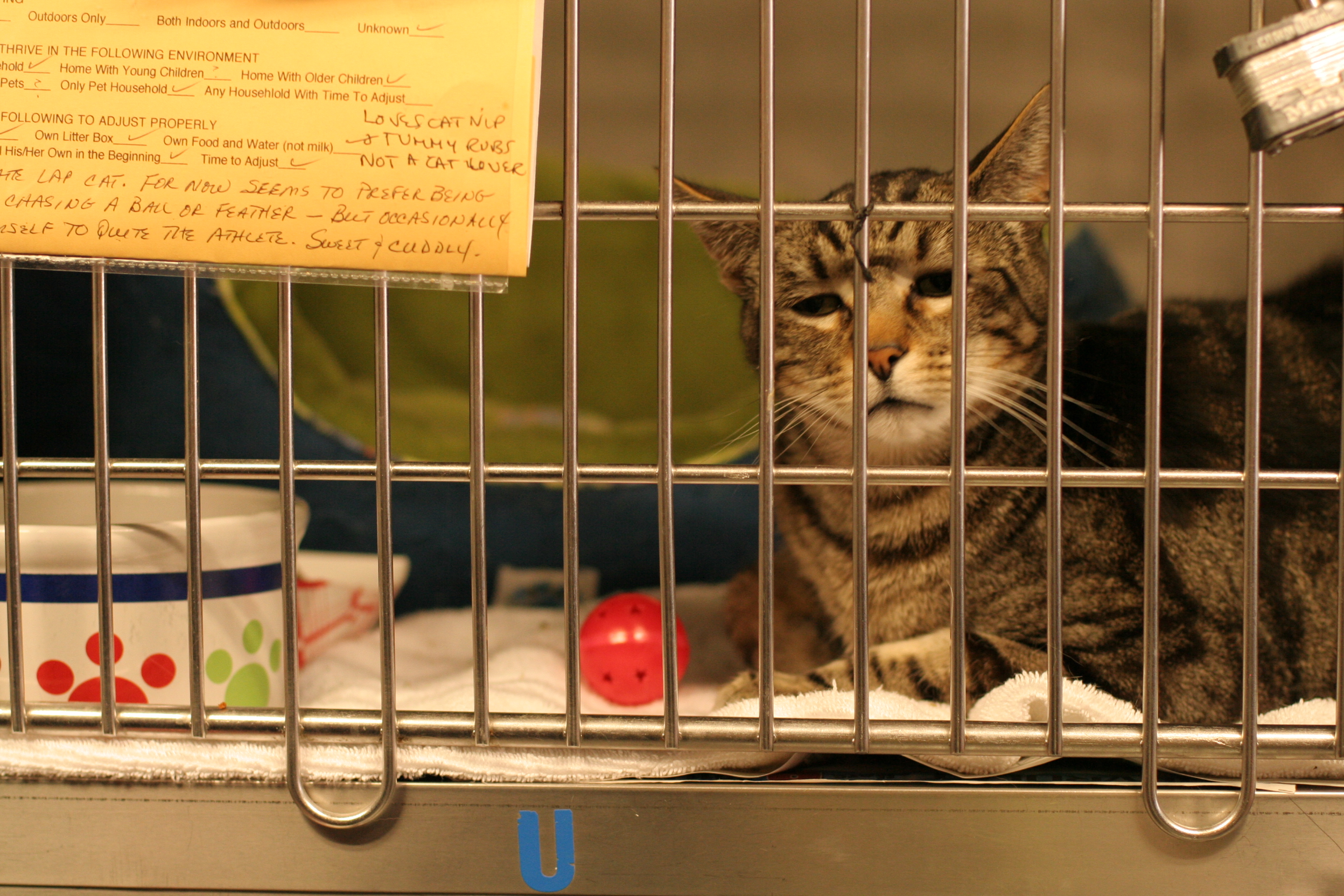
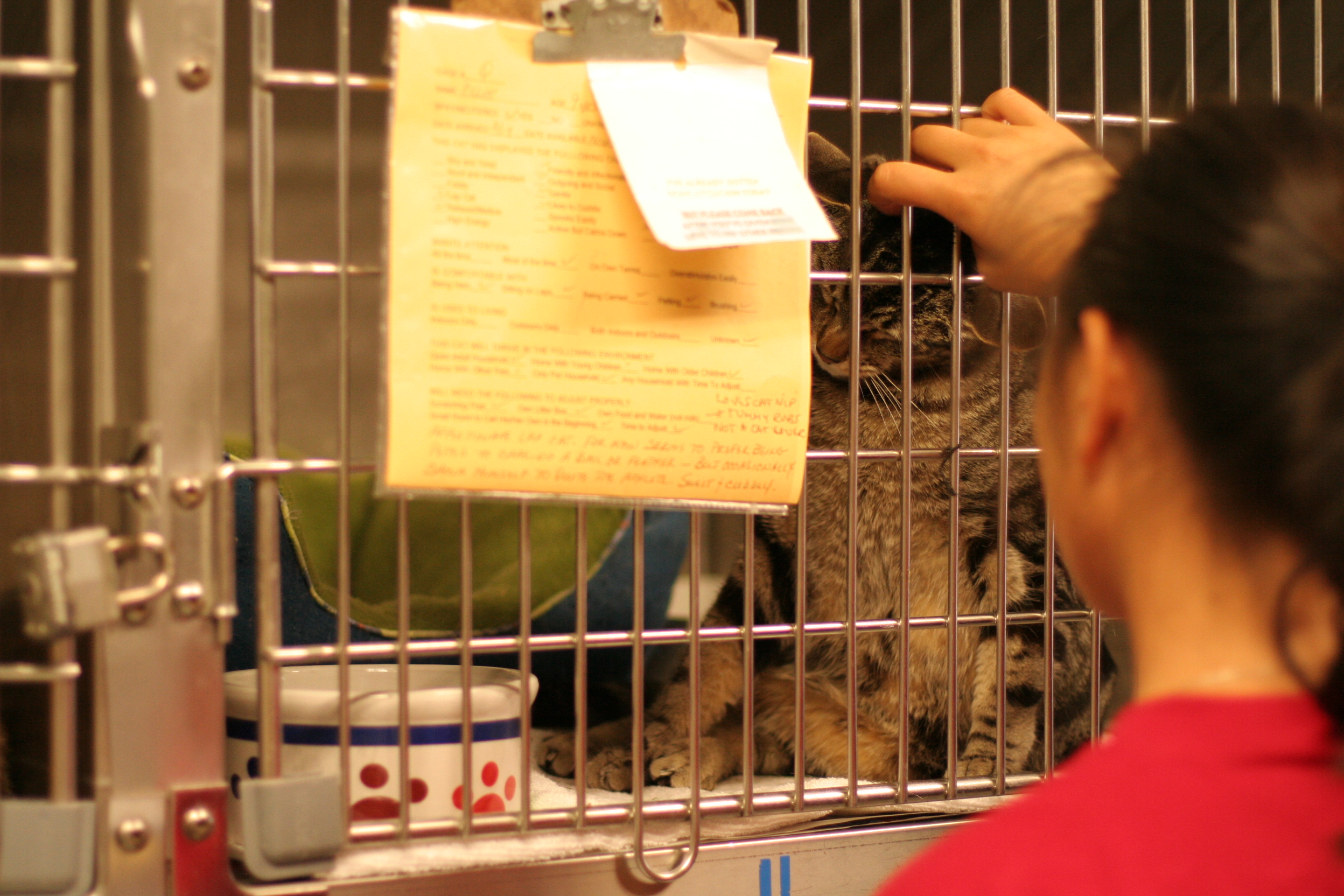
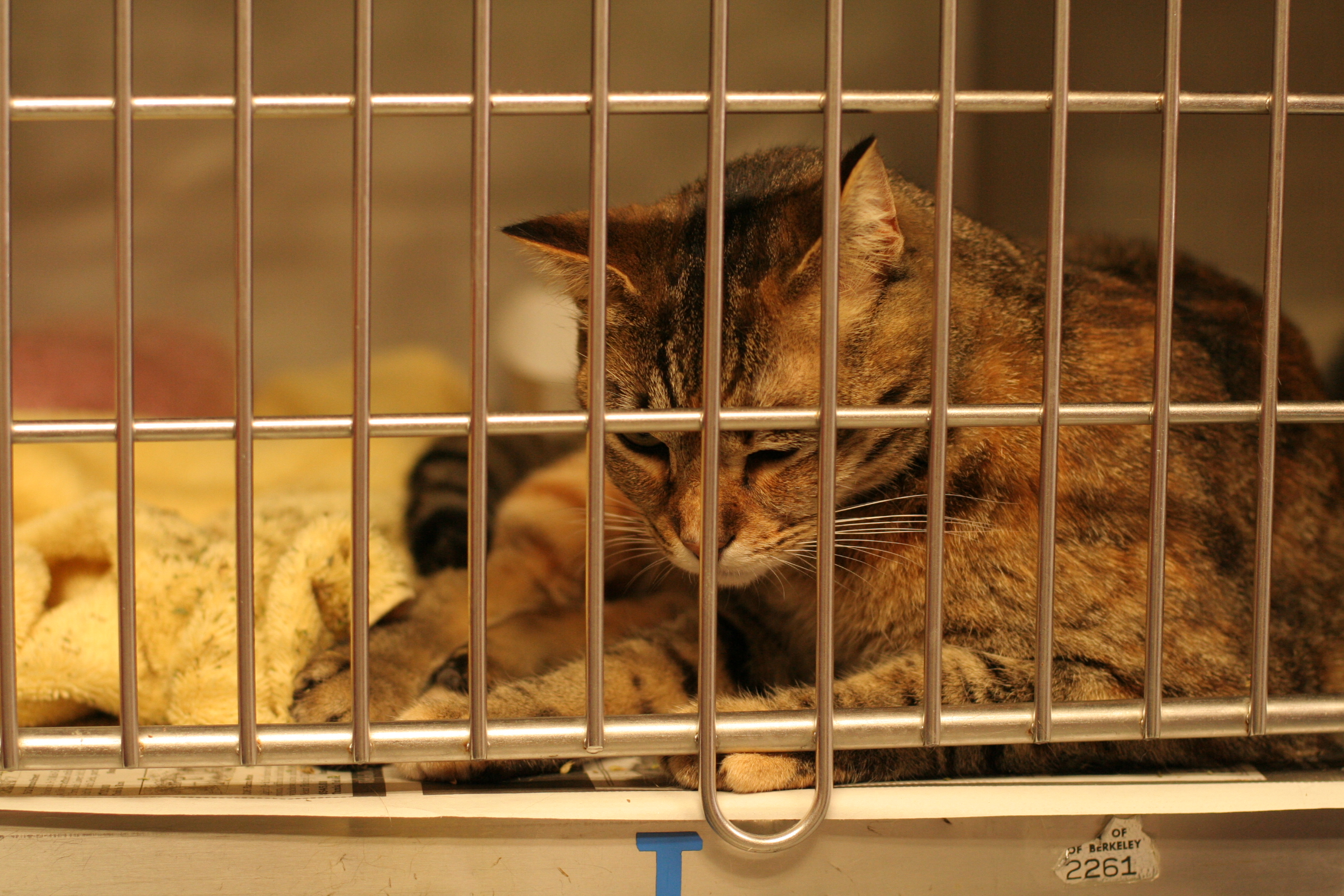
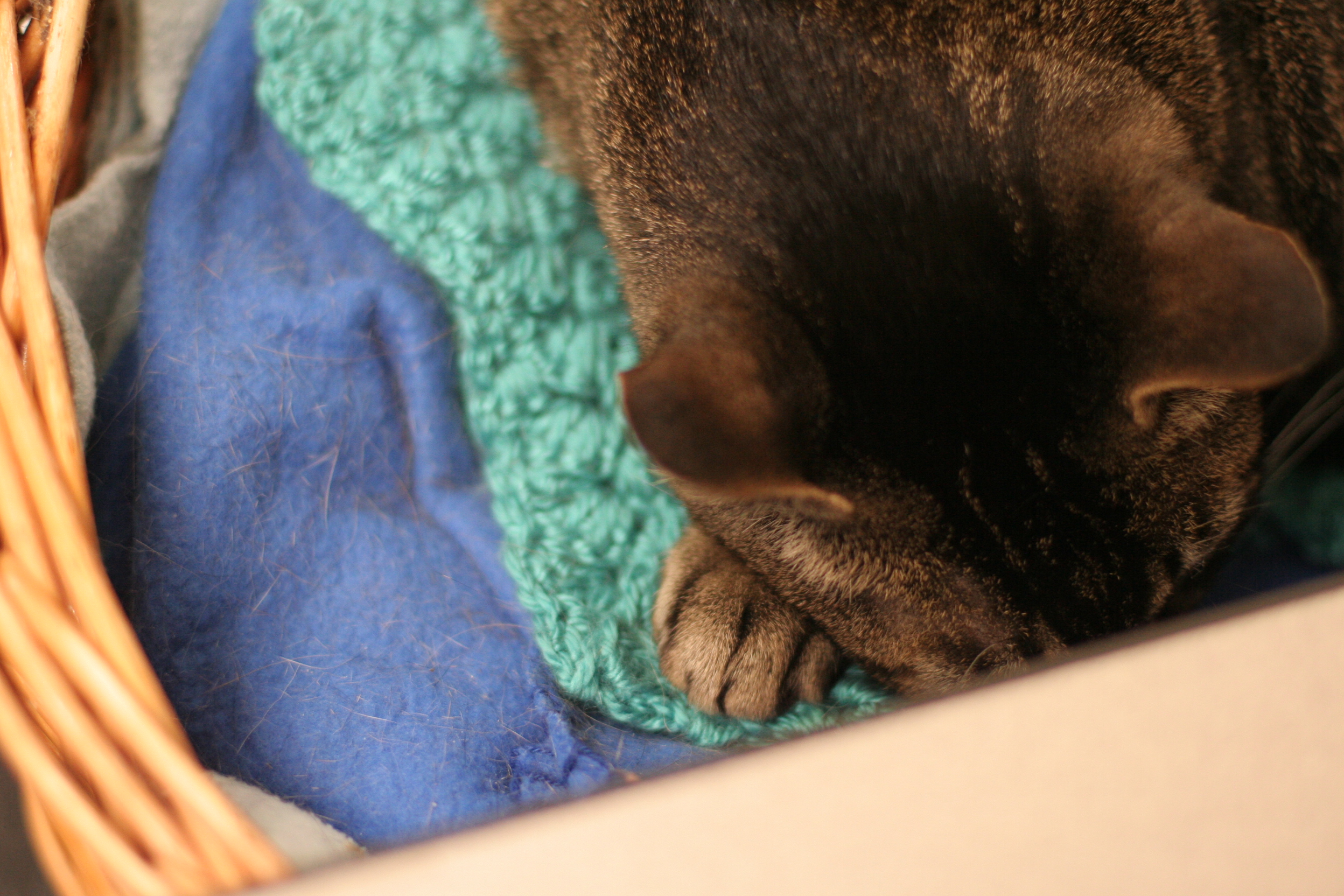
This weekend Ryan and I went to Berkeley Animal Care Services to visit with the cats. (“Kih’ens,” a variation on “kittens,” is mainly how I refer to domestic felines. My cat lady ways speak for themselves.) Based on our schedules and accommodations (carpet in the apartment), we probably won’t be able to adopt a kitty ourselves, but a little lap-purring therapy never hurts. I got a good vibe from this “no-kill” shelter — meaning that animals can stay for years, and are only euthanized if they are ill beyond treatment or too aggressive to be adopted. While the kih’ens we encountered didn’t seem thrilled to live in cages, they were definitely getting a lot of love and attention, and all the ones we spent time with were sweet as could be.






















 Kloncke