Do you create by hand? Do you create with words? Or both?
Yesterday and today, my faculty advisor has observed that although we humans make meaning in verbal and physical ways, for a variety of social reasons authority figures often overcultivate one side or the other. (Or neither, I might add.) Many of us are taught, through schooling, that what we type with our fingers or say with our mouths is more important than what we can make with our hands or sculpt with our bodies.
There’s some overlap here, of course, in that writing (or typing) is an action that lives in our hands. But my advisor’s point is that too often, that’s as far as it goes. Unless we also engage in other activities and ways of thinking (in terms of movement, in terms of texture, in terms of light or temperature or dimension), our writing and meaningmaking will be limited to our hands, rather than involving our entire bodies.
The moment he said this, I got it. When I was younger, before writing took over as the only mode of learning in school (did I create a single physical object in college?), I used to think and create with my hands. I used to make things by hand.
* * * * * *
My mother, being a sentimental soul, and having only one child, has trouble throwing my old things away. The garage of my childhood home is lined with boxes containing elementary school spelling tests, middle-school science papers, and God knows what else. My bedroom, though not exactly as I left it at 17, feels less transformed (say, into a study) than strategically looted, with some walls and drawers empty and others left intact, housing various middle-to-high-school artifacts.
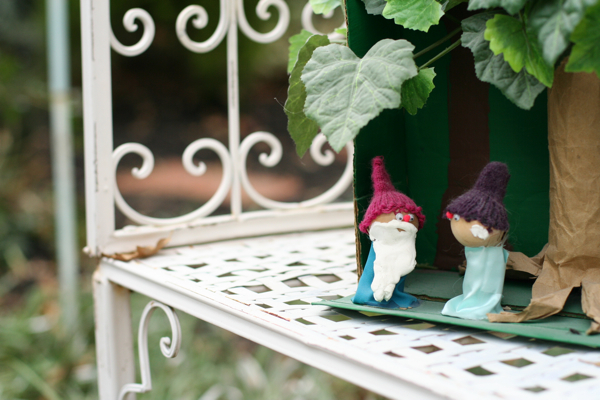
Pretty much every time I visit my parents, I use the desktop computer at least once. And pretty much every time I use the desktop computer, I notice and smile at the following diorama, perched on a nearby shelf in the cluttered study, and crafted by Yours Truly in about the fifth or sixth grade.
This slideshow requires JavaScript.
Thorin thinks that Bilbo should climb to the top of the tree and see if he can see any end to the forest. Bilbo reluctantly climbs up a tree and breaks through the canopy to the bright light of the sun. He sees thousands of butterflies and looks at “the black emperors for a long time and enjoyed the feel of the breeze in his hair and on his face.” [from The Hobbit, Chapter 8, pg. 148.]
Turns out, I used to love making all kinds of things when I was young. In eighth grade, I was supposed to present a visual aid about immigration to the US at the beginning of the 20th century. I wound up making a simple Rube Goldberg device: on one side of the machine there’s a tiny bucket where you place more and more stick figurines (representing immigrants). When the bucket gets heavy enough, it tips a see-saw that flips a gate, a marble rolls down a pathway and trips something else, and I forget exactly how the rest of it worked but in the end another tiny bucket flips over and out fall all these illustrations of ‘consequences of immigration’ (i.e. tenements, rats, spread of disease, and whatever else our history book told us).
But midway through high school or so, the making of things by hand fell away. It would be years before I rediscovered it: first through cooking, then letter writing, and now bootleg carpentry and picket-sign design. I hesitate to call these activities “making meaning” (sounds so lofty and . . . well . . . discursive), but at least they live in the same neighborhood.
How about you? Do you regularly use your hands to make meaning — playing music, painting, sculpting, deejaying? Or maybe even your entire body, through dance? Or are you mostly brain-mouth-and-keyboard -bound, like me?
How do you greet someone who’s just spent nine days not making a sound?
Our housemate Aneeta (who, incidentally, also authors the simple, generous, deeply healing, and truth-tellingly politicized dharma blog In The Process of Being) returns today from her first residential meditation retreat. In my experience, though each time is different, emerging from the womb-crucible of the meditation center has usually felt giddy and tender, and I’m amazed at how much effort is required just to speak. I feel it in my vocal chords. Each word, laugh, or murmur of assent demands attention in order to be born.
So as much as I’m looking forward to hearing all about her experience, I don’t want to be all like, Come verbalize with me!!! the second she walks in.
Frosting and sprinkles, then, to ease the initial homecoming.
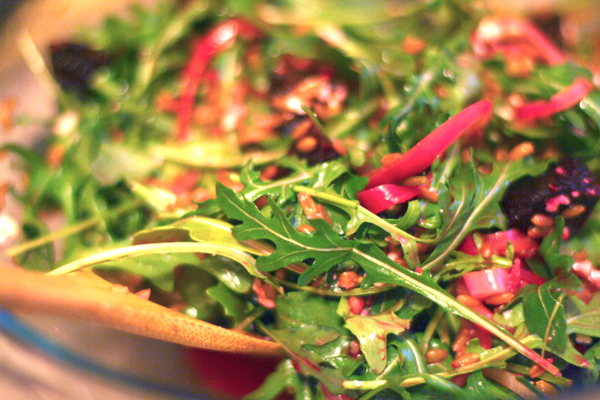
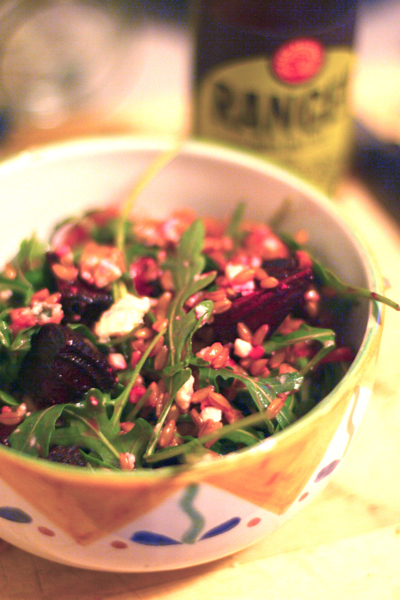
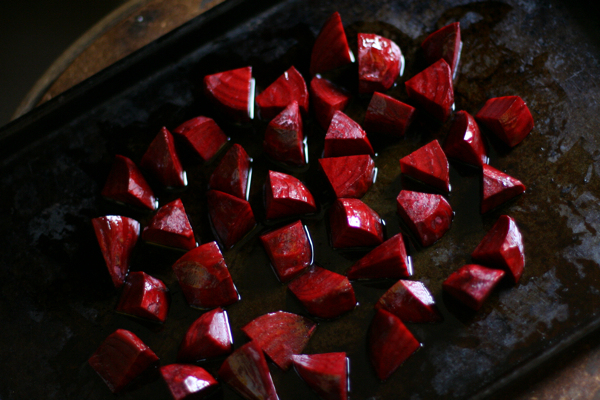
Not the most awesome photos, but I was excited to make this salad today, which involved my first pickling experience.
I had heard that quick-pickling onions is an easier task than it sounds, which I found to be true. But I didn’t realize how many delicious components were involved.
Cloves.
Chili.
Bay leaf.
Brown sugar.
And, of course, vinegar. (I used the apple-cider kind.)
So simple. So satisfying. Highly delicious.
I had been looking for a new way of using farro, a grain I adore for its chewy heartiness. Saw a beet, farro and arugula salad on a menu in SF and thought I would try my hand at something similar.
______
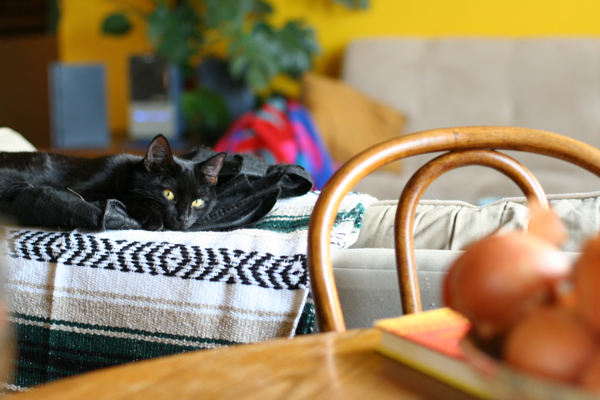
Ella observed my experiment from her perch on the grocery tote.
Hey folks, sorry for the signal loss! It’s been mad busy around here, partly because of the following little experiment I’m planning, with the help of some good friends. In short, for one afternoon I’m going to try to translate the blog “in real life” (IRL).
The only the IRL ‘blogger’ (or blogger-heavy) gatherings I’ve attended myself have been conferences. Media conferences; technology conferences; things like that. In this type of scene, bloggers from across the country (or among many countries) not only get to expound their theories before a live, half-listening-half-Tweeting audience, but can also lock screen-addled eyes with many writers theretofore befriended — or offended — exclusively online. I’ve seen drama erupt at these idea emporiums, but I’ve also witnessed cyberdenizens leap over tables to greet each other, practically converging midair in an embrace of mutual affection, admiration, and I-can’t-believe-it’s-really-you.
For my own shindig, though, I want to go in a different direction. Very chill, more like a housewarming or offbeat birthday party than a serious networking meet-and-greet. Although there are plentyofonlinewriters and creators I’d love to meet in person someday (and many wonderful ones I’ve already had the fortune to know), most everyone invited to Kloncke IRL are people I’ve known offline for a while. Here’s the email I sent out about it (well, a slightly less colorful version) to my local peeps. Faraway compas, I love you and wish you could be here! My address has been changed for this version because, well, I don’t want it circling around, you feel me? But I’m posting it here because I occasionally meet people in the Bay who’ve read Kloncke but don’t know me personally (yet). If that’s you, shoot me an email, and come on out next Saturday! Love to have you.
dear amazing wonderful human friends.
as most of you know, i make a blog called Kloncke.
i know you know about this blog because many of you have left rad, sweet, insightful, and sometimes hilarious comments there.
i appreciate this a whole lot. i appreciate YOU a whole lot!
and so, as a small means of saying thanks for reading, sharing, linking, and just being your fabulous selves, i want to warmly e-vite you to a gathering in my home, In Real Life (IRL).
what can you expect at such an event?
live incarnates of the cyber version; including:
vegetarian and vegan homemade treats
photographs, available by donation
group meditation
a reading of my recent guest column in make/shift magazine, on buddhism, feminism, and resistance
a “blogroll” table featuring your political, artistic, and spiritual lit to share or display (bring some!)
the colorful walls of our apartment
chillin and building with other lovely folks
Kloncke IRL
Saturday, October 15th 3–5pm (Reading at 4pm) 555 33rd Street, Oakland * * *
this event will be free (of course!) but please bring your own mug or thermos (for tea) and, if you can, a cushion to sit on. (we’ll also have a handful of chairs.) unfortunately our apartment is up one flight of stairs with no elevator or ramp; please let me know if this will be a problem for you, and we can try to work something out.
also, please arrive scent-free so my peeps with Multiple Chemical Sensitivities can come and enjoy themselves without getting sick!
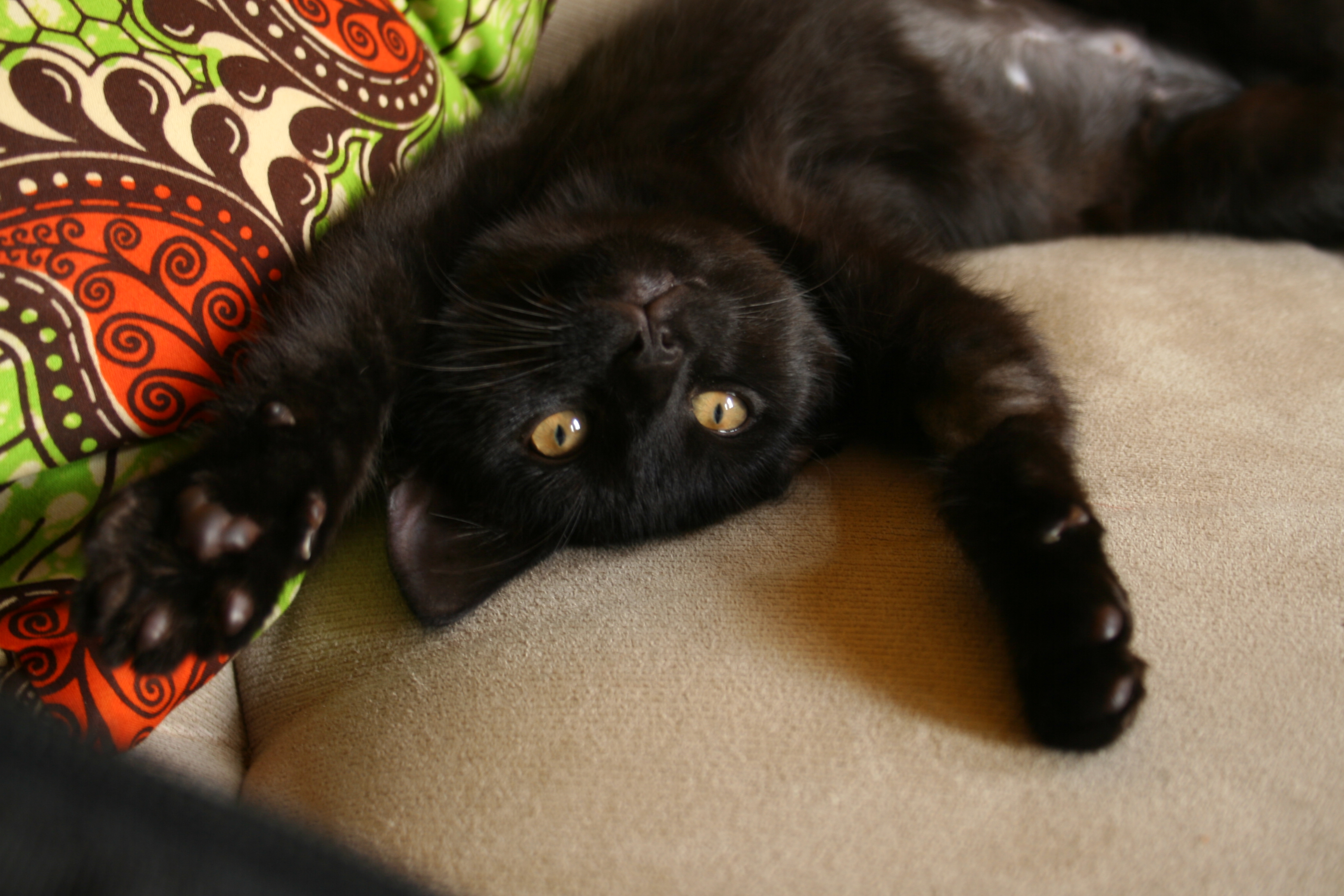
finally, Our place has limited space! Please RSVP so we can have a sense of numbers, and calculate how many walls to knock down.(j/k :) feel free to RSVP-plus-one or two, but don’t roll through with a whole posse. our kitten Eloise will be acting as bouncer, keeping careful track of the guest list.
__
thanks, love, take care, see you soon, be well, and call or e-mail me with any questions,
katie loncke
More to come this week online: the next Newsies post on how the courts are stacked against us, inspired by a frustrating but illuminating experience this morning before a judge. Stay tuned. :)
Three humor videos with fearsome subtexts: about “throwing away” our old material (and perceptions of self — hello Buddhism); economic violence and growing up poor and Black in a food desert in the U.S.; and . . . well, while there’s nothing inherently sad or scary about being hard of hearing / deaf / Deaf / fluent in sign language, but watching it pushes me to consider how, for every hearing person who enjoys and appreciates it, there are countless events that remain stubbornly inaccessible to non-hearing folks.
Case in point: the other two videos in this post.
If I’m being honest, I feel like I don’t have time to make transcripts for the other videos. If I’m being really honest, I mostly just don’t feel like doing it.
[Fast-forward an hour of wandering the internet aimlessly, feeling background-guilty about not writing transcripts, and noticing a stream of thoughts that justify why I don’t have to do it.]
[Now starting to write transcripts. Hey, this ain’t so bad. Kinda fun, actually. Helps that these two ppl are talented.]
Selected and /or outlined transcripts below the jump. Imperfect.
Concluding this spontaneous miniseries on companionship (or maybe not concluding it — who knows? — it’s spontaneous), we arrive at Ryan. You know, my partner, the guy from kale vs. flowers and Bad Good Romance. The other day, I read a passage from James Agee’s Southern novel A Death In the Family that reminded me of our household dynamic. Specifically, the ways that we negotiate gendered roles, try to both anticipate and discuss each others’ needs, and occasionally discover “dhamma,” or insights about the nature of things, right in the (dis)comfort of our own home.
In this scene from the book, Jay has just jolted awake in the dead of night thanks to a call from his brother Ralph, who drunkenly warns that their father may soon die from long-battled heart problems. Jay has decided to take the train up to his parents’ town, and he and his wife Mary, also awakened by the phone call, are getting him ready to leave.
“It may all be a false alarm. I know Ralph goes off his trolley easy. But we just can’t afford to take that chance.”
“Of course not, Jay.” There was a loud stirring as she got from bed.
“What you up to?”
“Why, your breakfast,” she said, switching on the light. “Sakes alive,” she said, seeing the clock.
“Oh, Mary. Get on back to bed. I can pick up something downtown.”
“Don’t be ridiculous,” she said, hurrying into her bathrobe.
“Honest, it would be just as easy,” he said. He liked night lunchrooms, and had not been in one since Rufus was born. He was very faintly disappointed. But still more, he was warmed by the simplicity with which she got up for him, thoroughly awake.
“Why, Jay, that is out of the question!” she said, knotting the bathrobe girdle. She got into her slippers and shuffled quickly to the door. She looked back and said, in a stage whisper, “Bring your shoes — to the kitchen.”
He watched her disappear, wondering what in the hell she meant by that, and was suddenly taken with a snort of silent amusement. She had looked so deadly serious, about the shoes. God, the ten thousand little things every day that a woman kept thinking of, on account of children. Hardly even thinking, he thought to himself as he pulled on his other sock. Practically automatic. Like breathing.
And most of the time, he thought, as he stripped, they’re dead right. Course they’re so much in the habit of it (he stepped into his drawers) that sometimes they overdo it. But most of the time if you think even for a second before you get annoyed (he buttoned his undershirt), there is good common sense behind it.
Ryan tells this funny joke sometimes about one method, half-conscious at most, by which person X tries to evade domestic work and pile it on a partner. “But you’re so good at [cooking, doing laundry, calming a fretful child]. If I do it, I’ll just fuck it up.” A passive-aggressive compliment-trap, which leaves the other person feeling obligated to do the thing they’re so much better at doing.
__
Obviously, this is one of the big problems with the naturalization of gender roles in heteronormative family requirements. Men are raised to believe that they don’t have to learn how to cook/clean/mend/mind children because women are so naturally good at it. Jay appears to have no clue that his wife was brought up to learn how to be a “good woman,” which means acquiring certain social and reproductive skills, including staying attuned to the needs of her socially-sanctioned husband and children. She might enjoy learning those skills; she might not. The point is, the skills aren’t endemic to her based on her gender. For a whole host of reasons that I won’t get into here, she’s not really free to self-determine her own gender identity and presentation, fertility, or (as a working-class person) the circumstances of her productive and reproductive labor.
So this is the background against which Ryan and I operate. Furthermore, Ryan works. I “work” from home on grad school (viz. this blog, or planning for EastBaySol). I spend more time at home so its levels of (un)tidiness affect me more, which makes me more inclined to change/correct them myself. Also, I like to cook more than he does. So he takes pains to counteract the assumption that just because I know how to cook, and even enjoy it, that this means it’s effortless for me, and that he’s entitled to its products, as though he were plucking a ripe plum from a backyard tree. And those times when I do wind up cooking more than 50%, he makes sure to do the bulk of the cleanup. Last week when I started washing dishes out of turn after lunch, he straight-up chased me out of the kitchen. Another morning as I slept he made breakfast and green tea, then came back to bed to cuddle me awake.
__
Maintaining mindfulness around housework distribution doesn’t have to be robotic or transactional. It’s actually a pretty emotional and tender process for us, and I think for a lot of people. The other day I was talking to a woman who lives with her girlfriend, and was telling me that even though her partner works longer hours than she does, they cook dinner together every night and split the remaining housework evenly. “I just knew I would be unhappy otherwise,” she said. I love that this negotiation takes the feeling of work into account, and not just some supposedly objective measurement of household labor — in joules, or whatever.
Jay and Mary’s middle-of-the-night crisis management takes a turn for the tender, too. I see many of my relationship dynamics reflected between them.
He sat on the bed and reached for one shoe.
Oh.
Yup.
He took his shoes, a tie, a collar and collar buttons, and started from the room. He saw the rumpled bed. Well, he thought, I can do something for her. He put his things on the floor, smoothed the sheets, and punched the pillows. The sheets were still warm on her side. He drew the covers up to keep the warmth, then laid them open a few inches, so it would look inviting to get into. She’ll be glad of that, he thought, very well pleased with the looks of it. He gathered up his shoes, collar, tie and buttons, and made for the [bathroom], taking special care when he passed the children’s door, which was slightly ajar.
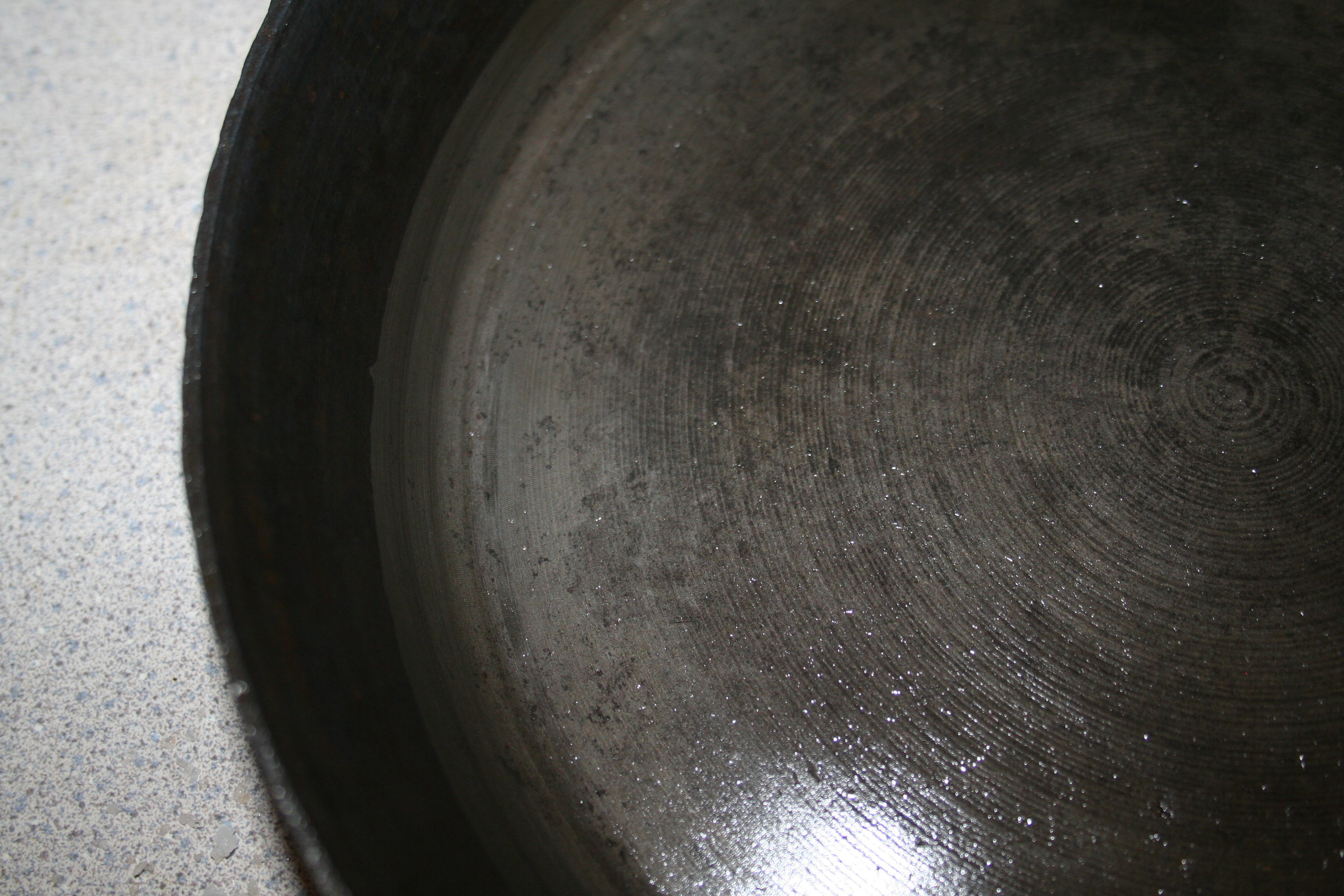
Having finished and submitted a grad school paper today, I am rewarding myself with another round of re-seasoning our cast-iron skillet.
Did you know that it’s virtually impossible to find out how to properly season one of these puppies just by looking it up on the Internet? Oh, sure, you’ll find instructions and opinions, but they differ wildly from person to person, sharing only the barest of fundamentals: you need to put oil in the pan and heat it up; then the pan will be smooth and non-stick.
But how? Why? Really?
Sheryl’s Blog explains. Fantastically. Scientifically. Read and be amazed.
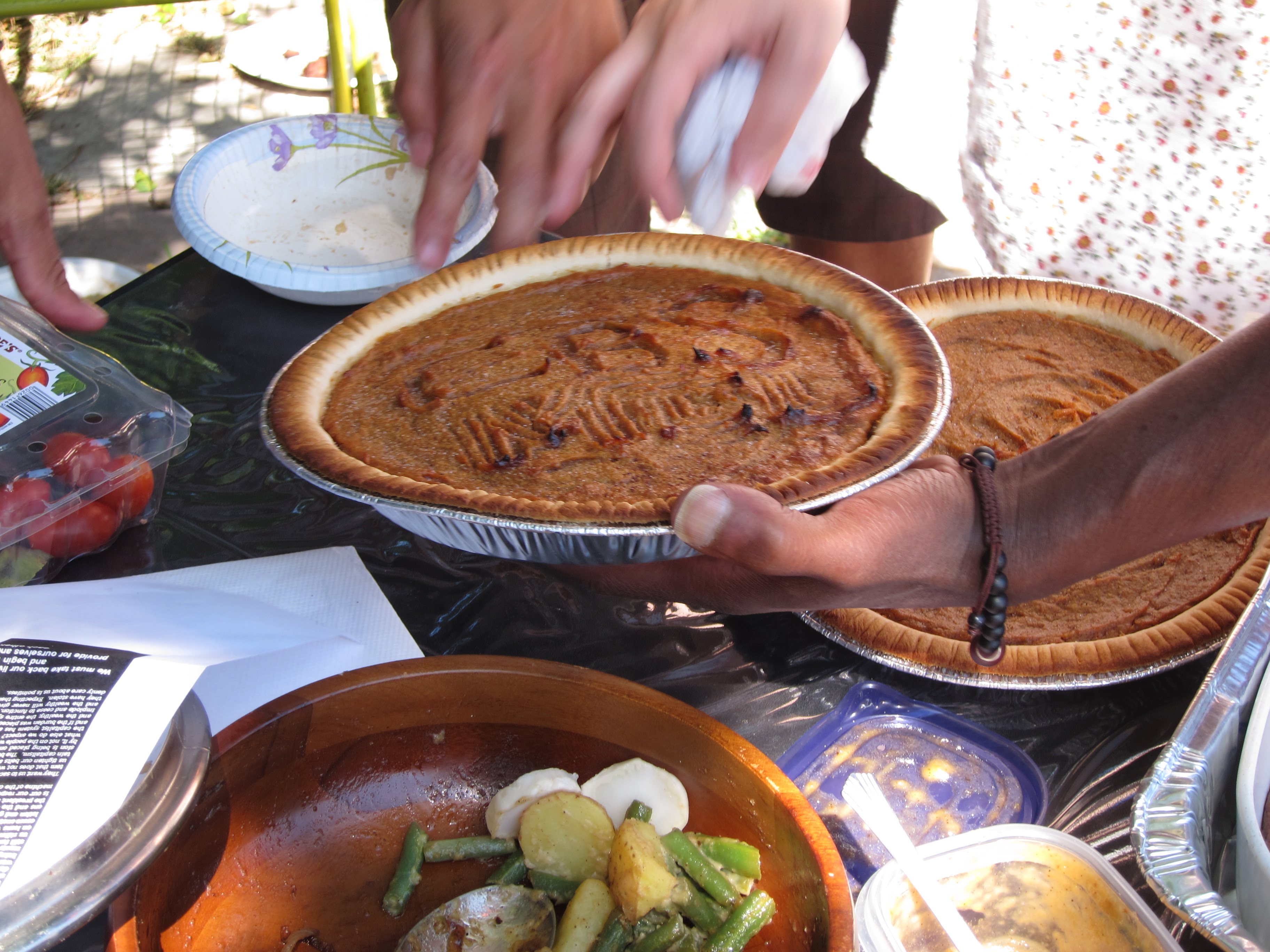
Feeling a bit sick today, but wanted to share a few fotos from this weekend’s meeting-slash-potluck. Originally conceived as a mini reportback and collaborative skillshare between San Francisco Solidarity Network and East Bay Solidarity Network, only one SF member was able to show, so we pumped her for a lot of info. :) And sat around eating homemade vegan cornbread, spicy green bean and potato salad with caramelized-onion-mustard dressing, vegan mango lassi, risotto, brownies, and Mel’s sweet potato pie that will “make your arms go up in the air.”
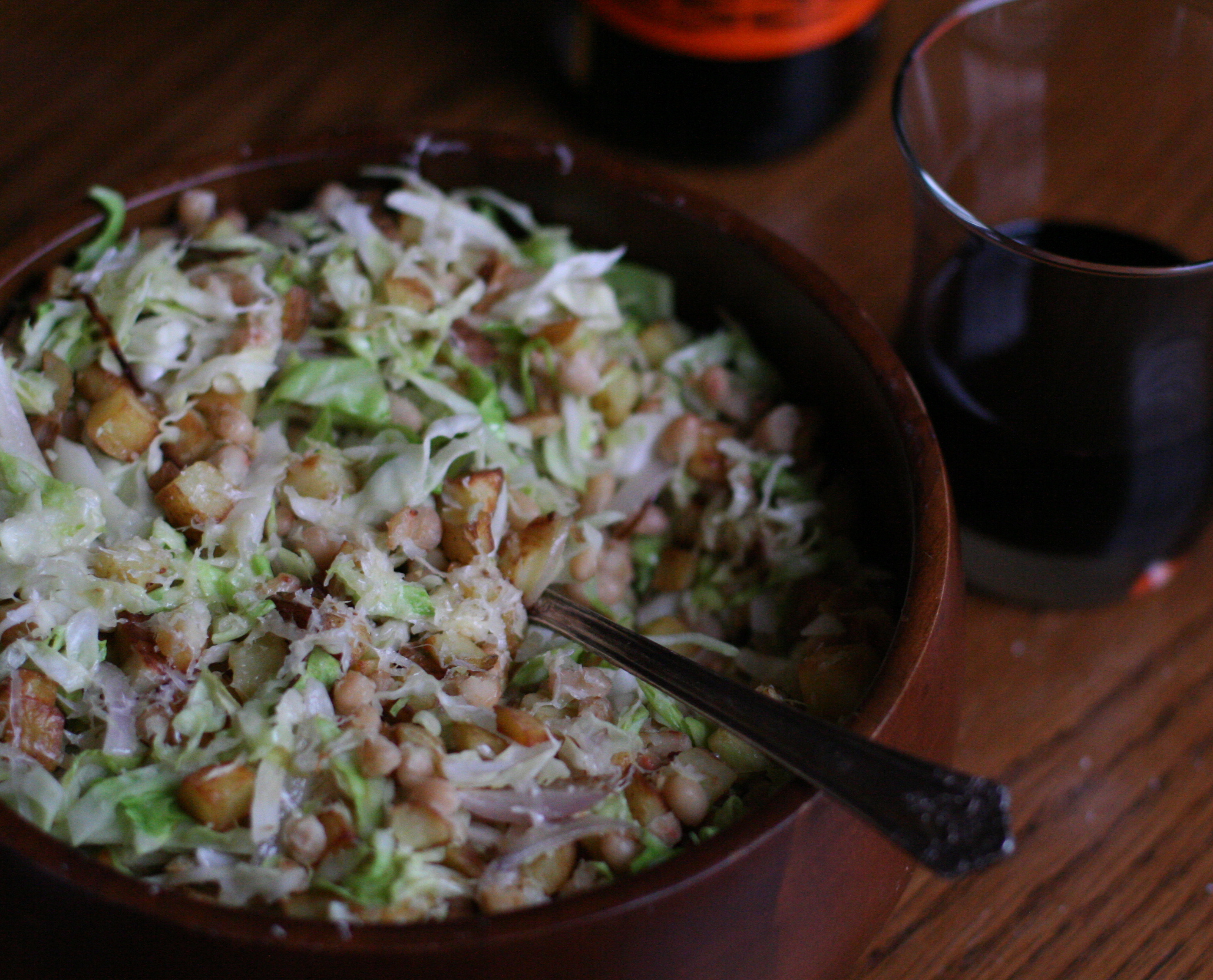
Dinner. Cover recipe from Heidi Swanson’s new cookbook, Super Natural Every Day. The flavors here are more subtle than I’m used to (normally I just douse everything in lemon juice and pile on the cayenne and cumin), but once I lasered in, I found a lot to enjoy. Slight spiciness of the barely-cooked cabbage plays off the creamy sweetness of the beans (I used canned fagioli) and tiny diced Yukon Gold potatoes. I actually smiled at a burst of tangy-smokiness from the sauteed shallots. It’s the kind of dish where each ingredient matters because it all comes together quite quickly in one pan, so you can fully taste the fresh produce* without relying a lot on spices. And because each flavor is independent, every spoonful yields a slightly different taste combination. Which is dangerous, because it makes me curious to eat more and more even after I am so so full!
Here’s what I did, adapted from Heidi’s formula.
12 oz. fagioli white beans from a can, rinsed and drained
6 or 7 small Yukon Gold potatoes, each about golf-ball-size
1 large shallot
Half of 1 medium green cabbage
4 glugs extra virgin olive oil
two big pinches of salt
Parmesan cheese (optional)
Wash the potatoes well and dice them into tiny cubes. In a big frying pan (I used 2 skillets to ensure maximal crusty browning action) glub in 2 glubs of olive oil (that’s 2 each if you’re using 2 pans) and turn the heat to medium (5–6 on my burner dial). When the oil is hot, add the potatoes, sprinkle with the salt, and toss to coat. Cover and set a timer for 2 minutes; when it goes off, toss them again to help brown on all sides. Cook for a total of 5–7 minutes or until tender and golden.
Meanwhile, slice the shallot very thin, and chop/slice the cabbage thin, also. When the potatoes are cooked, add the shallot and the beans, and spread the beans on the bottom of the pan so they get a chance to get nice and crusty, too. (Scrape around the bottom of the pan to loosen all the crusty bits.) Let ’em hang out for a few minutes, finish chopping your cabbage, then add the cabbage and stir to warm through — just enough so it wilts a little and goes bright green.
When it all looks and smells tantalizing, turn out into a serving dish and serve with a dusting of parmesan cheese, or as-is for a vegan feast. Hell yes.
————————————
*Under communism, I am told, everyone will have fresh produce because there won’t be the kind of leave-the-unprofitable-extra-produce-to-deliberately-spoil bullshit that currently goes on, and instead we will grow food for use, not profit. Yay!



 Kloncke