My Second Week On The Streets Of San Francisco


Hey friends,

I probably won’t be updating Kloncke for the next week or so, and that’s because, for my second time, I’ll be joining the Faithful Fools in their annual Street Retreat: seven days and nights living, sleeping, and reflecting in the streets of the Tenderloin neighborhood, in San Francisco.

Coming to terms with the street retreat as a reflective and humanizing practice has been difficult for me.  To be honest, I still feel significant resistance to the idea.  Fortunately, though, over the past few weeks I’ve been able to sit with this resistance and discomfort (a time when the dhamma practice has come in handy), talk with friends and other Fools about it, and work through it in a positive way.

Before getting into my reservations and reconciliations, here’s a nice, basic description of what the street retreat, from fellow Fool intern Josh Mann:

Starting this Saturday, I will be participating in my first week-long Street Retreat through the Faithful Fools. I’ll be leaving my money, cell phone, and keys behind and taking a sleeping bag and backpack. I plan to sleep outside and eat mostly in soup kitchens, and I anticipate a lot of searching for public bathrooms. Twice a day, I’ll be meeting up with eight to ten other people to reflect on the experience. And, some of us will be sleeping as a group.

Part of the mission of the Faithful Fools is to “participate in shattering myths about those living in poverty” and to help people discover what is common to all of us regardless of our economic standing or housing status. As a Street Retreat participant, I am asked to reflect throughout the retreat on what keeps me separate from others as well as what connects me.

Ever since my first term in college, I have felt compelled to engage the social issues of poverty and hunger, and I expect that this retreat will help me better understand these issues including the way that public policies, laws, and urban planning affect people with little to no money.

At the same time, the founders of the Faithful Fools put great emphasis on the fact that we are not pretending to be homeless. I will begin the retreat knowing that it has a specific end time on Saturday, October 30th. It also seems important for me to acknowledge that I go as an able-bodied, college-educated U.S. citizen who is white, male, and straight, which will no doubt be a factor in both how other people respond to me and how I experience the streets.

Please keep me in your thoughts this week. I seek to know my own heart, and I need all of the help I can get. I also invite you to participate with me in some way or another wherever you are. I recommend setting aside a little time one day to wander and see who and what you encounter. The spirit of this retreat as I understand it is to meet more deeply the people and places that we sometimes hurry past.

So there’s a little bit of background.  As you can see, the retreat is not a study or experiment, nor is it a gimmick for “playing homeless.”  The spirit is one of renunciation.   We wouldn’t fast in order to “understand what it’s like to be a starving person,” but in order to push and expand our own views of the world we inhabit right now, as we are.  It’s not about appropriating or trying on someone else’s experience (the simplistic idea of “standing in someone else’s shoes”), but about peeling off the layers of ourselves, the skins thickened by routine and dualism, that pervert our own views of reality — including our views of ourselves.

What had been bugging me so much, I think (and it disturbed me so strongly that I very nearly backed out of the whole thing), wasn’t the idea of the street retreat itself, but its purported connections to mechanisms of social transformation.  I’ve talked on this blog before about what I see as the dangers of believing in a method for changing the world one mind at a time.  This approach rightly observes that human social “systems” are made up of individual people, but wrongly induces that these systems are therefore merely the sum of their parts, and that persistent hearts-and-minds education can eventually (through influencing voters and “those in power”) translate into large-scale fundamental social improvements.

I disagree with this approach for various reasons; now isn’t the time to go into ’em.  Suffice it to say, now that I’ve managed to decouple the reflective, community side of the street retreat from positive claims about its structural effectiveness, I feel a bit calmer about participating.

One common concern about street retreats is that we are “taking away resources” from people who need them, by eating in soup kitchens and sometimes sleeping in shelters (if we can get in).  I sympathize with the concern here, but the way I see it is: we do far more to support poverty and homelessness through our everyday complacency with the capitalist system than we could possibly do by individually taking a couple dozen free meals.  The scarcity (of beds, less frequently of food) is artificial.

Another frequent worry, especially from my dad: YOU ARE GOING TO GET YOURSELF KILLED.  IT IS DANGEROUS OUT THERE.

Don’t worry, papa.  (And others.)  From my observation over the past year, there is little danger of random violence on the streets of the Tenderloin.  The main types of violence we see here are (1) interpersonal violence among acquaintances, (2) low-level police violence in the form of harassment and enabling rape culture, and (2) structural violence, like the abovementioned artificial scarcity that keep families homeless while apartment buildings sit vacant for years, or the racist, sexist, homophobic criminalization of mental illness and drug addiction.

I guess both of these ‘responses,’ intended to allay fears, kind of sidestep the issues by pointing out how they are dwarfed by larger problems.  Well, that’s sort of how it goes for me, at the moment.  We’ll see if any more insights come during the week.

Wish me luck!  I will try to log some time on the computers in the public library, but the lines are generally long, the connections slow, and the time limits brief.

Take care, friends.

~katie

Sidewalk Sit

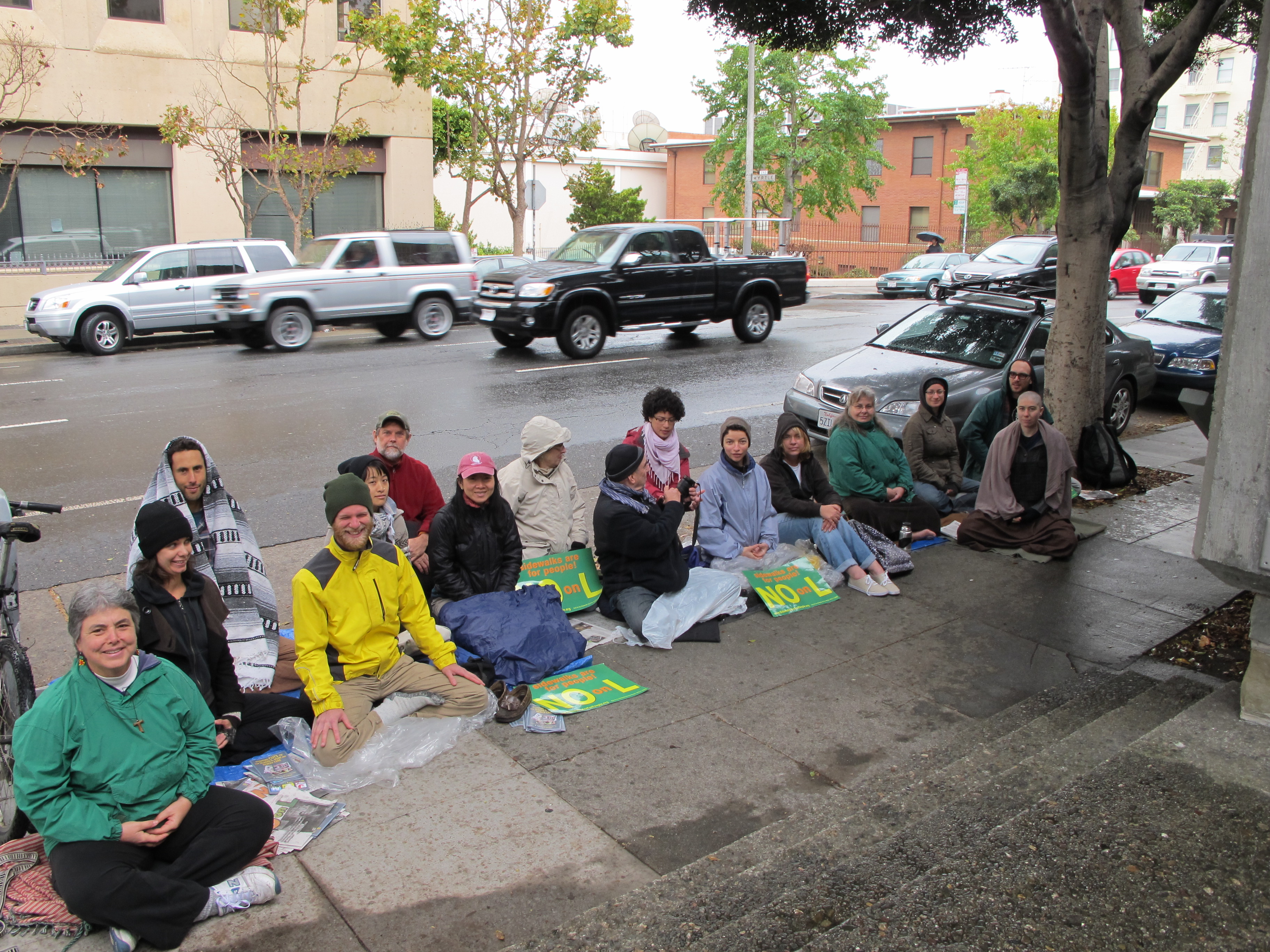
Sarah Weintraub, Michael Bedar, Tyson Casey and Michaela O'Connor Bono sitting off of O'Farrell Street, with a sign reading "sidewalks are for people; NO on L." photo by Sr. Carmen Barsody

Sorry I didn’t get a chance to post on Friday, folks — this weekend was a particularly busy one. Starting Friday evening, we (at the Faithful Fools) hosted about 16 participants in a three-day gathering for Buddhists and friends dedicated to social justice. “Working for Liberation,” we called it: the culmination of, oh, about six months of co-planning between me and the lovely Tyson Casey of the Buddhist Peace Fellowship, with guidance from Carmen of the Fools and Alan Senauke of Clear View Project (also vice-abbot of Berkeley Zen Center and author of the newly published The Bodhisattva’s Embrace: Dispatches from Engaged Buddhism’s Front Lines).

I wanna say more — much more — about the weekend, but I gotta run back to Sacramento. So for now I’ll leave you with these two images of our final weekend ‘activity’: a performative outreach effort in the Sidewalks Are For People Campaign, or “No on Prop L.” A grey, drizzly Sunday morning; chilly but thoroughly enjoyable.

Sixteen of the eighteen meditators sitting on wet Franklin Street sidewalks, sheltered under neighborhood trees. photo by Sonny of the UU Church


Neighborhood Happenings: Housing Occupation

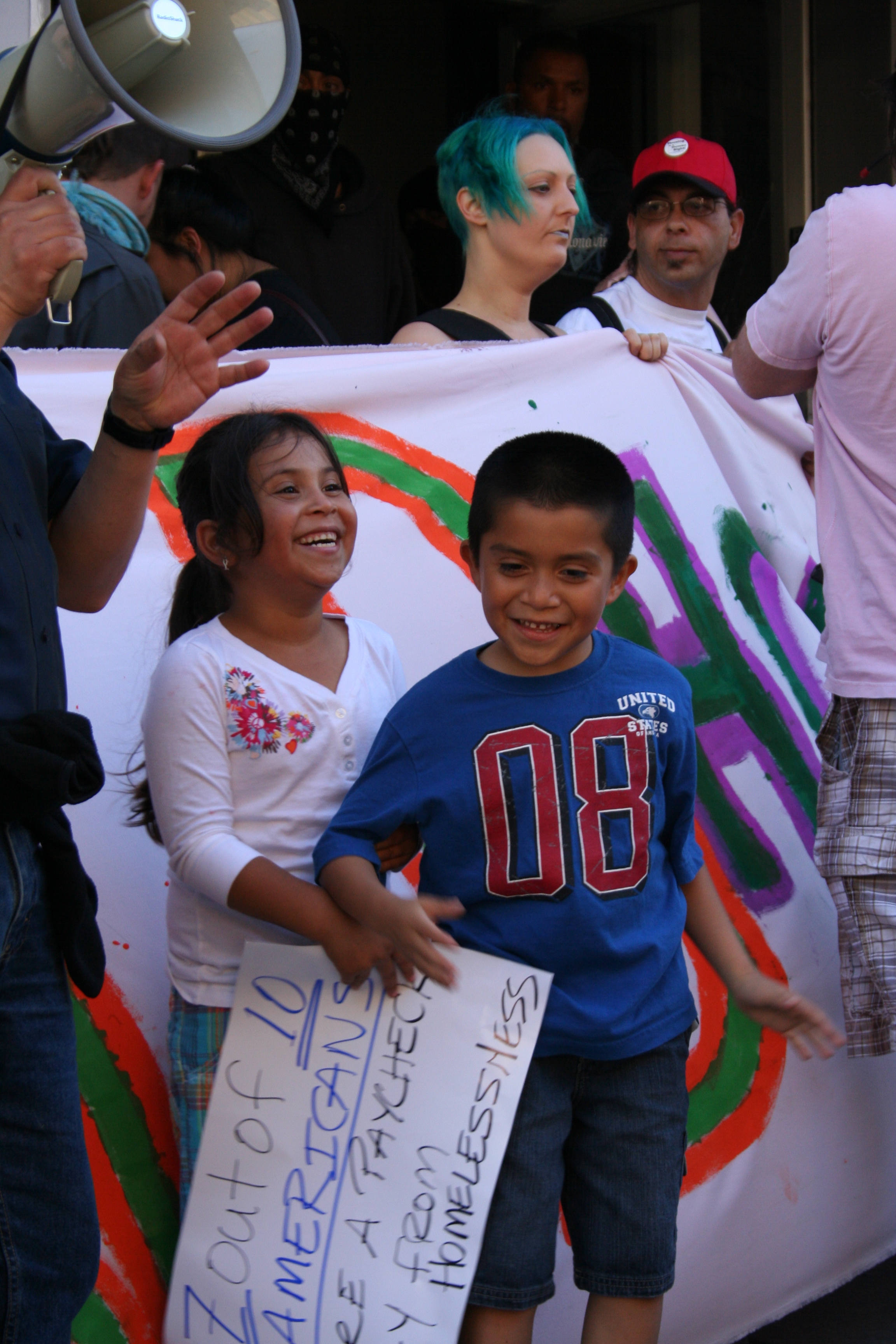
Today, in honor of World Homeless Day, folks with Homes Not Handcuffs and other groups hosted a “Creative Housing Liberation”: a rally, unpermitted march, and occupation/liberation of a 68-unit apartment building that has been vacant for years now. Coincidentally, that building happened to be right around the corner from our home at the Faithful Fools — a stroke of luck that allowed us to run back and grab a couple of “donations” (a chair and a vase of flowers) to offer to the building.

The event was really well done, and so far everything has gone off without a hitch. Crowd energy was strong; the occupiers had the banner drops all ready for us as our march turned the corner down Eddy Street; they had a dope sound system, powered by a generator, that transformed the corner into a dance party; Food Not Bombs even hooked it up with a tasty dinner for everyone.

Also fortunate: the landlord could not be reached by the police. And since the cops can’t break in and apprehend people without first getting the go-ahead from the landlord, the occupiers will hold the building at least until tomorrow morning.

This slideshow requires JavaScript.

Tomorrow, if I have time, I’ll try to add a bit more of my own perspective and analysis on housing occupation as a response to racist, heterosexist state violence in the form of denying people adequate housing. According to the event organizers, 30,000 housing units remain vacant in San Francisco, a city with 15,000 people living in homelessness. In light of this, does occupation of empty buildings seem morally wrong?

More germane to my line of questioning these days: what role can fun, vibrant, direct actions like today’s play in a larger strategic movement to transcend an economic system where, as Introducing Capitalism: A Graphic Guide puts it in a euphemistic half-truth, “the means of production are privately owned”?

(Note: very first chant of the march, as we took the streets? “Homelessness is not a crime! Capitalism IS a crime!”)

Happy Failures

Some of the smartest people I know — including my friend Ivan, and what I’ve read/heard by Suzuki Roshi — excel at failing.  They know how to fail in ways that allow the flow to continue, if you know what I’m saying.  The failure is not crippling, but just part of taking on a difficult challenge.  Generally speaking, I think that people with scientific minds (including serious meditators) are pretty good at failing happily.  Failing in ways that reveal new opportunities, even as they foreclose the ones we thought we wanted.

Endeavoring to improve on my ability to fail doesn’t mean tackling tasks that seem doomed from the start.  That would be too easy!  The kind of failure I’m talking about does not come cheap.  I am invested.  I want to succeed.  Each attempt, each step, is made with confidence, commitment, and openness.

Suzuki Roshi says that this is how we move toward enlightenment.  Through repeating small moments of enlightenment — those moments of a letting-go mind, a mind that is being, not chasing — while at the same time working hard to deepen and strengthen our practice.

I hope this is somewhat clear, what I’m trying to say.  As an example of a recent, happy failure of mine, I wanted to share a letter I wrote to all the people I’d talked to with an interest in building a disarm BART police campaign.  My intention in sending it was (1) to let folks know that I would no longer be pursuing the courses I’d proposed (for instance: organizing a direct action of civil disobedience for the day of Mehserle’s sentencing), and Why; and (2) to thank them for the inspiring connections we’d made in the course of the (eventual) failure.

It felt good to write this letter, not only because I have a lot of admiration and goodwill toward each of the recipients (including those with whom I disagree politically), but also because it was an exercise in observing and accepting reality as it is — rather than as I would like it to be.  A little inroad into rooting out dukkha.

I’d love to know your thoughts, resonances, and criticisms.

Hello everybody,

Hope this note finds you well!

Over the past couple of months, I’ve been talking with BART workers, Oscar Grant movement organizers, Oakland peacekeepers, Marxist feminists, reverends, priests, meditators, lawyers, non-profiters, poets, anarchists, communists, peace activists, radicals, progressives, friends, and random strangers about the possibility of coalescing a campaign toward disarming the BART police. I and others envisioned this as one small step in aiding a shift from weaponized, racist, capitalist-serving security culture toward community-controlled safety initiatives, dual power, and restorative justice.

Continue reading

Repost: Panthers at Peralta

My friend Aaron recommended this piece to me (a historical essay written by local Laney College Student Unity & Power folks) as an encouraging example of demands done well.

Boy, is it good.

I’ll quote from the conclusion, but really — read the whole thing (and check the other re-post, with commentary, at Advance the Struggle).

We are often confronted by a legacy of the Panthers as either a detoothed community service organization or all claws. But the BPP experience at Peralta shows the work of a multifaceted organic expression of a specific section of Oakland’s working class to overturn institutions that claim to serve them and remake them into bases for struggle. When the Panthers spoke of occupying a building, it wasn’t (only) to appeal for more funds from the state, but to keep the state away from self-organized community programs. This meant not simply a negation of racist, authoritarian educational institutions, but their redefinition and reuse. As the editorial of the first issue of The Grapevine wrote,

To the continuing students and student-workers, right-on to the work you have done and the work you have inspired your communities to do, right-on to your moves to secure your community institution, to moving for freedom from oppression, to moving to make this a real community college – in practice. We still have work to do, but we have reached a higher level of organizing and our work will be even more effective in the future. We will win our fight to keep our community college and control it.

This is a message to today’s student movement. Beyond “demand[ing] affordable, accessible and quality education” or “keep[ing] California’s original promise of higher education” lies the seizure and re-invention of these institutions around fundamental principles of self-determination, self-management and freedom from oppression.

Elaboration on the BARS Banner

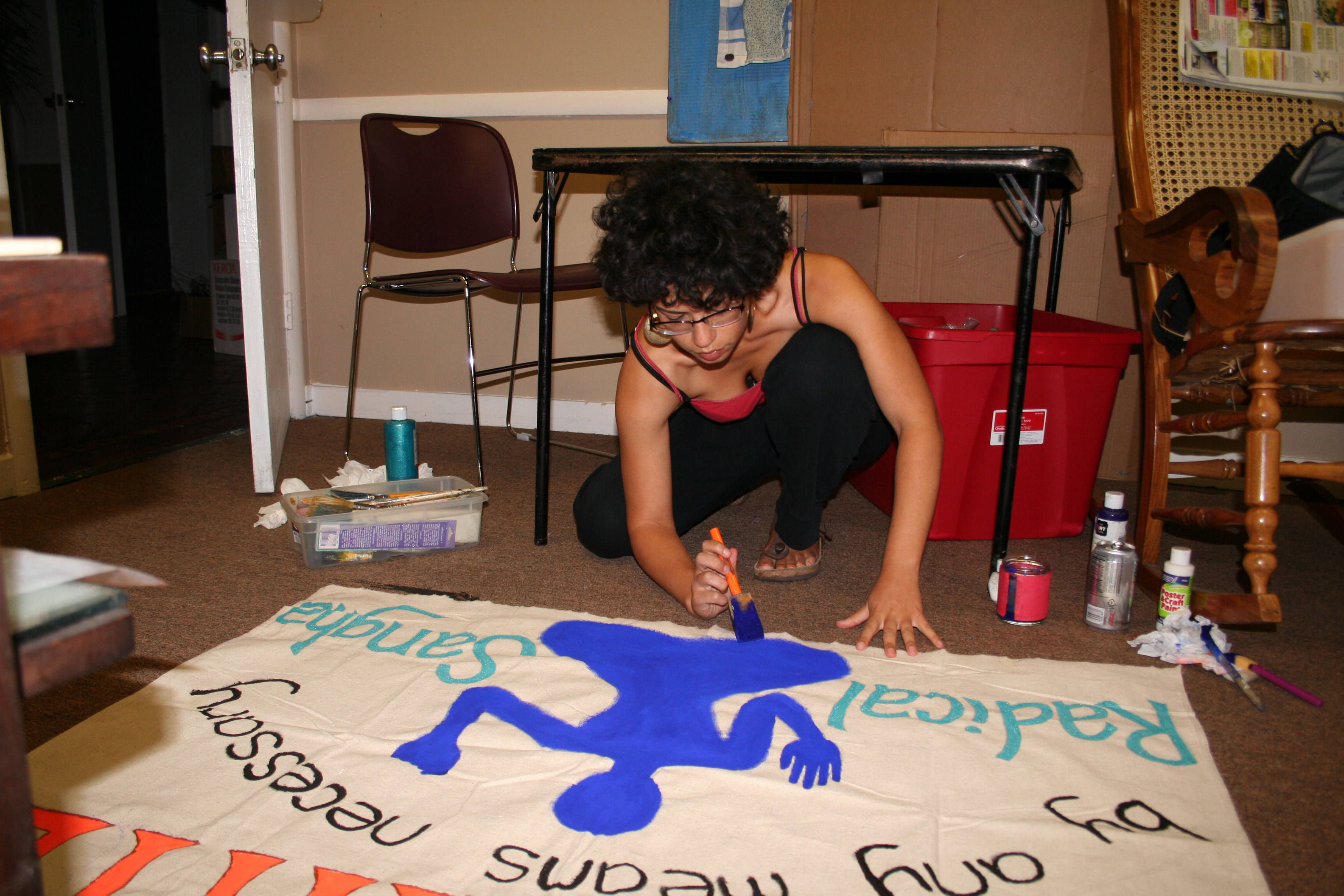
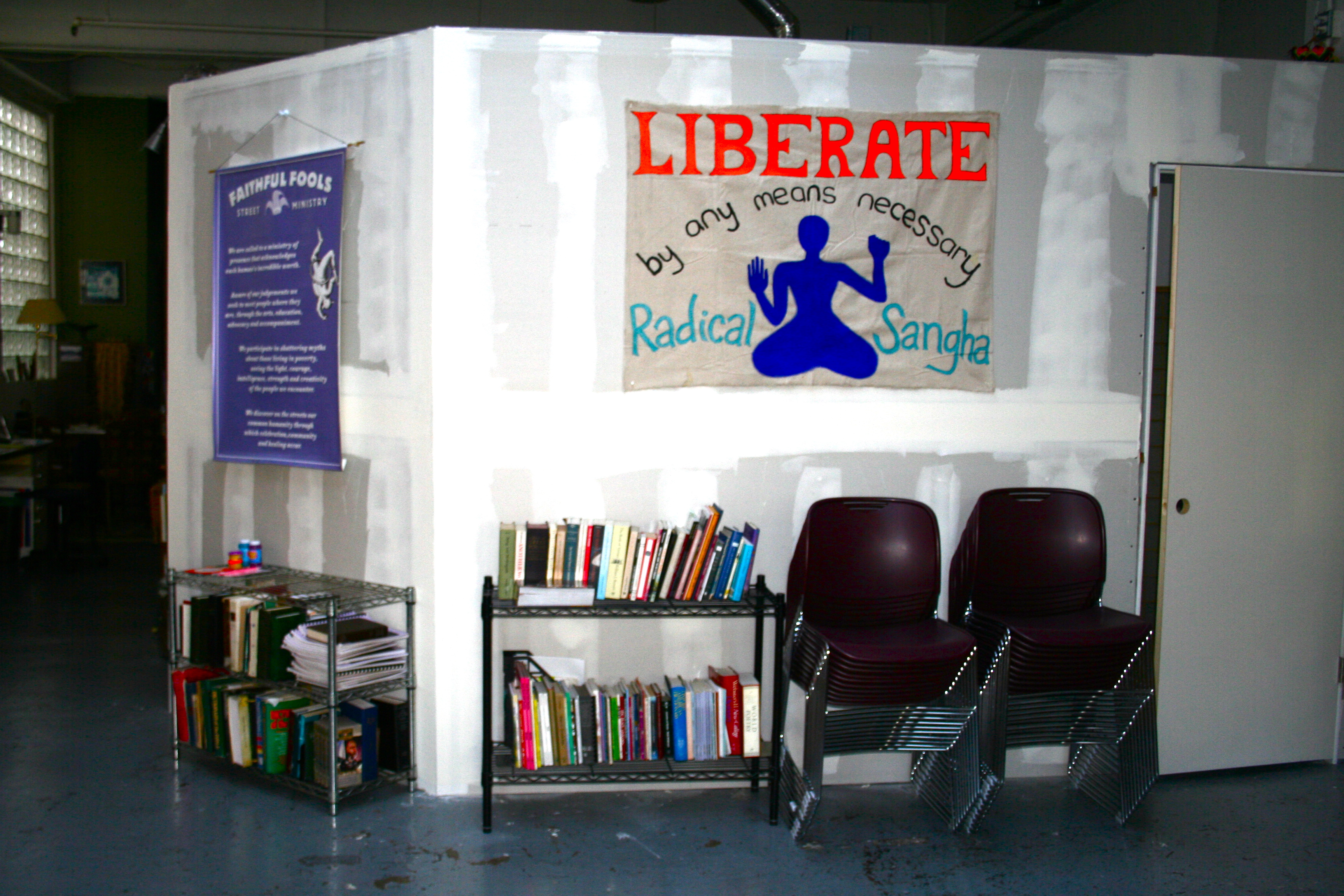
The Radical Sangha banner (also pictured in Monday’s post) has raised a few questions. This might be a good space to engage with some of them.

1. What’s a sangha?

I’ve heard a couple different translations for sangha, which is a Pali word. Loosely, it means something like “community.” In a Buddhist context, it’s one part of the Triple Gem in which practitioners take refuge. Triple Gem includes “buddha” (the historical Siddhatha Gotama from around 500 BC, as well as other buddhas or enlightened folks); “dhamma” (the teachings of the buddha; truth; or practices that lead to understanding truth through direct experience); and “sangha” (sometimes explained as an advanced practitioner to whom we might look for inspiration; other times explained more as a supportive community or assembly of practitioners). So sangha is a group of two or more people practicing dhamma, and helping one another to discover deeper and deeper truths about reality.

2. What’s your understanding of the phrase, ‘by any means necessary?’

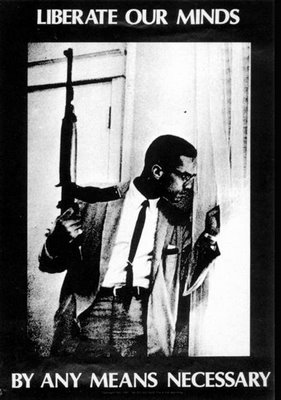
Good question. I associate the phrase with Malcolm X and Black liberation movements that bucked norms by insisting that they had a right to use violence, among other tactics, to win their social freedom.

Put in a dhammic context for the banner, I love the apparent tension between the imperative to “Liberate,” and the famous militant phrase. The way I think about it, the Buddha himself did not rule out violence as a means to liberation. He didn’t rule out any means, and indeed gave a good honest try to many of the highest spiritual trainings available to him in his youth. He explored for himself (and encouraged all of his students to explore) the ways that mental negativity (almost always concomitant with doing acts of violence) undermines the quest for liberation from suffering.

What I would love to see among politically active dhamma practitioners in the Bay is a greater spirit of bold experimentation, in the tradition of the Buddha and other awakened folks. Too often we get stuck with a closed-case of nonviolence, or even pacifism. Too often this justifies and hides our fear of confrontation. Fear of conflict. Fear of pain.

And even among the dhammic people who exhibit extraordinary courage and commitment in the face of violent oppression — submitting to arrest and imprisonment for months or years at a stretch, over and over again — I still think we could use a little more of the “any means necessary” mentality. After all, the “necessary” part means what is necessary to win. Not just what feels good to us. Not just what mimics established forms. What works!  Right?

3. I recognize the fist, but what’s with the other hand?

Excusing, if you will, my mediocre drawing skills, the right hand of the figure is supposed to be an abhaya mudra: a gesture of friendly greeting, peace, benevolence, and the dispelling of fear.

For us to liberate (ourselves and each other) requires fortitude and oppositional stances; but it also calls for the special kind of fearlessness that comes from compassion. With compassion, free from delusion, we recognize the good in the opponent. We also see and tend lovingly to the hatred, fear, and greed within ourselves. This compassion inspires and guides our action just as much as strategy; just as much as the urgent wish to “smash” harmful systems.

——————————————

So there’s a little explanation of where I was coming from. Thoughts?  More questions?

love,

katie

Radical BBQ, Radical Sangha

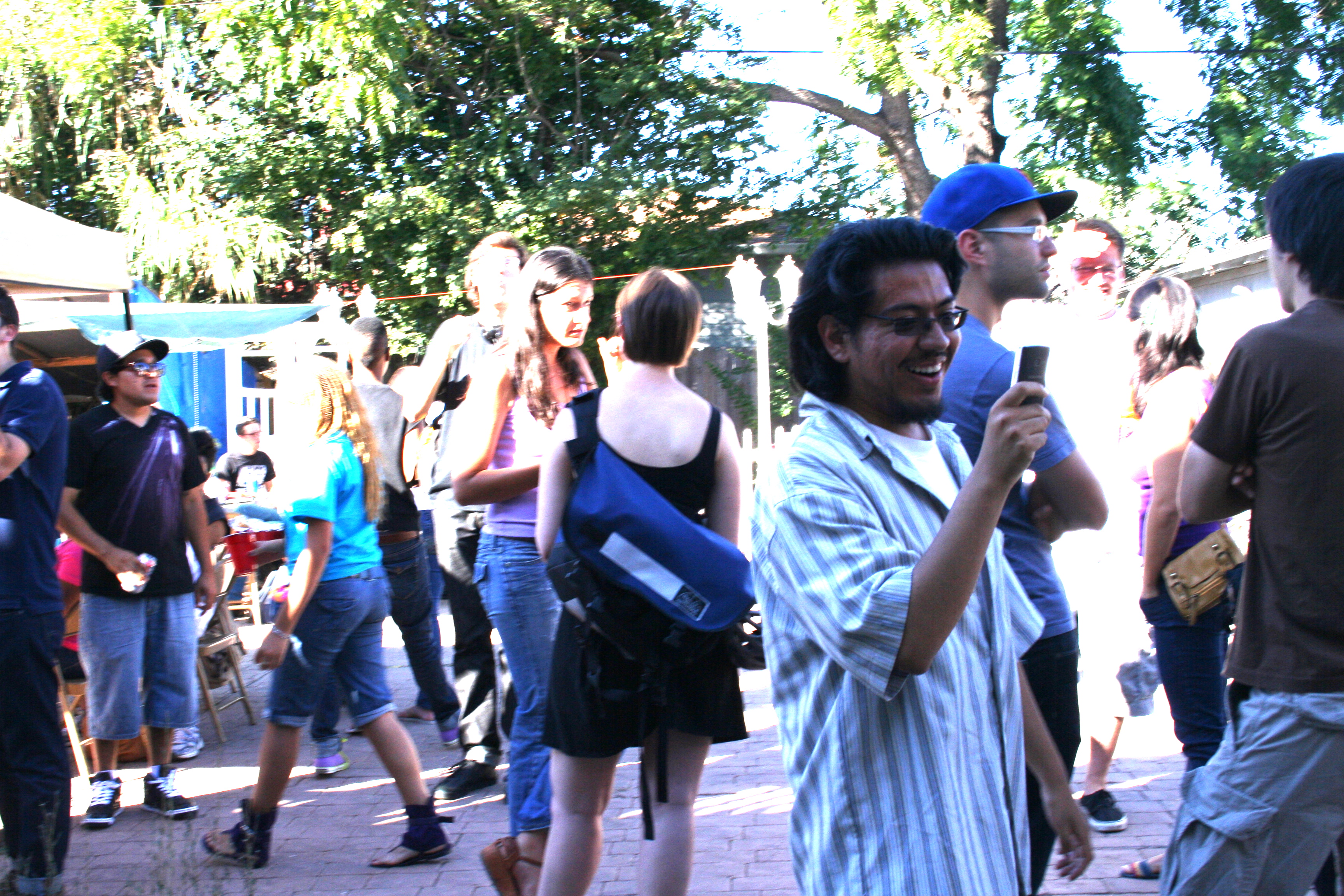
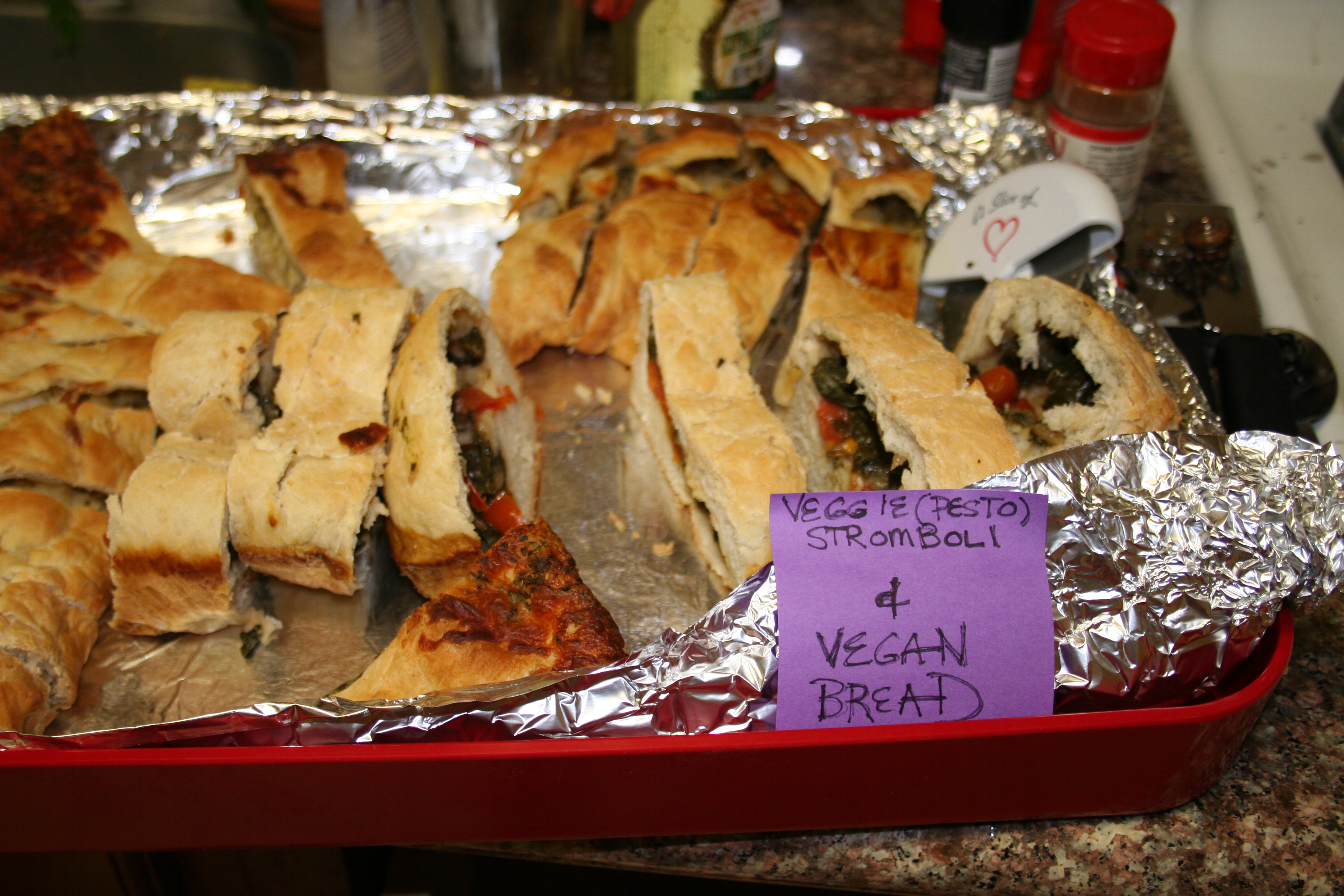
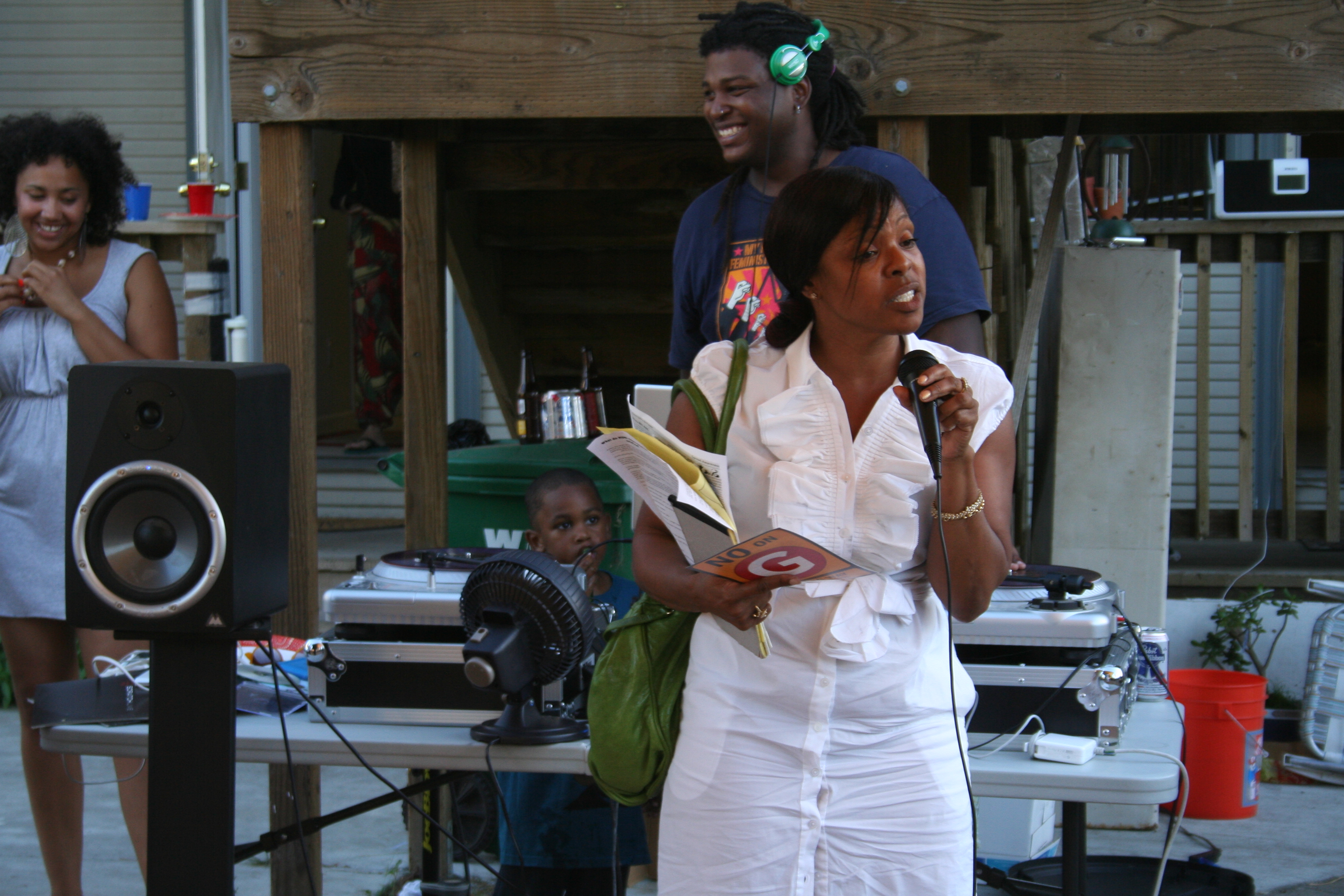
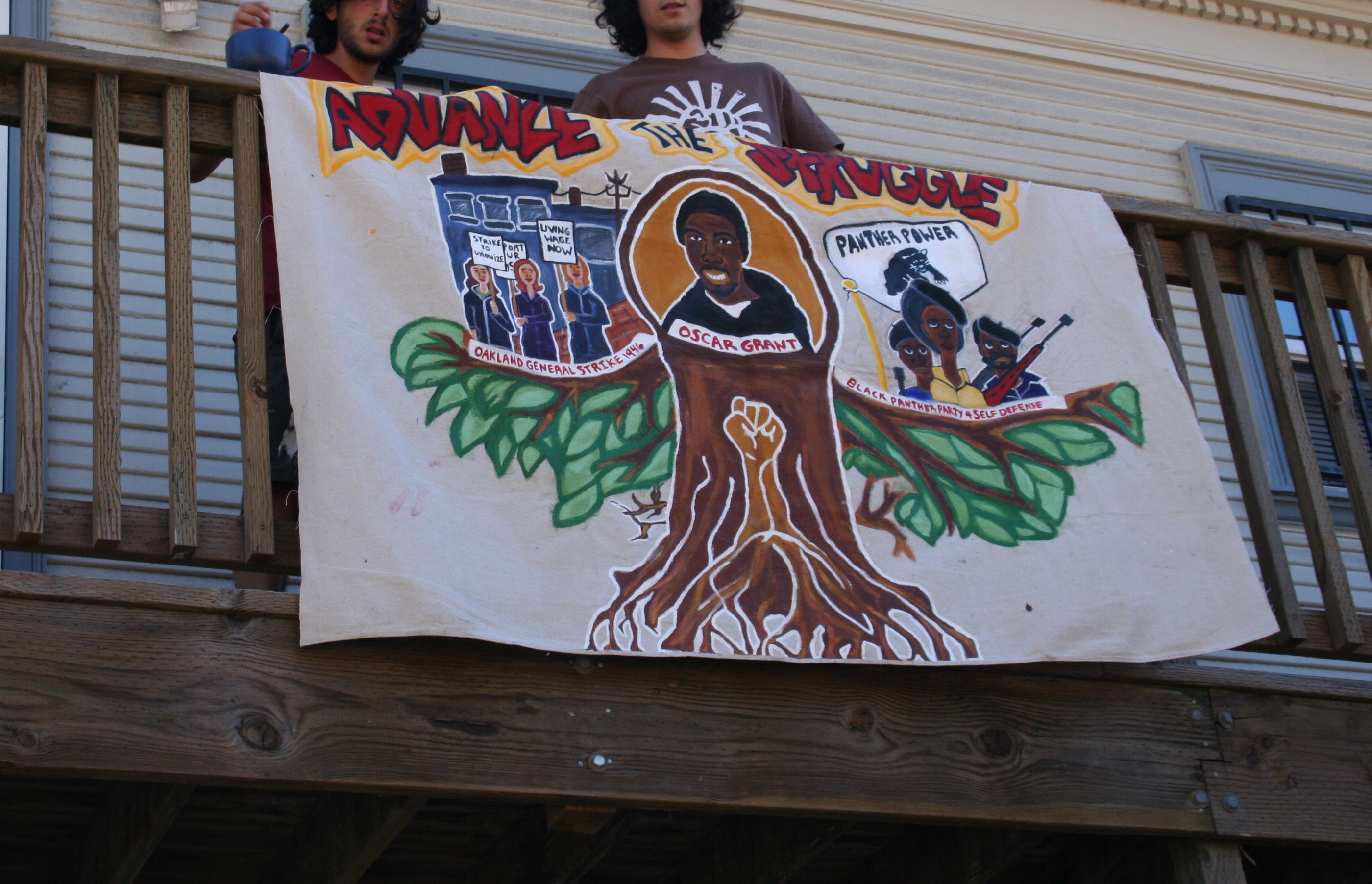
Some friends threw an utterly beautiful “Radical BBQ” yesterday in Oakland. Young and old, different races, different genders and presentations, fun, kind, relaxed, co-operative, joyful, political. Food (good heavens — Dani made these amazing stuffed stromboli and vegan bread from scratch); music and dancing; a speech from a MUNI driver (SF public transit) on the struggles they’re facing among the rank-and-file; wonderful art (check the Advance the Struggle banner: gorgeous). And they even provided art supplies for people to do their own thing. I took advantage and sketched out a small banner to use for Radical Sangha. Took it home and spent the night painting and finishing it up.

The banner may come in handy tomorrow evening, as the scheduled Radical Sangha will be meeting and then carpooling to San Quentin prison to join the protest of the first death-penalty execution in California in four years. Albert Greenwood Brown is scheduled to be killed by the state on Wednesday. The decision to resume executions (backed by Jerry Brown) was sudden, and has shocked a lot of folks who’ve been doing anti-death-penalty work for years. I only heard about it last Thursday, through folks in Oscar Grant organizing.

I’ll be writing up some thoughts and questions soon on tactics and strategy for radical organizing (sparked in part by an event the Faithful Fools catered yesterday: a talk by lifelong activist and frequent prisoner Father Louis Vitale, a Franciscan priest who works around anti-nuclear intervention and the School of the Americas Watch). Part of me feels ambivalent about attending a protest of the death penalty, with no clear mechanism for affecting this structural, state violence. But I also feel that with the proper perspective, and in tandem with different types of tactics and organizing, it can be a fruitful part of a holistic, loving, politicized life.

What really bugs me is that I won’t be able to make it to another dope event featuring my friend’s mom: An Evening of Solidarity with Women of Haiti. If you’re in the Bay area and not coming to the execution protest, think about hitting this up instead.

And a good Monday to y’all.

Bay Area Race Map: I think the Tenderloin is the little blue dot there

Interesting cartography project by Eric Fischer: racial breakdowns of 40 U.S. cities, inspired by a similar Chicago map by Bill Rankin. Here’s the Bay Area (based on 2000 Census data). Pink means white people; blue is Black; orange is Latin@; and green is Asian. (Invisible is Native? And Middle-Eastern? Does “Asian” include South Asian? Racial breakdowns are so strange.)

Correct me if I’m off, but I think the TL (where I live, at the Faithful Fools) is the little blue dot north-west of the Mission.

For comparison, here’s NYC:

Via Feministe.

Symposium on Western Socially Engaged Buddhism: Views from a Nobody

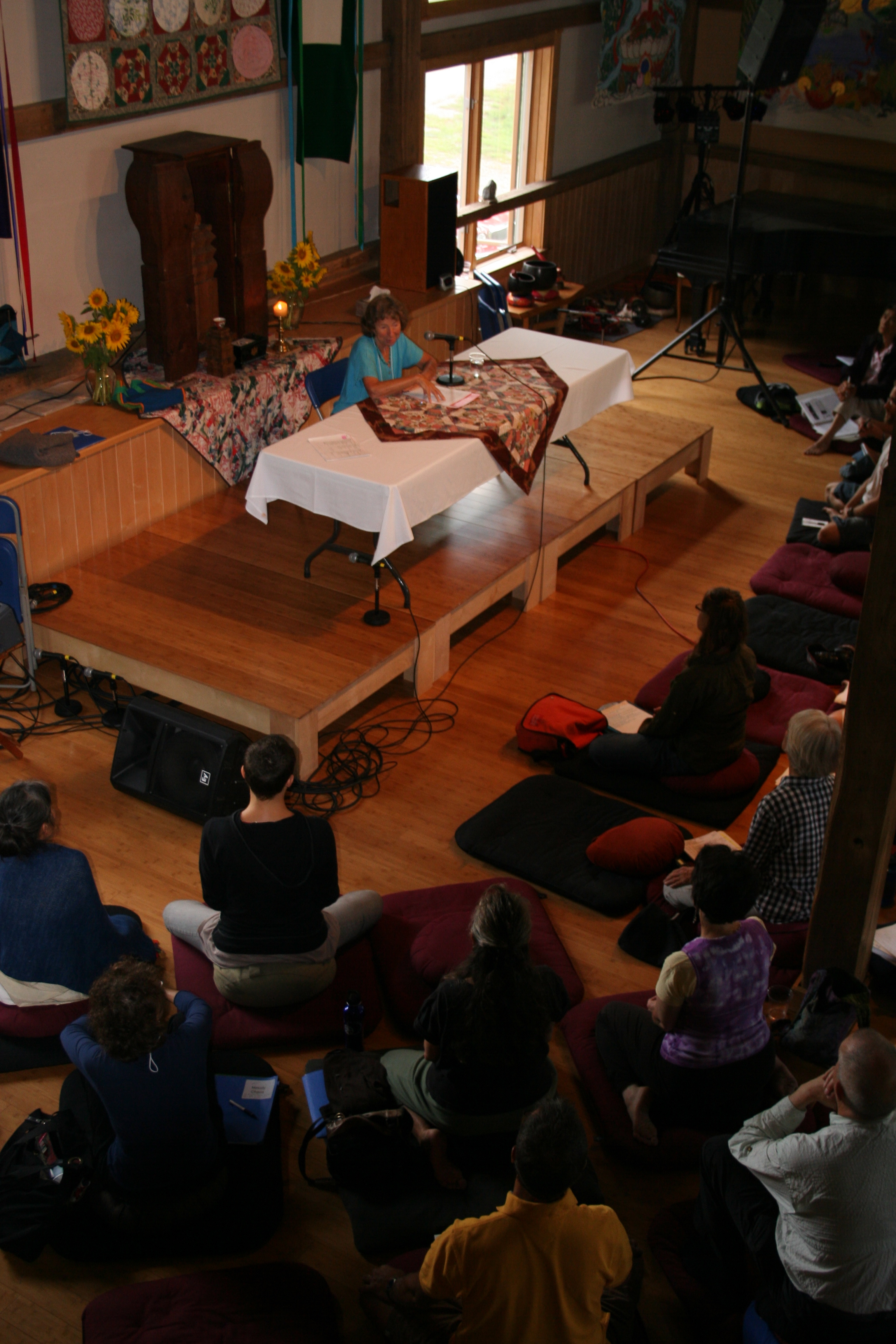
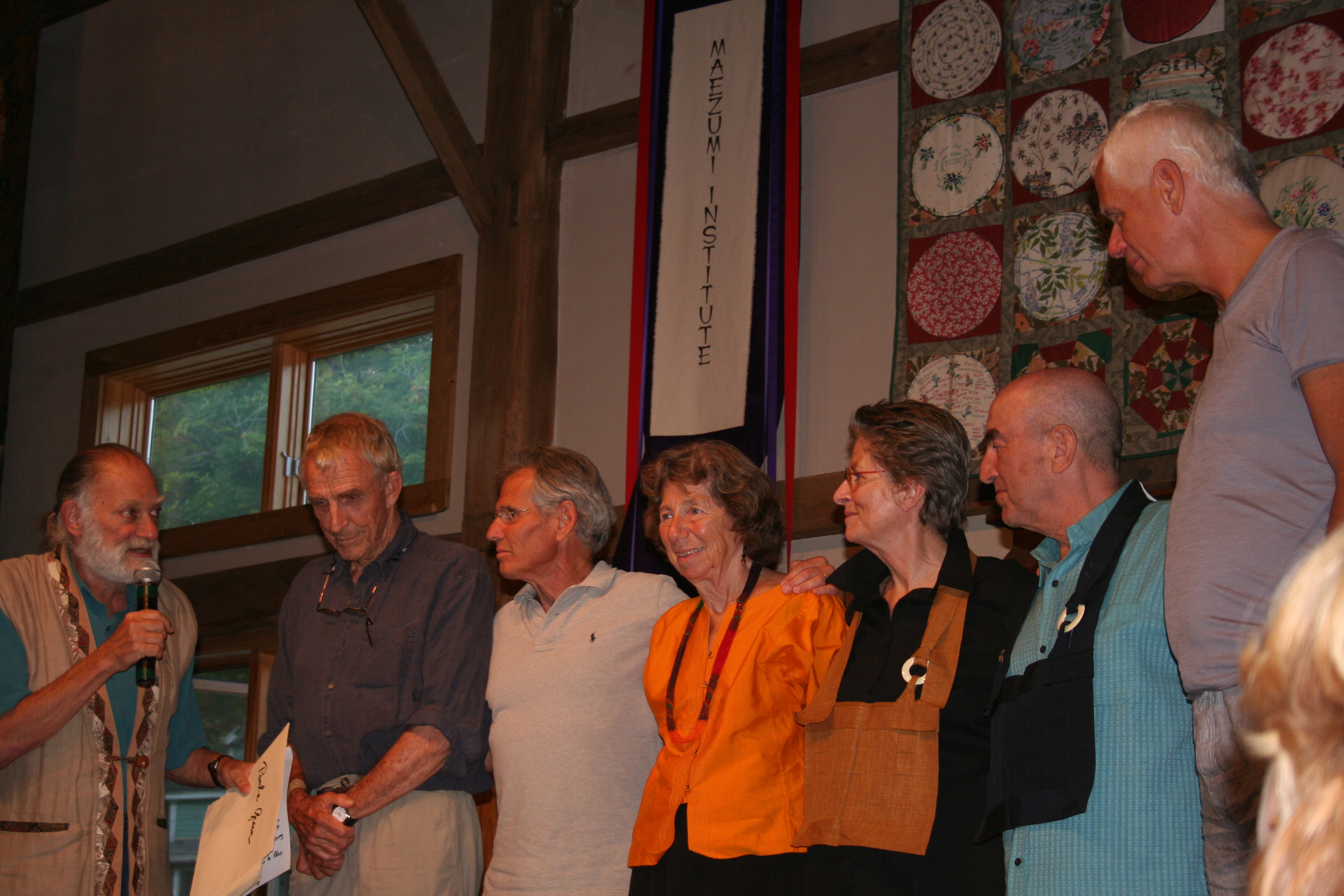
Paula Green delivers a keynote talk

If you’re looking for an account of the Zen Peacemakers’ Symposium on Western Socially Engaged Buddhism — hosted last month in pastoral Montague, Massachusetts — from a reputable, authoritative, or well-known source, I can tell you right now: you’re barking up the wrong bodhi tree.  The Symposium was chock-full of dharma celebrities; I am not among them.  I’m not a Roshi, Bhikkhuni, Director, Founder, or Professor.  I am a Nobody.  At least in this context.

But, you know, a Nobody isn’t such a terrible thing to be.  You get a very interesting vantage point as a Nobody.  You see things that others don’t get to see.

For example, as a Nobody with No Money, I witnessed the gestation and birth of the volunteer program for the Symposium.  Back in January, when I first learned of the national event from an ad in Tricycle magazine, I called up the ZP folks and said, “Hello!  I’m interested in socially engaged Buddhism, but I don’t have $600 for registration fees.  What can I do?”

Months later, after a few rounds of phone tag (and the beginning of a friendship with fellow young’un and ZP Media Master Ari Pliskin), a Volunteer Application Page was added to the website.  Something like 40 people applied to fill 15 slots.  And sure enough, the 15 of us who would show up a day early and work the whole week had two things in common.

We were broke, and we were Nobodies.

Except, instead of being Nobodies, we were now Volunteers.  A select team.

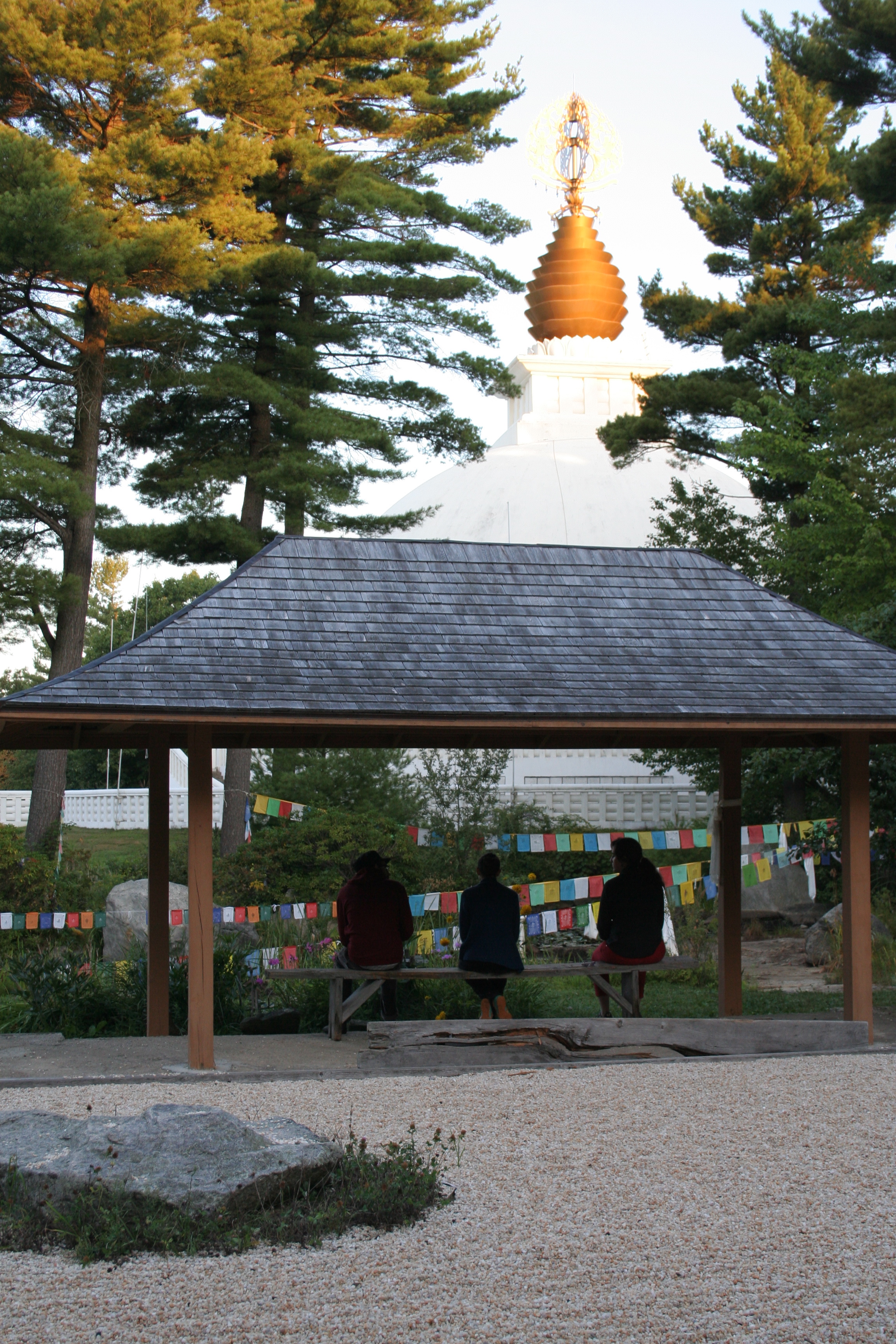
Volunteers Seth Josephson, Ashley Berry, and Jane Gish take a sunrise trip to the Peace Pagoda

And we had fun!  We stayed in the beautiful ZP farmhouse — beneficiaries of amazing hospitality and generosity from the residents.  We joked and collaborated and griped and ate together, bonding over tasks and talks.  We even went on group field trips, a couple nights and dawntime mornings.  Truly, the Volunteers were a vibrant, splendid bunch, with stellar direction from a pair of unpaid volunteer coordinators, who as far as I’m concerned accomplished the work of five people between the two of them.

And like paying participants, we got to hear and join in the week’s rich conversations, beautifully facilitated and well-crafted (if a little heavy on the lecture-vibe for my tastes).  We asked questions, mingled, savored those jolts of mutual recognition with kindred spirits.  We also got to discuss with some of our dharma heroes.  For me that included Roshi Joan Halifax, Jan Willis, David Loy, Bhikkhu Bodhi, Alan Seunake (who I already knew from the Bay Area), Matthieu Ricard, and Frank Ostaseski.

Still, unlike participants, and unlike presenters, we were Volunteers.

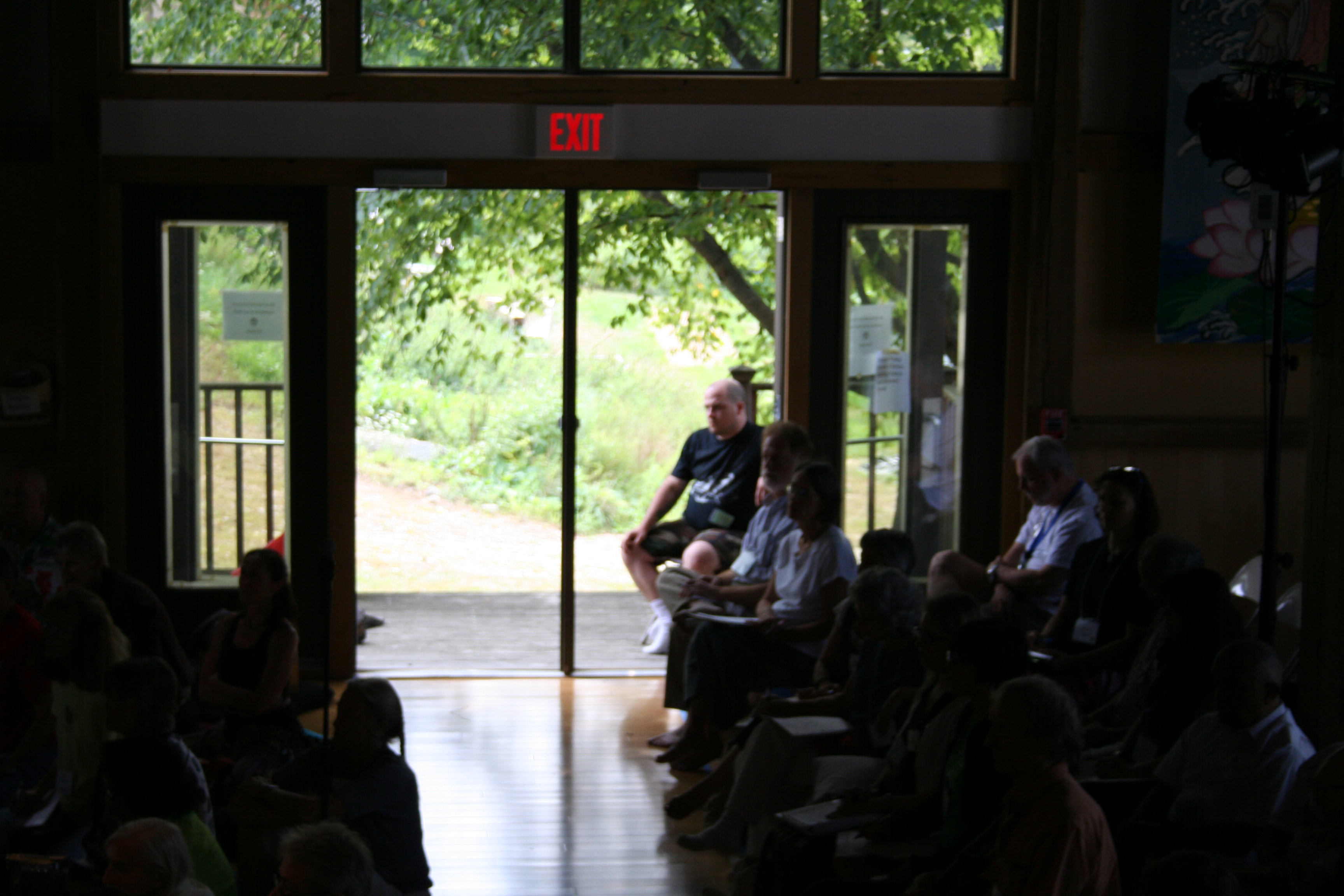
Volunteer and founder of Boston Dharma Punks, Sean Bowers, listens to a talk from just outside the door

Part of being Volunteers meant a waived registration fee, with all our meals and lodging covered.  Everyone felt extremely grateful to the Zen Peacemakers for welcoming us so fully into the household.

But another part of being Volunteers meant taking on responsibilities that prevented us from participating on an equal basis in the week’s events.

Frequently we had to leave presentations early in order to go work a shift.

Occasionally we missed entire morning programs, assembling bag lunches in the caterer’s basement restaurant in nearby Amherst.

Because of a Volunteers meeting, a few of us got pulled out early from the breakout discussion group on Diversity: the sole mini-program, out of a whole 6 days, dedicated to race and all other types of demographic categories.  As a Nobody among Nobodies (I may very well have been the only person of color under 30 years old, out of a conference of hundreds), in that moment I felt particularly lonely.

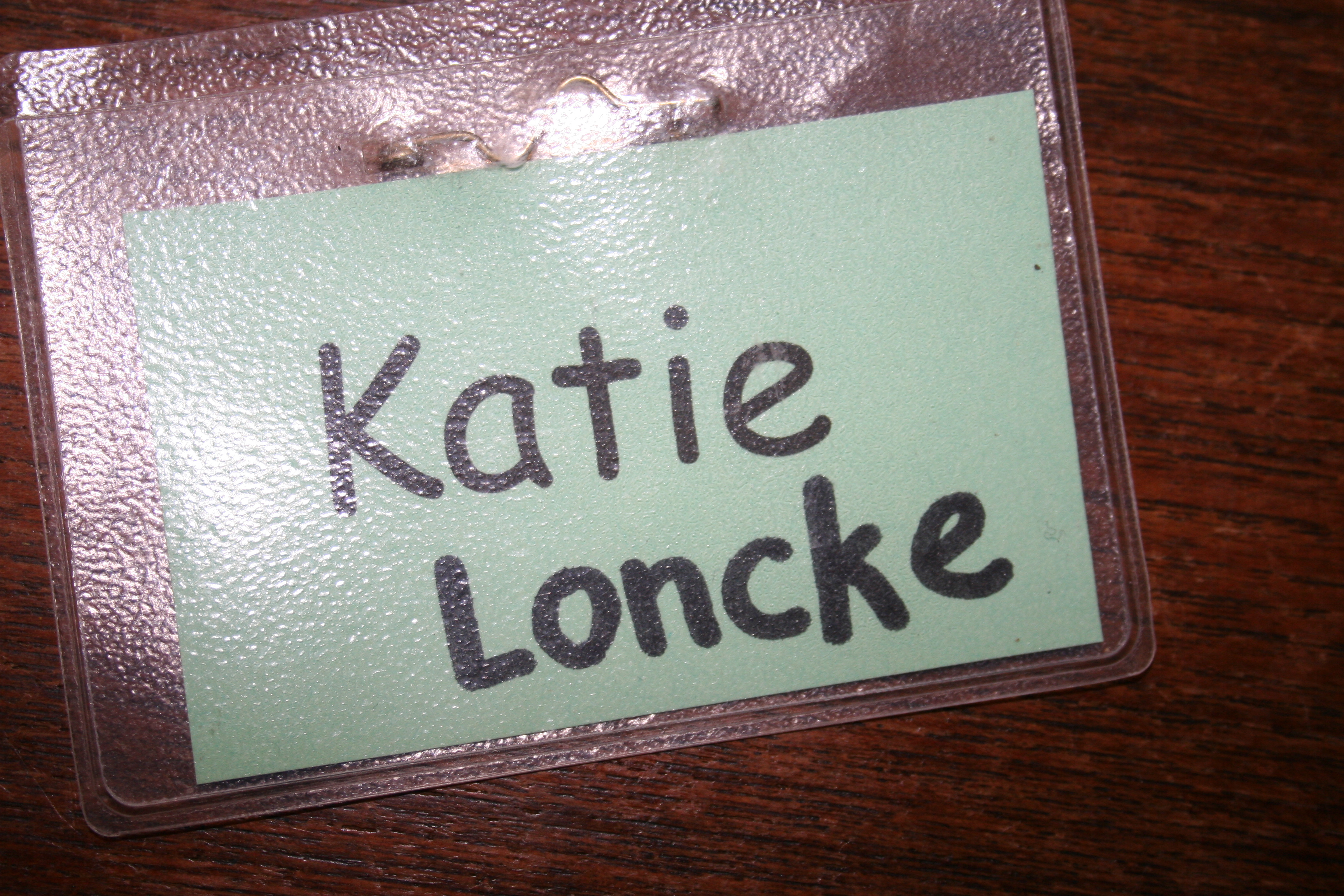
And finally, being a Volunteer meant having a green-colored nametag for the week.  Participants had white nametags and presenters had blue ones.

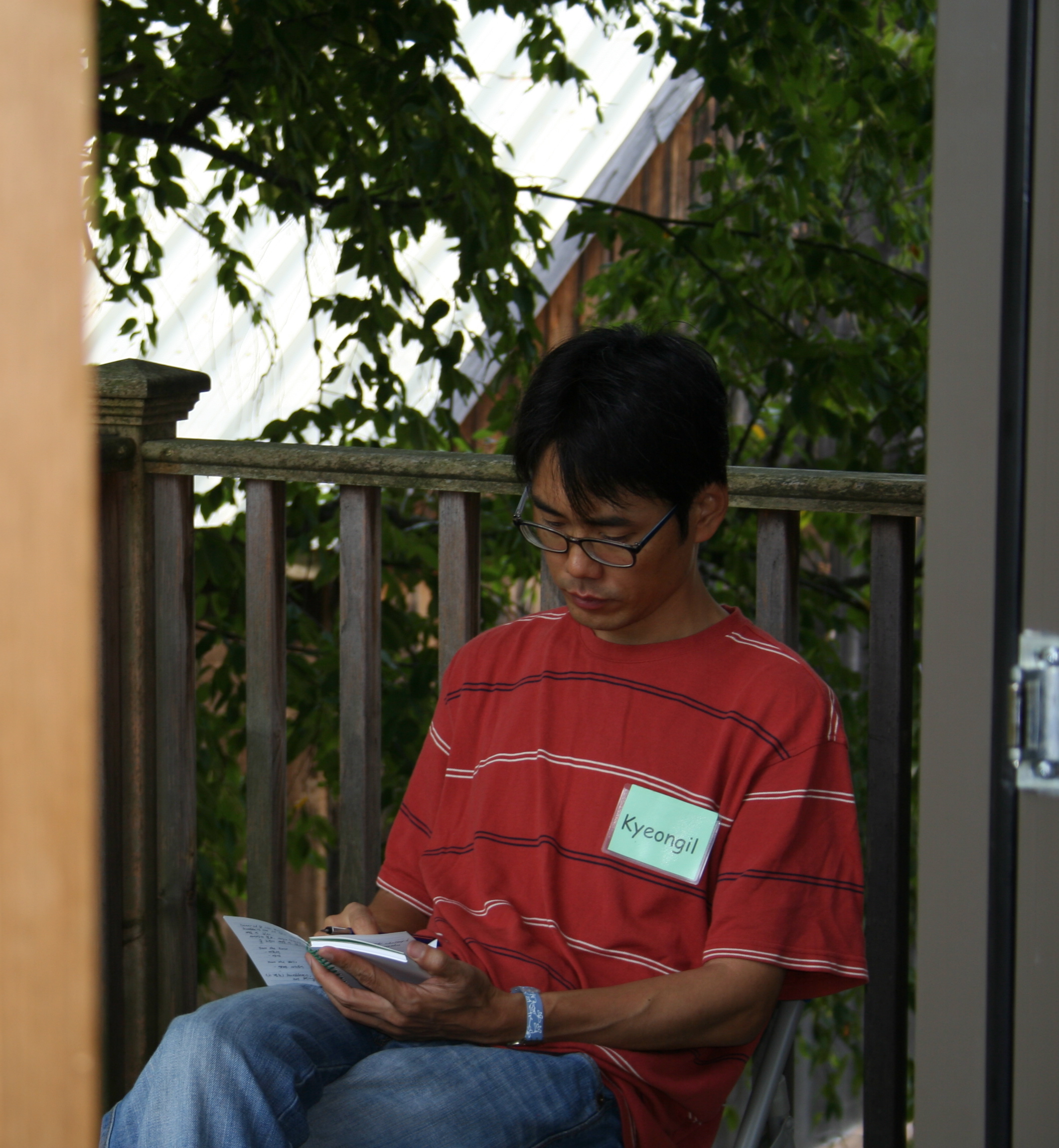
But while everyone else had their first and last names (helpful for recognition and networking purposes), ours had only our first names.  Melissa.  Karen.  Sean.  Kyeongil.

(Weeks later, when I told my dad about the Volunteers’ nametags, he said to me, “And I’ll bet you took a marker and wrote in your last name yourself.”  Knows me well, that man!)

Now, I really don’t want to paint a negative picture of this tremendous event.  And I don’t want to give a false impression: in my human-to-human experiences, no one ever treated me as less-than.  On the contrary, it was one of the warmest, most jovial conferences I’ve ever attended.  I left feeling inspired to organize a radical sangha in my own community, to collaborate with existing groups in the Bay Area, and to keep up the work of socially engaged dharma with renewed vigor.

In the Zen Peacemakers farmhouse

But the nametag thing, inconsequential though it might seem, really underscored for me the subtle class hierarchy between workers (Volunteers) and participants.  My goodness!  If, consciously or unconsciously, we continue to reproduce class divisions and mental/manual labor splits in the name of advancing “Socially Engaged Buddhism,” then it’s almost certainly a doomed movement.

I understand the need to raise funds.  I do.  But fundraising, while vital to movement building, must never be conflated with it.  As much as possible, especially in a Buddhist or dhammic context, we should endeavor to collect what’s needed by promoting dana (generosity), a sense of interdependence, and erosion of the economic and social hierarchies stratifying our society.

Across many different social change movements, this common problem emerges.  People with less material wealth automatically wind up washing dishes to ‘earn their place’ in the big annual strategy session.  Unfortunately, this is sloppy generosity, and serves no one.

At the same time, washing dishes together can be a great way of strengthening community and camaraderie!  Collective manual labor is indispensable to healthy movement activity.

Volunteer event photographer Clemens Breitschaft worked tirelessly! And brought smiles to everyone, too.

The issue isn’t the volunteer work itself, but whether or not it hinges on obligation — explicit or implicit.  There’s a big difference between (1) registering as an event volunteer in order to get in the door, and (2) entering like everyone else, and then signing up, along with anyone else who wishes, to do the work that needs to get done.

Furthermore, the work-exchange problem isn’t only a matter of economics, but diversity, too.

Volunteer Jane Gish expresses her 'social engagement'
Volunteer Kyeongil Jung reflects

Low-income people, the ones most likely to rely on work-exchanges, are disproportionately young, of-color, queer, criminalized, and marginalized.  If we want a diverse movement, we need to make sure everyone enters on as equal a basis as possible.

Many organizations inside and outside of Socially Engaged Buddhism are finding cool, creative ways of solving the money problem for giant gatherings.

Some run almost exclusively on dana (donations), or institute a very manageable sliding-scale fee.  Others charge for tickets while encouraging all buyers to purchase an extra for someone who otherwise wouldn’t be able to afford it.  Donations (of food, lodging, advertising space) often play a key role.

As Larry Yang of the East Bay Meditation Center says of its dana-based system, the basis is not an economy of exchange.  It’s an economy of gift.  And what a treasured legacy, passed down through various lineages, spiritual and otherwise.

ZP founder Bernie Glassman honors U.S. Socially Engaged Buddhists

Would it really be feasible to host an event as large and snazzy as the Symposium using dana or suggested donations alone?  Honestly, I don’t know.  Maybe we’d need to give up some of the scope and the snazz for the sake of inclusivity and fairness.  My hope is that last month’s event will act as a jump-starter for higher sustained levels of regional collaboration among socially engaged and politically active dhamma practitioners.

Mayumi Oda with one of her gorgeous thangkas in the background. Image by Dennis A. Landi

And maybe the next time we get together on a national level, our enthusiasm, commitment, resourcefulness and generosity will generate a door large enough for everyone to enter as guests; not customers.

In the exquisite Zen Peacemaker spirit of bearing witness, not-knowing, and compassionate action, I believe we can learn from the worldly divides between haves and have-nots, investigate our own blind spots, and skillfully improve on eradicating these hierarchies — the echoes of capitalism — within our own organizations and initiatives.  Our means and our ends can better align.

Together, we can move from Nobodies and Somebodies toward Anybody and Everybody.

Confronting Capitalism through Feminist Fat Acceptance

Despite being a longtime denizen of the feminist blogosphere, it wasn’t til last year that I learned about the Fat Acceptance (FA) movement. (Also called Health At Every Size (HAES) or Fat Liberation. Fat Fu, The Fat Nutritionist, Fatshionista, and Shapely Prose are good places to start if you’re unfamiliar.)

The connection clicked immediately.  In our society, fat people get discriminated against (and dehumanized) in ways that intersect with gender and other dimensions of body politics.  Duh.  Bonus: the fatosphere bloggers I’ve come across are funny and really good writers.

And today, thanks to a post by wickedday, a guest blogger at Feministe, I made another big thinky-type connection: this time between fat-shaming and capitalism.

Basically, what the fat-shaming helps to do is obscure the bald hypocrisy of a capitalist society that claims to care about people’s dietary health (e.g. fighting “the obesity epidemic” on the level of ‘education’ and personal lifestyle choices), while generating enormous profits from food industries that are fundamentally health-hazardous, environmentally devastating, and/or horribly inhumane (processed and genetically modified foods; hormone-filled factory meats; subsidized corn for corn syrup, etc. etc. etc.).  And using super-exploited immigrant labor to do a lot of it.

Now, this isn’t a new argument among FA feminists, but my perspective extends wickedday’s outline of the parallels between slut-shaming and fat-shaming, placing a greater emphasis on the historical and material basis for both.  By most FA accounts I’ve read, fatphobia comes from some combination of hatred, thin privilege, and jealousy: as wickedday puts it, the idea that “it is agonising to look at someone ignoring the rules that you punish yourself with, and still being happy.”

At the moment I’m more curious about bigger-picture causes.  The macro-relationships.  Because, as I say in my comment (copied below), as much as we might argue that our bodies are none of their business, as long as we live under capitalism, their business is precisely what our bodies are.

kloncke 9.7.2010 at 5:31 pm

Loving this post, and wondering if anyone else is interested in bringing the analysis toward the realm of political economy? I’m trying to figure out plausible, material reasons *why* the hegemonic discourse is so concerned with fat-shaming and slut-shaming.

Because on one hand, from an ethical perspective, “my body” (in terms of its size and sexual activity) is none of “your business.”

But from a point of view of class struggle in a capitalist context, “my body” as a vehicle for the commodity of labor-power (and/or the reproduction of labor-power; i.e. childbearing and domestic work) is *precisely* “your business” (“you,” the capitalist class) — in the sense that it is the source of the surplus value that capitalists (who are almost entirely men) extract as profit. No wonder the state (largely synonymous with the capitalist class) monitors the bodies of its labor force a.k.a. profit machine.

Continue reading