I talked with my folks tonight: slow, nothing-much, touching base. The dog has tapeworms, but seems more chipper since getting his medicine. Mom doubts Pop’ll make it through this weekend’s performance of Fiddler On the Roof without dozing off. At times the silences sagged between our phones. Tomorrow they (my parents) will be moving all the furniture so the carpets can be deep-cleaned.
Suddenly my dad’s voice brightened. Can I tell you one thing about today, he said.
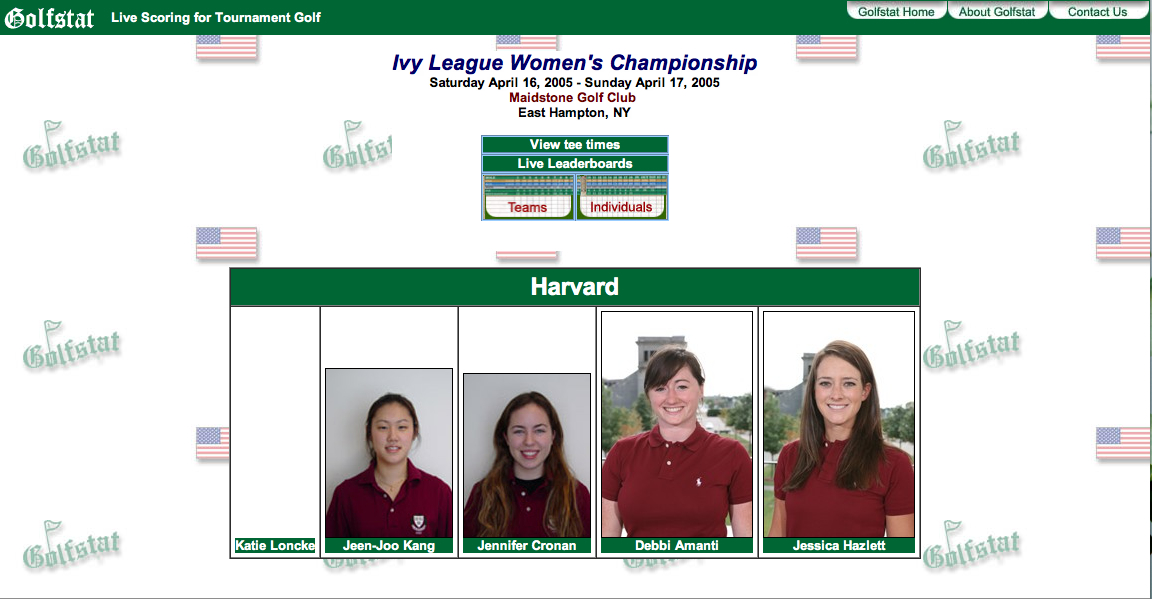
As he was cleaning out the study, he came across a leaderboard from my golfing days. Based on our conversation I’m still not sure exactly what kind of object he’s describing (I remember leaderboards being huge, like billboards — not something you could fit in our study chock-full of files and wires and junk), but he said it had that fine, pristine writing (those gray, permed, chalk-wielding old ladies keeping public score always cut the most dashing sevens), and at the top, number one, my name: Katie Loncke. Shot a 78 the first day; 72 the second. Below me (my father’s voice grows incandescent) are players who went on to be really serious. Casey Gee, who fell just shy of the PGA, and now works at a bank. Christina Stockton, who’s gone pro. Danielle Civitanov — we think she’s in school to be a nurse. The top Sacramento girl golfers from my middle-school and high-school years. Proof that I had bested the whole lot of them at least once. Dad mused aloud about sending the board to my Oma. Your granddaughter, number one! I could picture his smiling apple-cheeks, shaped just like mine.
If you know me well you probably know that golf and I have had a fraught relationship. I once tried to break my own finger with a hammer to get out of playing a tournament. When that plan failed, I turned to a bottle of pills.
Enough time has passed that I’m not so tense about it anymore. I can even contemplate dusting off my clubs for fun, maybe with a couple of novice guy friends. I would probably run circles around them, even though I haven’t played in years. I used to be that good.
And I made my dad proud. If he shadowed me for a round, weeks afterward he could tell you every single shot on every single hole.
Tonight, despite a thorny past, I let myself rejoice a little in his shine.
not sure why my picture’s not there, but find it hilariously appropriate
I’ve been thinking lately: we need some kind of People’s Award Association. For those of us who might choose unconventional paths, or never have a real shot at mainstream prestige in this fucked up, pseudo-meritocratic, hyper-competitive society. Our unpaid work organizing against the prison industrial complex, or fighting foreclosures, or founding radical sanghas may not yield a trophy, medal, plaque or certificate, but our excellence still matters, and people in our lives should know about it. They should have more chances to be proud of us.
Ideally a real, beautiful object for display, but even just an email — to a grandparent, mentor, partner, whomever — stating ceremoniously:
Congratulations: your loved one, {____________}, has been awarded an Outstanding {What They Do Well} Prize. This honor is conferred by the People’s Award Association in recognition of {___________}’s excellence in transforming oppression and building toward a better world: a world with freedom for all.
Raised fist via Colorlines“Maquila: Sweatshop” by Favianna Rodriguez
Janie found out very soon that her widowhood and property was a great challenge in South Florida. Before Jody had been dead a month, she noticed how often men who had never been intimates of Joe, drove considerable distances to ask after her welfare and offer their services as advisor.
“Uh woman by herself is uh pitiful thing,” she was told over and again. “Dey needs aid and assistance. God never meant ’em tuh try tuh stand by theirselves. You ain’t been used tuh knockin’ round and doin’ fuh yo’self, Mis’ Starks. You been well taken keer of, you needs uh man.”
Zora Neale Hurston, Their Eyes Were Watching God
The representation of her sources of language seems to be her principal concern, as she consciously shifts back and forth between her “literate” narrator’s voice and a highly idiomatic black [sic] voice found in wonderful passages of free indirect discourse. Hurston moves in and out of these distinct voices effortlessly, seamlessly … It is this usage of a divided voice, a double voice unreconciled, that strikes me as her great achievement, a verbal analogue of her double experiences as a woman in a male-dominated world and as a black person in a nonblack world, a woman writer’s revision of W.E.B. DuBois’s metaphor of “double-consciousness” for the hyphenated African-American.
Henry Louis Gates, Jr. in the Afterword
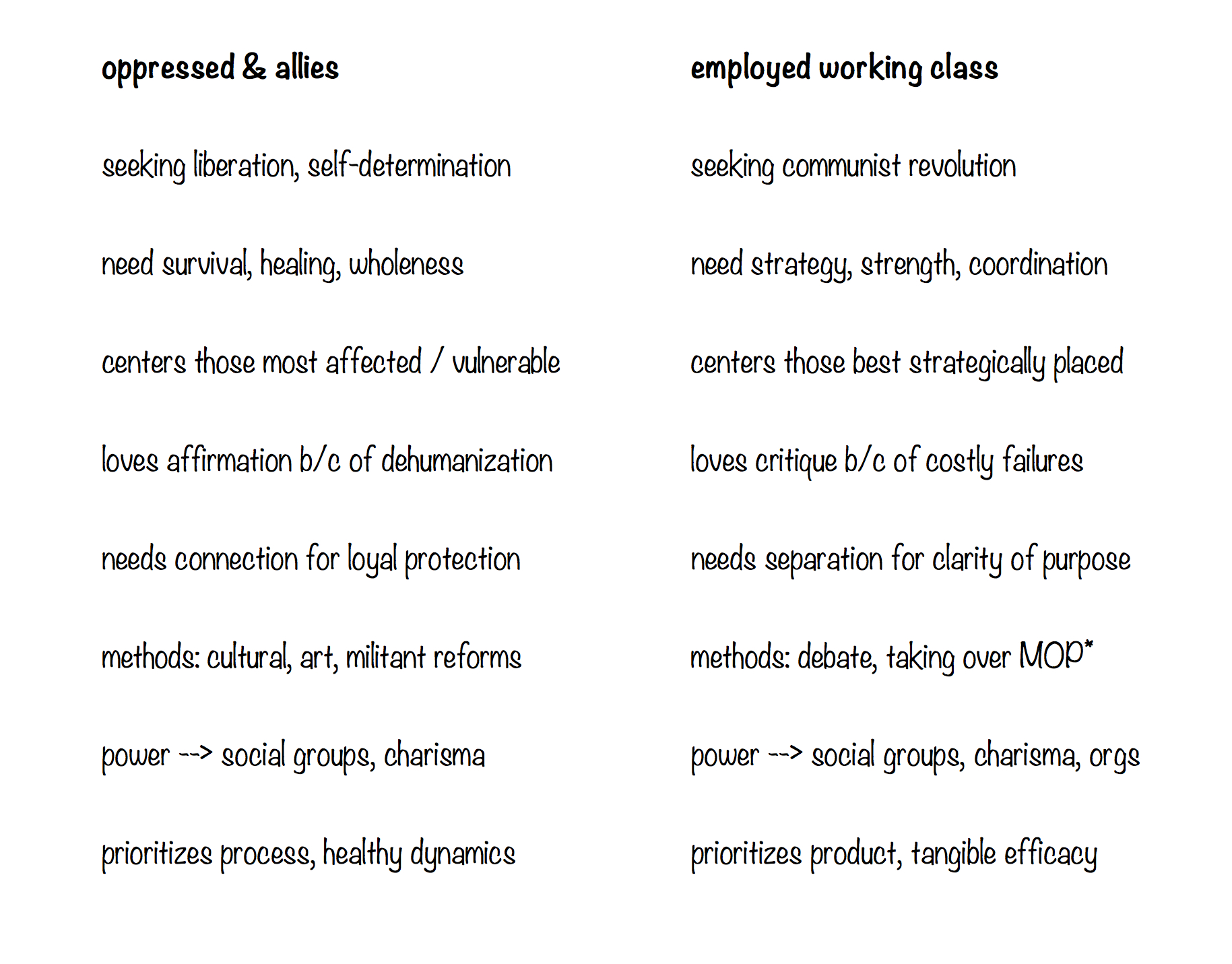
Binaries are false, and suck in many ways. Categories, even when there are more than two (black white yellow red brown; astrological signs) still inherently oversimplify. And yet, in the midst of an embattled year of trying to figure out where I belong within radical traditions, what a great relief it is to me to create two nice neat columns and try to map out some ideas. (Non-column schemas in the works.)
“Malcolm X” by Favianna Rodriguez“Everything Counts” by Favianna Rodriguez
These categories came as blessings from this weekend’s Everything For Everyone conference, a festival for radical anti-capitalists that was hosted in Seattle and attracted militants from across the country. In their closing plenary speeches, Mike Ely of the Kasama blog and Kali Akuno of the Malcolm X Grassroots Movement each raised the importance of “building alliances” between the oppressed and the employed working class.
But before I can think about building alliances, I want to try to understand the two groups. Who are they, exactly? How are they delineated — different from one another? As a first step I want to deeply and compassionately ‘interview’ these groups. Ask, in my mind, what they want. And to be clear, these groups and their characteristics Do Not Exist In The Real World in any sort of neat and tidy way. It’s just that the categories represent patterns I’ve witnessed in the Left/radical movements I’ve been around, and witnessed within myself, too.
*MOP = Means Of Production, the land, water, machines, and other material resources human beings use to keep ourselves alive, to reproduce our society.
These categories are not necessarily or always in opposition to one another! Which is what makes them tricky to puzzle out. I’ve seen revolutionaries try to reconcile them by pointing to certain common examples of overlap.
1. Indigenous/Latin@ Immigrants & Economically Displaced People
In the US, economically displaced workers from central and south america who toil at miserable jobs play a key role in the national economy. They are both “most affected” by and “vulnerable” to certain strands of racist, gender-oppressive, and economic persecution, and strategically positioned within the economy to fuck shit up for capitalism for real, as we’ve seen in beautiful explosions like the enormous immigrant strike on May Day 2006.
2. Queers Queer Liberation Is Class Struggle, a piece put out a minute ago by members of Unity and Struggle, lays out this argument super thoroughly, and in many dimensions: critique of the heteropatriarchal family, re-visibilizing the queer working class, exposing the ways labor disciplines our gender expressions, etc. One part I’ll come back to in a second:
I’ve heard vague calls for queers to [ally] with labor.
…
An “alliance” or “intersection” should not even be necessary, it is only made necessary by the fact that the union bureaucracy dominates “labor” and the gay elites dominate “queerness.” If we can break down these twin dominations then it will be much easier to build an “alliance” because most queers already are labor and many laborers are queer. This involves struggle and organizing.
3. Women
Women make up the majority of the world proletariat, comrades remind us. Furthermore, capitalism deploys patriarchy as a kind of leverage or bonus round for surplus labor, systematically labeling women’s work as “unskilled” and “domestic,” which conveniently justifies paying little or no wages for it. To organize for the liberation of women as a group, or even just “Black and Brown” women, the argument goes, is to make tremendous headway in organizing the working class as a whole.
But the working class is not a monolith. Over the weekend, for the first time in my memory, I heard revolutionary comrades start to use the term “employed working class” as a way of being more specific about which part of the working class they’re talking about. Before, I’d usually hear a broad-sweeping definition of the working class as “Those of us who have nothing to sell but our ability to work.” This broader definition, while sometimes helpful in pointing out what we share in common, and who our opposition is, frequently glosses over important strategic differences within the working class.
Some of us, whether because of racist systems of criminalization (got a felony? much harder finding a job), heteropatriarchal gender coercion (want to present transgressive gender or dramatically transition your gender at work? again, not easy in most cases), disabilities, or other reasons, cannot sell our ability to work. When the U&S piece says that “most queers already are labor and many laborers are queer,” this may be true, and yet transgender folks face double the average rate of unemployment in the US. Folks with non-normative gender or sexuality presentations are often only precariously employed.
Industrial Workers of the World
It is this harsh material reality that helps maintain informal economies (selling sex, drugs, under-the-table labor) and is also prompting large-scale experimentation in solidarity economies: ways of taking care of one another when the labor market rejects us. Networks of survival have always existed for those on the margins, but as Kali from MXGM pointed out, at this moment even more Black and Brown people are transitioning out of “surplus labor” populations (think: bringing in scabs of color to break up white strikes) into “disposable” populations, more like First Nations people and other resisters of genocide. No longer are Black folks needed in the US as a labor-substitute threat which helps maintain downward pressure on working conditions. Increasingly, this is a role brown migrant and undocumented workers play, terrorized under the threat of ICE. (again, i’m oversimplifying since black and brown aren’t always separate. Also, it’s possible that if and when the migrant surplus population organizes to strike as well, capital will call in a second reserve army: people in cages / prisons.)
The scale and speed of this process, marginalizing the criminalized and oppressed poor to the point of barring access to basics like food and shelter, is serious enough that oppressed groups are innovating systemic new ways of coping, or new versions of old forms. These innovations fit the logic of survival and sometimes even self-determination (Maker movement, urban farming), but rarely do they seem to translate into revolutionary threats to the capitalist system as a whole.
And this is where I often feel stuck, or torn. As a person of African descent in the US, should I set aside my people’s struggles simply because large numbers of us no longer occupy a central or strategic place as the employed working class, like we did in auto plants of Detroit in the 60s? Should revolutionary queers de-emphasize queer liberation just because anti-assimilationist queers are excluded from the formal labor market? Should people with disabilities that make wage labor impossible sit on the sidelines of revolutionary transformation? How will the dispossessed fight both to stay alive and to help make communist revolution in the US?
Arundhati Roy interviews guerilla fighters of the Communist Party of India (Maoist), 2010
I feel this double-consciousness within myself. I don’t know how to choose between, nor how to reconcile the two.
I read and read, but nothing seems to quite capture it. Blogs like Mia McKenzie’s Black Girl Dangerous exemplify the Self-Determination-Of-The-Oppressed logic, quite beautifully and sharply at times, as in her Open Letter to Folks of Color.
Despite your children being gunned down by cops like every single day, despite your mothers being sent to prison for “stealing” public education, despite your sisters dying in the heat of the desert while “sneaking” into a land that belongs to your own ancestors, not to mention being deported from that same land in record numbers, despite the CONSTANT beatings inflicted on your souls, you somehow still have souls. That’s fucking amazing. I mean, I’m not surprised. Your ancestors couldn’t have survived slavery and genocide without some damn serious sturdy genes. But still. It’s impressive.
I love you for all of these things.
From cultural workers and artists to Non-Profit-Industrial-Complex warriors, I see oppressed people and allies pouring heart and soul into defending and uplifting one another: trying to fight off reactionary laws, plant community gardens, bash back, feed bellies that need filling, pull teeth that need pulling. Not always doing it wisely, but coming on some level from different types of love.
Other pieces of McKenzie’s take a flip side of the POC-love coin, throwing a sharp tongue at ignorant white people and white queers. Today on a Facebook thread, two talented Bay Area queer revolutionaries called on McKenzie for “a bigger analysis” of white supremacy that “strives to look at the totality of the system, the capitalist patriarchal system, and the ways it has created and oppressed queers through placing us outside of the system.” Defying my categorized columns above, one of them argues, “Writing and writing our truths in particular is healing and important work. But I am also needing some strategy for liberation.”
But despite the brilliance that comes from so many writers, cultural workers, and organizers resisting oppression and developing new ways of being together, I have yet to see anywhere a strategy of communist revolution, even from revolutionaries in a Marxist tradition, that stems from an anti-oppression analysis, framework, and spirit more deeply rooted than the happenstance overlap of the oppressed and the employed working class. Folks in the anti-oppression liberation tradition tend to be amazing at critiquing the system, often with highly sophisticated analysis. Oppressed people articulate the cruel ironies of capitalism, a system that supposedly generates innovation and abundance but in practice murders, exploits, degrades and immiserates the majority of beings and the earth, reserving special forms of torture for different groups. This is true and important. But I don’t know how we propose to move from critique to strategy, without switching modes and focusing by default on the employed working class. I haven’t seen this done in the US. Have you?
I can’t reconcile the contradiction here. My impression is that many communist revolutionaries believe that the employed working class is in the best strategic position to overtake the means of production, a key step in making a worldwide revolution to overthrow capitalism and usher in a better system of social relations. This, then, becomes the focus of their strategy. Although many groups aim to “race, gender, and sexuality seriously,” this cannot ever equal the commitment of a Black person to the Black Liberation Movement, or a queer mujerista to the abolition of gender oppression.
“Distribution of the Arms” by Diego Rivera
Meanwhile, I am not sure what the focus of revolutionary strategy is for oppressed people seeking to overthrow oppression. A lot of the work seems to be in building faith in the worthiness of the oppressed (so systemically denied and crushed, ideologically and in the stupidity of everyday work — that’s real), building their/our autonomy, resisting attacks from capitalists and fellow working-class people, and having faith that they/we will discover for ourselves how to build new systems of social relations autonomously, even under capitalism. Eventually, we will transform society for the better. At the very least, we want to survive with dignity and exuberance.
I do not take this goal lightly. And yet, and still, I feel stuck.
When Skip Gates lauds Hurston for achieving unity of two unreconciled voices in her writing, he fails to mention that even within this double-ness, hierarchy persists. There is a reason that the white voice is the narrator (third person, omniscient) and the Black voice is the dialogue. Can you imagine reversing them? Can you imagine that a book with a Black-idiom omniscient narrator and white dialogue would make it in a white-controlled publishing market? Can you imagine it would sell in a white-dominated literary industry, as anything other than a curiosity (probably with porn themes)?
Similarly with revolutionary double-consciousness, I sense an implicit hierarchy. When people call for building alliances between the oppressed and the employed working class, I think oftentimes they really mean, organize the oppressed to support the employed working class so it can make the biggest moves to abolish class altogether.
I can empathize with this reasoning.
At this moment, I believe that the Employed Working Class perspective has a more plausible strategy for putting an end to the exploitative social relations of capitalism.
But this perspective seems extremely weak in its methods and strategy for sustaining healing and liberation from social oppressions that won’t automatically disappear even if we someday kick out capitalism. And it is therefore fundamentally limited in its ability to transform the world for the better. Not only limited, but self-undermining in its own quest for freedom, and tending to subordinate the struggles of the oppressed. They matter strategically only insofar as they link up to the employed working class.
This is not only a problem for the future, but a conflict right now.
Am I alone in thinking and feeling this? Do you agree? Disagree? Have you felt this revolutionary double-consciousness? Is Maoism an attempt to reconcile these two logics? What the fuck is even going on? Please help — I am rambling on too long. :)
Ignore the raping of Native women, the breeding and hoarding of slaves, the sale of young girls, assaults in prisons, assaults by la migra, assaults by soldiers on ‘enemies’ and fellows.
Ignore the hundreds of thousands of families being cheated, lied to, robbed, and pushed around by capital.
you see, intact neighborhoods mean something to me; mean more to me the more i reflect on my own family. i never grew up really knowing our neighbors, but my dad, now over 70 years old, is still best friends with the Jenkins brothers, from way back in the 1940s, in their stickball days. Over on Victory Drive, the Lonckes helped raise the Jenkins kids and the Jenkins helped raise the Lonckes. i’ve called them uncles all my life. and when i’m 70 i won’t have friends like that, connected to a street from childhood. but someone should.
i met some neighbors on my block this evening: just four streets north of the birthplace of the Black Panther Party.
a few have been in their houses upwards of forty years. Thelma. Verita. Denise’s mother, who has dementia. they’re the lucky ones. for every one who has stayed, many more have been pushed out. maybe a while ago, maybe recently.
this needs to end. people deserve sovereignty over our bodies, and over our homes. somehow we need to decommodify houses, and bodies, and land.
applying for studio apartments gives me a sad about racism, transphobia, displacement, the prison industrial complex, and the whole system of property, among other things. still, here’s hoping i can find a good nest for the next year or so. may a new refuge support my / our work for freedom. ♥
Dear friends,
If you are going to read this article, please read the entire comment thread, as well. People have brought up some important points that give essential political context to any discussion of Black masculinity and sexuality. Rich and clarifying offline conversations have also happened. As Black women, the author and I welcome contributions and criticisms in the spirit of liberating our people, all beings, and the earth. Peace!
[You may have noticed that, despite having studied sexuality in college, I don’t write about sex on this blog anymore. That’s because of some family stuff. But since sex positivity remains important to me, I wanted feature this really interesting guest blog from my friend, comrade, and fellow engaged Buddhist Skyla. Thanks Skyla!
If reading sexually graphic material on my blog will make you uncomfortable, please skip this one. Thanks!
–Kloncke]
__
Dear David,
May I call you David? Thanks. I thought you’d feel that way. You seem eager to develop the intimacy between us. At least, that’s what I gleaned from what you said in your interview on MadameNoir.com, which was supposed to be about rapping with respect for women. Since the video title declares, “David Banner Speaks Exclusively To Women,” and I count myself in this category, and since you look at me through the camera and say things like, “I’m here to love you … touch you … hold you …”, I’m gonna go ahead and take your word for it that you are trying to make some sort of connection with me. Which, great! You seem smart and goofy, which I like, and in an interview about Trayvon Martin you talk about class war in a way that made me cheer out loud.
So David, since we’re fostering this connection, I want to offer some feedback about your analysis of your own song, “Play” — a song you refer to in the MadameNoire interview as “actual commentary” on your sex life, as well as “one of the dirtiest songs in the world.” And you’re right — this song is hella explicit!
(Static uncensored video and lyrics after the jump: NSFW)
Now, in your interview you lament the fact that most people missed the point of this song. They got too distracted by all the sexed-up language and missed your message: a message of respect for women. In your words:
Most men when they make songs it’s like “Girl come get in the car [etc etc I’ll fuck this, fuck that, throw you out the car, etc etc].” I said, I want to make a song where a man is telling a woman what he wants to do to make her happy. … But, you know, it’s about respect. And it’s about making a woman feel comfortable with herself and with her sexuality and with her body. And if you can do that without making her feel violated, she’ll do whatever she can — and that’s what “Play” was. And people missed that!
But where does that leave us? Honestly, to me it comes off as just another feminist holla, or a way of indirectly bragging on your own masculinized prowess by being like, “yeah, do this, do that, i’m awesome because i enjoy making you / watching you cum.” I mean, like I say, that’s maybe better than “I’m awesome because I’ll beat the pussy up in a way that gives me pleasure and status regardless of how it makes you feel.” At the same time, it’s neither easy nor simple to escape the ‘male gaze’: in other words, the ways in which women’s pleasure primarily gains value and meaning insofar as it is seen through the eyes of men, and helps get men off. Like spectacle lesbianism. Know what I mean?
Maybe what would’ve changed that for me is if the song had contained more of a tone of wonder, unknowing, appreciation and active learning about sexuality and what makes people cum. (Or, more broadly, what makes people feel happy and fulfilled sexually.) Personally, I get turned on more by a relationship and communication of caring / responsiveness. The vibe I get from “Play” is more like, “I already know what’s going to make you feel good, so I don’t even need to bother learning your particular body.”
This comes across in the visual language of the commercial music video, too, where all the exercising/stereotypically hot women are presented as interchangeable. We don’t need to know why you find them hot; the ‘objective’ fact of their hotness makes them special as a category but interchangeable as individuals. (I won’t even go into the ways that the whole workout / personal trainer theme totally undermines your point about making women feel more comfortable with their bodies … I’ll just give you the benefit of the doubt and assume you fought against your manager or whoever it was who insisted on that video concept.)
Adding to the sense of all-the-sameness, there’s also the standard line, “bring your friends over,” which, as usual in pop, omits any artistic details (emotional, aesthetic, or otherwise) of how that orgy might actually feel in real life. It’s just supposed to be what heteros do to get freaky. (Never hear these male pop/rap stars asking if they can bring their homeboys over to join them and the girl tho …)
To me real eroticism is about the details, the particulars — colors, textures, shapes, sounds, sensations. Being present and open enough to be surprised. And maybe “surprise” partly means what Audre Lorde defines as eroticism: powerful nonrationality. A nonrationality which, like women’s cumming, achieves much of its social value through the ways that it benefits men.
As women, we have come to distrust that power which rises from our deepest and nonrational knowledge. We have been warned against it all our lives by the male world, which values this depth of feeling enough to keep women around in order to exercise it in the service of men, but which fears this same depth too much to examine the possibilities of it within themselves. So women are maintained at a distant/inferior position to be psychically milked, much the same way ants maintain colonies of aphids to provide a life-giving substance for their masters.
In addition to exploiting/constraining feminine sexuality, I also think this know-it-all, feminist-holla swagger impoverishes masculine sexuality. Ultimately it becomes about marketing a repertoire of sexual skills, with no need to demonstrate responsiveness, mindfulness, and openness to the many permutations of sexuality that might actually exist! Like, sure i might care if you can fuck me hard or get me wet or eat me out in some artisinal way, but i’m more concerned about how you’ll respond if i feel like i want to ask permission to cum for the first time with you. Or to lie on my stomach in a weird and possibly unflattering position. will that freak you out? turn you off? will you respond supportively? can you ask questions and aim to learn?
that relational component of sexuality also feels, to me, somehow related to subverting the masculine/feminine, male/female binary. trans and intersex embodiment, as well as genderqueerness, can help us learn how to value and prioritize the asking of questions, honoring and enjoying people’s self-determinations and peculiarities, and not assuming that we know all about someone’s body going into sex.
Which, to me, is not about having lifestyle-activism sex. But about having hotter, more creative, fun and mindful sex — unlike the boring, cookie-cutter, fake-sweaty T&A that your music video producers are giving me.
Suzuki Roshi puts it well in his classic, Zen Mind, Beginner’s Mind. “In the beginner’s mind there are many possibilities, but in the expert’s there are few.”
Give me some more possibilities, please, David. That is, unless I’m someone who gets turned on when you dictate to me what I do or don’t enjoy.
But how will you find that out about me if you already think you know?
I first learned of this disorder through a radio commercial for some drug that’s supposed to counteract it. The drug’s name escapes me, but it could well have been NUVIGIL®, whose web site explains SWD as a medical condition that may affect 1 in 4 people out of the “15 million Americans [who] work outside of the traditional 9 to 5 schedule.”
SWD is a medical condition that can be diagnosed and treated by a doctor
SWD occurs when your body’s internal sleep-wake clock is out of sync with your work schedule—your body is telling you to go to sleep when your work schedule needs you to stay awake.
If you work non-traditional hours and struggle to stay awake at work, you may be experiencing excessive sleepiness (ES) due to SWD.
People with ES due to SWD often struggle to stay awake during their waking hours, or have trouble sleeping during their sleeping hours.
And, of course, we then have the side effects that may be worse than the actual “condition”:
What important information should I know about NUVIGIL?
NUVIGIL may cause serious side effects including a serious rash or a serious allergic reaction that may affect parts of your body such as your liver or blood cells, and may result in hospitalization and be life-threatening. If you develop a skin rash, hives, sores in your mouth, blisters, swelling, peeling, or yellowing of the skin or eyes, trouble swallowing or breathing, dark urine, or fever, stop taking NUVIGIL and call your doctor right away or get emergency help.
NUVIGIL is not approved for children for any condition. It is not known if NUVIGIL is safe or if it works in children under the age of 17.
You should not take NUVIGIL if you have had a rash or allergic reaction to NUVIGIL or PROVIGIL® (modafinil) Tablets [C-IV], or are allergic to any of the following ingredients: modafinil, armodafinil, croscarmellose sodium, lactose monohydrate, magnesium stearate, microcrystalline cellulose, povidone, or pregelatinized starch.
What are possible side effects of NUVIGIL?
Stop taking NUVIGIL and call your doctor or get emergency help if you get any of the following serious side effects:
Mental (psychiatric) symptoms, including: depression, feeling anxious, sensing things that are not really there, extreme increase in activity (mania), thoughts of suicide, aggression, or other mental problems
Symptoms of a heart problem, including: chest pain, abnormal heart beat, and trouble breathing
Common side effects of NUVIGIL are headache, nausea, dizziness, and trouble sleeping. These are not all the side effects of NUVIGIL.
I honestly don’t know which is worse: (A) having white bosses or managers peg you as “lazy” because you have trouble staying alert during rotating or night shifts that fuck with your body’s natural cycles, or (B) having white doctors diagnose you with SWD and prescribe medication that makes you dizzy and nauseous and may give you difficulty breathing. Or (C) just avoiding the whole prescription thing and getting hooked on street methamphetamines. Either way, as I said recently:
UH GUYS IT’S NOT A PATHOLOGY IT’S CALLED WAGE SLAVERY
Next, let’s examine [. . .] Gender Identity Disorder. The diagnostic criteria for adults and adolescents [APA94] are:
A. A strong and persistent cross-gender identification (not merely a desire for any perceived cultural advantages of being the other sex). In adolescents and adults, the disturbance is manifested by symptoms such as a stated desire to be the other sex, frequent passing as the other sex, desire to live or be treated as the other sex, or the conviction that he or she has the typical feelings and reactions of the other sex.
B. Persistent discomfort with his or her sex or sense of inappropriateness in the gender role of that sex. In adolescents and adults, the disturbance is manifested by symptoms such as preoccupation with getting rid of primary and secondary sex characteristics (e.g., request for hormones, surgery, or other procedures to physically alter sexual characteristics to simulate the other sex) or belief that he or she was born the wrong sex.
__
C. The disturbance is not concurrent with a physical intersex condition.
D. The disturbance causes clinically significant distress or impairment in social, occupational, or other important areas of functioning.
Specify if (for sexually mature individuals) Sexually Attracted to Males, … Females,… Both, … Neither.
The clinical significant criterion, D, was added to all conditions in the Sexual and Gender Identity Disorders section. The definition of “distress or impairment” lies at the heart of the issue of pathologization of gender expression.
If you’ve read or known me for a while, you probably know that I think GID is a bunch of bullshit. Apart from the fact that it conflates sex and gender (people inhabit and express All Kinds of Genders, which certainly don’t map neatly onto a binary sex-assignment system so half-assed that it doesn’t even account for basic and common human biological diversity), GID is all wrapped up in a medical system that *requires* people to conform to this narrow script (“I was born the wrong/opposite gender”; “I’m a man/woman trapped in a woman’s/man’s body”) in order to qualify for medical treatment that ought to be available to whoever wants it. It’s called gender self-determination, people. Or the abolition of gender (someday). Take your pick.
3. Post-Traumatic Stress Disorder (PTSD)
Just to be clear: I’m not saying that the so-called “disorders” in this list don’t cause people a ton of pain. It’s horrible to live on the brink of nodding off while driving trucks all day and night. It’s scary to face a society that questions and/or criminalizes and/or may kill you for failing/refusing to conform to your assigned sex and socialized gender. It’s awful to suffer nightmares, waking terrors, and flashbacks from a traumatic event. All I’m saying is that in a society that equates disorders with shamefulness and even immorality, we would do well to avoid blaming/pathologizing individuals for what are primarily social and structural problems.
Service members who experience PTSD, TBI, MST, and combat stress have the right to exit the traumatic situation and receive immediate support, and compensation. Too often, service members are forced to redeploy back into dangerous combat, or train in situations that re-traumatize them. We say, individuals suffering from trauma have the right to remove themselves from the source of the trauma. Service members who are not physically or mentally healthy shall not be forced to deploy or continue service. Learn more about what Operation Recovery is fighting for here
Rather than acquiescing to dominant narratives positing PTSD as a sign of mental weakness, IVAW reclaims woundedness and a right to heal. Racist, sexist, homophobic, imperialist, earth-degrading war is the problem; not individual combatants’ mental fragility. (a.k.a. humanity.)
4. Multiple Chemical Sensitivities (MCS)
__
Lotta people in this world, including medical experts, simply don’t buy that MCS is a real thing.
Many experts and major medical organizations — such as the American Medical Association and the American Academy of Asthma, Allergy and Immunology — have stated that the connection between the patient’s symptoms and environmental exposures are speculative and evidence of disease is lacking. The American Medical Association Council on Scientific Affairs believes that multiple chemical sensitivity should not be considered a recognized clinical syndrome.
But hold up, Kloncke. I thought you were mad at the medical establishment for over-pathologizing. Now they’re under-pathologizing?? Make up your damn mind, girl!
Fair. But here’s why I include this one: regardless of what Science says, in the world where I live, people get harmed by chemicals. Like the webMD article says:
People who have the symptoms [including headache, fatigue, dizziness, nausea, etc] may blame them on a major event, such as a chemical spill. Or they may point to long-term contact with low levels of chemicals at work, perhaps while working in an office with poor ventilation. Reported triggers include tobacco smoke, auto exhaust, perfume, insecticide, new carpet, chorine, and countless others.
And most of the time, folks who have identified certain chemical triggers that make them feel sick have a helluva time convincing other people and institutions to take that shit seriously. So in effect, people with MCS (whether or not medical associations recognize it as a ‘real thing’) are treated as disordered and irrational, and pushed out of many spaces directly or indirectly.
But as with PTSD, GID, and SWD, the main problem isn’t individual frailty or deviance; it’s systemic oppression. Environmental illness is not an individual person’s problem. Society-wide, there’s a profit motive to manufacture goods at the cheapest rate possible in order to outdo competitors — and often this means adding cheap, unsafe chemicals and preservatives to products; manufacturing commodities in conditions that are super unsafe for workers; or constructing toxic industry in poor neighborhoods — all of which can contribute to chronic environmental illnesses.
__
It’s also true that folks’ MCS can be triggered by high-end products like top-of-the-line essential oils, etc. From what I understand, this is due to an underlying reaction pattern that makes them much more sensitive to highly concentrated manufactured shit in general: even if the stuff being concentrated is sandalwood or lavender. Whatever the particular triggers, the main point is: thanks to an economy driven by profit motives, owned by a ruling class, and utterly unaccountable to regular people, poor and working-class people disproportionately have to put up with ubiquitous toxic externalities and poisons. Are we surprised when people’s bodies show significant signs of damage?
Now, bringing down these hyper-toxified manufacturers and the ruling class that controls them might take a minute. In the meantime, fortunately, there are things we can do to respect and support our friends and comrades with MCS (and probly make our own spaces a little healthier while we’re at it). Check out this recently-crafted Fragrance Free Femme Of Colour Realness guide for tips and resources!
5. Infantile Disorder (LOL)
j/k. Lenin jokes, anyone?
This is just a partial list, drawing together various issues that have been on my mind lately. I’m sure you / we can think of more! And I do want to be really clear: I’m not arguing that all illness is socially constructed -slash- doesn’t exist. Yes, illnesses exist. “Birth, old age, sickness, and death” (as the Buddhist phrase goes). Inevitable, in many respects. What concerns me is that capitalist society blames *our bodies* for struggling to survive under *its torments.*
Eff that noise. Our bodies — in all their beautiful fragility, disability, diversity — are not the problem. You want problems?
Tough to feel deserving of any positive blogging recognition when my updates here have been so scattered the past few months. But as always, I’m honored and humbled by this shoutout from the wonderful engaged Buddhist writer and activist Maia Duerr. You know how some people are mad talented at giving compliments? Maia is one of those people. She’s so thoughtful and specific when she names what she appreciates about people’s work. You can tell she’s really moving with what they’re putting out; not just scattering praise for feel-good purposes. Of Kloncke.com, she writes
Katie Loncke’s blog is, to me, the perfect intersection of spirit, politics, and heart.
Is that sweet or what? Really tho.
And the best part about being tagged with this kind of blogly award? Passing it on. Since Maia put her own spin on the shoutout selection by limiting her list to women, I’m going to create my own parameters, too. My list consists only of people I know and build with (politically, spiritually) in person.







 Kloncke