Revolutionary and Pre-Figurative Politics

How do the two fit together?

This question’s been yelling itself in my face for the past couple of days. (Weeks?) Not only in theoretical terms, but in practical ways. Touched on by elders, peers, friends, strangers.

Roughly (and this is my own attempt, for which I’ll accept blame but not credit):

Some groups are great at building and exemplifying models of anti-oppressive ways of being. (Pre-figurative politics, as I understand it, means practicing now the kind of society you want to build in the future.) Enacting horizontal group dynamics, confronting white supremacist and racist behavior, challenging and transforming sexism, homophobia, transphobia, fatphobia, ableism, etc. in myriad ways, and continually developing sophisticated, intersectional analyses of these lived oppressions. Honoring and valuing healing; promoting literacy around dealing with trauma and mental wellness. Developing healthy sex-positive cultures grounded in consent. Practicing conscientious methods for dealing with intimate violence and abuse. Giving and receiving criticism with humility, generosity, bravery, and kindness. Doing very practical things like organizing childcare collectives, artmaking groups, and food distribution programs; infusing them with liberatory values. Transforming estranged relationship with our bodies, the earth, and nature. Theorizing these and more practices, and sharing them.

At the same time, some groups are great at developing people’s revolutionary class consciousness. Examining the material processes of history with an eye toward figuring out the best ways to intervene in those historical processes, and change things for the better. Get rid of classes altogether. Put an end to imperialism. Employ practice and theory, in current conditions, to avoid the pitfall of reformism and move militantly and decisively toward a world of “freely associating producers” — a world where violent compulsion is no longer ambient, as it is under capitalism and has been under all forms of class society (to stake a claim against what I learned about Foucault, in college). I’m impressed and inspired by groups that maintain a keen focus on this goal, and whose work reflects the urgency of building the class power necessary for exploited people to liberate themselves/ourselves from the yoke (and rod) of capital.

Now. Is there overlap between these ‘types’ of groups?

Yes.

A lot?

In the Bay Area? In the US?

IIIIIIII dunno. What do you think? What are you finding?

That’s all for now; more questions than answers.

g’night, friends.

Metta, Militancy, And A Call For Queer Ally Support

It’s been a long time since I’ve talked about metta. Many of you are familiar with it, but for those who aren’t: metta is a particular type of meditation practice that focuses on cultivating and exuding loving-kindness. Which might sound like trying to muscle a halo onto your own head, striving to become all saintly and luminous and stuff, but actually has much more to do with focusing attention on others: wishing them well.

I like the above video not primarily for its message of metta-as-problem-solver (although I have definitely experienced moments where my metta practiced seemed to lubricate and ease a tense situation), but mostly for the way Ven. Balacitta’s articulation encapsulates the practice: wishing that others be free of enmity, be calm and happy, and be able to take care of themselves well.

Crucially, it seems clear to me that his wish for others to be “calm” is not a front for wishing for them to agree with him, or to become passive. The practice is not about wanting conflict to magically disappear. And even though the focus is on kindness, friendliness, and well-being, in my own experience it is impossible to separate these from the realities of suffering and animosity. Although metta is different from the Tibetan tonglen practice (a “training in altruism” in which one “visualizes taking onto oneself the suffering of others on the in-breath, and on the out-breath giving happiness and success to all sentient beings,” and thus focuses equally on suffering and well-being), metta also inherently contains both positive and negative aspects.

Lately I’ve been returning to metta a lot more. Tremendously helpful. Conflict has arisen between me and my dad, which has been very painful for me (I won’t go into detail), and metta helps me to re-ground in wishing well-being for him, and for myself. Again, this doesn’t mean glossing over harm and dissonance, but fostering my own outward vectors of deep friendliness.

You might be thinking: metta sounds okay for a conflict where power is fairly equal. But what about when cops are manhandling my girlfriend at a student action? And when I protest (verbally, from a distance), two huge officers violently tackle me to the ground, then wrongfully arrest me with trumped-up charges and a $35,000 bail?

It’s a tough question. Metta is by no means a mandatory practice for all situations. And focusing solely on loving-kindness, without also seriously analyzing and militantly opposing the oppressive forces at work, is not an approach I can get down with.

On the other hand, what happens when metta and militancy combine?

Yes, let’s leave it there for now. What happens when metta and militancy combine? Can we imagine that? Do we see examples of it in our own political work?  Do we see areas, in ourselves, where one or the other might benefit from conscious cultivation?

* * * * * * * * *

Thanks in advance for donating to free Jesse, the above-linked genderqueer student protester who was arrested while fighting for trans and queer rights on campus (at Laney College, where Ryan also goes, and has been part of this organizing).  As of now, they are still being held on multiple false charges. Anything you can give is much appreciated.

“Don’t Look Down On The Defilements, They Will Laugh At You”

Tricycle has a wonderful interview with Burmese monastic Sayadaw U Tejaniya, who authored a book with a fabulous title (see above). When asked about its name, he responds,

We picked the title because it is important not to underestimate the power of the defilements. When I teach meditation I emphasize the importance of watching the mind. While doing this you will see a lot of defilements. In their grosser manifestations, the defilements are anger, greed, and delusion. And they have plenty of friends and relatives, who often show up as the five hindrances: desire, aversion, torpor, restlessness, and doubt. I advise yogis to get to know and investigate the defilements, because only through understanding them can we learn to handle them and eventually become free of them. If we ignore them, the joke’s on us: they’ll always get the better of us.

If they cause us so much grief, why do we ignore them? People often become attached to what they’re good at, to what they’ve achieved; they only want to see their good sides. Therefore they often don’t acknowledge their weaknesses. They become proud and conceited because they don’t see their negative sides. But if you cannot see both sides, the good and the bad, you can’t say the picture is complete. If you do not observe the defilements wisdom cannot grow.

Is wisdom an absence of defilements?
Yes, when there is right understanding there won’t be any defilements. They are opposites; non-delusion is wisdom. Wisdom inclines toward the good but is not attached to it. It shies away from what is not good, but has no aversion to it. Wisdom recognizes the difference between skillful and unskillful, and it sees the undesirability of the unskillful.

The whole interview is well worth a read — he gets into a range of topics, from learning more and more effective ways of overcoming his own depression, to the folly of mistaking the sitting posture for the meditation itself — but I just wanted to flag a resonance between the danger of condescension in spiritual work, and parallel problems in political efforts.

Continue reading

The Soft Anguish of Dukkha

I don’t remember who exactly — though I have a hunch it was Joseph Goldstein — who said, at a dharma talk I went to once at CIMC, that much of dukkha (the Buddhist word for “suffering” — the basis of the First Noble Truth) is not this dramatic, cataclysmic affair. Instead, the majority of dukkha is like rubbing your face softly against a brick wall. Doesn’t really hurt. But the problem is, we don’t stop. We keep on rubbing . . . and rubbing . . . and rubbing. Ouch.

I think a similar insight finds its expression in those two unforgettable lines of the poem I shared here last year, by Nyoshul Khenpo:

Those with dualistic perception regard suffering as happiness,
Like they who lick the honey from a razor’s edge.

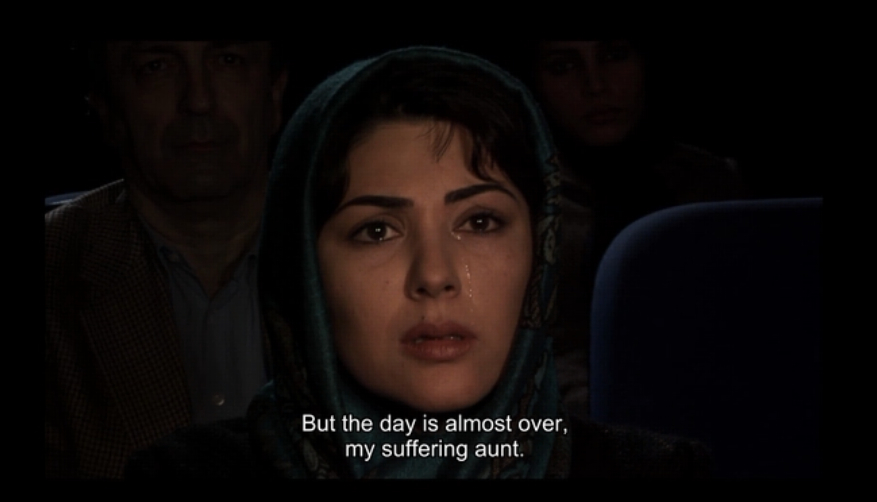
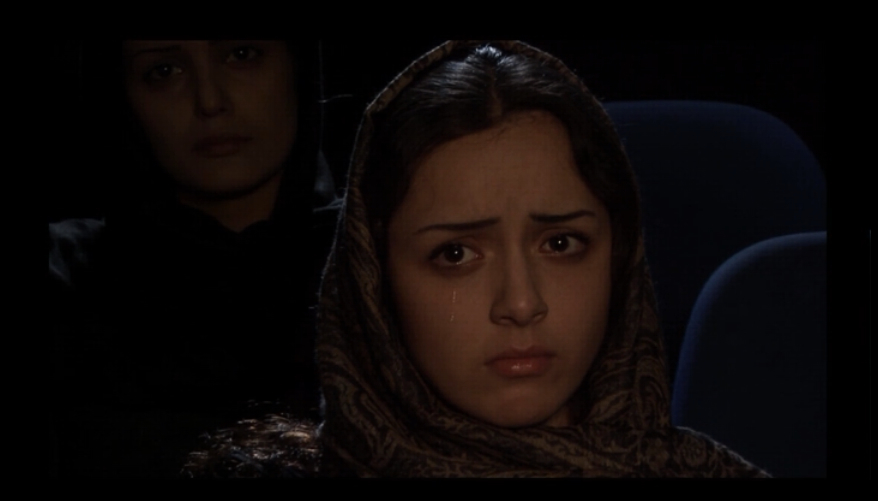
And yesterday, this dharma found its way to me yet again, in the form of an Iranian movie. Celebrated filmmaker Abbas Kiarostami created this work, Shirin, by filming the faces of over 100 Iranian stage and screen actresses as they themselves watch a film of an 800-year-old Persian epic love poem: the story of Shirin and Khosrow. Shirin is an hour and thirty minutes of framed face shots, inviting us to meditate on subtle and dramatic changes of expression as the women become emotionally involved with the story. The film also invokes self-consciousness about our own being and emotional vicariousness: spectators spectating other spectators.

For me, the arresting part in the epic poem (which is both audible and subtitled in Kiarostami’s film) was this, from a scene where a dying queen shares her final words with her heiress, Shirin:

AUNT: “I had my blossoming spring, I grew old at fall. Now I welcome the winter and the snow that will cover my grave.”

SHIRIN—”Haven’t I suffered enough? My heart can’t afford to be broken again, or my body to be abandoned.”

AUNT: “It took me a long time on this earth to understand that the joys of life are like the caress of a feather on the palm of your hand. Pleasurable at first, and a real torment if it perdures. I leave this earth to people who deserve a better life.”

(Visuals show women’s faces, teary and crying.)

The feathers tickling our palms are not emotions themselves. Rather, they are the self-generated process of reacting blindly to those emotions: embracing pleasant ones and running from unpleasant ones. We blindly, habitually react in countless small ways like this every day, allowing transient moods and the vicissitudes of experience — pain, pleasure, neutrality — to dictate our internal well-being.

Part of what I love about Kiarostami’s film, though, is that it allows us to step back from our emotional entanglements and watch them play out externally, on a stream of other faces. It’s like ninety minutes of looking in a mirror, and watching the flow of feeling pass by, unhindered. We don’t get to know any one woman long enough to get caught up in her story. It’s simply beautiful to greet her for a moment, welcoming her into a growing rosary of all the audience members. I’m reminded that I myself am, in some ways, a rosary of many faces: always changing, counted one by one. This allows me to relax. It’s the same comfort I feel when I look out the window on a long train or bus ride. The scenery is flowing by so quickly that there’s no time to fixate on it; and so I let go and simply watch. Give the feather — and the brick wall — a rest.

This slideshow requires JavaScript.

Interdependence, Colonialism, and Commodity Fetishism

In Buddhist parlance, we often encounter the word “interdependence.”  It comes up in many contexts.  One way I often hear it invoked (in dhammic as well as New-Agey spaces) is as a kind of feel-good spiritual brainteaser.  Isn’t it amazing and beautiful how we are all connected?

Here’s a good example, from my own life.  I was attending a conference about spirituality and technology: the Wisdom 2.0 Summit.  One of the keynote speakers, Tony Hseih, CEO of the online retailer Zappos, gave a talk about the culture of happiness at his company, and how attention to the human connections between merchant and consumer fosters better, more lucrative business.  The title of his book sums it up nicely: Delivering Happiness: A Path To Profits, Passion, and Purpose.

When it came time for Q&A, I raised my hand and got the mic (standing up, semi-terrified, before this large crowd of very successful techno-seekers). I thanked Tony for his work, and then asked what he thought — and what all of us present thought — about the happiness of the people who produce the technology we use.  The people working in the factories that make our phones, our laptops, our desktops.  The people mining the minerals for all of these.  What about their happiness?

It’s all well and good to look at interdependence as a network for human kindness and beneficence.  But the fact is, it is just as much (if not more) a network for exploitation: of humans, animals, and the earth.

In his newest book, The Boddhisattva’s Embrace: Dispatches from Engaged Buddhism’s Front Lines, Hozan Alan Senauke of the Clear View Project cuts to the core of exploitative interdependence in the conclusion of a beautiful essay on the shipbreaking industry in Bangladesh.
Continue reading

Friends, Meet Imani


Folks, I’m going through it a little bit this week.  Just a lot of complex stuff coming up.  Haven’t found the right words for sharing it here, yet.  But in the meantime, this video of my friend and fellow Goddardite — vocalist, composer, interfaith priestess, and cultural worker Imani Uzuri — made me smile today in a full, full way.  Not only does Imani bless the world with mad artistic skills (including, but not limited to, the most moving voice I’ve ever heard in person in my whole entire life: no lie), she also illuminates the people around her with her spiritual reflections, historical insights, unbeatable hilarity, and genuine compassion.


Here, she reminds us of the importance of exploring and loving our always-complex selves.  It reminds me of an essay I read yesterday in the current issue of make/shift: a piece by Alexis Pauline Gumbs called “M/Othering Ourselves: A Black Feminist Genealogy, Or, The Queer Thing.”  The essay in turn takes its inspiration from a line from Audre Lorde: “We can learn to mother ourselves.”  Gumbs asks:

What would it mean for us to take the word mother less as a gendered identity and more as a possible action, a technology of transformation that those people who do the most mothering labor are teaching us right now?

I hear this question (and its associated family of questions) echoed in Imani’s 120-second share.  (And enacted, unwittingly, in the sweet out-takes in the final few seconds.)


Imani’s work itself is powerful enough; being in her presence during Goddard residencies, and seeing the mind, soul, and radical self-mothering behind the music, has been an extraordinary gift to me.  She’s real and grounded, as well as spiritually developed and crazy talented.  Quite the combo.  Check her out, and join me in celebrating the friends who inspire us, even unknowingly, while we’re slogging along.


Tow, Please Tow Me

In the vein of Lovely Inconveniences.

Yesterday on my way home from the Jarvis Masters hearings, I was driving down San Pablo when an object appeared in the road. Only when I drove over the object did I realize what it was: a sharp rock the size of a bowling ball.

The crunch of the undercarriage sounded real ugly. I pulled into an empty corner lot, stepped out to have a look, and sure enough, velvety black liquid was pouring from my mom’s Volvo.

I’d never seen a pool of oil that big. Part of me wanted to smear it on my arms, just to feel.

Out comes the Triple-A card. (Maybe my first time using it?) Before I’d even connected with the California office, a friendly man from the car transmissions store across the street had come over to lend a hand, and an eye.

Looks like the oil pan, he said.

Awkwardly, I patched back and forth between him — meeting his eyes, answering his questions — and the AAA person on the phone. Pretty soon he got shy or bored from my half attention, and retreated to his store. “One second,” I said into the phone, and hollered a clear thanks to him. He waved and disappeared.

The tow truck would be there in an hour. In search of a bathroom, I began to walk the stretch of San Pablo. On foot I got to see more clearly the things I’d sped past just minutes ago in the car. A tiny taquería adjacent to a car wash. A strange eco- toy store. Salvage yards sourced largely from UC Berkeley frats and sororities, brimming with windows, chairs, stone buddhas, a pink sink and matching tub.

When I finally found a place to pee, it was inside one of the most beautiful restaurants I’ve ever seen. A barbecue joint overflowing with antique radios and stoves, Black family portraits and Southern paraphernalia. Where crown molding would go, there were rows of roof shingles.

Eddie, the AAA driver who picked me up, brought the car to a shop, waited for me, and then drove me home. We joked in the massive cab.

Now, there are a lot of important factors that reduced my stress around this incident. No one was hurt. My family can afford the car repairs. I wasn’t late for some important appointment. I was in a safe, well-lit area.

Still, I have to credit some of my calm (even enjoyment) to the dhamma study. This is a practice that teaches us to stay in the moment, rather than wasting time grasping at the future (I should be home by now; It’s been over an hour, where is that tow guy?) or harping on the past (Why didn’t I swerve or something? What was that damn rock doing in the middle of the road, anyway?). Rather than wishing it hadn’t happened to us, we accept responsibility for the continual flow of our life. There’s no escaping it.

And why would we want to? Without being Pollyanna-ish (meaning, I think, refusing to acknowledge unpleasantness), we can still open up our vision enough to include the beauty of inconvenient or ouchy circumstances.

Will I take pains to avoid unknown objects in the road next time? Yes. But I certainly don’t regret my tow day.

* * * * * * * *

PS: It’s another Full Moon Walk night tonight! Think about taking a stroll, wherever you are.

PPS: I’ve been messing around with new themes for the blog, but I think I like this one better than yesterday’s experimental one.  Agreements?  Disagreements?  Hope this guy works alright for you, for now.

What To The Radical Is Martin Luther King Day?

Alan’s got a lovely piece up at Clear View Blog (digging his jaunty-angled question: what would MLK, Malcolm X, and Paul Robeson think about being put on U.S. postage stamps?) that points to the connections between big-L Love and the effort to, in King’s words, “defeat evil systems.”

Compassion and militancy.  Neither can substitute for the other.  If you’ve got militancy but don’t practice compassion, your friends and comrades — the people upon whom you most rely, politically and personally — prob’ly won’t enjoy being around you.  Not in the long term, anyway.  And if you’ve got compassion but no critical analysis of “evil systems,” or meaningful program to defeat them, you are, as Ryan points out, utopian.

Combine the two, compassion and militancy, and you’ll get something powerful.  But you’ll also get problems.

Frederick Douglas famously asked, “What to the slave is the Fourth of July?”  We might do well to extend the same skepticism to today’s hallowed, lovey-dovey vacation day.

Beneath the hype, MLK day can serve as a reminder that people who advance the fight for radical liberation, using their own compassion and militancy, are undoubtedly risking their lives.

So if you’re among them, thank you for your courage.  May the earth continue to bless you with beauty every day. May you sometimes have a sweet picnic by the lake.

Continue reading

Buddhist Production, Feminist Effort, and the God of Work

It’s a gorgeous, crisp day outside: perfect for a ride on my pretty new bike, and no time to be stuck inside blogging til dark. So the thought-connections in this post will be loose. Maybe I’ll try tightening them up sometime.

The following are three excerpts from three different pieces: Buddhist, economic, and Marxist-feminist. All deal with the same theme: work. I’m simply interested in thinking about parallels and dissonances among them, and working toward a more holistic understanding of how work operates in reality, and how we might want it to operate.

1. Buddhist Production

Let’s start with the Buddhist one, from Tricycle Magazine online:

When explaining meditation, the Buddha often drew analogies with the skills of artists, carpenters, musicians, archers, and cooks. Finding the right level of effort, he said, is like a musician’s tuning of a lute. Reading the mind’s needs in the moment—to be gladdened, steadied, or inspired—is like a palace cook’s ability to read and please the tastes of a prince.

Collectively, these analogies make an important point: Meditation is a skill, and mastering it should be enjoyable in the same way mastering any other rewarding skill can be. The Buddha said as much to his son, Rahula: “When you see that you’ve acted, spoken, or thought in a skillful way—conducive to happiness while causing no harm to yourself or others—take joy in that fact and keep on training.”

– Thanissaro Bhikkhu, “The Joy of Effort”

Continue reading

Harmful Sexuality: Workplace Exploitation

One of the Buddhist precepts that I don’t hear discussed much in ‘official’ settings is the advice to “avoid using sexuality in harmful ways.” There’s a ton to unpack there, obviously, but one connection I’m making has to do with a meeting tonight of Bay Area radicals rallying around a friend of mine who got fired from her job.

She’s been an educator in an Oakland after-school program for a while, and a few weeks ago her boss fired her. Didn’t tell her why. (Still hasn’t.) Didn’t even bother to notify her: she came in and worked a whole day before being told that her contract had been terminated.

So what’s this got to do with sexuality? Well, even though no one has told her why she was fired, my friend has a pretty good idea: she turned down her boss’s sexual advances. For months he had been flirting with her, but as soon as she put a stop to it, the game changed. You can read her entire account on her blog.

Sexual harassment at the workplace? Clearly not okay. So tonight a bunch of us will get together and see what we can do to support. My friend already took the lead herself, by refusing to play along with her boss in the first place. (Reminds me of Robin D. G. Kelley’s Race Rebels, where he examines everyday worker resistance, and specifically names the form of struggle wherein women respond with calculated coldness to sexually aggressive male superiors.) But individual assertions of dignity are not enough. Not even when it comes to sila (Buddhist morality, including the precepts.) It takes sangha, community, to breathe life into explorations of harm and benefit.

And importantly, the precepts aren’t some kind of spiritual checklist. Don’t lie — gotcha; Don’t steal — okey dokey. If that were true, then as long as my shit is under control, I wouldn’t need to care about anybody else’s struggles with harm.

To me, rather than instruments for performance evaluation, precepts can act as guideposts for looking deeply and holistically into processes of harm and benefit.

We’ll see what we can come up with at tonight’s meeting.