I’m Back! To the Beginning…

Hey everybody!  Sorry to disappear like that.  Between the beautiful visit with family and friends in Cali, returning to an almost palpable sense of community in Cambridge, adventuring in DC/Maryland for the inauguration, working for one final 40-hour week, and now packing up to move to Spain in four days, it’s been…busy.

And while the experiences have been amazing (a few even historic), amidst the travel I somehow slipped deep into my own mind.  There’s been a shortage of direct, calm, open experiencing and an overabundance of thinking.  It’s a common problem for me, one that manifests in cycles of anxiety so subtle and slow-building that one day, without warning, I break down crying over dry cleaning or a rotten lemon.

This morning, when I sat down to meditate for half an hour, I only made it for three minutes.

But here’s what I wanted to share about these brooding cycles of mine: they come and go.  Typically peaking twice a year: once in the summer, and once in the winter, after the new year.  And while the faithful regressions may frustrate the logic of linear progression (experience yields greater efficiency; age yields greater wisdom), they also offer something very valuable, which is a chance to practice starting at the beginning.  For the past few years, every major breakdown, once it passed, left me feeling radiant — almost newly born.  Ready to start again.

The beginner’s mind is a concept I’ve been wanting to write to y’all about for weeks.  One of the most helpful essays I read last year (and possibly ever) was Shunryu Suzuki’s “Zen Mind, Beginner’s Mind.”  Indulge me for a minute while I quote it extensively.  Then there will be some pretty pictures!

In Japan we have the phrase shoshin, which means “beginner’s mind.”  The goal of practice is always to keep our beginner’s mind.  Suppose you recite the Prajna Paramita Sutra only once.  It might be a very good recitation.  But what would happen if you recited it twice, three times, four times, or more?  You might easily lose your original attitude towards it.  The same thing will happen in your other Zen practices.  For a while you will keep your beginner’s mind, but if you continue to practice one, two, three years or more, although you may improve some, you are liable to lose the limitless meaning of original mind.

Now, I know that for some of us, bouncing around from new thing to new thing is our modus oh-lordy: a mind captivated by distractions and, therefore, beginnings.  Ooh this! — Now that! — Hey, how ’bout this thing over here?!  But the beginner’s mind is different in a couple of ways.  One, it implies intention.  We are deliberately setting out as beginners in an undertaking that we consider worthwhile.  We might be real novices at it; we might have been working at it for most of our lives.  Whatever it is, we choose it — it doesn’t choose us.  It doesn’t seduce us.  Secondly, whereas a lot of folks I know judge themselves harshly for being distractable (I can’t focus; I’m unreliable; I’m irresponsible), the beginner’s mind is free of judgment.  After all, you’re just a beginner!  We give it our best shot, and then we move on to what comes next.  We feel excited, engaged, buoyant — not worried about who’s watching, or whether we’ll mess up.  We’re beginning, and it feels fresh and spacious.

When we let go of pride and perfectionism, then we are open to new information, new experiences, and new directions.  Suzuki writes,

In the beginner’s mind there is no thought, “I have attained something.” All self-centered thoughts limit our vast mind.  When we have no thought of achievement, no thought of self, we are true beginners.  Then we can really learn something.  The beginner’s mind is the mind of compassion.  When our mind is compassionate, it is boundless. . .Then we are always true to ourselves, in sympathy with all beings, and can actually practice.

Of course, the beginner’s mind doesn’t apply exclusively to Zen Buddhism, or spiritual practices in general.  We could just as easily say, “When our mind is compassionate, it is boundless. . .Then we are always true to ourselves, in sympathy with all beings, and can actually [live].”

Well, friends, now it’s back to packing, and stressing, and packing some more.  But just by sharing this idea, contemplating it, I’ve begun to relax.  And when I relax, I can marvel.  So here are some snapshots of a few of the marvelous things that have happened since California…

———

Inauguration

———

Update: photo tech’s not co-operating; see here for more marvels!

Happy Inaugo’naug!

Greetings from DC!

Today has been epic and wonderful.  Wonderful even though I sense that my own excitement comes from a different place than that of many others.  Doesn’t diminish it.  I will never forget the sight of the crowds — the first time I have been surrounded by that many people whose collective witness was a celebration, not an indictment.

I’ll post my thoughts (and photos!) soon, once I collect them.  But face-time trumps typing, so right now I’m going to go enjoy some fine company in Columbia Heights,  and then hopefully Silver Spring, MD.  (Henry!  Yayy!)

Be well, everyone.

Empathetic Nervous System

First thing this morning, I learned about the murder of Oscar Grant.  The following is from an email I got over a listserv — I hope it might be helpful to some of y’all.  Please know that I am not here to nag you into action, only to pass along resources in case any of them resonate.

5 Things You Can Do Right Now

About the Oscar Grant Shooting

Share w/ your peeps

by Makani Themba-Nixon

1. Digg the story so that the national media can pick up on it (Thanks, Jabari For this link): http://digg. com/world_news/Oakland_Police_Officer_Shoots_Unarmed_Man_Handcuffed_Man

or
http://digg.com/world_news/Oakland_Police_Officer_Shoots_Unarmed_Man_Handcuffed_Man?OTC-em-st1

2. Contact BART Director Carole Ward Allen and demand that 1) the officers involved be taken off duty without pay and charged and fully prosecuted; 2) there be an independent investigation of the shooting that includes a review of training and hiring practices; and 3) BART establish an independent residents’ review board for the police Call her at 510-464-6095 or email the BART Directors at BoardofDirectors@bart.gov

3. Call the BART police to complain about the officers’ conduct and demand immediate action:

Internal Affairs: Sergeant David Chlebowski 510.464.7029,dchlebo@bart.gov

Chief of Police: Gary Gee 510.464.7022, ggee@bart.gov

Call them toll free at 877.679.7000 and press the last four digits of the phone number you wish to reach.

4. Talk it up on your blogs, networks and talk radio shows (call Michael Baisden 877-6BADBOY or Rev. Al, etc. to get this on the national radar)

5. Stay tuned for other actions, protests, etc., especially if you are in the Bay.

peace,
makani

For those who haven;’t seen the horrific video take a look and note that this our tax dollars at work

Watch the video —
http://cbs5.com/local/oakland.BART.shooting.2.900634.html

After watching a dozen versions of video footage, I cracked open, and my mother held me as I cried.

It’s impossible to separate my sadness for Oscar Grant from my pain over the Gaza massacres.  I can’t even separate it from my love for my father, or my own personal fears and occasional despair. It’s like one giant, continuous upwelling.

That’s part of what makes empathy magical, I guess.

Friends, Meet Henry Mills.

henry frogazoomOh boy.  Oh boy, oh boy.  You know those reflex tests where the doctor taps your knee and you can’t help but kick?  Or if you’re asleep and someone pinches your nose shut, you can’t help but open your mouth?  Thinking about Henry Mills is kinda like that for me: no matter what, a smile just comes.

As Beyoncé Knowles once said (yes, seriously), “You are who you’re around.  If I don’t want to be like you, then I don’t want to be around you.”  The positive side of that aphorism: surround yourself with people who not only impress you, but also inspire you.

Henry and I met in the summer of 2006, volunteering in New Orleans with the Common Ground Collective.  I still can’t believe my luck in running into him.  Henry is the kind of person you want to be around.  Especially in the following situations:

> walking in a quiet park or garden

> cartwheeling in the rain

> getting juggling lessons in your Uncle John’s basement

> reading children’s stories aloud in a giant used bookstore

> brewing ginger tea

> mourning a loss

> driving in a fantastic lightning storm

> gettin’ down at a great show

> making your own great show

Another great situation to share with Henry (and I hope he won’t mind my saying this) is a kissing situation.  Continue reading

Family In Gaza

One of my roommates, Noa, one of the people I care for most in the world, spent her childhood summers with family in Tel Aviv, Israel.  When I hear fireworks, she hears bombs.  When I hear lightning storms, she hears explosives.  I can never understand what it’s like to grow up where she did.  To love a family that remains there, a family both culpable and vulnerable.  Still, I know that Noa’s heart is heavy, like mine, at the news of today’s invasion, and for the people killed.  They are also family; they are also loved.

Below is an email from someone I don’t know, forwarded by my dear, wonderful friend Henry Mills (Introduction forthcoming). There’s such a feeling in it of familial loss and heartache, mourning the dead and calling the living to action.

I have resisted writing emails like this for so long, emails to tell people what they already know and feel.
I woke up this morning to news from my family about 200 people killed in Gaza overnight in raids, and clashes happening right now in Ramallah.
I could say, these are two hundred people that had lives, lists of places to visit before they die or a plan for a better life, even a TV show they have been wanting to follow till the end, but it doesn’t matter.

All I can think about, are all of those people that are still alive. Continue reading

Laroy’s Tea

wellbetter tea
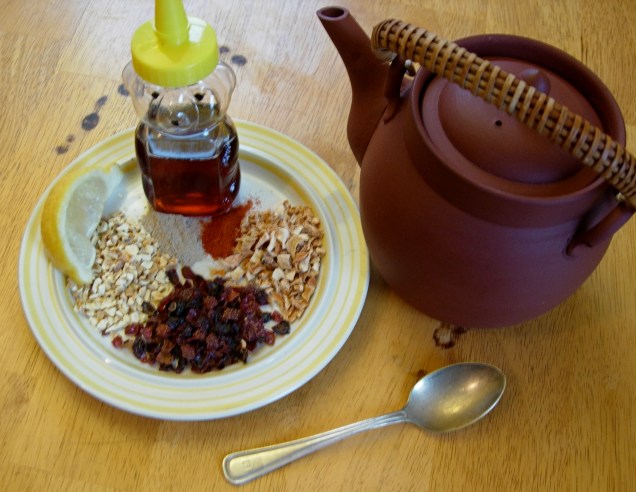
Clockwise from top: Farmer Al's honey, cayenne, orange peel, rosehips, lemon peel, lemon, echinacea.

Lately I’ve come down with a bit of a winter bug.  One of the pleasurable parts about being sick is that you get to guzzle tons of delicious liquids: orange juice, tea, water.  (Yes, I count water as a delicious drink.  Hydration: key to life.  You heard it here first.)

My friend Laroy, from California, was generous enough to give me a recipe for a wellbetter tea, so I hopped across the street to the local grocery co-op, where I knew they’d stock oddities like rosehips and echinacea.  In bulk.  (Thank you, Cambridge MA.)

A crucial detail about this kind of tea, though, as Laroy explained to me, is that it’s not intended to make you well only when you’re ill.  You’re supposed to drink it consistently.  The philosophy behind preventive medicine and holistic health emphasizes strengthening our bodies in addition to killing disease.  A rather alien concept to our typical aspirin-popping approach, especially since it means long-term, gradual results, not necessarily immediate relief.

If and when we finally socialize health care in the U.S., I hope we’ll be in for a major shift toward preventive medicine and wellness promotion.  From the state’s perspective, it’s far easier to treat a population with a high wellness baseline.  In the nutrition realm, I think we’re already beginning to see signs of a sea change with legislative efforts and the enormous popularity of writers like Michael Pollan. (Not that I fully agree with the dude.  I’ll write specifically on Food[racism/feminism/economics/health/environmentalism] later on, maybe.)

But for many of us, myself included, learning to think of healthiness as an ongoing personal practice — not just the result of genetic luck or sporadic medical intervention — requires some major cognitive rewiring.  It means focusing on protection and correction.

One thing’s certain: it helps when the tea tastes good.  Thanks, Laroy!