Quickly, since it’s been on my mind, I just want to give a nod to two very different but equally historic and fascinating stories in world-class running.
First, of course, there’s Bolt — and his two record-breaking times, including the 9.58 seconds that blew history’s last best 100-meter run completely out of the water. Unbelievable.
But this week in running, there’s “unbelievable,” and then there’s “unbelievable.”
Hence the story of another winner, 18-year-old Caster Semenya. An unknown who exploded to World Championship victory in the women’s 800-meter race, Semenya’s legitimacy as a competitor is now under investigation.
My dear friend Adaner posted this article on Facebook: an interview with Afghan women’s rights activist Malalai Joya. Barely out of her twenties, Joya continues to courageously oppose Taliban and warlord oppression, expose U.S. propaganda, and inspire thousands of people — at the cost of her own personal safety. Though her efforts have been completely non-violent (illegally educating girls and speaking her mind as an elected representative) the resulting death threats have forced her to live under constant armed guard, sleeping in a different house every night and adopting a pseudonym to protect the identity of her family.
It’s a powerful interview. One point in particular stuck with me, in conversation with my recent reading on the life of Gandhi, to whom these words are attributed:
“Whatever you do will be insignificant, but it is very important that you do it.”
Joya is expressing the same idea, I think, when she says,
“I am young and I want to live. But I say to those who would eliminate my voice: ‘I am ready, wherever and whenever you might strike. You can cut down the flower, but nothing can stop the coming of the spring.'”
Just as a flower is not a season, but an expression of it, a good activist is not a hero, but an expression of a greater heroic impulse. At some point or another, almost everyone I know who has worked for social justice in some way has confronted this paradox. We want to contribute; we want to do our duty; we want to give. But how do we do this, knowing that though we may work ourselves literally to death, ultimately our contribution will be insignificant?
What we give may be minuscule, but that we give, and give purely, is what matters. To give purely means to be guided by something greater than ourselves, our clever ideas, our generosity, our solidarity, our unflagging commitment. To give purely means simply surrendering ourselves to the heroic impulse. After that, the gift will express itself in whatever form it wants to.
But of course, self-surrender is one of life’s most difficult goals. Requires an enormous amount of faith.
In Joya’s case, much of her faith seems to rest in other people. She trusts them to continue, even if she cannot.
“If I should die, and you should choose to carry on my work, you are welcome to visit my grave. Pour some water on it and shout three times. I want to hear your voice.”
I know we never knew each other while you were living, but you’ve been on my mind a lot this week. Your death at the hands of a trigger-ready undercover cop — who stayed put on your front porch even when you asked him to move — is tragic. And it is an extreme example of the same overreach of the law that put Professor Gates in handcuffs and mugshots. And Sean Bell, like you, in a coffin. No one can prove beyond a doubt that Blackness had anything to do with it. And yet we all know…
These prejudices, now measurable through tools like Implicit Association Tests, don’t start out explosive and deadly. They germinate and spread silently, almost unnoticed. Until another patch of poisonous weeds forces its way through the topsoil and bares itself in daylight.
I remember a germ of this idea. One instance. It was in college, and a friend of mine — white, Jewish — sat on the edge of the bed, trembling, her hands poised for storytelling. A male student had approached her while she was studying, she said, and despite her efforts to resume her work, and then get up and walk away from him, he wouldn’t leave her alone. Wouldn’t accept her lack of interest. Kept flirting aggressively. And she started to feel uneasy, then trapped, then terrified.
I’ve been there. Many women have. And I wanted to comfort my friend, to tell her I sympathized. The problem, though, was that in recounting the events, she kept referring to the man as “this big Black guy.” As in, “I had this big Black guy towering over me…”
My friend wasn’t being intentionally malicious, but the implications of her words are clear. She feared this man more because he was Black. She automatically, and I might say unconsciously, interpreted Black maleness as a particularly dangerous threat to her safety.
Perhaps some of the same unconsciousness overcame the policeman who killed you.
Or maybe, like the infamous “Floyd” in The Fugees’s The Score, he “gets a hard-on from just shootin’ n***as.”
I didn’t object or question my friend about what she said — that day, or ever. If the same situation arises again, though, I’ll say something. Your life and needless death reminds me how this unconsciousness, left unchecked, spreads so quickly. Not only costing lives, but corroding the hearts and minds of millions. I don’t want people like my friend to remain unconscious in this way. I love her. And I know she can be better, more open, less afraid. Just like Officer Crowley can be better.
Despite the circumstances and against the odds, I hope you passed peacefully, Mr. Walker. I hope that when you saw that death’s arrival was inevitable, you accepted it, and allowed it to fill you with love and light, not anger or animosity. As another victim of a brutal murder once said, full of compassion even throughout his killing, “They know not what they do.”
Thank you for spreading love and light to me. You will be missed, certainly, and also, you will matter.
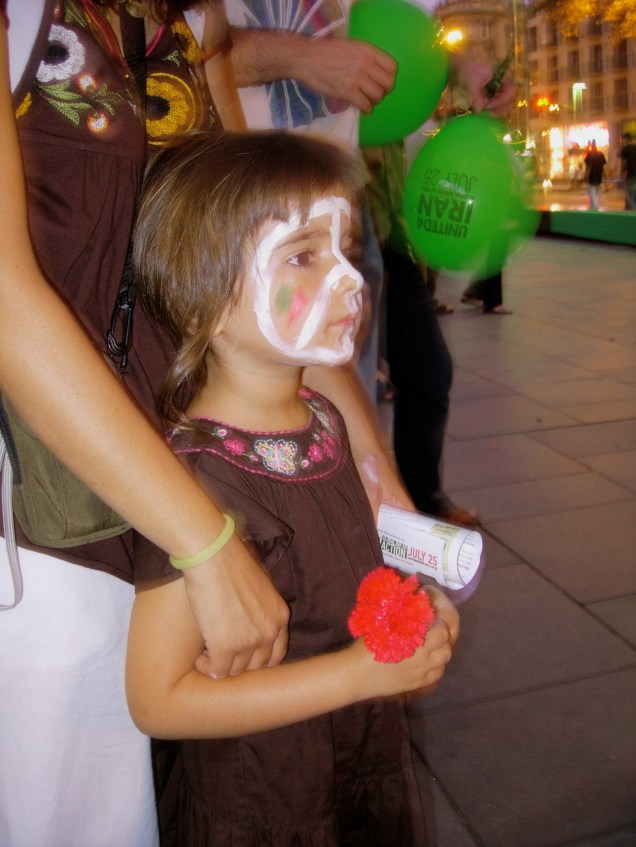
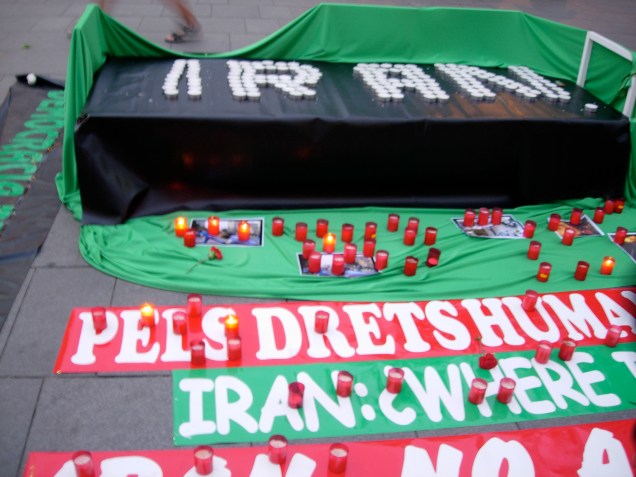
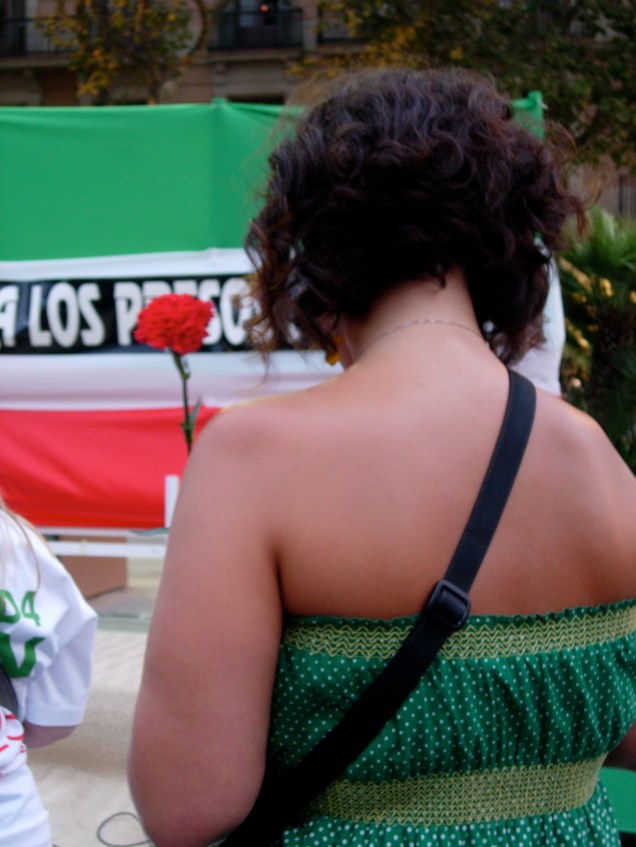
Saturday evening at Plaça de la Universitat. Sometime I’ll learn how to take better photos at night…but in a fitting way, the fuzziness implies an aspect of the experience: vision blurred with tears.
Seeing all these people here in Catalunya, families and strangers and activists and musicians, I was amazed at the sheer strength of everyone. And struck at the thought that the pain and anguish among those resisting is reflected in equal measure among the men with machine guns carrying out the repression. Their lives, too, are hellish.
Overwhelmed by my own emotion, I kept lifting up my camera halfheartedly, and then putting it down again. It’s like Jay Smooth says: sometimes we have to live our grief directly, without making media out of it. Sorry I couldn’t translate the moment into better photos to share with you.
Today, at the park near Notre Dame, I was the only one dancing.
It’s true.
The young-white-guy jazz players, with smiles like jukebox pages flip-flapping between smugness and delight, asked so nicely. Get up from the benches, everyone. Get up and dance.
And the boy next to me put down his sandwich (from the Subway by the Seine) and stood alongside me for the first couple minutes, clapping. But somewhere along the way, he disappeared.
And that was it. The drummer kept soliciting; I gestured to people to join in; but no one budged from behind their cameras. Taking pictures, video. Two months from now, finally getting around to uploading their vacation photos, they’ll rediscover these and say, “Oh, darling, remember that jazz band? They were so talented.”
What does it mean when a plaza full of people who are free to dance, free to engage with real people playing music, cannot bring themselves to participate?
And why was I so acutely aware of this freedom as freedom?
Nowhere have I felt my Blackness so self-consciously as here in Paris. Maybe that’s why dancing today, 15 minutes of white gaze on my sore-thumb body, felt like I was just barely getting away with something. Almost an act of defiance. These things start small, you know?
As usual, Toni Morrison’s got something deep to say about all this. Why art (literature) requires both solitude — the ability to dance alone — and community — an environment safe enough to dance at all. And why we have to secure these conditions for art to go on living.
Please, let’s dance when we can. And let’s ensure that everyone else can, too.
There is a certain kind of peace that is not merely the absence of war. It is larger than that. The peace I am thinking of is not at the mercy of history’s rule, nor is it a passive surrender to the status quo. The peace I am thinking of is the dance of an open mind when it engages another equally open one–an activity that occurs most naturally, most often in the reading/writing world we live in. Accessible as it is, this particular kind of peace warrants vigilance. The peril it faces comes not from the computers and information highways that raise alarm among book readers, but from unrecognized, more sinister quarters.
I want to tell two little stories– anecdotes really–that circle each other in my mind. They are disparate, unrelated anecdotes with more to distinguish each one from the other than similarities, but they are connected for me in a way that I hope to make clear.
The first I heard third or fourth-hand, and although I can’t vouch for its accuracy, I do have personal knowledge of situations exactly like it. A student at a very very prestigious university said that it was in graduate school while working on his Ph.D. that he had to teach himself a skill he had never learned. He had grown up in an affluent community with very concerned and caring parents. He said that his whole life had been filled with carefully selected activities: educational, cultural, athletic. Every waking hour was filled with events to enhance his life. Can you see him? Captain of his team. Member of the Theatre Club. A Latin Prize winner. Going on vacations designed for pleasure and meaningfulness; on fascinating and educational trips and tours; attending excellent camps along with equally highly motivated peers. He gets the best grades, is a permanent fixture on the honor roll, gets into several of the best universities, graduates, goes on to get a master’s degree, and now is enrolled in a Ph.D. program at this first-rate university. And it is there that (at last, but fortunately) he discovers his disability: in all those years he had never learned to sit in a room by himself and read for four hours and have those four hours followed by another four without any companionship but his own mind. He said it was the hardest thing he ever had to do, but he taught himself, forced himself to be alone with a book he was not assigned to read, a book on which there was no test. He forced himself to be alone without the comfort of disturbance of telephone, radio, television. To his credit, he learned this habit, this skill, that once was part of any literate young person’s life.
Toni Morrison receiving the Medal for Distinguished Contribution to American Letters at the 1996 National Book Awards. Photo: Robin Platzer.
Last night, after arriving back to Izzy’s place in Paris, I had a wonderful Skype conversation with a dear friend in California. At one point the topic turned to love, surrender, and letting go of the illusion of control. Reminded me of one of my favorite love poems, by Iranian Sufi poet Hafez.
The Sun Never Says
Even
After
All this time
The Sun never says to the Earth,
“You owe me.”
Look
What happens
With a love like that,
It lights the whole sky.
With metta and prayers for the people of Iran today.
Hey, friends. Today I’m going to do something a little unusual.
Over a year ago, on another blog, I wrote a piece about my transforming body. A number of people responded to it in heartwarming and wonderful ways, for which I’m still very grateful. In the many months since then, far more than I’ve thought about my particular physical change, I’ve often thought about the way I immediately accepted its arrival.
At the time, I recognized this acceptance as so extraordinary, so unexpected, and so profoundly bad-ass that it could not have come from just “me.” I, alone, was not strong enough to understand such an event so deeply and so quickly. My insight, as I said, owed itself to many teachers and inspirations in trans and feminist communities.
Now, though, there’s a new angle. Looking back on what I wrote, in addition to transfeminism I recognize another perspective: a budding consciousness of dhamma — the teaching of the Buddha. Nothing is permanent. Everything changes. So it’s best to accept the change, and learn to let go of the appearance of things. Learn directly.
This is probably one of the most powerful examples, in my own life experience, of the practical benefits of dhammic wisdom. In Pali, bhavanamayapanya — the wisdom gained by one’s own direct experience. Not because I heard it; not because I puzzled it out; but because, at the level of the body, I felt it. And it helped me.
So here, re-posted, is the piece I wrote. Offered in hopes that it might continue to help! And offered with thanks to more teachers, probably, than I even remember.
* * * * *
Trans Feminism And My Vagina: A Love Story
Today at 1pm, the hearing for HB1722, “An Act Relative to Gender-Based Discrimination and Hate Crimes,” is going down at the State House. As always, Quench is on top of it. The following is a highly untheoretical, personal expression of tremendous, joyous gratitude to everyone who struggles against transphobia. Oversharing for a greater purpose, you might call it.
Reclining, legs stiffly spread, during my routine Pap test a couple of months previous, the nurse had neared the end of her business, and I’d asked, with as much nonchalance as one can muster in such a position, whether she’d happened to notice that thing in there…kind of like a swelling?
Trundling out of UHS into another icy December afternoon, I couldn’t remember the medical term she used. Just that it sounded a lot like “cyst.”
And now here I was, back at my laptop, staring at the blank white Google Search box. What did she call it? I knew “cyst” was off — it wasn’t going to help my search. Instead, hesitantly, I typed in a few related words: “bulging bladder vagina.”
May you enjoy this new right in as many healthy, consensual, loving, joyful, and creative ways as there are people in the country. ;) And may this outer, legal liberation encourage your inner, spiritual liberation — toward the peace and happiness of all beings.
love,
katie
—————
Update: My friend Ellora wrote a great note on Facebook pointing out the links between queer rights and anti-imperialism in this victory. I’m not sure if you have to be friends with her on Facebook in order to read it…but if not, definitely check it out!
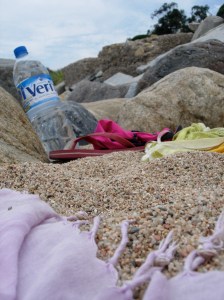
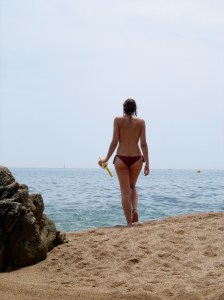
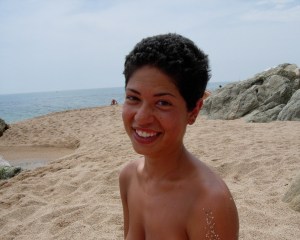
My friend Nuria grew up in Catalunya, so she knows where to find the quiet beaches here. No screaming babies, squawking vendors, or complaining tourists. (Though those scenes have their own charm, too).
This Sunday she took me to a tiny one, 45 minutes by train outside of Barcelona. Maybe two dozen people in the little nook we picked.
We had a simple day, enjoying the sun and sand and water on our skin. (Bathing suits: unnecessary. Ya feel me?)
But even the simple days are also, inevitably, complex. When you escape the crowds, sometimes you find the loners.
First there was the white guy crouching in the rocks above the beach. Nuria’s eyes narrowed. “Qué hace?” she hissed, hackles visibly raised. She stood up to get a better look. When she was reassured that he had left, we talked about the violence of voyeurs. Men who spy on naturist beaches to ogle and masturbate. A couple of shady characters I encountered on The Camino. Nuria is one of the most loving people I know, toward everyone she meets, but she also has a temper, and this behavior is a big trigger. She has been known to throw stones.
So we talked about the ways in which these men are suffering from addiction, lost deep in their own pain and ignorance, and doing such harm to others because of it. How almost everyone on Earth, including ourselves, at times, is addicted to pleasure in some form or another.
And how, fortunately, most of the time, the collective, family vibe among nude beachgoers (who tend to have a higher level of comfort with their own bodies, and less sexual neurosis about nudity) overwhelms the negativity of predatory intruders. As we talked, Nuria opened up about her past, her own painful histories. Even on the simple days, these things tend to resurface.
Then there was the long-haired argentino dude who sat down next to us, asking for rolling papers and tobacco. His speech was so rapid and his accent so heavily Italian that I gave up trying to follow. One thing I did catch: “. . .parejas?” “Partners?” Pointing to both of us. Well, we are in Spain, a country that recognizes same-sex marriages. Maybe assumptions here are different. Maybe this was a heartwarming break from heteronormativity. Except that…it clearly wasn’t. I didn’t have to understand this guy’s words in order to see his intentions. Just the same old sexist fantasy: girl-on-girl action. And even better — a white girl with a brown girl.
Oh, dear.
Why does a day at the beach have to be so complicated?
Except that…it doesn’t.
There’s a lovely saying I’ve heard a couple of times recently, in different contexts. Just as darkness cannot survive the arrival of light, suffering cannot survive the arrival of equanimity. When you become equanimous — that is, fully present and accepting — toward something that is bothering you, it stops bothering you. You just see it for what it is. Someone is acting out their insecurity. Someone is doing harm. If the harm occurring is severe, requiring action to stop it, take action. If not, let it be. Let it pass. Either way, the first step is to observe, without a knee-jerk reaction.
Eventually, not finding the response he wanted from us, the long-haired dude left.
Did racist patriarchy spoil our day at the beach?
Well, we took some photos. You tell me.
——— [Heads-up: nothing explicit, but maybe not the safest for work]




 Kloncke