Well This Is Challenging

From A Policy of Kindness: An Anthology of Writings By and About The Dalai Lama:

From a deep point of view, while we don’t have our independence and are living in someone else’s country, we have a certain type of suffering, but when we return to Tibet and gain our independence, then there will be other types of suffering.  So, this is just the way it is.  You might think that I’m pessimistic, but I am not.  This is the Buddhist realism.  This is how, through Buddhist teaching and advice, we handle situations.  When fifty thousand people in the Shakya clan were killed one day, Shakyamuni Buddha, their clansman, didn’t suffer at all.  He was leaning against a tree, and he was saying, “I am a little sad today because fifty thousand of my clansmen were killed.”  But he, himself, remained unaffected.  Like that, you see (laughter).  This was the cause and effect of their own karma.  There was nothing he could do about it.  These sorts of thoughts make me stronger; more active.  It is not at all a case of losing one’s strength of mind or will in the face of the pervasive nature of suffering.

Family Resemblence At Police Confrontations

Now this is pretty amazing.

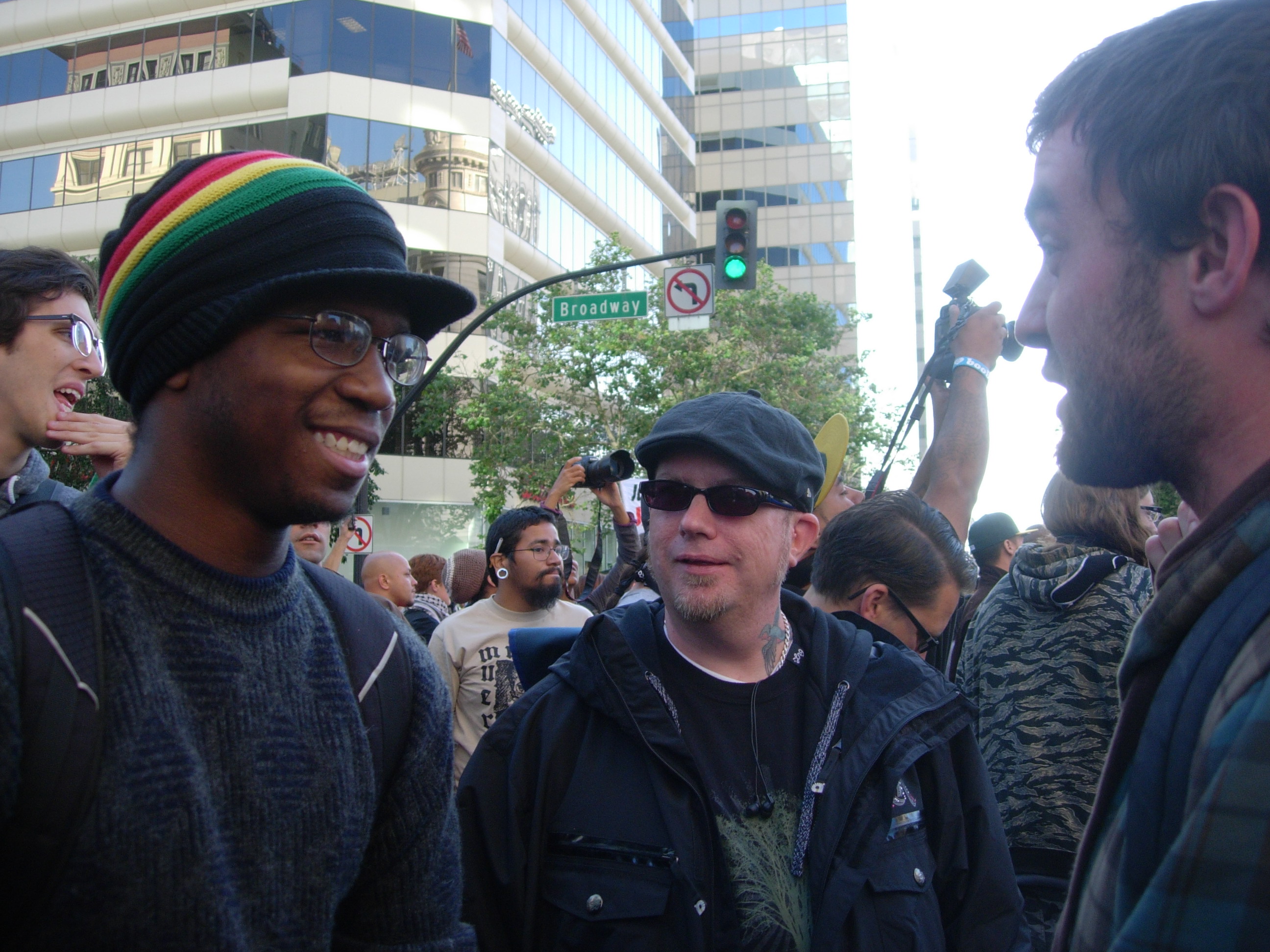
Me last week at the Mehserle verdict demonstration, among a crowd facing an enormous swarm of riot police; my dad in 1969 at Cornell University, when a group of Black students armed themselves and took over a campus building.

Not that the two situations are comparable in terms of danger, of course — it’s a miracle the Willard Straight Takeover didn’t explode into a bloodbath, whereas in Oakland, despite all the state weaponry, I never really believed that the cops would kill us right there on the spot.

But what an uncanny visual of a family lineage — the twin furrowed brows, the calm mouths, the keen watchfulness. Taking it in. Trying to solve the problem at hand, to find a peaceful but effective way forward.

There’s a story here about non-dualistic inheritance: a story about how none of us is really our own discrete self.  How each individual, living in the present moment, also spans generations into the past.  Reading Thich Nhat Hanh’s Teachings On Love last year brought this idea home for me for the first time.  The subtle ways we manifest traumas, neuroses, wounds, strengths, and gifts from our ancestors.

And when Rumi says, “This being human is a guest house/ Every morning a new arrival,” I suppose that leaves room for your own father to drop in for a spell.

Oscar Grant, Audre Lorde, Chögyam Trungpa Rinpoche and the question of loving our enemies.

Cross-posted at Feministe. As the verdict approaches, I find myself thinking more and more about the relationships between state violence and intimate violence. In what ways our focus on state violence, and mechanisms for resisting it, jive and don’t jive with methods for dealing with intimate violence. Aaron Tanaka made a wonderful comment on the original post — as always, Aaron, I’m truly grateful for your insights and questions, and their organic connection to the great work you do.

Just yesterday, only 20 minutes after a conversation about police alternatives, as my friend Noa was dropping me off at home, we found ourselves in an impromptu cop watch. Four officers were arresting three men on my block — two of whom I recognized as regulars on the corner, and one with whom I’ve tossed a football across Hyde Street traffic. When I saw the cops lining the men up against the fence, I just stepped out of Noa’s car onto the sidewalk and inserted myself. After one of the officers attempted to intimidate Noa by calling in her plate number (we’d been stopped and talking in the car inside a red parking zone), she drove around the block, parked, came back and joined me for the next half hour as we watched these three men get yelled at, cuffed, and loaded into a police van.

I’ll maybe write up a full summary tomorrow, because the effect of our intervention on the cops’ behavior was pretty interesting, as well as the conversation we struck up with two male officers. For now, here’s my Feministe piece from Sunday.

————————–
————————–

Continue reading

Friday Words From The Wise

Stuck right with me this week, these four:

Compassion is not about kindness.  Compassion is about awareness.

~Khandro Rinpoche

— — — — — — —

Religious suffering is, at one and the same time, the expression of real suffering and a protest against real suffering. Religion is the sigh of the oppressed creature, the heart of a heartless world, and the soul of soulless conditions.

~ Karl Marx

— — — — — — —

“But say a man does know.  He sees the world as it is and he looks back thousands of years to see how it all came about.  He watches the slow agglutination of capital and power and he sees its pinnacle today.  He sees America as a crazy house.  He sees how men have to rob their brothers in order to live.  He sees children starving and women working sixty hours a week to get to eat.  He sees a whole damn army of unemployed and billions of dollars and thousands of miles of land wasted.  He sees war coming.  He sees how when people suffer just so much they get mean and ugly and something dies in them.  But the main thing he sees is that the whole system of the world is built on a lie.  And although it’s as plain as the shining sun — the don’t-knows have lived with that lie so long they just can’t see it.”

~ Jake Blount, local madman, in Carson McCullers’ novel The Heart Is A Lonely Hunter

— — — — — — —

When you plant seeds in the garden, you don’t dig them up every day to see if they have sprouted yet.

~Bhikshuni Thubten Chodron.

— — — — — — —

That’s all for now, friends. Take care; see you next week!

Faithful Fools Street Retreat, Gender Identity Disorder, and Disability As Class

I heard this radio piece on Tuesday morning because Sharon* wanted to listen to the voice of her late husband.  She was a bit of a nervous wreck (understandably) because later that day she and Carmen would be appearing before a judge who would decide whether or not Sharon qualifies for disability benefits.  With all the tumult of the past year — losing her husband, quitting a rehab program prematurely, entering a better program only to have her housing number come up in the lottery, which meant choosing between completing rehabilitation and having a place to stay when she got out (I know, right?) — this decision felt particularly momentous.  She’d been trying for over a year to secure this income in addition to government assistance, since she can’t hold a job because of her psychological disabilities.

Witnessing our welfare system firsthand through accompanying folks in the Tenderloin is a tremendous eye-opener for me, for sure.  I knew the system was fucked in a thousand ways, including bureaucracy and stigma, but it’s another thing entirely to stand beside someone as they endure the process.  In justifying her need for support by proving her incapacity to work, Sharon had to prove that she was off drugs (because people with disabilities and addictions don’t deserve support?) and recount all the traumas she has suffered in her life, from being born to a mother addicted to heroin, to being molested by her foster family, to being raped while working as a prostitute.  Rather than a celebration of her incredible resilience and survival, the testimony had to be crafted to emphasize inability, incapacity, pathology.

“Break a leg” I said as I dropped her and Carmen off at a downtown Starbucks, where they would meet with her lawyer to review before the hearing.  “Yeah,” she cracked, “maybe that would help my case.”

Continue reading

Liberation, Social and Spiritual — East Bay Meditation Center

Hey friends!  Sorry I dropped off the face of the earth so suddenly!  I went into another Vipassana meditation retreat (my third so far under S. N. Goenka), and by the time I realized I’d forgotten to update the blog about it, it was too late: no phone, internet, reading, writing, or speaking for ten long days.  Thanks to everyone who’s visited and written to me in the meantime — a number of delightful messages and comments when I arrived home to San Francisco.  Mmmm.

For the first day or two since returning from the retreat, I’d been experiencing something of a blockage.  A mild panic or depression that left me feeling that all the activities and avenues I had been struggling to juggle up until the meditation course — work at the Faithful Fools; grad school and blogging; political study; and day-to-day dharma practice — were far too hazy, murky, massive, or complicated for me to ever significantly impact or contribute to any of them.  It’s been a long time since I felt such strong pessimism and self-doubt, and the timing — directly after a Vipassana retreat, which usually leaves me feeling giddy and abundant — added to the confusion.

Fortunately, I had just spent almost two weeks focusing at a deep level on the reality of change.  So I did the best that I could do: watched and waited.  Tried not to spin out or magnify things unnecessarily.  Felt and explored the negativity, stayed curious about it, rather than trying to push it away.

And wouldn’t you know — it worked!  Today my feet started coming back under me, thanks to some conversations with Ryan as well as three key pieces of media: one video, one book, and one radio segment.

I’ll share the book and the radio spot in the next few days.  The video, below, is an independent documentary made for this year’s East Bay Meditation Center annual fundraiser.  Seeing it today for the first time since early February, when it debuted at the event with Alice Walker and Jack Kornfield, reminded me just how much this organization inspires me, and how fortunate I am to be able to take part in it.  (Even participating in the documentary making was great!  Met some wonderful fellow members, and the filmmaker was tremendous, too.)

No more introduction necessary, really.  Enjoy!  And if you feel so moved, join in.

———

love,

katie
Avoid Stealing. But How?

Traditionally, the dharma outlines 5 precepts for laypeople to follow.  They’re not commandments so much as helpful signposts to happiness and mental purity.  The idea being that performing any of these actions requires generating mental negativities in one’s own mind, in addition to harming others.  It’s an interesting non-dualistic take on morality, and in general I find the precepts useful to keep in mind.  They are:

1.  Avoid killing.

2. Avoid stealing.

3. Avoid speaking lies.

4. Avoid using sexuality in ways that harm others.

5. Avoid abusing intoxicants (mainly because it diminishes our ability to observe the other four.)

Ok, so far so good, the Buddhists have whittled it down from 10 to 5, or something.  But I’ve got a few questions about number 2: the whole thieving thing.

See, it’s pretty obvious how to avoid the vulgar kinds of stealing: bank robbery, purse-snatching, embezzlement, etc.

But what do we do when we live on stolen land?  In a country where, as Thea Lim of Racialicious points out, “if you live on native land, you benefit from native genocide”?  And where “many First Nations people in Canada, [where Thea’s from], live under third world conditions in a first world country“?

“Surely,” she observes, “there is a political option to remedy this beyond shameful situation, between ignoring it and moving back to England.”

Are we discussing and exploring those options in dharma communities?

And furthermore, how do we relate to stealing when we live in an economic system that operates on the basis of unpaid labor?  (Which is the origin of profit under capitalism.)  Does that count as stealing?  Are we then morally obligated to oppose it?  Justified in occupying university buildings and factories? How do we see our dharma practice reflected in these systems and struggles?

These are my questions.  I would love to hear your thoughts.

Now off to Wisdom 2.0!

Later, y’all.

Help One Of My Blogging Idols to Afford A Computer!

Hey friends!  I’m really excited about this dana (generosity) drive for one of my oldest blogging inspirations, brownfemipower of Flip Flopping Joy.  Her latest computer has died on her, and after decades (in blog-years) of providing brilliant, soulful commentary in a dope synthesis of journal/journalistic blogging on radical mamis, motherhood, U.S. immigration, wisdom, resistance, healing, and community, it’s high time she got a decent machine worthy of her gifts.  The target amount to secure a MacBook Pro: $2000.

The reason I’m fundraising for so big of an amount is because I have been working on second hand/hand me down computers for about six years now–the entirety of my time blogging. And that means that I’ve gone through a ton of computers. I’ve had one catch on fire, one of them the cat broke, another one the little mouse nob in the middle of the keyboard doesn’t work anymore (so I have no mouse), and of course, this last one–the keyboard is broken.

And as if the opportunity for awesome radical POC artist solidarity and sharing weren’t enough, BFP is giving away gifts corresponding to the amount donated.  Cards!  Zines!  Sur-prizes!  Fabulous.

She’s already halfway there.  Go pitch in!

Happy Wednesday, y’all.