Folks, I’m going through it a little bit this week. Just a lot of complex stuff coming up. Haven’t found the right words for sharing it here, yet. But in the meantime, this video of my friend and fellow Goddardite — vocalist, composer, interfaith priestess, and cultural worker Imani Uzuri — made me smile today in a full, full way. Not only does Imani bless the world with mad artistic skills (including, but not limited to, the most moving voice I’ve ever heard in person in my whole entire life: no lie), she also illuminates the people around her with her spiritual reflections, historical insights, unbeatable hilarity, and genuine compassion.
Here, she reminds us of the importance of exploring and loving our always-complex selves. It reminds me of an essay I read yesterday in the current issue of make/shift: a piece by Alexis Pauline Gumbs called “M/Othering Ourselves: A Black Feminist Genealogy, Or, The Queer Thing.” The essay in turn takes its inspiration from a line from Audre Lorde: “We can learn to mother ourselves.” Gumbs asks:
What would it mean for us to take the word mother less as a gendered identity and more as a possible action, a technology of transformation that those people who do the most mothering labor are teaching us right now?
I hear this question (and its associated family of questions) echoed in Imani’s 120-second share. (And enacted, unwittingly, in the sweet out-takes in the final few seconds.)
Imani’s work itself is powerful enough; being in her presence during Goddard residencies, and seeing the mind, soul, and radical self-mothering behind the music, has been an extraordinary gift to me. She’s real and grounded, as well as spiritually developed and crazy talented. Quite the combo. Check her out, and join me in celebrating the friends who inspire us, even unknowingly, while we’re slogging along.
This semester in my MFA I have the profound good fortune of working with an amazing faculty member: poet, writer, and cultural historian Gale Jackson. Today in our twelve-person advising group, we worked together to respond to one of her poems — “1691. Tituba of Salem.” — which happened to be the first and only one I had already read.
* * * * * * * *
The whole poem is a deeply layered thing that I know I’ll continue to revisit. One line (now the title of this blog post) echoed as I was reading Detroit: I Do Mind Dying: A Study In Urban Revolution. (Remember when I mentioned that? Yep, ha, still makin’ my way through it.) Describing an opening sequence in Finally Got The News (a renowned documentary self-made by the League of Revolutionary Black Workers), I Do Mind Dying authors quote League leader John Watson:
You get a lot of arguments that black people are not numerous enough in America to revolt, that they will be wiped out. This neglects our economic position. . . . There are groups that can make the whole system cease functioning. These are auto workers, bus drivers, postal workers, steel workers, and others who play a crucial role in the money flow, the flow of materials, the creation of production. By and large, black people are overwhelmingly in those kinds of jobs. [116]
The rich, ongoing resistance of immigrant workers in the US testifies that this shifting terrain does not completely close down our opportunities for struggle. Disruption and destabilization are still possible.
* * * * * * *
I also wonder about the converse. Perhaps if we can poison, then we can also serve.
I mean this more in terms of the ways that I might poison my own life. The ways that I might relate to, and feed, my own internal sufferings. Day to day, in subtle ways. Clinging to high expectations. Beating myself up over mistakes. Fearing and worrying about the future. Indulging in fantasies and daydreams, even when they make me feel kind of sticky and queasy afterward. In general, surrendering my happiness to the mercy of my own thoughts.
Goenkaji says: there is nothing more harmful than our own untamed mind. And there is nothing more helpful, more beneficial, than our own trained mind, tamed mind. This observation comes up again and again in dhamma teachings — the idea of “turning the (monkey-) mind into an ally.”
So much in one post! Hope I haven’t overwhelmed you. Happy Monday, friends.
PS: You, like me, might want to support Gale and her important ongoing work as an artist. She’s more of an “analog girl in a digital world,” to borrow a phrase from Erykah, so since the PayPal button is out, over the next couple days we’re gonna put our heads together to find a simple way for y’all to make offerings and contributions (and/or purchase some of her breathtaking books!) from afar.
Yesterday on my way home from the Jarvis Masters hearings, I was driving down San Pablo when an object appeared in the road. Only when I drove over the object did I realize what it was: a sharp rock the size of a bowling ball.
The crunch of the undercarriage sounded real ugly. I pulled into an empty corner lot, stepped out to have a look, and sure enough, velvety black liquid was pouring from my mom’s Volvo.
I’d never seen a pool of oil that big. Part of me wanted to smear it on my arms, just to feel.
Out comes the Triple-A card. (Maybe my first time using it?) Before I’d even connected with the California office, a friendly man from the car transmissions store across the street had come over to lend a hand, and an eye.
Looks like the oil pan, he said.
Awkwardly, I patched back and forth between him — meeting his eyes, answering his questions — and the AAA person on the phone. Pretty soon he got shy or bored from my half attention, and retreated to his store. “One second,” I said into the phone, and hollered a clear thanks to him. He waved and disappeared.
The tow truck would be there in an hour. In search of a bathroom, I began to walk the stretch of San Pablo. On foot I got to see more clearly the things I’d sped past just minutes ago in the car. A tiny taquería adjacent to a car wash. A strange eco- toy store. Salvage yards sourced largely from UC Berkeley frats and sororities, brimming with windows, chairs, stone buddhas, a pink sink and matching tub.
When I finally found a place to pee, it was inside one of the most beautiful restaurants I’ve ever seen. A barbecue joint overflowing with antique radios and stoves, Black family portraits and Southern paraphernalia. Where crown molding would go, there were rows of roof shingles.
Eddie, the AAA driver who picked me up, brought the car to a shop, waited for me, and then drove me home. We joked in the massive cab.
Now, there are a lot of important factors that reduced my stress around this incident. No one was hurt. My family can afford the car repairs. I wasn’t late for some important appointment. I was in a safe, well-lit area.
Still, I have to credit some of my calm (even enjoyment) to the dhamma study. This is a practice that teaches us to stay in the moment, rather than wasting time grasping at the future (I should be home by now; It’s been over an hour, where is that tow guy?) or harping on the past (Why didn’t I swerve or something? What was that damn rock doing in the middle of the road, anyway?). Rather than wishing it hadn’t happened to us, we accept responsibility for the continual flow of our life. There’s no escaping it.
And why would we want to? Without being Pollyanna-ish (meaning, I think, refusing to acknowledge unpleasantness), we can still open up our vision enough to include the beauty of inconvenient or ouchy circumstances.
Will I take pains to avoid unknown objects in the road next time? Yes. But I certainly don’t regret my tow day.
* * * * * * * *
PS: It’s another Full Moon Walk night tonight! Think about taking a stroll, wherever you are.
PPS: I’ve been messing around with new themes for the blog, but I think I like this one better than yesterday’s experimental one. Agreements? Disagreements? Hope this guy works alright for you, for now.
Via cnekez, keeper of the beautiful blogspace to live (def):.
Interviewer: Isn’t love a union between two people? Or does Eartha fall in love with herself?
Eartha Kitt: [Smiles] I think, if you want to think about it in terms of analyzing … Yes. I fall in love with myself … and I want someone to share it with me. I want someone to share me with me.
Seems to me that Eartha Kitt (a singer, dancer, and actress) is talking about falling in love with the whole world. Even with the interviewer — asking those leading, loaded questions.
She cuts right through his seeming innocence (or cluelessness?), mocking the true misogynistic subtext: that a woman is incomplete without a man (hello, heterosexism), and that in order to make love ‘work’, women have to ‘compromise.’ (And in this sexist, racist society, we know what that means, y’all.)
To me, this scene is a profound display of pitch-perfect compassion. As Khandro Rinpoche says, “Compassion is not about kindness. Compassion is about awareness.” She is on some next-level shit here. And she is sharing it.
What does it mean to fall in love with oneself (“for the right reason; for the right purpose”)?
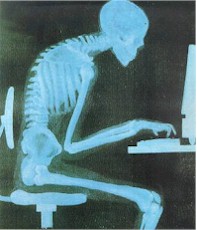
At different times in my life, I’ve been inclined to sit up straight, and I’ve been inclined to slouch. Maybe the same is true for you.
Unsurprisingly, at the times when my default is to sit up straight, I’m usually active in dance, yoga, or some sort of regular exercise that both strengthens my back and brings awareness to my bodily experience. This is kind of the mechanical explanation for posture: practice makes perfect. Just do it.
But recently a book helped me to re-member another, subtler aspect of sitting up.
It takes some courage.
Really. When I’m sitting erect and alert, I feel more permeable. I am not hiding. My body feels sturdy, in a way, but also fragile and exposed.
I think it’s possible to experience this fragility, openness, and permeable vulnerability even with a crooked spine. But for me, the straight spine is quite an effective jump-starter. It’s something I can control* that has a noticeable, positive (though sometimes challenging) effect on my mental state.
The act of sitting up automatically invites non-cognizing awareness. I’m not thinking, Okay, now shift the right hip 3 centimeters forward, raise the upper back 30 degrees… The awareness encourages the movement, and the movement encourages awareness.
This kind of awareness, or mindfulness, can feel pleasant, but it also contains a dark undertone. It is frightening to open awareness to painful sensations. Painful realities. Especially when I can’t control them with my thinking. I can’t think my way out of a sensory experience: an unpleasant smell, a twinge, a wave of nausea. And at the same time, burying them under mental chatter, while it may provide some temporary respite, does not make the unpleasantness disappear.
Why does this matter?
Maybe it doesn’t. But for me, returning to a straight back is like a small homecoming. In fact, regardless of whether I’m sitting straight or not, simply noticing where I’m at with my posture brings a different, brighter quality to my experience.
This is all dhamma stuff, in a way, and at the same time it’s non-sectarian, and not self-improvement. Straighten up, or don’t.
Here’s part of the chapter on Sitting from the abovementioned book, Sensory Awareness: The Rediscovery of Experiencing, which I checked out of the library on the urging of my friend David, a regular at Interfaith Bible Study at the Faithful Fools.
Now let us try coming to actual sitting. We leave the back of the chair for good, sensing the readjustments throughout our structure as the support is given up, feeling how we come more and more into the vertical, simultaneously reaching down to the seat of the chair and rising up from it.
If we are now really to relate to what we sit on, we must become much more awake than usual in the region of us directly in contact. Let us rise a little from the seat, pause, and gently find our way back without using hands or eyes. Can we find it? Ah! There is a definite meeting. Our nerves are as good down there as anywhere.
The question comes up: are we just padding down there where our sitting originates, as we may have always imagined? By no means! We begin to feel a definite structure, possibly as firm as the chair itself. To explore it let us raise one buttock and slip a hand underneath. Somewhat gingerly, we sit now on our own hand. Something in our bottom is not just firm but hard. Can we raise the other buttock, to sit on both hands at once? Ouch! We had not dreamed there would be such hardness. With relief, we divide our weight between our two hands, so as not to crush either. What is so hard in there? Even our heels do not seem so hard.
Cautiously, buttock by buttock, we leave our hands and return to the unprotesting seat. It becomes clear that, whatever the singular nomenclature for our bottom, sitting is actually divided between two sitting-bones. We can allow an equal or unequal distribution of weight, for more or less pressure on the seat, and of course on our own tissues. We can also “walk” with these sitting-bones. With a little experimentation, we find we can walk here and there on the seat until we are quite familiar with it, perhaps discovering a very agreeable perceptiveness in our own pelvis. Finally we may perch ourselves on the very edge of the chair, where our thighs no longer rest on anything, but bridge out into space. By this time our whole pelvis may be wide awake. [83-84]
—————————————————
*Even as I typed that sentence, my back slowly unfurled and straightened up in front of the computer! Ha! Now, we can’t always control our posture, or make our spine erect. I’ve been reminded of this over the last couple of months, watching my dad recover from a terrible spinal infection that initially made sitting up on his own impossible. Slowly, with agonizing pain, tremendous patience, and a lot of assistance, he regained the ability to sit up, to hermit-crab around the rehab center in a wheelchair, to stand, and now to walk, with a walker. What a gift, to be able to sit up straighter and straighter with less and less pain.
I hate tyranny.
Believe me, I do.
Each day I resolve anew to smash tyrannical impulses wherever they may lurk,
and destroy tyrannical structures wherever they may lord.
Like the sea star, my many arms stretch in many directions,
each fending off an enemy,
and like the sea star my guts burst forth out of my mouth,
and from my belly I bellow:
“Death to tyranny! Fuck you, tyranny! Fuck you!”
But countering my thrusts are a thousand treasons,
and even more traitors.
Every hour, it seems, an ugly surprise. A slap in the kisser.
I gamely push back. No pigeon shall shit on my head! It is declared.
No splinter shall burrow into my pinky,
No roommate shall pile up dirty dishes,
or sprinkle pubic hair on the toilet seat like an amateur parsley garnish.
No clock shall molasses its way through a boring psychology lecture
Or a morning at the DMV,
No mail delivery person shall give me the side-eye,
No ex-lover shall guilt-trip me with two tickets to Anthony Hamilton.
I fight every fight I can.
But these are just the preliminaries.
These are merely the foundational bricks of my anti-tyrannical fortress.
If I let these petty traitors get to me, I will lack the power necessary to defeat tyranny where it matters most.
So I grit my teeth and deplete my resources
(Each daily assault costs so many resources; it is truly exhausting.)
Let me tell you something.
One time, someone threw a glass of water in my face.
A fucking glass of water in my fucking face.
Can you imagine?
Who could do that to a person?
Not that it’s the worst thing been done to me, but still.
Who could ever justify throwing a glass of fucking water
In somebody’s fucking face?
At the time, what came to mind was a wind-battered cypress
reeling back from the treacherous coast, preparing
to strike the inevitable blow.
For a long time now, I’ve avoided giving book recommendations on dhamma. “Avoided” is too weak a word, really. There’s been some sort of block. It’s like I’ve been mentally and physically incapable of suggesting reading.
Part of this has to do with an awful experience I had with intellectualized Buddhism. When I got to Harvard as an eager, wide-eyed freshman, the very first elective class I took was a seminar on Indo-Tibetan Buddhism.
Dry, dry, dry, dry, dry.
I never read another word on dhamma for the next four years.
On the flip side of things, as a bibliophile and generally thinking-trapped individual, I’m acutely aware of how easily one can become fascinated and hypnotized by Buddhist philosophy, without ever really putting any of it into practice. So it sometimes feels false or misleading to recommend books, rather than just accompany someone in learning basic dhammic meditation training.
Bodhidharma, credited with bringing Zen Buddhism from Northern India to China. Dude is said to have cut his own eyelids off to stop himself from falling asleep while meditating.
But the truth is, even when people who are trained and do practice ask me for books, I’ve been slow and reluctant. So today is an effort to shift that.
A couple words about this short list. One, as you may notice, there is a lot of Mahayana, even though I’m down with the Hinayana. What can I say? When it comes to reading, I like what I like. Two, there are no suttas or canonic/original texts. Looking forward to diving into those in 2011. Three, the significance of these books in my life has had less to do with intellectual edification, and more to do with flat-out inspiring me to practice. There are many more fascinating Buddhist works, scholarship, biographies, etc. that have helped and educated me, but these are more along the lines of altering my worldview and day-to-day spiritual engagement.
So here we go: my top 5 dharma books, in chronological order of when I read them.
0. Entering the Stream: An Introduction to the Buddha and His Teachings
Edited by Samuel Bercholz and Sherab Chödzin Kohn
A wonderful and diverse collection of essays and excerpts that got me psyched on both reading and sitting practice.
Includes work by Shunryu Suzuki Roshi (“Zen Mind, Beginner’s Mind” – classic), Bhikku Bodhi (with whom I walked across the Golden Gate Bridge last week; amazing), and other greats.
I probably won’t be updating Kloncke for the next week or so, and that’s because, for my second time, I’ll be joining the Faithful Fools in their annual Street Retreat: seven days and nights living, sleeping, and reflecting in the streets of the Tenderloin neighborhood, in San Francisco.
Coming to terms with the street retreat as a reflective and humanizing practice has been difficult for me. To be honest, I still feel significant resistance to the idea. Fortunately, though, over the past few weeks I’ve been able to sit with this resistance and discomfort (a time when the dhamma practice has come in handy), talk with friends and other Fools about it, and work through it in a positive way.
Before getting into my reservations and reconciliations, here’s a nice, basic description of what the street retreat, from fellow Fool intern Josh Mann:
Starting this Saturday, I will be participating in my first week-long Street Retreat through the Faithful Fools. I’ll be leaving my money, cell phone, and keys behind and taking a sleeping bag and backpack. I plan to sleep outside and eat mostly in soup kitchens, and I anticipate a lot of searching for public bathrooms. Twice a day, I’ll be meeting up with eight to ten other people to reflect on the experience. And, some of us will be sleeping as a group.
Part of the mission of the Faithful Fools is to “participate in shattering myths about those living in poverty” and to help people discover what is common to all of us regardless of our economic standing or housing status. As a Street Retreat participant, I am asked to reflect throughout the retreat on what keeps me separate from others as well as what connects me.
Ever since my first term in college, I have felt compelled to engage the social issues of poverty and hunger, and I expect that this retreat will help me better understand these issues including the way that public policies, laws, and urban planning affect people with little to no money.
At the same time, the founders of the Faithful Fools put great emphasis on the fact that we are not pretending to be homeless. I will begin the retreat knowing that it has a specific end time on Saturday, October 30th. It also seems important for me to acknowledge that I go as an able-bodied, college-educated U.S. citizen who is white, male, and straight, which will no doubt be a factor in both how other people respond to me and how I experience the streets.
Please keep me in your thoughts this week. I seek to know my own heart, and I need all of the help I can get. I also invite you to participate with me in some way or another wherever you are. I recommend setting aside a little time one day to wander and see who and what you encounter. The spirit of this retreat as I understand it is to meet more deeply the people and places that we sometimes hurry past.
So there’s a little bit of background. As you can see, the retreat is not a study or experiment, nor is it a gimmick for “playing homeless.” The spirit is one of renunciation. We wouldn’t fast in order to “understand what it’s like to be a starving person,” but in order to push and expand our own views of the world we inhabit right now, as we are. It’s not about appropriating or trying on someone else’s experience (the simplistic idea of “standing in someone else’s shoes”), but about peeling off the layers of ourselves, the skins thickened by routine and dualism, that pervert our own views of reality — including our views of ourselves.
What had been bugging me so much, I think (and it disturbed me so strongly that I very nearly backed out of the whole thing), wasn’t the idea of the street retreat itself, but its purported connections to mechanisms of social transformation. I’ve talked on this blog before about what I see as the dangers of believing in a method for changing the world one mind at a time. This approach rightly observes that human social “systems” are made up of individual people, but wrongly induces that these systems are therefore merely the sum of their parts, and that persistent hearts-and-minds education can eventually (through influencing voters and “those in power”) translate into large-scale fundamental social improvements.
I disagree with this approach for various reasons; now isn’t the time to go into ’em. Suffice it to say, now that I’ve managed to decouple the reflective, community side of the street retreat from positive claims about its structural effectiveness, I feel a bit calmer about participating.
One common concern about street retreats is that we are “taking away resources” from people who need them, by eating in soup kitchens and sometimes sleeping in shelters (if we can get in). I sympathize with the concern here, but the way I see it is: we do far more to support poverty and homelessness through our everyday complacency with the capitalist system than we could possibly do by individually taking a couple dozen free meals. The scarcity (of beds, less frequently of food) is artificial.
Another frequent worry, especially from my dad: YOU ARE GOING TO GET YOURSELF KILLED. IT IS DANGEROUS OUT THERE.
Don’t worry, papa. (And others.) From my observation over the past year, there is little danger of random violence on the streets of the Tenderloin. The main types of violence we see here are (1) interpersonal violence among acquaintances, (2) low-level police violence in the form of harassment and enabling rape culture, and (2) structural violence, like the abovementioned artificial scarcity that keep families homeless while apartment buildings sit vacant for years, or the racist, sexist, homophobic criminalization of mental illness and drug addiction.
I guess both of these ‘responses,’ intended to allay fears, kind of sidestep the issues by pointing out how they are dwarfed by larger problems. Well, that’s sort of how it goes for me, at the moment. We’ll see if any more insights come during the week.
Wish me luck! I will try to log some time on the computers in the public library, but the lines are generally long, the connections slow, and the time limits brief.
Good morning, heartache
You old gloomy sight
Good morning, heartache
Thought we said goodbye last night
I tossed and turned until it seemed you had gone
But here you are with the dawn
Wish I’d forget you
But you’re here to stay
It seems I met you
When my love went away
Now every day I start by saying to you
Good morning, heartache, what’s new?
Stop haunting me now
Can’t chase you no how
Just leave me alone
I’ve got those Monday Blues
Straight through Sunday blues
Good morning, heartache
Here we go again
Good morning heartache
You’re the one who knew me when
Might as well get used to you hanging around
Good morning, heartache — sit down
Stop haunting me now
Can’t chase you no how
Just leave me alone
I’ve got those Monday Blues
Straight through Sunday blues
Good morning, heartache
Here we go again
Good morning, heartache
You’re the one who knew me when
Might as well get used to you hanging around
Good morning, heartache — sit down
This being human is a guest house.
Every morning a new arrival.
A joy, a depression, a meanness,
some momentary awareness comes
as an unexpected visitor.
Welcome and entertain them all!
Even if they’re a crowd of sorrows,
who violently sweep your house
empty of its furniture,
still, treat each guest honorably.
He may be clearing you out
for some new delight.
The dark thought, the shame, the malice,
meet them at the door laughing,
and invite them in.
Be grateful for whoever comes,
because each has been sent
as a guide from beyond.
Some of the smartest people I know — including my friend Ivan, and what I’ve read/heard by Suzuki Roshi — excel at failing. They know how to fail in ways that allow the flow to continue, if you know what I’m saying. The failure is not crippling, but just part of taking on a difficult challenge. Generally speaking, I think that people with scientific minds (including serious meditators) are pretty good at failing happily. Failing in ways that reveal new opportunities, even as they foreclose the ones we thought we wanted.
Endeavoring to improve on my ability to fail doesn’t mean tackling tasks that seem doomed from the start. That would be too easy! The kind of failure I’m talking about does not come cheap. I am invested. I want to succeed. Each attempt, each step, is made with confidence, commitment, and openness.
Suzuki Roshi says that this is how we move toward enlightenment. Through repeating small moments of enlightenment — those moments of a letting-go mind, a mind that is being, not chasing — while at the same time working hard to deepen and strengthen our practice.
I hope this is somewhat clear, what I’m trying to say. As an example of a recent, happy failure of mine, I wanted to share a letter I wrote to all the people I’d talked to with an interest in building a disarm BART police campaign. My intention in sending it was (1) to let folks know that I would no longer be pursuing the courses I’d proposed (for instance: organizing a direct action of civil disobedience for the day of Mehserle’s sentencing), and Why; and (2) to thank them for the inspiring connections we’d made in the course of the (eventual) failure.
It felt good to write this letter, not only because I have a lot of admiration and goodwill toward each of the recipients (including those with whom I disagree politically), but also because it was an exercise in observing and accepting reality as it is — rather than as I would like it to be. A little inroad into rooting out dukkha.
I’d love to know your thoughts, resonances, and criticisms.
Hello everybody,
Hope this note finds you well!
Over the past couple of months, I’ve been talking with BART workers, Oscar Grant movement organizers, Oakland peacekeepers, Marxist feminists, reverends, priests, meditators, lawyers, non-profiters, poets, anarchists, communists, peace activists, radicals, progressives, friends, and random strangers about the possibility of coalescing a campaign toward disarming the BART police. I and others envisioned this as one small step in aiding a shift from weaponized, racist, capitalist-serving security culture toward community-controlled safety initiatives, dual power, and restorative justice.






 I think it’s possible to experience this fragility, openness, and permeable vulnerability even with a crooked spine. But for me, the straight spine is quite an effective jump-starter. It’s something I can control* that has a noticeable, positive (though sometimes challenging) effect on my mental state.


 Kloncke