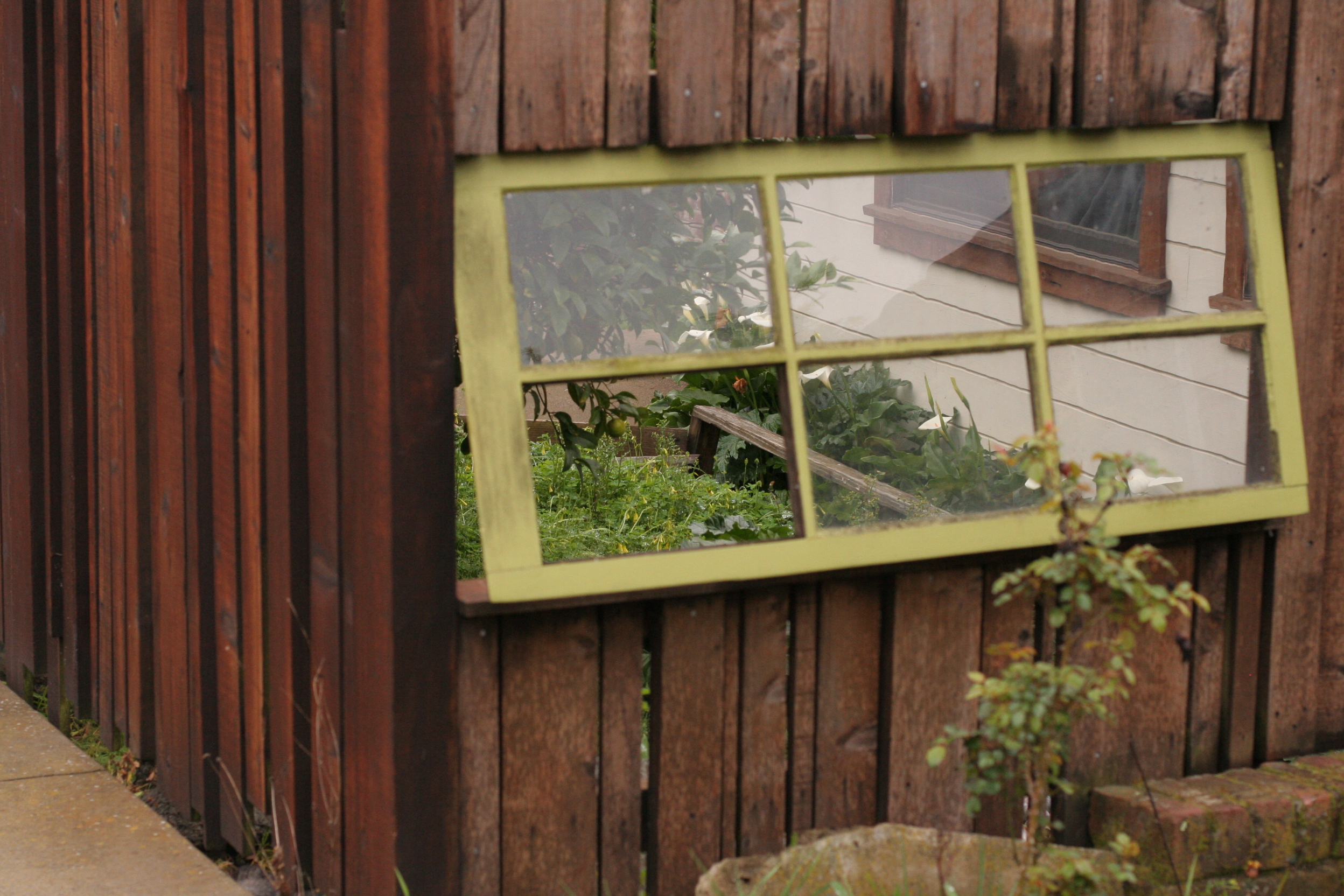
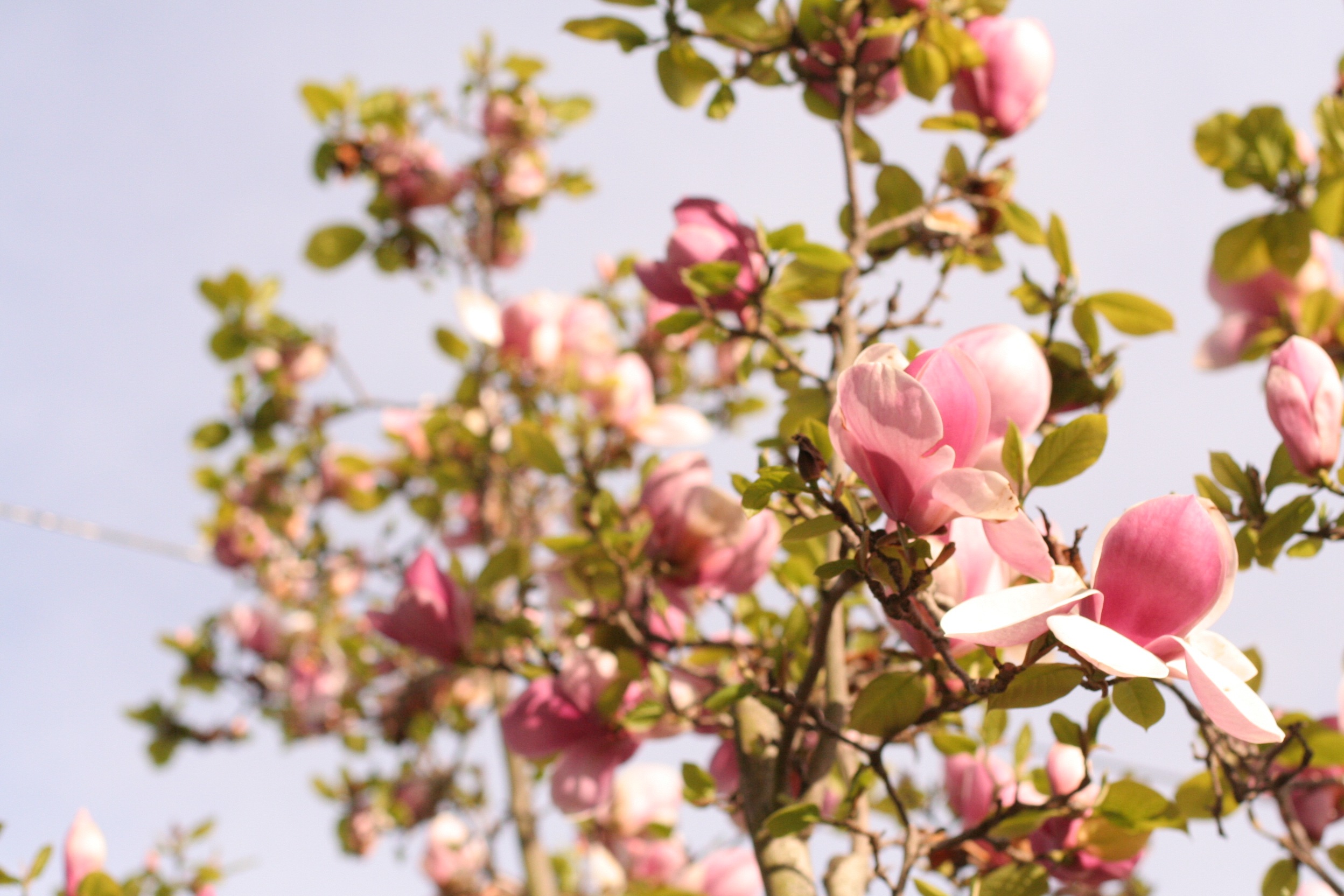
Still tongue-tied for the moment (though I did give a radio interview today, for the community station, on my blogging art practice and its connection to social justice). Click the photos to enlarge; they’re better that way. Especially that phenomenal fern.
Loving the first reading from a new Socially Engaged Buddhist study group that’s getting started this month: chapter 11 of Nalin Swaris’ book The Buddha’s Way To Human Liberation: A socio-historical approach. Swaris argues that karma is not properly understood (either in terms of actual functioning, or in terms of how the historical Buddha explained it) as an individual inheritance of bad or good deeds committed in past lives that determines one’s social station in this birth. Such commonplace/hegemonic conservative interpretations are basically ruling-class ideology, serving to legitimize the group(s) in power. “You were born a brahmin/king/rich light-skinned dude? You must’ve accumulated lots of merit in past lives. You were born ugly/a woman/poor/Black? You must’ve done some bad shit in a past life.”
Instead, Swaris defines karma as the inherited social and material conditions fashioned by previous generations of humans as a group, which then delimit but do not determine individual and collective actions in the present. Essentially, he locates Marxist historical materialism and dialectics within the original teachings of the Buddha. Dope! And kind of hilarious, in a makes-me-giddy-but-I-take-it-seriously sort of way.
Human Agency – A Species Potential
To understand what is meant by the ‘species nature’ of humans, one must turn to Karl Marx who introduced the concept. This recourse to Marx may seem like an attempt to read into the Buddha’s teaching on interpretation of kamma which has no basis in the canonical scriptures. I ask the reader to bear with me, follow the theoretical clarification and see its relevance to understand the Buddha’s extraordinary elucidations of human nature and human agency.
Sorry for the late post again — feeling pretty drained, with a lot of heavy stuff coming up this week. But! I am buoyed, so soulfully buoyed, by my mama, my partner, my peeps in organizing from the Bay to Seattle, friends near and far, the Oakland sunlight, the air, and troves of loving, radical praxis that I’m discovering, really trying on, for the first time.
The primary situation I’ve been directly engaging today is delicate and requires confidentiality. So instead of talking about my own ish, I just want to point to a resource that’s been a true blessing for me: the transformative justice (TJ) work of Philly Stands Up! (PSU), a volunteer collective in West Philadelphia.
What is TJ? From their web site, here’s PSU’s explanation:
Transformative Justice has no one definition. It is a way of practicing alternative justice which acknowledges individual experiences and identities and works to actively resist the state’s criminal injustice system.
Transformative Justice recognizes that oppression is at the root of all forms of harm, abuse and assault. As a practice it therefore aims to address and confront those oppressions on all levels and treats this concept as an integral part to accountability and healing. Generation FIVE does a great job of laying out the main goals, principles and questions of Transformative Justice. These are their words:
The goals of Transformative Justice are:
Safety, healing, and agency for survivors
Accountability and transformation for people who harm
Community action, healing, and accountability
Transformation of the social conditions that perpetuate violence – systems of oppression and exploitation, domination, and state violence
The principles of a Transformative Justice approach to addressing all forms of violence include:
Liberation
Shifting power
Accountability
Safety
Collective Action
Respect Cultural Difference/ Guard against Cultural Relativism
Sustainability
Transformative Justice invites us to ask:
How do we build our personal and collective capacity to respond to trauma and support accountability in a transformational way?
How do we shift power towards collective liberation?
How do we build effective and sustainable movements that are grounded in resilience and life-affirming power?
PSU, Generation FIVE, INCITE! Women of Color Against Violence, and other like-minded TJ groups are helping to co-construct, through community, some of the most exciting, uplifting, and inspiring praxical contributions to “collective liberation” that I have seen in a long time.
“Liberation” is a big, important, but tough-to-pin-down word for this blog, and it may not mean the same thing in dhammic/Buddhist and radical political/power contexts. Liberation from suffering in samsara requires different strategies and approaches (8-Fold Path as Buddha’s “program”? :) than liberation from capitalist imperialist heteropatriarchy. And yet, to my mind, especially in the realm of sila (morality, or basically how to live a “good” and wholesome life), there is room for tremendous, tremendous overlap.
Thanks to a workshop and texts from PSU and AORTA (Anti-Oppression Resource and Training Alliance), this afternoon I sensed some possibilities for synthesis between these two paths. A meticulous practice of compassion recommended by an erstwhile Indian prince over 2500 years ago, and a working model for confronting intimate violence — forged from the crucibles of so many struggles against racist heteropatriarchy, the State, and their interwoven, often co-morphous manifestations.
Buddhist suttas warn practitioners against heavy-handedness in concentration training (the focus should neither be too loose, nor too tight), and meditation teachers urge us over and over to be “firm yet gentle” with our chattering monkey minds, gradually teaching ourselves to rest our attention on the meditation object (in my tradition, that’s usually the breath). Is this mere people-pleasing packaging? Some sort of dogmatic or (what is probably the same thing) careless Middle Way-ism? No. The firm-yet-gentle combo doesn’t just sound nice and “balanced” — it points to an actually hospitable environment for difficult intentional transformation. Too gentle, and we get lazy, restless, defensive, or shut-down. Too firm, and we become dogmatic, dulled, judgmental, tightly-wound, and generally prone to missing the whole “compassion” boat, or burning out altogether.
Similar principles, it seems to me, apply to TJ work. If our goal is to foster transformation, we need to be firm yet gentle — not too loose, and not too tight. This is a radical departure from the punitive model of justice on which the US legal system is based (and irregularly, prejudicially, oppressively applied). It invites us, as the above definition says, to “respond” to trauma, not react. Rather than “cracking down” on people who commit violent behaviors, we stop excusing, minimizing, and supporting those behaviors. We work instead to “water the good seeds” (as Thich Nhat Hanh says of inclinations in the mind) of meaningful accountability (in other words, a process with real milestones, material structure, boundaries, consequences, goals, etc.) and support.
Is this all making sense? So very new and tender shoots, these are. I’m no urban gardener but I’m trying the best I can.
Check out the zine by Philly Stands Up!, “A Stand Up Start Up.” Let me know what you think.
take care, friends,
katie
———————————————————— Update: For a great list of oppression-denying and -compounding behaviors (“excusing, minimizing, and supporting”), I’ve added a link to a post by NellaLou on “Sex and the Sangha,” looking in part at the various types of responses to the recent exposure of some Zen teachers’ sexual misconduct with their students. It’s a really wonderful resource for naming the harmful and frustrating apologistic dynamics that often accompany the outing of intimate abuse, and NellaLou also points toward restorative justice as an alternative model. Thanks, NellaLou!
Say what you will about Saul Alinsky: the man organized some creative actions. I’ll never forget one example of his (I think he described it in Rules For Radicals) where the community cooked and ate a huge baked-bean dinner, then packed an orchestra hall owned by the “enemy,” and let loose with their own smelly music.
This weekend’s East Bay Solidarity Network action wasn’t quite so dramatic, but I did feel a resonance with Alinsky’s tactical virtuosity. We knew why we were there, who the target was, what we wanted to accomplish, and how it fits in to the larger strategy of the fight. And we even saw encouraging results during the action itself.
My own personal ruminations revolve (unsurprisingly) around whether and where there is room for compassion within direct actions that make a target uncomfortable — or “harm” them (major scare-quotes) economically. Actions that tend (especially in a masculinist context) to dramatize and promote an ‘us versus them’ framework. I’ll be contemplating this question much more over the next couple of months, but for now I’ll just say this. I believe it’s possible to speak and act very forcefully against a perpetrator (I’m experimenting with saying “perpetrator,” rather than “enemy,” to guard against the typically dehumanizing crystallization of enemyism, and to invoke the work of radical anti-sexual-violence communities that seek to transform both behaviors and systems) while still maintaining compassion for them. It’s something I’m experimenting with myself, in this EBSol work.
With that said, I’m just gonna go ‘head and cross-post the whole entry on today’s action from our brand-spankin’-new website. Hope you enjoy!
Making Good On Our Promises
Monday EBSol flyering squad (Sunday team not pictured)
In our demand letter that we delivered to Alpha Omicron Pi sorority two weeks ago, we promised to return in 14 days if our reasonable demands were not met. True to our word, yesterday and today we continued our campaign to win former “house boy” employee and tenant William fair compensation for his shady firing and the outrageous eviction that left him homeless.
For our second action, both yesterday and today, we flyered and door-knocked the surrounding blocks to inform the whole neighborhood of the egregious injustice. We don’t know what was more encouraging: the enthusiasm from neighborhood co-op members (some even offered their contact info and asked to be notified of future actions), or the surprise and horror of the sorority managers when they realized what our posters were airing.
Less than 24 hours after our Sunday flyering session, taped shreds of paper — remnants of our flyers — testified to the sorority managers’ embarrassment. Before we had even left the block, they were already tearing down our work from the street signs and telephone poles. But today we were back for another round! They won’t get rid of us easily.
The bosses are already on the defensive, and this fight is just getting started. If you want to join us as we ramp things up with escalating actions, email or call us to make sure you’re on our contact list!
At a dhamma study group that met at my house this weekend, we discussed this passage from the Satipatthana Sutta, out of the Middle Length Discourses of the Buddha. It’s come in handy for me this week.
3. Contemplation of the Mind-State
And how, bhikkhus, does a bhikkhu abide contemplating mind as mind? Here a bhikkhu understands mind affected by lust as mind affected by lust, and mind unaffected by lust as mind unaffected by lust. He understands mind affected by hate as mind affected by hate, and mind unaffected by hate. He understands mind affected by delusion as mind affected by delusion, and mind unaffected by delusion as mind unaffected by delusion. He understands contracted mind as contracted mind, and distracted mind as distracted mind as distracted mind. He understands exalted mind as exalted mind, and unexalted mind as unexalted mind. He understands surpassed mind as surpassed mind, and unsurpassed mind as unsurpassed mind. He understands concentrated mind as concentrated mind, and unconcentrated mind as unconcentrated mind. He understands liberated mind as liberated mind, and unliberated mind as unliberated mind.
In this way he abides contemplating mind as mind internally, or he abides contemplating mind as mind externally, or he abides contemplating mind as mind both internally and externally. Or else he abides contemplating in mind its arising factors, or he abides contemplating in mind its vanishing factors, or he abides contemplating in mind both its arising and vanishing factors. Or else mindfulness that ‘there is a mind’ is simply established in him to the extent necessary for bare knowledge and mindfulness. And he abides independent, not clinging to anything in the world. That is how a bhikkhu abides contemplating mind as mind.
Hey, friends! Today I want to share a new game I learned from a fellow member of my dhamma study group. It’s a Buddhist game, sort of. Here’s how it works.
PHASE 1:
Team up with a partner and take turns asking each other the following question-pair.
What are you noticing right now?
[Partner responds]
Is that pleasant, unpleasant, or neutral?
[Partner responds]
Thank you.
. . . What are you noticing now?
Keep up the exercise for about 2-3 minutes, then switch roles.
PHASE 2:
Now ask the following question-pairs:
What is something pleasant that you’re noticing right now?
[Partner responds]
What is your reaction to it?
[Partner responds]
Thank you. What is something neutral that you’re noticing right now?
[Partner responds]
What is your reaction to it?
[Partner responds]
Thank you. What is something unpleasant that you’re noticing right now?
[Partner responds]
What is your reaction to it?
[Partner responds]
Thank you.
Keep repeating the cycle (doesn’t really matter what order) for 2-3 minutes, then switch roles.
The responses to the questions can be internal or external — “I’m noticing that I’m having anxious thoughts about finding a job;” “I’m noticing the pillowy clouds out the window;” “I’m noticing a slight coldness in my hands.” It doesn’t matter whether they are pleasant, unpleasant or neutral in some objective sense (for instance, I might call the odor of skunks or gasoline pleasant, while my mom finds them nauseating). What matters is your own subjective experience.
The point is not to get all deep or articulate with the observations, but to keep it as stream-of-consciousness as possible. I think the game originates from the “noting” practice common among many Buddhists (particularly, if I’m not mistaken, Theravada/Thai Forest/Insight? Zen folks, Tibetan peeps, help me out?). With “noting,” you meditate while bringing awareness to different sensations in the body, and also to the umbrella category of “thinking.” Some forms involve naming or labeling the sensations; others advise against that.
For me, these exercises and games, and the logic behind them, have been quite useful. They bring our calm attention to what Buddhists call vedanā: a Pali word for “sensations.” Typically, the teachings say, our habit is to react to vedanā with various types of attachment or ignorance. When we experience a pleasant sensation, we often crave more of it. We want it to continue. When we experience something unpleasant, we wish it would go away as fast as possible. Neutral sensations, which make up a huge part of our everyday life, often escape our notice altogether; we don’t find them worthy or interesting enough to pay attention to.
What happens when we start bringing investigative attention to vedanā? It allows us to decouple our experiences from our reactions.
Sorry I’ve been lagging so hard on the posting lately. Things have been super busy offline! Political education classes; meet-ups; meetings; paid work (thankfully); etc. etc. This weekend Ryan and I are going camping with a couple friends. Can’t wait to be among those big trees.
Anyway, recently I’ve been feeling re-inspired about the Radical Sangha idea, and wanted to be more vocal here about the particular “dharma doors” I’ve been encountering lately. Now isn’t the ideal time, since I’m headed out the door to a birthday party, but I wanted to quickly pass along this lovely piece (via Mushim Ikeda-Nash‘s Facebook feed) that helped refresh my practice today. It comes from a Tibetan tradition. Sogyal Rinpoche recalls the teachings of Dudjom Rinpoche on the three qualities every human should cultivate: sampa zangpo, tenpo, and lhöpo (a good heart; stability and reliability; and spaciousness, or being at ease with oneself).
The whole piece is worth a read over on Tricycle, but I especially loved these two paragraphs on reliability and spaciousness.
For example, a string of beads has a thread running through all the beads, keeping them together. What we need is a thread too—of sanity* and stability. Because when you have a thread, even though each bead is separate, they hang together. When we have the teachings in us, stabilizing us, there’s a thread to keep our life together that prevents us from falling apart. And when you have this string, you have flexibility, too. That’s how you can have the freedom to be unique and special and individual and still have stability and humor. This kind of character is what we need to develop; this character is the thread.
*Thanks to insightful feminist critique of similar, though slightly worse phrasing in a different Buddhist essay, I now cringe when the word “sanity” gets thrown into pieces like this. It’s not something to take lightly in a society like ours where people are persecuted and violently oppressed because of a perceived lack of “sanity.” So I want to mark that, and yet acknowledge that most people, even on a broad spectrum of neurodiversity and psychodiversity, probably experience moments and phases of greater or lesser stability, characterized by comfortable, firm groundedness that’s not overly rigid.
On spaciousness, Sogyal Rinpoche writes,
If we are at ease with ourselves, we are at ease with others. If we are not at ease with ourselves, then we will be uncomfortable, especially in company. Imagine you find yourself at a smart party in Paris. All kinds of people are there, from different backgrounds, slightly different from you, and one very suave and successful person turns round to greet you. Even the way he says “bonjour” has a supercilious air about it, as he looks down his nose at you condescendingly. If you’re at ease with yourself, there’s no problem. He can drawl “bonjour” and look down on you, and you feel completely fine, because for you it is actually a bon jour, since you are well with yourself.
When we are well with ourselves, then whatever happens, it really doesn’t matter, because we have equilibrium and stability. We don’t feel any lack of confidence. If not, we’re always on edge, waiting to see how someone reacts to us, what people say to us or think about us. Our confidence hangs on what people tell us about how we are, how we look, how we behave. When we are really in touch with ourselves, we know ourselves beyond what others may tell us.
Spaciousness is an especially great asset for political folks, it seems to me. It allows us to face conflict without feeling backed into a corner, trapped and defensive. Far from passivity, I find that spaciousness means a robust engagement with many different dimensions of a situation. It makes room for anger, fear, resentment, and all that fetid stuff: neither repressing it nor allowing it to dominate the entire mental environment.
Very useful — to me, anyway, and I hope to you, too! Have a wonderful weekend, folks; see you Monday.
This question’s been yelling itself in my face for the past couple of days. (Weeks?) Not only in theoretical terms, but in practical ways. Touched on by elders, peers, friends, strangers.
Roughly (and this is my own attempt, for which I’ll accept blame but not credit):
Some groups are great at building and exemplifying models of anti-oppressive ways of being. (Pre-figurative politics, as I understand it, means practicing now the kind of society you want to build in the future.) Enacting horizontal group dynamics, confronting white supremacist and racist behavior, challenging and transforming sexism, homophobia, transphobia, fatphobia, ableism, etc. in myriad ways, and continually developing sophisticated, intersectional analyses of these lived oppressions. Honoring and valuing healing; promoting literacy around dealing with trauma and mental wellness. Developing healthy sex-positive cultures grounded in consent. Practicing conscientious methods for dealing with intimate violence and abuse. Giving and receiving criticism with humility, generosity, bravery, and kindness. Doing very practical things like organizing childcare collectives, artmaking groups, and food distribution programs; infusing them with liberatory values. Transforming estranged relationship with our bodies, the earth, and nature. Theorizing these and more practices, and sharing them.
At the same time, some groups are great at developing people’s revolutionary class consciousness. Examining the material processes of history with an eye toward figuring out the best ways to intervene in those historical processes, and change things for the better. Get rid of classes altogether. Put an end to imperialism. Employ practice and theory, in current conditions, to avoid the pitfall of reformism and move militantly and decisively toward a world of “freely associating producers” — a world where violent compulsion is no longer ambient, as it is under capitalism and has been under all forms of class society (to stake a claim against what I learned about Foucault, in college). I’m impressed and inspired by groups that maintain a keen focus on this goal, and whose work reflects the urgency of building the class power necessary for exploited people to liberate themselves/ourselves from the yoke (and rod) of capital.
Now. Is there overlap between these ‘types’ of groups?
Yes.
A lot?
In the Bay Area? In the US?
IIIIIIII dunno. What do you think? What are you finding?
Tricycle has a wonderful interview with Burmese monastic Sayadaw U Tejaniya, who authored a book with a fabulous title (see above). When asked about its name, he responds,
We picked the title because it is important not to underestimate the power of the defilements. When I teach meditation I emphasize the importance of watching the mind. While doing this you will see a lot of defilements. In their grosser manifestations, the defilements are anger, greed, and delusion. And they have plenty of friends and relatives, who often show up as the five hindrances: desire, aversion, torpor, restlessness, and doubt. I advise yogis to get to know and investigate the defilements, because only through understanding them can we learn to handle them and eventually become free of them. If we ignore them, the joke’s on us: they’ll always get the better of us.
If they cause us so much grief, why do we ignore them? People often become attached to what they’re good at, to what they’ve achieved; they only want to see their good sides. Therefore they often don’t acknowledge their weaknesses. They become proud and conceited because they don’t see their negative sides. But if you cannot see both sides, the good and the bad, you can’t say the picture is complete. If you do not observe the defilements wisdom cannot grow.
Is wisdom an absence of defilements? Yes, when there is right understanding there won’t be any defilements. They are opposites; non-delusion is wisdom. Wisdom inclines toward the good but is not attached to it. It shies away from what is not good, but has no aversion to it. Wisdom recognizes the difference between skillful and unskillful, and it sees the undesirability of the unskillful.
The whole interview is well worth a read — he gets into a range of topics, from learning more and more effective ways of overcoming his own depression, to the folly of mistaking the sitting posture for the meditation itself — but I just wanted to flag a resonance between the danger of condescension in spiritual work, and parallel problems in political efforts.
I don’t remember who exactly — though I have a hunch it was Joseph Goldstein — who said, at a dharma talk I went to once at CIMC, that much of dukkha (the Buddhist word for “suffering” — the basis of the First Noble Truth) is not this dramatic, cataclysmic affair. Instead, the majority of dukkha is like rubbing your face softly against a brick wall. Doesn’t really hurt. But the problem is, we don’t stop. We keep on rubbing . . . and rubbing . . . and rubbing. Ouch.
I think a similar insight finds its expression in those two unforgettable lines of the poem I shared here last year, by Nyoshul Khenpo:
Those with dualistic perception regard suffering as happiness,
Like they who lick the honey from a razor’s edge.
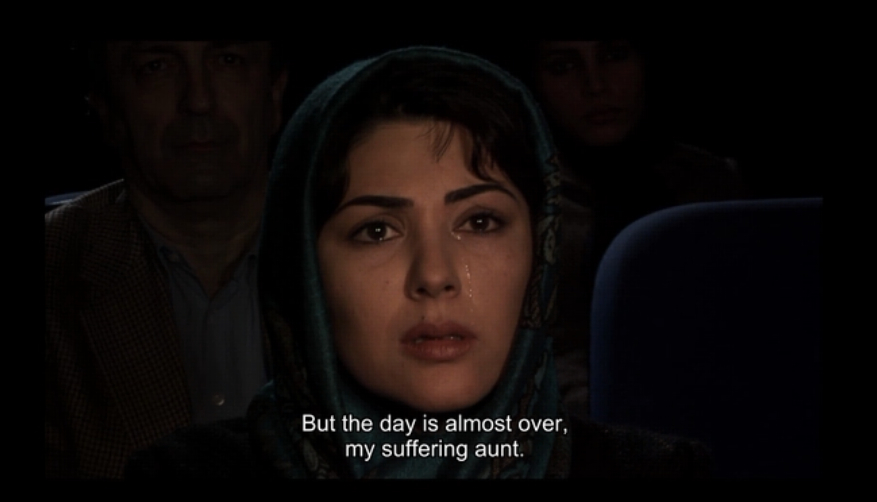
And yesterday, this dharma found its way to me yet again, in the form of an Iranian movie. Celebrated filmmaker Abbas Kiarostami created this work, Shirin, by filming the faces of over 100 Iranian stage and screen actresses as they themselves watch a film of an 800-year-old Persian epic love poem: the story of Shirin and Khosrow. Shirin is an hour and thirty minutes of framed face shots, inviting us to meditate on subtle and dramatic changes of expression as the women become emotionally involved with the story. The film also invokes self-consciousness about our own being and emotional vicariousness: spectators spectating other spectators.
For me, the arresting part in the epic poem (which is both audible and subtitled in Kiarostami’s film) was this, from a scene where a dying queen shares her final words with her heiress, Shirin:
AUNT: “I had my blossoming spring, I grew old at fall. Now I welcome the winter and the snow that will cover my grave.”
SHIRIN—”Haven’t I suffered enough? My heart can’t afford to be broken again, or my body to be abandoned.”
AUNT: “It took me a long time on this earth to understand that the joys of life are like the caress of a feather on the palm of your hand. Pleasurable at first, and a real torment if it perdures. I leave this earth to people who deserve a better life.”
(Visuals show women’s faces, teary and crying.)
The feathers tickling our palms are not emotions themselves. Rather, they are the self-generated process of reacting blindly to those emotions: embracing pleasant ones and running from unpleasant ones. We blindly, habitually react in countless small ways like this every day, allowing transient moods and the vicissitudes of experience — pain, pleasure, neutrality — to dictate our internal well-being.
Part of what I love about Kiarostami’s film, though, is that it allows us to step back from our emotional entanglements and watch them play out externally, on a stream of other faces. It’s like ninety minutes of looking in a mirror, and watching the flow of feeling pass by, unhindered. We don’t get to know any one woman long enough to get caught up in her story. It’s simply beautiful to greet her for a moment, welcoming her into a growing rosary of all the audience members. I’m reminded that I myself am, in some ways, a rosary of many faces: always changing, counted one by one. This allows me to relax. It’s the same comfort I feel when I look out the window on a long train or bus ride. The scenery is flowing by so quickly that there’s no time to fixate on it; and so I let go and simply watch. Give the feather — and the brick wall — a rest.










 Kloncke