bfp at Feministe, Indigenous Land Defense at Home

The owner of this business, which desecrated a 3,500-year-old Ohlone shellmound in order to construct its offices, now wants to build a vacation home on other sacred indigenous land: this time on Rattlesnake Island in Lake County, CA.

Don’t have much time to chat today, friends, but those of you who’ve been following Kloncke for a while will know just how jazzed I am that brownfemipower (a.k.a. bfp) is guest-blogging at Feministe.  She’s taking an in-depth material look at her home state of Michigan, or, in her words:

While I’m here, I’ll be working to contextualize all the big words: “post-industrialization,” “nationalism,” “white supremacist heteropatriarchy,” “decay porn,” “borders,” “distribution systems,” etc within a framework that centers Detroit, Michigan, and the US Midwest.

Or I may just wind up posting pretty pictures. Who knows. :D

In her first post offering background on the region, bfp begins with a brief overview of the indigenous peoples from whom the land was stolen.

It’s important to know about Michigan’s history of colonization because indigenous peoples in Michigan are still still struggling with the vestiges of colonization. They are also leaders in the fight against corporate violence against the land and the people. There is often a false idea that the violences of industrialization play out almost exclusively in urban areas. But those serene lakes and beautiful mountains we all like going to for our week vacation are the same places that keep the urban factories up and running.

Yep, primitive accumulation, and capitalists’ access to natural resources, has everything to do with imperialism, colonization, genocide, enslavement, and misogyny and heteropatriarchy.  Advance the Struggle had a good post a while back touching on this link between pro-communist struggle and indigenous land defense, using as an illustrative example the recently successful defense of Sogorea Te / Glen Cove, up in Vallejo (photos of the encampment at the end of that post) — in which Ryan, I, and other East Bay Solidarity friends played a very small supportive role.

Now it looks like we and EastBaySol may have another opportunity to support the defense of indigenous sacred land from bourgeois development.  (The aggressor’s business, Nady Electronics, has offices in Emeryville, about a mile away from Ryan’s and my apartment, located right on top of an Ohlone sacred shellmound.  The guy just won’t let up, apparently.)  I received this press release in my email today.  The money quote:

Supervisor Comstock, the Lake County Board Supervisor who cast the deciding vote, commented, “I’m a huge proponent of private property rights.” He added, “My family’s been living in Lake County for 150 years- you can’t get more native than that”.

Yet another example of institutional white supremacy and heteropatriarchy supporting the accumulation of capital & resources to the (historically white, patriarchal) ruling class.  Time to remind this dude, through direct action and defense, that yes, you can get more native than that.  Entire press release after the jump.
Continue reading

Ten Year Anniversary of the War

via Lydia Pelot-Hobbs.

On the morning ten years ago when we in Sacramento heard the news, I remember my dad driving me to school. Us listening to the radio. I didn’t really understand what was happening (then again, who did?), but I remember starting to cry when I realized that people in other parts of the world live in fear of bombings every day.

What does it mean to hope and pray for a better society, free from imperialist wars, patriarchy, racism, and class, without rejecting or wishing away the current reality?

To me, it means: now (the present) is the best and only time we have in which to try our hardest. To keep building toward the freedoms we wish for all beings.

We may not live to see it, but we can help create it.

Quick Snapshot of Today’s Action

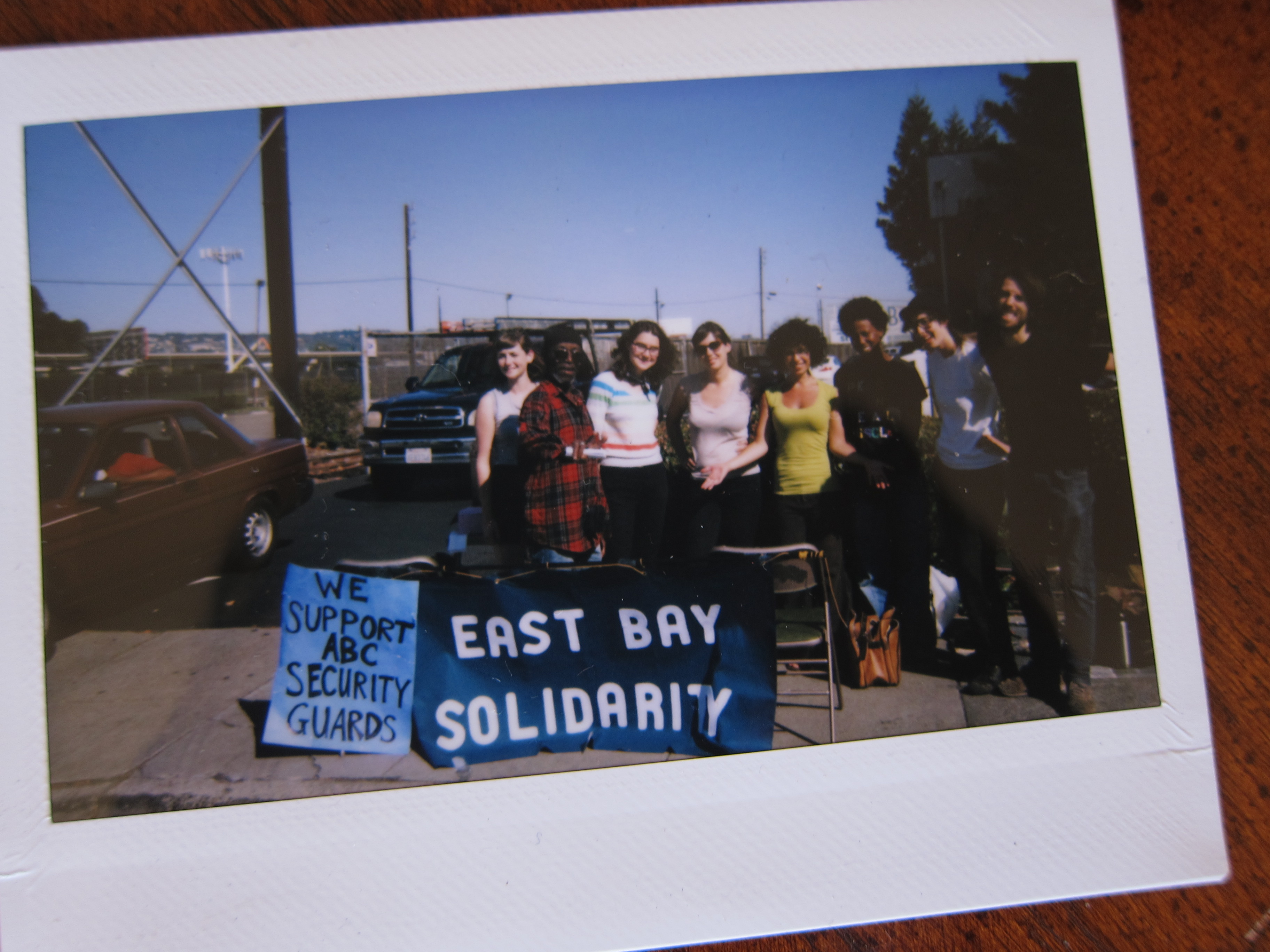
Polaroid by Anastasia. More than 20 people came out to flyer under hot Oakland sun.

In a crucial step for Mel’s fight to win back his job and improve conditions at the site where he had been working as a security guard, over 20 people from the still-fledgling East Bay Solidarity Network staged an all-day fact-finding and outreaching session at the entrance to the offices of ABC Security: Mel’s former (and hopefully future) employer. Today was payday, and workers were coming to get their checks. As they entered and exited the long driveway leading to the private-property offices, we distributed our flyers explaining Mel’s fight. In a few hurried words, we tried to agitate* ABC guards by asking them how they felt about their job (most: from so-so to shitty) and what ever happened to that raise they’d been promised (three years and no sign of it). Some of the guards were hella down for what we’re doing (quote: “Yeah, the company doesn’t care if people die”), and their ire toward ABC’s owner only increased when we showed them photos of her mansion in the Oakland hills.

__

Most importantly, though, the workers aided us by providing names of sites that employ ABC guards. Now that we’ve collected this client list (ranging from apartment complexes to warehouses and a golf course), we can use it to apply economic pressure to the company, escalating the fight to serious levels.

One of the highlights of the day, for me, was seeing Mel stand up to the supervisor who got him fired, with ten of us standing there to support him. Bolsters my hope that our group is helping shift the balance of power further toward the lowest-paid workers, and away from managers and millionaire CEOs.

Waiting for workers to pass through the driveway afforded us time to connect with each other, too. These are some lovely, vibrant people with great visions of building solidarity in the East Bay and beyond. (Earlier morning conversations focused around movements in Mexico, Chile, and Argentina, and how we might ally with / extend them here in Oakland.)

Anyway, I’ll keep you posted if/when we post an official account on the EastBaySol blog, but just wanted to share some of the joy of the day! Hope you’re well, friends.

Not Gonna Lie: I’m Proud Of Our Banner

__

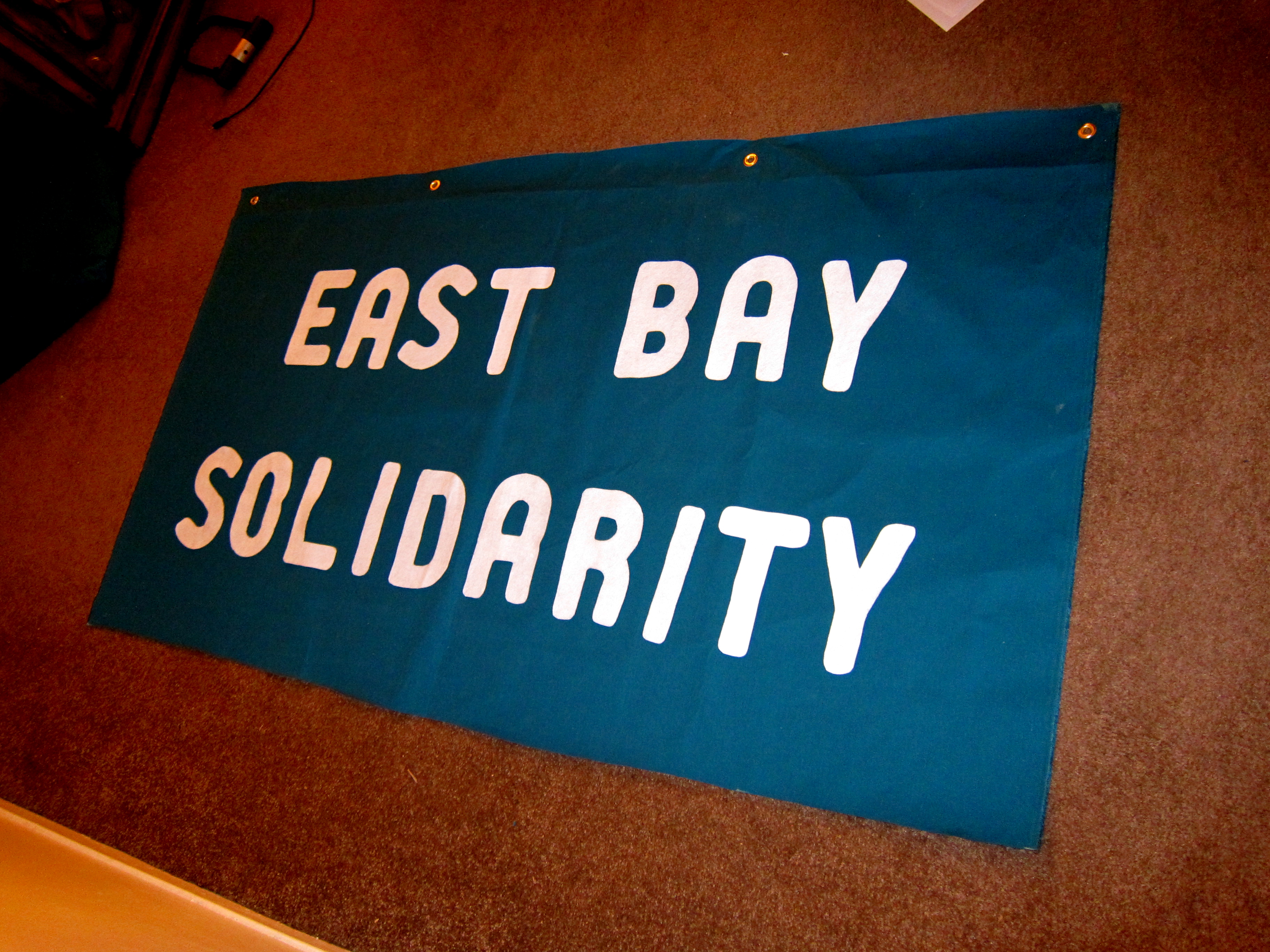
Spent today shopping for an East Bay Solidarity Network sign-making party, agonizing for an embarrassingly long time over what color (and heft) of banner fabric to get, and what color felt for the letters, and later (with William) what font to use. But now it’s finished — grommets and all — and looks F%*@IN’ SICK, if I do say so myself. :)

Between printing the letters, cutting them out, tracing them onto the white felt, and then cutting out the felt and gluing the letters onto the banner, our core organizers also called all the people on our phone tree to mobilize for the next action, coming up on Wednesday. Cooperating on mini-projects over weeks and months is cultivating a beautiful ease among us. We crack each other up; we respect each others’ opinions. We brew each other tea. (Louise, if you’re reading this: we will miss you!)

Next week, after the action, I’ll share photos of the fight-specific signs we made. Right now it’s time to sleep the deep, delicious sleep of the DIY-satisfied.

__

Ableism and East Bay Solidarity Network

Love this image from Mingus' site, labeled "watercolor painting of an octopus done in greens, yellows, oranges and pinks."

To me, femme must include ending ableism, white supremacy, heterosexism, the gender binary, economic exploitation, sexual violence, population control, male supremacy, war and militarization, and ownership of children and land.

—from Mia Mingus’ keynote, “Moving Toward the Ugly: A Politic Beyond Desirability” at the Femmes of Color Symposium this weekend in Oakland

Yesterday: downtown Oakland is in full Art-And-Soul festival mode, and a small squad of us from East Bay Solidarity Network gather outside its gated entrance to do our own jovial yet serious work. Once we finally locate one another in the crowd (who has whose cell numbers?), it’s on to the business of distributing xeroxed posters and tape (did we bring enough tape? it sucks to run out), and divvying out areas to flyer. Some of us are slow and others are impatient.  Caught in between as an unofficially appointed problem solver, I feel my face edge toward a scowl. Luckily, though, our little gang laughs together more and more as months pass. And laughter is nature’s aspirin for the headache of logistics.  Besides: no one’s getting paid here, and there are no managers or fears of getting fired and losing that paycheck, so we’re more free to move at our own pace.

Have I told you about our current fight? Mel Hill was a security guard working for ABC Security. After working at a number of different locations, he was stationed way, way out at a bus yard, miles from any public transport. The way Mel puts it: “I had leg muscles big as Popeye from walking to and from work.” He posted up in a little World War II tin shack (“hot when it’s hot; cold when it’s cold”) with no heat, electricity, water — nothing. Leaks in the roof let the rain in. Misery. After months of enduring this, with no administrative response to his complaints, he began bringing a yellow blanket along on his shifts, to keep himself warm. This, he was told by management, is “unprofessional” and unacceptable.  Eventually Mel was fired, and brought his case to us, the East Bay Solidarity Network.  We explained that in order for us to take on his fight to win his job back and improve site conditions, he would have to join the network and agree to be there for other people’s fights, as well.

There’s more than enough fights to go around.

Economic need compels people who don’t own the means of production (a.k.a. the vast majority of us) to work in conditions that are often terrible for our bodies. Job conditions are set up that way in order to save time and production costs (including wages). If we object, as Mel did, we get the message (implicitly or explicitly) that (a) we’re lazy, or (b) our bodies are the problem; our bodies are defective. Look: other people can do it. Why can’t you?  Stop bringing the blanket.  It’s unprofessional.

What can we do about this core of ableism within the exploitative, competitive, profit-driven system?

Master of not-fitting: Chican@ queer & disability scholar Gloria Anzaldúa

Continue reading

On Self Defense from Cops, Men, and Slumlords

Been a little under the weather, on and off, over the last few days.  Downsides: pain.  Upsides: opportunities to observe pain, and taking time to lie low and read hella articles on the Innernet. Here are three of them which happen to be about self-defense.

  • Deadly Secrets: How California Law Has Shielded Oakland Police Violence
    Oakland Police Headquarters in Downtown Oakland, CA. (Photo by Jorge Rivas/Colorlines.com)

    Colorlines has a meticulously researched article about the secrecy and opacity shrouding Oakland police personnel reports.  Some say that if the public had access to these files, they could be used to weed out ‘loose cannon’ cops before their aggression leads to fatal shootings.  But problems with policing go way deeper than that, if you ask me — including pro-ruling-class trends in the laws that police are paid to enforce as an arm of the state.  In any case, responses to OPD brutality seem to fall into three camps: individual lawsuits; accountability/reform measures; and resistance/defiance.  I was sensing some author bias toward accountability, but you can read for yourself.  One of the only mentions of on-the-streets resistance to OPD brutality, the riots following Oscar Grant’s murder, is glossed over in a somewhat awkwardly placed sentence: “Rachel Jackson, an organizer of the Bay Area protests of Oscar Grant’s killing, says the indictment on murder charges of ex-BART Officer Johannes Mehserle, following widespread public outcry, is proof of the point: ‘If there’s street heat, they’ll do something.’” [Emphasis mine.]  On one hand, I appreciate that the author is illuminating OPD murder cases besides Grant’s.  On the other hand, the lack of elaboration on Jackson’s crucial political claim seems, uh, strange. Given that we regard OPD murder patterns as a problem (to say nothing of other types of police-on-people violence, like sexual assault), what are our best strategies for self-defense? Shouldn’t we discuss that underlying orientation?

  • In a very different and awesome take on community safety and protection:
    __

    Continue reading

Thanissaro Bhikkhu and Planet of the Apes: On Restraint, Dignity, and Power

__

Thanissaro Bhikkhu, a Theravadan Buddhist monk, lays it down in Tricycle Magazine with a fabulous article on restraint.

(via wonderful dhamma teacher Mushim Ikeda-Nash.)

When you’re meditating, the same process [of restraint] holds. People sometimes wonder why they can’t get their minds to concentrate. It’s because they’re not willing to give up other interests, even for the time being. A thought comes and you just go right after it without checking to see where it’s going. This idea comes that sounds interesting, that looks intriguing, you’ve got a whole hour to think about whatever you want. If that’s your attitude toward the meditation period, nothing’s going to get accomplished. You have to realize that this is your opportunity to get the mind stable and still. In order to do that, you have to give up all kinds of other thoughts. Thoughts about the past, thoughts about the future, figuring this out, planning for that, whatever: you have to put them all aside. No matter how wonderful or sophisticated those thoughts are, you just say no to them.

YES! Good Lord, it always seems like my best, most nuanced ideas come when I’m trying to meditate. And all I want to do is get up from the floor and go write them down. Or else I’ll forget! And this key conceptual innovation will be lost forever! People will die and movements will perish unless I fully formulate and record this thought!

Underlying this mildly desperate grasping, for me, anyway, is the notion that my ideas, my intellectual products, are my most important features and contributions. “Features” in the sense that they might make me more admirable; “contributions” in the sense that they might make me more useful. If an idea can be articulated, recorded, and disseminated, it will be worth more to a greater number of people than my 60 minutes of calm, settled mind, which are beneficial only to me.

But what Thanissaro Bhikkhu is getting at, I think, is that ways of being — i.e. patience, restraint, generosity, and dignity — can be equally important features and contributions.

I think that in some way, this is borne out through his article itself. He’s talking about patience and dignity, he’s using well-crafted language to describe it, which is lovely and useful. But it is our experiences of beneficial patience, restraint, dignity and generosity that leave more profound impressions on us, and on the ways we engage the world. Observing, emulating, and deliberately cultivating these qualities intervenes more significantly in culture (even on the level of our friendship groups, or workplaces, or organizing committees) than an eloquent description of their beauty.

If that doesn’t grab you, and you still think good ideas are the shit, consider this: a calm mind can act as a stronger foundation for discernment and discriminating thought. So even if we have to let go of some idea-streams in the short term, in the long term we may learn to call on a broader range of faculties in determining which ideas are worthy of extended investigation. We may find that we need to ‘chase’ good ideas less, and instead allow them to arise and show themselves in our minds.

I do have one quibble with Thanissaro’s article, though. While I completely agree that much of consumer culture pushes us toward instant gratification, I also think there are a few vital exceptions to this rule: examples of toxic, twisted imperatives toward “restraint” that illustrate important truths about economics, politics, and gender.

Exception 1: The Dieting Industry

__

Each year, people in the U.S. spend $40 billion on “weight loss programs and products.” On one hand, it’s true that “restraint” does not figure too overtly into the industry vocab. On the contrary, I think, we often see a marketing strategy of “indulgence.” The health bar that tastes like a candy bar! Sumptuous weight-loss meals prepared and delivered to your door!

Continue reading

East Bay / SF Solidarity Network Potluck

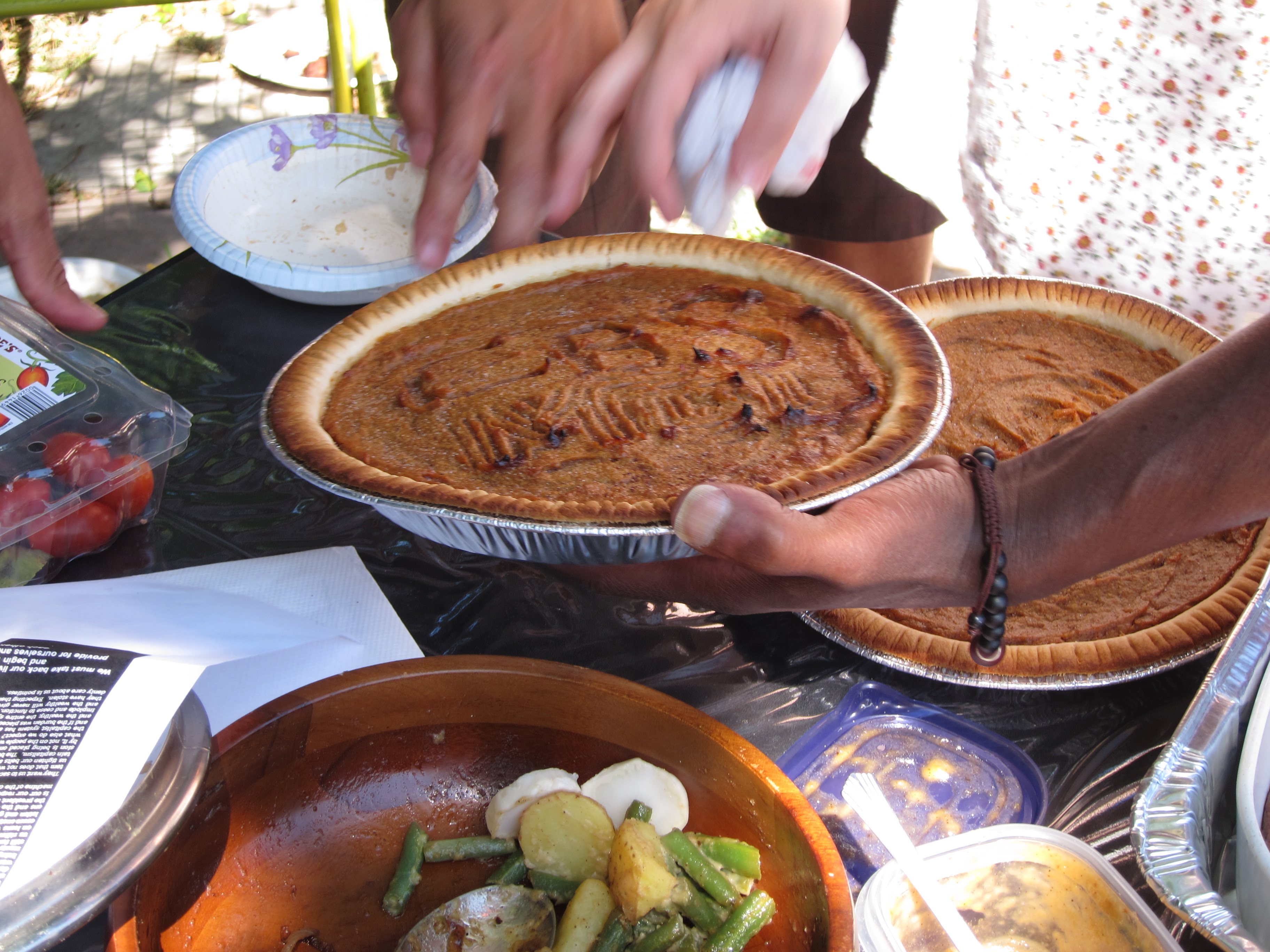
Feeling a bit sick today, but wanted to share a few fotos from this weekend’s meeting-slash-potluck. Originally conceived as a mini reportback and collaborative skillshare between San Francisco Solidarity Network and East Bay Solidarity Network, only one SF member was able to show, so we pumped her for a lot of info. :) And sat around eating homemade vegan cornbread, spicy green bean and potato salad with caramelized-onion-mustard dressing, vegan mango lassi, risotto, brownies, and Mel’s sweet potato pie that will “make your arms go up in the air.”

This slideshow requires JavaScript.

What A Poem

I originally found this great blog, 2 Eyes Open, through This Is A Takeover, Not A Makeover.  Hadn’t checked up on it for months.  Then today, I found a treasure (even for someone who’s not a huge fan of poetry).

Wrote This On a Plane to Houston, On My Way To Guatemala

I like to pretend sometimes,
that I got this hunching spine
from working so meticulously at my craft.
Each day carefully placing my toolbox on the table,
unfolding the lid and curling my soft pink fingers into their positions
to forge these words into some kind of weapon,
to whittle at these ideas until they pierce the chest.

I like to pretend sometimes
that this glow is a kiln,
I wipe my brow, and it makes no matter
that my hand comes away dry.
Because this feels like the work of a workman,
and I make like I’m adjusting my spectacles
and gripping my tweezers
as I deftly shift another syllable.

I like to pretend sometimes
that I’m just like that man I watched
crack firewood with ballet strokes,
cut grass finely with a dull machete,
coax coffeebeans to fall with massaging fingers,
like the spider spindling the fly.

Continue reading

“A Living Example of Joy In Struggle”

by Emory Douglas

From Elizabeth Gurley Flynn’s The Rebel Girl: An Autobiography, about her experiences as an agitator and organizer with the Industrial Workers of the World (IWW, or “Wobblies”) at the peak of its power, in the 1910’s:

Foster’s campaign against dual unionism was aided by Tom Mann of England, who came over on a speaking trip in 1913.

. . .

Never had I heard such a flow of fast-spoken, picturesque and colorful oratory, charged with tremendous fervor and fighting spirit.  It was a hot night and after he finished some English weavers took him away with them, promising to bring him to the railroad station to make an eleven-thirty train back.  They came rushing him along at the very last minute, bubbling with reminiscences of where they knew him and had heard him speak before.  We asked, “What did you do, Tom?” and he said cheerily, “They took me for warm ale.  There’s nothing like it after a speech.”  He was a living example of joy in struggle and proved that a light heart makes the road shorter and the load easier.  He lived to be over 80—oratorical, exuberant and vital—a great agitator to the end.

How do we nurture joy in struggle? For me, it’s a dialectical question. How do we struggle? Strategically, which courses do we choose? And how do we nurture joy? What traditions and methods do we adopt, adapt, learn, preserve, and transform? And how do we live joy in our struggles? And how do we live struggle through our joy?

Continue reading