Letter To David Banner (Or, Why Mindful Queer Sex Is Hotter Than A Feminist Holla)

Note on Sunday, April 29:

Dear friends,
If you are going to read this article, please read the entire comment thread, as well. People have brought up some important points that give essential political context to any discussion of Black masculinity and sexuality. Rich and clarifying offline conversations have also happened. As Black women, the author and I welcome contributions and criticisms in the spirit of liberating our people, all beings, and the earth. Peace!

[You may have noticed that, despite having studied sexuality in college, I don’t write about sex on this blog anymore. That’s because of some family stuff. But since sex positivity remains important to me, I wanted feature this really interesting guest blog from my friend, comrade, and fellow engaged Buddhist Skyla. Thanks Skyla!

If reading sexually graphic material on my blog will make you uncomfortable, please skip this one. Thanks!

–Kloncke]
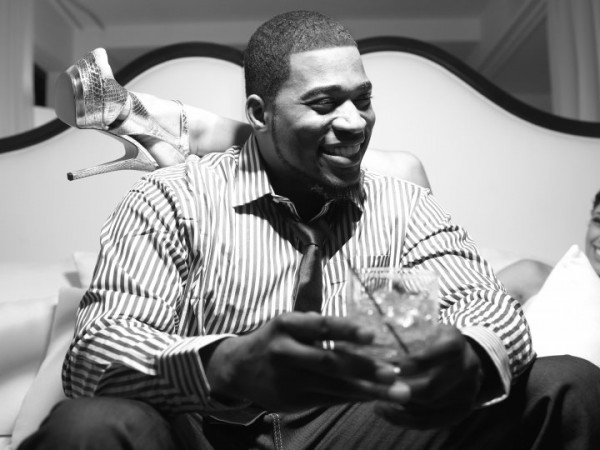
__

Dear David,

May I call you David? Thanks. I thought you’d feel that way. You seem eager to develop the intimacy between us. At least, that’s what I gleaned from what you said in your interview on MadameNoir.com, which was supposed to be about rapping with respect for women. Since the video title declares, “David Banner Speaks Exclusively To Women,” and I count myself in this category, and since you look at me through the camera and say things like, “I’m here to love you … touch you … hold you …”, I’m gonna go ahead and take your word for it that you are trying to make some sort of connection with me. Which, great! You seem smart and goofy, which I like, and in an interview about Trayvon Martin you talk about class war in a way that made me cheer out loud.

So David, since we’re fostering this connection, I want to offer some feedback about your analysis of your own song, “Play” — a song you refer to in the MadameNoire interview as “actual commentary” on your sex life, as well as “one of the dirtiest songs in the world.” And you’re right — this song is hella explicit!

(Static uncensored video and lyrics after the jump: NSFW)

[Lyrics]

Now, in your interview you lament the fact that most people missed the point of this song. They got too distracted by all the sexed-up language and missed your message: a message of respect for women. In your words:

Most men when they make songs it’s like “Girl come get in the car [etc etc I’ll fuck this, fuck that, throw you out the car, etc etc].” I said, I want to make a song where a man is telling a woman what he wants to do to make her happy. … But, you know, it’s about respect. And it’s about making a woman feel comfortable with herself and with her sexuality and with her body. And if you can do that without making her feel violated, she’ll do whatever she can — and that’s what “Play” was. And people missed that!

So David, I mean, on one level, as a straight-identifying woman, I feel you. When we take a step away from the bestselling, mainstream narrative of men getting off on harming, humiliating, and not giving a fuck about women, that’s a good step to take. Further, you seem to be actively interested in women experiencing consensual sexual pleasure, which seems like a lovely, sex-positive interest to have.

But where does that leave us? Honestly, to me it comes off as just another feminist holla, or a way of indirectly bragging on your own masculinized prowess by being like, “yeah, do this, do that, i’m awesome because i enjoy making you / watching you cum.” I mean, like I say, that’s maybe better than “I’m awesome because I’ll beat the pussy up in a way that gives me pleasure and status regardless of how it makes you feel.” At the same time, it’s neither easy nor simple to escape the ‘male gaze’: in other words, the ways in which women’s pleasure primarily gains value and meaning insofar as it is seen through the eyes of men, and helps get men off. Like spectacle lesbianism. Know what I mean?

Maybe what would’ve changed that for me is if the song had contained more of a tone of wonder, unknowing, appreciation and active learning about sexuality and what makes people cum. (Or, more broadly, what makes people feel happy and fulfilled sexually.) Personally, I get turned on more by a relationship and communication of caring / responsiveness. The vibe I get from “Play” is more like, “I already know what’s going to make you feel good, so I don’t even need to bother learning your particular body.”

This comes across in the visual language of the commercial music video, too, where all the exercising/stereotypically hot women are presented as interchangeable. We don’t need to know why you find them hot; the ‘objective’ fact of their hotness makes them special as a category but interchangeable as individuals. (I won’t even go into the ways that the whole workout / personal trainer theme totally undermines your point about making women feel more comfortable with their bodies … I’ll just give you the benefit of the doubt and assume you fought against your manager or whoever it was who insisted on that video concept.)

Adding to the sense of all-the-sameness, there’s also the standard line, “bring your friends over,” which, as usual in pop, omits any artistic details (emotional, aesthetic, or otherwise) of how that orgy might actually feel in real life. It’s just supposed to be what heteros do to get freaky. (Never hear these male pop/rap stars asking if they can bring their homeboys over to join them and the girl tho …)

To me real eroticism is about the details, the particulars — colors, textures, shapes, sounds, sensations. Being present and open enough to be surprised. And maybe “surprise” partly means what Audre Lorde defines as eroticism: powerful nonrationality. A nonrationality which, like women’s cumming, achieves much of its social value through the ways that it benefits men.

As women, we have come to distrust that power which rises from our deepest and nonrational knowledge. We have been warned against it all our lives by the male world, which values this depth of feeling enough to keep women around in order to exercise it in the service of men, but which fears this same depth too much to examine the possibilities of it within themselves. So women are maintained at a distant/inferior position to be psychically milked, much the same way ants maintain colonies of aphids to provide a life-giving substance for their masters.

In addition to exploiting/constraining feminine sexuality, I also think this know-it-all, feminist-holla swagger impoverishes masculine sexuality. Ultimately it becomes about marketing a repertoire of sexual skills, with no need to demonstrate responsiveness, mindfulness, and openness to the many permutations of sexuality that might actually exist! Like, sure i might care if you can fuck me hard or get me wet or eat me out in some artisinal way, but i’m more concerned about how you’ll respond if i feel like i want to ask permission to cum for the first time with you. Or to lie on my stomach in a weird and possibly unflattering position. will that freak you out? turn you off? will you respond supportively? can you ask questions and aim to learn?

that relational component of sexuality also feels, to me, somehow related to subverting the masculine/feminine, male/female binary. trans and intersex embodiment, as well as genderqueerness, can help us learn how to value and prioritize the asking of questions, honoring and enjoying people’s self-determinations and peculiarities, and not assuming that we know all about someone’s body going into sex.

Which, to me, is not about having lifestyle-activism sex. But about having hotter, more creative, fun and mindful sex — unlike the boring, cookie-cutter, fake-sweaty T&A that your music video producers are giving me.

Suzuki Roshi puts it well in his classic, Zen Mind, Beginner’s Mind. “In the beginner’s mind there are many possibilities, but in the expert’s there are few.”

Give me some more possibilities, please, David. That is, unless I’m someone who gets turned on when you dictate to me what I do or don’t enjoy.

But how will you find that out about me if you already think you know?

love,

Skyla

5 “Disorders” That Aren’t

1.  Shift Work Disorder (SWD)

I first learned of this disorder through a radio commercial for some drug that’s supposed to counteract it.  The drug’s name escapes me, but it could well have been NUVIGIL®, whose web site explains SWD as a medical condition that may affect 1 in 4 people out of the “15 million Americans [who] work outside of the traditional 9 to 5 schedule.”

SWD is a medical condition that can be diagnosed and treated by a doctor

SWD occurs when your body’s internal sleep-wake clock is out of sync with your work schedule—your body is telling you to go to sleep when your work schedule needs you to stay awake.

If you work non-traditional hours and struggle to stay awake at work, you may be experiencing excessive sleepiness (ES) due to SWD.

People with ES due to SWD often struggle to stay awake during their waking hours, or have trouble sleeping during their sleeping hours.

24 Hour Clock

And, of course, we then have the side effects that may be worse than the actual “condition”:

What important information should I know about NUVIGIL?

  • NUVIGIL may cause serious side effects including a serious rash or a serious allergic reaction that may affect parts of your body such as your liver or blood cells, and may result in hospitalization and be life-threatening. If you develop a skin rash, hives, sores in your mouth, blisters, swelling, peeling, or yellowing of the skin or eyes, trouble swallowing or breathing, dark urine, or fever, stop taking NUVIGIL and call your doctor right away or get emergency help.
  • NUVIGIL is not approved for children for any condition. It is not known if NUVIGIL is safe or if it works in children under the age of 17.
  • You should not take NUVIGIL if you have had a rash or allergic reaction to NUVIGIL or PROVIGIL® (modafinil) Tablets [C-IV], or are allergic to any of the following ingredients: modafinil, armodafinil, croscarmellose sodium, lactose monohydrate, magnesium stearate, microcrystalline cellulose, povidone, or pregelatinized starch.

What are possible side effects of NUVIGIL?

  • Stop taking NUVIGIL and call your doctor or get emergency help if you get any of the following serious side effects:
    • Mental (psychiatric) symptoms, including: depression, feeling anxious, sensing things that are not really there, extreme increase in activity (mania), thoughts of suicide, aggression, or other mental problems
    • Symptoms of a heart problem, including: chest pain, abnormal heart beat, and trouble breathing
  • Common side effects of NUVIGIL are headache, nausea, dizziness, and trouble sleeping. These are not all the side effects of NUVIGIL.

I honestly don’t know which is worse: (A) having white bosses or managers peg you as “lazy” because you have trouble staying alert during rotating or night shifts that fuck with your body’s natural cycles, or (B) having white doctors diagnose you with SWD and prescribe medication that makes you dizzy and nauseous and may give you difficulty breathing.  Or (C) just avoiding the whole prescription thing and getting hooked on street methamphetamines.  Either way, as I said recently:

UH GUYS IT’S NOT A PATHOLOGY IT’S CALLED WAGE SLAVERY

24 Hour Clock

2.  Gender Identity Disorder (GID)

302.85 Gender Identity Disorder

__

Next, let’s examine [. . .] Gender Identity Disorder. The diagnostic criteria for adults and adolescents [APA94] are:

A. A strong and persistent cross-gender identification (not merely a desire for any perceived cultural advantages of being the other sex). In adolescents and adults, the disturbance is manifested by symptoms such as a stated desire to be the other sex, frequent passing as the other sex, desire to live or be treated as the other sex, or the conviction that he or she has the typical feelings and reactions of the other sex.

B. Persistent discomfort with his or her sex or sense of inappropriateness in the gender role of that sex. In adolescents and adults, the disturbance is manifested by symptoms such as preoccupation with getting rid of primary and secondary sex characteristics (e.g., request for hormones, surgery, or other procedures to physically alter sexual characteristics to simulate the other sex) or belief that he or she was born the wrong sex.

__

C. The disturbance is not concurrent with a physical intersex condition.

D. The disturbance causes clinically significant distress or impairment in social, occupational, or other important areas of functioning.
Specify if (for sexually mature individuals) Sexually Attracted to Males, … Females,… Both, … Neither.

The clinical significant criterion, D, was added to all conditions in the Sexual and Gender Identity Disorders section. The definition of “distress or impairment” lies at the heart of the issue of pathologization of gender expression.

If you’ve read or known me for a while, you probably know that I think GID is a bunch of bullshit. Apart from the fact that it conflates sex and gender (people inhabit and express All Kinds of Genders, which certainly don’t map neatly onto a binary sex-assignment system so half-assed that it doesn’t even account for basic and common human biological diversity), GID is all wrapped up in a medical system that *requires* people to conform to this narrow script (“I was born the wrong/opposite gender”; “I’m a man/woman trapped in a woman’s/man’s body”) in order to qualify for medical treatment that ought to be available to whoever wants it. It’s called gender self-determination, people. Or the abolition of gender (someday). Take your pick.

3.  Post-Traumatic Stress Disorder (PTSD)

Just to be clear: I’m not saying that the so-called “disorders” in this list don’t cause people a ton of pain. It’s horrible to live on the brink of nodding off while driving trucks all day and night. It’s scary to face a society that questions and/or criminalizes and/or may kill you for failing/refusing to conform to your assigned sex and socialized gender. It’s awful to suffer nightmares, waking terrors, and flashbacks from a traumatic event. All I’m saying is that in a society that equates disorders with shamefulness and even immorality, we would do well to avoid blaming/pathologizing individuals for what are primarily social and structural problems.

This is part of why I love Operation: Recovery (led by Iraq Veterans Against the War) as a tactic of resistance to US militarization.

Operation Recovery

__

Service members who experience PTSD, TBI, MST, and combat stress have the right to exit the traumatic situation and receive immediate support, and compensation. Too often, service members are forced to redeploy back into dangerous combat, or train in situations that re-traumatize them. We say, individuals suffering from trauma have the right to remove themselves from the source of the trauma. Service members who are not physically or mentally healthy shall not be forced to deploy or continue service. Learn more about what Operation Recovery is fighting for here

Rather than acquiescing to dominant narratives positing PTSD as a sign of mental weakness, IVAW reclaims woundedness and a right to heal. Racist, sexist, homophobic, imperialist, earth-degrading war is the problem; not individual combatants’ mental fragility. (a.k.a. humanity.)

4.  Multiple Chemical Sensitivities (MCS)

__

Lotta people in this world, including medical experts, simply don’t buy that MCS is a real thing.

Many experts and major medical organizations — such as the American Medical Association and the American Academy of Asthma, Allergy and Immunology — have stated that the connection between the patient’s symptoms and environmental exposures are speculative and evidence of disease is lacking. The American Medical Association Council on Scientific Affairs believes that multiple chemical sensitivity should not be considered a recognized clinical syndrome.

But hold up, Kloncke. I thought you were mad at the medical establishment for over-pathologizing. Now they’re under-pathologizing?? Make up your damn mind, girl!

Fair. But here’s why I include this one: regardless of what Science says, in the world where I live, people get harmed by chemicals. Like the webMD article says:

People who have the symptoms [including headache, fatigue, dizziness, nausea, etc] may blame them on a major event, such as a chemical spill. Or they may point to long-term contact with low levels of chemicals at work, perhaps while working in an office with poor ventilation. Reported triggers include tobacco smoke, auto exhaust, perfume, insecticide, new carpet, chorine, and countless others.

And most of the time, folks who have identified certain chemical triggers that make them feel sick have a helluva time convincing other people and institutions to take that shit seriously. So in effect, people with MCS (whether or not medical associations recognize it as a ‘real thing’) are treated as disordered and irrational, and pushed out of many spaces directly or indirectly.

But as with PTSD, GID, and SWD, the main problem isn’t individual frailty or deviance; it’s systemic oppression. Environmental illness is not an individual person’s problem. Society-wide, there’s a profit motive to manufacture goods at the cheapest rate possible in order to outdo competitors — and often this means adding cheap, unsafe chemicals and preservatives to products; manufacturing commodities in conditions that are super unsafe for workers; or constructing toxic industry in poor neighborhoods — all of which can contribute to chronic environmental illnesses.

__

It’s also true that folks’ MCS can be triggered by high-end products like top-of-the-line essential oils, etc. From what I understand, this is due to an underlying reaction pattern that makes them much more sensitive to highly concentrated manufactured shit in general: even if the stuff being concentrated is sandalwood or lavender. Whatever the particular triggers, the main point is: thanks to an economy driven by profit motives, owned by a ruling class, and utterly unaccountable to regular people, poor and working-class people disproportionately have to put up with ubiquitous toxic externalities and poisons. Are we surprised when people’s bodies show significant signs of damage?

Now, bringing down these hyper-toxified manufacturers and the ruling class that controls them might take a minute. In the meantime, fortunately, there are things we can do to respect and support our friends and comrades with MCS (and probly make our own spaces a little healthier while we’re at it). Check out this recently-crafted Fragrance Free Femme Of Colour Realness guide for tips and resources!

5.  Infantile Disorder (LOL)

j/k. Lenin jokes, anyone?

This is just a partial list, drawing together various issues that have been on my mind lately. I’m sure you / we can think of more! And I do want to be really clear: I’m not arguing that all illness is socially constructed -slash- doesn’t exist. Yes, illnesses exist. “Birth, old age, sickness, and death” (as the Buddhist phrase goes). Inevitable, in many respects. What concerns me is that capitalist society blames *our bodies* for struggling to survive under *its torments.*

Eff that noise. Our bodies — in all their beautiful fragility, disability, diversity — are not the problem. You want problems?

  • Wage Slavery
  • Heteropatriarchy, Transphobia & Cissexism
  • War
  • Racist, Earth-Degrading Capitalism.

Happy Monday, friends!  See you out there.

Versatile Blogger Award

__

Tough to feel deserving of any positive blogging recognition when my updates here have been so scattered the past few months.  But as always, I’m honored and humbled by this shoutout from the wonderful engaged Buddhist writer and activist Maia Duerr.  You know how some people are mad talented at giving compliments? Maia is one of those people.  She’s so thoughtful and specific when she names what she appreciates about people’s work. You can tell she’s really moving with what they’re putting out; not just scattering praise for feel-good purposes.  Of Kloncke.com, she writes

Katie Loncke’s blog is, to me, the perfect intersection of spirit, politics, and heart.

Is that sweet or what?  Really tho.

And the best part about being tagged with this kind of blogly award?  Passing it on.  Since Maia put her own spin on the shoutout selection by limiting her list to women, I’m going to create my own parameters, too. My list consists only of people I know and build with (politically, spiritually) in person.

Continue reading

Infaquerical Breakup

infaquerical: a term created by my friends Candy and Castro,* who did not identify with either monogamy or polyamory, and wanted a new framework for thinking and living their coupledom. After writing out the aspects of their relationship that matter to them, together they birthed this word.

in: indigenous

fa: familia (chosen, community, & biological)

que: queer, querida

r: revolutionary, radical

ical: magical

Since its inception, they’ve been using infaquerical as a touchstone as they navigate complexities of a nontraditional, gender-bending and anti-capitalist romance.  Castro might say to Candy: querida, I really want to spend my time with you: it’s been a hard week and my instinct is to retreat with you into our little world.  But since we’re in an infaquerical relationship I think it’s important for me to spend some time with my homies, rather than defaulting into monogamous isolation.

Or Candy (feminine-centered) might relish opening doors for Castro.

Or Castro (masculine-centered) might enjoy sitting on Candy’s lap in public.

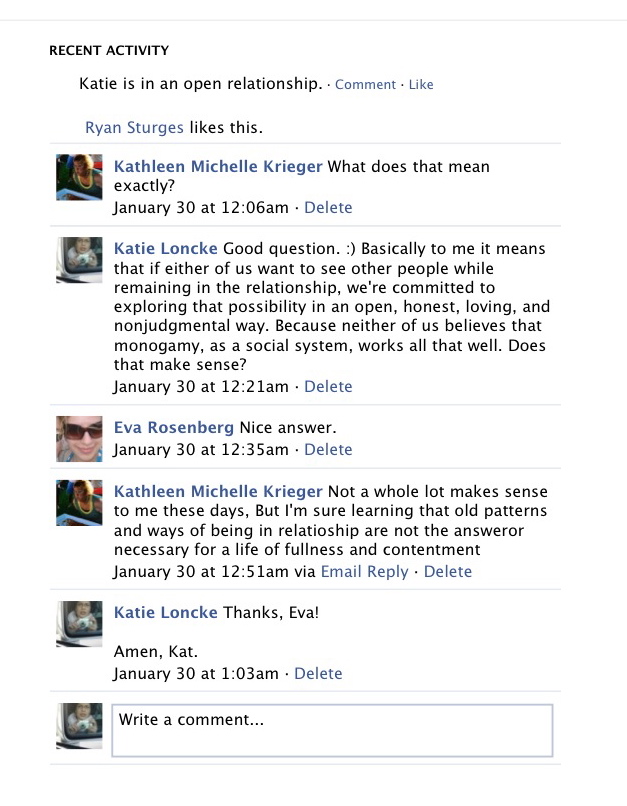
As you might imagine, I instantly fell in love with this dope-as-hell word.  Not only for the meanings it carries, but for the process of intention that shaped it, and the ways it might live through people’s loving thoughts and actions.  Reminds me a bit of the way Ryan and I attempted to (re)define our “Open Relationship” Facebook status in the early days.

Now, over two years later, Ryan and I have decided to end our time as a couple. And I think the way we’re doing it reflects the infaquerical qualities of our time together.

  • Non-blaming.  It so happens that our breakup is nobody’s fault.  If a couple (or group) decides to split up because one person wants to have children and the other(s) don’t, is anyone to blame?  Ryan’s and my situation differs in specifics, but the gist is similar: our needs and desires just don’t happen to match up. Since we’ve spent over two years together responding to our conflicts with compassionate listening rather than defensive blaming, the breakup conversation, too, remained drama-free.
  • Supporting.  In addition to harboring no resentment, we each have an inclination to actively (and carefully!) support one another.  I say “carefully” because you know what?  It’s easy for us sensitive-type humans to deceive ourselves, during a breakup, into thinking that the best form of support is sustained contact and connection.  We want to show our former partner that we still care.  So we stick around.  (This has usually been my instinct, personally.)  For some people this might work out well; I’ve seen it happen once or twice.  But for many of us, “supporting” our former partner may actually mask our own desire to feel needed, wanted, and less-than-dispensable.  More important than soothing them is ensuring they have the tools they need to heal independently.  For cohabitants: do they have a place to go if they don’t want to stay at home with you?  Can you stay with a friend for a while to make space for your partner?  The stresses of making rent under capitalism can add a whole other level of stress to co-habitating couples splitting up.  Can you have conversations about housing and property that stem from a place of “from each according to ability; to each according to need”? Instead of trying to be the main person emotionally supporting your former partner, can you enlist others?  (Which brings us to:)
  • Community building.  Typically when we think of a community supporting a couple, we might imagine a wedding (if we’re more mainstream) or a, Octavia-Butler-esque collective of people (and/or vampires), romantically and non-romantically involved, sharing resources and helping to raise the next generations.  But it seems to me that for infaquerical relationships, the breakup is also an important moment to deepen community ties and trust.  Especially when, as is the case with Ryan and me, the former partners share friends/comrades and important projects.  Like Candy and Castro, Ryan and I have always felt it’s important to encourage each other to deepen friendships even while remaining anchored in a primary partnership.  Now I see the fruits of this orientation.  The day Ryan and I decided to separate, I later ran into one of his friends on the street, and as we were chatting it came quite naturally to me to ask this friend to check in on Ryan, to let him know that he’s loved and cared for.  I know Ryan would do the same for me.
  • Enlightening. One of the most precious aspects of our relationship — and one that I’ll carry with me — was the way Ryan and I supported each other’s Buddhist practice.  And as Thanissaro Bhikkhu says, “This is what we’ve been practicing for: the situations where the practice doesn’t come easily,” a.k.a. crises, or “storms.” A breakup like ours encourages us to cultivate paramis (positive qualities) of patience, generosity, acceptance, compassion, and determination.  And while it may not hold true for everyone, I’ve noticed that for me, times of disorientation and big emotion (Pema Chödron famously calls this “groundlessness“) can actually flow spontaneously into deeper dhamma practice.  When the mind and heart get overloaded, it can be easier to escape the tyranny of cognitive thought.  Notice more sensations; notice the quality of change itself.

When green leaves turn in the wind
I vow with all beings
to enjoy the forces that turn me
face up, face down on my stem

~Robert Aitken Roshi, a senryu verse from The Dragon Who Never Sleeps

Naturally, separating from someone we love brings pain.  Not tryna deny that sadness.  Splitting up with Ryan means losing my best friend.  But if I’ve learned anything from dharma and visionary politics, it’s that within crises — inside the instabilities: of gender, of capitalism, of heteropatriarchy, of the mind — we can also find opportunities for liberation.

With deepest gratitude to everyone who has loved and supported me and Ryan, as a couple and as independent people: you bring infaquerical to life!

love,

katie

–––––––––––––––––––––––––––––––
* Sweet corrections from Castro:

[M]y my housemate Ray, Candy and I all thought we should re-name and re-define our reality by creating an evolving framework and term that speaks to our lived experiences. So, infaquerical was a trio effort which is why it is also so wonderful because as Candy pointed out, the way we defined our reality included another person (Ray) not just the two of us.

In: Indigenous
fa: familia (chosen, community and biological)
que: querida/queer
r: radical/revolutionary
ical: magical

Infaquerical: a magical, radical, revolutionary and romantic relationship between two non-gendered conforming people; they live to restore humanity instead of living to make profit; have the desire to decolonize their mind and to abolish male supremacy; value familia (biological, chosen and communidad) and challenging male supremacist ways of thinking.

So amazing, right? Have you experienced or witnessed dynamics of infaquerical in your life? (Hehe, I know the answer is Yes because so many of y’all are dope livin-yr-politics messy queer feminist beauties) Please feel free to share testimony! I’ll be sure it makes its way back to Candy and Castro. :)

Inside/Outside: Demo at San Quentin Prison

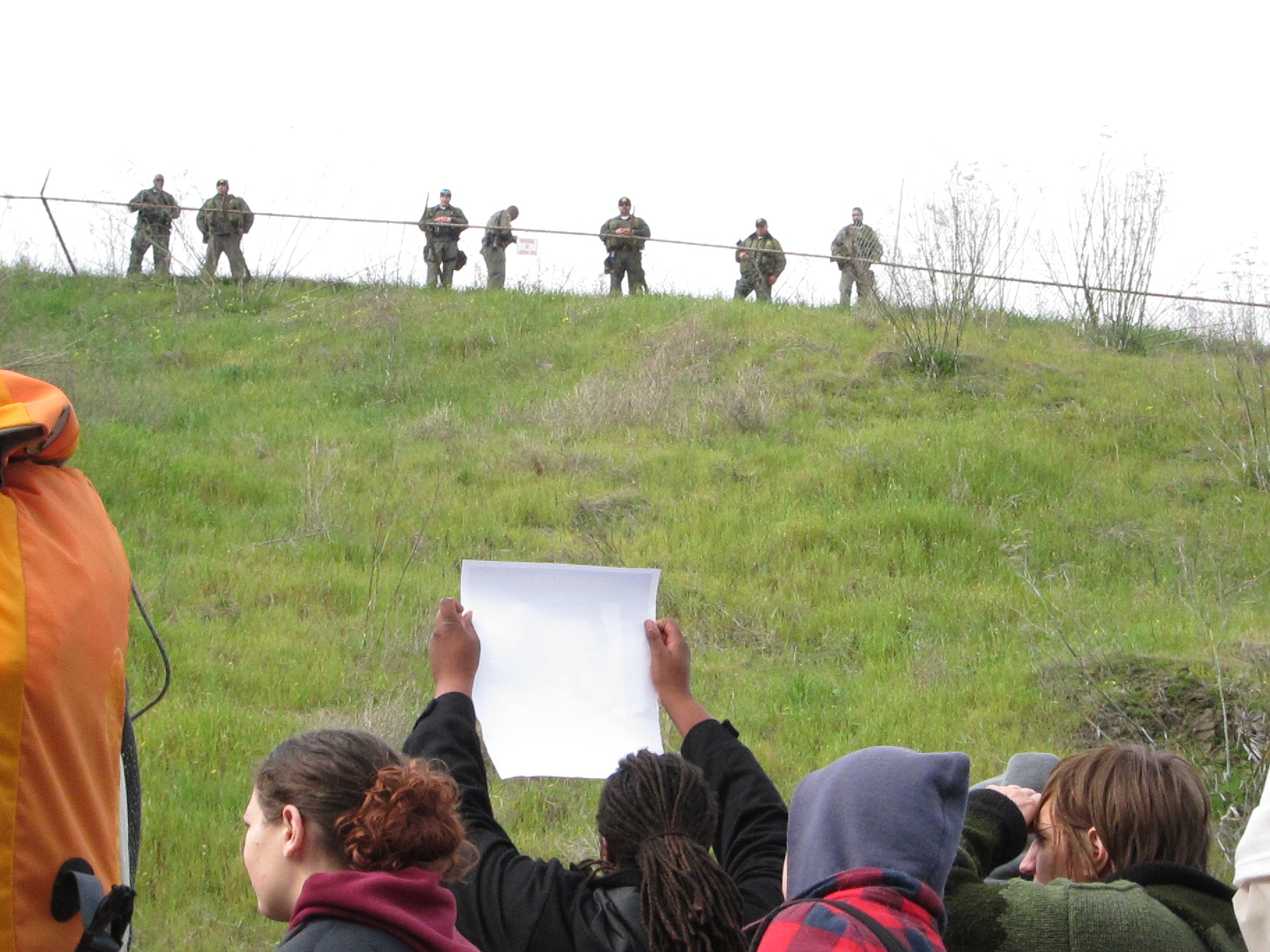
All photos from demo: some taken by me, others taken by friends.

When I heard of the call raised In Oakland, California, to “Occupy the Prisons,” I gasped. It was not an especially radical call, but it was right on time.

~Mumia Abu Jamal, Souls On Ice

As the carload of us walks back along the two-lane road toward the parking area, leaving a crowd of 500 or so outside the east gate of San Quentin, clusters of military-looking guards stud the hills above us, watching through sunglasses. We’re tired from walking and standing for a few hours. I’m feeling cranky, and a little disappointed. What was I expecting? Maybe the Occupy/Decolonize events have spoiled me with their frequent snake marches and militant ruckus-making. Shutting down banks; shutting down ports; attempting to take empty buildings for community use. Being near San Quentin (my first time) has me itching to tear down a wall or two.

__

Continue reading

Effort, Aspirations

Thich Nhat Hanh is quite literally a tree hugger.  He embraces trunks, he caresses bark, he bows to roots and touches the soil.  Thich Nhat Hanh is a person who loves trees.

One time, one of his most beloved arboreal friends, a linden tree at Plum Village, got caught in a storm and was nearly destroyed.  Thich Nhat Hanh writes,

When I saw the linden tree after the storm, I wanted to cry.  I felt the need to touch it, but I did not get much pleasure from that touching.  I saw that the tree was suffering, and I resolved to find ways to help it.

When we resolve to help, we cultivate aspirations for the well being of others.

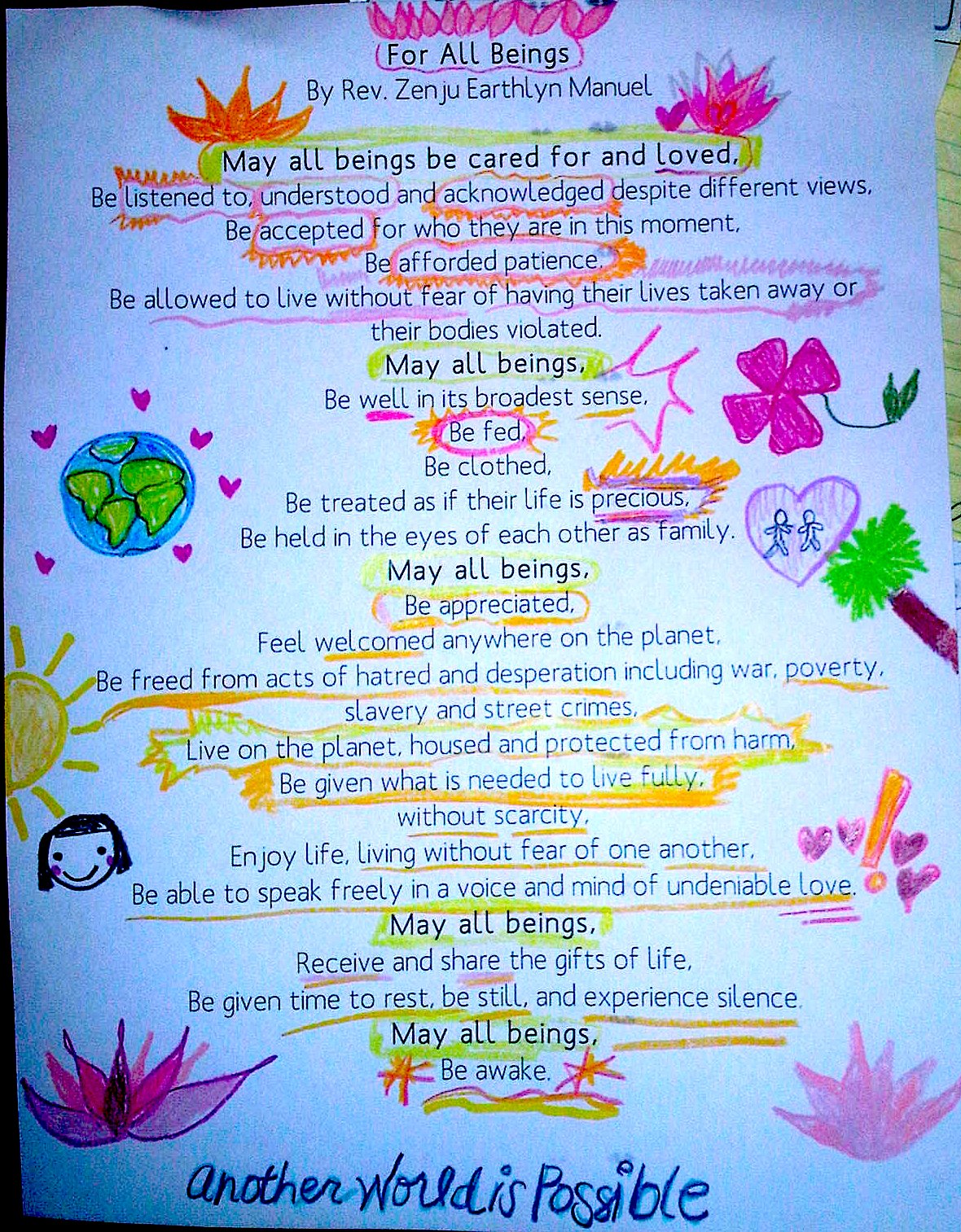
Buddhist culture seems full of these aspirations, no? Here’s a beautiful version — a poem by Rev. Zenju Earthlyn Manuel, based on the Metta Sutta — that my friend Anastasia posted on Facebook today.

__

Aspirations for a better world, for more well being. Yes.

But that’s not the whole story. Returning to the tale of the ailing linden in Plum Village, we find:

Fortunately, our friend Scott Mayer is a doctor for trees, and he took such good care of the linden tree that now it is even stronger and more beautiful than before.

A doctor for trees! We need aspirations, yes, and we also need effort and know-how!


To be a teacher and not join in struggle is a pedagogical contradiction.

Professing to care — even caring — is only part of our mission. An important part, yes, but I think that engaged Buddhism (loosely defined) might really benefit from some deep conversations about whether and how we are joining in struggle strategically and accountably. We actually want to heal this tree! (Slash society.) Is that going to happen through kinder capitalism? Is it going to happen through lifestyle activism, recycling our way to salvation? Is it going to happen by taking over the factories, the farms, the hospitals, demanding that we run them ourselves for people not profit, and then defending them from owners/capitalists who try to repossess them? Do we want a welfare state or no state at all?

We may share hopes for universal well-being, but how can we work together to make that happen if our efforts are at odds with each other?

Thich Nhat Hanh points to this effort/aspiration combo when he says,

We may need a doctor or a nurse to help, but we also need compassion and joy for the wound to heal quickly.

For emphasis in the engaged Buddhist context, I’d flip that around and say, “We may need compassion and joy, but we also need doctors and nurses.”

By Hand: Hobbit Diorama

__

Do you create by hand? Do you create with words? Or both?

Yesterday and today, my faculty advisor has observed that although we humans make meaning in verbal and physical ways, for a variety of social reasons authority figures often overcultivate one side or the other. (Or neither, I might add.) Many of us are taught, through schooling, that what we type with our fingers or say with our mouths is more important than what we can make with our hands or sculpt with our bodies.

There’s some overlap here, of course, in that writing (or typing) is an action that lives in our hands. But my advisor’s point is that too often, that’s as far as it goes. Unless we also engage in other activities and ways of thinking (in terms of movement, in terms of texture, in terms of light or temperature or dimension), our writing and meaningmaking will be limited to our hands, rather than involving our entire bodies.

The moment he said this, I got it. When I was younger, before writing took over as the only mode of learning in school (did I create a single physical object in college?), I used to think and create with my hands. I used to make things by hand.

* * * * * *

My mother, being a sentimental soul, and having only one child, has trouble throwing my old things away. The garage of my childhood home is lined with boxes containing elementary school spelling tests, middle-school science papers, and God knows what else. My bedroom, though not exactly as I left it at 17, feels less transformed (say, into a study) than strategically looted, with some walls and drawers empty and others left intact, housing various middle-to-high-school artifacts.

Pretty much every time I visit my parents, I use the desktop computer at least once. And pretty much every time I use the desktop computer, I notice and smile at the following diorama, perched on a nearby shelf in the cluttered study, and crafted by Yours Truly in about the fifth or sixth grade.

This slideshow requires JavaScript.

Thorin thinks that Bilbo should climb to the top of the tree and see if he can see any end to the forest. Bilbo reluctantly climbs up a tree and breaks through the canopy to the bright light of the sun. He sees thousands of butterflies and looks at “the black emperors for a long time and enjoyed the feel of the breeze in his hair and on his face.” [from The Hobbit, Chapter 8, pg. 148.]

Turns out, I used to love making all kinds of things when I was young. In eighth grade, I was supposed to present a visual aid about immigration to the US at the beginning of the 20th century. I wound up making a simple Rube Goldberg device: on one side of the machine there’s a tiny bucket where you place more and more stick figurines (representing immigrants). When the bucket gets heavy enough, it tips a see-saw that flips a gate, a marble rolls down a pathway and trips something else, and I forget exactly how the rest of it worked but in the end another tiny bucket flips over and out fall all these illustrations of ‘consequences of immigration’ (i.e. tenements, rats, spread of disease, and whatever else our history book told us).

But midway through high school or so, the making of things by hand fell away. It would be years before I rediscovered it: first through cooking, then letter writing, and now bootleg carpentry and picket-sign design. I hesitate to call these activities “making meaning” (sounds so lofty and . . . well . . . discursive), but at least they live in the same neighborhood.

How about you? Do you regularly use your hands to make meaning — playing music, painting, sculpting, deejaying? Or maybe even your entire body, through dance? Or are you mostly brain-mouth-and-keyboard -bound, like me?

Occupy Is Failing — And That’s A Good Thing

__

Holy smokes, is this a welcome morsel of public intellectualism.

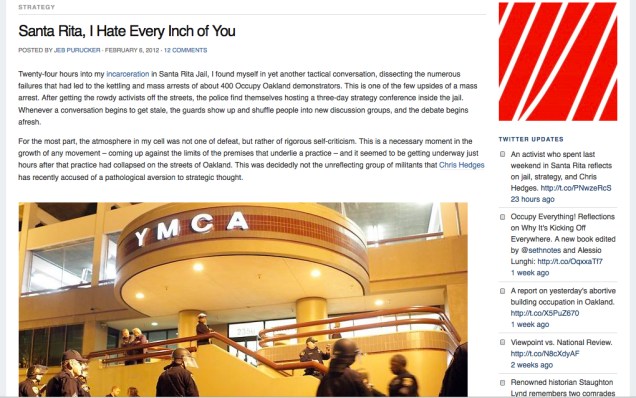
The entire piece is deft and deeply relevant — worth a read, for sure. And since I seem incapable of connective theorizing that extends beyond whichever book I’ve last read, or whatever idea I’ve most recently started exploring (“Neuroplasticity, you say? You know, in a weird way that comes up in this book/article/Facebook post I just read on Black politics/Barbara Kingsolver/the disappearance of bees.” Lazy, I know, but at least the randomized combinations keep things surprising), I’m struck by the similarities between the recent work of Keith Hennessey (a performance artist who just presented and workshopped here at the MFAIA program) and the kind of thinking that Jeb Purucker applies to Occupy Oakland.

“Failure” is evidently enjoying a current popularity surge within academia: Jack Halberstam and a few others are releasing books on the topic. In his lectures and hands-on workshop here, Keith discussed a recent piece of his called Turbulence, in which he explores the concept of failure — as in, a performance piece that is set up to fail. Without going too much into it, I’ll say that participating in his workshops helped remind me of (a) the fruitfulness and dignity that come from improvisation, (b) the usefulness of reflecting on failures in order to glean lessons, and (c) the ways in which, with “success” kind of off the table, we are freed up to redouble our focus on how we work together. The process.

Continue reading

This Is Some Serious, Glorious Play Right Here

Click to read the full article on Libcom

5. The workers at the General Hospital of Kilkis answer to this totalitarianism with democracy. We occupy the public hospital and put it under our direct and absolute control. The Γ.N. of Kilkis will henceforth be self-governed and the only legitimate means of administrative decision making will be the General Assembly of its workers.

. . .

7. The labour union of the Γ.N. of Kilkis will begin, from 6 February, the retention of work, serving only emergency incidents in our hospital until the complete payment for the hours worked, and the rise of our income to the levels it was before the arrival of the troika (EU-ECB-IMF). Meanwhile, knowing fully well what our social mission and moral obligations are, we will protect the health of the citizens that come to the hospital by providing free healthcare to those in need, accommodating and calling the government to finally accept its responsibilities, overcoming even in the last minute its immoderate social ruthlessness.

I’m ruminating on this today, thinking about play and experimentation in radical takeovers. Gratitude to Pete Hocking, Keith Hennessey, and the relational aesthetics folks (readin’ up on ’em here at Goddard) who are giving me some new perspectives to play with. May come back with some new ideas for EastBaySol. :)

As always, would love to hear your thoughts. Feel free to share!

Gratitude to Nigerian General Strikers

__

The General Strike worked in Nigeria! Beautiful testament to who really constitutes the foundation of the world economy: not politicians or businesspeople (so-called “innovators”), but workers and ordinary people (who continually innovate new ways of asserting power against bosses, patriarchs, and state oppression).

Thank you, friends in Nigeria, for inspiring the rest of us! May we continue to develop and use our collective material power, worldwide, and discover together how to replace capitalism with a system that promotes freedom, equality, compassion, and positive interdependence among humans, animals, and the earth (and maybe robots; who knows ;) ).

Also, smiled at this seemingly pro-queer shoutout from Femi:

Later in his office, Mr. Kuti shouted at his television as he watched the labor leaders announce the end of the strike. “I told you those people would back down,” he said to his aides, looking up from the screen. As for the government, he said, “They prosecute people for being gay, but there is no law against stealing 14 million.”