Three Blog Posts, a Poem and a Song

I try not to do too many reading-list posts, mainly because I know that most of us have our own gigantic stacks of reading to get to.  But!  These pieces are simply dope and exciting, and written or shared with me by people I like.  Plus, the collection represents, in a way, some key themes in my life right now: feminism, political work, and spirituality.  So!

The lovely and talented author of This Moi (elder sister of ei powell) has a guest post up at Jezebel on the Man To Man (M2M) phenomenon — as experienced by herself, a keen and observant young woman of color, during a trip to a shooting range.

brownfemipower (my esteem of whom is well documented) contributed a ridiculously good piece to Feministe, on citizenship privilege in sexual/sexualized violence.

And!  The Advance the Struggle collective (AS) published their analysis of the March 4th day of action (for public education in California + beyond), which breaks down, in very useful, insightful ways, the dis/advantages of two different tendencies among the anti-capitalist players involved, and how to combine their strengths into a “genuine class struggle left.”  Personally, it helped me clarify and contextualize my experience participating in the SF March 4th committee, which I found pretty frustrating overall.  In hindsight, I now understand a lot of the key ideological splits that I couldn’t articulate at the time.  As AS puts it, “the [clashes] of approaches to radicalizing consciousness were key determinants in differentiating the political forces in the movement.”  Also nifty to see analyzed summaries of all the different major actions in Cali, as well as efforts in Seattle.  Check it out.

This poem, which my boss read to me during our latest reflection session (yes, I’m lucky enough to have good poetry in my work meetings!) immediately resonated with a fear that’s been haunting me ever since I started deepening my meditation practice last year.

Tree

by Jane Hirshfield

———

———

It is foolish
to let a young redwood
grow next to a house.

Even in this
one lifetime,
you will have to choose.

That great calm being,
this clutter of soup pots and books —

Already the first branch-tips brush at the window.
Softly, calmly, immensity taps at your life.

Will it be possible for me to combine a lifelong commitment to practicing dharma (with the retreat experience and internal work required) while at the same time holding on to worldly commitments like partnerships and social justice work?  Oftentimes I sense that someday, in this one lifetime, I’ll have to choose.  Do you ever feel that way?

Finally, a little something by Ahmad Jamal, just because.

Happy Thursday, friends, and happy birthday Henry Mills!

Introducing the Stat Dragon

by Jeffrey Donato

A stat counter is a common tool that lets bloggers see the number of people who visit their site.  I learned about it back in 2005, when I first became acquainted with blogs, and have interacted with stat counters and traffic graphs in my bloggerly life ever since.  Every day (ok let’s be real: practically every five minutes), I check my traffic chart on Kloncke to see how many people are reading.  I glance at the line graph and its 15-day history, with the current day’s data point climbing ever upward until the stroke of midnight, when its ascending carriage takes a pumpkin-like tumble back down to zero.  New day, new stats.

Within the past few months, I noticed myself monitoring my stat charts with increasing closeness and intensity.  It became sort of embarrassingly compulsive.  I checked my traffic at Gmail-like intervals (read: Too Frequently).  And of course, my heart would soar and sink according to the graph’s altitude.

High: high.

Low: low.

Many page views: “My writing is helping people.”

Few views: “This blogging thing is just a narcissistic waste of time.”

Et cetera.

And then, the real kicker: auto-adjusting scale.

Let’s say I’ve been plugging along on my little blog for a month, and one day I get 25 views, the next day 30, the next day 7, and so on.  The top of the y-axis represents the largest number of views in a single day: 150.  The smallest, one notch above zero, is 3.  Then, one day, the blog is viewed 170 times.  What happens to the chart?

Continue reading

Touring the TL, Screwing Over Its People

by Thor Swift for the NYT

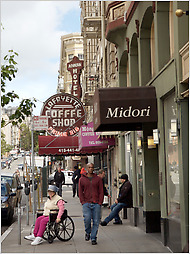
I honestly don’t have much to say about this article from the NYT (lead photo taken directly in front of our home at Fools’ Court) on a potential new tourism trade in San Francisco’s Tenderloin (TL) district.  The backward priorities, exploitation, and opportunism seem pretty obvious to me.

Encouraging adventure-seeking San Franciscans to visit may be easier than selling the Tenderloin to tourists, city tourism officials say. Laurie Armstrong, a spokeswoman for the San Francisco Convention and Visitors Bureau, called the recent efforts “a step in the right direction,” but added that it was a “very, very long road” to make the neighborhood appealing.

Appealing to whom?  Not the people who live here, but outsiders — with money to spend.  The bright side here, I suppose, is exposing the persistence of the trickle-down mentality that drives city planning.  Promoting tourism will supposedly help businesses, which will supposedly help…homeless folks?  Not likely.  Most stores around here won’t even let you in to use the bathroom if you look like you’ve spent the night on the streets.  Which might appear to be the case even if you do sleep inside, in a shelter or SRO: single-resident occupancy.

Just a couple days ago, at the feminist Marxist study group at the Faithful Fools, we talked with Diane, a longtime visitor to the Fools, about her experiences living in an SRO.  It’s sort of like a jail, she said with a chuckle.  You’re permitted a limited number of visits every month.  (8 per month is the max at her place, she thinks.)  Since you can’t have more than 3 people per room, a single mother with three children is out of luck.  There are no kitchen facilities, turn-of-the-century wiring (making personal cooking devices surefire circuit overloaders), and one communal microwave for all 150 tenants.  You’re supposed to get 24 hour’s notice before anyone comes to inspect your room, but managers rarely honor rules like that.

Diane teaching Ryan some dance moves.

Not to say that SROs are no better than sleeping in doorways.  But investing in them as tourist attractions?  How exactly is this helping to create, as Gavin Newsom claims, “a positive identity for the Tenderloin”?  Why not tax rich people (a.k.a. wealthy tourists and corporations) and put funding directly into improving and expanding housing?  Making it a human right in practice, not just in theory?  Of course, the city instead assists landlords who evict low-income tenants in order to turn rental units into condominiums (through legislation like the Ellis Act, which Diane was explaining to us). Meanwhile, the thousands of housing units currently vacant could easily eliminate homelessness altogether.

Forget appealing to tourists.  Personally, I’d rather the folks of the TL follow the lead of Homes Not Jails, who just a week ago occupied a vacant building, resisting eviction and declaring the duplex public property.  Organizing in opposition to state-supported capitalist institutional violence would give the Tenderloin a much more “positive identity,” in my mind, than million-dollar slum museums and “hundreds of [fucking] plaques on buildings throughout the neighborhood.”

Friends On Friday

friend of the furry variety

Kind of like #followfriday, only more of a plain old celebration of the folks touching one Black girl’s heart this week.

Above, Miss Maxine, who slowly but surely welcomed me into her life after a rough start on Sunday.  She’s almost as much of a delight as her owners, Chris and Donna.

Adrienne Maree Brown is just tremendous.  Everybody should read her.  You should read her.  Like, starting now.

Aaron Tanaka is also tremendous.  His blog is pretty much brand-new, but already one of my all-time favorites.  Eclectic, on-point, funny, educational.  Solid.

If you ever get the chance, spend some quality time with Carmen Barsody.  Trust me on this one.

Last but not least, word has it that Advance the Struggle is about to publish a piece analyzing March 4th.  Get excited!

And have a fantastic weekend.

————–

love,

katie

Midwestern Soul

Part of my job is to help facilitate “street retreats,” which are the foundational practice of the Faithful Fools. Participants (typically people who are housed and roughly middle-class) spend a day walking the streets of the Tenderloin, eating lunch in one of the soup kitchens, and observing what arises in themselves. What fears, what judgments, what surprises. Yesterday, we hosted a retreat for 23 students from the University of Montana, sending them out into the streets with the day’s mantra: “What holds us separate? What keeps us separated? As we walk the streets, what still connects us?”

Now, I’ll be honest. I saw myself as very much separate from these people. Yes, my bias against “flyover country” reared its head. These middle-America white folks are about to be scandalized, I thought. Horrified at the unChristian hustles of the big-city neighborhood. Let’s just hope they don’t run into a trans sex worker.

I also had low expectations about the group reflection that would end the day. The Tenderloin is the most diverse neighborhood in one of the most diverse cities in one of the most diverse states. Would these Montannnins be open to seeing and appreciating its nuances?

And wouldn’t you know it. This turned out to be quite the brilliant, thoughtful, insightful, and yes, soulful group. Wonderful reflections. Courageous. Allowing themselves to be vulnerable with the rest of us, enthusiastic about all that they witnessed during the day, and eager to translate the learning back into their lives at school. Just fabulous.

And so, even though I spent the day indoors, making soup and bread for the post-reflection meal, I got my own taste of the street retreat: challenging my own judgments, and rediscovering the truth in the Faithful Fools’ credo: “On the streets we discover our common humanity.”

Hats off to these Midwestern fools.

Online Mindfulness And Facebook Meditation

Loved this post from American Buddhist Perspective.  Sometime this week I think I’ll finally have a minute to offer a list of my own favorite “mindful blogging” spaces.  This entry is a prime example: a blogging praxis that creates a tight dialectical relationship between online and offline life, encouraging and enhancing mindfulness — present awareness, plus hopefully wisdom and compassion — in both.

Wednesday, March 24, 2010

You Are No Longer Following Buddha

Mindfulness in a techno-buzz-twit-book world.


Thanks, Google, for simply negating my last nine years of study and practice as a so-called Buddhist. Now that I am no longer following Buddha, what will I do? No white letters in cool blue bubbles fade in from the background to tell me.

Sorry Buddha, but the Google Ads in Buzz was uncool. I don’t mind them on websites (to a degree), I don’t mind them on blogs (you can find some here and buy me coffee by clickin ’em), but in buzz, they’re uncool.

In fact I’m not really sold on Buzz as a whole. I’m told that people are following me that I didn’t even know about. My girlfriend told me it forced her to follow me. I chuckle. That’s just so wrong. Who, or what algorithm at the world’s smartest company, is making these decisions?

Twitter (follow me….) has won my heart because most of my blogosphere friends are there. It allows a nice combination of headlines for our mutual blog posts, as well as something of a community chat function for discussion and banter. Not to mention news stories hand-selected by like-minded folks for me to read. Can’t beat that. If twitter is ever clogged with ads like my Buzz today, that too may need to go.

Facebook (add me…) still gets a fair amount of my daily attention, but is growing into a sort of bloated colorful cousin to twitter. I prefer twitter more (I find myself aimlessly meandering on facebook way too often) for its compact, quickly moving aesthetic. What it has and twitter lacks is all of my real (IRL) friends from over the years which makes any annoyances more than worth it. Besides, I should take the opportunities to be mindful in the colorful environment of facebook more seriously. Limiting my daily time. Being purposeful. Focused. And when meandering, just as in meditation, to simply catch it – gently – and ‘come back’ to my main page.

at 9:48 PM Labels: , , ,

A Woman’s Work = Non-Profits?

From a Facebook Note I wrote last night.  (Friend me if we’re not friends already!)

Dear lovely people,

I hope this note finds you well! I’m writing it at the end of an exhausting day of work — cooking, grocery shopping, driving, hosting, facilitating — when all my body wants to do is sleep, but my mind’s got other plans.

Since reading Selma James’ “Sex, Race, and Class” and another work of hers and Mariarosa Dalla Costa’s (“The Power of Women and the Subversion of the Community“), both offered this week through a rad study group here in the Bay, I’ve been considering parallels between the role of nonprofits (like the one I work for, in exchange for room and board) and the un-waged domestic/reproductive/social labor of (mostly) women, as James and Della Costa explain it. Wanted to share my thoughts with y’all– as always, your insights are tremendously appreciated.

Arundhati Roy names a process by which NGO’s, in ministering to the needs created by gaps in both private and public capitalist enterprise, chill the potential for social resistance. “Non-profits’ real contribution is that they defuse political anger and dole out as aid or benevolence what people ought to have by right.” Folks who work for non-profits often acknowledge that their efforts amount to a Band-Aid approach: covering up the problem, but failing to reach its root causes. But Roy seems to reject the Band-Aid analogy. A metaphor she’d choose might be more like: taking painkillers to ‘heal’ a broken leg. The immediate pain might be numbed, but by continuing to walk on the leg, you’re only worsening the injury.

Similarly, Della Costa and James argue that both trade unions and nuclear families trap us in this painkiller predicament:

Like the trade union [or non-profit, in this case], the family protects the worker, but also ensures that he and she will never be anything but workers. And that is why the struggle of the woman of the working class against the family is crucial.

Unlike trade unions, though, which address the conditions of masculinized wage labor, non-profits often seem to institutionalize the work traditionally associated with feminized labor performed within the family. Need a hot meal? A soup kitchen will serve you one. Sick? A clinic will treat you. Want to come home to a lovely garden? No need to rely on Grandma or the wife: your local eco-NGO will build a permaculture paradise for the whole neighborhood.

There are exceptions, of course, like hotel worker unions which may parallel feminized family housework, or media non-profits that are basically mainstream corporations with an opportunistic tax status. But overall, I’m struck by the resemblance. Is the non-profit an incorporated version of James’ and Della Costa’s working-class woman? Complete with moral imperatives to ‘nurture,’ or in this case, ‘serve the community,’ all the while scraping by on allowances wheedled from donor husbands and grantmaker sugar daddies?

I know a lot of us are thinking and living similar questions right now, and I just wanted to share my own musings. Thank you for all the inspiration and strength you give me! I love all of you and miss those I don’t get to see.

hugs and more hugs,

katie

And let’s not forget that NGO work doesn’t replace the “second shift” of unpaid housework!  After coming home from the non-profit you still gotta wash dishes.  (In my case, throughout the day at the non-profit.  And we wash lots of people’s dishes.)

Happy Monday!

love,

katie

Share The Wealth, California: UC Berkeley Takes The Streets

A Cal dance party gets political.

The No Cuts movement in California, opposing the violence inherent in shifting the burden of the financial crisis to the working class (including students at public schools), is gaining steam all over, it seems.  The next local fight I’m excited to focus on, after the March 4th day of strikes and actions to defend public education, is the oppressively expensive public transit system in the Bay Area — especially as higher-ups falsely pit riders against operators, claiming that since bus drivers don’t want to give up their pensions, users have no choice but to swallow higher fares and fewer routes.  Gross.

More on that later, but in the meantime, check out this cheeky analysis of the UC Berkeley administration’s reactions (and non-reactions) to recent University of California controversies, including the street-dance-party action above.

Dear UCMeP Faithful,

We here at the UC Movement for Efficient Privatization are morally outraged over recent events at the University of California.

No, we aren’t (just) talking about the racist actions at UC San Diego or the homophobic vandalism at UC Davis.

We are talking about the band of terrorists disguised as students dancing to defend public education who, in the early morning hours of February 26, struck a vicious blow to everything UC Berkeley holds dear: its dumpsters and trash cans.

Within hours of this despicable event, Chancellor Bobby Birgeneau – writing from the same undisclosed location he has been bravely hiding in since December – sent an email to the entire campus community titled “Vandalism at Durant Hall.”

In this powerful missive, Birgeneau, “condemn[ed] in the strongest terms the overnight criminal vandalism in Durant Hall that spilled over onto Bancroft and Telegraph avenues.”

As increasingly belligerent acts of racism and homophobia shake UC Berkeley’s sister campuses, UCMeP would just like to commend the leaders of the UCB administration for their bold decision to not speak out against racism and homophobia this past Friday. We are proud that they have instead highlighted the real threat facing the UC: all those students, faculty, and employees vainly struggling to defend what’s left of public education.

That Chancellor Birgeneau has yet to publicly condemn the hanging of a noose in UCSD’s library or the vandalism of UC Davis’ LGBT center is more than appropriate. After all, why should the leader of UC Berkeley be concerned about goings-on at other campuses of the UC when he has burning trash cans on his own campus to contend with?

Friends, as Chancellor Birgeneau has recently demonstrated, racism, sexism, and hate speech are not the biggest enemies the University of California faces. The real foes are free speech, the right to dissent, and the tolerance of minority opinion.

We must battle these democratic evils with everything we’ve got.

It is toward dance parties and brief midnight occupations of construction sites that our moral outrage should be directed, not nooses and homophobia.

Faithfully Yours,

UCMeP

ucmep.wordpress.com

UCMePberkeley@gmail.com

Facebook: UC Movement for Efficient Privatization (UCMeP)

Youtube: UCMePberkeley

Twitter: UCMeP

Update: Black students at Cal block a main entrance gate to campus, in solidarity with UC San Diego and UCLA. Solid.

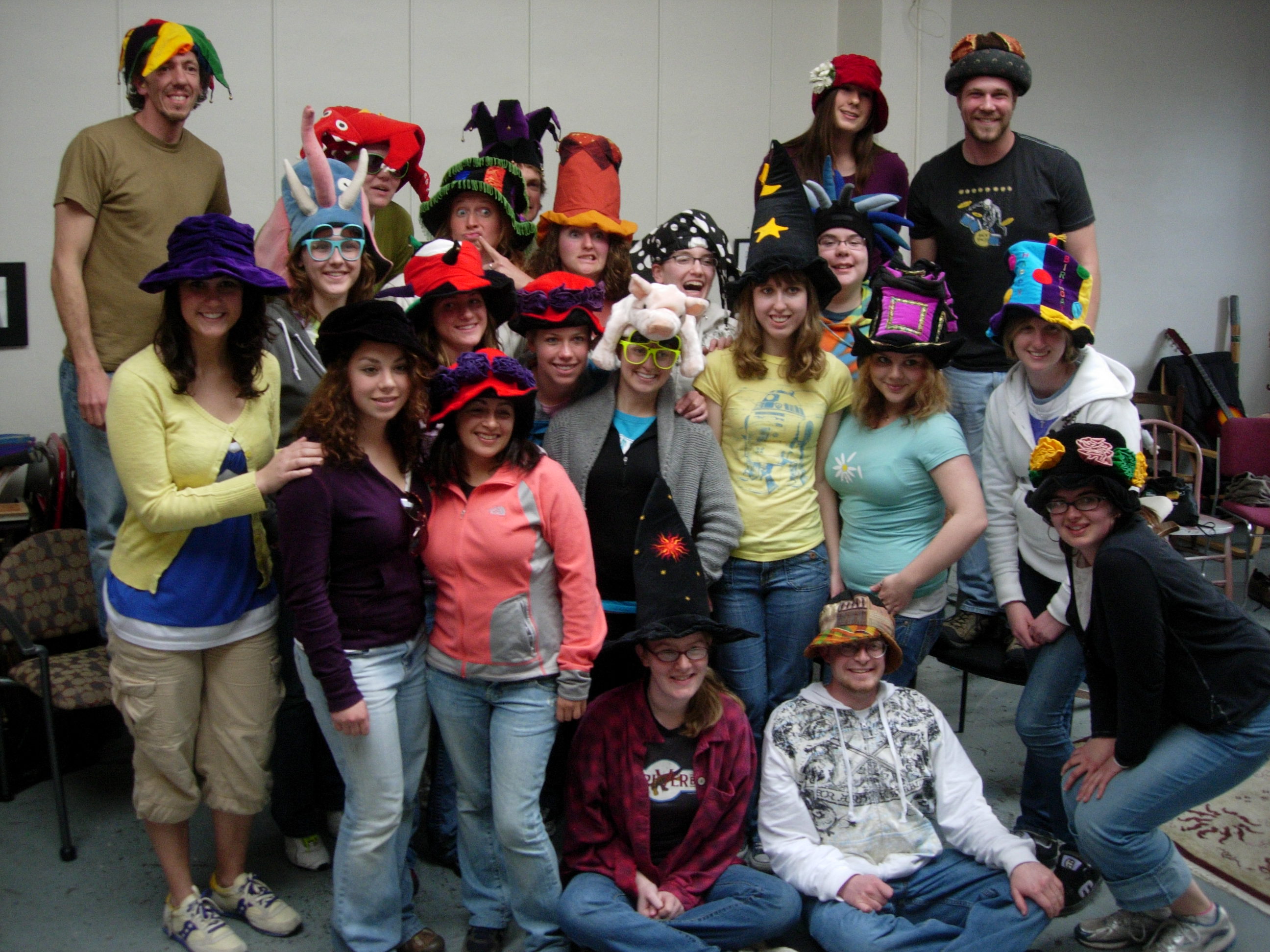
I like how the pictures sort of look like a twist on a class photo.