
Just as well — it was a little risky, and starting to make me nervous.
Hope you are having a wonderful day, friends. I’ll try to regroup for Wednesday.
love,
katie

Just as well — it was a little risky, and starting to make me nervous.
Hope you are having a wonderful day, friends. I’ll try to regroup for Wednesday.
love,
katie

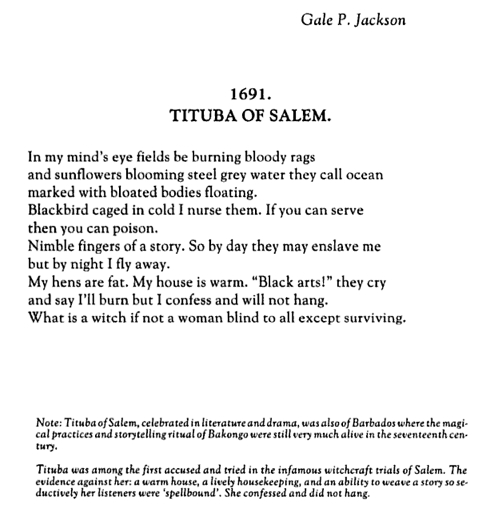
This semester in my MFA I have the profound good fortune of working with an amazing faculty member: poet, writer, and cultural historian Gale Jackson. Today in our twelve-person advising group, we worked together to respond to one of her poems — “1691. Tituba of Salem.” — which happened to be the first and only one I had already read.
* * * * * * * *
The whole poem is a deeply layered thing that I know I’ll continue to revisit. One line (now the title of this blog post) echoed as I was reading Detroit: I Do Mind Dying: A Study In Urban Revolution. (Remember when I mentioned that? Yep, ha, still makin’ my way through it.) Describing an opening sequence in Finally Got The News (a renowned documentary self-made by the League of Revolutionary Black Workers), I Do Mind Dying authors quote League leader John Watson:
You get a lot of arguments that black people are not numerous enough in America to revolt, that they will be wiped out. This neglects our economic position. . . . There are groups that can make the whole system cease functioning. These are auto workers, bus drivers, postal workers, steel workers, and others who play a crucial role in the money flow, the flow of materials, the creation of production. By and large, black people are overwhelmingly in those kinds of jobs. [116]
Of course, times and circumstances change. This brings new questions. What does US de-industrialization mean for the potential of workers in the United States to “poison” the system we serve? How does utter disposability, from the point of view of capital, affect the position of undocumented immigrant workers as they clandestinely serve, haunted by a terrorizing, racist, sexist campaign of economic opportunism that threatens to incarcerate, violate, and deport?
The rich, ongoing resistance of immigrant workers in the US testifies that this shifting terrain does not completely close down our opportunities for struggle. Disruption and destabilization are still possible.
* * * * * * *
I also wonder about the converse. Perhaps if we can poison, then we can also serve.
I mean this more in terms of the ways that I might poison my own life. The ways that I might relate to, and feed, my own internal sufferings. Day to day, in subtle ways. Clinging to high expectations. Beating myself up over mistakes. Fearing and worrying about the future. Indulging in fantasies and daydreams, even when they make me feel kind of sticky and queasy afterward. In general, surrendering my happiness to the mercy of my own thoughts.
Goenkaji says: there is nothing more harmful than our own untamed mind. And there is nothing more helpful, more beneficial, than our own trained mind, tamed mind. This observation comes up again and again in dhamma teachings — the idea of “turning the (monkey-) mind into an ally.”
So much in one post! Hope I haven’t overwhelmed you. Happy Monday, friends.
PS: You, like me, might want to support Gale and her important ongoing work as an artist. She’s more of an “analog girl in a digital world,” to borrow a phrase from Erykah, so since the PayPal button is out, over the next couple days we’re gonna put our heads together to find a simple way for y’all to make offerings and contributions (and/or purchase some of her breathtaking books!) from afar.
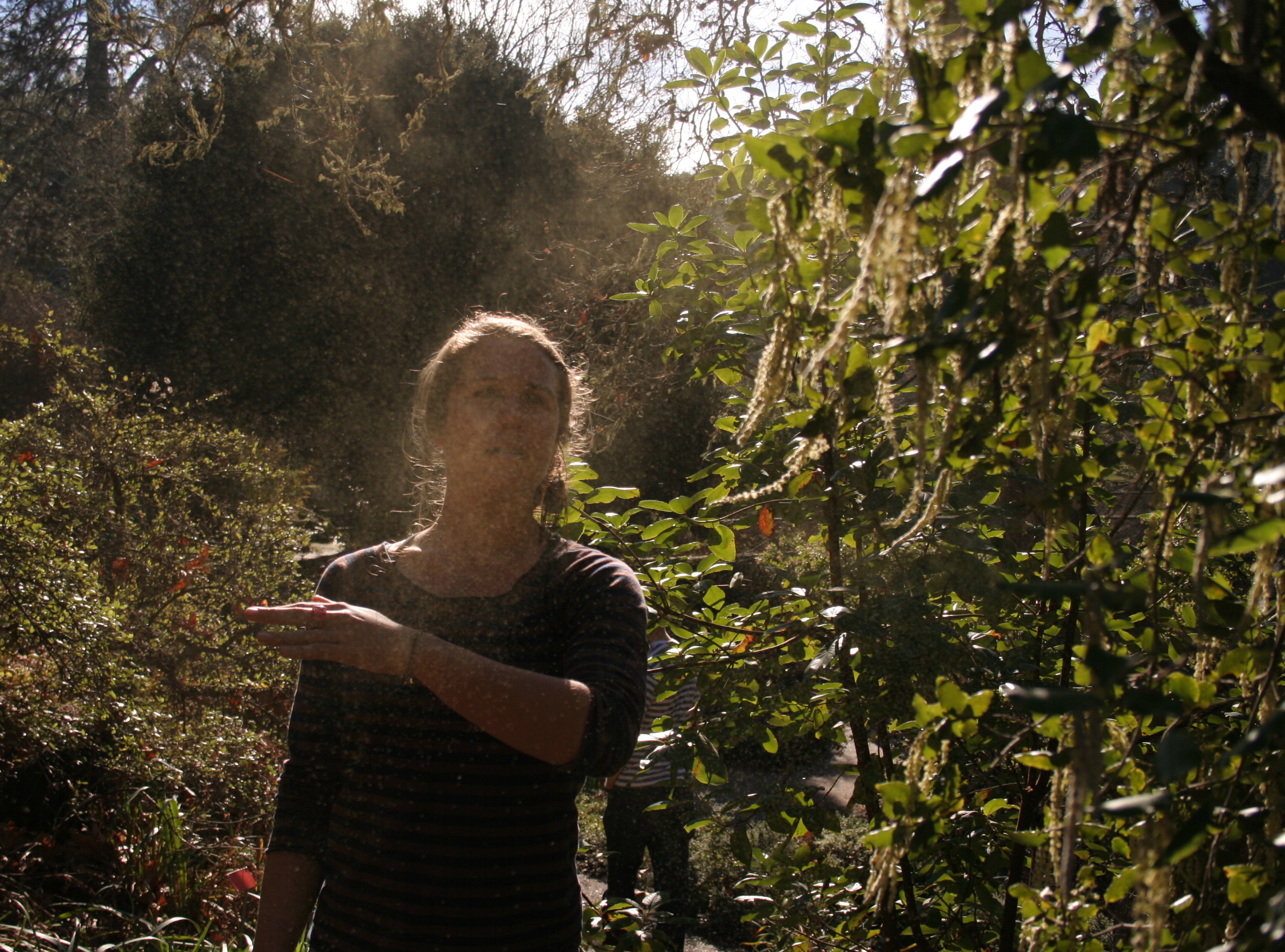
These images come from “Women of Egypt,” a Facebook collection by Leil-Zahra Mortada, someone I don’t know but to whom I’m grateful.
There are so many powerful photos emerging now. These three from Mortada’s album especially resonated with me. How we view the stories in them depends so much, I think, on our own (often complex) experiences with police, and our analysis of state violence.



Alan’s got a lovely piece up at Clear View Blog (digging his jaunty-angled question: what would MLK, Malcolm X, and Paul Robeson think about being put on U.S. postage stamps?) that points to the connections between big-L Love and the effort to, in King’s words, “defeat evil systems.”
Compassion and militancy. Neither can substitute for the other. If you’ve got militancy but don’t practice compassion, your friends and comrades — the people upon whom you most rely, politically and personally — prob’ly won’t enjoy being around you. Not in the long term, anyway. And if you’ve got compassion but no critical analysis of “evil systems,” or meaningful program to defeat them, you are, as Ryan points out, utopian.
Combine the two, compassion and militancy, and you’ll get something powerful. But you’ll also get problems.
Frederick Douglas famously asked, “What to the slave is the Fourth of July?” We might do well to extend the same skepticism to today’s hallowed, lovey-dovey vacation day.
Beneath the hype, MLK day can serve as a reminder that people who advance the fight for radical liberation, using their own compassion and militancy, are undoubtedly risking their lives.
So if you’re among them, thank you for your courage. May the earth continue to bless you with beauty every day. May you sometimes have a sweet picnic by the lake.


One of the Buddhist precepts that I don’t hear discussed much in ‘official’ settings is the advice to “avoid using sexuality in harmful ways.” There’s a ton to unpack there, obviously, but one connection I’m making has to do with a meeting tonight of Bay Area radicals rallying around a friend of mine who got fired from her job.
She’s been an educator in an Oakland after-school program for a while, and a few weeks ago her boss fired her. Didn’t tell her why. (Still hasn’t.) Didn’t even bother to notify her: she came in and worked a whole day before being told that her contract had been terminated.
So what’s this got to do with sexuality? Well, even though no one has told her why she was fired, my friend has a pretty good idea: she turned down her boss’s sexual advances. For months he had been flirting with her, but as soon as she put a stop to it, the game changed. You can read her entire account on her blog.
Sexual harassment at the workplace? Clearly not okay. So tonight a bunch of us will get together and see what we can do to support. My friend already took the lead herself, by refusing to play along with her boss in the first place. (Reminds me of Robin D. G. Kelley’s Race Rebels, where he examines everyday worker resistance, and specifically names the form of struggle wherein women respond with calculated coldness to sexually aggressive male superiors.) But individual assertions of dignity are not enough. Not even when it comes to sila (Buddhist morality, including the precepts.) It takes sangha, community, to breathe life into explorations of harm and benefit.
And importantly, the precepts aren’t some kind of spiritual checklist. Don’t lie — gotcha; Don’t steal — okey dokey. If that were true, then as long as my shit is under control, I wouldn’t need to care about anybody else’s struggles with harm.
To me, rather than instruments for performance evaluation, precepts can act as guideposts for looking deeply and holistically into processes of harm and benefit.
We’ll see what we can come up with at tonight’s meeting.
‘Mornin y’all! Hope you had a wonderful weekend.
It’s cold here in Oakland. I am a hot-weather person. But it’s all good: I’m snuggled up under some blankets, and feeling especially cozy and glad because I get to share two lovely new blogspaces with you!
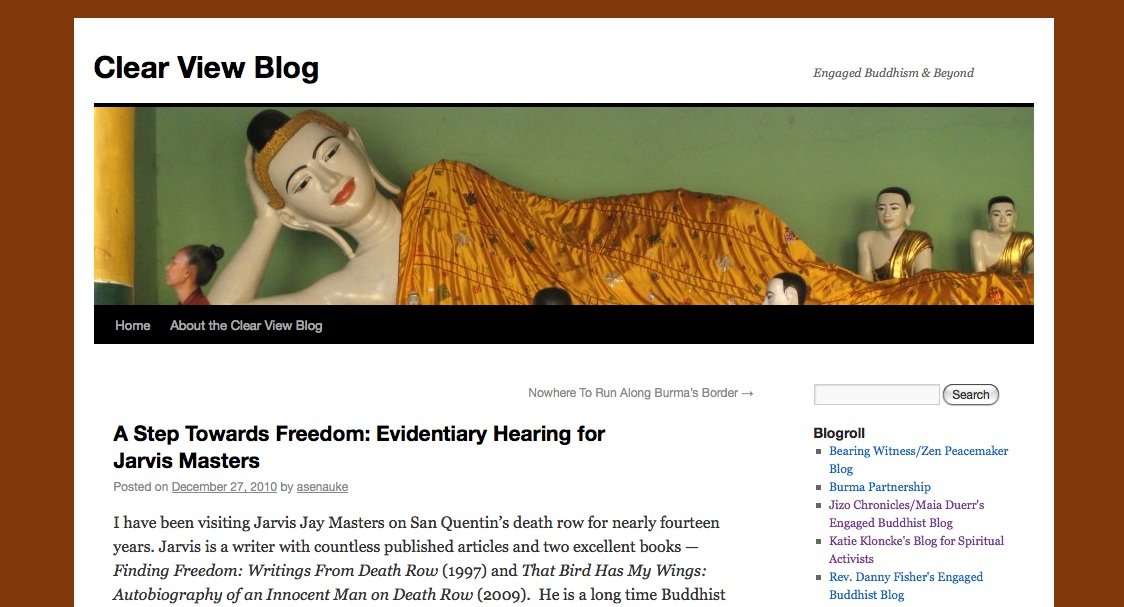
The first one a lot of folks are already excited about. It’s a blog for the Clear View Project, an engaged Buddhism org led by the totally rad Hozan Alan Senauke, vice-abbot at the Berkeley Zen Center. (Which, incidentally, is just a ways down from my new apartment. hey, neighbor.)
Just barely out the gate, Alan’s blog is already shining. Current events (national and international); incredible music (DAMN!); and personal/political reporting on the ongoing hearing of author, Buddhist, and death row prisoner Jarvis Masters — with whom Alan has cultivated a friendship for nearly 14 years. At Alan’s invitation on the blog, I joined supporters for part of the first day of Jarvis’ hearings in Marin. As someone who particularly appreciates blogs that bridge the online/offline divide, I’m so grateful that the CVP’s very first post was an offering for prison-support action. Dope, dope, dope. And the icing on the cake: Alan’s a superb writer. Clear View Blog: check it out, if you haven’t already.
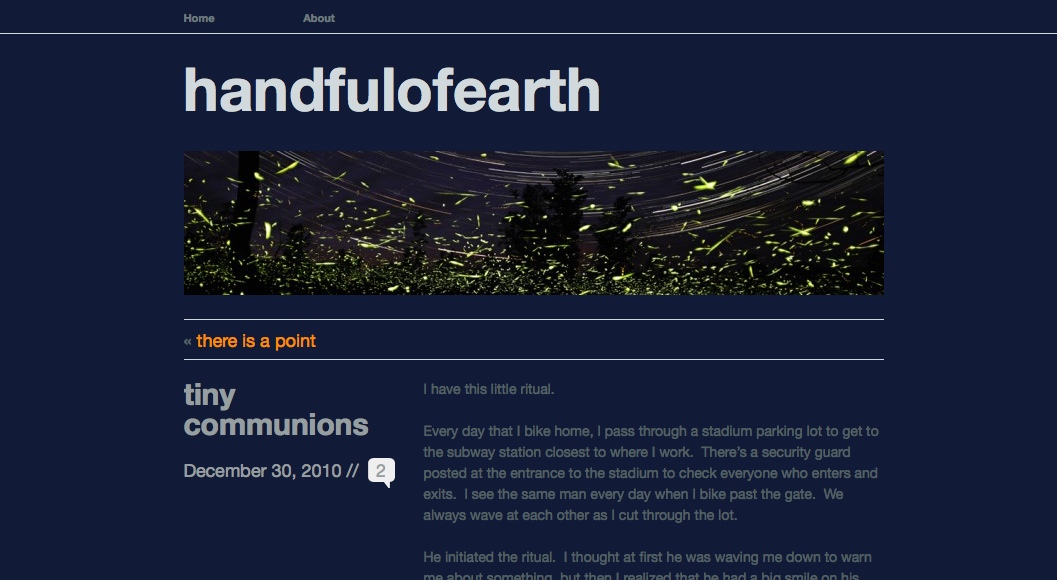
And the second new blog, like most of the sites on my blogroll, is by a longtime friend and fellow young status-quo-questioner (who chooses to remain anonymous). The first few postings on handful of earth are personal and insightful, with the kind of sweet storytelling that, when you’re finished reading, makes you want to go on with your day a little differently; a little better. I especially love this dharma-infused reflection on a daily commute ritual with a stranger, commenting on the connection between generosity and joy.
There it is — two brand-new cybergems. Here’s to sharing freely online, while we still have the chance.
When I graduated high school, I got a fairy-tale-like scholarship that would fully fund my higher education, wherever I wanted to go, for however many degrees I wanted to complete.
No, for real.

Dear friends,
Happy New Year!* Sorry I wasn’t able to put up a post yesterday, but I have a good excuse: no Internet, because I was moving into a new apartment!
2011 is bringing new beginnings for me on many major levels. After over a year of living and learning with the Faithful Fools in San Francisco, I’m crossing the Bay from the City to the Town, setting up shop in a cozy apartment in North Oakland. The “shop” itself will be the final four semesters of the Masters of Fine Arts in Interdisciplinary Arts (through Goddard College) that I started in spring of last year, with the unbelievably generous support of the Buck Foundation scholarship. And my shopmates (fellow housemates) will be Ryan (whom you know) and Mai, a friend I got to know through the Marxist-Feminist study group.
Those are the basic facts; the meanings behind them feel a little complex.
Bittersweetness at leaving the Tenderloin, just as I was beginning to form some strong relationships, build trust, and get a solid feel for the place. Excitement to be living in Oakland, which was my original destination upon arriving in the Bay Area. (The Faithful Fools thing, in the city, kind of popped up as a surprise.)
Enthusiasm and optimism for my first time living with a partner.
And a complicated mixture of gratitude and grief about this amazing opportunity to pursue my dream education, fully funded, while so many other students worldwide suffer under tremendous debt from student loans — a collective yet tremendously isolating form of suffering owing to neoliberal attacks on public, accessible, common-good resources. But that matter deserves a whole post to itself: stay tuned.
As I transition into this new phase step by step, preparing to put lovely kitchen things into these lovely kitchen drawers (above), I just want to thank you, again, for reading, for commenting, for your kind encouragement, for your critiques, for your friendship, for your inspiration, collaboration, solidarity, and love in 2010. It was a year of great growth and change on Kloncke. To know that what I’m offering here continues to be of benefit to some people means more than I can express.
Thanks friends, take care, and be well in the new *Gregorian year!
love,
katie

Started reading a book yesterday, borrowed from my friend Anastasia, called Detroit: I Do Mind Dying — A Study In Urban Revolution. Remembering that this year’s U.S. Social Forum (with its defensive hodgepodge of Lefty traditions) was hosted in Motor City, I’m especially interested in learning about the particularly radical, revolutionary history of the place.
Just began, so don’t have much to comment on yet, but the history of one legal case struck me something serious.
It’s a retelling — an entire prologue — of the amazing case of James Johnson: a Black auto plant worker who, in the summer of 1970, after being suspended for refusing to cooperate in a work speed-up, shot and killed a Black foreman, a white foreman, and a white job setter on the factory floor.
Remarkably, “the jury found James Johnson not responsible for his actions.”
Why?

Hey friends! Thank you for the rich discussion in the last post, on communicating with our elders. I’m always so humbled and grateful for the open, honest reflections that people share in this space. And that’s part of why this weekly practice of blogging continues.
Speaking of practices, I’m on a mission to cultivate more traditions and rituals in my life. Little anchors and measuring sticks for relating to change, and the passage of time, in a slightly different way. (Note: I love the weekly butcher-shop ritual described in this gorgeous essay by a dynamic/post-/questioning vegan; link via Napaquetzalli and Ernesto.)
One ritual that I’ve been recalling lately dates back to 2008/early 2009, when I lived in Central Square, back in Cambridge. My friend Jen turned me on to this weekly program on an independent radio station. “The Secret Spot.” Old-school and R&B jams: from Erykah Badu to Teddy Pendergrass, D’Angelo, Aretha Franklin, Chaka Khan, Lauryn Hill, Al Green. I LOVED The Secret Spot. And on Saturday nights, I would light some candles in the living room, turn down the lights, cozy up with a blanket in my favorite armchair, and listen. Sing along, too, if the apartment was empty (which it often was — this being Saturday night, when my fellow twentysomething housemates were typically engaged in more age-appropriate activities).
 Kloncke