
Catching up on life. Today was another big day for baby East Bay Solidarity Network. More tomorrow. Love, Katie

Catching up on life. Today was another big day for baby East Bay Solidarity Network. More tomorrow. Love, Katie
Hey folks,
Sorry for the late post again — feeling pretty drained, with a lot of heavy stuff coming up this week. But! I am buoyed, so soulfully buoyed, by my mama, my partner, my peeps in organizing from the Bay to Seattle, friends near and far, the Oakland sunlight, the air, and troves of loving, radical praxis that I’m discovering, really trying on, for the first time.
The primary situation I’ve been directly engaging today is delicate and requires confidentiality. So instead of talking about my own ish, I just want to point to a resource that’s been a true blessing for me: the transformative justice (TJ) work of Philly Stands Up! (PSU), a volunteer collective in West Philadelphia.

What is TJ? From their web site, here’s PSU’s explanation:
Transformative Justice has no one definition. It is a way of practicing alternative justice which acknowledges individual experiences and identities and works to actively resist the state’s criminal injustice system.
Transformative Justice recognizes that oppression is at the root of all forms of harm, abuse and assault. As a practice it therefore aims to address and confront those oppressions on all levels and treats this concept as an integral part to accountability and healing. Generation FIVE does a great job of laying out the main goals, principles and questions of Transformative Justice. These are their words:
The goals of Transformative Justice are:
- Safety, healing, and agency for survivors
- Accountability and transformation for people who harm
- Community action, healing, and accountability
- Transformation of the social conditions that perpetuate violence – systems of oppression and exploitation, domination, and state violence
The principles of a Transformative Justice approach to addressing all forms of violence include:
- Liberation
- Shifting power
- Accountability
- Safety
- Collective Action
- Respect Cultural Difference/ Guard against Cultural Relativism
- Sustainability
Transformative Justice invites us to ask:
- How do we build our personal and collective capacity to respond to trauma and support accountability in a transformational way?
- How do we shift power towards collective liberation?
- How do we build effective and sustainable movements that are grounded in resilience and life-affirming power?
PSU, Generation FIVE, INCITE! Women of Color Against Violence, and other like-minded TJ groups are helping to co-construct, through community, some of the most exciting, uplifting, and inspiring praxical contributions to “collective liberation” that I have seen in a long time.
“Liberation” is a big, important, but tough-to-pin-down word for this blog, and it may not mean the same thing in dhammic/Buddhist and radical political/power contexts. Liberation from suffering in samsara requires different strategies and approaches (8-Fold Path as Buddha’s “program”? :) than liberation from capitalist imperialist heteropatriarchy. And yet, to my mind, especially in the realm of sila (morality, or basically how to live a “good” and wholesome life), there is room for tremendous, tremendous overlap.
Thanks to a workshop and texts from PSU and AORTA (Anti-Oppression Resource and Training Alliance), this afternoon I sensed some possibilities for synthesis between these two paths. A meticulous practice of compassion recommended by an erstwhile Indian prince over 2500 years ago, and a working model for confronting intimate violence — forged from the crucibles of so many struggles against racist heteropatriarchy, the State, and their interwoven, often co-morphous manifestations.

Buddhist suttas warn practitioners against heavy-handedness in concentration training (the focus should neither be too loose, nor too tight), and meditation teachers urge us over and over to be “firm yet gentle” with our chattering monkey minds, gradually teaching ourselves to rest our attention on the meditation object (in my tradition, that’s usually the breath). Is this mere people-pleasing packaging? Some sort of dogmatic or (what is probably the same thing) careless Middle Way-ism? No. The firm-yet-gentle combo doesn’t just sound nice and “balanced” — it points to an actually hospitable environment for difficult intentional transformation. Too gentle, and we get lazy, restless, defensive, or shut-down. Too firm, and we become dogmatic, dulled, judgmental, tightly-wound, and generally prone to missing the whole “compassion” boat, or burning out altogether.
Similar principles, it seems to me, apply to TJ work. If our goal is to foster transformation, we need to be firm yet gentle — not too loose, and not too tight. This is a radical departure from the punitive model of justice on which the US legal system is based (and irregularly, prejudicially, oppressively applied). It invites us, as the above definition says, to “respond” to trauma, not react. Rather than “cracking down” on people who commit violent behaviors, we stop excusing, minimizing, and supporting those behaviors. We work instead to “water the good seeds” (as Thich Nhat Hanh says of inclinations in the mind) of meaningful accountability (in other words, a process with real milestones, material structure, boundaries, consequences, goals, etc.) and support.
Is this all making sense? So very new and tender shoots, these are. I’m no urban gardener but I’m trying the best I can.
Check out the zine by Philly Stands Up!, “A Stand Up Start Up.” Let me know what you think.
take care, friends,
katie
————————————————————
Update: For a great list of oppression-denying and -compounding behaviors (“excusing, minimizing, and supporting”), I’ve added a link to a post by NellaLou on “Sex and the Sangha,” looking in part at the various types of responses to the recent exposure of some Zen teachers’ sexual misconduct with their students. It’s a really wonderful resource for naming the harmful and frustrating apologistic dynamics that often accompany the outing of intimate abuse, and NellaLou also points toward restorative justice as an alternative model. Thanks, NellaLou!

It’s been a rough few days, folks. A really rough few days. No running water in the apartment — and that’s the least of it.
Despite the plumbing obstacles, I managed to whip up a batch of cookies for a cookbook signing -slash- potluck by my culinary crush Heidi Swanson. Her new book, Super Natural Every Day, has already made the NYT Bestseller list after like a week on the market. I didn’t even have time to let the hot cookies cool down before popping two dozen of them into two empty egg cartons (an impromptu innovation in pastry transport) and hopping on my bike to dash across the border to Berkeley.
Those that didn’t make the carton cut found their way over to my friend Noa’s place, with its lovely succulents.
When things fall apart, I’m grateful for generous, loving, and and precious friends, and for cooking. At times when I’m feeling down, or, even more precisely, when I’m focusing very intently on uncomfortable and difficult emotions and experiences, my appetite plummets and gets very particular. I crave fruit and whole-milk yogurt, water, leafy greens, things like that. (Again, this is when I’m bringing mindfulness and patience to the difficulties. When I’m flat-out stressed, and especially rushed, it’s a whole ‘nother matter, and that’s when I turn to the sugar, the French fries, the “numbing” foods, as Noa calls them — not pejoratively, but descriptively.) I feel lucky and privileged that I’m able to feed my healthier, deeper cravings as they arise. So in this case, with little appetite for anything that wasn’t recently growing on a tree, I wasn’t as keen to devour these delightfully tart versions of my favorite jam thumbprint cookies. But the act of creating food for others is grounding and healing, too.
[Update 2:30pm: Just wanna say I love posting about this just as this year’s Safety Fest is getting underway! Safety Fest is an annual weekend of events organized by Communities United Against Violence (CUAV), supported this year by Critical Resistance, on the theme of queer and trans power, anti-violence at the intimate, community, and state levels, and abolition of the prison-industrial complex (PIC). Awesome!]
For the 10th anniversary issue of Left Turn Magazine, anti-imperialist organizer Clare Bayard offers a wonderful look at “demilitarization as rehumanization” work in the US. Her examples are varied and informative, from youth-of-color-led anti-recruitment efforts in Bay-PEACE Oakland, to community-based transformative justice approaches to intimate violence, to indigenous people’s and immigrants’ movements to stop US imperialism at home and abroad. Her primary example, relating to work she herself has been doing with US Iraq Veterans Against the War (IVAW), highlights a thought-provoking and politically visionary approach to war resistor organizing. It’s called Operation Recovery: Stop the Deployment of Traumatized Troops (OpRec).
The underlying strategy is IVAW’s basic model: organizing GIs to withdraw their consent from wars. Its success in stopping deployment of troops with severe trauma would incapacitate the occupations of Afghanistan and Iraq by knocking out 20 to 50 percent of the fighting force. It’s a dilemma campaign. If we win, the wars are hamstrung. Or, if the military continues deploying wounded troops, this visible criminal negligence will hurt their legitimacy and ability to keep recruiting. Either way, we also improve our capacity to provide our own community-based care, which is needed far beyond just the veterans’ community. An element of the campaign is developing survival programs, inspired by the Black Panthers, to address the needs of people whose ability to resist their command often depends on access to support.
Operation Recovery exposes the silenced crises of Military Sexual Trauma (MST), Traumatic Brain Injury (TBI), and Post-Traumatic Stress Disorder (PTSD). IVAW, partnered with the Civilian-Soldier Alliance, has a strategy to win on multiple fronts. Demanding the right to heal is a point of leverage to challenge the institution, as well as a survival need within this community. OpRec has begun targeting base commanders who have the power to make immediate decisions preventing deployments. Here, even “damage control” means fewer lives destroyed.
Amplifying the voices of traumatized troops deepens awareness of the scope of disaster in these wars. After last fall’s media exposure of Afghanistan “kill teams,” IVAW member Ethan McCord responded, “You’re taking soldiers who are on psychotropic drugs for PTSD or TBI, and you’re putting a weapon in their hand and sending them right back to where they were traumatized and telling them to go kill Afghans. What did you think was going to happen when you place these soldiers in that same situation?”
The dual strategy of withdrawing worker power from the war machine while simultaneously building alternative structures for healing and recovery that do not depend on the state represents, to me, a beautiful synthesis of peace work and anti-imperialism. Not a superficial synthesis as in a combination of two stereotypically gendered approaches (macho “war resistors” and feminine “healing”), but the real, dialectical synthesis represented in one of the mottos of UBUNTU, a women-of-color and survivor -led community network against sexual violence in Durham, North Carolina:
To resist, we must heal; to heal, we must resist.
In her chapter of The Revolution Will Not Be Funded, Paula X. Rojas advocates the same kind of approach, modeled in many of the people’s struggles in Central and South America: using politicized horizontal organizations that meet community needs as a leverage point against militarized state power. The politically-infused practice of building people’s power to form their own schools, justice systems, food supplies, squatter organizations, and so on, articulates base building not in terms of recruiting people out of their homes into some new hierarchical organization or corps, but “thinking beyond the state, and even beyond an alternative vision of current institutions, by politicizing every aspect of everyday life and alternative forms of dealing with them.” (202) We can see how this resonates with Bayard’s articulation of using OpRec to “improve our capacity to provide our own community-based care” for traumatized veterans, as well as act as a “point of leverage to challenge the institution.”
Having heard so much hype about using Buddhist meditation practices for healing, it’s so refreshing to encounter this articulation of wellness that names the elephant in the room: ambient institutional violence in a militarized, imperialist culture. Not everyone is impacted in the same ways, or to the same degrees, and yet we are all responsible for transforming this reality. As Clare says, “Affirming everyone’s humanity and centering the importance of healing capsizes the logic of militarism.”
In these terms, healing is not an “escape” from worldly troubles, just as meditation is not an exercise in stopping pesky thoughts from arising. Rather than chase after some imaginary permanent spa day, a life in the realm of the gods that is also ultimately impermanent, we turn toward suffering and confront militarization as one of the the primary mechanisms for the maintenance of class society. Not only in manifestations of, as Lenin called them, “special bodies of armed men,” but also in the patriarchal, hierarchical, and punitive tendencies — subtle and overt — that we each bring to our organizing collectives.
One last dimension I love about Bayard’s piece, that I think is relevant to the “Socially Engaged Buddhism” discourse, is the focus on GI leadership. Often, it seems to me, in progressive Buddhist thinking, we see strains of liberal logic of “empowerment” or “responsibility” manifesting as a kind of self-centeredness. For example, my friend Maia over at the Jizo Chronicles recently resolved to face her own “hypocrisy” as someone who is against US wars but also pays taxes that support them. Now, I know that Maia wasn’t trying to propose some sort of program for ending the wars — it was more of an exercise in self examination and transformation — but I hear this angle echoed a lot in white liberal anti-war circles. As I understand it, this line of thinking looks at the ways in which we are each individually accountable, through our own actions, and seeks to use our individual power to change our behaviors. Kind of an aggregate approach — if enough people follow suit, there will be a big shift. I respect and admire some of the ideas there, but on strategic grounds I disagree with centering them. What does it mean that such war resistance efforts can happen totally divorced from relationships with GIs? Clare touches on this problem in her discussion of the challenges of veteran organizing, describing not only separation but “friction between GI resistance and majority white and class-privileged peace movements,” also exacerbated by “the carefully designed race and class makeup of the military.”
Now, I hear a lot of emphasis placed on war spending (read: electoral politics) and weapons manufacture as points of intervention for peace/anti-war work, but that doesn’t mean that other organizing tacts don’t exist in Buddhist circles that I don’t know about! Anyone have a lead on veteran-led anti-war work supported by organized Buddhists?
In the meantime, please give Clare’s whole article a thorough read, and feel welcome to share insights, reflections, and disgreements here.
Have a wonderful weekend, friends!
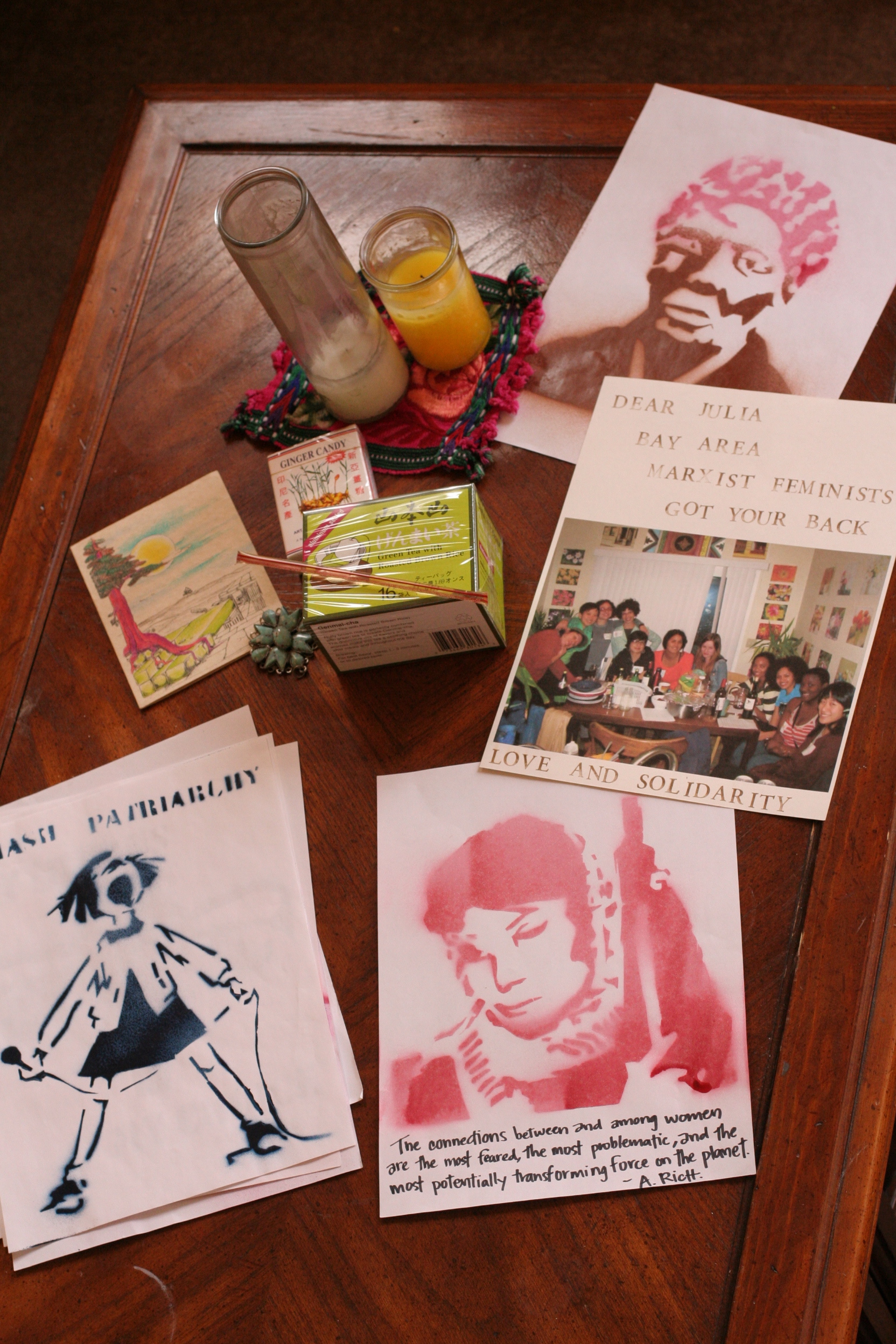
Last week, our Marxist Feminist study group assembled some offerings for a care package. A comrade of ours in LA (close friend to some, known through her work to others) has been going through a difficult time lately, and we wanted to send a small token of appreciation for her strength, amazing organizing work, and general fabulousness.
Handmade stencils, a card, a poem, ginger candy, green tea with a honey stick, a necklace pendant, and a hand-stamped group photo from our inter-state Marxist Feminist gathering a few months back. The finishing touch will be a batch of cookies I’ll bake up tomorrow.
Care packages! A personal favorite.
Say what you will about Saul Alinsky: the man organized some creative actions. I’ll never forget one example of his (I think he described it in Rules For Radicals) where the community cooked and ate a huge baked-bean dinner, then packed an orchestra hall owned by the “enemy,” and let loose with their own smelly music.
This weekend’s East Bay Solidarity Network action wasn’t quite so dramatic, but I did feel a resonance with Alinsky’s tactical virtuosity. We knew why we were there, who the target was, what we wanted to accomplish, and how it fits in to the larger strategy of the fight. And we even saw encouraging results during the action itself.
My own personal ruminations revolve (unsurprisingly) around whether and where there is room for compassion within direct actions that make a target uncomfortable — or “harm” them (major scare-quotes) economically. Actions that tend (especially in a masculinist context) to dramatize and promote an ‘us versus them’ framework. I’ll be contemplating this question much more over the next couple of months, but for now I’ll just say this. I believe it’s possible to speak and act very forcefully against a perpetrator (I’m experimenting with saying “perpetrator,” rather than “enemy,” to guard against the typically dehumanizing crystallization of enemyism, and to invoke the work of radical anti-sexual-violence communities that seek to transform both behaviors and systems) while still maintaining compassion for them. It’s something I’m experimenting with myself, in this EBSol work.
With that said, I’m just gonna go ‘head and cross-post the whole entry on today’s action from our brand-spankin’-new website. Hope you enjoy!

In our demand letter that we delivered to Alpha Omicron Pi sorority two weeks ago, we promised to return in 14 days if our reasonable demands were not met. True to our word, yesterday and today we continued our campaign to win former “house boy” employee and tenant William fair compensation for his shady firing and the outrageous eviction that left him homeless.
For our second action, both yesterday and today, we flyered and door-knocked the surrounding blocks to inform the whole neighborhood of the egregious injustice. We don’t know what was more encouraging: the enthusiasm from neighborhood co-op members (some even offered their contact info and asked to be notified of future actions), or the surprise and horror of the sorority managers when they realized what our posters were airing.

Less than 24 hours after our Sunday flyering session, taped shreds of paper — remnants of our flyers — testified to the sorority managers’ embarrassment. Before we had even left the block, they were already tearing down our work from the street signs and telephone poles. But today we were back for another round! They won’t get rid of us easily.
The bosses are already on the defensive, and this fight is just getting started. If you want to join us as we ramp things up with escalating actions, email or call us to make sure you’re on our contact list!


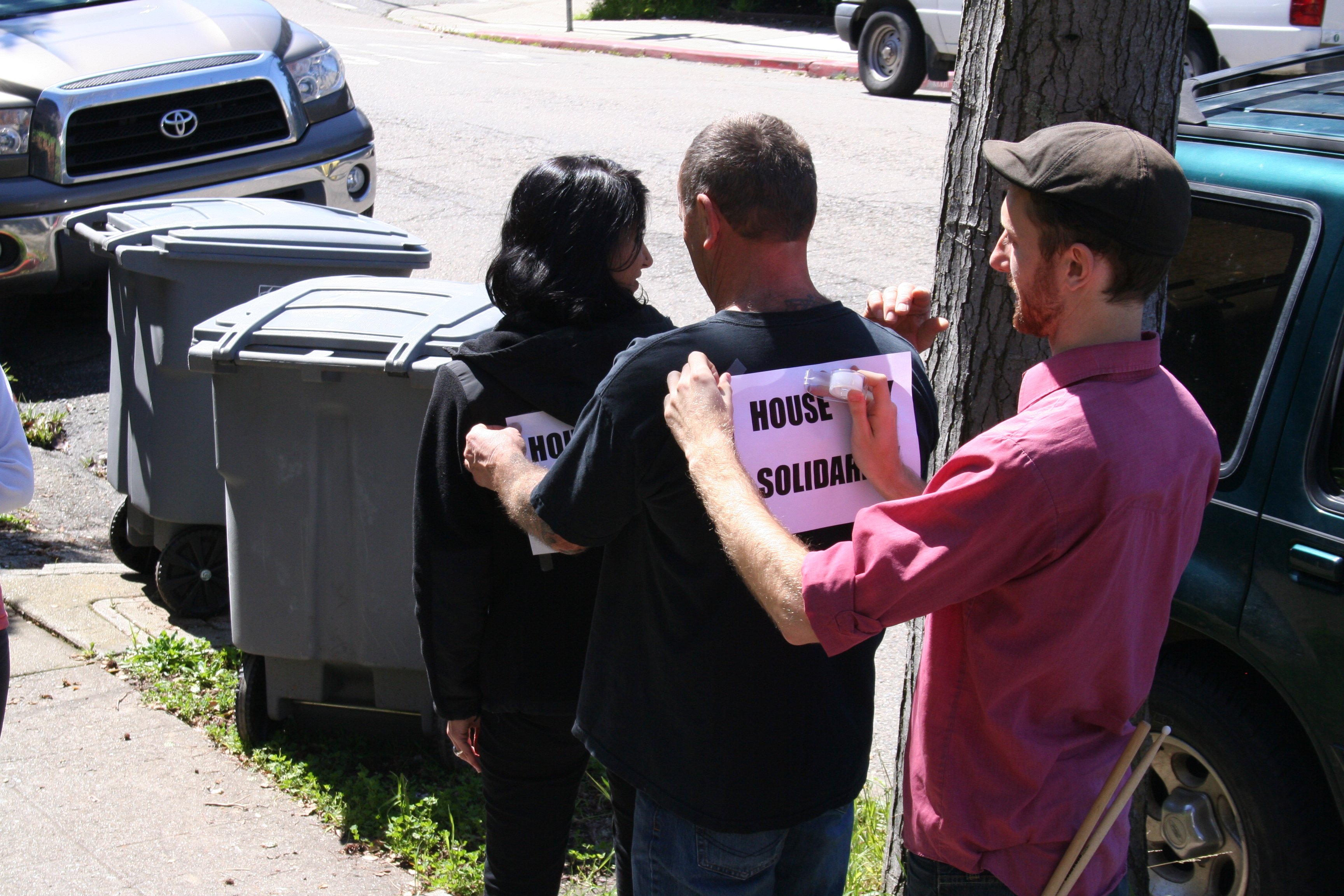
At 12:24pm today, after a sunny Berkeley bike ride, Mackenzie and I were the first ones to arrive at the designated decoy meet-up location, just down the block from the actual target. We taped up a sign that read: HOUSE BOY SOLIDARITY. Slowly, people began to trickle in. Many knew each other through other political work, greeting each other with big smiles and hugs, and “long-time-no-see’s.” By 12:50, everyone knew the plan, the choreography, and the goal. The ten of us headed toward the Alpha Omicron Pi sorority house, one leading our chant on the bullhorn: AIN’T NO POWER LIKE THE POWER OF THE PEOPLE ‘CAUSE THE POWER OF THE PEOPLE DON’T STOP!!!
Thus began our first action as the East Bay Solidarity Network (EBSol).
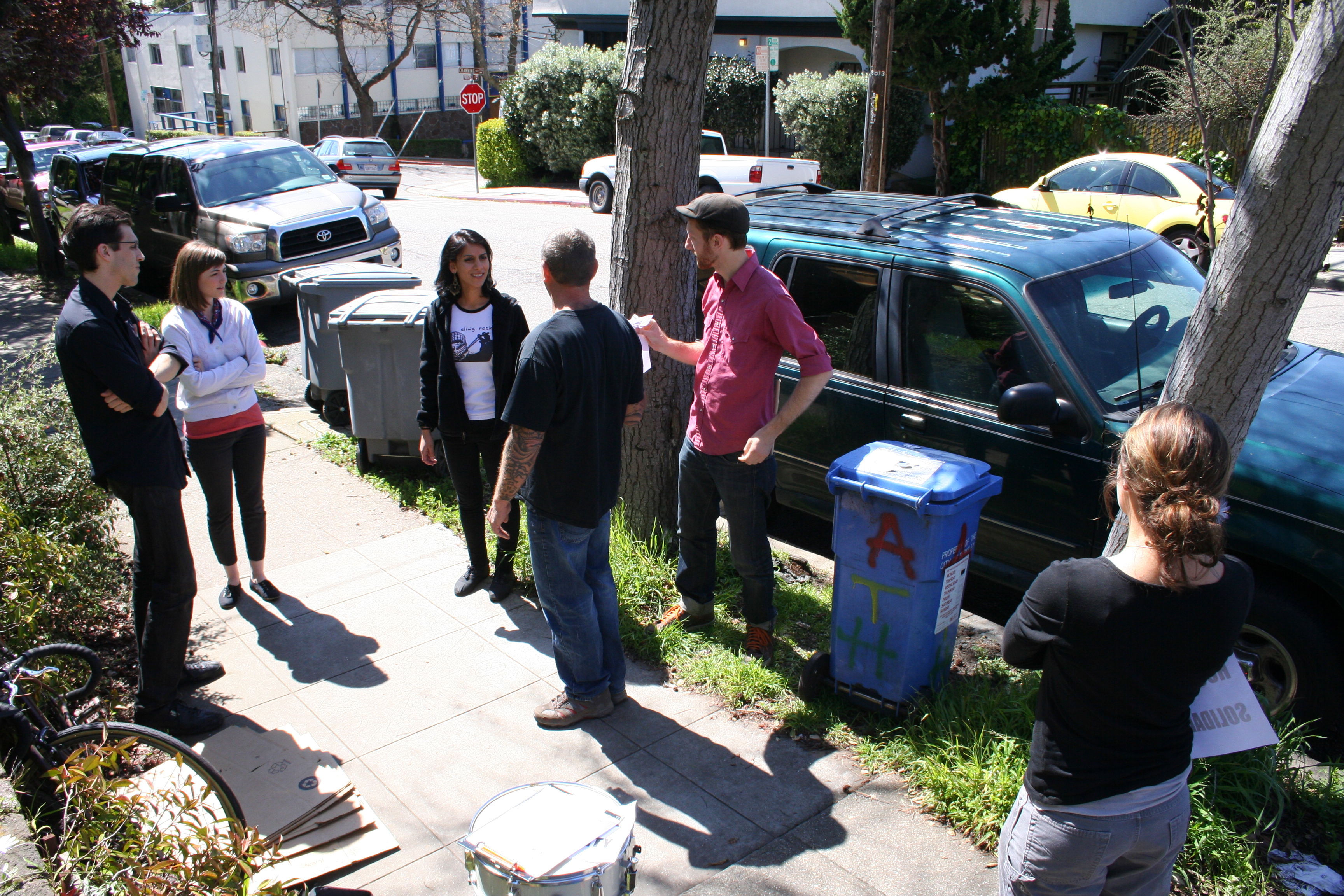
William had been working and living at UC Berkeley’s Alpha Omicron Pi as a “house boy”: a common term used to refer to live-in cooks who help prepare meals for Cal sororities. He was still receiving training, and had had no serious reprimands or complaints about his performance. On the contrary, he often received a “Good work” and a fist pound from the other, senior cook at the end of the shift. All that changed when they fired the dishwasher and made William and the others pick up the extra work. Without extra pay.
After weeks of working extra hours to cover the undone job, and clearly seeing how exploitative this was, William demanded that his manager hire another dishwasher. They did not; but not long afterward, he was called in for another meeting. He was told that he was being fired for unsanitary work practices (again, having never been seriously reprimanded or warned about any such failures), and that he had three days to move out of his lodgings in the basement of the sorority.
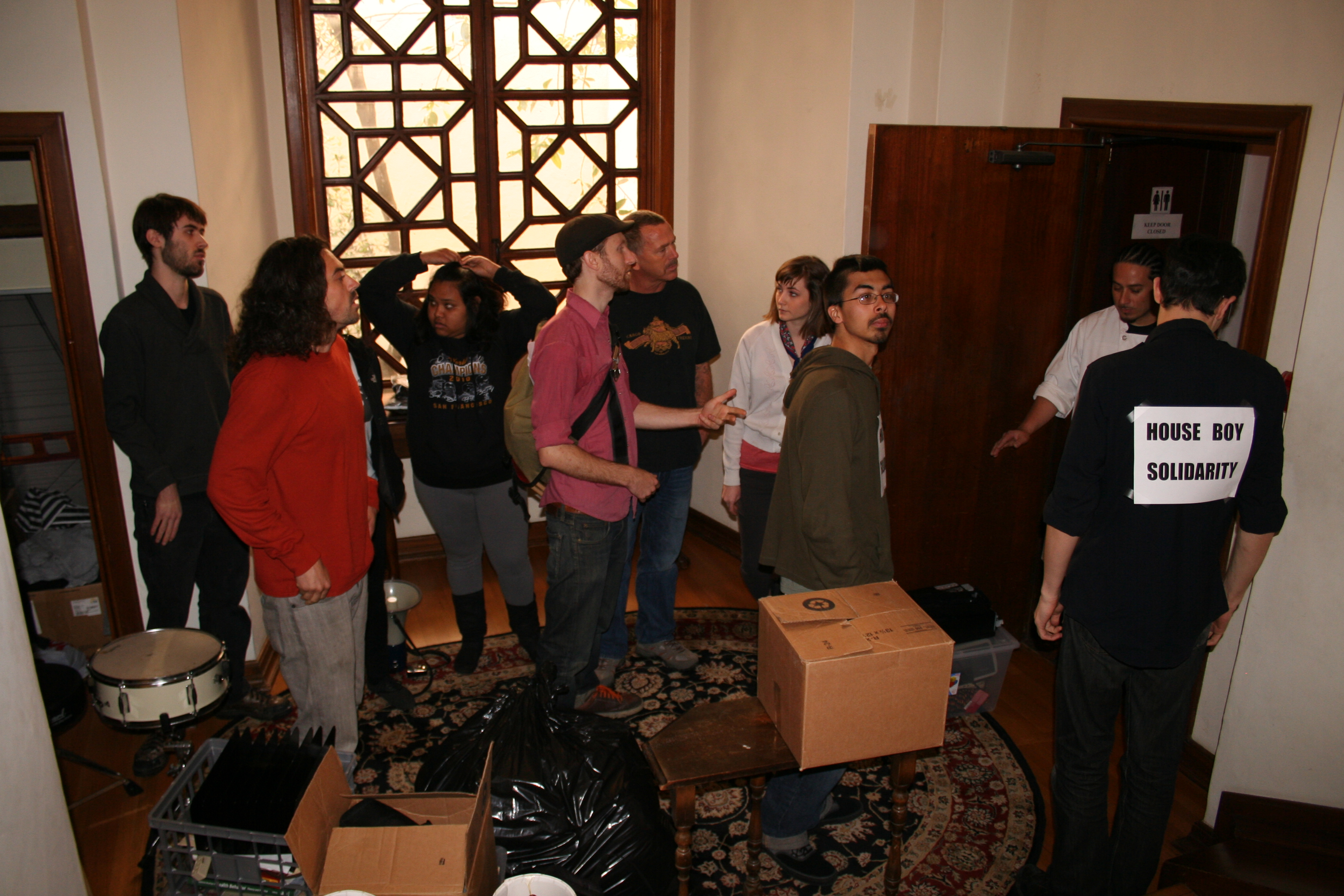
Until now, the sorority management had been dealing with one lone, vulnerable worker: easy to exploit, oppress, fire for causing trouble, illegally evict, and all that sort of typical thing. But today, William wasn’t a lone worker. He was a part of the solidarity network, and he was joined by his fellow members.
Together, we brought his earthly belongings up from the basement (where they had been packed up without his consent and stored in the boiler room, to make space for the new “house boy”) and, after a brief back-and-forth with his back-stabbing co-worker, took up our formation on the front staircase and passed each item, bucket-brigade-style, down the line. (Wish I had pictures of the bucket brigade, but it’s hard to be photographer and participant at the same time!) Meanwhile, Ryan played a militant march on his snare drum. We had discipline, choreography, and musical flair, man. Doubtless we left an impression.
Now that the managers had been made distinctly aware of our collective presence, William delivered to them the official EBSol letter, specifying our reasonable demands of the sorority managers, and letting them know that if our demands are not met within 14 days, we, as a group, will take action against them.
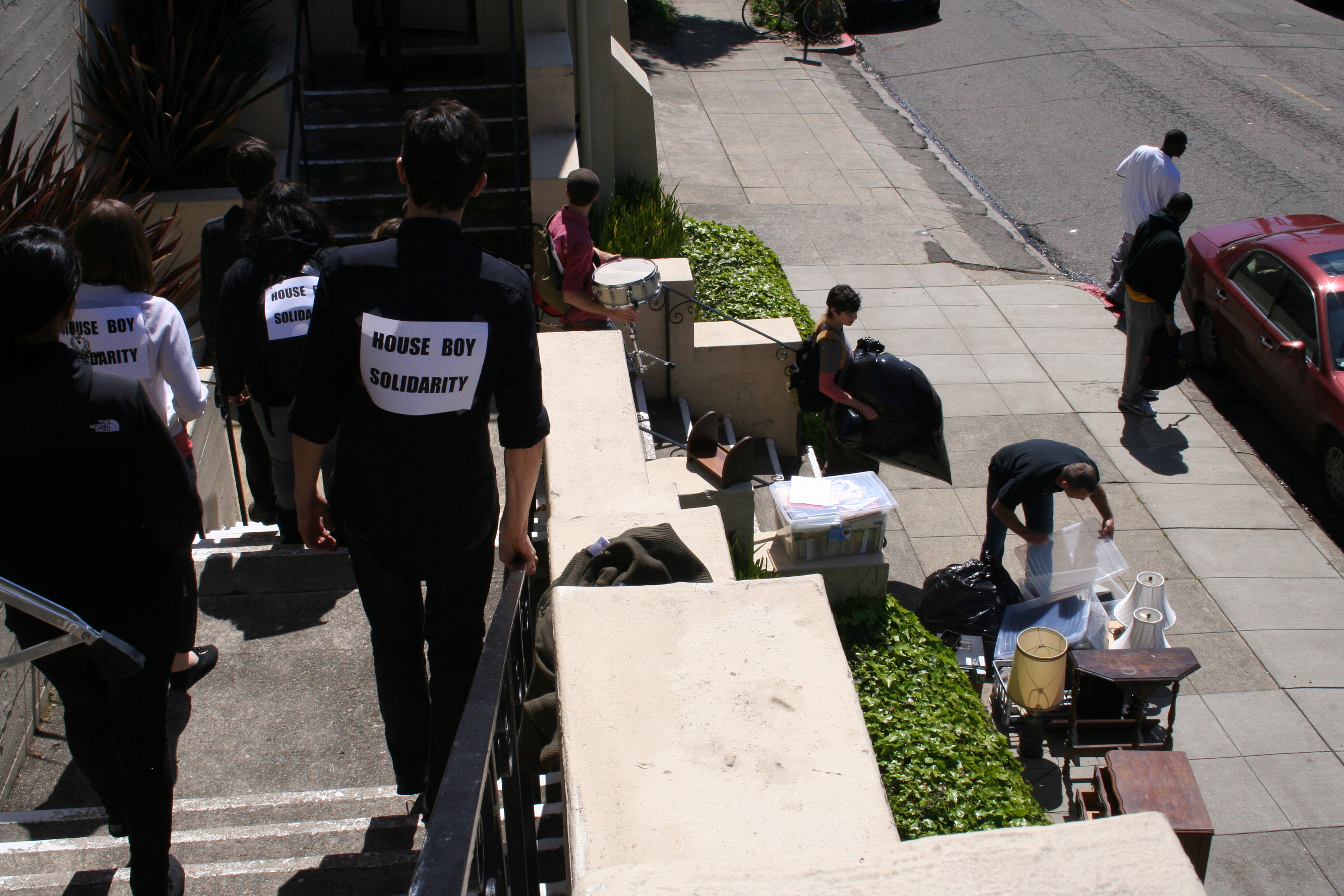
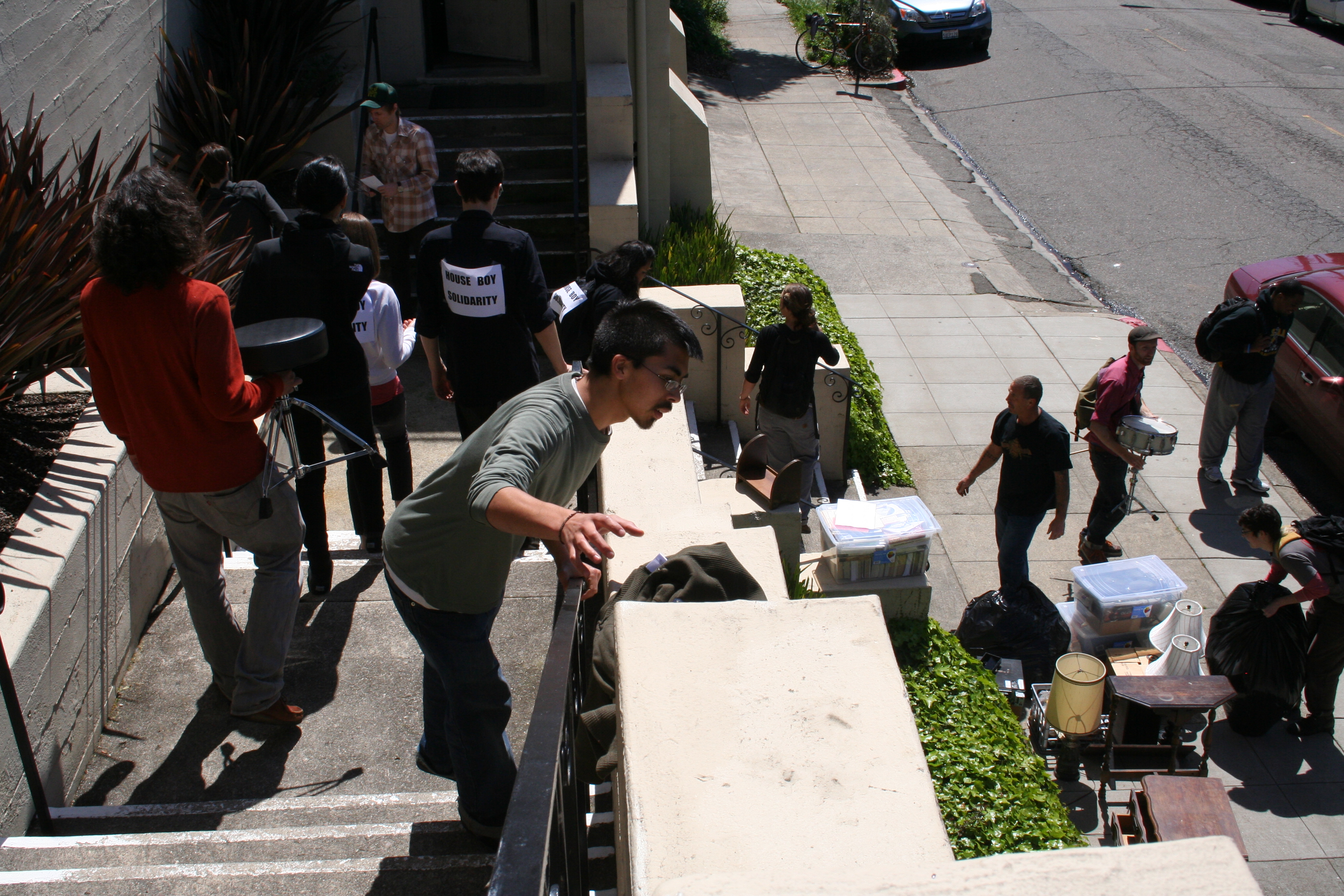
When all his stuff was piled on the sidewalk, William took the bullhorn and told his whole story to an explicit crowd (our group, now 13 total with some late arrivals) and an implicit crowd (the sorority girls, peeping wide-eyed in bunches through the upper-floor windows; and the managers and staff on site). A manager from a nearby sorority, an in-law of one of William’s former managers, came storming over and tried to shut him down — grabbed at his bullhorn, and threatened to call the cops on all of us for trespassing in a “private home.” We pointed out that it was not only a home, but a workplace, and William kept shouting out the gory details of how they screwed him over.
With his passion, his technology, and the cheering response of the rest of us in the solidarity group, William (and we) easily drowned out the flustered and angry stand-in-boss, creating quite a spectacle for the women watching from the windows. (Whom William was quick to remind that it’s the boss we’re fighting, not the sisters.) For a while the managers even withheld William’s last check, trying to force us all to stay til the cops came in response to the bogus trespassing call, but soon enough they relented and handed over his payment. We loaded his belongings into cars, and left happy.

There are a million reasons I’m excited about how today’s action went. For one, it feels great to take up the case of a domestic worker, whose labor is so completely invisibilized and underpaid most of the time. Second, enthusiasm in the group was really high, partly because everyone was in a fighting mood, partly because a lot of us are friends, and also because this was not a symbolic action: it had both the moral high ground and specific objectives to accomplish (dramatize the moveout with disciplined formations; deliver the demand letter promising more action to come). Also, I think, we all felt inspired to see William stand up to his bosses (or their stand-ins), express his anger at being exploited, and be emboldened by the real mechanism of our group. It made me feel, at least, that if I’m ever getting screwed by my landlord or a boss, and I don’t have a fighting union to help me, then I sure as hell want a solidarity network like this! There’s a lot to be learned just by being there to help other people’s fights.
As with any tactic, this one had its inherent limitations; and there were moments of confusion and things we could have done better. This week, the five of us who planned the action (William included) will get together to debrief and reflect on how to improve. But overall, I think we really pulled off something fine today, and I think everyone who participated felt it was deeply worthwhile. Now, the campaign has begun — more updates to come in 14 days….unless our victory comes sooner!
On a final note, speaking for my own self, there are a lot of messy, fruitful dhamma questions coming up for me as a result of this EBSol organizing. Is there room for an adversarial organizing premise like that of a solidarity network — united against corrupt bosses and landlords — within the concept of nonviolent, kind, wise boddhisattva action? I’ve never really heard anything like that, myself. Usually Buddhist activists point to the universal lovingkindness of a Martin Luther King, who seemed to be able to embrace his adversaries even as he disobeyed their rules and laws. SeaSol — The Seattle Solidarity Network, from whence our model comes — makes no such embrace across the class line. Yet, their actions are nonviolent and strategic. So to me, it seems there’s more overlap than not. What’s your take? How does the solidarity network idea sound to you? Share your wisdom — or better yet, join us for our next action, and then tell me what you think. ;)
How do the two fit together?
This question’s been yelling itself in my face for the past couple of days. (Weeks?) Not only in theoretical terms, but in practical ways. Touched on by elders, peers, friends, strangers.
Roughly (and this is my own attempt, for which I’ll accept blame but not credit):
Some groups are great at building and exemplifying models of anti-oppressive ways of being. (Pre-figurative politics, as I understand it, means practicing now the kind of society you want to build in the future.) Enacting horizontal group dynamics, confronting white supremacist and racist behavior, challenging and transforming sexism, homophobia, transphobia, fatphobia, ableism, etc. in myriad ways, and continually developing sophisticated, intersectional analyses of these lived oppressions. Honoring and valuing healing; promoting literacy around dealing with trauma and mental wellness. Developing healthy sex-positive cultures grounded in consent. Practicing conscientious methods for dealing with intimate violence and abuse. Giving and receiving criticism with humility, generosity, bravery, and kindness. Doing very practical things like organizing childcare collectives, artmaking groups, and food distribution programs; infusing them with liberatory values. Transforming estranged relationship with our bodies, the earth, and nature. Theorizing these and more practices, and sharing them.
At the same time, some groups are great at developing people’s revolutionary class consciousness. Examining the material processes of history with an eye toward figuring out the best ways to intervene in those historical processes, and change things for the better. Get rid of classes altogether. Put an end to imperialism. Employ practice and theory, in current conditions, to avoid the pitfall of reformism and move militantly and decisively toward a world of “freely associating producers” — a world where violent compulsion is no longer ambient, as it is under capitalism and has been under all forms of class society (to stake a claim against what I learned about Foucault, in college). I’m impressed and inspired by groups that maintain a keen focus on this goal, and whose work reflects the urgency of building the class power necessary for exploited people to liberate themselves/ourselves from the yoke (and rod) of capital.
Now. Is there overlap between these ‘types’ of groups?
Yes.
A lot?
In the Bay Area? In the US?
IIIIIIII dunno. What do you think? What are you finding?
That’s all for now; more questions than answers.
g’night, friends.

Do any of y’all celebrate Pi day? π = 3.14 = March 14th! My high school math teachers were the first to introduce me to the holiday, which is honored by eating pie. Sign me up!
This morning I headed down the block to Lois The Pie Queen’s place and picked up a couple slices from the wonderfully warm folks there. Having just read my friend ChakaZ’s thoughtful, incisive piece touching on gentrification in Oakland (a process that often leads to the overthrow of pie queens, and the replacement of barbecue shacks with fancy coffeeshops), it was even more gratifying to support a Black-owned, Black-cultural business that’s been in the neighborhood — and in their family — for 50 years. And clearly not, might I add, as a gimmicky “exotic Southern food for upscale whites” kind of establishment, but as a low-key, proud-yet-humble, neighborly sort of place.
In addition to the beauty above, I also got a piece of banana cream, but a bumpy ride on the bus left it unfit for open-casket photos.
Later in the day, being unable to finish both slices by myself, I would leave the leftover banana cream in its takeout pod in a big paper bag, hidden conspicuously behind a bush in Berkeley. Fortunately, my hopes were realized: a man named Terry found and enjoyed what remained of the treat. Unfortunately, I know that Terry found and enjoyed it because Terry also found my cell phone, which I forgot inside the paper bag.
I must have had some good karma on my side, though, because Terry seems like a really nice guy. Tomorrow we’ve arranged a hand-off for the mobile. I think I’ll bring him another slice from Lois’. He was really wild about that banana cream.

Hey friends — sorry for such a late post today! It’s been a whirlwind. Morning tea with a dharma/movement kindred spirit (a revival of Radical Sangha is in the works!); a super-intense two-and-a-half-hour group session with a generative somatics facilitator/counselor/consultant/rad person at the Faithful Fools; being interviewed by someone who’s making a video documentary about the Fools; and now off to prep some work with the Marxist feminist group in honor of International Women’s Day tomorrow.
Life: it’s full sometimes! And I was in a similar gear last Friday when, among other things, I showed up to join a crew of about 20 supporters of a rank-and-file picket of health care workers (above) who were illegally fired for going on strike. More on their inspiring (and victorious!) battle, including videos of Friday’s picket, here. Then, most of us supporters rolled out to a downtown Oakland rally against the gang injunctions. Here are some photos of each; sorry for the lack of commentary, but hopefully tomorrow I’ll have time to add a little more.
hugs,
katie
 Kloncke