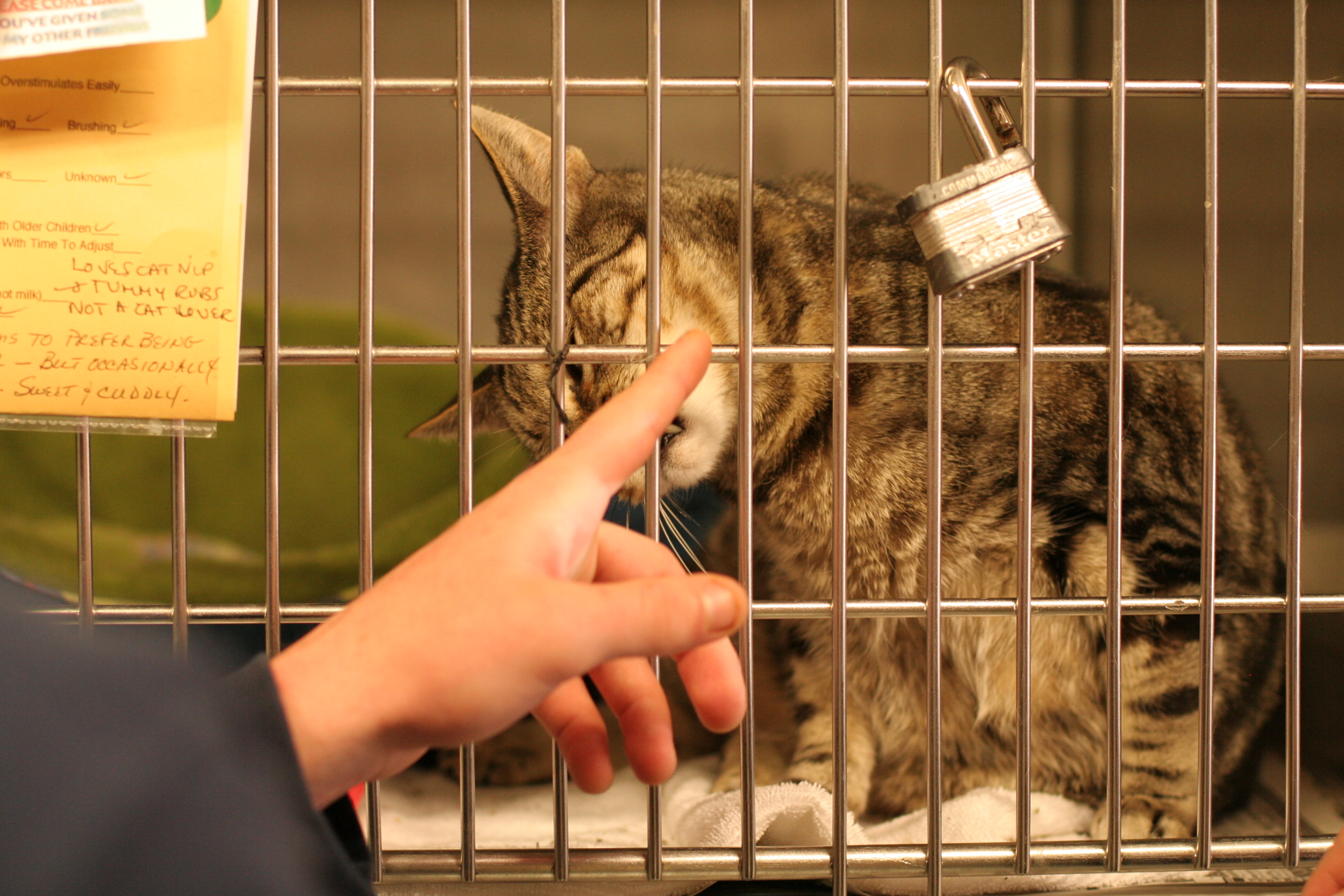
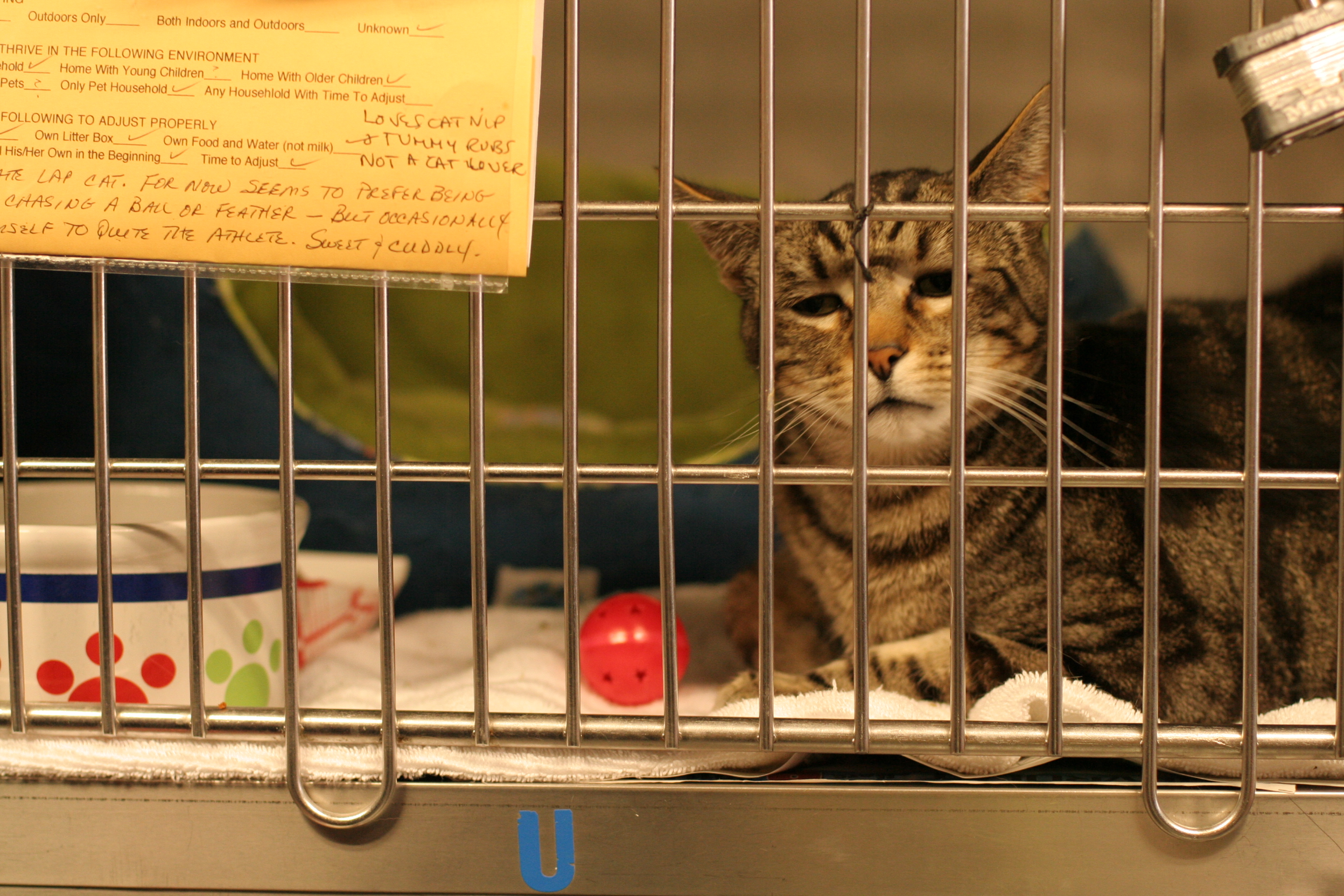
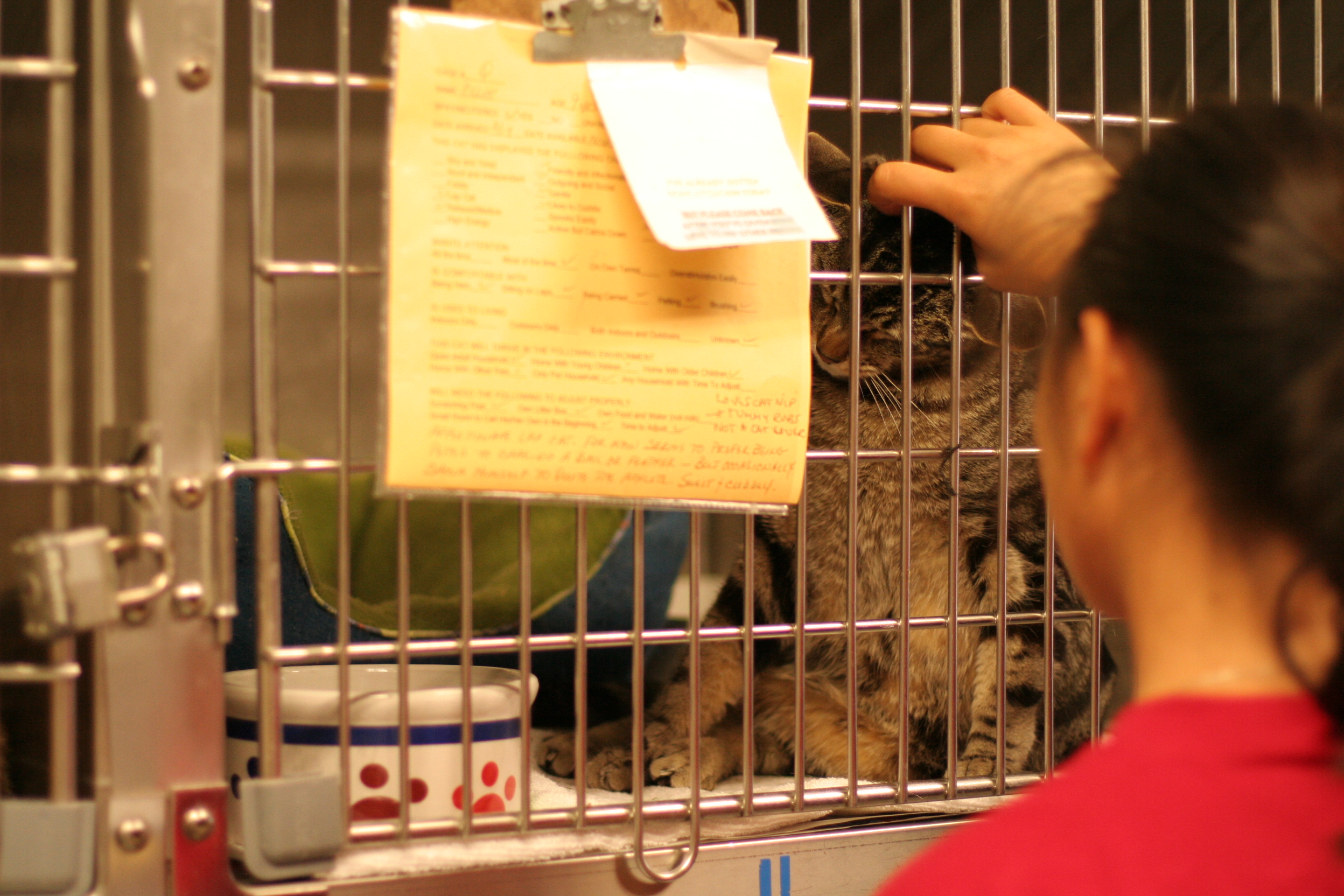
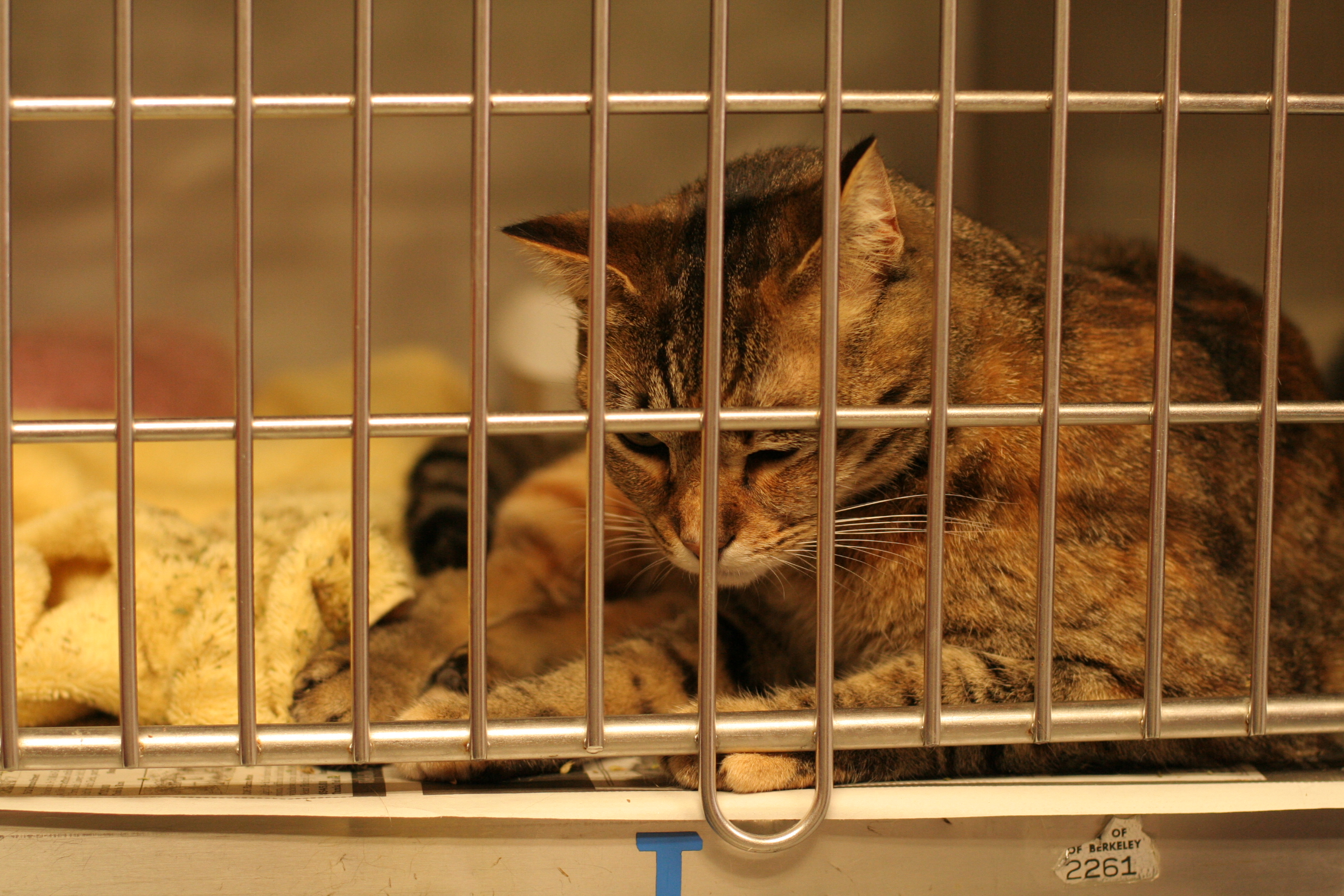
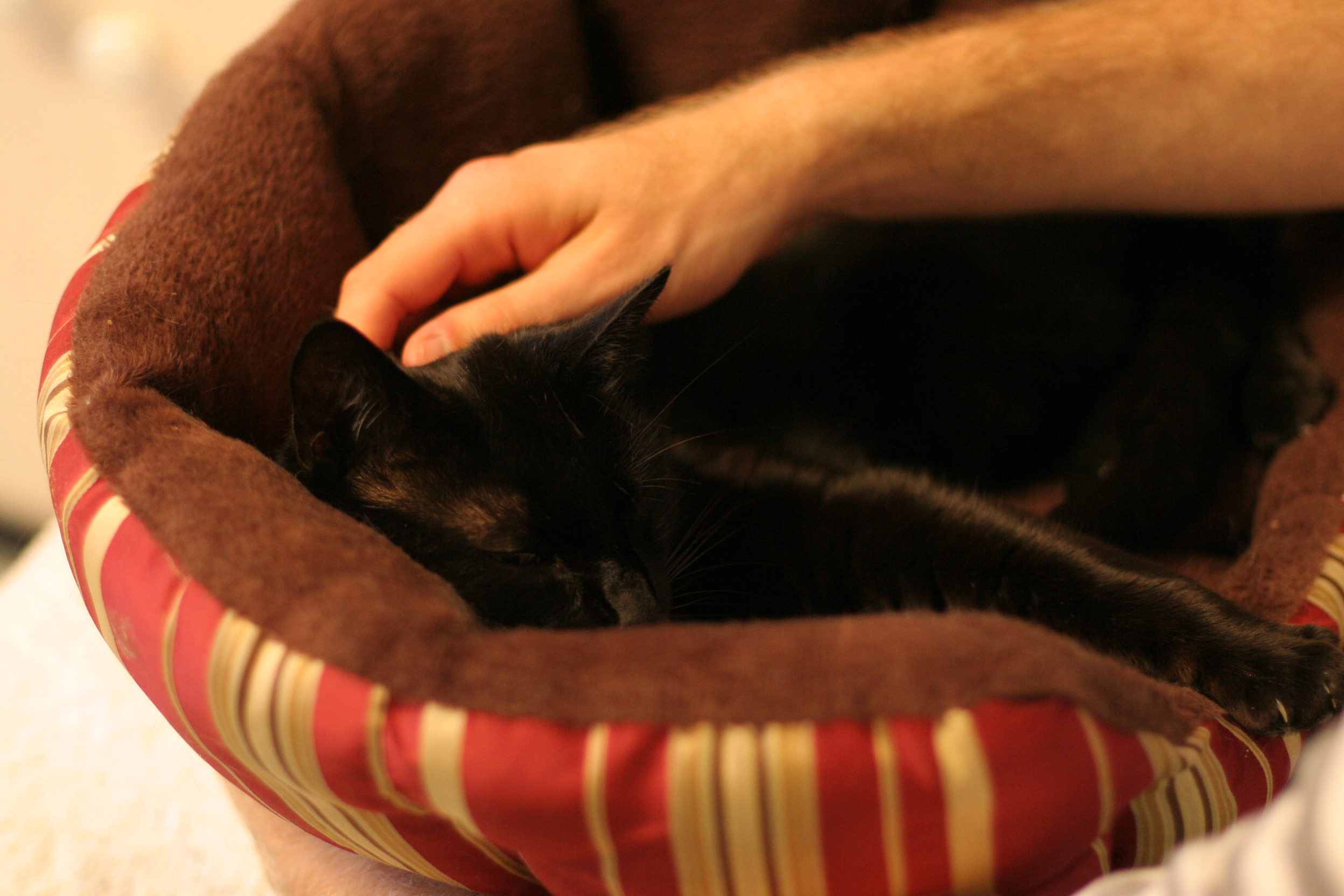
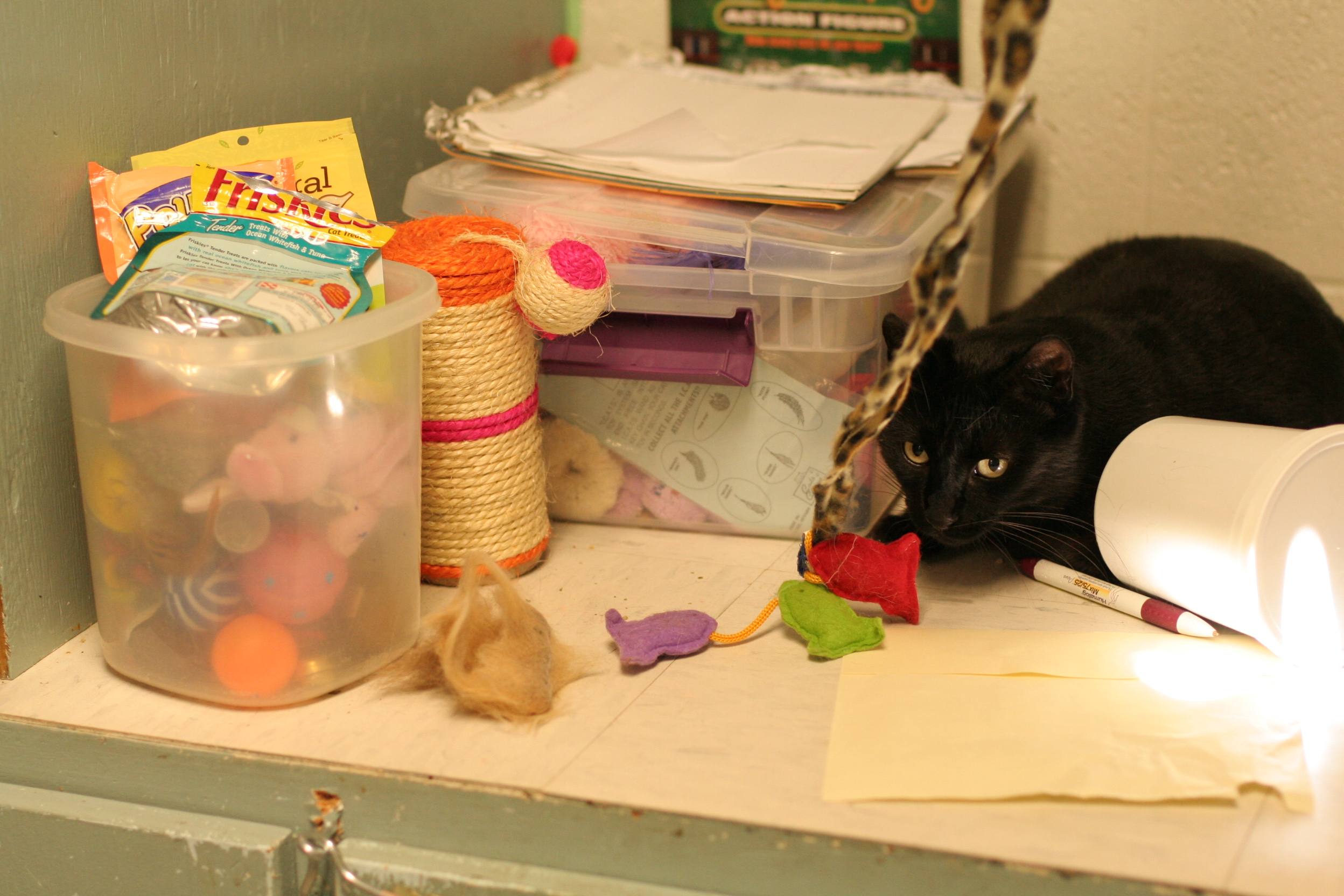
This weekend Ryan and I went to Berkeley Animal Care Services to visit with the cats. (“Kih’ens,” a variation on “kittens,” is mainly how I refer to domestic felines. My cat lady ways speak for themselves.) Based on our schedules and accommodations (carpet in the apartment), we probably won’t be able to adopt a kitty ourselves, but a little lap-purring therapy never hurts. I got a good vibe from this “no-kill” shelter — meaning that animals can stay for years, and are only euthanized if they are ill beyond treatment or too aggressive to be adopted. While the kih’ens we encountered didn’t seem thrilled to live in cages, they were definitely getting a lot of love and attention, and all the ones we spent time with were sweet as could be.
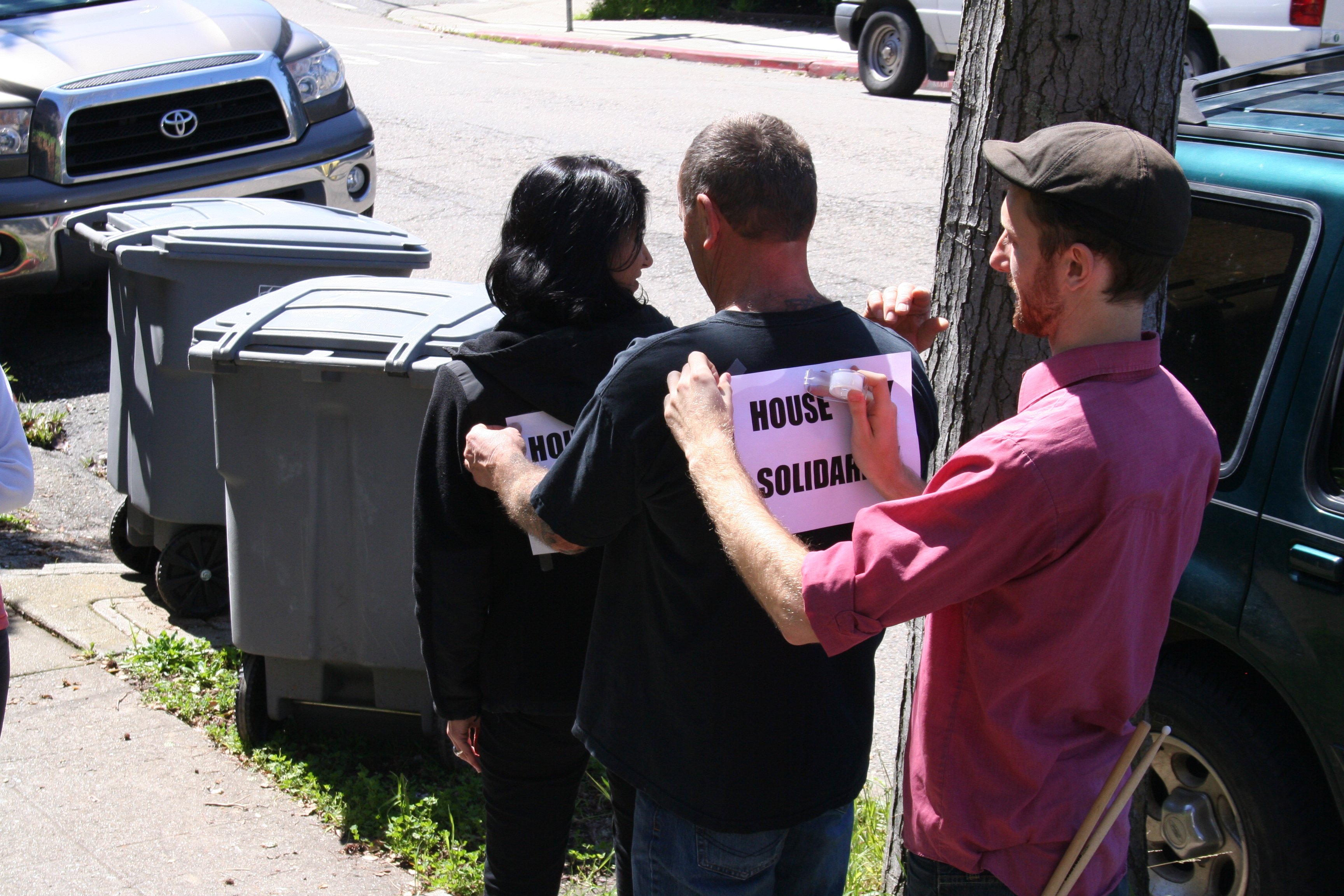
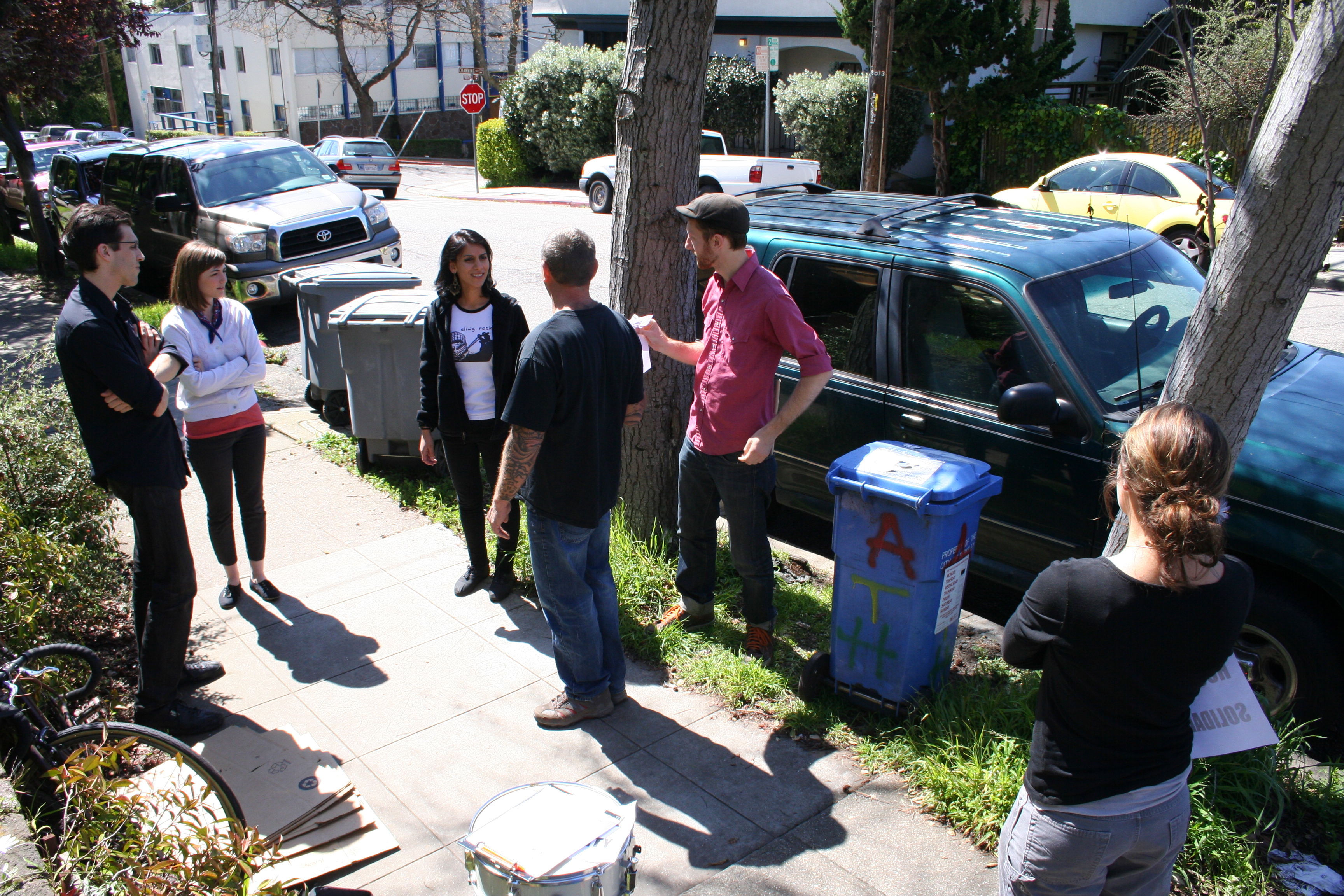
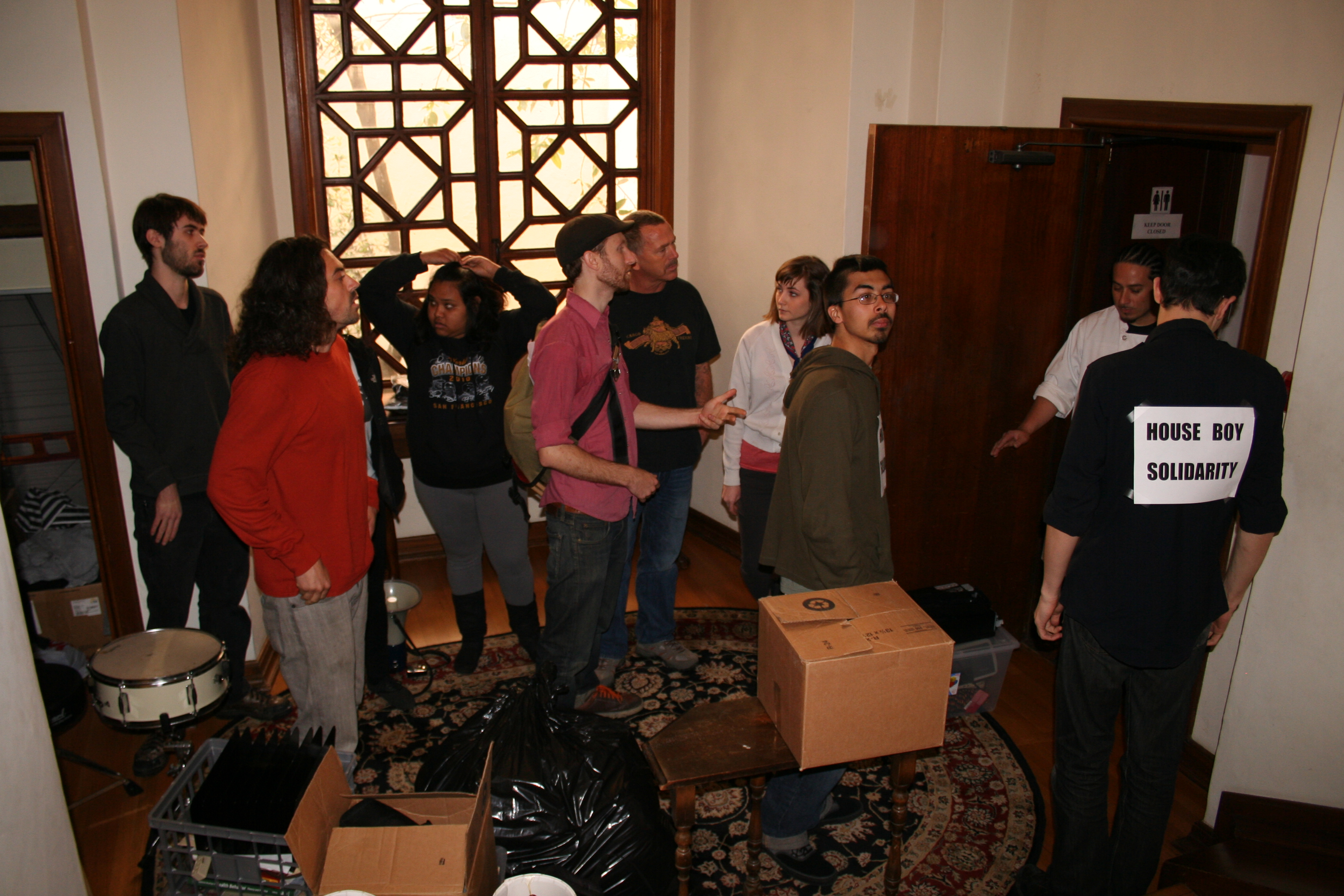
At 12:24pm today, after a sunny Berkeley bike ride, Mackenzie and I were the first ones to arrive at the designated decoy meet-up location, just down the block from the actual target. We taped up a sign that read: HOUSE BOY SOLIDARITY. Slowly, people began to trickle in. Many knew each other through other political work, greeting each other with big smiles and hugs, and “long-time-no-see’s.” By 12:50, everyone knew the plan, the choreography, and the goal. The ten of us headed toward the Alpha Omicron Pi sorority house, one leading our chant on the bullhorn: AIN’T NO POWER LIKE THE POWER OF THE PEOPLE ‘CAUSE THE POWER OF THE PEOPLE DON’T STOP!!!
Thus began our first action as the East Bay Solidarity Network (EBSol).
William had been working and living at UC Berkeley’s Alpha Omicron Pi as a “house boy”: a common term used to refer to live-in cooks who help prepare meals for Cal sororities. He was still receiving training, and had had no serious reprimands or complaints about his performance. On the contrary, he often received a “Good work” and a fist pound from the other, senior cook at the end of the shift. All that changed when they fired the dishwasher and made William and the others pick up the extra work. Without extra pay.
After weeks of working extra hours to cover the undone job, and clearly seeing how exploitative this was, William demanded that his manager hire another dishwasher. They did not; but not long afterward, he was called in for another meeting. He was told that he was being fired for unsanitary work practices (again, having never been seriously reprimanded or warned about any such failures), and that he had three days to move out of his lodgings in the basement of the sorority.
Until now, the sorority management had been dealing with one lone, vulnerable worker: easy to exploit, oppress, fire for causing trouble, illegally evict, and all that sort of typical thing. But today, William wasn’t a lone worker. He was a part of the solidarity network, and he was joined by his fellow members.
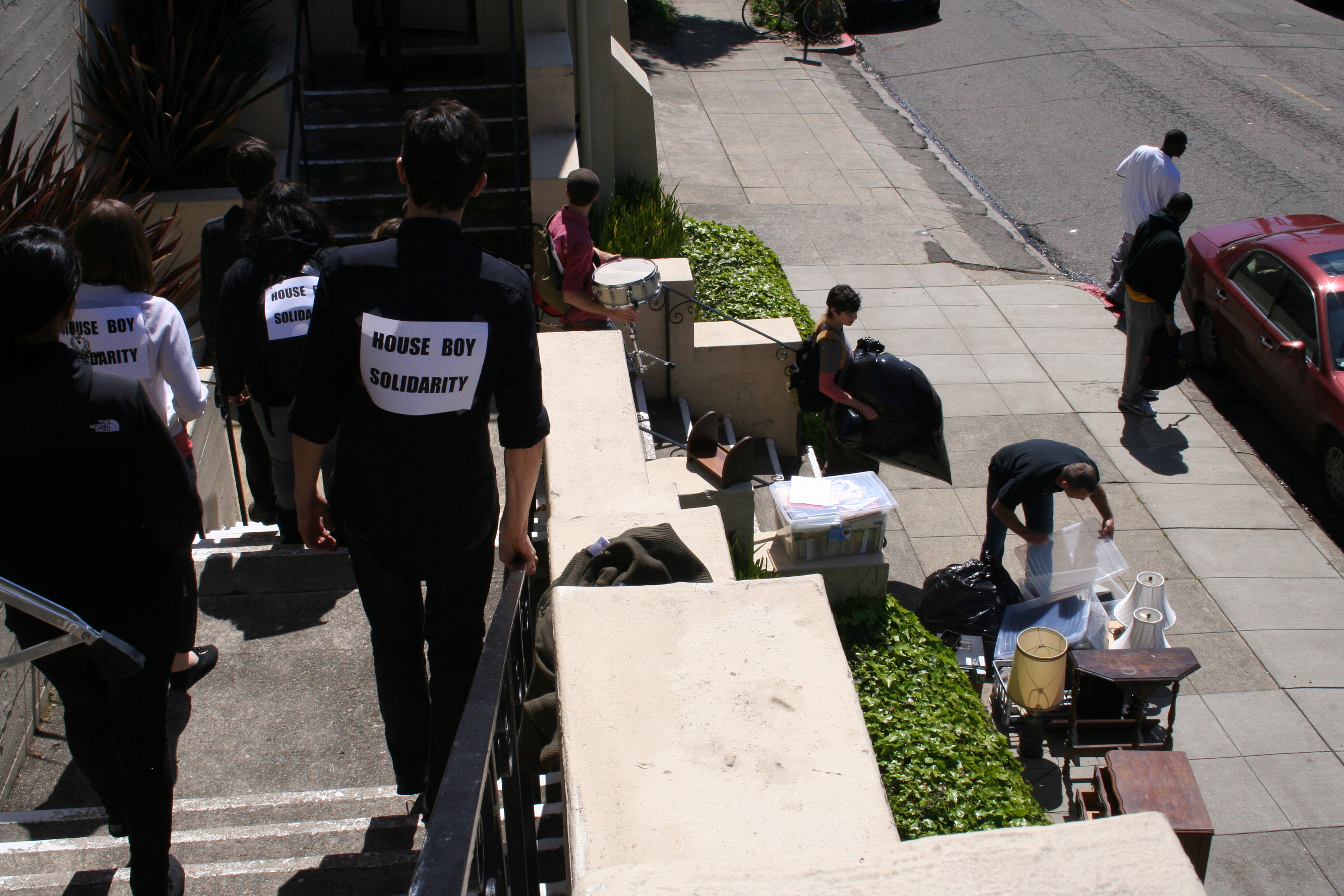
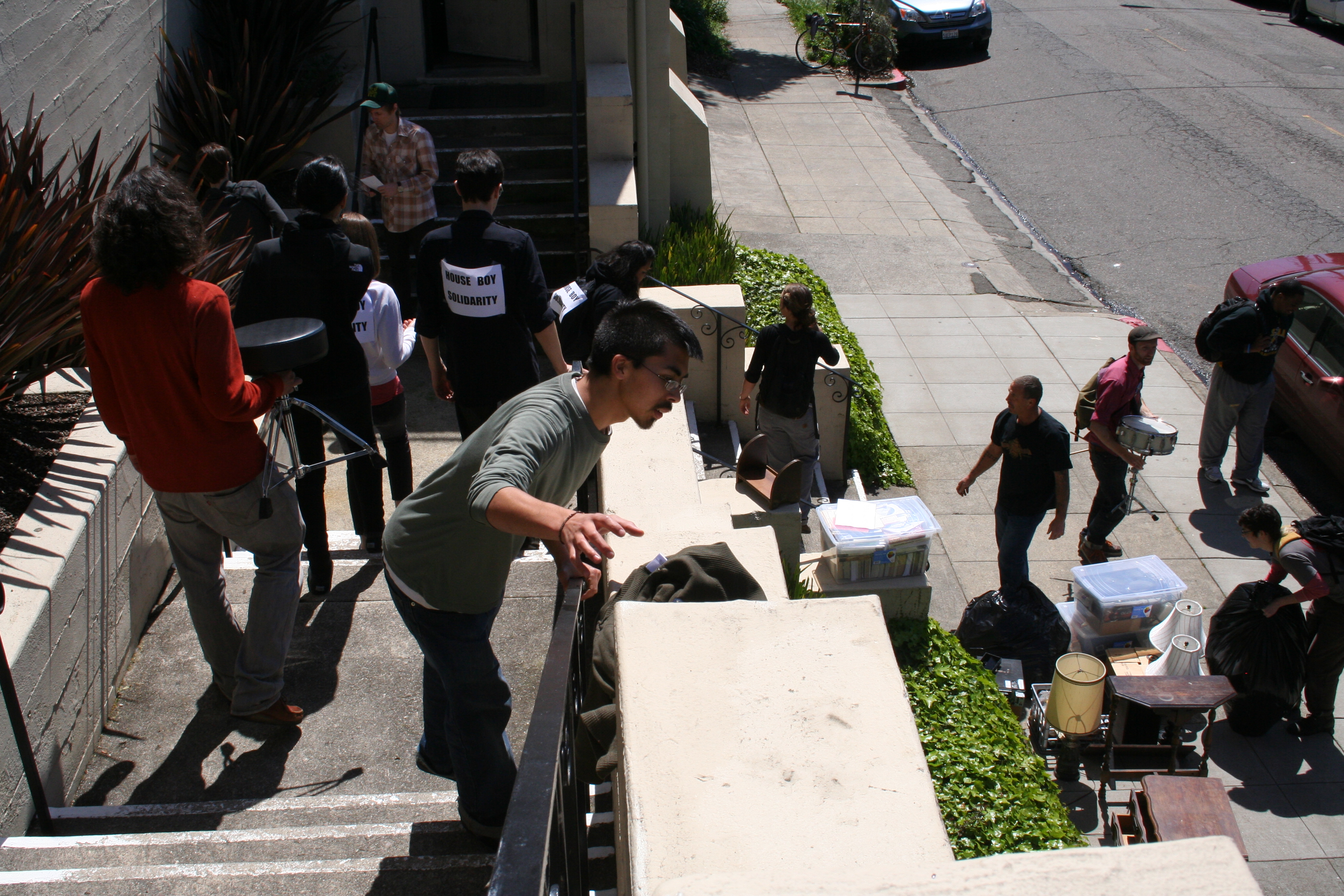
Together, we brought his earthly belongings up from the basement (where they had been packed up without his consent and stored in the boiler room, to make space for the new “house boy”) and, after a brief back-and-forth with his back-stabbing co-worker, took up our formation on the front staircase and passed each item, bucket-brigade-style, down the line. (Wish I had pictures of the bucket brigade, but it’s hard to be photographer and participant at the same time!) Meanwhile, Ryan played a militant march on his snare drum. We had discipline, choreography, and musical flair, man. Doubtless we left an impression.
Now that the managers had been made distinctly aware of our collective presence, William delivered to them the official EBSol letter, specifying our reasonable demands of the sorority managers, and letting them know that if our demands are not met within 14 days, we, as a group, will take action against them.
When all his stuff was piled on the sidewalk, William took the bullhorn and told his whole story to an explicit crowd (our group, now 13 total with some late arrivals) and an implicit crowd (the sorority girls, peeping wide-eyed in bunches through the upper-floor windows; and the managers and staff on site). A manager from a nearby sorority, an in-law of one of William’s former managers, came storming over and tried to shut him down — grabbed at his bullhorn, and threatened to call the cops on all of us for trespassing in a “private home.” We pointed out that it was not only a home, but a workplace, and William kept shouting out the gory details of how they screwed him over.
With his passion, his technology, and the cheering response of the rest of us in the solidarity group, William (and we) easily drowned out the flustered and angry stand-in-boss, creating quite a spectacle for the women watching from the windows. (Whom William was quick to remind that it’s the boss we’re fighting, not the sisters.) For a while the managers even withheld William’s last check, trying to force us all to stay til the cops came in response to the bogus trespassing call, but soon enough they relented and handed over his payment. We loaded his belongings into cars, and left happy.
There are a million reasons I’m excited about how today’s action went. For one, it feels great to take up the case of a domestic worker, whose labor is so completely invisibilized and underpaid most of the time. Second, enthusiasm in the group was really high, partly because everyone was in a fighting mood, partly because a lot of us are friends, and also because this was not a symbolic action: it had both the moral high ground and specific objectives to accomplish (dramatize the moveout with disciplined formations; deliver the demand letter promising more action to come). Also, I think, we all felt inspired to see William stand up to his bosses (or their stand-ins), express his anger at being exploited, and be emboldened by the real mechanism of our group. It made me feel, at least, that if I’m ever getting screwed by my landlord or a boss, and I don’t have a fighting union to help me, then I sure as hell want a solidarity network like this! There’s a lot to be learned just by being there to help other people’s fights.
As with any tactic, this one had its inherent limitations; and there were moments of confusion and things we could have done better. This week, the five of us who planned the action (William included) will get together to debrief and reflect on how to improve. But overall, I think we really pulled off something fine today, and I think everyone who participated felt it was deeply worthwhile. Now, the campaign has begun — more updates to come in 14 days….unless our victory comes sooner!
On a final note, speaking for my own self, there are a lot of messy, fruitful dhamma questions coming up for me as a result of this EBSol organizing. Is there room for an adversarial organizing premise like that of a solidarity network — united against corrupt bosses and landlords — within the concept of nonviolent, kind, wise boddhisattva action? I’ve never really heard anything like that, myself. Usually Buddhist activists point to the universal lovingkindness of a Martin Luther King, who seemed to be able to embrace his adversaries even as he disobeyed their rules and laws. SeaSol — The Seattle Solidarity Network, from whence our model comes — makes no such embrace across the class line. Yet, their actions are nonviolent and strategic. So to me, it seems there’s more overlap than not. What’s your take? How does the solidarity network idea sound to you? Share your wisdom — or better yet, join us for our next action, and then tell me what you think. ;)
Hey, friends! Today I want to share a new game I learned from a fellow member of my dhamma study group. It’s a Buddhist game, sort of. Here’s how it works.
PHASE 1:
Team up with a partner and take turns asking each other the following question-pair.
What are you noticing right now?
[Partner responds]
Is that pleasant, unpleasant, or neutral?
[Partner responds]
Thank you.
. . . What are you noticing now?
Keep up the exercise for about 2-3 minutes, then switch roles.
PHASE 2:
Now ask the following question-pairs:
What is something pleasant that you’re noticing right now?
[Partner responds]
What is your reaction to it?
[Partner responds]
Thank you. What is something neutral that you’re noticing right now?
[Partner responds]
What is your reaction to it?
[Partner responds]
Thank you. What is something unpleasant that you’re noticing right now?
[Partner responds]
What is your reaction to it?
[Partner responds]
Thank you.
Keep repeating the cycle (doesn’t really matter what order) for 2-3 minutes, then switch roles.
The responses to the questions can be internal or external — “I’m noticing that I’m having anxious thoughts about finding a job;” “I’m noticing the pillowy clouds out the window;” “I’m noticing a slight coldness in my hands.” It doesn’t matter whether they are pleasant, unpleasant or neutral in some objective sense (for instance, I might call the odor of skunks or gasoline pleasant, while my mom finds them nauseating). What matters is your own subjective experience.
The point is not to get all deep or articulate with the observations, but to keep it as stream-of-consciousness as possible. I think the game originates from the “noting” practice common among many Buddhists (particularly, if I’m not mistaken, Theravada/Thai Forest/Insight? Zen folks, Tibetan peeps, help me out?). With “noting,” you meditate while bringing awareness to different sensations in the body, and also to the umbrella category of “thinking.” Some forms involve naming or labeling the sensations; others advise against that.
For me, these exercises and games, and the logic behind them, have been quite useful. They bring our calm attention to what Buddhists call vedanā: a Pali word for “sensations.” Typically, the teachings say, our habit is to react to vedanā with various types of attachment or ignorance. When we experience a pleasant sensation, we often crave more of it. We want it to continue. When we experience something unpleasant, we wish it would go away as fast as possible. Neutral sensations, which make up a huge part of our everyday life, often escape our notice altogether; we don’t find them worthy or interesting enough to pay attention to.
What happens when we start bringing investigative attention to vedanā? It allows us to decouple our experiences from our reactions.
Sorry I’ve been lagging so hard on the posting lately. Things have been super busy offline! Political education classes; meet-ups; meetings; paid work (thankfully); etc. etc. This weekend Ryan and I are going camping with a couple friends. Can’t wait to be among those big trees.
Anyway, recently I’ve been feeling re-inspired about the Radical Sangha idea, and wanted to be more vocal here about the particular “dharma doors” I’ve been encountering lately. Now isn’t the ideal time, since I’m headed out the door to a birthday party, but I wanted to quickly pass along this lovely piece (via Mushim Ikeda-Nash‘s Facebook feed) that helped refresh my practice today. It comes from a Tibetan tradition. Sogyal Rinpoche recalls the teachings of Dudjom Rinpoche on the three qualities every human should cultivate: sampa zangpo, tenpo, and lhöpo (a good heart; stability and reliability; and spaciousness, or being at ease with oneself).
The whole piece is worth a read over on Tricycle, but I especially loved these two paragraphs on reliability and spaciousness.
For example, a string of beads has a thread running through all the beads, keeping them together. What we need is a thread too—of sanity* and stability. Because when you have a thread, even though each bead is separate, they hang together. When we have the teachings in us, stabilizing us, there’s a thread to keep our life together that prevents us from falling apart. And when you have this string, you have flexibility, too. That’s how you can have the freedom to be unique and special and individual and still have stability and humor. This kind of character is what we need to develop; this character is the thread.
*Thanks to insightful feminist critique of similar, though slightly worse phrasing in a different Buddhist essay, I now cringe when the word “sanity” gets thrown into pieces like this. It’s not something to take lightly in a society like ours where people are persecuted and violently oppressed because of a perceived lack of “sanity.” So I want to mark that, and yet acknowledge that most people, even on a broad spectrum of neurodiversity and psychodiversity, probably experience moments and phases of greater or lesser stability, characterized by comfortable, firm groundedness that’s not overly rigid.
On spaciousness, Sogyal Rinpoche writes,
If we are at ease with ourselves, we are at ease with others. If we are not at ease with ourselves, then we will be uncomfortable, especially in company. Imagine you find yourself at a smart party in Paris. All kinds of people are there, from different backgrounds, slightly different from you, and one very suave and successful person turns round to greet you. Even the way he says “bonjour” has a supercilious air about it, as he looks down his nose at you condescendingly. If you’re at ease with yourself, there’s no problem. He can drawl “bonjour” and look down on you, and you feel completely fine, because for you it is actually a bon jour, since you are well with yourself.
When we are well with ourselves, then whatever happens, it really doesn’t matter, because we have equilibrium and stability. We don’t feel any lack of confidence. If not, we’re always on edge, waiting to see how someone reacts to us, what people say to us or think about us. Our confidence hangs on what people tell us about how we are, how we look, how we behave. When we are really in touch with ourselves, we know ourselves beyond what others may tell us.
Spaciousness is an especially great asset for political folks, it seems to me. It allows us to face conflict without feeling backed into a corner, trapped and defensive. Far from passivity, I find that spaciousness means a robust engagement with many different dimensions of a situation. It makes room for anger, fear, resentment, and all that fetid stuff: neither repressing it nor allowing it to dominate the entire mental environment.
Very useful — to me, anyway, and I hope to you, too! Have a wonderful weekend, folks; see you Monday.
This question’s been yelling itself in my face for the past couple of days. (Weeks?) Not only in theoretical terms, but in practical ways. Touched on by elders, peers, friends, strangers.
Roughly (and this is my own attempt, for which I’ll accept blame but not credit):
Some groups are great at building and exemplifying models of anti-oppressive ways of being. (Pre-figurative politics, as I understand it, means practicing now the kind of society you want to build in the future.) Enacting horizontal group dynamics, confronting white supremacist and racist behavior, challenging and transforming sexism, homophobia, transphobia, fatphobia, ableism, etc. in myriad ways, and continually developing sophisticated, intersectional analyses of these lived oppressions. Honoring and valuing healing; promoting literacy around dealing with trauma and mental wellness. Developing healthy sex-positive cultures grounded in consent. Practicing conscientious methods for dealing with intimate violence and abuse. Giving and receiving criticism with humility, generosity, bravery, and kindness. Doing very practical things like organizing childcare collectives, artmaking groups, and food distribution programs; infusing them with liberatory values. Transforming estranged relationship with our bodies, the earth, and nature. Theorizing these and more practices, and sharing them.
At the same time, some groups are great at developing people’s revolutionary class consciousness. Examining the material processes of history with an eye toward figuring out the best ways to intervene in those historical processes, and change things for the better. Get rid of classes altogether. Put an end to imperialism. Employ practice and theory, in current conditions, to avoid the pitfall of reformism and move militantly and decisively toward a world of “freely associating producers” — a world where violent compulsion is no longer ambient, as it is under capitalism and has been under all forms of class society (to stake a claim against what I learned about Foucault, in college). I’m impressed and inspired by groups that maintain a keen focus on this goal, and whose work reflects the urgency of building the class power necessary for exploited people to liberate themselves/ourselves from the yoke (and rod) of capital.
Now. Is there overlap between these ‘types’ of groups?
Yes.
A lot?
In the Bay Area? In the US?
IIIIIIII dunno. What do you think? What are you finding?
It’s been a long time since I’ve talked about metta. Many of you are familiar with it, but for those who aren’t: metta is a particular type of meditation practice that focuses on cultivating and exuding loving-kindness. Which might sound like trying to muscle a halo onto your own head, striving to become all saintly and luminous and stuff, but actually has much more to do with focusing attention on others: wishing them well.
I like the above video not primarily for its message of metta-as-problem-solver (although I have definitely experienced moments where my metta practiced seemed to lubricate and ease a tense situation), but mostly for the way Ven. Balacitta’s articulation encapsulates the practice: wishing that others be free of enmity, be calm and happy, and be able to take care of themselves well.
Crucially, it seems clear to me that his wish for others to be “calm” is not a front for wishing for them to agree with him, or to become passive. The practice is not about wanting conflict to magically disappear. And even though the focus is on kindness, friendliness, and well-being, in my own experience it is impossible to separate these from the realities of suffering and animosity. Although metta is different from the Tibetan tonglen practice (a “training in altruism” in which one “visualizes taking onto oneself the suffering of others on the in-breath, and on the out-breath giving happiness and success to all sentient beings,” and thus focuses equally on suffering and well-being), metta also inherently contains both positive and negative aspects.
Lately I’ve been returning to metta a lot more. Tremendously helpful. Conflict has arisen between me and my dad, which has been very painful for me (I won’t go into detail), and metta helps me to re-ground in wishing well-being for him, and for myself. Again, this doesn’t mean glossing over harm and dissonance, but fostering my own outward vectors of deep friendliness.
It’s a tough question. Metta is by no means a mandatory practice for all situations. And focusing solely on loving-kindness, without also seriously analyzing and militantly opposing the oppressive forces at work, is not an approach I can get down with.
On the other hand, what happens when metta and militancy combine?
Yes, let’s leave it there for now. What happens when metta and militancy combine? Can we imagine that? Do we see examples of it in our own political work? Do we see areas, in ourselves, where one or the other might benefit from conscious cultivation?
* * * * * * * * *
Thanks in advance for donating to free Jesse, the above-linked genderqueer student protester who was arrested while fighting for trans and queer rights on campus (at Laney College, where Ryan also goes, and has been part of this organizing). As of now, they are still being held on multiple false charges. Anything you can give is much appreciated.
Yesterday morning, the street in our neighborhood where organizing saved a woman's house
What a week, folks. A week that included:
Going to a reading discussion about the League of Revolutionary Black Workers (the subject of Detroit: I Do Mind Dying), attended by two former League members (one of whom worked thirty years on an auto assembly line…..DAMN), still fiery and utterly inspiring
Flyer from a similar LRBW event
Huffing, puffing, and grinning up Berkeley hills on my gorgeous new bike
Feeling grateful for warm, dry, cozy home-shelter from the winter rain
Showing up with Ryan at a 6am anti-eviction action, a few blocks from our apartment, to find out that it had already won: once the media started contacting Wells Fargo for comment, they backed down (for now) from taking away this woman’s home
That’s it for me, folks. Hope your week was filled with ups, as well as downs — but most of all, spaciousness enough for both. See you Monday!
Ryan and I both happened to be in Sacramento again for this month’s Full Moon Walk, which turned into a full moon bike ride (hence his stylin’ reflector vest, and my hard-to-detect helmet) along the short stretch of levee that isn’t privatized.
The camera even began to see in the dark, thanks to a cloudless sky and a tripod on loan from my dear sweet mama.
Next month we’ll be in the Bay for sure. I hope you’ll join us if you’re around!
Alan’s got a lovely piece up at Clear View Blog (digging his jaunty-angled question: what would MLK, Malcolm X, and Paul Robeson think about being put on U.S. postage stamps?) that points to the connections between big-L Love and the effort to, in King’s words, “defeat evil systems.”
Compassion and militancy. Neither can substitute for the other. If you’ve got militancy but don’t practice compassion, your friends and comrades — the people upon whom you most rely, politically and personally — prob’ly won’t enjoy being around you. Not in the long term, anyway. And if you’ve got compassion but no critical analysis of “evil systems,” or meaningful program to defeat them, you are, as Ryan points out, utopian.
Combine the two, compassion and militancy, and you’ll get something powerful. But you’ll also get problems.
Frederick Douglas famously asked, “What to the slave is the Fourth of July?” We might do well to extend the same skepticism to today’s hallowed, lovey-dovey vacation day.
Beneath the hype, MLK day can serve as a reminder that people who advance the fight for radical liberation, using their own compassion and militancy, are undoubtedly risking their lives.
So if you’re among them, thank you for your courage. May the earth continue to bless you with beauty every day. May you sometimes have a sweet picnic by the lake.



























 Kloncke