As per our plan, for our one-year dating anniversary, Ryan and I made our own hot sauce. It took 20 roasted habañeros (a.k.a. Scotch Bonnet peppers), four cloves of roasted garlic, and some elusive smoked paprika to blend up this incredibly delicious condiment. (Full recipe below, slightly tweaked from one we found online.) Some of the habs came straight from Ryan’s dad’s backyard garden — part of how we cooked up this idea in the first place.
And after it was finished, we took one of the two bottles on a journey down to the Mission for some pupusas.
This slideshow requires JavaScript.
Celebrating an extraordinary year with this wonderful person, near the annual TransgenderDay Of Remembrance, I was especially aware of the privileges and basic safety that we enjoy in our loving partnership. We are a legibly cisgender, hetero, same-age couple, both U.S. citizens, living in a time of war but unaffected by it directly. We live in a time and place where interracial relationships are largely accepted and even commonplace; where open relationships are at least acknowledged, if frequently maligned or misunderstood; and where I am not likely, as a woman, to be openly attacked for asserting my own sexuality, and seeking control over my own reproductivity.
I truly wish that loving — and simply living with integrity, with basic safety — did not require so much courage from so many people.
May my life’s work, and Ryan’s, contribute to bringing about conditions that encourage everyone to love in the best ways we know how.
———————————————————
Habañero Hot Sauce Recipe

20 habañero peppers
3-5 cloves of garlic
1/2 cup distilled white vinegar
2-3 Tbsp lemon juice
1 tsp smoked paprika
1 tsp brown sugar (we used light brown)
1 tsp salt
1/2 tsp chili powder

Equipment: Oven, baking sheet, food processor.

Set oven to 350º.
Peel and halve garlic.
Cut off stem tops and halve peppers (keeping the seeds).
Roast together on an oiled baking sheet until golden brown
and smelling amazing (about 20 minutes).

Add peppers and garlic to the food processor with dry ingredients.
Pulse to combine.
Slowly pour in wet ingredients while blending.*
When you've got a smooth, uniform consistency, adjust to taste.**

Bottle (we used a couple old hot sauce bottles) and refrigerate.

*Adding liquid too soon may result in splashing, necessitating turkey-baster triage.
**Ignore any eggings-on, and taste only a tiny bit at a time.  Think twice before,
for instance, dipping a hunk of bread in the hot sauce as though it were hummus.
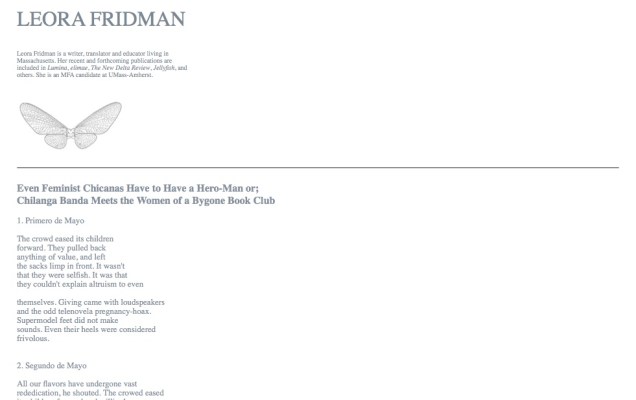
My dear friend Leora Fridman in published online form. So much lovely. Miss you, sistercat.
Not much more from yours truly today. Just thinkin’, readin’, cookin’, meditatin’, and trying not to catch pneumonia. (Slowly, slowly, my Cambridgewear is trickling into my Tenderloin closet. Yesterday, an enormous white scarf.)
Have a wonderful weekend, friends! See you next week!
Saturday I crossed the Golden Gate Bridge to spend the day (and overnight) at San Francisco Zen Center’s Green Gulch Farm with my friends Michaela and Sarah. Michaela, a newly ordained priest, has lived on the farm for the last 5 years, and since ordination in September, will undergo 4 more years of training before becoming … a more official priest! Or something. I’m not quite sure how the Zen works. And Sarah, who has taken her lay vows, is not only the executive director of Buddhist Peace Fellowship, but also a true SFZC baby, raised by Zen teacher parents among its three campuses: Green Gulch, Tassajara, and City Center.
Anyhow, the two of them go way back, and it was a delight to spend a while walking, joking, thinking out loud, and generally hangin out with these amazing, brilliant, passionate dharma sisters. And the setting, while old-hat to them in some ways, for me was … well. Green Gulch — a functioning subsistence-plus-sales farm, as well as a practice center, located in one of the wealthiest counties in the US — has its issues, is evolving, is imperfect. And has its gorgeousness, my, my.
This week Kloncke is gonna be pretty foto heavy. Because I’ve been spending time in pretty places. Thinking a lot about land, too, and my connection to it (or estrangement from it).
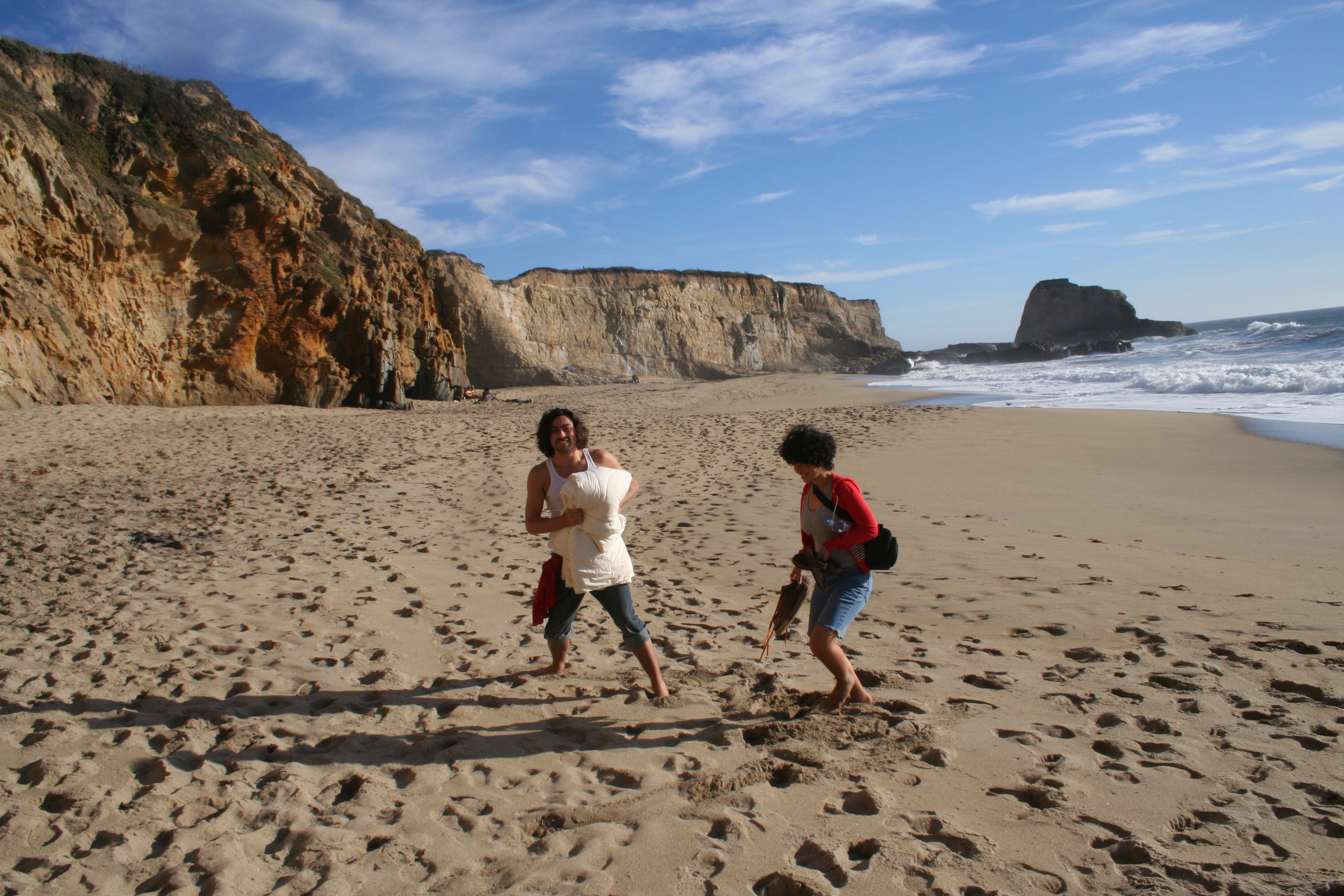
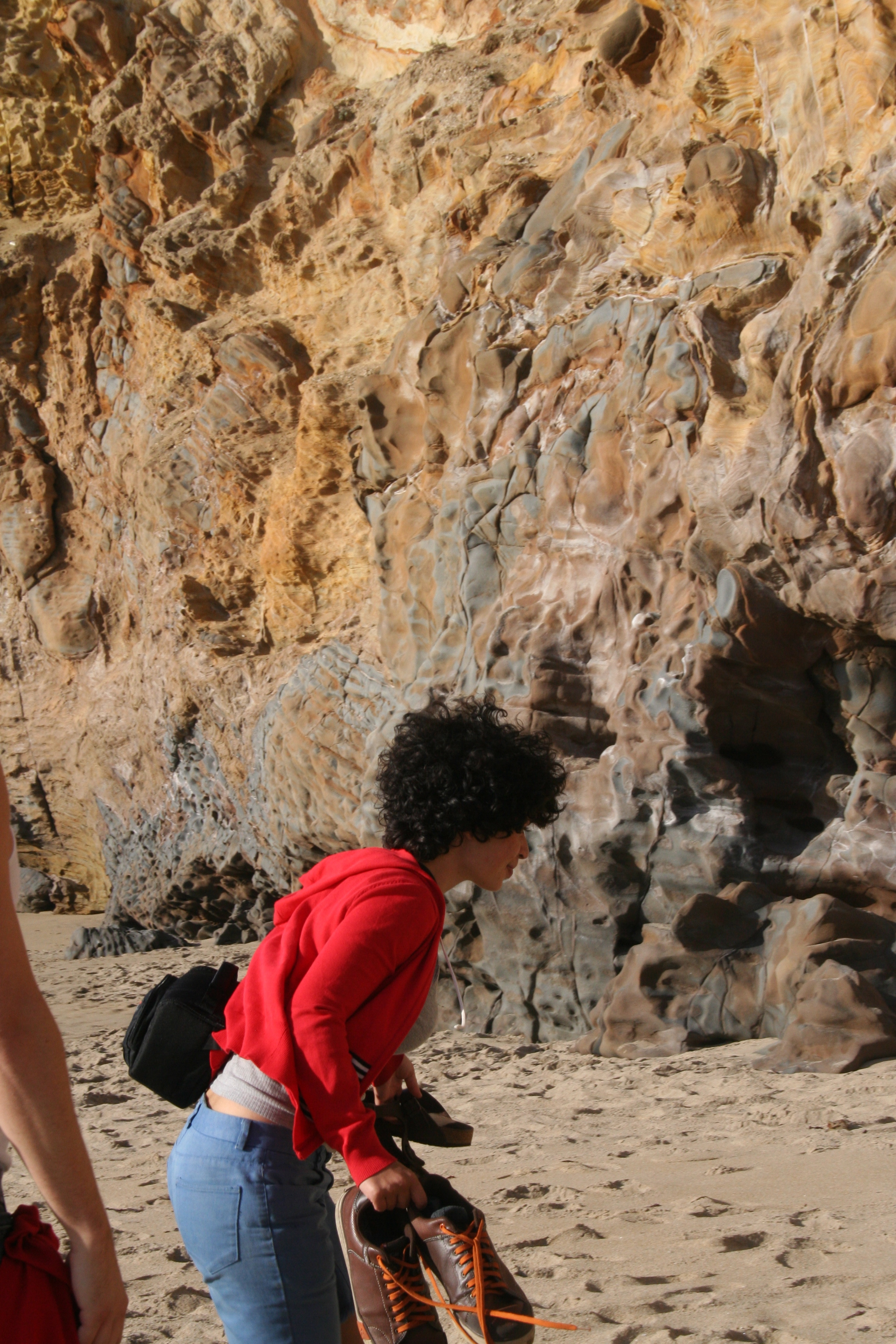
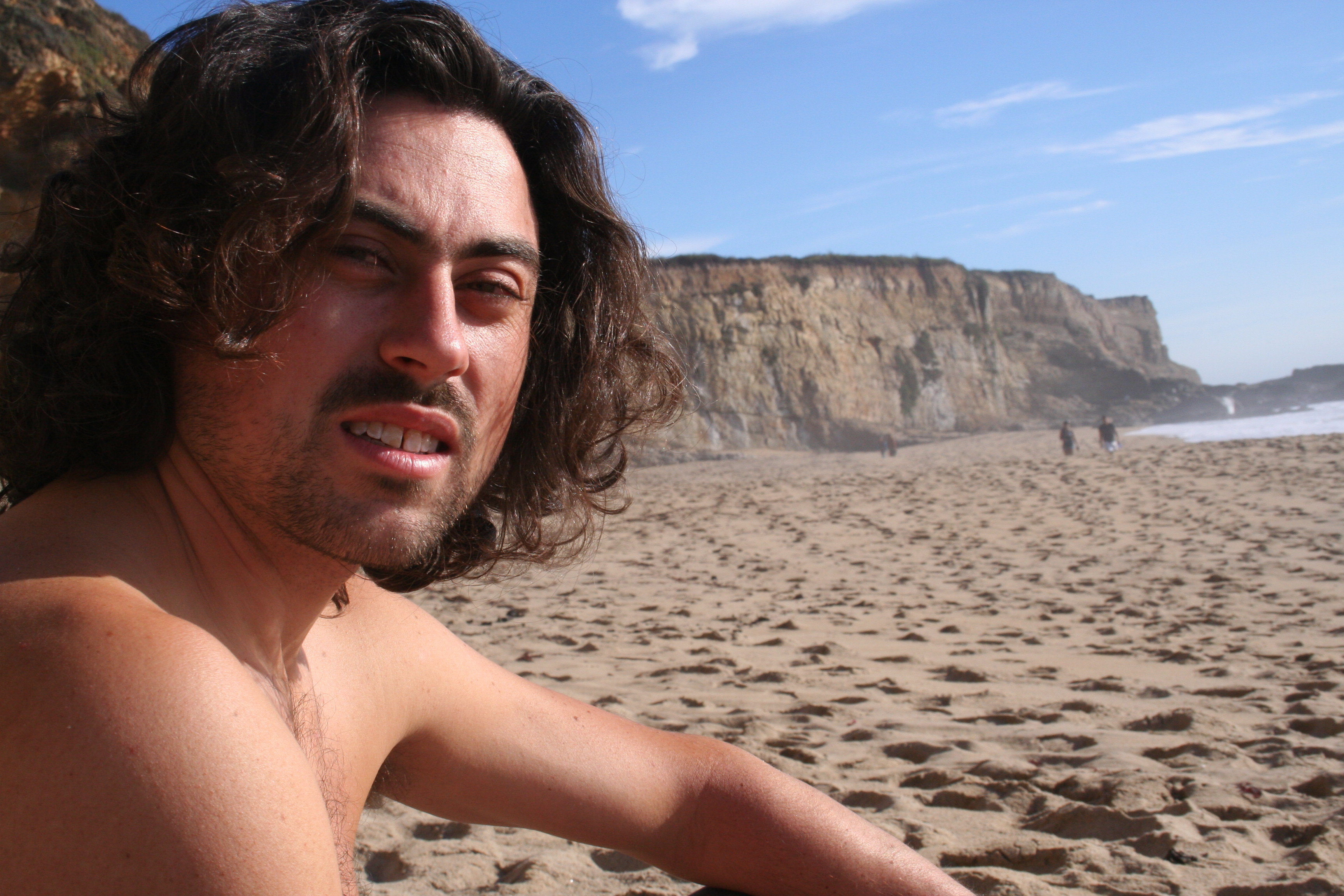
Here, some shots from an amazing afternoon at Panther Beach, on the outskirts of Santa Cruz. Some of the best of Northern California, in its own way, I think. One of the things I love most about spots like this is the visible age and marks of motion in the stone. The oldness of the cliffs, and the patterns of waterwear and erosion. Makes me feel patient and slow and humbled. Kind of like being among elder redwoods.
One of my favorites from the Hot Sevens. Recently arrived as part of a mix-CD gift from my friend Hozan Alan Senauke (of Berkeley Zen Center and Clear View Project). I had it playing this week when my friend Cat was over for tea, and we both looked at each other with a little jolt of recognition at the final, extra-long, lovely solo on this record, though I couldn’t remember the name of the song.
Last month, while Alan was over’ our place for our Working for Liberation retreat at the Fools (can’t believe I still haven’t written a full piece about that . . . dang), he noticed the two posters hanging in my room: one of Louis Armstrong and one of Billie Holiday. And so he offered to make me a mix.
Jazz of this calibre is what made me first fall in love with music, for real. It wasn’t until high school that I started staying up late into the night, listening to the same album over and over, letting it soak in. I can still practically sing along to the entirety of Kind of Blue.
Much gratitude to Alan, a musician at the mind- heart- body- and community- level.
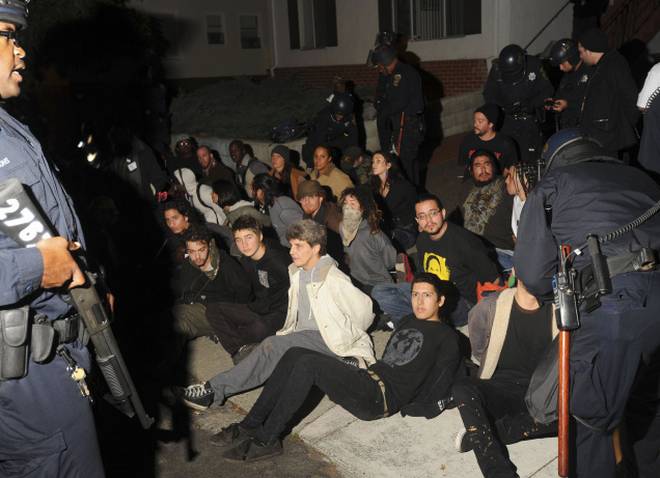
Protesters are arrested in Oakland. Note the giant gun in the officer’s hand on the left. Image from The Hindu.
Paramis, or Paramitas, also called the Ten Perfections, are qualities that dhammic practitioners try to cultivate on the path to enlightenment.
I found myself thinking about the Paramis throughout a long Friday night and Saturday, when I was arrested, along with 152 others, for “unlawful assembly”: marching in the streets of Oakland to protest police violence and impunity. I was held in custody for about 20 hours; some people still haven’t been released. (Please consider donating to legal aid for protester defense.)
A concrete detention cell might seem like a strange setting for reflecting on the attributes leading to Buddhahood. A far cry from the bucolic campuses of well-funded meditation centers. On the other hand, many people have famously developed their spiritual practice while incarcerated, or even while being tortured. I’m not saying that every setting is equally optimal for developing every part of dhammic practice. But once you’ve learned some of the basics in a more controlled, safe environment, it’s interesting to see how they can manifest in non-stereotypical situations.
Generosity (dana)
He straps on a second backpack, belonging to his friend, who doesn’t have papers, to afford more mobility for avoiding arrest.
They trade jokes and soggy jail cookies. They offer room for one another on the concrete benches of the cramped holding cell.
Lawyers work for free to get the protesters out of jail. The work can take months, for folks facing trumped-up charges.
FIRST PRECEPT
Aware of the suffering caused by the destruction of life, I vow to cultivate compassion and learn ways to protect the lives of people, animals, plants, and minerals. I am determined not to kill, not to let others kill, and not to condone any act of killing in the world, in my thinking, and in my way of life.
SECOND PRECEPT
Aware of the suffering caused by exploitation, social injustice, stealing, and oppression, I vow to cultivate loving kindness and learn ways to work for the well-being of people, animals, plants, and minerals. I vow to practice generosity by sharing my time, energy, and material resources with those who are in real need. I am determined not to steal and not to possess anything that should belong to others. I will respect the property of others, but I will prevent others from profiting from human suffering or the suffering of other species on Earth.
Renunciation (nekkhamma)
In jail, they give us plasticized bologna and surprisingly good oranges. Over twelve hours later, they’ve given nothing else. We practice responding to this harm without suffering. We practice fasting. We explore the limits of our basic needs.
In jail, when we ask at 5am how much longer they think we’ll be here, we are told: Ask me how much longer, and I’ll hold you here an extra hour. Ask me again, and I’ll hold you two more hours. We practice responding to this harm without suffering. We practice abiding. We explore the limits of our basic needs.
Knowing the risks, we have nevertheless stood up for what we believe. Some of us are better accustomed to making do in these conditions. All of us are being reminded that we are more than our comforts.
Wisdom (pañña)
This is a complex one. Can we understand the nature of impermanence, egolessness, and unsatisfactoriness of phenomena? Can we respond to the relative world of material harm, while still practicing diligently on our inner liberation from needless suffering?
As the zip-tie handcuffs cut off circulation and my shoulders begin to ache and tingle, I summon my meditation practice, explore the pain, and try my best to observe the present moment with equanimity. After three hours or so, the handcuffs are cut off.
Effort/Strength (viriya)
As we are blocked in by riot police, some with machine guns, on a residential Oakland street, we keep chanting:
WE ARE ALL OSCAR GRANT!
As we are handcuffed and lined up seated on the pavement, we keep chanting:
WE ARE ALL OSCAR GRANT!
As my 20-hour family sits in our women’s holding cell, hour after long hour, we cheer and applaud as each individual is released. The cops try to intimidate us, say they’ll keep us there longer if we keep up the noise. Same for the adjacent women’s cell, where we can hear them yelling. We all keep on celebrating. And together we chant:
WE ARE ALL OSCAR GRANT!
Patience (khanti)
Patience is best when combined with sound strategy. Do I hope to move beyond marches? Yes. Do I want to help grow the movement against police violence, proliferating it in different sectors with the power to disrupt the economy in big ways? Yep. Do I want to simultaneously develop community-based safety systems that are actually accountable, healthy, and responsive to the needs of participants? Hell yes. Will all this take time? You bet. Waiting it out in jail is only one small part of the process.
Truthfulness (sacca)
Bearing witness directly is a wonderful antidote to media spin and misinformation. Contrary to sensationalist reporting, this was not a violent, roaming mob. We were trying to march to the Fruitvale station where Oscar Grant was killed, and menacing riot police hemmed us in at every turn, so we improvised the route. This is not marauding; it is a snake march. Which authorities don’t like very much, because they are not in total control of it.
Again, contrary to reporting, the purpose of our demonstration was not to wreak havoc. The super, super, nearly total majority of people, including every single person I knew, damaged no property. And even those who may have, engaged in no violence that I saw. Property destruction is very different from violence. And even though I don’t support the former in this case, I don’t want it irresponsibly conflated with the latter, the way the mainstream media consistently has in its coverage of the Oscar Grant case.
You know what’s violent? Denying a woman in custody access to her chemotherapy treatment. She was only one of many people I witnessed being denied medical attention — to antidepressants, to necessary medications. And when the woman who was ill from missing her chemo finally got transferred to a cell with a pay phone, called the National Lawyers Guild to tell them what was happening, and half an hour later the cell door rolled open . . . the cops berated her for “costing them a lot of time and money,” and informed her that because of what she’d done, they would delay her release.
Another interesting element around truth: When they had us cornered, just before they arrested us, the police declared a crime scene and instructed everyone from the press to disperse, while still preventing the rest of us (who wanted to go peacefully) from leaving. Nearly all the professional journalists crossed the police line to depart. Kind of chilling, given that the event that catalyzed all this was documentation of an act of police violence against an unresisting, restrained person.
A final truth: From what I saw, and this is only my own personal impression, many of these cops appear to be deeply scarred people. The one who kept me in line on the arrest scene before we boarded the paddy wagons wouldn’t even look me in the eye at first. The internal damage and delusion of a jailer is cyclical: one must already be suffering in order to lock someone up and deny them food or medicine for twelve hours (whether the denial is polite and bureaucratic or spiteful and direct is largely irrelevant). And participating in that process itself produces more delusion, more scarring, more habit patterns.
But though I was initially disappointed at being categorized as an extremist, as I continued to think about the matter I gradually gained a measure of satisfaction from the label. Was not Jesus an extremist for love: “Love your enemies, bless them that curse you, do good to them that hate you, and pray for them which despitefully use you, and persecute you.” . . . Perhaps the South, the nation and the world are in dire need of creative extremists.
Lovingkindness (metta)
Much gratitude to all my fellow detainees who made my time in custody human and even fun.
Much gratitude to all who have offered their support from the outside.
Much gratitude to all those who continue to oppose oppression, even when doing so is unpopular.
May all beings be safe. May no human be trapped in a cage. May no human be psychologically conditioned to harm others in an effort to make themselves feel more powerful and secure. May we abolish prisons and end policing as we know it, replacing them with participatory processes that care for people and treat all living beings with dignity.
May you be safe. May you be happy. May you be free.
For a long time now, I’ve avoided giving book recommendations on dhamma. “Avoided” is too weak a word, really. There’s been some sort of block. It’s like I’ve been mentally and physically incapable of suggesting reading.
Part of this has to do with an awful experience I had with intellectualized Buddhism. When I got to Harvard as an eager, wide-eyed freshman, the very first elective class I took was a seminar on Indo-Tibetan Buddhism.
Dry, dry, dry, dry, dry.
I never read another word on dhamma for the next four years.
On the flip side of things, as a bibliophile and generally thinking-trapped individual, I’m acutely aware of how easily one can become fascinated and hypnotized by Buddhist philosophy, without ever really putting any of it into practice. So it sometimes feels false or misleading to recommend books, rather than just accompany someone in learning basic dhammic meditation training.
Bodhidharma, credited with bringing Zen Buddhism from Northern India to China. Dude is said to have cut his own eyelids off to stop himself from falling asleep while meditating.
But the truth is, even when people who are trained and do practice ask me for books, I’ve been slow and reluctant. So today is an effort to shift that.
A couple words about this short list. One, as you may notice, there is a lot of Mahayana, even though I’m down with the Hinayana. What can I say? When it comes to reading, I like what I like. Two, there are no suttas or canonic/original texts. Looking forward to diving into those in 2011. Three, the significance of these books in my life has had less to do with intellectual edification, and more to do with flat-out inspiring me to practice. There are many more fascinating Buddhist works, scholarship, biographies, etc. that have helped and educated me, but these are more along the lines of altering my worldview and day-to-day spiritual engagement.
So here we go: my top 5 dharma books, in chronological order of when I read them.
0. Entering the Stream: An Introduction to the Buddha and His Teachings
Edited by Samuel Bercholz and Sherab Chödzin Kohn
A wonderful and diverse collection of essays and excerpts that got me psyched on both reading and sitting practice.
Includes work by Shunryu Suzuki Roshi (“Zen Mind, Beginner’s Mind” – classic), Bhikku Bodhi (with whom I walked across the Golden Gate Bridge last week; amazing), and other greats.
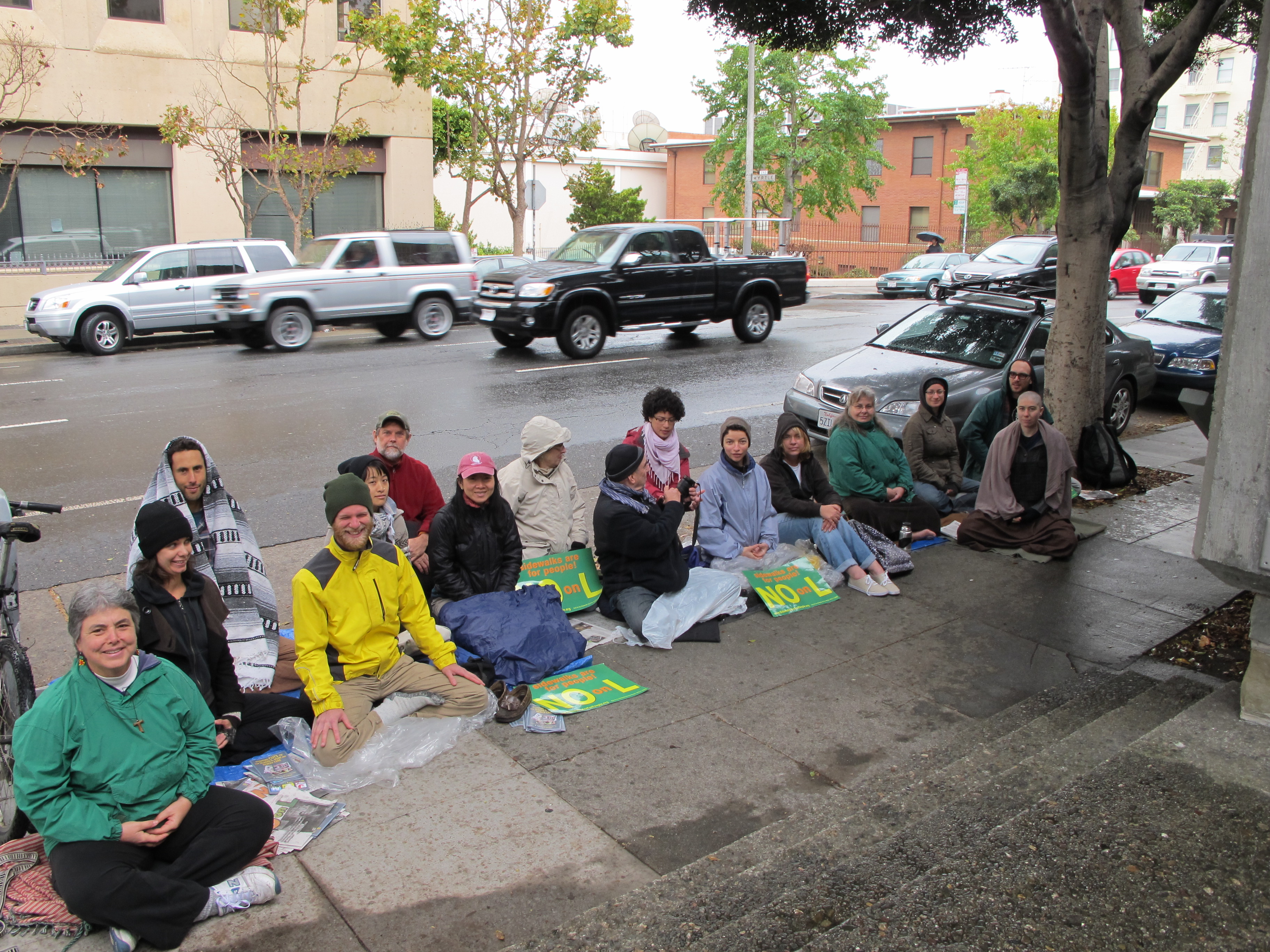
Sarah Weintraub, Michael Bedar, Tyson Casey and Michaela O'Connor Bono sitting off of O'Farrell Street, with a sign reading "sidewalks are for people; NO on L." photo by Sr. Carmen Barsody
Sorry I didn’t get a chance to post on Friday, folks — this weekend was a particularly busy one. Starting Friday evening, we (at the Faithful Fools) hosted about 16 participants in a three-day gathering for Buddhists and friends dedicated to social justice. “Working for Liberation,” we called it: the culmination of, oh, about six months of co-planning between me and the lovely Tyson Casey of the Buddhist Peace Fellowship, with guidance from Carmen of the Fools and Alan Senauke of Clear View Project (also vice-abbot of Berkeley Zen Center and author of the newly published The Bodhisattva’s Embrace: Dispatches from Engaged Buddhism’s Front Lines).
I wanna say more — much more — about the weekend, but I gotta run back to Sacramento. So for now I’ll leave you with these two images of our final weekend ‘activity’: a performative outreach effort in the Sidewalks Are For People Campaign, or “No on Prop L.” A grey, drizzly Sunday morning; chilly but thoroughly enjoyable.
Sixteen of the eighteen meditators sitting on wet Franklin Street sidewalks, sheltered under neighborhood trees. photo by Sonny of the UU Church
Today, in honor of World Homeless Day, folks with Homes Not Handcuffs and other groups hosted a “Creative Housing Liberation”: a rally, unpermitted march, and occupation/liberation of a 68-unit apartment building that has been vacant for years now. Coincidentally, that building happened to be right around the corner from our home at the Faithful Fools — a stroke of luck that allowed us to run back and grab a couple of “donations” (a chair and a vase of flowers) to offer to the building.
The event was really well done, and so far everything has gone off without a hitch. Crowd energy was strong; the occupiers had the banner drops all ready for us as our march turned the corner down Eddy Street; they had a dope sound system, powered by a generator, that transformed the corner into a dance party; Food Not Bombs even hooked it up with a tasty dinner for everyone.
Also fortunate: the landlord could not be reached by the police. And since the cops can’t break in and apprehend people without first getting the go-ahead from the landlord, the occupiers will hold the building at least until tomorrow morning.
This slideshow requires JavaScript.
Tomorrow, if I have time, I’ll try to add a bit more of my own perspective and analysis on housing occupation as a response to racist, heterosexist state violence in the form of denying people adequate housing. According to the event organizers, 30,000 housing units remain vacant in San Francisco, a city with 15,000 people living in homelessness. In light of this, does occupation of empty buildings seem morally wrong?
More germane to my line of questioning these days: what role can fun, vibrant, direct actions like today’s play in a larger strategic movement to transcend an economic system where, as Introducing Capitalism: A Graphic Guide puts it in a euphemistic half-truth, “the means of production are privately owned”?
(Note: very first chant of the march, as we took the streets? “Homelessness is not a crime! Capitalism IS a crime!”)
Some of the smartest people I know — including my friend Ivan, and what I’ve read/heard by Suzuki Roshi — excel at failing. They know how to fail in ways that allow the flow to continue, if you know what I’m saying. The failure is not crippling, but just part of taking on a difficult challenge. Generally speaking, I think that people with scientific minds (including serious meditators) are pretty good at failing happily. Failing in ways that reveal new opportunities, even as they foreclose the ones we thought we wanted.
Endeavoring to improve on my ability to fail doesn’t mean tackling tasks that seem doomed from the start. That would be too easy! The kind of failure I’m talking about does not come cheap. I am invested. I want to succeed. Each attempt, each step, is made with confidence, commitment, and openness.
Suzuki Roshi says that this is how we move toward enlightenment. Through repeating small moments of enlightenment — those moments of a letting-go mind, a mind that is being, not chasing — while at the same time working hard to deepen and strengthen our practice.
I hope this is somewhat clear, what I’m trying to say. As an example of a recent, happy failure of mine, I wanted to share a letter I wrote to all the people I’d talked to with an interest in building a disarm BART police campaign. My intention in sending it was (1) to let folks know that I would no longer be pursuing the courses I’d proposed (for instance: organizing a direct action of civil disobedience for the day of Mehserle’s sentencing), and Why; and (2) to thank them for the inspiring connections we’d made in the course of the (eventual) failure.
It felt good to write this letter, not only because I have a lot of admiration and goodwill toward each of the recipients (including those with whom I disagree politically), but also because it was an exercise in observing and accepting reality as it is — rather than as I would like it to be. A little inroad into rooting out dukkha.
I’d love to know your thoughts, resonances, and criticisms.
Hello everybody,
Hope this note finds you well!
Over the past couple of months, I’ve been talking with BART workers, Oscar Grant movement organizers, Oakland peacekeepers, Marxist feminists, reverends, priests, meditators, lawyers, non-profiters, poets, anarchists, communists, peace activists, radicals, progressives, friends, and random strangers about the possibility of coalescing a campaign toward disarming the BART police. I and others envisioned this as one small step in aiding a shift from weaponized, racist, capitalist-serving security culture toward community-controlled safety initiatives, dual power, and restorative justice.

























 Kloncke