Via cnekez, keeper of the beautiful blogspace to live (def):.
Interviewer: Isn’t love a union between two people? Or does Eartha fall in love with herself?
Eartha Kitt: [Smiles] I think, if you want to think about it in terms of analyzing … Yes. I fall in love with myself … and I want someone to share it with me. I want someone to share me with me.
Seems to me that Eartha Kitt (a singer, dancer, and actress) is talking about falling in love with the whole world. Even with the interviewer — asking those leading, loaded questions.
She cuts right through his seeming innocence (or cluelessness?), mocking the true misogynistic subtext: that a woman is incomplete without a man (hello, heterosexism), and that in order to make love ‘work’, women have to ‘compromise.’ (And in this sexist, racist society, we know what that means, y’all.)
To me, this scene is a profound display of pitch-perfect compassion. As Khandro Rinpoche says, “Compassion is not about kindness. Compassion is about awareness.” She is on some next-level shit here. And she is sharing it.
What does it mean to fall in love with oneself (“for the right reason; for the right purpose”)?
Of the four commonly-cited inescapable sufferings (birth, old age, sickness, and death — sidenote: why puberty-slash-adolescence didn’t make the list, I don’t know), lately I’ve been getting acquainted with the latter three. Dad has veered sharply and suddenly toward death in the past four months. (Thankfully, after this most recent spinal surgery a week ago, he’s recovering well.) And during our time in Nicaragua, I saw more closely than ever the way that my boss, teacher, friend, and a co-founder of the Faithful Fools, Kay Jorgenson, is living with her advanced and intensifying Parkinson’s.
It’s common knowledge that us kids these days in the States are generally lousy at caring for, and living with, those who are aging, whose faculties are deteriorating, and who are nearing their death. As products of a youth-worshiping and death-denying environment, we perpetuate and acquiesce to behavioral and institutional forms of elder isolation, shaming, and neglect — from expressing disgust toward the sexuality of the old (particularly women), to casually off-loading Grandma into the iconic nursing home, eager to get on with business.
So how can we, as young feminists and/or students of dhamma, create and reclaim healthier practices for relating to elders? It’s too big a question to cover right here, but I wanted to approach one small slice of the issue: communication around diminishing abilities, and growing needs for assistance.
A common example is driving. We think Opa shouldn’t be getting behind the wheel anymore. He feels otherwise. How do we navigate this?
As per our plan, for our one-year dating anniversary, Ryan and I made our own hot sauce. It took 20 roasted habañeros (a.k.a. Scotch Bonnet peppers), four cloves of roasted garlic, and some elusive smoked paprika to blend up this incredibly delicious condiment. (Full recipe below, slightly tweaked from one we found online.) Some of the habs came straight from Ryan’s dad’s backyard garden — part of how we cooked up this idea in the first place.
And after it was finished, we took one of the two bottles on a journey down to the Mission for some pupusas.
This slideshow requires JavaScript.
Celebrating an extraordinary year with this wonderful person, near the annual TransgenderDay Of Remembrance, I was especially aware of the privileges and basic safety that we enjoy in our loving partnership. We are a legibly cisgender, hetero, same-age couple, both U.S. citizens, living in a time of war but unaffected by it directly. We live in a time and place where interracial relationships are largely accepted and even commonplace; where open relationships are at least acknowledged, if frequently maligned or misunderstood; and where I am not likely, as a woman, to be openly attacked for asserting my own sexuality, and seeking control over my own reproductivity.
I truly wish that loving — and simply living with integrity, with basic safety — did not require so much courage from so many people.
May my life’s work, and Ryan’s, contribute to bringing about conditions that encourage everyone to love in the best ways we know how.
———————————————————
Habañero Hot Sauce Recipe

20 habañero peppers
3-5 cloves of garlic
1/2 cup distilled white vinegar
2-3 Tbsp lemon juice
1 tsp smoked paprika
1 tsp brown sugar (we used light brown)
1 tsp salt
1/2 tsp chili powder

Equipment: Oven, baking sheet, food processor.

Set oven to 350º.
Peel and halve garlic.
Cut off stem tops and halve peppers (keeping the seeds).
Roast together on an oiled baking sheet until golden brown
and smelling amazing (about 20 minutes).

Add peppers and garlic to the food processor with dry ingredients.
Pulse to combine.
Slowly pour in wet ingredients while blending.*
When you've got a smooth, uniform consistency, adjust to taste.**

Bottle (we used a couple old hot sauce bottles) and refrigerate.

*Adding liquid too soon may result in splashing, necessitating turkey-baster triage.
**Ignore any eggings-on, and taste only a tiny bit at a time.  Think twice before,
for instance, dipping a hunk of bread in the hot sauce as though it were hummus.
My dear friend Leora Fridman in published online form. So much lovely. Miss you, sistercat.
Not much more from yours truly today. Just thinkin’, readin’, cookin’, meditatin’, and trying not to catch pneumonia. (Slowly, slowly, my Cambridgewear is trickling into my Tenderloin closet. Yesterday, an enormous white scarf.)
Have a wonderful weekend, friends! See you next week!
[Today, former BART police officer Johannes Mehserle was sentenced to 2 years in prison, with 146 days already served, for the involuntary manslaughter of Oscar Grant. The Grant case marked the first time in California’s history that a peace officer was tried for murder.]
Whereas
We as women, transgender people, two-spirit people, queers, gender-oppressed people, and allies of the Bay Area mourn the loss of Oscar Grant;
Whereas we recognize that this young man was just one of countless victims of police violence;
Whereas we understand and experience police repression, particularly in poor, queer, and working-class communities of color;
Whereas we know that police violence both enables and enacts rape, brutalization, and degradation;
Whereas police violence compounds the dangers we face in domestic violence, sex trafficking, and homophobic and transphobic hate crimes;
Whereas police enforce the criminalization of our disabilities, addictions, and mental illnesses;
Whereas police enforce the criminalization of our skin color, sexualities, style of dress and speech, gender identities, religious practices, and nations of origin;
Whereas police violently enforce our subservience to an economy that enriches elites, while slaughtering, starving, sickening, and stealing from us as workers, child-rearers, and culture creators;
Whereas the rich and influential deploy police to violently crush our efforts toward self-determination, from queer social spaces to workplace strikes;
Whereas the rich and influential deploy police to kill or capture our leaders and heroes, like the recently deceased political prisoner Marilyn Buck;
Whereas police are employed to do as they are ordered;
Whereas police violence comes 10% from individual bigotry and improper training, and 90% from a capitalist state system designed to protect property, not people;
Whereas such a property-focused police system, controlled by the rich and influential, enacts and supports gender-based and sexual violence;
And Whereas such a system can never be adequately reformed, based as it is in the fundamental inequality borne of a patriarchal capitalist system:
We maintain compassion for individual police officers who both experience and inflict suffering; who face and enforce mortal danger.
We vow, in the effort to end sexist violence throughout the world, to eradicate the police system of the United States as we know it; and to transcend the misogynist capitalist system that demands this type of policing.
We undertake this mission with no hatred in our hearts toward individual police officers or those who support the police system.
We accept this responsibility out of love for all people, and the unquenchable desire for universal freedom and equality.
In the service of this calling, we will sing, strike, fuck, fight, rest, write, rebel, and rebuild until we achieve liberation for all beings.
I probably won’t be updating Kloncke for the next week or so, and that’s because, for my second time, I’ll be joining the Faithful Fools in their annual Street Retreat: seven days and nights living, sleeping, and reflecting in the streets of the Tenderloin neighborhood, in San Francisco.
Coming to terms with the street retreat as a reflective and humanizing practice has been difficult for me. To be honest, I still feel significant resistance to the idea. Fortunately, though, over the past few weeks I’ve been able to sit with this resistance and discomfort (a time when the dhamma practice has come in handy), talk with friends and other Fools about it, and work through it in a positive way.
Before getting into my reservations and reconciliations, here’s a nice, basic description of what the street retreat, from fellow Fool intern Josh Mann:
Starting this Saturday, I will be participating in my first week-long Street Retreat through the Faithful Fools. I’ll be leaving my money, cell phone, and keys behind and taking a sleeping bag and backpack. I plan to sleep outside and eat mostly in soup kitchens, and I anticipate a lot of searching for public bathrooms. Twice a day, I’ll be meeting up with eight to ten other people to reflect on the experience. And, some of us will be sleeping as a group.
Part of the mission of the Faithful Fools is to “participate in shattering myths about those living in poverty” and to help people discover what is common to all of us regardless of our economic standing or housing status. As a Street Retreat participant, I am asked to reflect throughout the retreat on what keeps me separate from others as well as what connects me.
Ever since my first term in college, I have felt compelled to engage the social issues of poverty and hunger, and I expect that this retreat will help me better understand these issues including the way that public policies, laws, and urban planning affect people with little to no money.
At the same time, the founders of the Faithful Fools put great emphasis on the fact that we are not pretending to be homeless. I will begin the retreat knowing that it has a specific end time on Saturday, October 30th. It also seems important for me to acknowledge that I go as an able-bodied, college-educated U.S. citizen who is white, male, and straight, which will no doubt be a factor in both how other people respond to me and how I experience the streets.
Please keep me in your thoughts this week. I seek to know my own heart, and I need all of the help I can get. I also invite you to participate with me in some way or another wherever you are. I recommend setting aside a little time one day to wander and see who and what you encounter. The spirit of this retreat as I understand it is to meet more deeply the people and places that we sometimes hurry past.
So there’s a little bit of background. As you can see, the retreat is not a study or experiment, nor is it a gimmick for “playing homeless.” The spirit is one of renunciation. We wouldn’t fast in order to “understand what it’s like to be a starving person,” but in order to push and expand our own views of the world we inhabit right now, as we are. It’s not about appropriating or trying on someone else’s experience (the simplistic idea of “standing in someone else’s shoes”), but about peeling off the layers of ourselves, the skins thickened by routine and dualism, that pervert our own views of reality — including our views of ourselves.
What had been bugging me so much, I think (and it disturbed me so strongly that I very nearly backed out of the whole thing), wasn’t the idea of the street retreat itself, but its purported connections to mechanisms of social transformation. I’ve talked on this blog before about what I see as the dangers of believing in a method for changing the world one mind at a time. This approach rightly observes that human social “systems” are made up of individual people, but wrongly induces that these systems are therefore merely the sum of their parts, and that persistent hearts-and-minds education can eventually (through influencing voters and “those in power”) translate into large-scale fundamental social improvements.
I disagree with this approach for various reasons; now isn’t the time to go into ’em. Suffice it to say, now that I’ve managed to decouple the reflective, community side of the street retreat from positive claims about its structural effectiveness, I feel a bit calmer about participating.
One common concern about street retreats is that we are “taking away resources” from people who need them, by eating in soup kitchens and sometimes sleeping in shelters (if we can get in). I sympathize with the concern here, but the way I see it is: we do far more to support poverty and homelessness through our everyday complacency with the capitalist system than we could possibly do by individually taking a couple dozen free meals. The scarcity (of beds, less frequently of food) is artificial.
Another frequent worry, especially from my dad: YOU ARE GOING TO GET YOURSELF KILLED. IT IS DANGEROUS OUT THERE.
Don’t worry, papa. (And others.) From my observation over the past year, there is little danger of random violence on the streets of the Tenderloin. The main types of violence we see here are (1) interpersonal violence among acquaintances, (2) low-level police violence in the form of harassment and enabling rape culture, and (2) structural violence, like the abovementioned artificial scarcity that keep families homeless while apartment buildings sit vacant for years, or the racist, sexist, homophobic criminalization of mental illness and drug addiction.
I guess both of these ‘responses,’ intended to allay fears, kind of sidestep the issues by pointing out how they are dwarfed by larger problems. Well, that’s sort of how it goes for me, at the moment. We’ll see if any more insights come during the week.
Wish me luck! I will try to log some time on the computers in the public library, but the lines are generally long, the connections slow, and the time limits brief.
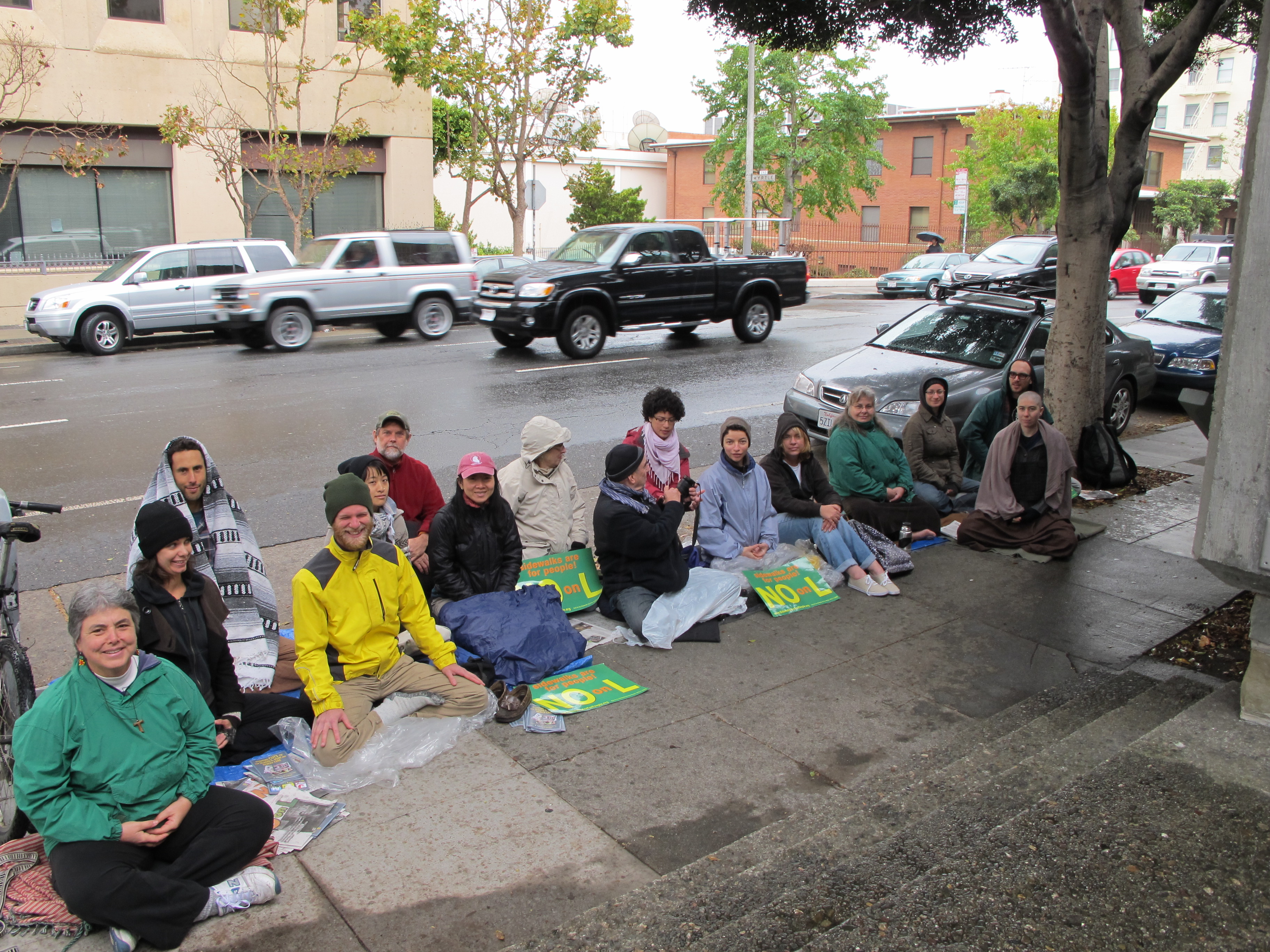
Sarah Weintraub, Michael Bedar, Tyson Casey and Michaela O'Connor Bono sitting off of O'Farrell Street, with a sign reading "sidewalks are for people; NO on L." photo by Sr. Carmen Barsody
Sorry I didn’t get a chance to post on Friday, folks — this weekend was a particularly busy one. Starting Friday evening, we (at the Faithful Fools) hosted about 16 participants in a three-day gathering for Buddhists and friends dedicated to social justice. “Working for Liberation,” we called it: the culmination of, oh, about six months of co-planning between me and the lovely Tyson Casey of the Buddhist Peace Fellowship, with guidance from Carmen of the Fools and Alan Senauke of Clear View Project (also vice-abbot of Berkeley Zen Center and author of the newly published The Bodhisattva’s Embrace: Dispatches from Engaged Buddhism’s Front Lines).
I wanna say more — much more — about the weekend, but I gotta run back to Sacramento. So for now I’ll leave you with these two images of our final weekend ‘activity’: a performative outreach effort in the Sidewalks Are For People Campaign, or “No on Prop L.” A grey, drizzly Sunday morning; chilly but thoroughly enjoyable.
Sixteen of the eighteen meditators sitting on wet Franklin Street sidewalks, sheltered under neighborhood trees. photo by Sonny of the UU Church
Guilty aspect number one: I actually prefer the radio edit version to the original. Not because I’m so scandalized by the phrase “fuck you,” but because I like the lilt provided by the extra syllable in “forget you.” Am I alone in this preference? Both versions are below; help me out, folks.
Guilty aspect number two: I like the video, even though it’s full of classic patriarchal tropes, also reflected in the lyrics themselves. As assets, women’s beauty and bodies are comparable to men’s money. Yeah, we get it. Still, I’m feelin the vignettes and backup singers/dancers — what can I say.
Guilty aspect number three: Not so guilty but actually kind of rad, when I first heard this song on the radio and knew nothing about it, it struck me as a genderfucked kind of affair. The singer’s voice seemed androgynous to me, and I couldn’t really tell, from the lyrics and who was being addressed with a “forget you, and forget her, too,” whether a girl had left her girlfriend for another girl, or a girl left her boyfriend for another girl, or a girl left a translady for another someone, or what. So even though I now know it’s a typical script, I still have positive associations of driving my parents’ car, hearing this come on the mainstream radio, and all smilin like, “Are they really playing this so casually on the radio? Neat!”
[Update: Oh, also! The sobbing/singing interlude? Could easily have turned out annoying, but I actually find it very impressive! Musicality and vocal control with the bawling. Nicely done, Ze Lo.]
Today, in honor of World Homeless Day, folks with Homes Not Handcuffs and other groups hosted a “Creative Housing Liberation”: a rally, unpermitted march, and occupation/liberation of a 68-unit apartment building that has been vacant for years now. Coincidentally, that building happened to be right around the corner from our home at the Faithful Fools — a stroke of luck that allowed us to run back and grab a couple of “donations” (a chair and a vase of flowers) to offer to the building.
The event was really well done, and so far everything has gone off without a hitch. Crowd energy was strong; the occupiers had the banner drops all ready for us as our march turned the corner down Eddy Street; they had a dope sound system, powered by a generator, that transformed the corner into a dance party; Food Not Bombs even hooked it up with a tasty dinner for everyone.
Also fortunate: the landlord could not be reached by the police. And since the cops can’t break in and apprehend people without first getting the go-ahead from the landlord, the occupiers will hold the building at least until tomorrow morning.
This slideshow requires JavaScript.
Tomorrow, if I have time, I’ll try to add a bit more of my own perspective and analysis on housing occupation as a response to racist, heterosexist state violence in the form of denying people adequate housing. According to the event organizers, 30,000 housing units remain vacant in San Francisco, a city with 15,000 people living in homelessness. In light of this, does occupation of empty buildings seem morally wrong?
More germane to my line of questioning these days: what role can fun, vibrant, direct actions like today’s play in a larger strategic movement to transcend an economic system where, as Introducing Capitalism: A Graphic Guide puts it in a euphemistic half-truth, “the means of production are privately owned”?
(Note: very first chant of the march, as we took the streets? “Homelessness is not a crime! Capitalism IS a crime!”)
Some of the smartest people I know — including my friend Ivan, and what I’ve read/heard by Suzuki Roshi — excel at failing. They know how to fail in ways that allow the flow to continue, if you know what I’m saying. The failure is not crippling, but just part of taking on a difficult challenge. Generally speaking, I think that people with scientific minds (including serious meditators) are pretty good at failing happily. Failing in ways that reveal new opportunities, even as they foreclose the ones we thought we wanted.
Endeavoring to improve on my ability to fail doesn’t mean tackling tasks that seem doomed from the start. That would be too easy! The kind of failure I’m talking about does not come cheap. I am invested. I want to succeed. Each attempt, each step, is made with confidence, commitment, and openness.
Suzuki Roshi says that this is how we move toward enlightenment. Through repeating small moments of enlightenment — those moments of a letting-go mind, a mind that is being, not chasing — while at the same time working hard to deepen and strengthen our practice.
I hope this is somewhat clear, what I’m trying to say. As an example of a recent, happy failure of mine, I wanted to share a letter I wrote to all the people I’d talked to with an interest in building a disarm BART police campaign. My intention in sending it was (1) to let folks know that I would no longer be pursuing the courses I’d proposed (for instance: organizing a direct action of civil disobedience for the day of Mehserle’s sentencing), and Why; and (2) to thank them for the inspiring connections we’d made in the course of the (eventual) failure.
It felt good to write this letter, not only because I have a lot of admiration and goodwill toward each of the recipients (including those with whom I disagree politically), but also because it was an exercise in observing and accepting reality as it is — rather than as I would like it to be. A little inroad into rooting out dukkha.
I’d love to know your thoughts, resonances, and criticisms.
Hello everybody,
Hope this note finds you well!
Over the past couple of months, I’ve been talking with BART workers, Oscar Grant movement organizers, Oakland peacekeepers, Marxist feminists, reverends, priests, meditators, lawyers, non-profiters, poets, anarchists, communists, peace activists, radicals, progressives, friends, and random strangers about the possibility of coalescing a campaign toward disarming the BART police. I and others envisioned this as one small step in aiding a shift from weaponized, racist, capitalist-serving security culture toward community-controlled safety initiatives, dual power, and restorative justice.







 Kloncke