Loving the first reading from a new Socially Engaged Buddhist study group that’s getting started this month: chapter 11 of Nalin Swaris’ book The Buddha’s Way To Human Liberation: A socio-historical approach. Swaris argues that karma is not properly understood (either in terms of actual functioning, or in terms of how the historical Buddha explained it) as an individual inheritance of bad or good deeds committed in past lives that determines one’s social station in this birth. Such commonplace/hegemonic conservative interpretations are basically ruling-class ideology, serving to legitimize the group(s) in power. “You were born a brahmin/king/rich light-skinned dude? You must’ve accumulated lots of merit in past lives. You were born ugly/a woman/poor/Black? You must’ve done some bad shit in a past life.”
Instead, Swaris defines karma as the inherited social and material conditions fashioned by previous generations of humans as a group, which then delimit but do not determine individual and collective actions in the present. Essentially, he locates Marxist historical materialism and dialectics within the original teachings of the Buddha. Dope! And kind of hilarious, in a makes-me-giddy-but-I-take-it-seriously sort of way.
Human Agency – A Species Potential
To understand what is meant by the ‘species nature’ of humans, one must turn to Karl Marx who introduced the concept. This recourse to Marx may seem like an attempt to read into the Buddha’s teaching on interpretation of kamma which has no basis in the canonical scriptures. I ask the reader to bear with me, follow the theoretical clarification and see its relevance to understand the Buddha’s extraordinary elucidations of human nature and human agency.
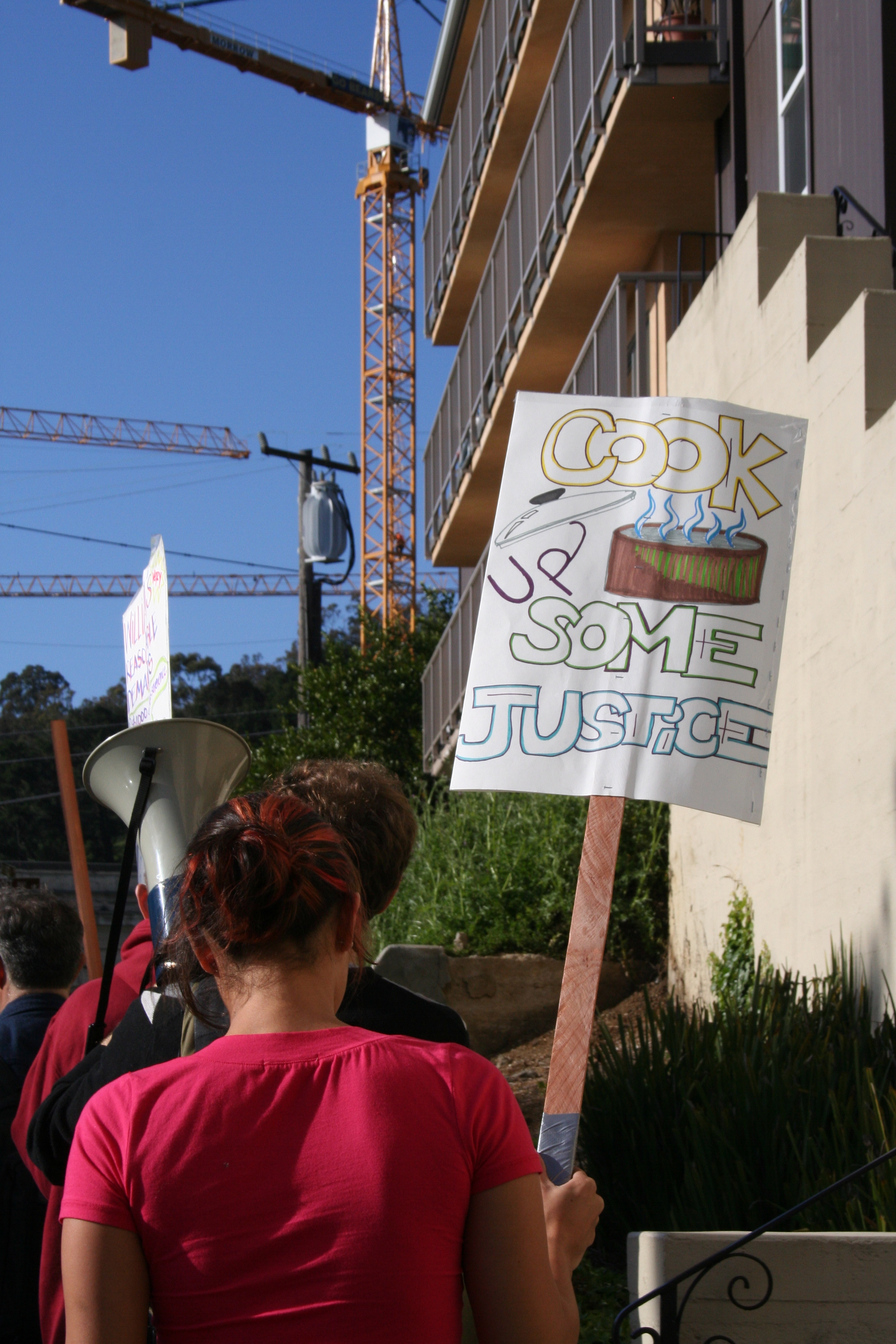
Check the latest at the EastBaySol blog — we had a fun, spirited picket that brought together militant workers from domestics to teachers to students to hotel and warehouse workers. I don’t have a photo of the flyer we used but I’ll try to get one and add it soon.
PICKETING AOII
This slideshow requires JavaScript.
Monday afternoon Bay Sol East kept up the fight in solidarity with former sorority “houseboy” William over in Berkeley, staging an informational picket at Alpha Omicron Pi’s weekly meeting. With handmade signs, a bullhorn, and half-sheet flyers for the sorority sisters, our group of a dozen or so created quite a spectacle on the quiet hillside street. Chants called for “Justice For Domestic Workers!” and urged AO∏ to “Exceed the Expectation” (their motto) and “Cease the Exploitation!”
To cap off the action, we collectively delivered a petition signed by 82 neighbors who support our fight. We’re grateful to local student co-ops for their enthusiasm!
In an extra-special demonstration of solidarity, we were joined on the line by a leader from the ongoing boycott at the Hotel Frank in San Francisco, as well as two visiting members of ¡Ella Pelea!, an Austin-based organization of “students and community members, both queer and straight, multi-gendered and multi-racial” who are fighting for democratic control over the University of Texas Austin. All told, our group included warehouse workers, teachers, students, hotel workers, grocery workers, mothers, writers, and more — demonstrating the diversity of labor that’s possible with a solidarity network model.
If you didn’t get an email or phone call about this action and wanted to receive one, our bad! We’re working hard to get our phone tree to reliably bear fruit. Feel free to send us a strongly worded email demanding that we hit you up next time.
[Update 2:30pm: Just wanna say I love posting about this just as this year’s Safety Fest is getting underway! Safety Fest is an annual weekend of events organized by Communities United Against Violence (CUAV), supported this year by Critical Resistance, on the theme of queer and trans power, anti-violence at the intimate, community, and state levels, and abolition of the prison-industrial complex (PIC). Awesome!]
For the 10th anniversary issue of Left Turn Magazine, anti-imperialist organizer Clare Bayard offers a wonderful look at “demilitarization as rehumanization” work in the US. Her examples are varied and informative, from youth-of-color-led anti-recruitment efforts in Bay-PEACE Oakland, to community-based transformative justice approaches to intimate violence, to indigenous people’s and immigrants’ movements to stop US imperialism at home and abroad. Her primary example, relating to work she herself has been doing with US Iraq Veterans Against the War (IVAW), highlights a thought-provoking and politically visionary approach to war resistor organizing. It’s called Operation Recovery: Stop the Deployment of Traumatized Troops (OpRec).
The underlying strategy is IVAW’s basic model: organizing GIs to withdraw their consent from wars. Its success in stopping deployment of troops with severe trauma would incapacitate the occupations of Afghanistan and Iraq by knocking out 20 to 50 percent of the fighting force. It’s a dilemma campaign. If we win, the wars are hamstrung. Or, if the military continues deploying wounded troops, this visible criminal negligence will hurt their legitimacy and ability to keep recruiting. Either way, we also improve our capacity to provide our own community-based care, which is needed far beyond just the veterans’ community. An element of the campaign is developing survival programs, inspired by the Black Panthers, to address the needs of people whose ability to resist their command often depends on access to support.
Operation Recovery exposes the silenced crises of Military Sexual Trauma (MST), Traumatic Brain Injury (TBI), and Post-Traumatic Stress Disorder (PTSD). IVAW, partnered with the Civilian-Soldier Alliance, has a strategy to win on multiple fronts. Demanding the right to heal is a point of leverage to challenge the institution, as well as a survival need within this community. OpRec has begun targeting base commanders who have the power to make immediate decisions preventing deployments. Here, even “damage control” means fewer lives destroyed.
Amplifying the voices of traumatized troops deepens awareness of the scope of disaster in these wars. After last fall’s media exposure of Afghanistan “kill teams,” IVAW member Ethan McCord responded, “You’re taking soldiers who are on psychotropic drugs for PTSD or TBI, and you’re putting a weapon in their hand and sending them right back to where they were traumatized and telling them to go kill Afghans. What did you think was going to happen when you place these soldiers in that same situation?”
The dual strategy of withdrawing worker power from the war machine while simultaneously building alternative structures for healing and recovery that do not depend on the state represents, to me, a beautiful synthesis of peace work and anti-imperialism. Not a superficial synthesis as in a combination of two stereotypically gendered approaches (macho “war resistors” and feminine “healing”), but the real, dialectical synthesis represented in one of the mottos of UBUNTU, a women-of-color and survivor -led community network against sexual violence in Durham, North Carolina:
To resist, we must heal; to heal, we must resist.
In her chapter of The Revolution Will Not Be Funded, Paula X. Rojas advocates the same kind of approach, modeled in many of the people’s struggles in Central and South America: using politicized horizontal organizations that meet community needs as a leverage point against militarized state power. The politically-infused practice of building people’s power to form their own schools, justice systems, food supplies, squatter organizations, and so on, articulates base building not in terms of recruiting people out of their homes into some new hierarchical organization or corps, but “thinking beyond the state, and even beyond an alternative vision of current institutions, by politicizing every aspect of everyday life and alternative forms of dealing with them.” (202) We can see how this resonates with Bayard’s articulation of using OpRec to “improve our capacity to provide our own community-based care” for traumatized veterans, as well as act as a “point of leverage to challenge the institution.”
Having heard so much hype about using Buddhist meditation practices for healing, it’s so refreshing to encounter this articulation of wellness that names the elephant in the room: ambient institutional violence in a militarized, imperialist culture. Not everyone is impacted in the same ways, or to the same degrees, and yet we are all responsible for transforming this reality. As Clare says, “Affirming everyone’s humanity and centering the importance of healing capsizes the logic of militarism.”
In these terms, healing is not an “escape” from worldly troubles, just as meditation is not an exercise in stopping pesky thoughts from arising. Rather than chase after some imaginary permanent spa day, a life in the realm of the gods that is also ultimately impermanent, we turn toward suffering and confront militarization as one of the the primary mechanisms for the maintenance of class society. Not only in manifestations of, as Lenin called them, “special bodies of armed men,” but also in the patriarchal, hierarchical, and punitive tendencies — subtle and overt — that we each bring to our organizing collectives.
One last dimension I love about Bayard’s piece, that I think is relevant to the “Socially Engaged Buddhism” discourse, is the focus on GI leadership. Often, it seems to me, in progressive Buddhist thinking, we see strains of liberal logic of “empowerment” or “responsibility” manifesting as a kind of self-centeredness. For example, my friend Maia over at the Jizo Chronicles recently resolved to face her own “hypocrisy” as someone who is against US wars but also pays taxes that support them. Now, I know that Maia wasn’t trying to propose some sort of program for ending the wars — it was more of an exercise in self examination and transformation — but I hear this angle echoed a lot in white liberal anti-war circles. As I understand it, this line of thinking looks at the ways in which we are each individually accountable, through our own actions, and seeks to use our individual power to change our behaviors. Kind of an aggregate approach — if enough people follow suit, there will be a big shift. I respect and admire some of the ideas there, but on strategic grounds I disagree with centering them. What does it mean that such war resistance efforts can happen totally divorced from relationships with GIs? Clare touches on this problem in her discussion of the challenges of veteran organizing, describing not only separation but “friction between GI resistance and majority white and class-privileged peace movements,” also exacerbated by “the carefully designed race and class makeup of the military.”
Now, I hear a lot of emphasis placed on war spending (read: electoral politics) and weapons manufacture as points of intervention for peace/anti-war work, but that doesn’t mean that other organizing tacts don’t exist in Buddhist circles that I don’t know about! Anyone have a lead on veteran-led anti-war work supported by organized Buddhists?
In the meantime, please give Clare’s whole article a thorough read, and feel welcome to share insights, reflections, and disgreements here.
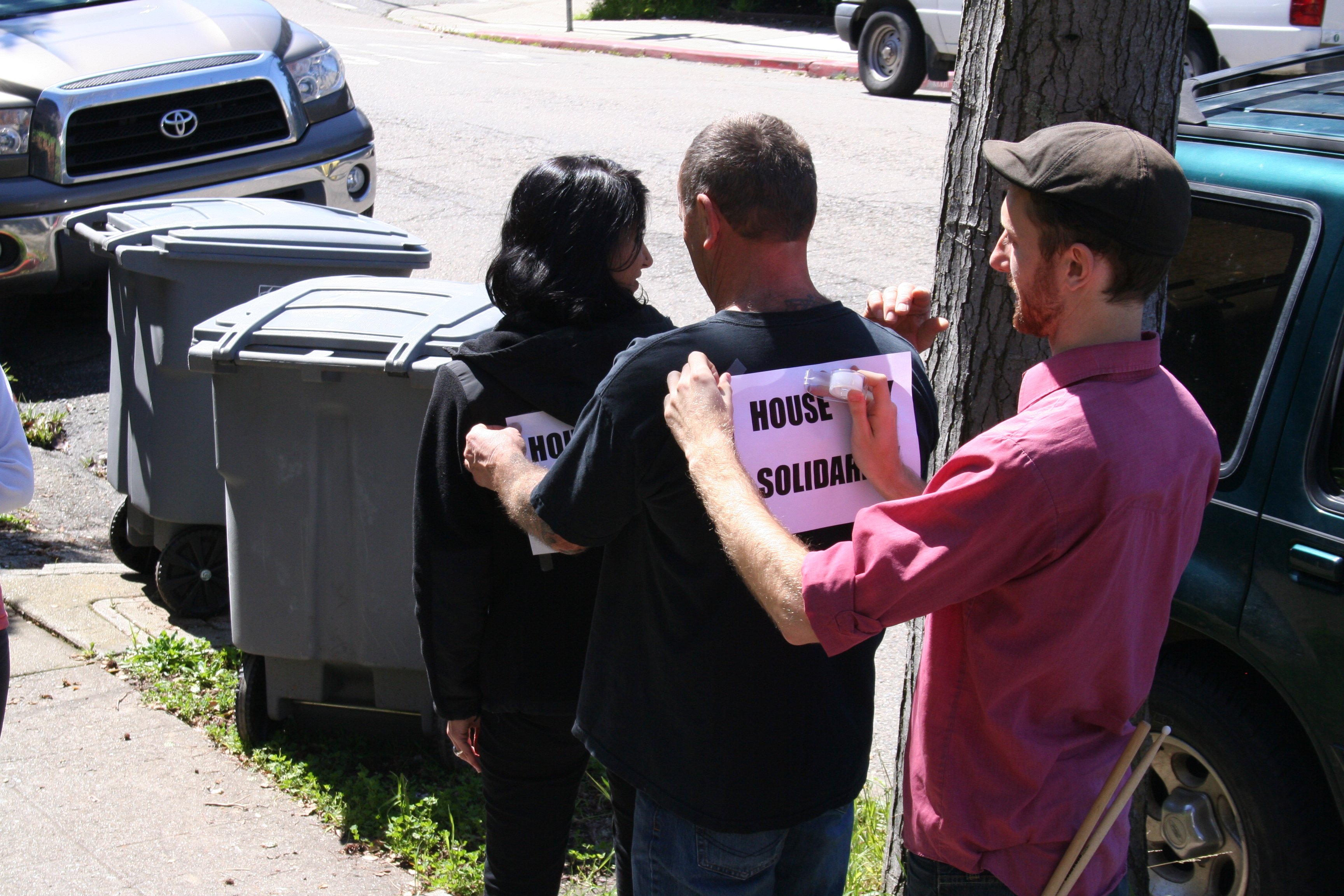
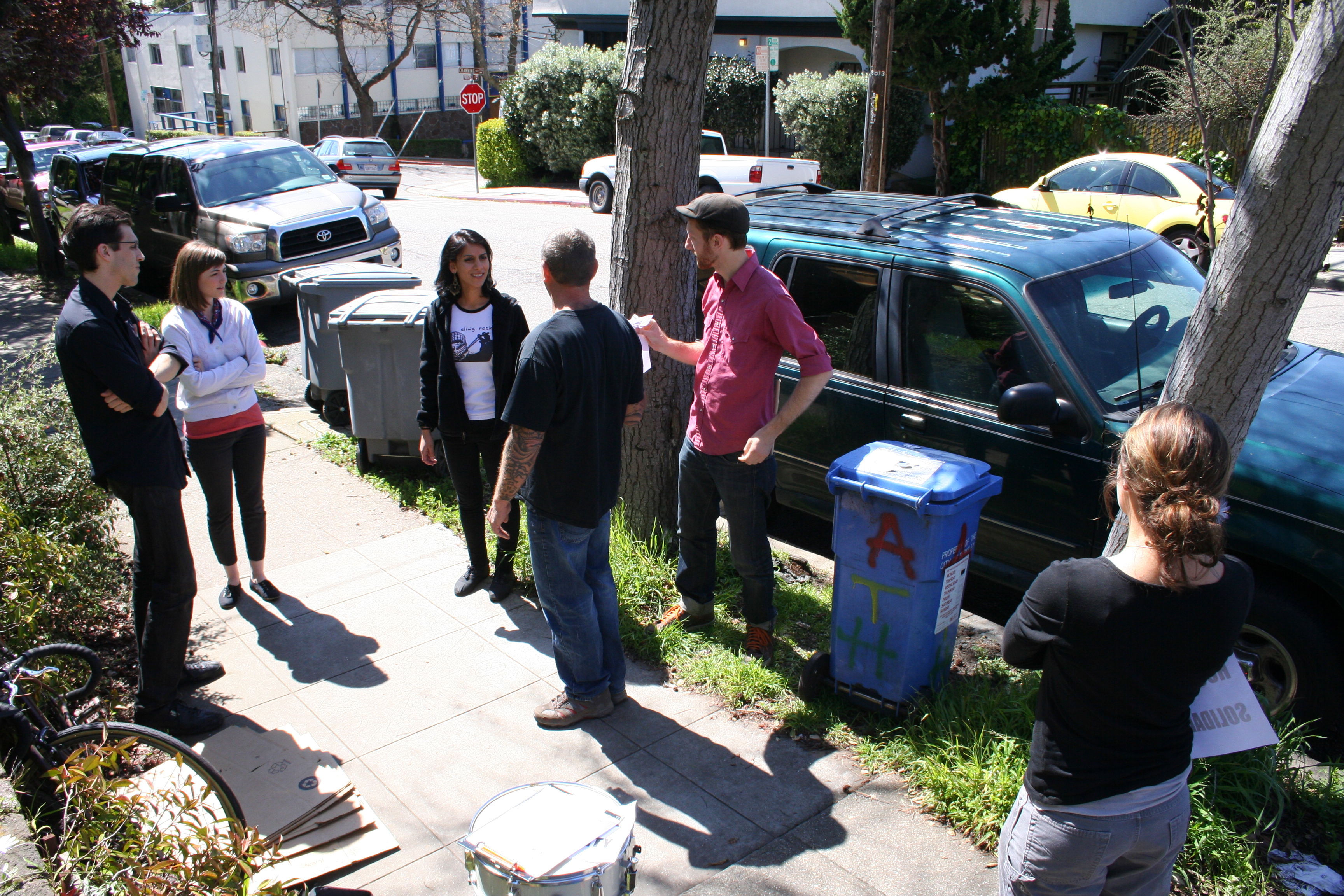
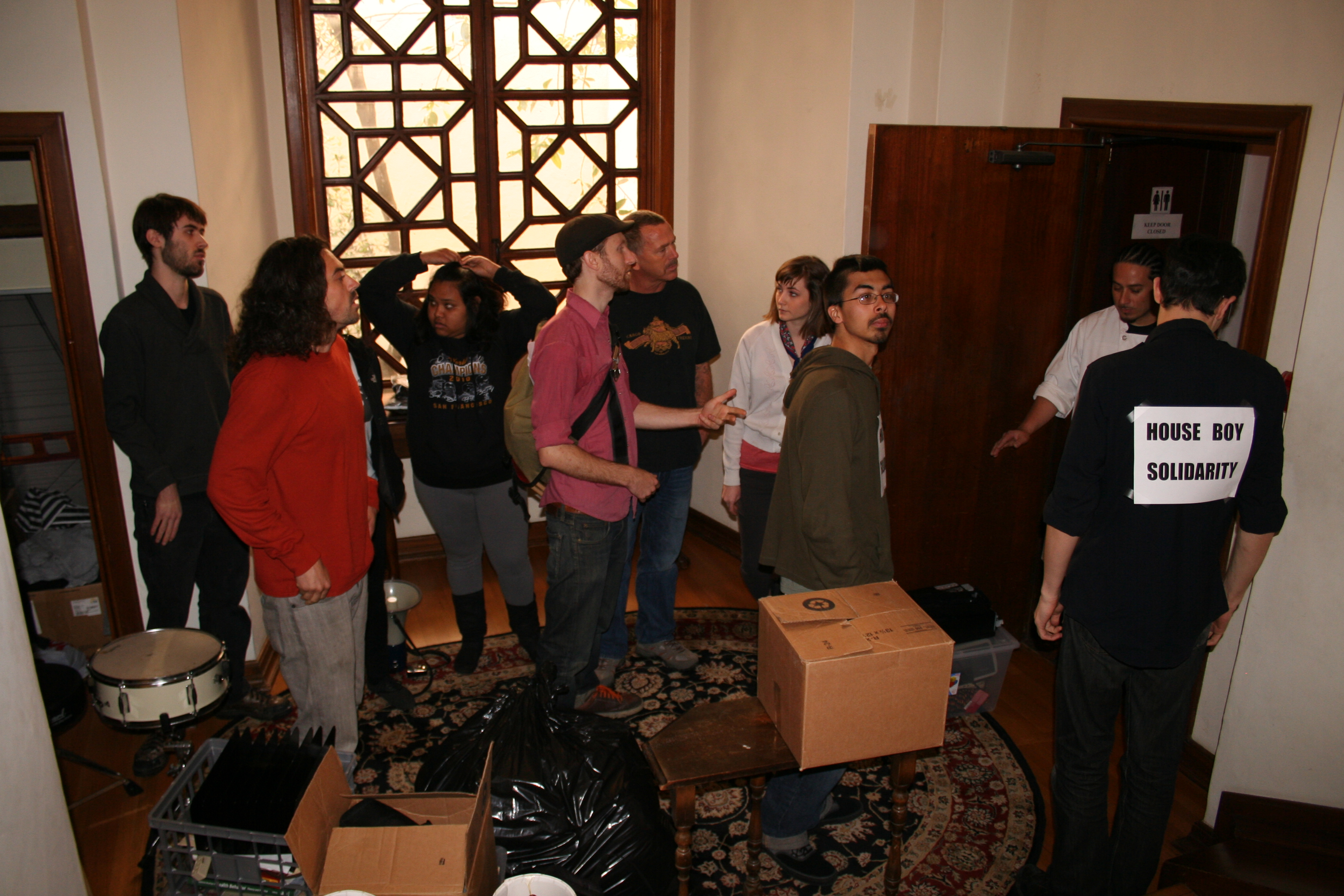
At 12:24pm today, after a sunny Berkeley bike ride, Mackenzie and I were the first ones to arrive at the designated decoy meet-up location, just down the block from the actual target. We taped up a sign that read: HOUSE BOY SOLIDARITY. Slowly, people began to trickle in. Many knew each other through other political work, greeting each other with big smiles and hugs, and “long-time-no-see’s.” By 12:50, everyone knew the plan, the choreography, and the goal. The ten of us headed toward the Alpha Omicron Pi sorority house, one leading our chant on the bullhorn: AIN’T NO POWER LIKE THE POWER OF THE PEOPLE ‘CAUSE THE POWER OF THE PEOPLE DON’T STOP!!!
Thus began our first action as the East Bay Solidarity Network (EBSol).
William had been working and living at UC Berkeley’s Alpha Omicron Pi as a “house boy”: a common term used to refer to live-in cooks who help prepare meals for Cal sororities. He was still receiving training, and had had no serious reprimands or complaints about his performance. On the contrary, he often received a “Good work” and a fist pound from the other, senior cook at the end of the shift. All that changed when they fired the dishwasher and made William and the others pick up the extra work. Without extra pay.
After weeks of working extra hours to cover the undone job, and clearly seeing how exploitative this was, William demanded that his manager hire another dishwasher. They did not; but not long afterward, he was called in for another meeting. He was told that he was being fired for unsanitary work practices (again, having never been seriously reprimanded or warned about any such failures), and that he had three days to move out of his lodgings in the basement of the sorority.
Until now, the sorority management had been dealing with one lone, vulnerable worker: easy to exploit, oppress, fire for causing trouble, illegally evict, and all that sort of typical thing. But today, William wasn’t a lone worker. He was a part of the solidarity network, and he was joined by his fellow members.
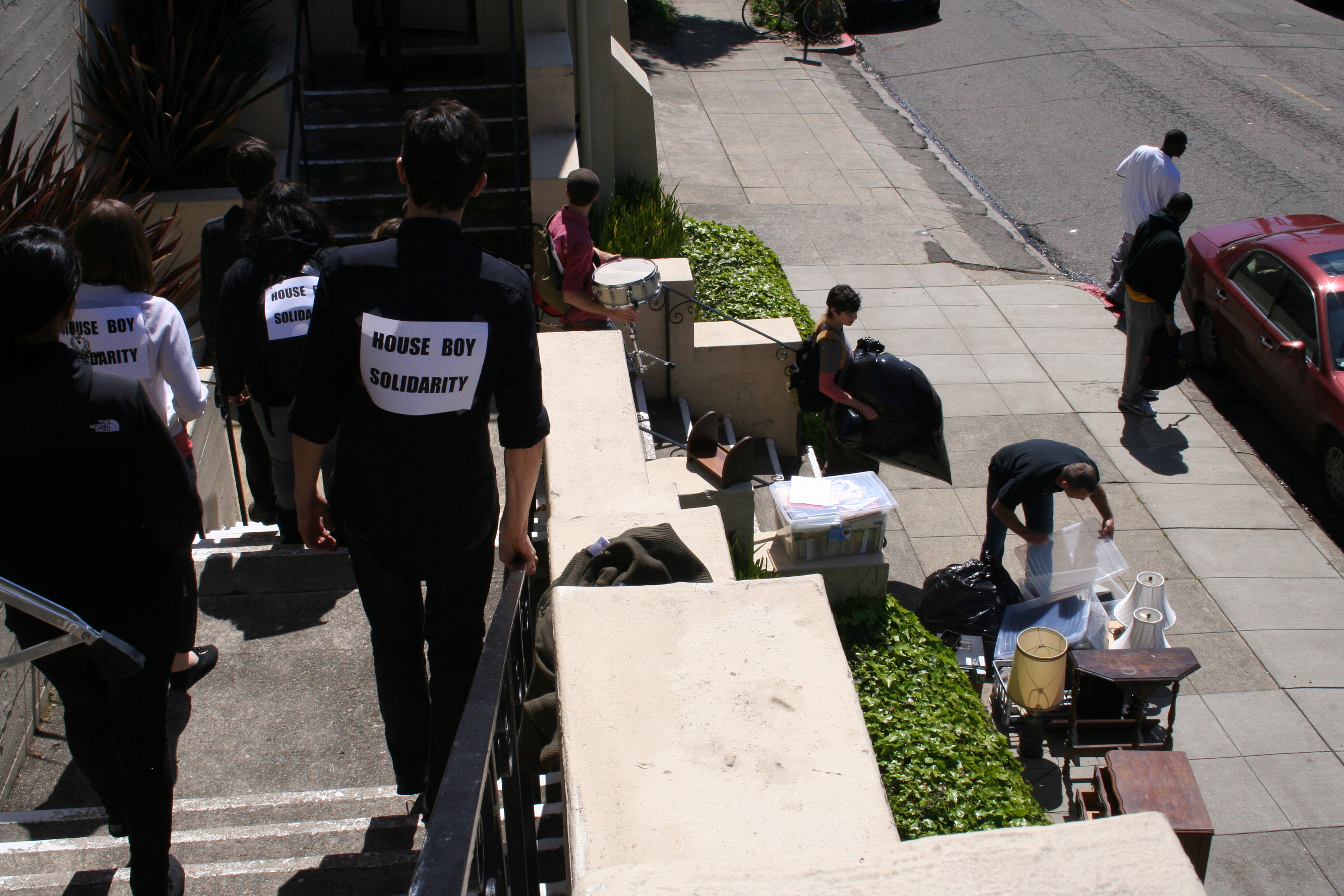
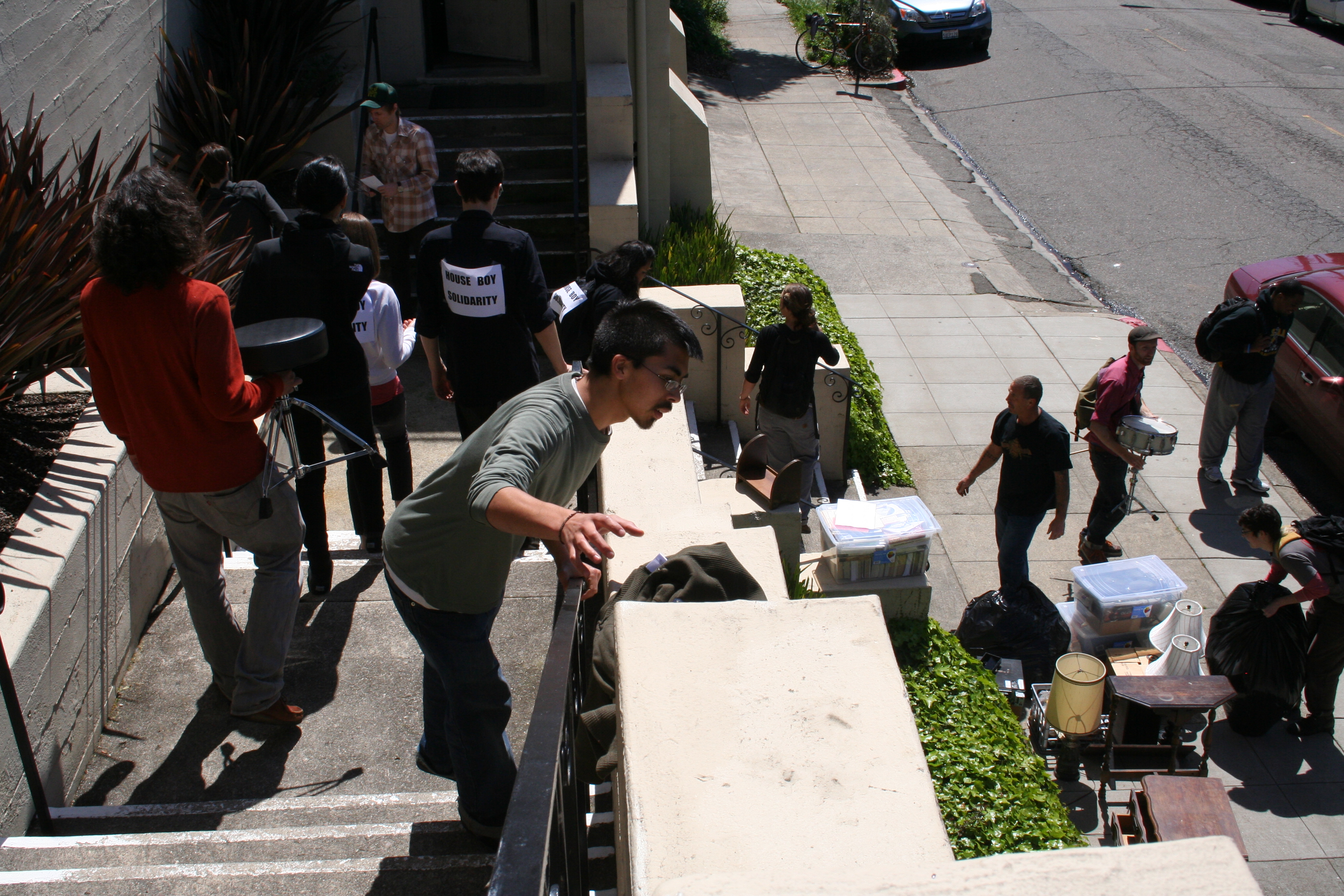
Together, we brought his earthly belongings up from the basement (where they had been packed up without his consent and stored in the boiler room, to make space for the new “house boy”) and, after a brief back-and-forth with his back-stabbing co-worker, took up our formation on the front staircase and passed each item, bucket-brigade-style, down the line. (Wish I had pictures of the bucket brigade, but it’s hard to be photographer and participant at the same time!) Meanwhile, Ryan played a militant march on his snare drum. We had discipline, choreography, and musical flair, man. Doubtless we left an impression.
Now that the managers had been made distinctly aware of our collective presence, William delivered to them the official EBSol letter, specifying our reasonable demands of the sorority managers, and letting them know that if our demands are not met within 14 days, we, as a group, will take action against them.
When all his stuff was piled on the sidewalk, William took the bullhorn and told his whole story to an explicit crowd (our group, now 13 total with some late arrivals) and an implicit crowd (the sorority girls, peeping wide-eyed in bunches through the upper-floor windows; and the managers and staff on site). A manager from a nearby sorority, an in-law of one of William’s former managers, came storming over and tried to shut him down — grabbed at his bullhorn, and threatened to call the cops on all of us for trespassing in a “private home.” We pointed out that it was not only a home, but a workplace, and William kept shouting out the gory details of how they screwed him over.
With his passion, his technology, and the cheering response of the rest of us in the solidarity group, William (and we) easily drowned out the flustered and angry stand-in-boss, creating quite a spectacle for the women watching from the windows. (Whom William was quick to remind that it’s the boss we’re fighting, not the sisters.) For a while the managers even withheld William’s last check, trying to force us all to stay til the cops came in response to the bogus trespassing call, but soon enough they relented and handed over his payment. We loaded his belongings into cars, and left happy.
There are a million reasons I’m excited about how today’s action went. For one, it feels great to take up the case of a domestic worker, whose labor is so completely invisibilized and underpaid most of the time. Second, enthusiasm in the group was really high, partly because everyone was in a fighting mood, partly because a lot of us are friends, and also because this was not a symbolic action: it had both the moral high ground and specific objectives to accomplish (dramatize the moveout with disciplined formations; deliver the demand letter promising more action to come). Also, I think, we all felt inspired to see William stand up to his bosses (or their stand-ins), express his anger at being exploited, and be emboldened by the real mechanism of our group. It made me feel, at least, that if I’m ever getting screwed by my landlord or a boss, and I don’t have a fighting union to help me, then I sure as hell want a solidarity network like this! There’s a lot to be learned just by being there to help other people’s fights.
As with any tactic, this one had its inherent limitations; and there were moments of confusion and things we could have done better. This week, the five of us who planned the action (William included) will get together to debrief and reflect on how to improve. But overall, I think we really pulled off something fine today, and I think everyone who participated felt it was deeply worthwhile. Now, the campaign has begun — more updates to come in 14 days….unless our victory comes sooner!
On a final note, speaking for my own self, there are a lot of messy, fruitful dhamma questions coming up for me as a result of this EBSol organizing. Is there room for an adversarial organizing premise like that of a solidarity network — united against corrupt bosses and landlords — within the concept of nonviolent, kind, wise boddhisattva action? I’ve never really heard anything like that, myself. Usually Buddhist activists point to the universal lovingkindness of a Martin Luther King, who seemed to be able to embrace his adversaries even as he disobeyed their rules and laws. SeaSol — The Seattle Solidarity Network, from whence our model comes — makes no such embrace across the class line. Yet, their actions are nonviolent and strategic. So to me, it seems there’s more overlap than not. What’s your take? How does the solidarity network idea sound to you? Share your wisdom — or better yet, join us for our next action, and then tell me what you think. ;)
I guess it is a great blessing that being sick makes a person seem grimy and messy — hacking, sneezing, all glassy-eyed, sweaty, and weak — because if it made us more beautiful, radiant, and appealing, then lots of people would flock to us and be consequently infected.
So here I am, nice and off-putting with my wet cough, taking the opportunity to read. I even get to read aloud to myself. The James Baldwin was great for that, as was the first response letter from my faculty adviser at Goddard. (She’s a poet, and shows it in her prose.)
So here are some of the highlights of what I’ve been up to, text-wise.
Similarly catching up with Maia Duerr’s thoughts, and skillful curating of other people’s thoughts, on socially engaged Buddhism over at The Jizo Chronicles
Getting down with the fabulous blog of a friend in Seattle — thorough, meaty posts on feminism and revolutionary organizing — from their perspective as a political organizer and exploited (to be redundant) Certified Nursing Assistant (CNA). Especially loved this post, and this page.
Falling in love with James Baldwin all over again through his 1964 essay Nothing Personal, recommended to me by my adviser. I don’t agree with him on everything, but damn he’s not afraid to get deep with it.
Following updates on the Berkeley steel mill strike that started yesterday, when nearly 500 workers formed a hard picket line at Pacific Steel Casting to demand the reversal of company decisions that would force workers to cover their own health care costs. Sounds like they want reinforcements down there, so if anyone reading is in the area and less ill than I am, think about heading down there to support!
Ok, friends, time for a glass of water and another nap. Hope your Wednesday’s goin well.
This question’s been yelling itself in my face for the past couple of days. (Weeks?) Not only in theoretical terms, but in practical ways. Touched on by elders, peers, friends, strangers.
Roughly (and this is my own attempt, for which I’ll accept blame but not credit):
Some groups are great at building and exemplifying models of anti-oppressive ways of being. (Pre-figurative politics, as I understand it, means practicing now the kind of society you want to build in the future.) Enacting horizontal group dynamics, confronting white supremacist and racist behavior, challenging and transforming sexism, homophobia, transphobia, fatphobia, ableism, etc. in myriad ways, and continually developing sophisticated, intersectional analyses of these lived oppressions. Honoring and valuing healing; promoting literacy around dealing with trauma and mental wellness. Developing healthy sex-positive cultures grounded in consent. Practicing conscientious methods for dealing with intimate violence and abuse. Giving and receiving criticism with humility, generosity, bravery, and kindness. Doing very practical things like organizing childcare collectives, artmaking groups, and food distribution programs; infusing them with liberatory values. Transforming estranged relationship with our bodies, the earth, and nature. Theorizing these and more practices, and sharing them.
At the same time, some groups are great at developing people’s revolutionary class consciousness. Examining the material processes of history with an eye toward figuring out the best ways to intervene in those historical processes, and change things for the better. Get rid of classes altogether. Put an end to imperialism. Employ practice and theory, in current conditions, to avoid the pitfall of reformism and move militantly and decisively toward a world of “freely associating producers” — a world where violent compulsion is no longer ambient, as it is under capitalism and has been under all forms of class society (to stake a claim against what I learned about Foucault, in college). I’m impressed and inspired by groups that maintain a keen focus on this goal, and whose work reflects the urgency of building the class power necessary for exploited people to liberate themselves/ourselves from the yoke (and rod) of capital.
Now. Is there overlap between these ‘types’ of groups?
Yes.
A lot?
In the Bay Area? In the US?
IIIIIIII dunno. What do you think? What are you finding?
A quote from Ryan, hailing the makers of this primer on how to build a solidarity network, or “direct action casework” group, along the lines of the dope and seriously successful Seattle Solidarity Network (SeaSol). :)
Tonight, a small group of us are getting together to talk about how we can build one in the East Bay. So I’ma get to readin. I’ll keep you updated on the work as it progresses!
And today: prayers for people in Japan; strength for fighters in Wisconsin (General Strike?!?!); and nothing but love and respect for Slow Loris.
In Buddhist parlance, we often encounter the word “interdependence.” It comes up in many contexts. One way I often hear it invoked (in dhammic as well as New-Agey spaces) is as a kind of feel-good spiritual brainteaser. Isn’t it amazing and beautiful how we are all connected?
Here’s a good example, from my own life. I was attending a conference about spirituality and technology: the Wisdom 2.0 Summit. One of the keynote speakers, Tony Hseih, CEO of the online retailer Zappos, gave a talk about the culture of happiness at his company, and how attention to the human connections between merchant and consumer fosters better, more lucrative business. The title of his book sums it up nicely: Delivering Happiness: A Path To Profits, Passion, and Purpose.
When it came time for Q&A, I raised my hand and got the mic (standing up, semi-terrified, before this large crowd of very successful techno-seekers). I thanked Tony for his work, and then asked what he thought — and what all of us present thought — about the happiness of the people who produce the technology we use. The people working in the factories that make our phones, our laptops, our desktops. The people mining the minerals for all of these. What about their happiness?
It’s all well and good to look at interdependence as a network for human kindness and beneficence. But the fact is, it is just as much (if not more) a network for exploitation: of humans, animals, and the earth.
In his newest book, The Boddhisattva’s Embrace: Dispatches from Engaged Buddhism’s Front Lines, Hozan Alan Senauke of the Clear View Project cuts to the core of exploitative interdependence in the conclusion of a beautiful essay on the shipbreaking industry in Bangladesh. Continue reading →
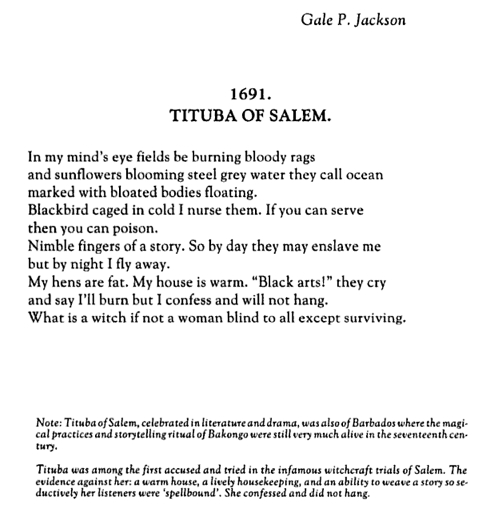
This semester in my MFA I have the profound good fortune of working with an amazing faculty member: poet, writer, and cultural historian Gale Jackson. Today in our twelve-person advising group, we worked together to respond to one of her poems — “1691. Tituba of Salem.” — which happened to be the first and only one I had already read.
* * * * * * * *
The whole poem is a deeply layered thing that I know I’ll continue to revisit. One line (now the title of this blog post) echoed as I was reading Detroit: I Do Mind Dying: A Study In Urban Revolution. (Remember when I mentioned that? Yep, ha, still makin’ my way through it.) Describing an opening sequence in Finally Got The News (a renowned documentary self-made by the League of Revolutionary Black Workers), I Do Mind Dying authors quote League leader John Watson:
You get a lot of arguments that black people are not numerous enough in America to revolt, that they will be wiped out. This neglects our economic position. . . . There are groups that can make the whole system cease functioning. These are auto workers, bus drivers, postal workers, steel workers, and others who play a crucial role in the money flow, the flow of materials, the creation of production. By and large, black people are overwhelmingly in those kinds of jobs. [116]
The rich, ongoing resistance of immigrant workers in the US testifies that this shifting terrain does not completely close down our opportunities for struggle. Disruption and destabilization are still possible.
* * * * * * *
I also wonder about the converse. Perhaps if we can poison, then we can also serve.
I mean this more in terms of the ways that I might poison my own life. The ways that I might relate to, and feed, my own internal sufferings. Day to day, in subtle ways. Clinging to high expectations. Beating myself up over mistakes. Fearing and worrying about the future. Indulging in fantasies and daydreams, even when they make me feel kind of sticky and queasy afterward. In general, surrendering my happiness to the mercy of my own thoughts.
Goenkaji says: there is nothing more harmful than our own untamed mind. And there is nothing more helpful, more beneficial, than our own trained mind, tamed mind. This observation comes up again and again in dhamma teachings — the idea of “turning the (monkey-) mind into an ally.”
So much in one post! Hope I haven’t overwhelmed you. Happy Monday, friends.
PS: You, like me, might want to support Gale and her important ongoing work as an artist. She’s more of an “analog girl in a digital world,” to borrow a phrase from Erykah, so since the PayPal button is out, over the next couple days we’re gonna put our heads together to find a simple way for y’all to make offerings and contributions (and/or purchase some of her breathtaking books!) from afar.
It’s a gorgeous, crisp day outside: perfect for a ride on my pretty new bike, and no time to be stuck inside blogging til dark. So the thought-connections in this post will be loose. Maybe I’ll try tightening them up sometime.
The following are three excerpts from three different pieces: Buddhist, economic, and Marxist-feminist. All deal with the same theme: work. I’m simply interested in thinking about parallels and dissonances among them, and working toward a more holistic understanding of how work operates in reality, and how we might want it to operate.
When explaining meditation, the Buddha often drew analogies with the skills of artists, carpenters, musicians, archers, and cooks. Finding the right level of effort, he said, is like a musician’s tuning of a lute. Reading the mind’s needs in the moment—to be gladdened, steadied, or inspired—is like a palace cook’s ability to read and please the tastes of a prince.
Collectively, these analogies make an important point: Meditation is a skill, and mastering it should be enjoyable in the same way mastering any other rewarding skill can be. The Buddha said as much to his son, Rahula: “When you see that you’ve acted, spoken, or thought in a skillful way—conducive to happiness while causing no harm to yourself or others—take joy in that fact and keep on training.”





 Kloncke