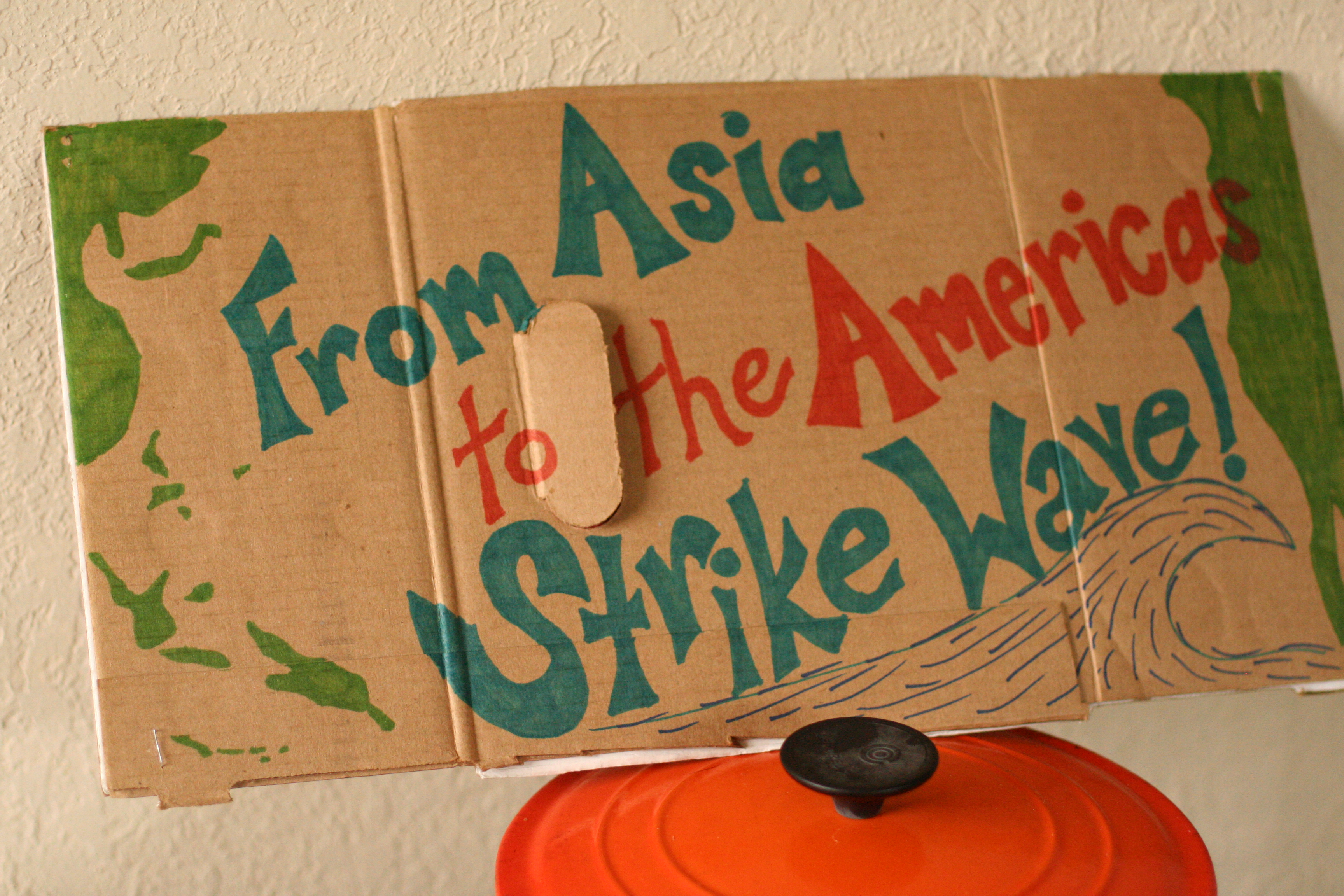
poor cartography but heartfelt enthusiasm: my sign from the WalMart Black Friday strike.
poor cartography but heartfelt enthusiasm: my sign from the WalMart Black Friday strike.

The worst thing about depression is how true your vision seems, like misery is the only correct perspective and everything you think when you’re happy is a sham. I didn’t even want to be happy anymore because I’d rather live in honest misery than fake bliss.
—Michelle Tea, Valencia
Yup. And then imagine being depressed and displaced from your longtime home on Valencia by pinkwashed gentrification.

I talked with my folks tonight: slow, nothing-much, touching base. The dog has tapeworms, but seems more chipper since getting his medicine. Mom doubts Pop’ll make it through this weekend’s performance of Fiddler On the Roof without dozing off. At times the silences sagged between our phones. Tomorrow they (my parents) will be moving all the furniture so the carpets can be deep-cleaned.
Suddenly my dad’s voice brightened. Can I tell you one thing about today, he said.
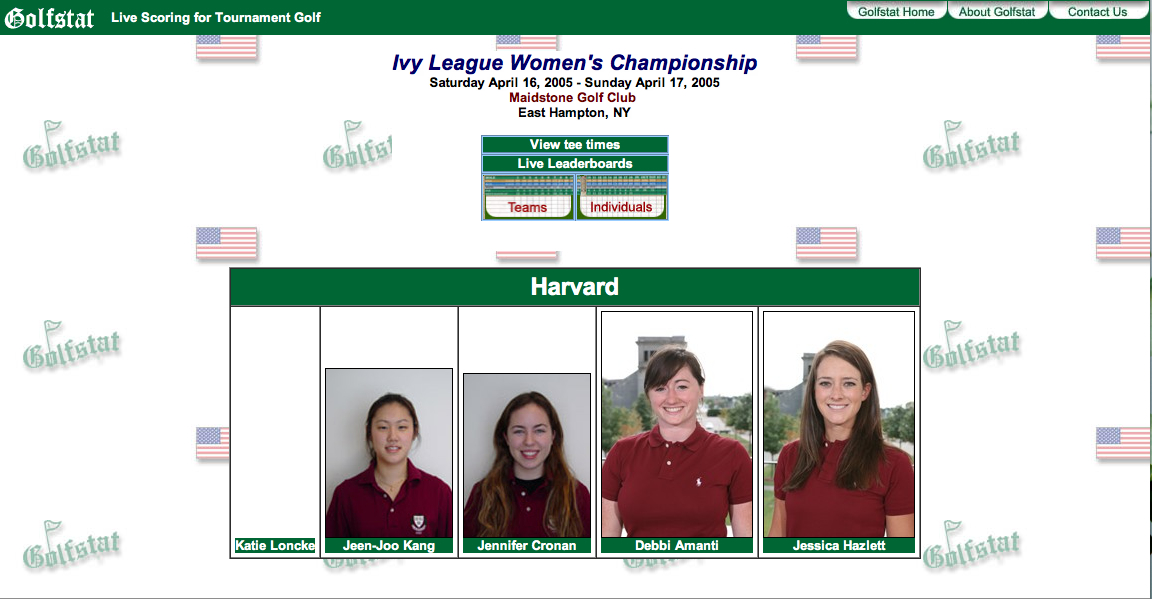
As he was cleaning out the study, he came across a leaderboard from my golfing days. Based on our conversation I’m still not sure exactly what kind of object he’s describing (I remember leaderboards being huge, like billboards — not something you could fit in our study chock-full of files and wires and junk), but he said it had that fine, pristine writing (those gray, permed, chalk-wielding old ladies keeping public score always cut the most dashing sevens), and at the top, number one, my name: Katie Loncke. Shot a 78 the first day; 72 the second. Below me (my father’s voice grows incandescent) are players who went on to be really serious. Casey Gee, who fell just shy of the PGA, and now works at a bank. Christina Stockton, who’s gone pro. Danielle Civitanov — we think she’s in school to be a nurse. The top Sacramento girl golfers from my middle-school and high-school years. Proof that I had bested the whole lot of them at least once. Dad mused aloud about sending the board to my Oma. Your granddaughter, number one! I could picture his smiling apple-cheeks, shaped just like mine.
If you know me well you probably know that golf and I have had a fraught relationship. I once tried to break my own finger with a hammer to get out of playing a tournament. When that plan failed, I turned to a bottle of pills.
Enough time has passed that I’m not so tense about it anymore. I can even contemplate dusting off my clubs for fun, maybe with a couple of novice guy friends. I would probably run circles around them, even though I haven’t played in years. I used to be that good.
And I made my dad proud. If he shadowed me for a round, weeks afterward he could tell you every single shot on every single hole.
Tonight, despite a thorny past, I let myself rejoice a little in his shine.
I’ve been thinking lately: we need some kind of People’s Award Association. For those of us who might choose unconventional paths, or never have a real shot at mainstream prestige in this fucked up, pseudo-meritocratic, hyper-competitive society. Our unpaid work organizing against the prison industrial complex, or fighting foreclosures, or founding radical sanghas may not yield a trophy, medal, plaque or certificate, but our excellence still matters, and people in our lives should know about it. They should have more chances to be proud of us.
Ideally a real, beautiful object for display, but even just an email — to a grandparent, mentor, partner, whomever — stating ceremoniously:
Congratulations: your loved one, {____________}, has been awarded an Outstanding {What They Do Well} Prize. This honor is conferred by the People’s Award Association in recognition of {___________}’s excellence in transforming oppression and building toward a better world: a world with freedom for all.

Tough to feel deserving of any positive blogging recognition when my updates here have been so scattered the past few months. But as always, I’m honored and humbled by this shoutout from the wonderful engaged Buddhist writer and activist Maia Duerr. You know how some people are mad talented at giving compliments? Maia is one of those people. She’s so thoughtful and specific when she names what she appreciates about people’s work. You can tell she’s really moving with what they’re putting out; not just scattering praise for feel-good purposes. Of Kloncke.com, she writes
Katie Loncke’s blog is, to me, the perfect intersection of spirit, politics, and heart.
Is that sweet or what? Really tho.
And the best part about being tagged with this kind of blogly award? Passing it on. Since Maia put her own spin on the shoutout selection by limiting her list to women, I’m going to create my own parameters, too. My list consists only of people I know and build with (politically, spiritually) in person.
infaquerical: a term created by my friends Candy and Castro,* who did not identify with either monogamy or polyamory, and wanted a new framework for thinking and living their coupledom. After writing out the aspects of their relationship that matter to them, together they birthed this word.
in: indigenous
fa: familia (chosen, community, & biological)
que: queer, querida
r: revolutionary, radical
ical: magical
Since its inception, they’ve been using infaquerical as a touchstone as they navigate complexities of a nontraditional, gender-bending and anti-capitalist romance. Castro might say to Candy: querida, I really want to spend my time with you: it’s been a hard week and my instinct is to retreat with you into our little world. But since we’re in an infaquerical relationship I think it’s important for me to spend some time with my homies, rather than defaulting into monogamous isolation.
Or Candy (feminine-centered) might relish opening doors for Castro.
Or Castro (masculine-centered) might enjoy sitting on Candy’s lap in public.
As you might imagine, I instantly fell in love with this dope-as-hell word. Not only for the meanings it carries, but for the process of intention that shaped it, and the ways it might live through people’s loving thoughts and actions. Reminds me a bit of the way Ryan and I attempted to (re)define our “Open Relationship” Facebook status in the early days.
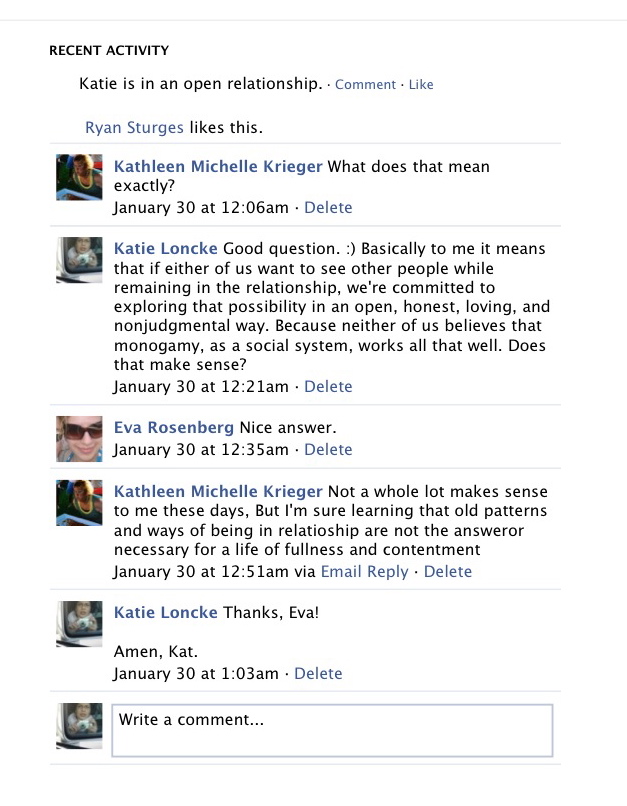
Now, over two years later, Ryan and I have decided to end our time as a couple. And I think the way we’re doing it reflects the infaquerical qualities of our time together.
When green leaves turn in the wind
I vow with all beings
to enjoy the forces that turn me
face up, face down on my stem~Robert Aitken Roshi, a senryu verse from The Dragon Who Never Sleeps
Naturally, separating from someone we love brings pain. Not tryna deny that sadness. Splitting up with Ryan means losing my best friend. But if I’ve learned anything from dharma and visionary politics, it’s that within crises — inside the instabilities: of gender, of capitalism, of heteropatriarchy, of the mind — we can also find opportunities for liberation.
With deepest gratitude to everyone who has loved and supported me and Ryan, as a couple and as independent people: you bring infaquerical to life!
love,
katie
–––––––––––––––––––––––––––––––
* Sweet corrections from Castro:
[M]y my housemate Ray, Candy and I all thought we should re-name and re-define our reality by creating an evolving framework and term that speaks to our lived experiences. So, infaquerical was a trio effort which is why it is also so wonderful because as Candy pointed out, the way we defined our reality included another person (Ray) not just the two of us.
In: Indigenous
fa: familia (chosen, community and biological)
que: querida/queer
r: radical/revolutionary
ical: magicalInfaquerical: a magical, radical, revolutionary and romantic relationship between two non-gendered conforming people; they live to restore humanity instead of living to make profit; have the desire to decolonize their mind and to abolish male supremacy; value familia (biological, chosen and communidad) and challenging male supremacist ways of thinking.
So amazing, right? Have you experienced or witnessed dynamics of infaquerical in your life? (Hehe, I know the answer is Yes because so many of y’all are dope livin-yr-politics messy queer feminist beauties) Please feel free to share testimony! I’ll be sure it makes its way back to Candy and Castro. :)
When I heard of the call raised In Oakland, California, to “Occupy the Prisons,” I gasped. It was not an especially radical call, but it was right on time.
~Mumia Abu Jamal, Souls On Ice
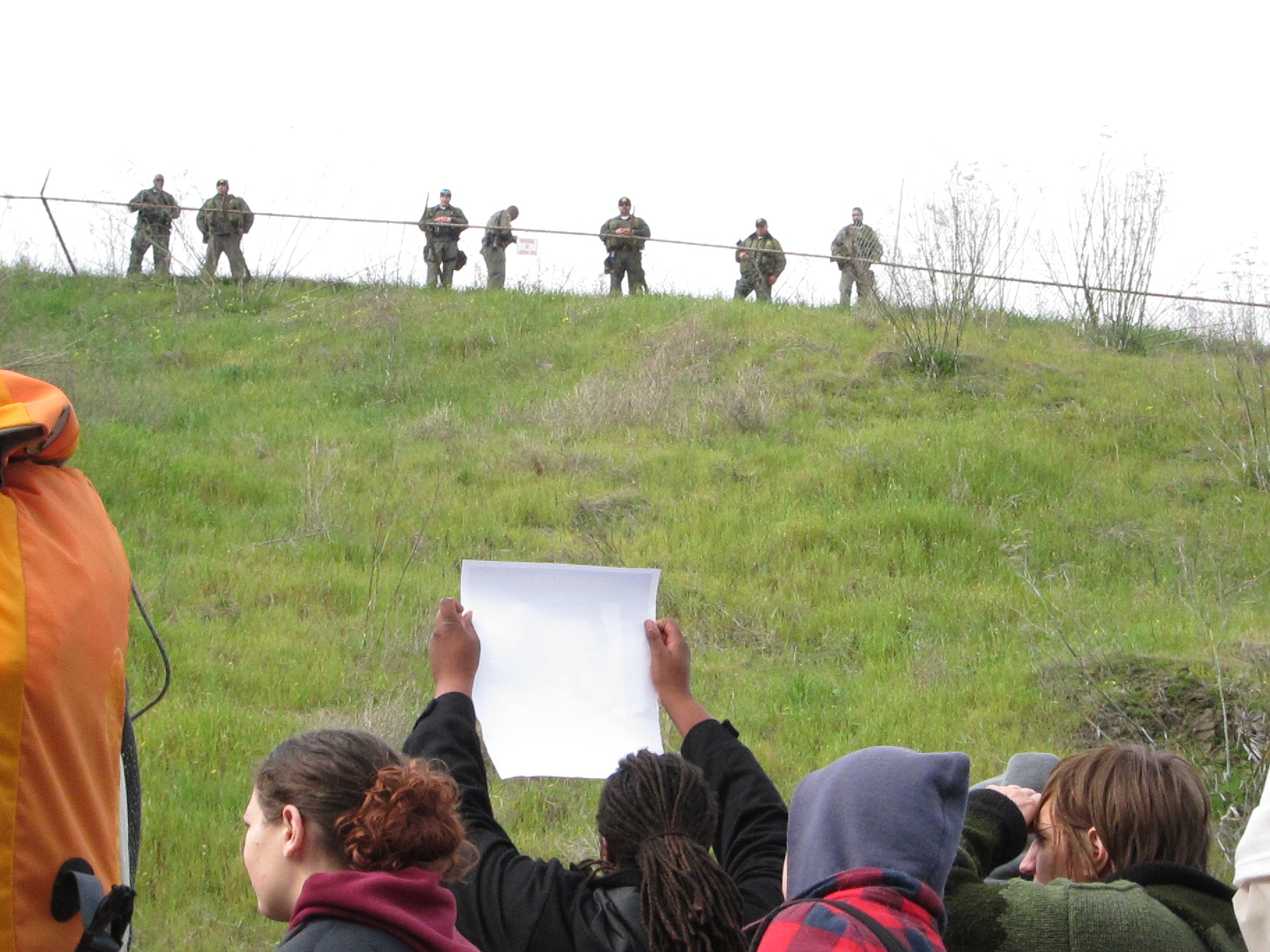
As the carload of us walks back along the two-lane road toward the parking area, leaving a crowd of 500 or so outside the east gate of San Quentin, clusters of military-looking guards stud the hills above us, watching through sunglasses. We’re tired from walking and standing for a few hours. I’m feeling cranky, and a little disappointed. What was I expecting? Maybe the Occupy/Decolonize events have spoiled me with their frequent snake marches and militant ruckus-making. Shutting down banks; shutting down ports; attempting to take empty buildings for community use. Being near San Quentin (my first time) has me itching to tear down a wall or two.

Long-time readers will immediately understand the significance of this gift from Ryan. :)

Do you create by hand? Do you create with words? Or both?
Yesterday and today, my faculty advisor has observed that although we humans make meaning in verbal and physical ways, for a variety of social reasons authority figures often overcultivate one side or the other. (Or neither, I might add.) Many of us are taught, through schooling, that what we type with our fingers or say with our mouths is more important than what we can make with our hands or sculpt with our bodies.
There’s some overlap here, of course, in that writing (or typing) is an action that lives in our hands. But my advisor’s point is that too often, that’s as far as it goes. Unless we also engage in other activities and ways of thinking (in terms of movement, in terms of texture, in terms of light or temperature or dimension), our writing and meaningmaking will be limited to our hands, rather than involving our entire bodies.
The moment he said this, I got it. When I was younger, before writing took over as the only mode of learning in school (did I create a single physical object in college?), I used to think and create with my hands. I used to make things by hand.
* * * * * *
My mother, being a sentimental soul, and having only one child, has trouble throwing my old things away. The garage of my childhood home is lined with boxes containing elementary school spelling tests, middle-school science papers, and God knows what else. My bedroom, though not exactly as I left it at 17, feels less transformed (say, into a study) than strategically looted, with some walls and drawers empty and others left intact, housing various middle-to-high-school artifacts.
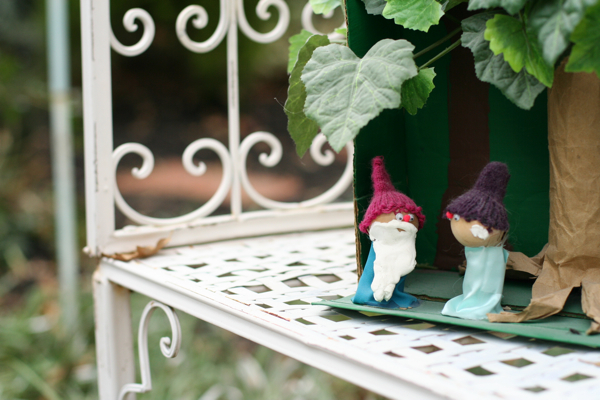
Pretty much every time I visit my parents, I use the desktop computer at least once. And pretty much every time I use the desktop computer, I notice and smile at the following diorama, perched on a nearby shelf in the cluttered study, and crafted by Yours Truly in about the fifth or sixth grade.
Thorin thinks that Bilbo should climb to the top of the tree and see if he can see any end to the forest. Bilbo reluctantly climbs up a tree and breaks through the canopy to the bright light of the sun. He sees thousands of butterflies and looks at “the black emperors for a long time and enjoyed the feel of the breeze in his hair and on his face.” [from The Hobbit, Chapter 8, pg. 148.]
Turns out, I used to love making all kinds of things when I was young. In eighth grade, I was supposed to present a visual aid about immigration to the US at the beginning of the 20th century. I wound up making a simple Rube Goldberg device: on one side of the machine there’s a tiny bucket where you place more and more stick figurines (representing immigrants). When the bucket gets heavy enough, it tips a see-saw that flips a gate, a marble rolls down a pathway and trips something else, and I forget exactly how the rest of it worked but in the end another tiny bucket flips over and out fall all these illustrations of ‘consequences of immigration’ (i.e. tenements, rats, spread of disease, and whatever else our history book told us).
But midway through high school or so, the making of things by hand fell away. It would be years before I rediscovered it: first through cooking, then letter writing, and now bootleg carpentry and picket-sign design. I hesitate to call these activities “making meaning” (sounds so lofty and . . . well . . . discursive), but at least they live in the same neighborhood.
How about you? Do you regularly use your hands to make meaning — playing music, painting, sculpting, deejaying? Or maybe even your entire body, through dance? Or are you mostly brain-mouth-and-keyboard -bound, like me?
Holy smokes, is this a welcome morsel of public intellectualism.
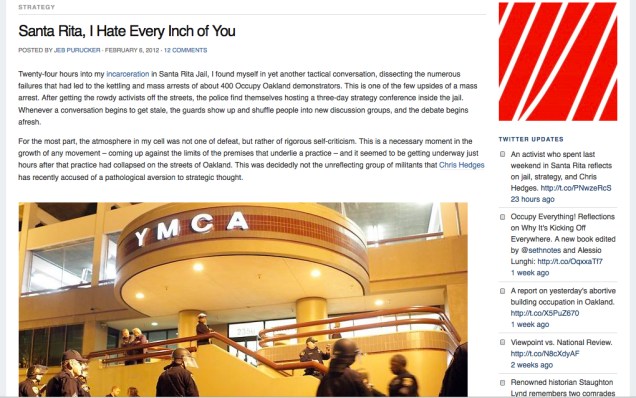
The entire piece is deft and deeply relevant — worth a read, for sure. And since I seem incapable of connective theorizing that extends beyond whichever book I’ve last read, or whatever idea I’ve most recently started exploring (“Neuroplasticity, you say? You know, in a weird way that comes up in this book/article/Facebook post I just read on Black politics/Barbara Kingsolver/the disappearance of bees.” Lazy, I know, but at least the randomized combinations keep things surprising), I’m struck by the similarities between the recent work of Keith Hennessey (a performance artist who just presented and workshopped here at the MFAIA program) and the kind of thinking that Jeb Purucker applies to Occupy Oakland.
“Failure” is evidently enjoying a current popularity surge within academia: Jack Halberstam and a few others are releasing books on the topic. In his lectures and hands-on workshop here, Keith discussed a recent piece of his called Turbulence, in which he explores the concept of failure — as in, a performance piece that is set up to fail. Without going too much into it, I’ll say that participating in his workshops helped remind me of (a) the fruitfulness and dignity that come from improvisation, (b) the usefulness of reflecting on failures in order to glean lessons, and (c) the ways in which, with “success” kind of off the table, we are freed up to redouble our focus on how we work together. The process.

5. The workers at the General Hospital of Kilkis answer to this totalitarianism with democracy. We occupy the public hospital and put it under our direct and absolute control. The Γ.N. of Kilkis will henceforth be self-governed and the only legitimate means of administrative decision making will be the General Assembly of its workers.
. . .
7. The labour union of the Γ.N. of Kilkis will begin, from 6 February, the retention of work, serving only emergency incidents in our hospital until the complete payment for the hours worked, and the rise of our income to the levels it was before the arrival of the troika (EU-ECB-IMF). Meanwhile, knowing fully well what our social mission and moral obligations are, we will protect the health of the citizens that come to the hospital by providing free healthcare to those in need, accommodating and calling the government to finally accept its responsibilities, overcoming even in the last minute its immoderate social ruthlessness.
I’m ruminating on this today, thinking about play and experimentation in radical takeovers. Gratitude to Pete Hocking, Keith Hennessey, and the relational aesthetics folks (readin’ up on ’em here at Goddard) who are giving me some new perspectives to play with. May come back with some new ideas for EastBaySol. :)
As always, would love to hear your thoughts. Feel free to share!
 Kloncke