In Buddhist parlance, we often encounter the word “interdependence.” It comes up in many contexts. One way I often hear it invoked (in dhammic as well as New-Agey spaces) is as a kind of feel-good spiritual brainteaser. Isn’t it amazing and beautiful how we are all connected?
Here’s a good example, from my own life. I was attending a conference about spirituality and technology: the Wisdom 2.0 Summit. One of the keynote speakers, Tony Hseih, CEO of the online retailer Zappos, gave a talk about the culture of happiness at his company, and how attention to the human connections between merchant and consumer fosters better, more lucrative business. The title of his book sums it up nicely: Delivering Happiness: A Path To Profits, Passion, and Purpose.
When it came time for Q&A, I raised my hand and got the mic (standing up, semi-terrified, before this large crowd of very successful techno-seekers). I thanked Tony for his work, and then asked what he thought — and what all of us present thought — about the happiness of the people who produce the technology we use. The people working in the factories that make our phones, our laptops, our desktops. The people mining the minerals for all of these. What about their happiness?
It’s all well and good to look at interdependence as a network for human kindness and beneficence. But the fact is, it is just as much (if not more) a network for exploitation: of humans, animals, and the earth.
In his newest book, The Boddhisattva’s Embrace: Dispatches from Engaged Buddhism’s Front Lines, Hozan Alan Senauke of the Clear View Project cuts to the core of exploitative interdependence in the conclusion of a beautiful essay on the shipbreaking industry in Bangladesh. Continue reading →
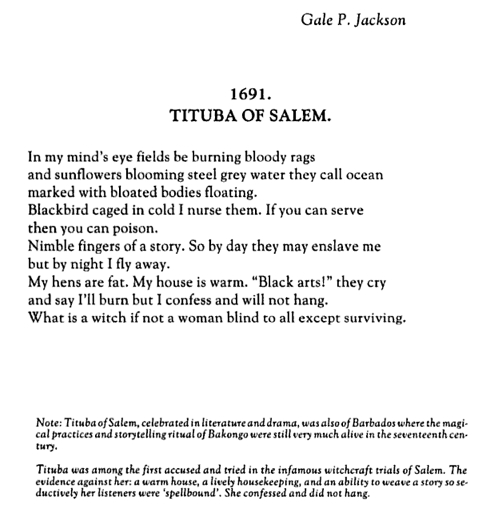
This semester in my MFA I have the profound good fortune of working with an amazing faculty member: poet, writer, and cultural historian Gale Jackson. Today in our twelve-person advising group, we worked together to respond to one of her poems — “1691. Tituba of Salem.” — which happened to be the first and only one I had already read.
* * * * * * * *
The whole poem is a deeply layered thing that I know I’ll continue to revisit. One line (now the title of this blog post) echoed as I was reading Detroit: I Do Mind Dying: A Study In Urban Revolution. (Remember when I mentioned that? Yep, ha, still makin’ my way through it.) Describing an opening sequence in Finally Got The News (a renowned documentary self-made by the League of Revolutionary Black Workers), I Do Mind Dying authors quote League leader John Watson:
You get a lot of arguments that black people are not numerous enough in America to revolt, that they will be wiped out. This neglects our economic position. . . . There are groups that can make the whole system cease functioning. These are auto workers, bus drivers, postal workers, steel workers, and others who play a crucial role in the money flow, the flow of materials, the creation of production. By and large, black people are overwhelmingly in those kinds of jobs. [116]
The rich, ongoing resistance of immigrant workers in the US testifies that this shifting terrain does not completely close down our opportunities for struggle. Disruption and destabilization are still possible.
* * * * * * *
I also wonder about the converse. Perhaps if we can poison, then we can also serve.
I mean this more in terms of the ways that I might poison my own life. The ways that I might relate to, and feed, my own internal sufferings. Day to day, in subtle ways. Clinging to high expectations. Beating myself up over mistakes. Fearing and worrying about the future. Indulging in fantasies and daydreams, even when they make me feel kind of sticky and queasy afterward. In general, surrendering my happiness to the mercy of my own thoughts.
Goenkaji says: there is nothing more harmful than our own untamed mind. And there is nothing more helpful, more beneficial, than our own trained mind, tamed mind. This observation comes up again and again in dhamma teachings — the idea of “turning the (monkey-) mind into an ally.”
So much in one post! Hope I haven’t overwhelmed you. Happy Monday, friends.
PS: You, like me, might want to support Gale and her important ongoing work as an artist. She’s more of an “analog girl in a digital world,” to borrow a phrase from Erykah, so since the PayPal button is out, over the next couple days we’re gonna put our heads together to find a simple way for y’all to make offerings and contributions (and/or purchase some of her breathtaking books!) from afar.
I wonder whether Moses, after being kicked out of the palace and downgraded to the slave caste, ever felt nostalgic for his royal upbringing. Same for Siddhartha, who left his princehood by choice and became an ascetic. Did St. Francis of Assisi, who shunned his cloth merchant inheritance, ever miss strutting down a 13th-century street in a fly outfit? What was it like for St. Clare, a follower of Francis, to abandon her landowner life and found the Order of Poor Ladies?
These folks all share certain dimensions of class transition, along with some leanings toward class treason — though I hesitate to call any of them class traitors because, while they attempted to carve out alternative, anti-hegemonic lifestyles and communities for their followers, to my knowledge they did not explicitly, politically confront the existence of the class line itself. (Someone please correct me on this if I’m wrong!)
Lately in my own life, I’ve been noticing painful areas in my move away from liberalism (and/or nominal radicalism) toward a politic that actually centers the working class and the dispossessed. This process, for me, involves somewhat shameful, tender stuff.
Alan’s got a lovely piece up at Clear View Blog (digging his jaunty-angled question: what would MLK, Malcolm X, and Paul Robeson think about being put on U.S. postage stamps?) that points to the connections between big-L Love and the effort to, in King’s words, “defeat evil systems.”
Compassion and militancy. Neither can substitute for the other. If you’ve got militancy but don’t practice compassion, your friends and comrades — the people upon whom you most rely, politically and personally — prob’ly won’t enjoy being around you. Not in the long term, anyway. And if you’ve got compassion but no critical analysis of “evil systems,” or meaningful program to defeat them, you are, as Ryan points out, utopian.
Combine the two, compassion and militancy, and you’ll get something powerful. But you’ll also get problems.
Frederick Douglas famously asked, “What to the slave is the Fourth of July?” We might do well to extend the same skepticism to today’s hallowed, lovey-dovey vacation day.
Beneath the hype, MLK day can serve as a reminder that people who advance the fight for radical liberation, using their own compassion and militancy, are undoubtedly risking their lives.
So if you’re among them, thank you for your courage. May the earth continue to bless you with beauty every day. May you sometimes have a sweet picnic by the lake.
It’s a gorgeous, crisp day outside: perfect for a ride on my pretty new bike, and no time to be stuck inside blogging til dark. So the thought-connections in this post will be loose. Maybe I’ll try tightening them up sometime.
The following are three excerpts from three different pieces: Buddhist, economic, and Marxist-feminist. All deal with the same theme: work. I’m simply interested in thinking about parallels and dissonances among them, and working toward a more holistic understanding of how work operates in reality, and how we might want it to operate.
When explaining meditation, the Buddha often drew analogies with the skills of artists, carpenters, musicians, archers, and cooks. Finding the right level of effort, he said, is like a musician’s tuning of a lute. Reading the mind’s needs in the moment—to be gladdened, steadied, or inspired—is like a palace cook’s ability to read and please the tastes of a prince.
Collectively, these analogies make an important point: Meditation is a skill, and mastering it should be enjoyable in the same way mastering any other rewarding skill can be. The Buddha said as much to his son, Rahula: “When you see that you’ve acted, spoken, or thought in a skillful way—conducive to happiness while causing no harm to yourself or others—take joy in that fact and keep on training.”
One of the Buddhist precepts that I don’t hear discussed much in ‘official’ settings is the advice to “avoid using sexuality in harmful ways.” There’s a ton to unpack there, obviously, but one connection I’m making has to do with a meeting tonight of Bay Area radicals rallying around a friend of mine who got fired from her job.
She’s been an educator in an Oakland after-school program for a while, and a few weeks ago her boss fired her. Didn’t tell her why. (Still hasn’t.) Didn’t even bother to notify her: she came in and worked a whole day before being told that her contract had been terminated.
So what’s this got to do with sexuality? Well, even though no one has told her why she was fired, my friend has a pretty good idea: she turned down her boss’s sexual advances. For months he had been flirting with her, but as soon as she put a stop to it, the game changed. You can read her entire account on her blog.
Sexual harassment at the workplace? Clearly not okay. So tonight a bunch of us will get together and see what we can do to support. My friend already took the lead herself, by refusing to play along with her boss in the first place. (Reminds me of Robin D. G. Kelley’s Race Rebels, where he examines everyday worker resistance, and specifically names the form of struggle wherein women respond with calculated coldness to sexually aggressive male superiors.) But individual assertions of dignity are not enough. Not even when it comes to sila (Buddhist morality, including the precepts.) It takes sangha, community, to breathe life into explorations of harm and benefit.
And importantly, the precepts aren’t some kind of spiritual checklist. Don’t lie — gotcha; Don’t steal — okey dokey. If that were true, then as long as my shit is under control, I wouldn’t need to care about anybody else’s struggles with harm.
To me, rather than instruments for performance evaluation, precepts can act as guideposts for looking deeply and holistically into processes of harm and benefit.
We’ll see what we can come up with at tonight’s meeting.
Via cnekez, keeper of the beautiful blogspace to live (def):.
Interviewer: Isn’t love a union between two people? Or does Eartha fall in love with herself?
Eartha Kitt: [Smiles] I think, if you want to think about it in terms of analyzing … Yes. I fall in love with myself … and I want someone to share it with me. I want someone to share me with me.
Seems to me that Eartha Kitt (a singer, dancer, and actress) is talking about falling in love with the whole world. Even with the interviewer — asking those leading, loaded questions.
She cuts right through his seeming innocence (or cluelessness?), mocking the true misogynistic subtext: that a woman is incomplete without a man (hello, heterosexism), and that in order to make love ‘work’, women have to ‘compromise.’ (And in this sexist, racist society, we know what that means, y’all.)
To me, this scene is a profound display of pitch-perfect compassion. As Khandro Rinpoche says, “Compassion is not about kindness. Compassion is about awareness.” She is on some next-level shit here. And she is sharing it.
What does it mean to fall in love with oneself (“for the right reason; for the right purpose”)?
Started reading a book yesterday, borrowed from my friend Anastasia, called Detroit: I Do Mind Dying — A Study In Urban Revolution.Remembering that this year’s U.S. Social Forum (with its defensive hodgepodge of Lefty traditions) was hosted in Motor City, I’m especially interested in learning about the particularly radical, revolutionary history of the place.
Just began, so don’t have much to comment on yet, but the history of one legal case struck me something serious.
It’s a retelling — an entire prologue — of the amazing case of James Johnson: a Black auto plant worker who, in the summer of 1970, after being suspended for refusing to cooperate in a work speed-up, shot and killed a Black foreman, a white foreman, and a white job setter on the factory floor.
Remarkably, “the jury found James Johnson not responsible for his actions.”
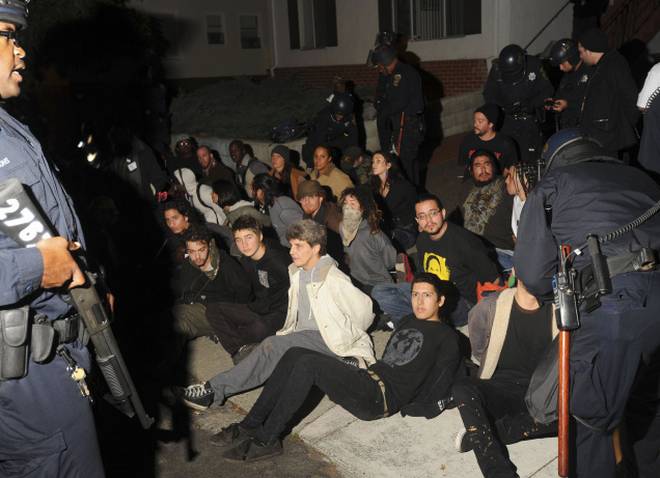
Protesters are arrested in Oakland. Note the giant gun in the officer’s hand on the left. Image from The Hindu.
Paramis, or Paramitas, also called the Ten Perfections, are qualities that dhammic practitioners try to cultivate on the path to enlightenment.
I found myself thinking about the Paramis throughout a long Friday night and Saturday, when I was arrested, along with 152 others, for “unlawful assembly”: marching in the streets of Oakland to protest police violence and impunity. I was held in custody for about 20 hours; some people still haven’t been released. (Please consider donating to legal aid for protester defense.)
A concrete detention cell might seem like a strange setting for reflecting on the attributes leading to Buddhahood. A far cry from the bucolic campuses of well-funded meditation centers. On the other hand, many people have famously developed their spiritual practice while incarcerated, or even while being tortured. I’m not saying that every setting is equally optimal for developing every part of dhammic practice. But once you’ve learned some of the basics in a more controlled, safe environment, it’s interesting to see how they can manifest in non-stereotypical situations.
Generosity (dana)
He straps on a second backpack, belonging to his friend, who doesn’t have papers, to afford more mobility for avoiding arrest.
They trade jokes and soggy jail cookies. They offer room for one another on the concrete benches of the cramped holding cell.
Lawyers work for free to get the protesters out of jail. The work can take months, for folks facing trumped-up charges.
FIRST PRECEPT
Aware of the suffering caused by the destruction of life, I vow to cultivate compassion and learn ways to protect the lives of people, animals, plants, and minerals. I am determined not to kill, not to let others kill, and not to condone any act of killing in the world, in my thinking, and in my way of life.
SECOND PRECEPT
Aware of the suffering caused by exploitation, social injustice, stealing, and oppression, I vow to cultivate loving kindness and learn ways to work for the well-being of people, animals, plants, and minerals. I vow to practice generosity by sharing my time, energy, and material resources with those who are in real need. I am determined not to steal and not to possess anything that should belong to others. I will respect the property of others, but I will prevent others from profiting from human suffering or the suffering of other species on Earth.
Renunciation (nekkhamma)
In jail, they give us plasticized bologna and surprisingly good oranges. Over twelve hours later, they’ve given nothing else. We practice responding to this harm without suffering. We practice fasting. We explore the limits of our basic needs.
In jail, when we ask at 5am how much longer they think we’ll be here, we are told: Ask me how much longer, and I’ll hold you here an extra hour. Ask me again, and I’ll hold you two more hours. We practice responding to this harm without suffering. We practice abiding. We explore the limits of our basic needs.
Knowing the risks, we have nevertheless stood up for what we believe. Some of us are better accustomed to making do in these conditions. All of us are being reminded that we are more than our comforts.
Wisdom (pañña)
This is a complex one. Can we understand the nature of impermanence, egolessness, and unsatisfactoriness of phenomena? Can we respond to the relative world of material harm, while still practicing diligently on our inner liberation from needless suffering?
As the zip-tie handcuffs cut off circulation and my shoulders begin to ache and tingle, I summon my meditation practice, explore the pain, and try my best to observe the present moment with equanimity. After three hours or so, the handcuffs are cut off.
Effort/Strength (viriya)
As we are blocked in by riot police, some with machine guns, on a residential Oakland street, we keep chanting:
WE ARE ALL OSCAR GRANT!
As we are handcuffed and lined up seated on the pavement, we keep chanting:
WE ARE ALL OSCAR GRANT!
As my 20-hour family sits in our women’s holding cell, hour after long hour, we cheer and applaud as each individual is released. The cops try to intimidate us, say they’ll keep us there longer if we keep up the noise. Same for the adjacent women’s cell, where we can hear them yelling. We all keep on celebrating. And together we chant:
WE ARE ALL OSCAR GRANT!
Patience (khanti)
Patience is best when combined with sound strategy. Do I hope to move beyond marches? Yes. Do I want to help grow the movement against police violence, proliferating it in different sectors with the power to disrupt the economy in big ways? Yep. Do I want to simultaneously develop community-based safety systems that are actually accountable, healthy, and responsive to the needs of participants? Hell yes. Will all this take time? You bet. Waiting it out in jail is only one small part of the process.
Truthfulness (sacca)
Bearing witness directly is a wonderful antidote to media spin and misinformation. Contrary to sensationalist reporting, this was not a violent, roaming mob. We were trying to march to the Fruitvale station where Oscar Grant was killed, and menacing riot police hemmed us in at every turn, so we improvised the route. This is not marauding; it is a snake march. Which authorities don’t like very much, because they are not in total control of it.
Again, contrary to reporting, the purpose of our demonstration was not to wreak havoc. The super, super, nearly total majority of people, including every single person I knew, damaged no property. And even those who may have, engaged in no violence that I saw. Property destruction is very different from violence. And even though I don’t support the former in this case, I don’t want it irresponsibly conflated with the latter, the way the mainstream media consistently has in its coverage of the Oscar Grant case.
You know what’s violent? Denying a woman in custody access to her chemotherapy treatment. She was only one of many people I witnessed being denied medical attention — to antidepressants, to necessary medications. And when the woman who was ill from missing her chemo finally got transferred to a cell with a pay phone, called the National Lawyers Guild to tell them what was happening, and half an hour later the cell door rolled open . . . the cops berated her for “costing them a lot of time and money,” and informed her that because of what she’d done, they would delay her release.
Another interesting element around truth: When they had us cornered, just before they arrested us, the police declared a crime scene and instructed everyone from the press to disperse, while still preventing the rest of us (who wanted to go peacefully) from leaving. Nearly all the professional journalists crossed the police line to depart. Kind of chilling, given that the event that catalyzed all this was documentation of an act of police violence against an unresisting, restrained person.
A final truth: From what I saw, and this is only my own personal impression, many of these cops appear to be deeply scarred people. The one who kept me in line on the arrest scene before we boarded the paddy wagons wouldn’t even look me in the eye at first. The internal damage and delusion of a jailer is cyclical: one must already be suffering in order to lock someone up and deny them food or medicine for twelve hours (whether the denial is polite and bureaucratic or spiteful and direct is largely irrelevant). And participating in that process itself produces more delusion, more scarring, more habit patterns.
But though I was initially disappointed at being categorized as an extremist, as I continued to think about the matter I gradually gained a measure of satisfaction from the label. Was not Jesus an extremist for love: “Love your enemies, bless them that curse you, do good to them that hate you, and pray for them which despitefully use you, and persecute you.” . . . Perhaps the South, the nation and the world are in dire need of creative extremists.
Lovingkindness (metta)
Much gratitude to all my fellow detainees who made my time in custody human and even fun.
Much gratitude to all who have offered their support from the outside.
Much gratitude to all those who continue to oppose oppression, even when doing so is unpopular.
May all beings be safe. May no human be trapped in a cage. May no human be psychologically conditioned to harm others in an effort to make themselves feel more powerful and secure. May we abolish prisons and end policing as we know it, replacing them with participatory processes that care for people and treat all living beings with dignity.
May you be safe. May you be happy. May you be free.
[Today, former BART police officer Johannes Mehserle was sentenced to 2 years in prison, with 146 days already served, for the involuntary manslaughter of Oscar Grant. The Grant case marked the first time in California’s history that a peace officer was tried for murder.]
Whereas
We as women, transgender people, two-spirit people, queers, gender-oppressed people, and allies of the Bay Area mourn the loss of Oscar Grant;
Whereas we recognize that this young man was just one of countless victims of police violence;
Whereas we understand and experience police repression, particularly in poor, queer, and working-class communities of color;
Whereas we know that police violence both enables and enacts rape, brutalization, and degradation;
Whereas police violence compounds the dangers we face in domestic violence, sex trafficking, and homophobic and transphobic hate crimes;
Whereas police enforce the criminalization of our disabilities, addictions, and mental illnesses;
Whereas police enforce the criminalization of our skin color, sexualities, style of dress and speech, gender identities, religious practices, and nations of origin;
Whereas police violently enforce our subservience to an economy that enriches elites, while slaughtering, starving, sickening, and stealing from us as workers, child-rearers, and culture creators;
Whereas the rich and influential deploy police to violently crush our efforts toward self-determination, from queer social spaces to workplace strikes;
Whereas the rich and influential deploy police to kill or capture our leaders and heroes, like the recently deceased political prisoner Marilyn Buck;
Whereas police are employed to do as they are ordered;
Whereas police violence comes 10% from individual bigotry and improper training, and 90% from a capitalist state system designed to protect property, not people;
Whereas such a property-focused police system, controlled by the rich and influential, enacts and supports gender-based and sexual violence;
And Whereas such a system can never be adequately reformed, based as it is in the fundamental inequality borne of a patriarchal capitalist system:
We maintain compassion for individual police officers who both experience and inflict suffering; who face and enforce mortal danger.
We vow, in the effort to end sexist violence throughout the world, to eradicate the police system of the United States as we know it; and to transcend the misogynist capitalist system that demands this type of policing.
We undertake this mission with no hatred in our hearts toward individual police officers or those who support the police system.
We accept this responsibility out of love for all people, and the unquenchable desire for universal freedom and equality.
In the service of this calling, we will sing, strike, fuck, fight, rest, write, rebel, and rebuild until we achieve liberation for all beings.




 Kloncke