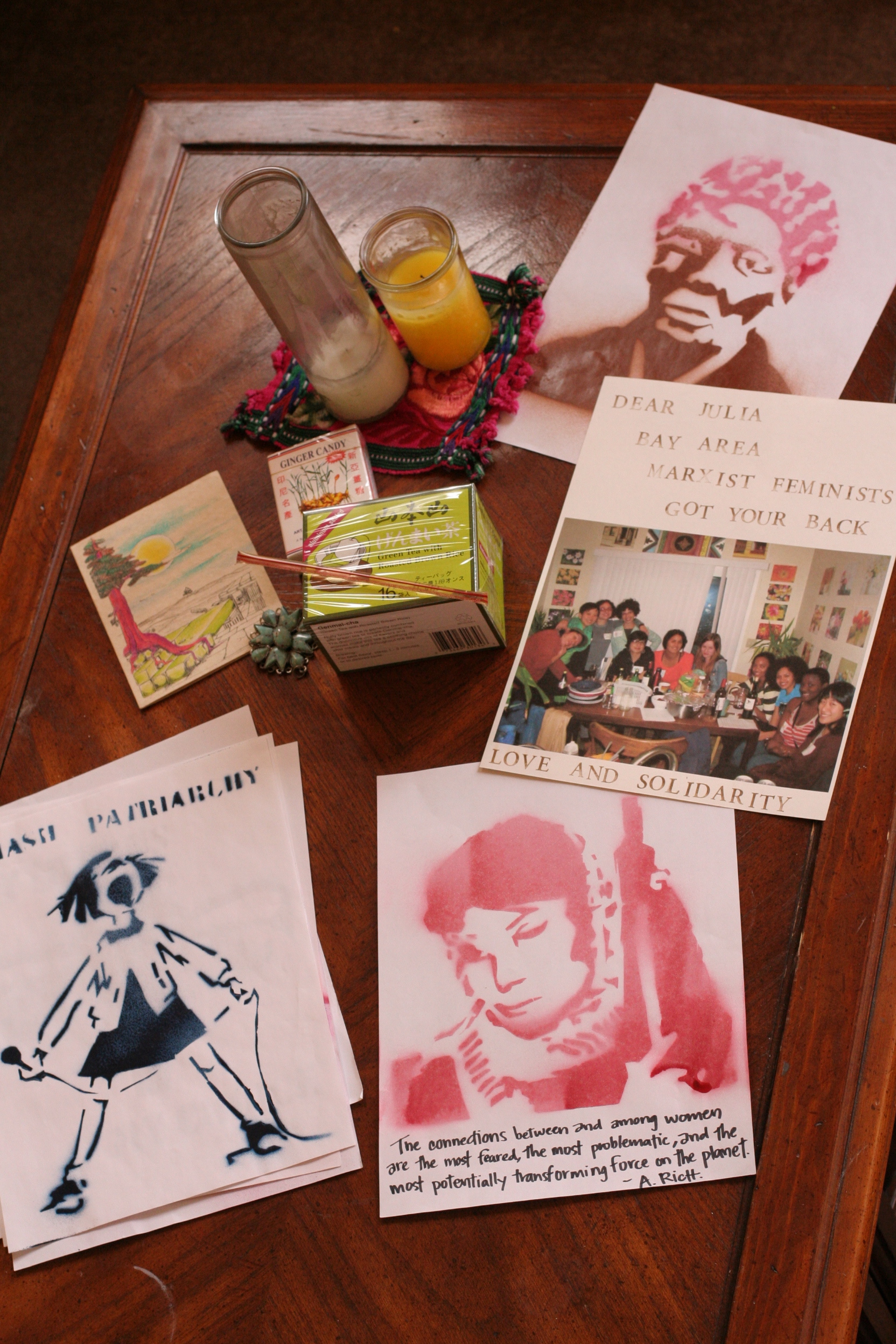
Last week, our Marxist Feminist study group assembled some offerings for a care package. A comrade of ours in LA (close friend to some, known through her work to others) has been going through a difficult time lately, and we wanted to send a small token of appreciation for her strength, amazing organizing work, and general fabulousness.
Handmade stencils, a card, a poem, ginger candy, green tea with a honey stick, a necklace pendant, and a hand-stamped group photo from our inter-state Marxist Feminist gathering a few months back. The finishing touch will be a batch of cookies I’ll bake up tomorrow.
Say what you will about Saul Alinsky: the man organized some creative actions. I’ll never forget one example of his (I think he described it in Rules For Radicals) where the community cooked and ate a huge baked-bean dinner, then packed an orchestra hall owned by the “enemy,” and let loose with their own smelly music.
This weekend’s East Bay Solidarity Network action wasn’t quite so dramatic, but I did feel a resonance with Alinsky’s tactical virtuosity. We knew why we were there, who the target was, what we wanted to accomplish, and how it fits in to the larger strategy of the fight. And we even saw encouraging results during the action itself.
My own personal ruminations revolve (unsurprisingly) around whether and where there is room for compassion within direct actions that make a target uncomfortable — or “harm” them (major scare-quotes) economically. Actions that tend (especially in a masculinist context) to dramatize and promote an ‘us versus them’ framework. I’ll be contemplating this question much more over the next couple of months, but for now I’ll just say this. I believe it’s possible to speak and act very forcefully against a perpetrator (I’m experimenting with saying “perpetrator,” rather than “enemy,” to guard against the typically dehumanizing crystallization of enemyism, and to invoke the work of radical anti-sexual-violence communities that seek to transform both behaviors and systems) while still maintaining compassion for them. It’s something I’m experimenting with myself, in this EBSol work.
With that said, I’m just gonna go ‘head and cross-post the whole entry on today’s action from our brand-spankin’-new website. Hope you enjoy!
Making Good On Our Promises
Monday EBSol flyering squad (Sunday team not pictured)
In our demand letter that we delivered to Alpha Omicron Pi sorority two weeks ago, we promised to return in 14 days if our reasonable demands were not met. True to our word, yesterday and today we continued our campaign to win former “house boy” employee and tenant William fair compensation for his shady firing and the outrageous eviction that left him homeless.
For our second action, both yesterday and today, we flyered and door-knocked the surrounding blocks to inform the whole neighborhood of the egregious injustice. We don’t know what was more encouraging: the enthusiasm from neighborhood co-op members (some even offered their contact info and asked to be notified of future actions), or the surprise and horror of the sorority managers when they realized what our posters were airing.
Less than 24 hours after our Sunday flyering session, taped shreds of paper — remnants of our flyers — testified to the sorority managers’ embarrassment. Before we had even left the block, they were already tearing down our work from the street signs and telephone poles. But today we were back for another round! They won’t get rid of us easily.
The bosses are already on the defensive, and this fight is just getting started. If you want to join us as we ramp things up with escalating actions, email or call us to make sure you’re on our contact list!
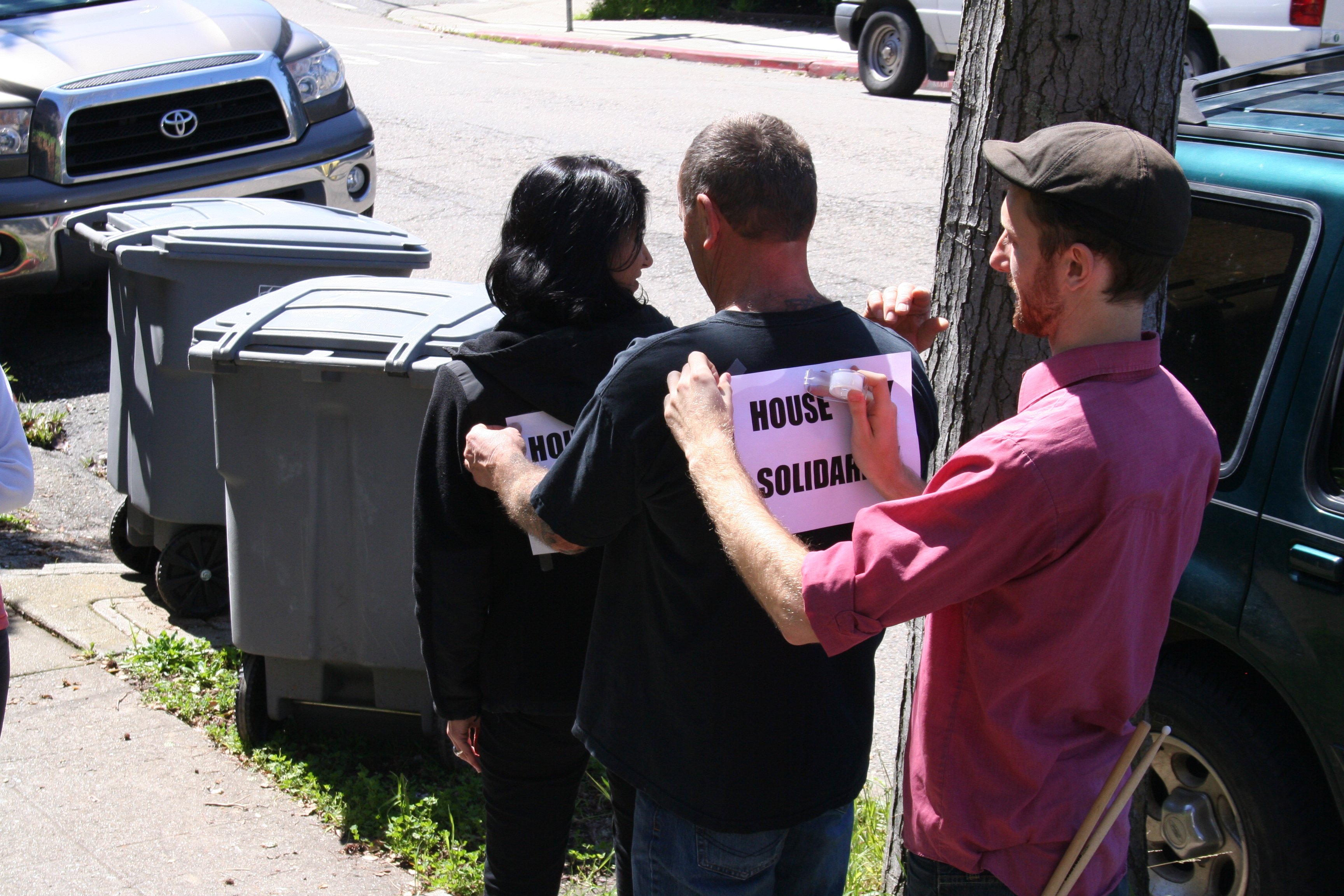
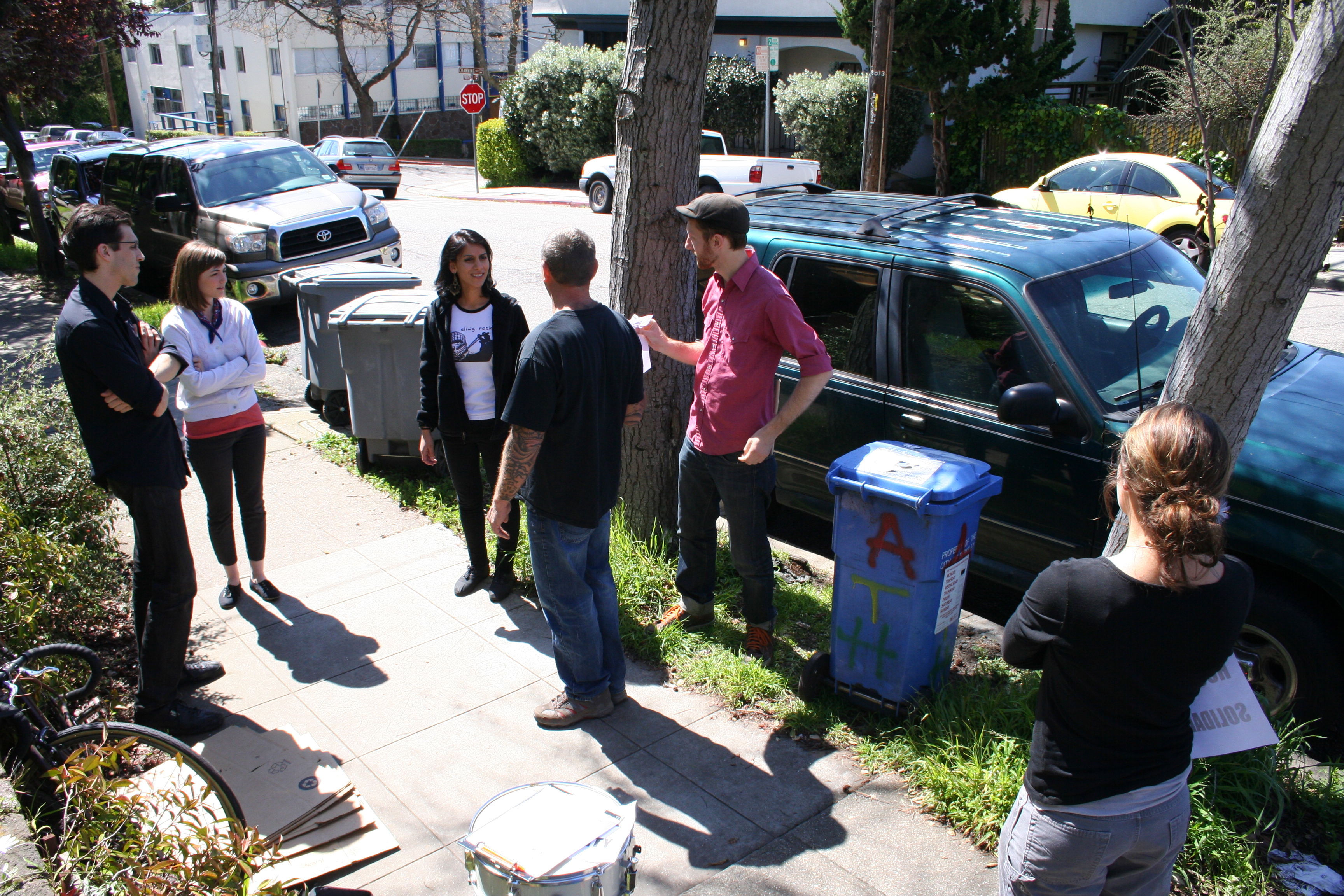
At 12:24pm today, after a sunny Berkeley bike ride, Mackenzie and I were the first ones to arrive at the designated decoy meet-up location, just down the block from the actual target. We taped up a sign that read: HOUSE BOY SOLIDARITY. Slowly, people began to trickle in. Many knew each other through other political work, greeting each other with big smiles and hugs, and “long-time-no-see’s.” By 12:50, everyone knew the plan, the choreography, and the goal. The ten of us headed toward the Alpha Omicron Pi sorority house, one leading our chant on the bullhorn: AIN’T NO POWER LIKE THE POWER OF THE PEOPLE ‘CAUSE THE POWER OF THE PEOPLE DON’T STOP!!!
Thus began our first action as the East Bay Solidarity Network (EBSol).
William had been working and living at UC Berkeley’s Alpha Omicron Pi as a “house boy”: a common term used to refer to live-in cooks who help prepare meals for Cal sororities. He was still receiving training, and had had no serious reprimands or complaints about his performance. On the contrary, he often received a “Good work” and a fist pound from the other, senior cook at the end of the shift. All that changed when they fired the dishwasher and made William and the others pick up the extra work. Without extra pay.
After weeks of working extra hours to cover the undone job, and clearly seeing how exploitative this was, William demanded that his manager hire another dishwasher. They did not; but not long afterward, he was called in for another meeting. He was told that he was being fired for unsanitary work practices (again, having never been seriously reprimanded or warned about any such failures), and that he had three days to move out of his lodgings in the basement of the sorority.
Until now, the sorority management had been dealing with one lone, vulnerable worker: easy to exploit, oppress, fire for causing trouble, illegally evict, and all that sort of typical thing. But today, William wasn’t a lone worker. He was a part of the solidarity network, and he was joined by his fellow members.
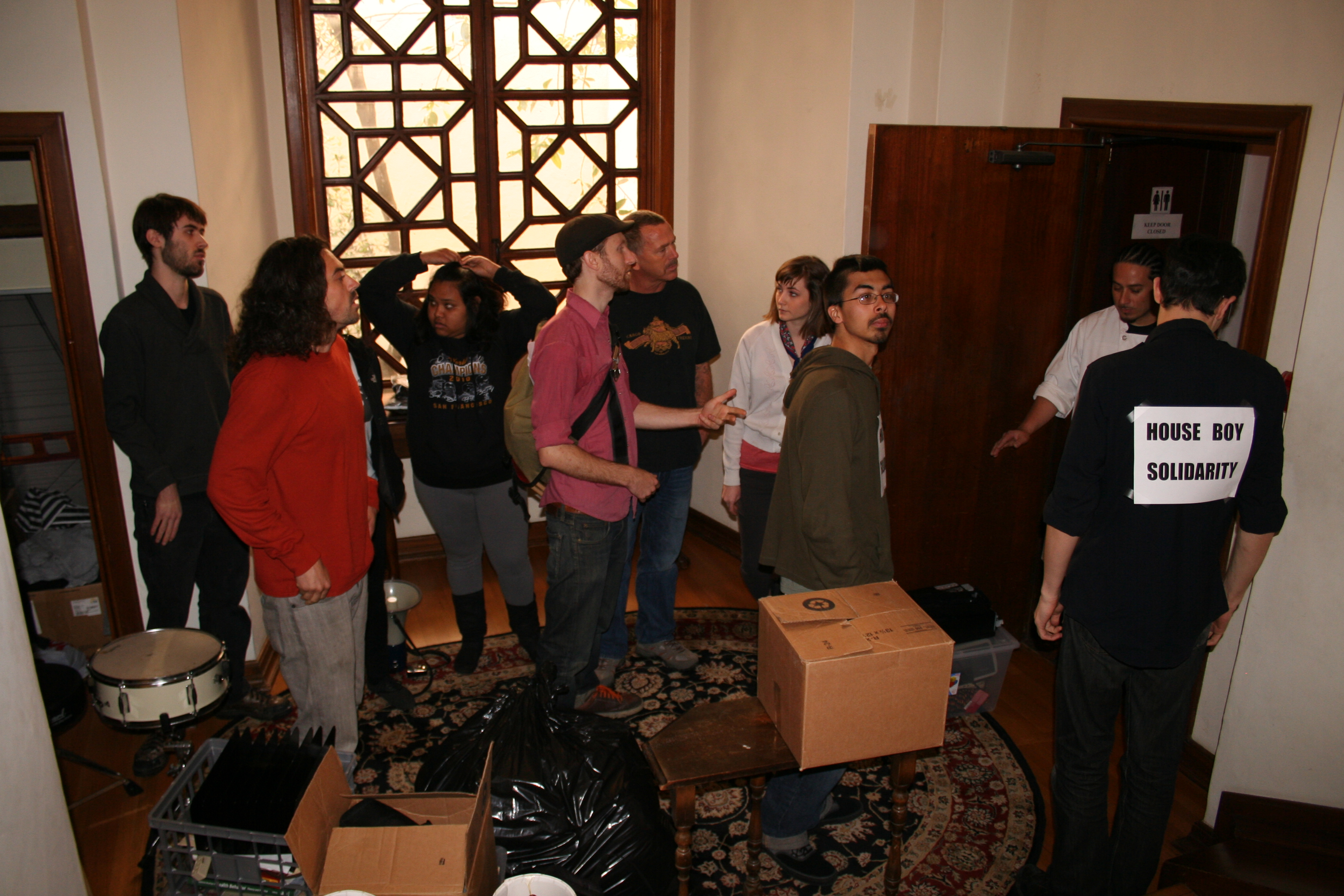
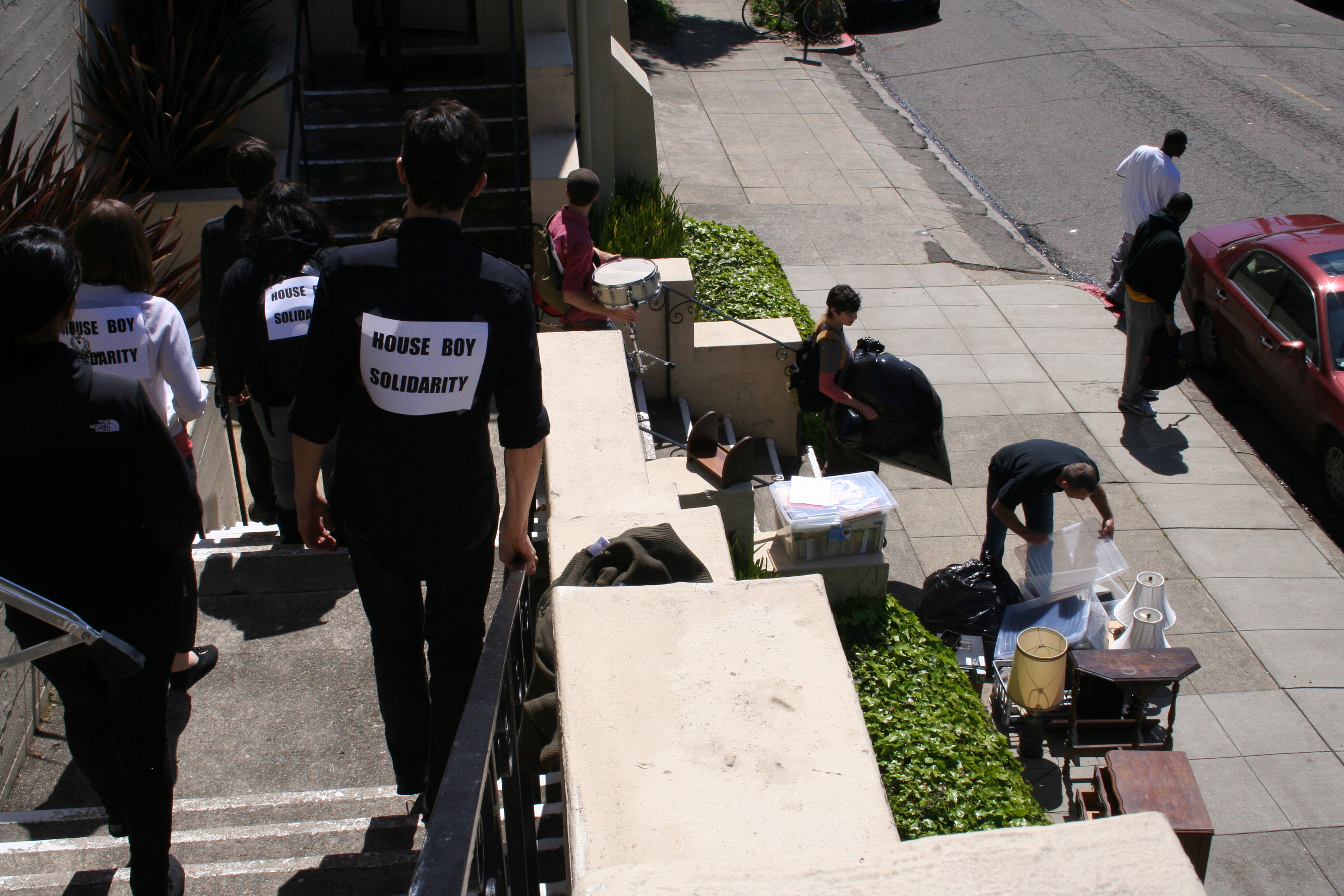
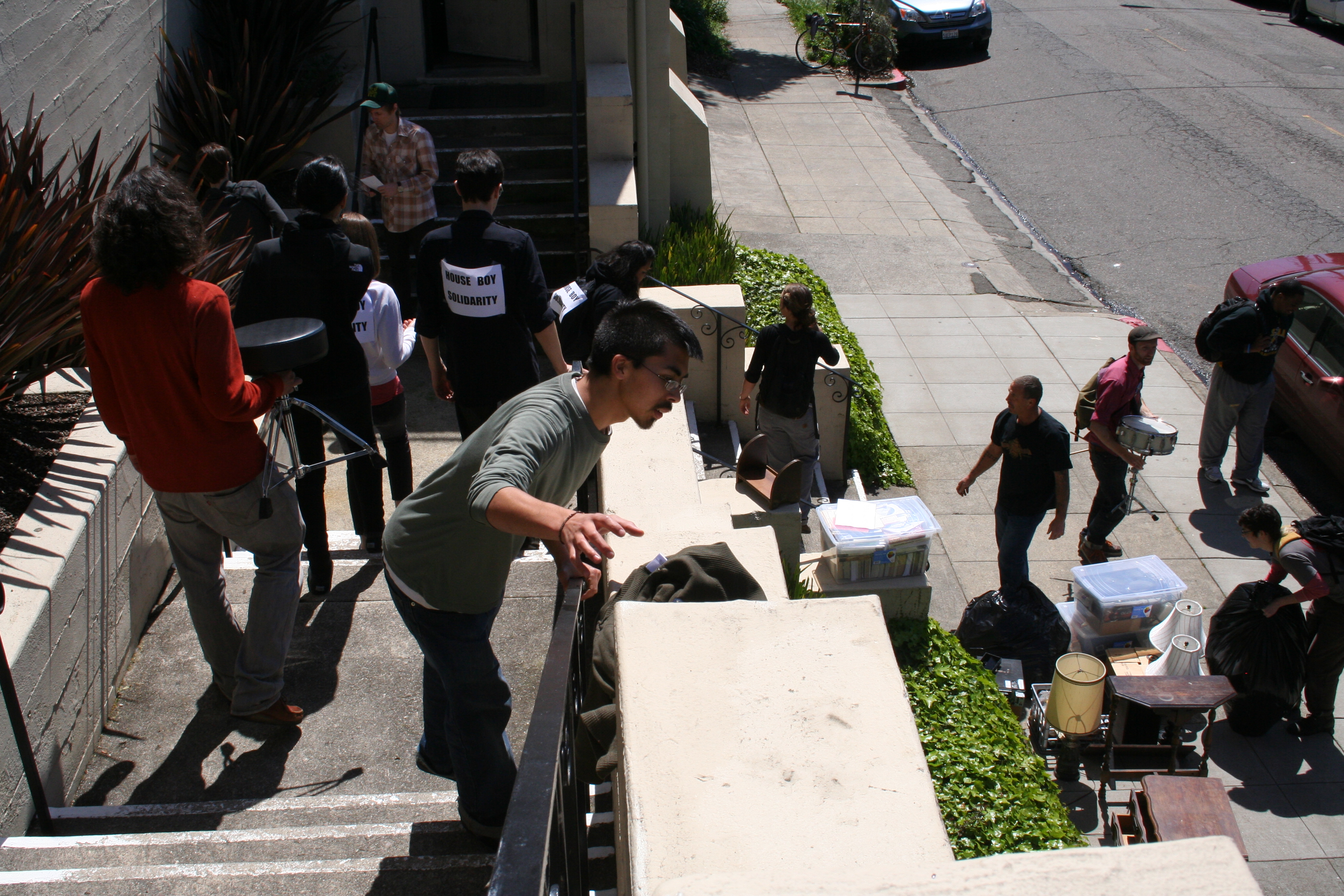
Together, we brought his earthly belongings up from the basement (where they had been packed up without his consent and stored in the boiler room, to make space for the new “house boy”) and, after a brief back-and-forth with his back-stabbing co-worker, took up our formation on the front staircase and passed each item, bucket-brigade-style, down the line. (Wish I had pictures of the bucket brigade, but it’s hard to be photographer and participant at the same time!) Meanwhile, Ryan played a militant march on his snare drum. We had discipline, choreography, and musical flair, man. Doubtless we left an impression.
Now that the managers had been made distinctly aware of our collective presence, William delivered to them the official EBSol letter, specifying our reasonable demands of the sorority managers, and letting them know that if our demands are not met within 14 days, we, as a group, will take action against them.
When all his stuff was piled on the sidewalk, William took the bullhorn and told his whole story to an explicit crowd (our group, now 13 total with some late arrivals) and an implicit crowd (the sorority girls, peeping wide-eyed in bunches through the upper-floor windows; and the managers and staff on site). A manager from a nearby sorority, an in-law of one of William’s former managers, came storming over and tried to shut him down — grabbed at his bullhorn, and threatened to call the cops on all of us for trespassing in a “private home.” We pointed out that it was not only a home, but a workplace, and William kept shouting out the gory details of how they screwed him over.
With his passion, his technology, and the cheering response of the rest of us in the solidarity group, William (and we) easily drowned out the flustered and angry stand-in-boss, creating quite a spectacle for the women watching from the windows. (Whom William was quick to remind that it’s the boss we’re fighting, not the sisters.) For a while the managers even withheld William’s last check, trying to force us all to stay til the cops came in response to the bogus trespassing call, but soon enough they relented and handed over his payment. We loaded his belongings into cars, and left happy.
There are a million reasons I’m excited about how today’s action went. For one, it feels great to take up the case of a domestic worker, whose labor is so completely invisibilized and underpaid most of the time. Second, enthusiasm in the group was really high, partly because everyone was in a fighting mood, partly because a lot of us are friends, and also because this was not a symbolic action: it had both the moral high ground and specific objectives to accomplish (dramatize the moveout with disciplined formations; deliver the demand letter promising more action to come). Also, I think, we all felt inspired to see William stand up to his bosses (or their stand-ins), express his anger at being exploited, and be emboldened by the real mechanism of our group. It made me feel, at least, that if I’m ever getting screwed by my landlord or a boss, and I don’t have a fighting union to help me, then I sure as hell want a solidarity network like this! There’s a lot to be learned just by being there to help other people’s fights.
As with any tactic, this one had its inherent limitations; and there were moments of confusion and things we could have done better. This week, the five of us who planned the action (William included) will get together to debrief and reflect on how to improve. But overall, I think we really pulled off something fine today, and I think everyone who participated felt it was deeply worthwhile. Now, the campaign has begun — more updates to come in 14 days….unless our victory comes sooner!
On a final note, speaking for my own self, there are a lot of messy, fruitful dhamma questions coming up for me as a result of this EBSol organizing. Is there room for an adversarial organizing premise like that of a solidarity network — united against corrupt bosses and landlords — within the concept of nonviolent, kind, wise boddhisattva action? I’ve never really heard anything like that, myself. Usually Buddhist activists point to the universal lovingkindness of a Martin Luther King, who seemed to be able to embrace his adversaries even as he disobeyed their rules and laws. SeaSol — The Seattle Solidarity Network, from whence our model comes — makes no such embrace across the class line. Yet, their actions are nonviolent and strategic. So to me, it seems there’s more overlap than not. What’s your take? How does the solidarity network idea sound to you? Share your wisdom — or better yet, join us for our next action, and then tell me what you think. ;)
Still sick as a dog, folks, so I’m letting Bessie take over for me today. Found this gem through the James Baldwin essay I mentioned Wednesday. Just amazing. I love the way she draws out her first “You can’t trust Noooooooo-body/ You might as well be alone.”
LONG OLD ROAD

Bessie Smith   1931
Bessie Smith   rec June 11th 1931 New York

It's a long old road, but I'm gonna find the end,
It's a long old road, but I'm gonna find the end,
And when I get there, I'm gonna shake hands with a friend.

On the side of the road,I sat underneath a tree,
On the side of the road,I sat underneath a tree,
Nobody knows a thought that came over me.

Weepin' and cryin', tears fallin'on the ground,
Weepin' and cryin', tears fallin'on the ground,
When I got to the end, I was so worried down.

Picked up my bag, baby, and I tried again,
Picked up my bag, baby, and I tried again,
I got to make it, I've got to find the end!

You can't trust nobody, you might as well be alone,
You can't trust nobody, you might as well be alone,
Found my long lost friend, and I might as well stayed at home!

[Lyrics from lyricsplayground.com]

(Contributed by Peter Akers - May 2009)
Speaking of the blues, in a way: have you ever had a very hideous umbrella? Not as a backup in the closet but I mean like your main public umbrella. Currently I’m saddled with one. i can imagine equally ugly models, but none uglier. it’s large and striped like a circus tent, yellow and white. the yellow isn’t a pretty saffron or gold, but like this really awful chemical lemon-drop yellow. the fabric is also torn off the spokes in one or two places. anyway, the reason i bring this up is that thursday morning i had a revelation about my very hideous public umbrella. before now, the two qualities counting in its favor were (a) that it was free, and a gift from my dad: i think he gave it to me one day when i was unprotected; and (b) that it is big: i think it was originally a golf umbrella, possibly one of the freebies they give you at the end of a swanky tournament (but not too swanky, i guess, since this one doesn’t have any sort of country club logo printed on it).
Random ugly umbrella on flickr; mine not shown. Would you be able to lose this? Didn't think so.
yesterday, however, i realized that the ugliness itself is also an advantage. because, like so many of us, i’ve lost uncountable umbrellas in my lifetime. uncountable. small, shitty ones; big, precious ones. but this guy i’ve hung onto longer than usual. why? precisely because i’m embarrassed about its hideousness. wherever i go, when i set my huge, janky, chemical lemon-drop umbrella on the floor, i remain mildly self-conscious about it the whole time. so i never forget to bring it with me when i leave.
has the Hideous Umbrella CurseBlessing ever happened to you? what do you think of my theory?
———————————————
***************************
———————————————
Finally, I leave you on an exciting note about fresh news to come on Monday: I’ll be reporting back from the first action of the new East Bay Solidarity Network that I helped to start up with four friends. We’re taking on a case of a comrade of ours who was unscrupulously fired from his live-in job, and summarily kicked out into homelessness. Next week, the fightback begins! I can’t share more details now because the action has to be a secret reveal, but I am suuuuper pumped about getting this production rolling. Already the organizing feels so solid and healthy with this quality team, based on the excellent, proven “recipe” for solidarity networks that comes out of the Seattle Solidarity Network, or SeaSol. It’s compassionate action with people power to back it up. I’m about to learn a TON through this project, and can’t wait to share it with y’all as it unfolds.
SeaSol logo, links to nifty web site
One note: since EBSol needs to get some more groundwork in place before our grand opening in mid-April, we’re not yet having open invitations to meetings or actions. But we will in a couple of weeks! So if you’re in the East Bay and want to help neighbors win stuggles against bosses and landlords, definitely hit me up and we’ll get you into our contact list!
love, solidarity, and no hugs for the moment due to unending nasal drippery,
I guess it is a great blessing that being sick makes a person seem grimy and messy — hacking, sneezing, all glassy-eyed, sweaty, and weak — because if it made us more beautiful, radiant, and appealing, then lots of people would flock to us and be consequently infected.
So here I am, nice and off-putting with my wet cough, taking the opportunity to read. I even get to read aloud to myself. The James Baldwin was great for that, as was the first response letter from my faculty adviser at Goddard. (She’s a poet, and shows it in her prose.)
So here are some of the highlights of what I’ve been up to, text-wise.
Similarly catching up with Maia Duerr’s thoughts, and skillful curating of other people’s thoughts, on socially engaged Buddhism over at The Jizo Chronicles
Getting down with the fabulous blog of a friend in Seattle — thorough, meaty posts on feminism and revolutionary organizing — from their perspective as a political organizer and exploited (to be redundant) Certified Nursing Assistant (CNA). Especially loved this post, and this page.
Falling in love with James Baldwin all over again through his 1964 essay Nothing Personal, recommended to me by my adviser. I don’t agree with him on everything, but damn he’s not afraid to get deep with it.
Following updates on the Berkeley steel mill strike that started yesterday, when nearly 500 workers formed a hard picket line at Pacific Steel Casting to demand the reversal of company decisions that would force workers to cover their own health care costs. Sounds like they want reinforcements down there, so if anyone reading is in the area and less ill than I am, think about heading down there to support!
Ok, friends, time for a glass of water and another nap. Hope your Wednesday’s goin well.
This question’s been yelling itself in my face for the past couple of days. (Weeks?) Not only in theoretical terms, but in practical ways. Touched on by elders, peers, friends, strangers.
Roughly (and this is my own attempt, for which I’ll accept blame but not credit):
Some groups are great at building and exemplifying models of anti-oppressive ways of being. (Pre-figurative politics, as I understand it, means practicing now the kind of society you want to build in the future.) Enacting horizontal group dynamics, confronting white supremacist and racist behavior, challenging and transforming sexism, homophobia, transphobia, fatphobia, ableism, etc. in myriad ways, and continually developing sophisticated, intersectional analyses of these lived oppressions. Honoring and valuing healing; promoting literacy around dealing with trauma and mental wellness. Developing healthy sex-positive cultures grounded in consent. Practicing conscientious methods for dealing with intimate violence and abuse. Giving and receiving criticism with humility, generosity, bravery, and kindness. Doing very practical things like organizing childcare collectives, artmaking groups, and food distribution programs; infusing them with liberatory values. Transforming estranged relationship with our bodies, the earth, and nature. Theorizing these and more practices, and sharing them.
At the same time, some groups are great at developing people’s revolutionary class consciousness. Examining the material processes of history with an eye toward figuring out the best ways to intervene in those historical processes, and change things for the better. Get rid of classes altogether. Put an end to imperialism. Employ practice and theory, in current conditions, to avoid the pitfall of reformism and move militantly and decisively toward a world of “freely associating producers” — a world where violent compulsion is no longer ambient, as it is under capitalism and has been under all forms of class society (to stake a claim against what I learned about Foucault, in college). I’m impressed and inspired by groups that maintain a keen focus on this goal, and whose work reflects the urgency of building the class power necessary for exploited people to liberate themselves/ourselves from the yoke (and rod) of capital.
Now. Is there overlap between these ‘types’ of groups?
Yes.
A lot?
In the Bay Area? In the US?
IIIIIIII dunno. What do you think? What are you finding?
Hey friends — sorry for such a late post today! It’s been a whirlwind. Morning tea with a dharma/movement kindred spirit (a revival of Radical Sangha is in the works!); a super-intense two-and-a-half-hour group session with a generative somatics facilitator/counselor/consultant/rad person at the Faithful Fools; being interviewed by someone who’s making a video documentary about the Fools; and now off to prep some work with the Marxist feminist group in honor of International Women’s Day tomorrow.
Life: it’s full sometimes! And I was in a similar gear last Friday when, among other things, I showed up to join a crew of about 20 supporters of a rank-and-file picket of health care workers (above) who were illegally fired for going on strike. More on their inspiring (and victorious!) battle, including videos of Friday’s picket, here. Then, most of us supporters rolled out to a downtown Oakland rally against the gang injunctions. Here are some photos of each; sorry for the lack of commentary, but hopefully tomorrow I’ll have time to add a little more.
Back at Harvard, I learned two twin currencies for liberal political engagement: prestige and critique. In order to make the most important, sophisticated contribution to your community, you should try to do one or the other. (Or, in my case, kind of switch back and forth between them.)
Prestige meant planning events with lots of endorsements by student and Real World groups; generating lots of publicity (including Real World media, if possible); and generally capitalizing on linkages with nodes of power, with the aim of Getting Big Things Done.
Critique meant showing up to a prestigious event and eviscerating it with progressive analysis. Pointing out that it reifies X Y and Z oppressive dynamic, invizibilizes A B and C communities, and generally fortifies neoliberalism and hierarchies of privilege.
Something like that. Now, I’m not saying that other approaches didn’t exist at Harvard (Harvard Progressive Action Group was probably doing things at least a little differently; and same for the Student-Labor Action Movement), but these were the ones that most affected me, in my thinky liberal way of moving through the world.
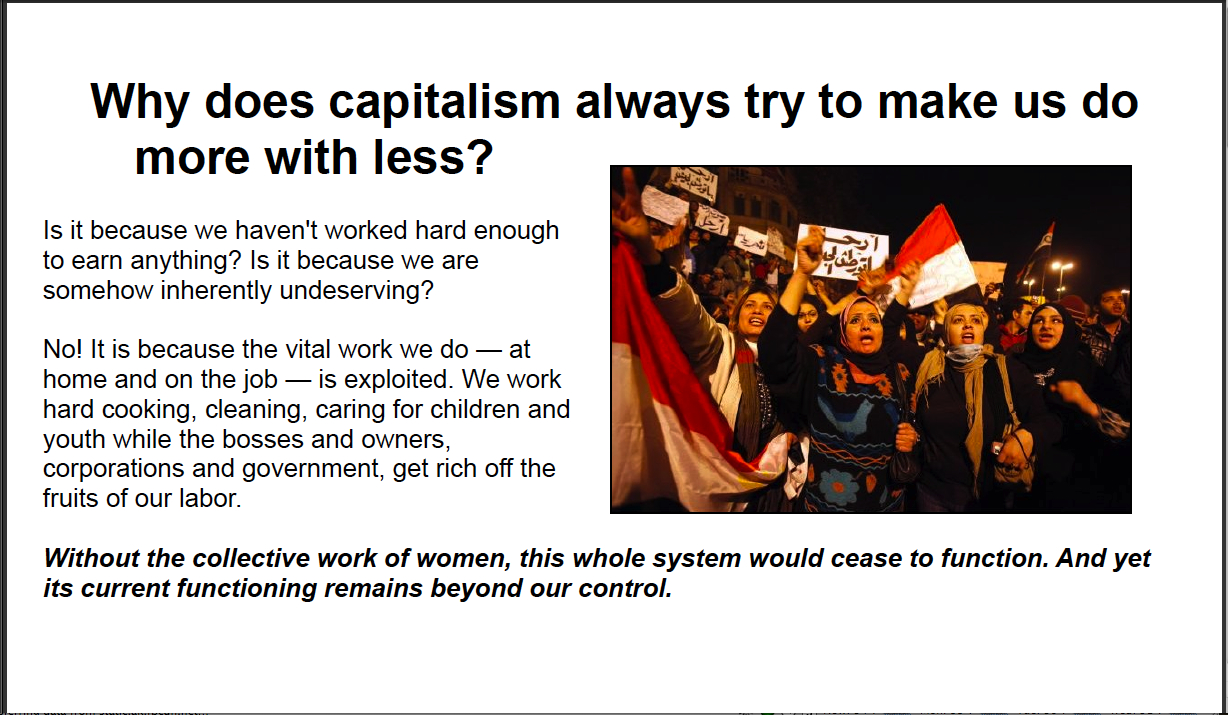
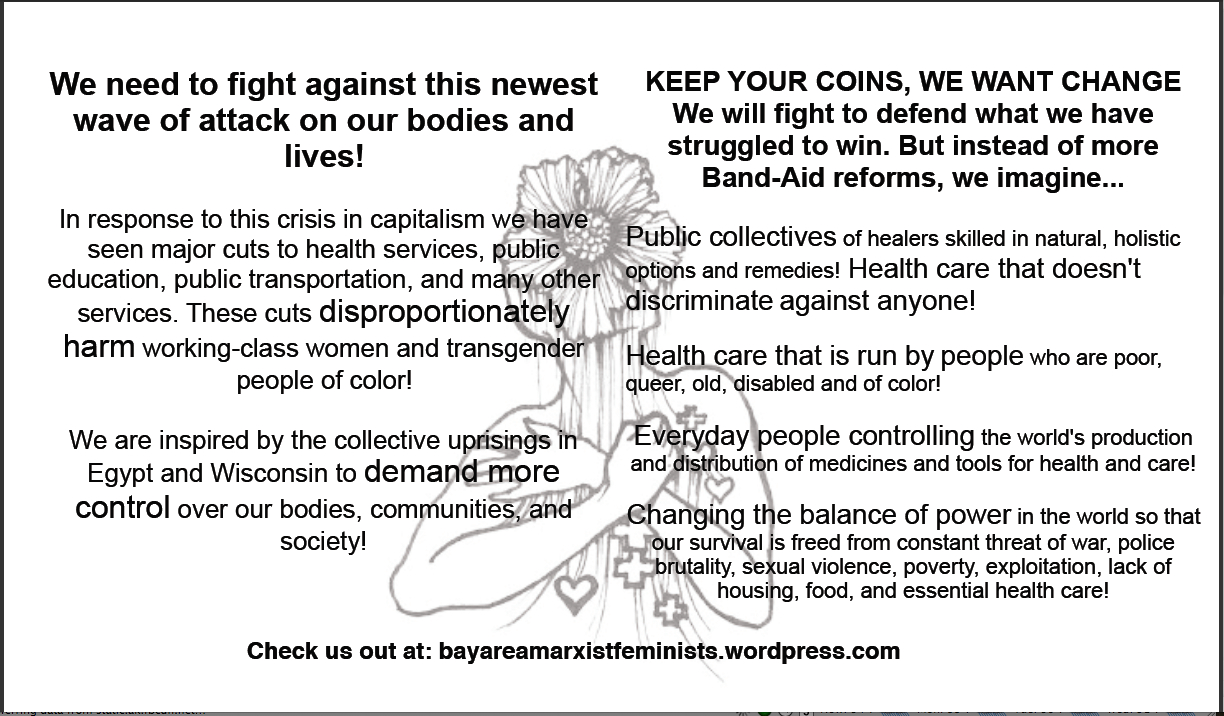
And so, yesterday, when six of us from the Marxist-Feminist study group arrived at a Bay Area Pro-Choice march armed with flyers that we had each played a part in creating, I thought to myself, This is a good offering. We chanted, we participated, we were a part of what was happening, and I felt tremendously grateful to all the people who have fought before us for the right to legal abortions. Some of the signs people carried gave me chills: “ABORTION ON DEMAND, WITHOUT APOLOGY”; “Rape Survivor For Choice [because I didn’t have one]”; and of course, the iconic coat hanger. At the rally, women shared personal stories about terminating their pregnancies, making real and visible the object of our shared struggle. No doubt, there was bravery here. This was something we wanted to support.
We were not, however, blind to the limitations of the event. A narrow focus on defending abortion rights completely overlooked the ways that austerity measures here in California are generally pummeling working-class people’s access to sexual health care. This myopia has long been a problem of largely white, middle-class reproductive rights movements. Surveying the crowd and listening to the speeches, I felt a little pessimistic about how our half-sheets would go over, fingering capitalism as a major part of women’s oppression and choicelessness.
But instead of standing on the sidelines hating (read: critiquing), we engaged. When the organizers opened up the stage for anyone to take the bullhorn, two of us got up and articulated our comparatively broader analysis. And the crowd was feelin it!
After that, flyering was easier and less awkward. People came to us.
Yesterday morning, the street in our neighborhood where organizing saved a woman's house
What a week, folks. A week that included:
Going to a reading discussion about the League of Revolutionary Black Workers (the subject of Detroit: I Do Mind Dying), attended by two former League members (one of whom worked thirty years on an auto assembly line…..DAMN), still fiery and utterly inspiring
Flyer from a similar LRBW event
Huffing, puffing, and grinning up Berkeley hills on my gorgeous new bike
Feeling grateful for warm, dry, cozy home-shelter from the winter rain
Showing up with Ryan at a 6am anti-eviction action, a few blocks from our apartment, to find out that it had already won: once the media started contacting Wells Fargo for comment, they backed down (for now) from taking away this woman’s home
That’s it for me, folks. Hope your week was filled with ups, as well as downs — but most of all, spaciousness enough for both. See you Monday!
I don’t remember who exactly — though I have a hunch it was Joseph Goldstein — who said, at a dharma talk I went to once at CIMC, that much of dukkha (the Buddhist word for “suffering” — the basis of the First Noble Truth) is not this dramatic, cataclysmic affair. Instead, the majority of dukkha is like rubbing your face softly against a brick wall. Doesn’t really hurt. But the problem is, we don’t stop. We keep on rubbing . . . and rubbing . . . and rubbing. Ouch.
I think a similar insight finds its expression in those two unforgettable lines of the poem I shared here last year, by Nyoshul Khenpo:
Those with dualistic perception regard suffering as happiness,
Like they who lick the honey from a razor’s edge.
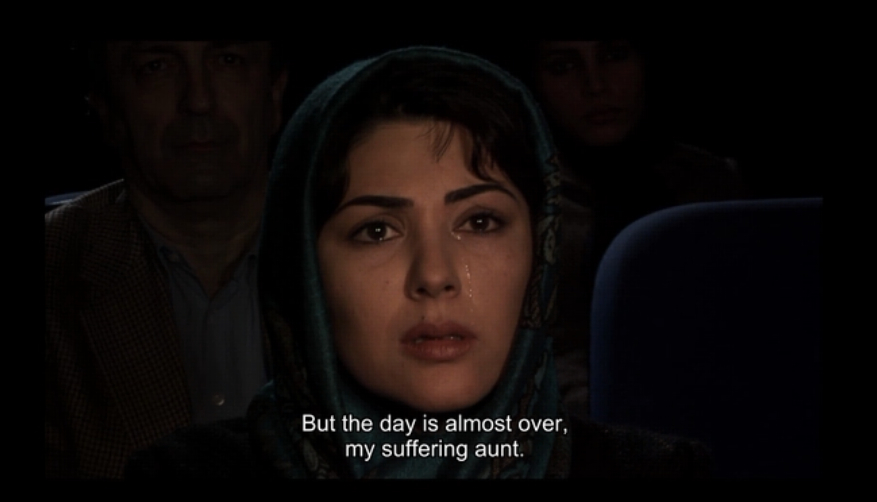
And yesterday, this dharma found its way to me yet again, in the form of an Iranian movie. Celebrated filmmaker Abbas Kiarostami created this work, Shirin, by filming the faces of over 100 Iranian stage and screen actresses as they themselves watch a film of an 800-year-old Persian epic love poem: the story of Shirin and Khosrow. Shirin is an hour and thirty minutes of framed face shots, inviting us to meditate on subtle and dramatic changes of expression as the women become emotionally involved with the story. The film also invokes self-consciousness about our own being and emotional vicariousness: spectators spectating other spectators.
For me, the arresting part in the epic poem (which is both audible and subtitled in Kiarostami’s film) was this, from a scene where a dying queen shares her final words with her heiress, Shirin:
AUNT: “I had my blossoming spring, I grew old at fall. Now I welcome the winter and the snow that will cover my grave.”
SHIRIN—”Haven’t I suffered enough? My heart can’t afford to be broken again, or my body to be abandoned.”
AUNT: “It took me a long time on this earth to understand that the joys of life are like the caress of a feather on the palm of your hand. Pleasurable at first, and a real torment if it perdures. I leave this earth to people who deserve a better life.”
(Visuals show women’s faces, teary and crying.)
The feathers tickling our palms are not emotions themselves. Rather, they are the self-generated process of reacting blindly to those emotions: embracing pleasant ones and running from unpleasant ones. We blindly, habitually react in countless small ways like this every day, allowing transient moods and the vicissitudes of experience — pain, pleasure, neutrality — to dictate our internal well-being.
Part of what I love about Kiarostami’s film, though, is that it allows us to step back from our emotional entanglements and watch them play out externally, on a stream of other faces. It’s like ninety minutes of looking in a mirror, and watching the flow of feeling pass by, unhindered. We don’t get to know any one woman long enough to get caught up in her story. It’s simply beautiful to greet her for a moment, welcoming her into a growing rosary of all the audience members. I’m reminded that I myself am, in some ways, a rosary of many faces: always changing, counted one by one. This allows me to relax. It’s the same comfort I feel when I look out the window on a long train or bus ride. The scenery is flowing by so quickly that there’s no time to fixate on it; and so I let go and simply watch. Give the feather — and the brick wall — a rest.








 Kloncke