My Day Off With Jan Willis

It’s been a lovely Wednesday.  Bánh mì sandwiches and reading in Golden Gate Park with Ryan; trees and sun and tea and vegan coffee-whiskey-fudge gelato.  Plus, I finished Jan Willis’ memoir, Dreaming Me (wisely re-subtitled, I think, in a later version: Black, Baptist And Buddhist — One Woman’s Spiritual Journey).

It’s well past my grandmotherly bedtime and I’m too tired to get into the autobio too much, but I will say it spoke to me, and I enjoyed it.  Raised in the 1950’s in a Klan-rife Alabama town, Willis attended Cornell as one of the first waves of black Ivy League students. (She and my dad, apparently, likely rubbed shoulders during the Straight Takeover  — in which an armed Black Students Association occupied the student union in the spring of ’69, protesting a local cross burning and demanding an Africana Studies department.) After graduating, she faced a soul-rattling decision between joining the Black Panther Party (the obligation, she believed, of “any thinking black person” in the U.S. at the time) or traveling to Nepal to study Buddhism.  Gotta love choices like that.

One of my favorite passages:

Of course, the next day things would return to normal and I’d find myself again in a divided camp, with whites on one side and blacks on the other.  This spiritual connection with all things did not erase the racism of the everyday world I inhabited.

Yup.  And:

Talking with the Dalai Lama brought this truth home again.  Buddhism was a process; one did not need to delude oneself or pretend to be other than oneself, and one did not have to become completely passive in order to embrace the notion of peace.  Choosing peace did not mean rolling over and becoming a doormat.  Pacifism did not mean passivism.  Still, patience and clarity were essential.

And finally:

[Baptists] knew that misery and joy can stand side by side.  Indeed, it is this very knowledge that black people call “the blues.”

The teachings, at least as interpreted by these African-Americans, were about overcoming suffering, about patience, strength, and the cultivation of true love.  And they were delivered with compassion.

Amen.

Spiritual Realism

Having used the literary concept of “magical realism” on a few occasions to describe my experience at Goddard, I’ve lately begun exploring an idea of “spiritual realism.”  It’s a phrase that speaks to many of my experiences in the last two years, and to my spiritual philosophy in general.  I’m interested in the spirituality of everyday life, in the most mundane places — ugly, resplendent, boring, and everything in between.  I’m especially drawn to spiritual practices that address the suffering inherent in social oppression.  That’s why I practice Vipassana meditation at donation-based centers; that’s why I sit with a sangha led by and for people of color and queer folks (also on a donation basis); that’s why I live and work with the Faithful Fools, a street ministry in the Tenderloin of San Francisco.

Spiritual realism is the antidote, the flip-side, to the “spiritual materialism” against which Chögyam Trungpa Rinpoche warns us.

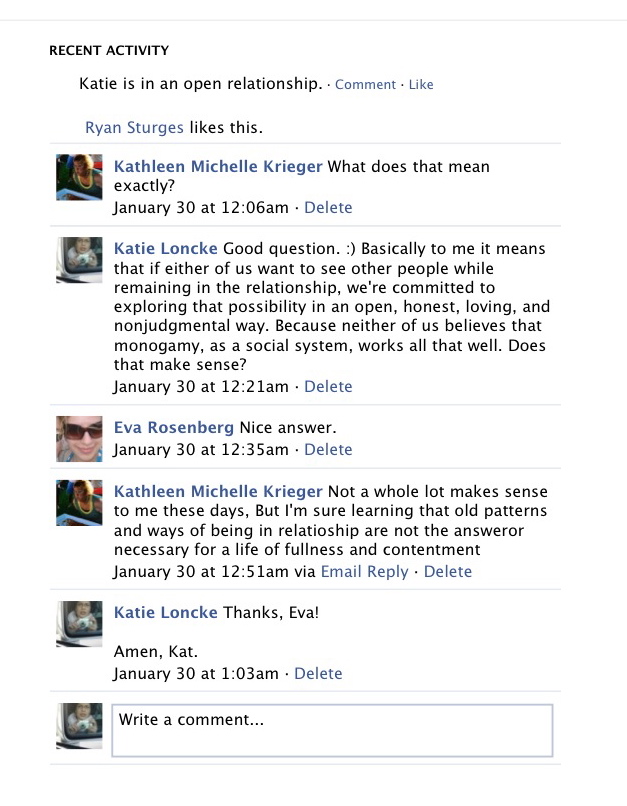
I’ve got a lot of thoughts on it, but for now I want to share one of its proximate inspirations, left as a gift on my Facebook wall.  Too good not to pass along: especially, I think, for those of us working for justice in some way.  The goals can seem so urgent that it’s easy to overlook the larger realities — the importance of process.  Thanks for the reminder, bk!

The Trans/Woman (Blogger) Question

At right is the cover of a book recently compiled by my Uncle John: a collection of the letters, writings, and photos of his godmother, Nellie Briscoe Perry.  His introduction to the book names the “why’s” of the project:

This compilation of writings is my way of sharing with others a rare opportunity to 1) learn about the lifestyle of African-Americans living in the historic Shaw district of Washington, D.C., which was rich in culture and the arts in the 1940s; 2) understand how the events of the early 1940s impacted all walks of life; and 3) know the feelings and thoughts of an African-American woman as she lived through and was affected by the events of those times.  Most of the contents of this book are in Nellie’s own words.  So too is the title, Forever Waiting, which was a loving message she used to end many letters to her future husband, Mutt.  You are invited to take this journey and hopefully find it to be an enlightening and enriching experience.

This week, Uncle John (known affectionately to me as “Tall Meat”) will be meeting with the Historical Society of Washington, D.C., which is interested in housing the letters and photos in their collection.  What were once personal articles will now become public pieces of shared history.

I haven’t had a chance to read the book yet, and nonetheless it’s been heavy on my mind the last few days.  Mainly, I wonder: what if Nellie’s documentation and communication didn’t take the form of old letters, but a modern blog?  Would their social value and interest change?  Diminish?  In general, when do we treasure personal communications, diaries, and scrapbooks, and when do we dismiss them as trivia or junk?  What makes the difference?

Continue reading

The “8” Of Section 8

It’s been a bit of a rough week, folks. Tuesday I woke up at 6:30am — it was Sharon’s big day. She had made it to the top of the Section 8 housing list, and for the first time in her forty-odd years of life, she was going to have a place of her own.  So we hoped.

The Section 8 Housing Choice Voucher Program subsidizes rent for families and individuals. As far as I can tell, it’s like a semi-privatized version of public housing, much like the whole school-voucher privatization schemes. The government pays landlords to house the otherwise-homeless, rather than building public units with state funding.

But what really blew my mind about Section 8 was the wait list. According to the Housing Authority, approval for an applicant takes between six months and eight years.

Eight years.

EIGHT YEARS.

Sharon, Melissa and I spent four hours Tuesday morning jumping through all the necessary hoops, until we could progress no further for the day. The next step, since Sharon does not have a spotless criminal record from the last 10 years (not too unusual for the chronically homeless and near-homeless, trying to survive), is collecting letters from interested parties testifying to her upstanding character.

Shelter: a privilege reserved for the righteous?

Time for bed. Night, y’all.

Mindful Blogging, Part 1: A Need

Image © Stephen Kroninger

Yesterday, during a haven’t-seen-you-in-a-year reunion adventure (involving a puppy, a car, a gorgeous hike, and a gas station clusterfuck), my friend Ivan called me out as only he can.

I was recounting my experience outing myself as “a blogger” at Goddard.  That’s where you made your mistake, he said.  You’re not a blogger; you’re a writer who happens to self-publish online.

Our friendly ensuing debate and the questions it raised have stuck with me.   Are there significant structural factors that differentiate bloggers from journalists, essayists, or memoirists?  Why do I call myself a mindful blogger?  And, conversely, why don’t I call myself a writer?  Why is it that, in the past six years, I’ve never really pursued publishing my own writing in any forms other than blogs?  What is that about?  Preference for a certain form?  Fear of rejection from more traditional, established publications?  Too lazy to write a column?  Or too enthusiastic to stop making posts and helping to shape online spaces?

There’s too much to sort through in one post, so I think this will become a theme of inquiry for the week.  Maybe longer.  One clue to the question of what distinguishes blogs as a literary medium came to me, a few days ago, through an unexpected messenger: a Buddhist quarterly magazine called Tricycle.

Zenshin Michael Haederle’s article “Dharma Wars” (illustrated with the delightful collage above) takes stock of the rocky dramas unfolding online in many American, mostly-convert Buddhist communities.

Continue reading

Oh, Is That What That Means?

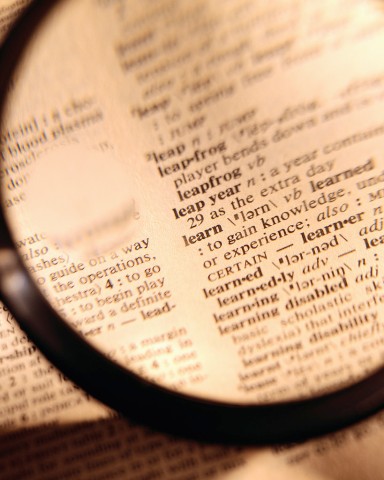
From Webster’s definition:

Knowledge and wisdom, far from being one,
Have ofttimes no connection. Knowledge dwells
In heads replete with thoughts of other men;
Wisdom, in minds attentive to their own.
Knowledge, a rude, unprofitable mass,
The mere materials with which wisdom builds,
Till smoothed, and squared, and fitted to its place,
Does but encumber whom it seems to enrich.
Knowledge is proud that he has learned so much;
Wisdom is humble that he knows no more.

— Cowper

Black Bodhisattvas

Well, friends, it’s been a tremendously emotional 24 hours for me.  This art school business really makes you take a look at some hard stuff.  Reaches in and digs it right out of you.  And last night and today, particularly, I’ve been encountering the legacy of Black American slavery again and again and again.  Blues.  Lynching.  Harriet Jacobs’ Incidents In The Life Of A Slave Girl — Written By Herself (1861).

There are so many ways to understand this multifaceted history, and new facts and visions keep emerging all the time.  Besides which, as one faculty member, Gale Jackson, reminded us tonight, we continue to live the history through trope in so many respects, acknowledged and unacknowledged.

So for tonight, for my part, all I want to do is honor the Black bodhisattvas of that legacy.  A bodhisattva, in certain Buddhist traditions, is one who has reached the cusp of enlightenment, but delays their own liberation in order to remain in the human realm and guide other people on the path.  Harriet Tubman, Harriet Jacobs, and even Billie Holiday, to me, exemplify this courage and selflessness, putting themselves at risk for the sake of others.

To all those who reach the brink of freedom, turn right around and plunge back in to help the next person.

Thank you.