Any of y’all seen Bagdad Cafe? I watched it last night with some work friends and fell somewhat in love. Everything about the film is just a little bit off, a little bit oblique, with touches of camp. To me it felt like a good short story: untidy characters; rich, indelible, lyrical images; a haunting setting that implies more than it reveals. Plus we all laughed and laughed.
And this, the theme song of the soundtrack, will stay with me for a long time.
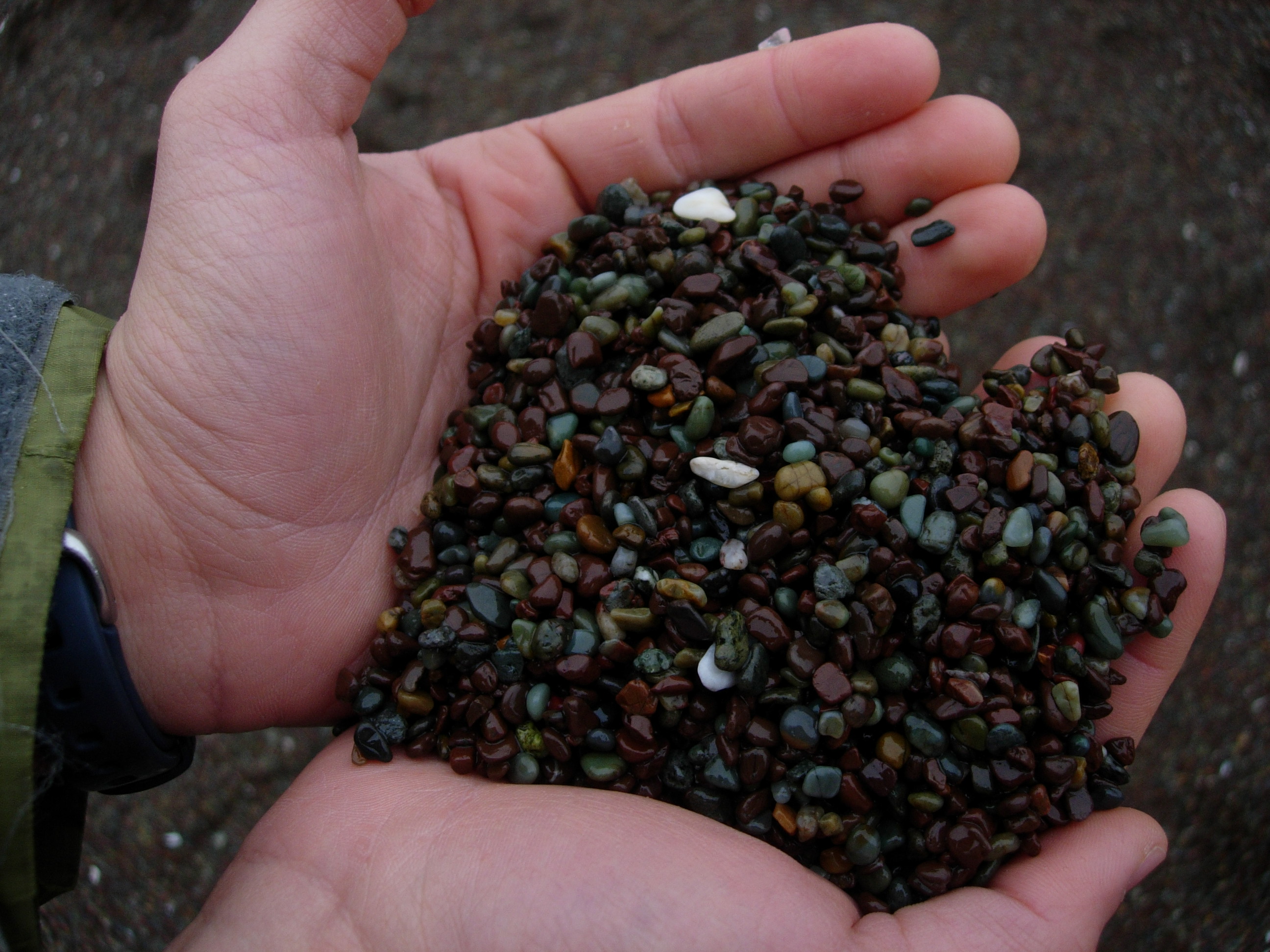
From lovely a gray morning with Cat at Rodeo Beach, where the sand is this beautiful bed of pebbles. Feels glorious to walk on, in the rain: the feet sink down just the right amount.
The No Cuts movement in California, opposing the violence inherent in shifting the burden of the financial crisis to the working class (including students at public schools), is gaining steam all over, it seems. The next local fight I’m excited to focus on, after the March 4th day of strikes and actions to defend public education, is the oppressively expensive public transit system in the Bay Area — especially as higher-ups falsely pit riders against operators, claiming that since bus drivers don’t want to give up their pensions, users have no choice but to swallow higher fares and fewer routes. Gross.
More on that later, but in the meantime, check out this cheeky analysis of the UC Berkeley administration’s reactions (and non-reactions) to recent University of California controversies, including the street-dance-party action above.
Dear UCMeP Faithful,
We here at the UC Movement for Efficient Privatization are morally outraged over recent events at the University of California.
We are talking about the band of terrorists disguised as students dancing to defend public education who, in the early morning hours of February 26, struck a vicious blow to everything UC Berkeley holds dear: its dumpsters and trash cans.
Within hours of this despicable event, Chancellor Bobby Birgeneau – writing from the same undisclosed location he has been bravely hiding in since December – sent an email to the entire campus community titled “Vandalism at Durant Hall.”
In this powerful missive, Birgeneau, “condemn[ed] in the strongest terms the overnight criminal vandalism in Durant Hall that spilled over onto Bancroft and Telegraph avenues.”
As increasingly belligerent acts of racism and homophobia shake UC Berkeley’s sister campuses, UCMeP would just like to commend the leaders of the UCB administration for their bold decision to not speak out against racism and homophobia this past Friday. We are proud that they have instead highlighted the real threat facing the UC: all those students, faculty, and employees vainly struggling to defend what’s left of public education.
That Chancellor Birgeneau has yet to publicly condemn the hanging of a noose in UCSD’s library or the vandalism of UC Davis’ LGBT center is more than appropriate. After all, why should the leader of UC Berkeley be concerned about goings-on at other campuses of the UC when he has burning trash cans on his own campus to contend with?
Friends, as Chancellor Birgeneau has recently demonstrated, racism, sexism, and hate speech are not the biggest enemies the University of California faces. The real foes are free speech, the right to dissent, and the tolerance of minority opinion.
We must battle these democratic evils with everything we’ve got.
It is toward dance parties and brief midnight occupations of construction sites that our moral outrage should be directed, not nooses and homophobia.
Some of you have probably heard of Ani Tenzin Palmo — a Britisher who left home at age 20 to spend the next quarter-century practicing Tibetan Buddhism as a nun in India. Twelve of those years she spent living in a cave, with walls and a door built onto it, in the valley of Lahoul in northern India. Kind of her bad-ass claim to faim — though the way she tells it, she just wanted some real solitude and was tremendously happy there: plus the cave was actually warmer than the traditional mud-wall houses everyone else lived in.
Anyhow, this paragraph from one of her books, Reflections On A Mountain Lake, caught my eye:
Many people ask how to get rid of anger, because it is an uncomfortable feeling. We don’t like feeling angry. We don’t like feeling hatred. But nobody has ever asked me, “How can I deal with my desire and my greed?” Yet greed and desire, along with ignorance, keep us trapped in samsara. But greed and desire are not really regarded as negative emotions in the West. After all, what would our consumer society be if we didn’t have desire? On the whole, desire is regarded as a positive thing, especially if you can satisfy it. Desire is seen as a motivating force. It propels people to go out and buy more and more and more, and that keeps the economy churning. This is the idea behind all this.
Imagine living in an economy based on contentment, compassion, and generosity, rather than desire.
This song — and this particular performance — has stuck in my mind for over a year now. The lyrics actually evoke, for me, a delicious physical feeling of awareness, attention, and anticipation. “People get ready/ There’s a train a-comin’.”
$600 for tuition, breakfast, and lunch. Dinner and lodging not included. (Not to mention the cost for me to travel to Massachusetts.)
Six hundred dollars? Probably closer to a thousand, all told? Now where’s the social engagement in that?
Of course, this is not a dilemma unique to the Zen Peacemakers. As nathan and I have been discussing lately, it’s a huge challenge to make a sangha’s economy reflect its philosophies. And when I called the ZPs to inquire about a sliding scale or some other option, it was clear that they were at least considering the contradiction between the symposium’s mission and its prohibitive costs. Within a couple of months, they had designed and posted a volunteer application, which would cover the cost of tuition — though still leaving the problem of travel and lodging. My new friend Ari, ZP assistant to Bernie Glassman, says they’re also pursuing possibilities for free places to stay: either camping on the property or staying with local sangha members. If you’re interested in attending, hit up the volunteer app! (Unless, of course, you can afford to pay — in which case you’d be helping make things more affordable for the rest of us.)
It’s important to keep in mind, I think, that the point of keeping entry costs low isn’t only a matter of accessibility. Of course, we want to make teachings and community-building events available to poor and working-class folks. But for a group explicitly interested in social justice or “social engagement,” there is also the problem of reproducing oppressive, class-based structures. Inclusion is not enough: we need transformation.
For example: what does it mean when social justice -oriented sanghas establish endowment funds, which invest donors’ contributions into the financial market, strengthening the capitalist structures that exploit and crush workers?
We don’t need to rely on this model. Check out this definition of a “dana economy” from the rad-sounding Eco-Dharma Center:
All our events are offered in the spirit of dana, a Sanskrit/pali term meaning giving and gift. The ethical practice of generosity expresses the transcendence of separate selfhood and constitutes a basic ethos at the heart of creative community. The economic forms of consumerism and capitalism highly condition our relationships in the world – encouraging us to experience ourselves as discrete subjective entities, producers or consumers, insulated from responsive engagement with others. Rather than emulate this, it is our intention to support economic relationships which contribute towards a culture of sharing.
We do not intend to enter into relationship with you as the providers of a service for a consumer. We intend to enter into a wholehearted human relationship with you, as co-producers and collaborators in the transformation of ourselves and our world. To support this intention we ask for contributions to make this work possible, rather than offering our work as a service to be bought. The basic principle of the Dana Economy is, “give what you can, take what you need”.
The suggested donations in our programme reflect the very basic income required to make the events viable. We do not have any independent means of financing the events and we do need that those attending offer financial support to make the events financially viable. If you can offer more, please do. If the incoming donations for an event are insufficient we will be unable to give them freely. So, please look at the suggested contributions and enter into the spirit of this approach by giving what you can. We are also willing to discuss donations in the form of skill sharing and offers of work to support the project.
I know we need to be realistic, and as Ari reminded me, most sanghas do not dedicate themselves exclusively to offering retreats, a la Goenkaji’s Vipassana centers, so that’s not a viable model for everyone. And I want to emphasize that I’m not trying to guilt-trip anybody. Rather, I’m eager to talk more, and more openly, about the real costs of maintaining sanghas, and how we can reproduce and sustain radical dana economies: economies of insight and generosity. I’d love to hear y’all’s thoughts.
In addition to volunteering in order to earn my way at the Symposium, I’m hoping to host a workshop on using the Internet as a tool of dharma. So wish me luck! Seems like it’s a popularsubject these days, and I’m psyched to hear how others are theorizing it.
Meanwhile, here’s a bit of info on the ZP’s newsletter — for which they often solicit contributions. I checked out the issue on prison meditation this month, and there were a number of really solid articles. (Also made me that much more eager to see Dhamma Brothers: a documentary on the introduction of a Goenka-style 10-day silent Vipassana course into an Alabama prison.)
Take care, y’all!
— — — — —
Zen Master Bernie Glassman and the Zen Peacemakers invite you to enjoy
The Zen Peacemakers founder, Bernie Glassman has created the a clearinghouse on Socially Engaged Buddhism in the West. We are pleased to invite you to receive our FREE monthly online publication.
You will learn about:
· Who?: Profiles, links and articles on the individuals and groups practicing service and working for social justice as Buddhist practice
· What?: Emerging service projects and social actions, including opportunities to train and get involved
· Why?: The history, ethical bases and philosophies that inspire the global movement of Buddhist communities towards social engagement
Ryan and I have come to an understanding on the subject of gift flowers. He’s into them, insofar as he enjoys flowers in general. Me, I like them in the wild, and in other people’s gardens or homes…but I told him if he’s ever thinking of getting me flowers, he can offer a bouquet of kale, instead. Now that would set my heart aflutter.
Our little inside joke came to mind Saturday morning as two friends and I were drinking in the Alemany farmers’ market (best show in town, far as I’ve seen). Small, tight brussels sprouts glowing like alabaster; giant purple-and-green sugar cane stalks; heaps of bright, cartoon-shaped carrots — well, an inventory isn’t the point. Let’s call it heaven for shorthand. (Especially given the row of prepared food vendors, including a lovely older lady at the helm of a large pupusa stand.)
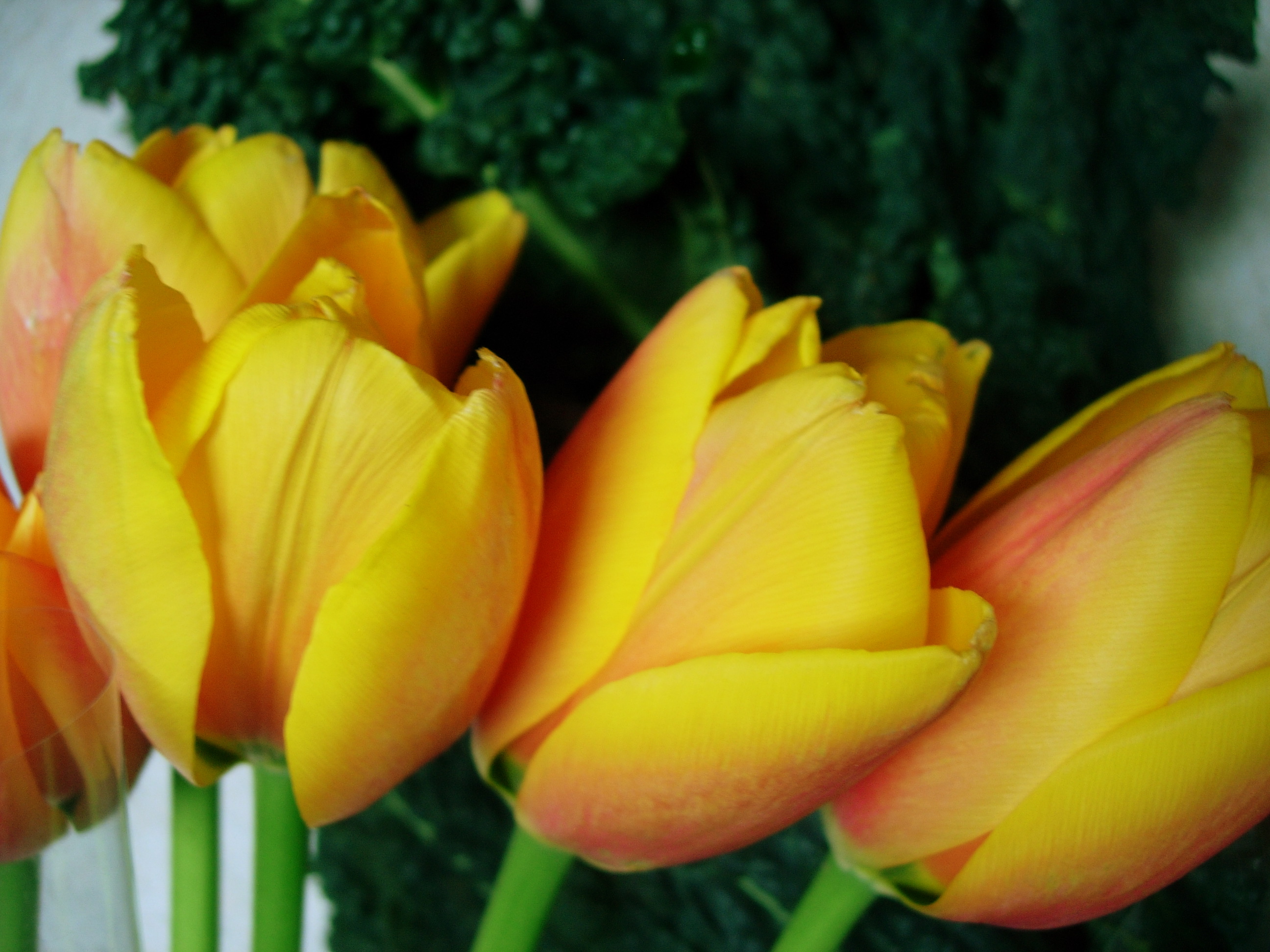
So I’m browsing and reveling, already saddled with a heavy shoulder bag of asparagus, beets, and all manner of Brassica oleracea(broccoli, cauliflower, b-sprouts, and my beloved lacinato kale), when we come upon some buckets of fresh flowers. I picked up these beautiful tulips to give to Ryan.
Feeling cheerful and rather delighted with the low-risk gender role reversal, I parted ways with my friends and boarded the bus home to downtown SF, where Ryan and I planned to meet up on Market Street. A fellow rider — gaunt with thick bangs and a charming toothless smile — complimented my kale and flowers, volunteering that she would actually prefer the former to the latter. I was in good company.
When I arrived at 8th and Market and settled against a wall to wait for Ryan, I discovered another perk to the gender bending.
A much older man walked straight up to me, staring intensely. He looked a bit off. Started talkin all this about Do I want to spend some time, and What am I up to. I smiled and said, “I’m waiting for my boyfriend, to give him these.” It wasn’t exactly a brush-off or an evasion tactic — though, like many people, I sometimes have to use those with aggressive men. Here, I was simply relating to the situation, with more warmth than irritation.
The man glanced down at the flowers, mumbled a goodbye, and strode off toward 9th.
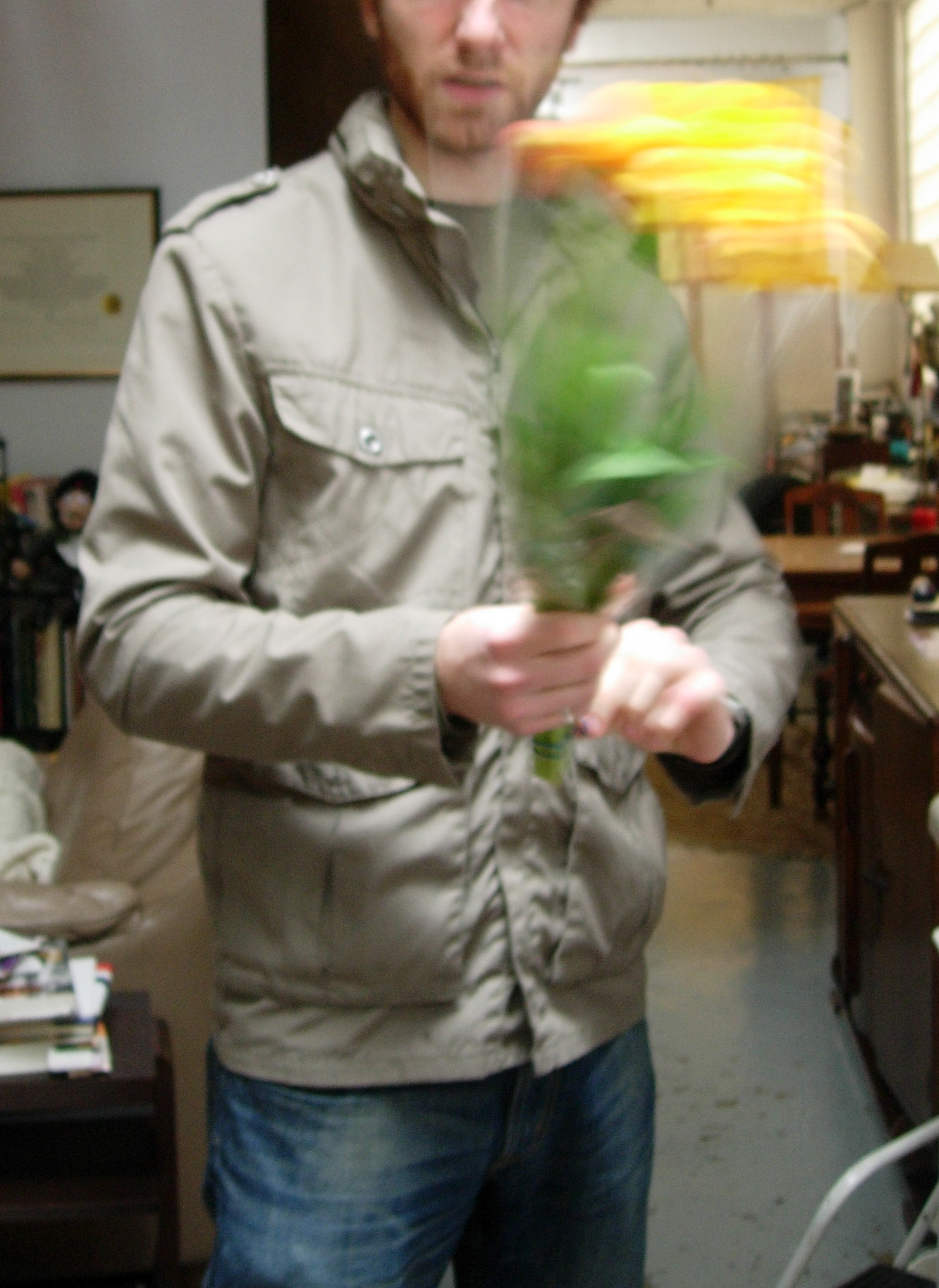
When Ryan did arrive, even though I handed him the tulips, he assumed I’d just bought them to dress up my own bedroom. Took him a while to realize that they were for him.
And the rest of the morning we spent cooking kale.
Well folks, it’s been quite a week! Yesterday was one of the best days I’ve had in a long time: not because everything went smoothly and pleasantly (although some things did) but because the quality of my own engagement was extraordinarily high. I felt able to respond with grace, patience, humor, and at least a little wisdom to whatever arose. A raucous 4am awakening by an unexpected visitor. Fraught group living negotiations. A friend bravely nursing a broken heart. Dicing potatoes to feed 100 homeless men, running home to lead evening group meditation at the Fools, then hopping the train to Oakland for the East Bay Meditation Center’s People Of Color night. Joyful or painful, every experience held its own wonder. And because the capacity to appreciate this wonder has come to me with practice, over time, and not just because of my inborn abilities, I know that all of us are capable of this same freedom.
Next week, maybe, I’ll share some details of the day’s events, but more importantly I’d like to give thanks to some of my teachers and inspirations for living happily.
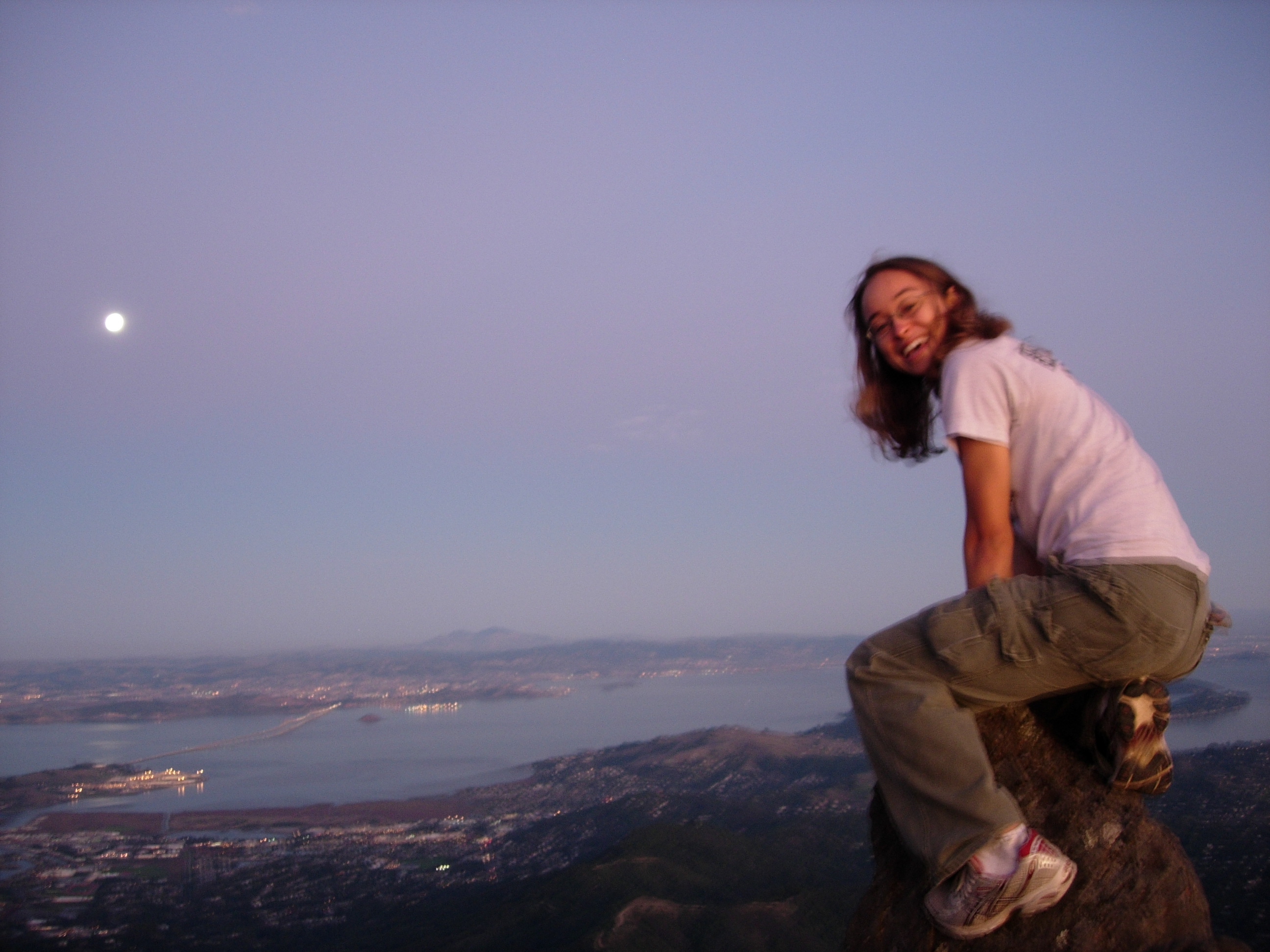
First of all, I dedicate yesterday to my dear friend Cat (above, perched), who’s been a tremendous inspiration to me on the path. I’ll have to introduce her to y’all sometime soon, but for now I just want to say I love you, sorry I missed you yesterday at EBMC, and can’t wait to see you next.













 Kloncke