[Today, former BART police officer Johannes Mehserle was sentenced to 2 years in prison, with 146 days already served, for the involuntary manslaughter of Oscar Grant. The Grant case marked the first time in California’s history that a peace officer was tried for murder.]
Whereas
We as women, transgender people, two-spirit people, queers, gender-oppressed people, and allies of the Bay Area mourn the loss of Oscar Grant;
Whereas we recognize that this young man was just one of countless victims of police violence;
Whereas we understand and experience police repression, particularly in poor, queer, and working-class communities of color;
Whereas we know that police violence both enables and enacts rape, brutalization, and degradation;
Whereas police violence compounds the dangers we face in domestic violence, sex trafficking, and homophobic and transphobic hate crimes;
Whereas police enforce the criminalization of our disabilities, addictions, and mental illnesses;
Whereas police enforce the criminalization of our skin color, sexualities, style of dress and speech, gender identities, religious practices, and nations of origin;
Whereas police violently enforce our subservience to an economy that enriches elites, while slaughtering, starving, sickening, and stealing from us as workers, child-rearers, and culture creators;
Whereas the rich and influential deploy police to violently crush our efforts toward self-determination, from queer social spaces to workplace strikes;
Whereas the rich and influential deploy police to kill or capture our leaders and heroes, like the recently deceased political prisoner Marilyn Buck;
Whereas police are employed to do as they are ordered;
Whereas police violence comes 10% from individual bigotry and improper training, and 90% from a capitalist state system designed to protect property, not people;
Whereas such a property-focused police system, controlled by the rich and influential, enacts and supports gender-based and sexual violence;
And Whereas such a system can never be adequately reformed, based as it is in the fundamental inequality borne of a patriarchal capitalist system:
We maintain compassion for individual police officers who both experience and inflict suffering; who face and enforce mortal danger.
We vow, in the effort to end sexist violence throughout the world, to eradicate the police system of the United States as we know it; and to transcend the misogynist capitalist system that demands this type of policing.
We undertake this mission with no hatred in our hearts toward individual police officers or those who support the police system.
We accept this responsibility out of love for all people, and the unquenchable desire for universal freedom and equality.
In the service of this calling, we will sing, strike, fuck, fight, rest, write, rebel, and rebuild until we achieve liberation for all beings.
For a long time now, I’ve avoided giving book recommendations on dhamma. “Avoided” is too weak a word, really. There’s been some sort of block. It’s like I’ve been mentally and physically incapable of suggesting reading.
Part of this has to do with an awful experience I had with intellectualized Buddhism. When I got to Harvard as an eager, wide-eyed freshman, the very first elective class I took was a seminar on Indo-Tibetan Buddhism.
Dry, dry, dry, dry, dry.
I never read another word on dhamma for the next four years.
On the flip side of things, as a bibliophile and generally thinking-trapped individual, I’m acutely aware of how easily one can become fascinated and hypnotized by Buddhist philosophy, without ever really putting any of it into practice. So it sometimes feels false or misleading to recommend books, rather than just accompany someone in learning basic dhammic meditation training.
Bodhidharma, credited with bringing Zen Buddhism from Northern India to China. Dude is said to have cut his own eyelids off to stop himself from falling asleep while meditating.
But the truth is, even when people who are trained and do practice ask me for books, I’ve been slow and reluctant. So today is an effort to shift that.
A couple words about this short list. One, as you may notice, there is a lot of Mahayana, even though I’m down with the Hinayana. What can I say? When it comes to reading, I like what I like. Two, there are no suttas or canonic/original texts. Looking forward to diving into those in 2011. Three, the significance of these books in my life has had less to do with intellectual edification, and more to do with flat-out inspiring me to practice. There are many more fascinating Buddhist works, scholarship, biographies, etc. that have helped and educated me, but these are more along the lines of altering my worldview and day-to-day spiritual engagement.
So here we go: my top 5 dharma books, in chronological order of when I read them.
0. Entering the Stream: An Introduction to the Buddha and His Teachings
Edited by Samuel Bercholz and Sherab Chödzin Kohn
A wonderful and diverse collection of essays and excerpts that got me psyched on both reading and sitting practice.
Includes work by Shunryu Suzuki Roshi (“Zen Mind, Beginner’s Mind” – classic), Bhikku Bodhi (with whom I walked across the Golden Gate Bridge last week; amazing), and other greats.
And all I want to do is read and eat pesto soba noodles.
So I will quote extensively from Pema Chödrön (recent celebrated guest teacher in San Francisco) in one of her famous books, When Things Fall Apart.
These piece in particular helped me considerably during the street retreat last week.
It’s as if you just looked at yourself in the mirror, and you saw a gorilla. The mirror’s there; it’s showing you, and what you see looks bad. You try to angle the mirror so you will look a little better, but no matter what you do, you still look like a gorilla. That’s being nailed by life, the place where you have no choice except to embrace what’s happening or push it away.
Most of us do not take these situations as teachings. We automatically hate them. We run like crazy. We use all kinds of ways to escape—all addictions stem from this moment when we meet our edge and just can’t stand it. We feel we have to soften it, pad it with something, and we become addicted to whatever it is that seems to ease the pain. In fact, the rampant materialism that we see in the world stems from this moment. There are so many ways that have been dreamt up to entertain us away from the moment, soften its hard edge, deaden it so we don’t have to feel the full impact of the pain that arises when we cannot manipulate the situation to make us come out looking fine. [13]
So many times, even in one single day, the situation is not the way I would like it to be. I do not act or appear the way I would like to. How do I respond in those moments?
I remain amazed at how much the pillars of (a) everyday metta practice and (b) sitting meditation help me to greet these gorillas, these frustrations and disappointments, with patience, curiosity, and more friendliness. Not to excuse them, or take them out on other people, but just to hang out with them for a while.
Feelings of fraudulence.
Inconvenient sexual tension.
Restlessness.
Irritation.
Wanting political struggle in the Bay Area to be something other than it is.
Fearing being wrong more than I fear causing harm.
I probably won’t be updating Kloncke for the next week or so, and that’s because, for my second time, I’ll be joining the Faithful Fools in their annual Street Retreat: seven days and nights living, sleeping, and reflecting in the streets of the Tenderloin neighborhood, in San Francisco.
Coming to terms with the street retreat as a reflective and humanizing practice has been difficult for me. To be honest, I still feel significant resistance to the idea. Fortunately, though, over the past few weeks I’ve been able to sit with this resistance and discomfort (a time when the dhamma practice has come in handy), talk with friends and other Fools about it, and work through it in a positive way.
Before getting into my reservations and reconciliations, here’s a nice, basic description of what the street retreat, from fellow Fool intern Josh Mann:
Starting this Saturday, I will be participating in my first week-long Street Retreat through the Faithful Fools. I’ll be leaving my money, cell phone, and keys behind and taking a sleeping bag and backpack. I plan to sleep outside and eat mostly in soup kitchens, and I anticipate a lot of searching for public bathrooms. Twice a day, I’ll be meeting up with eight to ten other people to reflect on the experience. And, some of us will be sleeping as a group.
Part of the mission of the Faithful Fools is to “participate in shattering myths about those living in poverty” and to help people discover what is common to all of us regardless of our economic standing or housing status. As a Street Retreat participant, I am asked to reflect throughout the retreat on what keeps me separate from others as well as what connects me.
Ever since my first term in college, I have felt compelled to engage the social issues of poverty and hunger, and I expect that this retreat will help me better understand these issues including the way that public policies, laws, and urban planning affect people with little to no money.
At the same time, the founders of the Faithful Fools put great emphasis on the fact that we are not pretending to be homeless. I will begin the retreat knowing that it has a specific end time on Saturday, October 30th. It also seems important for me to acknowledge that I go as an able-bodied, college-educated U.S. citizen who is white, male, and straight, which will no doubt be a factor in both how other people respond to me and how I experience the streets.
Please keep me in your thoughts this week. I seek to know my own heart, and I need all of the help I can get. I also invite you to participate with me in some way or another wherever you are. I recommend setting aside a little time one day to wander and see who and what you encounter. The spirit of this retreat as I understand it is to meet more deeply the people and places that we sometimes hurry past.
So there’s a little bit of background. As you can see, the retreat is not a study or experiment, nor is it a gimmick for “playing homeless.” The spirit is one of renunciation. We wouldn’t fast in order to “understand what it’s like to be a starving person,” but in order to push and expand our own views of the world we inhabit right now, as we are. It’s not about appropriating or trying on someone else’s experience (the simplistic idea of “standing in someone else’s shoes”), but about peeling off the layers of ourselves, the skins thickened by routine and dualism, that pervert our own views of reality — including our views of ourselves.
What had been bugging me so much, I think (and it disturbed me so strongly that I very nearly backed out of the whole thing), wasn’t the idea of the street retreat itself, but its purported connections to mechanisms of social transformation. I’ve talked on this blog before about what I see as the dangers of believing in a method for changing the world one mind at a time. This approach rightly observes that human social “systems” are made up of individual people, but wrongly induces that these systems are therefore merely the sum of their parts, and that persistent hearts-and-minds education can eventually (through influencing voters and “those in power”) translate into large-scale fundamental social improvements.
I disagree with this approach for various reasons; now isn’t the time to go into ’em. Suffice it to say, now that I’ve managed to decouple the reflective, community side of the street retreat from positive claims about its structural effectiveness, I feel a bit calmer about participating.
One common concern about street retreats is that we are “taking away resources” from people who need them, by eating in soup kitchens and sometimes sleeping in shelters (if we can get in). I sympathize with the concern here, but the way I see it is: we do far more to support poverty and homelessness through our everyday complacency with the capitalist system than we could possibly do by individually taking a couple dozen free meals. The scarcity (of beds, less frequently of food) is artificial.
Another frequent worry, especially from my dad: YOU ARE GOING TO GET YOURSELF KILLED. IT IS DANGEROUS OUT THERE.
Don’t worry, papa. (And others.) From my observation over the past year, there is little danger of random violence on the streets of the Tenderloin. The main types of violence we see here are (1) interpersonal violence among acquaintances, (2) low-level police violence in the form of harassment and enabling rape culture, and (2) structural violence, like the abovementioned artificial scarcity that keep families homeless while apartment buildings sit vacant for years, or the racist, sexist, homophobic criminalization of mental illness and drug addiction.
I guess both of these ‘responses,’ intended to allay fears, kind of sidestep the issues by pointing out how they are dwarfed by larger problems. Well, that’s sort of how it goes for me, at the moment. We’ll see if any more insights come during the week.
Wish me luck! I will try to log some time on the computers in the public library, but the lines are generally long, the connections slow, and the time limits brief.
Good morning, heartache
You old gloomy sight
Good morning, heartache
Thought we said goodbye last night
I tossed and turned until it seemed you had gone
But here you are with the dawn
Wish I’d forget you
But you’re here to stay
It seems I met you
When my love went away
Now every day I start by saying to you
Good morning, heartache, what’s new?
Stop haunting me now
Can’t chase you no how
Just leave me alone
I’ve got those Monday Blues
Straight through Sunday blues
Good morning, heartache
Here we go again
Good morning heartache
You’re the one who knew me when
Might as well get used to you hanging around
Good morning, heartache — sit down
Stop haunting me now
Can’t chase you no how
Just leave me alone
I’ve got those Monday Blues
Straight through Sunday blues
Good morning, heartache
Here we go again
Good morning, heartache
You’re the one who knew me when
Might as well get used to you hanging around
Good morning, heartache — sit down
This being human is a guest house.
Every morning a new arrival.
A joy, a depression, a meanness,
some momentary awareness comes
as an unexpected visitor.
Welcome and entertain them all!
Even if they’re a crowd of sorrows,
who violently sweep your house
empty of its furniture,
still, treat each guest honorably.
He may be clearing you out
for some new delight.
The dark thought, the shame, the malice,
meet them at the door laughing,
and invite them in.
Be grateful for whoever comes,
because each has been sent
as a guide from beyond.
Sarah Weintraub, Michael Bedar, Tyson Casey and Michaela O'Connor Bono sitting off of O'Farrell Street, with a sign reading "sidewalks are for people; NO on L." photo by Sr. Carmen Barsody
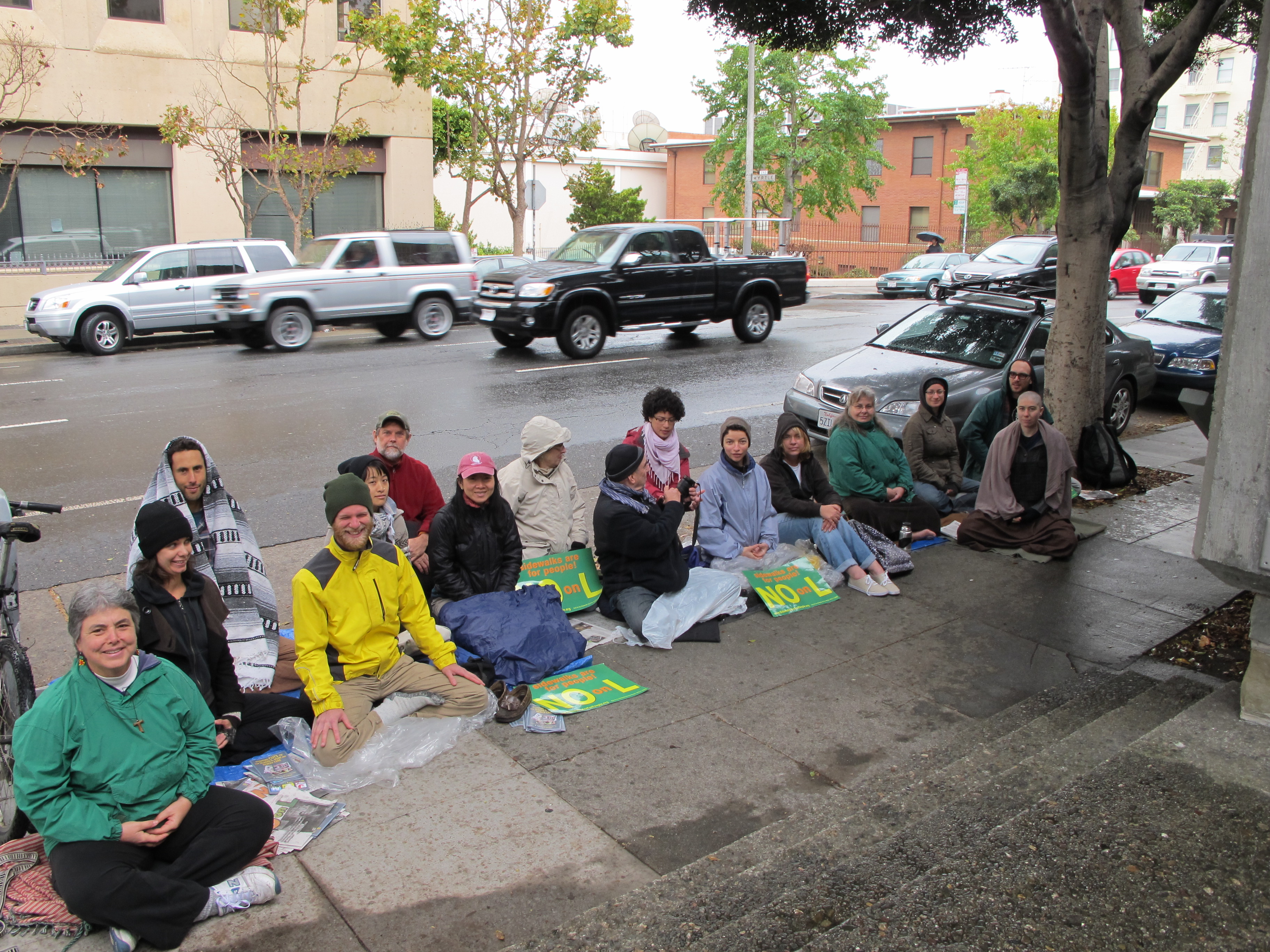
Sorry I didn’t get a chance to post on Friday, folks — this weekend was a particularly busy one. Starting Friday evening, we (at the Faithful Fools) hosted about 16 participants in a three-day gathering for Buddhists and friends dedicated to social justice. “Working for Liberation,” we called it: the culmination of, oh, about six months of co-planning between me and the lovely Tyson Casey of the Buddhist Peace Fellowship, with guidance from Carmen of the Fools and Alan Senauke of Clear View Project (also vice-abbot of Berkeley Zen Center and author of the newly published The Bodhisattva’s Embrace: Dispatches from Engaged Buddhism’s Front Lines).
I wanna say more — much more — about the weekend, but I gotta run back to Sacramento. So for now I’ll leave you with these two images of our final weekend ‘activity’: a performative outreach effort in the Sidewalks Are For People Campaign, or “No on Prop L.” A grey, drizzly Sunday morning; chilly but thoroughly enjoyable.
Sixteen of the eighteen meditators sitting on wet Franklin Street sidewalks, sheltered under neighborhood trees. photo by Sonny of the UU Church
Guilty aspect number one: I actually prefer the radio edit version to the original. Not because I’m so scandalized by the phrase “fuck you,” but because I like the lilt provided by the extra syllable in “forget you.” Am I alone in this preference? Both versions are below; help me out, folks.
Guilty aspect number two: I like the video, even though it’s full of classic patriarchal tropes, also reflected in the lyrics themselves. As assets, women’s beauty and bodies are comparable to men’s money. Yeah, we get it. Still, I’m feelin the vignettes and backup singers/dancers — what can I say.
Guilty aspect number three: Not so guilty but actually kind of rad, when I first heard this song on the radio and knew nothing about it, it struck me as a genderfucked kind of affair. The singer’s voice seemed androgynous to me, and I couldn’t really tell, from the lyrics and who was being addressed with a “forget you, and forget her, too,” whether a girl had left her girlfriend for another girl, or a girl left her boyfriend for another girl, or a girl left a translady for another someone, or what. So even though I now know it’s a typical script, I still have positive associations of driving my parents’ car, hearing this come on the mainstream radio, and all smilin like, “Are they really playing this so casually on the radio? Neat!”
[Update: Oh, also! The sobbing/singing interlude? Could easily have turned out annoying, but I actually find it very impressive! Musicality and vocal control with the bawling. Nicely done, Ze Lo.]
Today, in honor of World Homeless Day, folks with Homes Not Handcuffs and other groups hosted a “Creative Housing Liberation”: a rally, unpermitted march, and occupation/liberation of a 68-unit apartment building that has been vacant for years now. Coincidentally, that building happened to be right around the corner from our home at the Faithful Fools — a stroke of luck that allowed us to run back and grab a couple of “donations” (a chair and a vase of flowers) to offer to the building.
The event was really well done, and so far everything has gone off without a hitch. Crowd energy was strong; the occupiers had the banner drops all ready for us as our march turned the corner down Eddy Street; they had a dope sound system, powered by a generator, that transformed the corner into a dance party; Food Not Bombs even hooked it up with a tasty dinner for everyone.
Also fortunate: the landlord could not be reached by the police. And since the cops can’t break in and apprehend people without first getting the go-ahead from the landlord, the occupiers will hold the building at least until tomorrow morning.
This slideshow requires JavaScript.
Tomorrow, if I have time, I’ll try to add a bit more of my own perspective and analysis on housing occupation as a response to racist, heterosexist state violence in the form of denying people adequate housing. According to the event organizers, 30,000 housing units remain vacant in San Francisco, a city with 15,000 people living in homelessness. In light of this, does occupation of empty buildings seem morally wrong?
More germane to my line of questioning these days: what role can fun, vibrant, direct actions like today’s play in a larger strategic movement to transcend an economic system where, as Introducing Capitalism: A Graphic Guide puts it in a euphemistic half-truth, “the means of production are privately owned”?
(Note: very first chant of the march, as we took the streets? “Homelessness is not a crime! Capitalism IS a crime!”)
Some of the smartest people I know — including my friend Ivan, and what I’ve read/heard by Suzuki Roshi — excel at failing. They know how to fail in ways that allow the flow to continue, if you know what I’m saying. The failure is not crippling, but just part of taking on a difficult challenge. Generally speaking, I think that people with scientific minds (including serious meditators) are pretty good at failing happily. Failing in ways that reveal new opportunities, even as they foreclose the ones we thought we wanted.
Endeavoring to improve on my ability to fail doesn’t mean tackling tasks that seem doomed from the start. That would be too easy! The kind of failure I’m talking about does not come cheap. I am invested. I want to succeed. Each attempt, each step, is made with confidence, commitment, and openness.
Suzuki Roshi says that this is how we move toward enlightenment. Through repeating small moments of enlightenment — those moments of a letting-go mind, a mind that is being, not chasing — while at the same time working hard to deepen and strengthen our practice.
I hope this is somewhat clear, what I’m trying to say. As an example of a recent, happy failure of mine, I wanted to share a letter I wrote to all the people I’d talked to with an interest in building a disarm BART police campaign. My intention in sending it was (1) to let folks know that I would no longer be pursuing the courses I’d proposed (for instance: organizing a direct action of civil disobedience for the day of Mehserle’s sentencing), and Why; and (2) to thank them for the inspiring connections we’d made in the course of the (eventual) failure.
It felt good to write this letter, not only because I have a lot of admiration and goodwill toward each of the recipients (including those with whom I disagree politically), but also because it was an exercise in observing and accepting reality as it is — rather than as I would like it to be. A little inroad into rooting out dukkha.
I’d love to know your thoughts, resonances, and criticisms.
Hello everybody,
Hope this note finds you well!
Over the past couple of months, I’ve been talking with BART workers, Oscar Grant movement organizers, Oakland peacekeepers, Marxist feminists, reverends, priests, meditators, lawyers, non-profiters, poets, anarchists, communists, peace activists, radicals, progressives, friends, and random strangers about the possibility of coalescing a campaign toward disarming the BART police. I and others envisioned this as one small step in aiding a shift from weaponized, racist, capitalist-serving security culture toward community-controlled safety initiatives, dual power, and restorative justice.
My friend Aaron recommended this piece to me (a historical essay written by local Laney College Student Unity & Power folks) as an encouraging example of demands done well.
We are often confronted by a legacy of the Panthers as either a detoothed community service organization or all claws. But the BPP experience at Peralta shows the work of a multifaceted organic expression of a specific section of Oakland’s working class to overturn institutions that claim to serve them and remake them into bases for struggle. When the Panthers spoke of occupying a building, it wasn’t (only) to appeal for more funds from the state, but to keep the state away from self-organized community programs. This meant not simply a negation of racist, authoritarian educational institutions, but their redefinition and reuse. As the editorial of the first issue of The Grapevine wrote,
To the continuing students and student-workers, right-on to the work you have done and the work you have inspired your communities to do, right-on to your moves to secure your community institution, to moving for freedom from oppression, to moving to make this a real community college – in practice. We still have work to do, but we have reached a higher level of organizing and our work will be even more effective in the future. We will win our fight to keep our community college and control it.
This is a message to today’s student movement. Beyond “demand[ing] affordable, accessible and quality education” or “keep[ing] California’s original promise of higher education” lies the seizure and re-invention of these institutions around fundamental principles of self-determination, self-management and freedom from oppression.





 Kloncke