Yesterday’s International Women’s Day reminded me of how, worldwide, imperialist accumulation, austerity programs, and sexual violence — all swirling together in the global financial crisis — continue to exploit and poison women. Especially, obviously, poor women of color. And yet, so many women and allies are fighting back! In ways big and small.
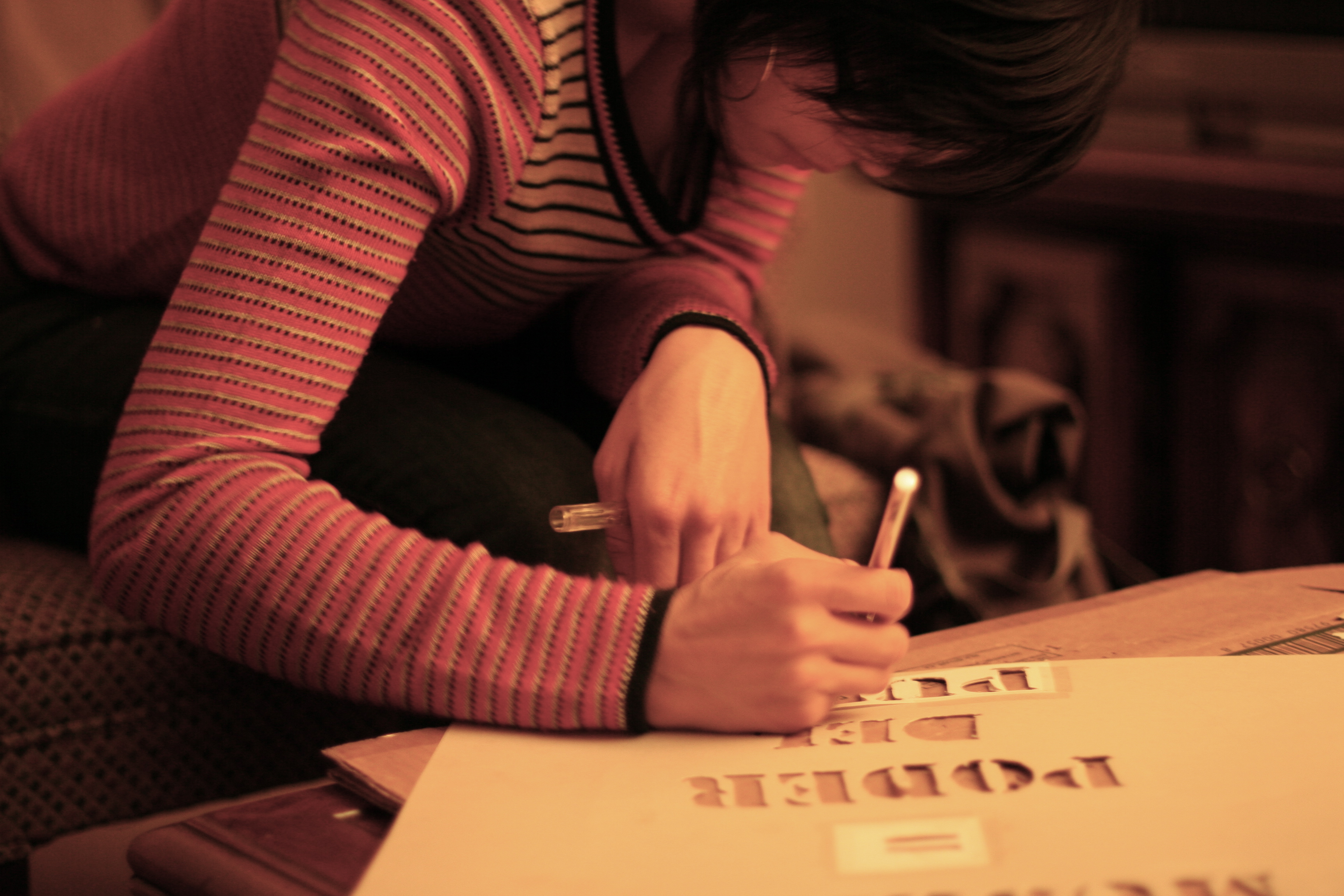
Here’s a friend of mine making stencils to celebrate the day. Hope you did something uplifting, too. :)
Hey friends — sorry for such a late post today! It’s been a whirlwind. Morning tea with a dharma/movement kindred spirit (a revival of Radical Sangha is in the works!); a super-intense two-and-a-half-hour group session with a generative somatics facilitator/counselor/consultant/rad person at the Faithful Fools; being interviewed by someone who’s making a video documentary about the Fools; and now off to prep some work with the Marxist feminist group in honor of International Women’s Day tomorrow.
Life: it’s full sometimes! And I was in a similar gear last Friday when, among other things, I showed up to join a crew of about 20 supporters of a rank-and-file picket of health care workers (above) who were illegally fired for going on strike. More on their inspiring (and victorious!) battle, including videos of Friday’s picket, here. Then, most of us supporters rolled out to a downtown Oakland rally against the gang injunctions. Here are some photos of each; sorry for the lack of commentary, but hopefully tomorrow I’ll have time to add a little more.
It’s been a long time since I’ve talked about metta. Many of you are familiar with it, but for those who aren’t: metta is a particular type of meditation practice that focuses on cultivating and exuding loving-kindness. Which might sound like trying to muscle a halo onto your own head, striving to become all saintly and luminous and stuff, but actually has much more to do with focusing attention on others: wishing them well.
I like the above video not primarily for its message of metta-as-problem-solver (although I have definitely experienced moments where my metta practiced seemed to lubricate and ease a tense situation), but mostly for the way Ven. Balacitta’s articulation encapsulates the practice: wishing that others be free of enmity, be calm and happy, and be able to take care of themselves well.
Crucially, it seems clear to me that his wish for others to be “calm” is not a front for wishing for them to agree with him, or to become passive. The practice is not about wanting conflict to magically disappear. And even though the focus is on kindness, friendliness, and well-being, in my own experience it is impossible to separate these from the realities of suffering and animosity. Although metta is different from the Tibetan tonglen practice (a “training in altruism” in which one “visualizes taking onto oneself the suffering of others on the in-breath, and on the out-breath giving happiness and success to all sentient beings,” and thus focuses equally on suffering and well-being), metta also inherently contains both positive and negative aspects.
Lately I’ve been returning to metta a lot more. Tremendously helpful. Conflict has arisen between me and my dad, which has been very painful for me (I won’t go into detail), and metta helps me to re-ground in wishing well-being for him, and for myself. Again, this doesn’t mean glossing over harm and dissonance, but fostering my own outward vectors of deep friendliness.
It’s a tough question. Metta is by no means a mandatory practice for all situations. And focusing solely on loving-kindness, without also seriously analyzing and militantly opposing the oppressive forces at work, is not an approach I can get down with.
On the other hand, what happens when metta and militancy combine?
Yes, let’s leave it there for now. What happens when metta and militancy combine? Can we imagine that? Do we see examples of it in our own political work? Do we see areas, in ourselves, where one or the other might benefit from conscious cultivation?
* * * * * * * * *
Thanks in advance for donating to free Jesse, the above-linked genderqueer student protester who was arrested while fighting for trans and queer rights on campus (at Laney College, where Ryan also goes, and has been part of this organizing). As of now, they are still being held on multiple false charges. Anything you can give is much appreciated.
Tricycle has a wonderful interview with Burmese monastic Sayadaw U Tejaniya, who authored a book with a fabulous title (see above). When asked about its name, he responds,
We picked the title because it is important not to underestimate the power of the defilements. When I teach meditation I emphasize the importance of watching the mind. While doing this you will see a lot of defilements. In their grosser manifestations, the defilements are anger, greed, and delusion. And they have plenty of friends and relatives, who often show up as the five hindrances: desire, aversion, torpor, restlessness, and doubt. I advise yogis to get to know and investigate the defilements, because only through understanding them can we learn to handle them and eventually become free of them. If we ignore them, the joke’s on us: they’ll always get the better of us.
If they cause us so much grief, why do we ignore them? People often become attached to what they’re good at, to what they’ve achieved; they only want to see their good sides. Therefore they often don’t acknowledge their weaknesses. They become proud and conceited because they don’t see their negative sides. But if you cannot see both sides, the good and the bad, you can’t say the picture is complete. If you do not observe the defilements wisdom cannot grow.
Is wisdom an absence of defilements? Yes, when there is right understanding there won’t be any defilements. They are opposites; non-delusion is wisdom. Wisdom inclines toward the good but is not attached to it. It shies away from what is not good, but has no aversion to it. Wisdom recognizes the difference between skillful and unskillful, and it sees the undesirability of the unskillful.
The whole interview is well worth a read — he gets into a range of topics, from learning more and more effective ways of overcoming his own depression, to the folly of mistaking the sitting posture for the meditation itself — but I just wanted to flag a resonance between the danger of condescension in spiritual work, and parallel problems in political efforts.
Back at Harvard, I learned two twin currencies for liberal political engagement: prestige and critique. In order to make the most important, sophisticated contribution to your community, you should try to do one or the other. (Or, in my case, kind of switch back and forth between them.)
Prestige meant planning events with lots of endorsements by student and Real World groups; generating lots of publicity (including Real World media, if possible); and generally capitalizing on linkages with nodes of power, with the aim of Getting Big Things Done.
Critique meant showing up to a prestigious event and eviscerating it with progressive analysis. Pointing out that it reifies X Y and Z oppressive dynamic, invizibilizes A B and C communities, and generally fortifies neoliberalism and hierarchies of privilege.
Something like that. Now, I’m not saying that other approaches didn’t exist at Harvard (Harvard Progressive Action Group was probably doing things at least a little differently; and same for the Student-Labor Action Movement), but these were the ones that most affected me, in my thinky liberal way of moving through the world.
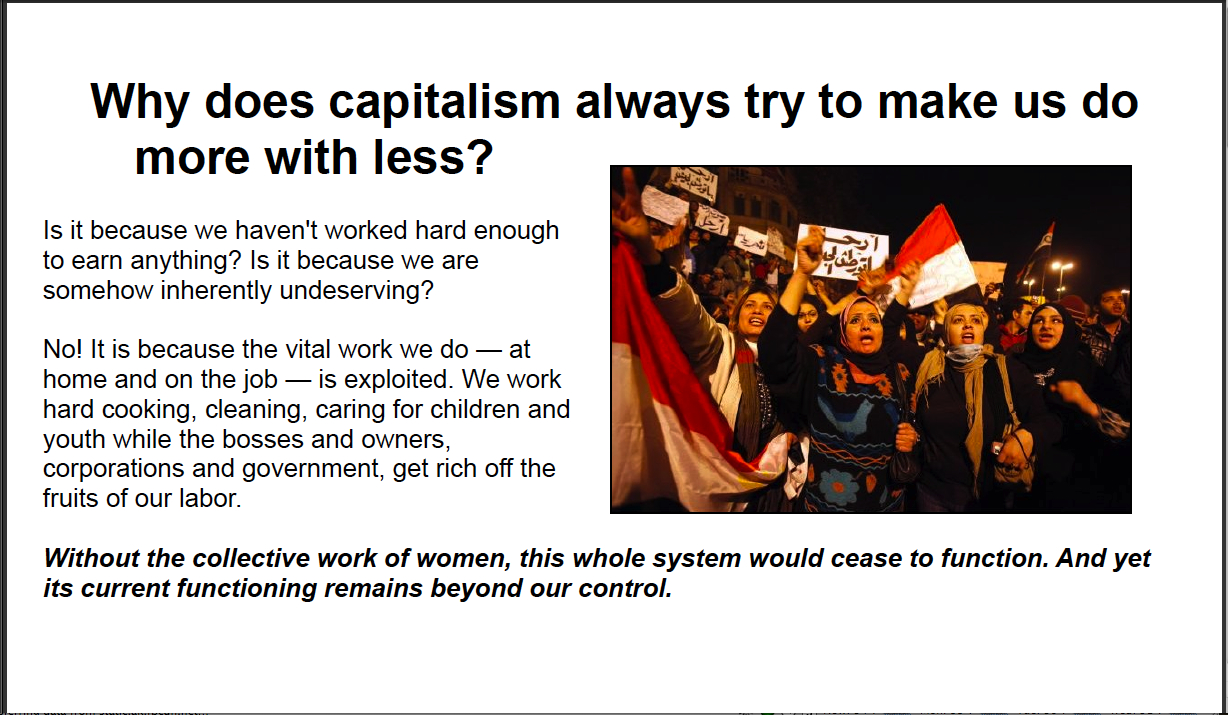
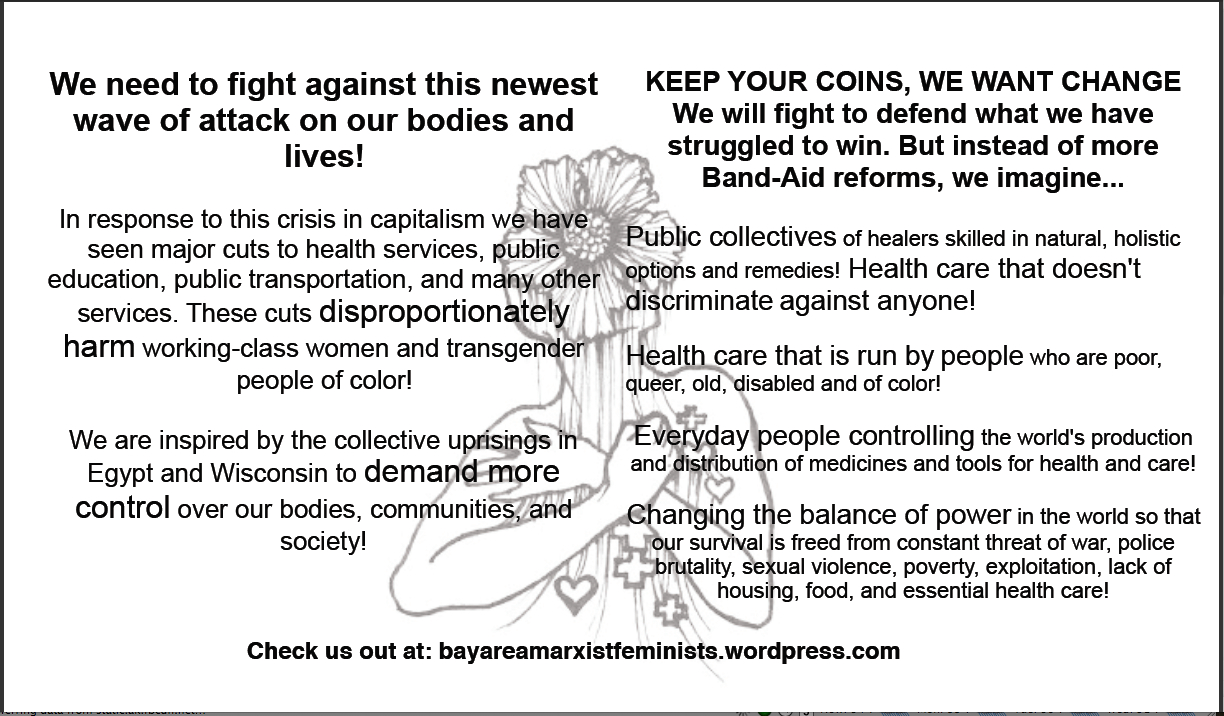
And so, yesterday, when six of us from the Marxist-Feminist study group arrived at a Bay Area Pro-Choice march armed with flyers that we had each played a part in creating, I thought to myself, This is a good offering. We chanted, we participated, we were a part of what was happening, and I felt tremendously grateful to all the people who have fought before us for the right to legal abortions. Some of the signs people carried gave me chills: “ABORTION ON DEMAND, WITHOUT APOLOGY”; “Rape Survivor For Choice [because I didn’t have one]”; and of course, the iconic coat hanger. At the rally, women shared personal stories about terminating their pregnancies, making real and visible the object of our shared struggle. No doubt, there was bravery here. This was something we wanted to support.
We were not, however, blind to the limitations of the event. A narrow focus on defending abortion rights completely overlooked the ways that austerity measures here in California are generally pummeling working-class people’s access to sexual health care. This myopia has long been a problem of largely white, middle-class reproductive rights movements. Surveying the crowd and listening to the speeches, I felt a little pessimistic about how our half-sheets would go over, fingering capitalism as a major part of women’s oppression and choicelessness.
But instead of standing on the sidelines hating (read: critiquing), we engaged. When the organizers opened up the stage for anyone to take the bullhorn, two of us got up and articulated our comparatively broader analysis. And the crowd was feelin it!
After that, flyering was easier and less awkward. People came to us.
Yesterday morning, the street in our neighborhood where organizing saved a woman's house
What a week, folks. A week that included:
Going to a reading discussion about the League of Revolutionary Black Workers (the subject of Detroit: I Do Mind Dying), attended by two former League members (one of whom worked thirty years on an auto assembly line…..DAMN), still fiery and utterly inspiring
Flyer from a similar LRBW event
Huffing, puffing, and grinning up Berkeley hills on my gorgeous new bike
Feeling grateful for warm, dry, cozy home-shelter from the winter rain
Showing up with Ryan at a 6am anti-eviction action, a few blocks from our apartment, to find out that it had already won: once the media started contacting Wells Fargo for comment, they backed down (for now) from taking away this woman’s home
That’s it for me, folks. Hope your week was filled with ups, as well as downs — but most of all, spaciousness enough for both. See you Monday!
I don’t remember who exactly — though I have a hunch it was Joseph Goldstein — who said, at a dharma talk I went to once at CIMC, that much of dukkha (the Buddhist word for “suffering” — the basis of the First Noble Truth) is not this dramatic, cataclysmic affair. Instead, the majority of dukkha is like rubbing your face softly against a brick wall. Doesn’t really hurt. But the problem is, we don’t stop. We keep on rubbing . . . and rubbing . . . and rubbing. Ouch.
I think a similar insight finds its expression in those two unforgettable lines of the poem I shared here last year, by Nyoshul Khenpo:
Those with dualistic perception regard suffering as happiness,
Like they who lick the honey from a razor’s edge.
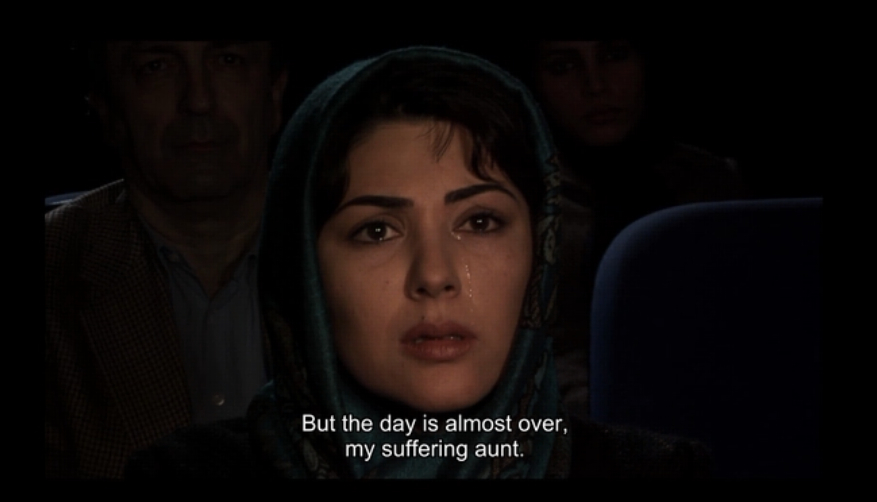
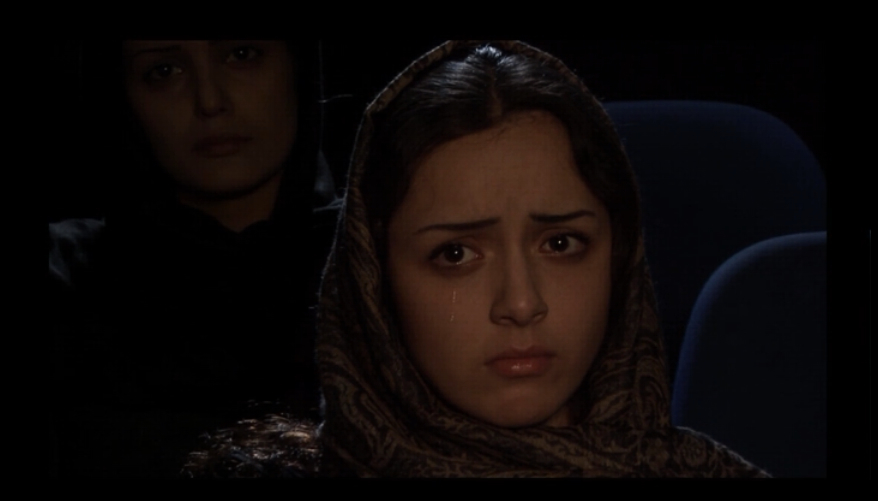
And yesterday, this dharma found its way to me yet again, in the form of an Iranian movie. Celebrated filmmaker Abbas Kiarostami created this work, Shirin, by filming the faces of over 100 Iranian stage and screen actresses as they themselves watch a film of an 800-year-old Persian epic love poem: the story of Shirin and Khosrow. Shirin is an hour and thirty minutes of framed face shots, inviting us to meditate on subtle and dramatic changes of expression as the women become emotionally involved with the story. The film also invokes self-consciousness about our own being and emotional vicariousness: spectators spectating other spectators.
For me, the arresting part in the epic poem (which is both audible and subtitled in Kiarostami’s film) was this, from a scene where a dying queen shares her final words with her heiress, Shirin:
AUNT: “I had my blossoming spring, I grew old at fall. Now I welcome the winter and the snow that will cover my grave.”
SHIRIN—”Haven’t I suffered enough? My heart can’t afford to be broken again, or my body to be abandoned.”
AUNT: “It took me a long time on this earth to understand that the joys of life are like the caress of a feather on the palm of your hand. Pleasurable at first, and a real torment if it perdures. I leave this earth to people who deserve a better life.”
(Visuals show women’s faces, teary and crying.)
The feathers tickling our palms are not emotions themselves. Rather, they are the self-generated process of reacting blindly to those emotions: embracing pleasant ones and running from unpleasant ones. We blindly, habitually react in countless small ways like this every day, allowing transient moods and the vicissitudes of experience — pain, pleasure, neutrality — to dictate our internal well-being.
Part of what I love about Kiarostami’s film, though, is that it allows us to step back from our emotional entanglements and watch them play out externally, on a stream of other faces. It’s like ninety minutes of looking in a mirror, and watching the flow of feeling pass by, unhindered. We don’t get to know any one woman long enough to get caught up in her story. It’s simply beautiful to greet her for a moment, welcoming her into a growing rosary of all the audience members. I’m reminded that I myself am, in some ways, a rosary of many faces: always changing, counted one by one. This allows me to relax. It’s the same comfort I feel when I look out the window on a long train or bus ride. The scenery is flowing by so quickly that there’s no time to fixate on it; and so I let go and simply watch. Give the feather — and the brick wall — a rest.
Friends, I’m gonna try an experiment. Rather than pour out a long story about today’s topic (non-monogamy and polyamory), I’m just going to give a brief thumbnail sketch — and we can see where the comment thread takes us.
As some of y’all may have noticed on Facebook, Ryan and I (with our Bad Good Romance) have been in an open relationship for over a year. In the past, when asked “What’s that all about,” I’ve explained that rather than a declaration about having other lovers, it’s more an expression of commitment to exploring our desires in a non-judgmental, loving, honest way that doesn’t assume monogamy is the best path to a healthy relationship — for us or for others.
A little more background on the situation is that I identify (and have for years) as someone with polyamorous tendencies. I can feel happy and fulfilled with multiple lovers at once. Also, I’m happy for my lovers when I know they’re enjoying sex and companionship with other people. (Note: this is only true when things between my lover and me are going well. If things between us are souring, then I typically feel super jealous of the other sweethearts in their life.)
Ryan, on the other hand, has always operated on the monogamous side of things. By this I mean: when he’s with a partner, he’s not interested in being with other lovers; and it’s painful to him to know that someone he loves, and who loves him, also wants to romance somebody else. At the same time, he’s deeply respectful and even admiring of polyamory, and investigates questions of (non)monogamy both through reading (like the classic “Poly Primer” [as make/shift’s crossword puzzle clue called it] The Ethical Slut, which Ryan had read even before we met) and by deeply reflecting on his own feelings, perceptions, and experiences.
Up til now, our difference in orientation hasn’t mattered much for us. But recently, one of my favorite former lovers (what one might call an “ex-boyfriend”) moved from the Midwest to Berkeley, a short ways from our house. After a rocky past and more than a year without seeing each other or really communicating at all, he and I now find ourselves spending time together. An entire afternoon last week; something like fourteen hours yesterday.
And so, Ryan and I have been doing a lot of processing. Each of us feels scared of limiting or hurting the other one. But we don’t want to break up, either. Not an easy place. We both agree that polyamory seems like a positive practice, a good way to live. But for people who naturally gravitate toward exclusive relationships, walking this new path ain’t easy — and may not ultimately be worth the hurt.
At the same time, the way we hold one another — mentally and physically — throughout these painful talks only underscores how much, and how well, we love each other. This is non-violent communication from the heart, organically: expressing pain, grief, fear and heartache without blaming; taking physical space and declining touch when we need to; listening; not escalating; acknowledging and validating each other; taking the time and space to do all this properly; being physically affectionate when we both feel ready; and committing to follow through on what we decide, together, as the best way to move forward.
In Buddhist parlance, we often encounter the word “interdependence.” It comes up in many contexts. One way I often hear it invoked (in dhammic as well as New-Agey spaces) is as a kind of feel-good spiritual brainteaser. Isn’t it amazing and beautiful how we are all connected?
Here’s a good example, from my own life. I was attending a conference about spirituality and technology: the Wisdom 2.0 Summit. One of the keynote speakers, Tony Hseih, CEO of the online retailer Zappos, gave a talk about the culture of happiness at his company, and how attention to the human connections between merchant and consumer fosters better, more lucrative business. The title of his book sums it up nicely: Delivering Happiness: A Path To Profits, Passion, and Purpose.
When it came time for Q&A, I raised my hand and got the mic (standing up, semi-terrified, before this large crowd of very successful techno-seekers). I thanked Tony for his work, and then asked what he thought — and what all of us present thought — about the happiness of the people who produce the technology we use. The people working in the factories that make our phones, our laptops, our desktops. The people mining the minerals for all of these. What about their happiness?
It’s all well and good to look at interdependence as a network for human kindness and beneficence. But the fact is, it is just as much (if not more) a network for exploitation: of humans, animals, and the earth.
In his newest book, The Boddhisattva’s Embrace: Dispatches from Engaged Buddhism’s Front Lines, Hozan Alan Senauke of the Clear View Project cuts to the core of exploitative interdependence in the conclusion of a beautiful essay on the shipbreaking industry in Bangladesh. Continue reading →
Folks, I’m going through it a little bit this week. Just a lot of complex stuff coming up. Haven’t found the right words for sharing it here, yet. But in the meantime, this video of my friend and fellow Goddardite — vocalist, composer, interfaith priestess, and cultural worker Imani Uzuri — made me smile today in a full, full way. Not only does Imani bless the world with mad artistic skills (including, but not limited to, the most moving voice I’ve ever heard in person in my whole entire life: no lie), she also illuminates the people around her with her spiritual reflections, historical insights, unbeatable hilarity, and genuine compassion.
Here, she reminds us of the importance of exploring and loving our always-complex selves. It reminds me of an essay I read yesterday in the current issue of make/shift: a piece by Alexis Pauline Gumbs called “M/Othering Ourselves: A Black Feminist Genealogy, Or, The Queer Thing.” The essay in turn takes its inspiration from a line from Audre Lorde: “We can learn to mother ourselves.” Gumbs asks:
What would it mean for us to take the word mother less as a gendered identity and more as a possible action, a technology of transformation that those people who do the most mothering labor are teaching us right now?
I hear this question (and its associated family of questions) echoed in Imani’s 120-second share. (And enacted, unwittingly, in the sweet out-takes in the final few seconds.)
Imani’s work itself is powerful enough; being in her presence during Goddard residencies, and seeing the mind, soul, and radical self-mothering behind the music, has been an extraordinary gift to me. She’s real and grounded, as well as spiritually developed and crazy talented. Quite the combo. Check her out, and join me in celebrating the friends who inspire us, even unknowingly, while we’re slogging along.










 Kloncke